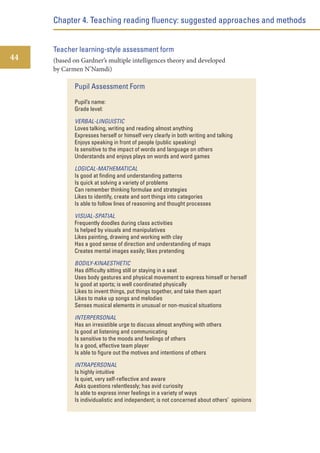
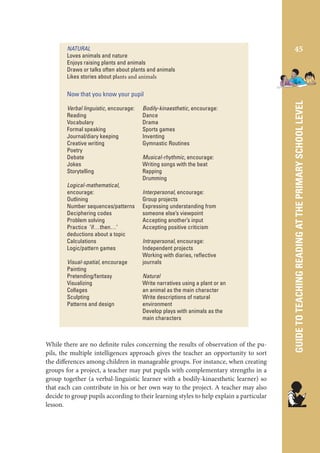
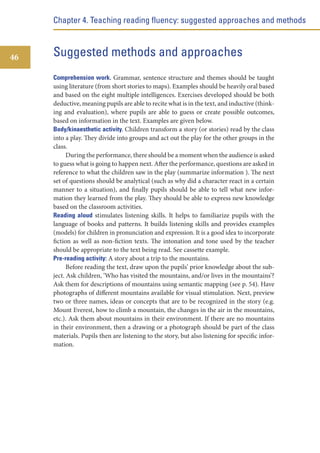
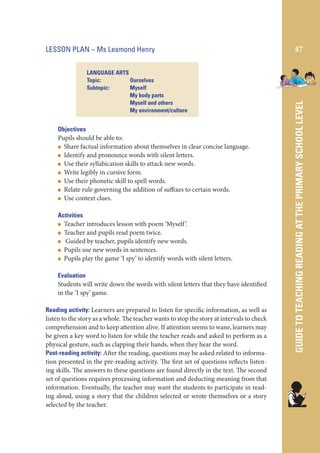
Guide to
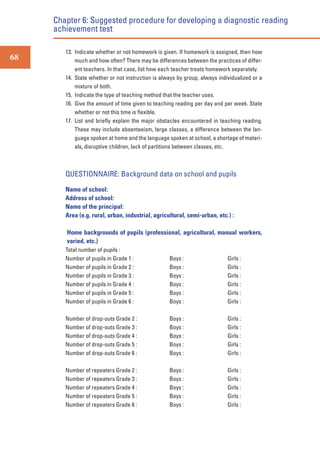
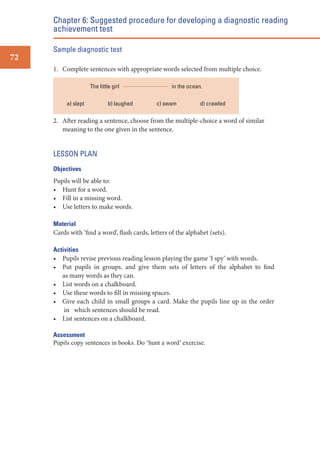
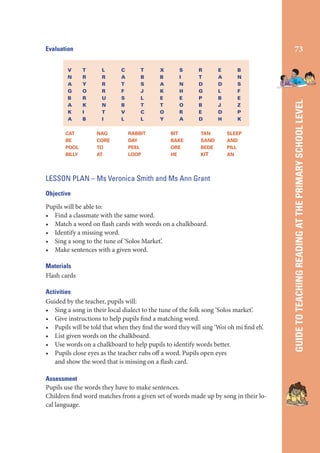
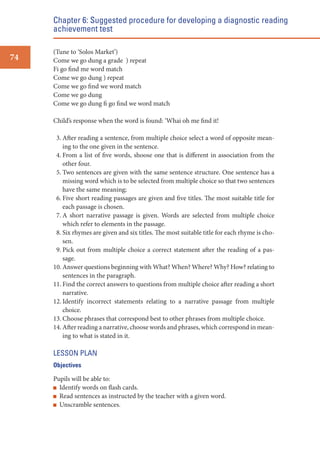
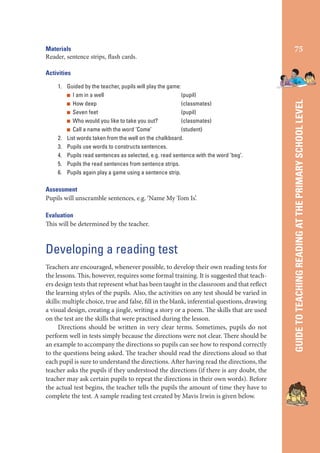
Teaching Reading
at the
Primary School Level
Kemba A. N’Namdi
The author is responsible for the choice and presentation of the facts
contained in this book and for the opinions expressed therein, which are
not necessarily those of UNESCO and do not commit the Organization.

Published in 2005
by the United Nations Educational,
Scientific and Cultural Organization
7, place de Fontenoy, 75352 PARIS 07 SP
Composed and printed in the workshops of UNESCO
© UNESCO 2005
Printed in France
(ED-2005/WS/28

CLD 21709)
PREFACE
iteracy is the manipulation of thoughts and language to express ideas. It helps
to build an understanding of various texts, people and situations, and promotes
self-empowerment. Our global society depends increasingly on literacy as a major factor for progress. Unfortunately, at a time when the ability to read and write
is becoming imperative in order to contribute actively to society, many children do
not have access to education. Skills in reading enable learners to benefit from educational activities, and to participate fully in the social and economic activities in
which they take part. In addition, reading is fundamental to progress and success
in all other school subjects (Irwin, 1967).
Reading development involves the participation of children, parents, educators and the community as a whole. This manual was developed to assist
teachers in teaching reading at the primary school level. It is intended to help
teachers create an educational vision for ensuring reading abilities and develop an
edu-cational philosophy based on this vision. This philosophy should ultimately
assist in the development of the scope and sequence of reading strategies used in
the classroom. Reference is made to reading experts and specialists from as early
as the 1960s to show that the thinking has persisted over a period of time.
This manual is based on the results of work with teacher trainers with the
technical support of Dr V. Elaine Carter. The reading methods have been complemented by the work of Mavis Irwin in Jamaica, and studies carried out by
UNESCO in 1993 in China, Ethiopia, and Jamaica. The materials from these
texts and others have been compiled to create a general guide to enhance reading
achievement at the primary level. The reading programme integrates reading,
writing, speaking and listening skills, so that they reinforce each other.
Literacy can underlie every aspect of education across the grades, empowering all students to reflect on, and potentially reshape, themselves and their world
(Langer, 1995, p. 1). The information in this manual provides a framework to
help educators facilitate effective reading instruction and enable learners to acquire the necessary tools to become literate.

L
The Dakar Framework for Action emanating from the World Education Forum (Dakar, Senegal, April 2000), reiterated the need for all children to have
access to good quality primary education. In the 1960s, when many countries
achieved independence, one of the principle concerns was education. However,
today over 800 million adults are illiterate worldwide. A generation of adults has
not been able to benefit from education. The Dakar Framework seeks to help
prepare today’s children to reap the benefits of education, thus creating a new
generation of literate adults. The target for the Dakar Framework is 100 per cent
enrolment by 2015.
In 1998, over 700 million children were enrolled in school. What difference
would it make if all the children enrolled in schools were permanently literate?
By 2015, the school system would have changed the lives of 1.5 billion young
adults.
Today, the challenge is to make a dramatic difference in the provision of
education, so that the next generation of adults is permanently literate. In taking up this challenge, we cannot ignore the importance of the wider environment and of the community itself. The absence of ready support structures (e.g.
libraries, electricity and flourishing publishing industries), language policies in
multi-lingual situations and patterns of communication to reinforce reading are
challenges in many communities. Nonetheless, the school can, and should, play
its role as a force for change, ensuring that children not only learn to read, but
also develop good reading habits.
In many countries that have long-established education systems, there is a
constant effort towards improving and towards undoing the wrongs of past educational approaches. Today, a lot more is known about the way children learn, the
factors that affect their learning and the ways in which teachers can be most effective in teaching reading. Countries that are new at establishing reading programmes
benefit from not having to reform their educational methods; rather, they are able
to create a reading programme based on the latest and most progressive information from yesterday and today.
UNESCO would like to thank Kemba A. N’Namdi for preparing this document as well as all those who worked with her, especially Elaine Carter and June
Wallace.
SECTION FOR PRIMARY EDUCATION
DIVISION OF BASIC EDUCATION
EDUCATION SECTOR
CONTENTS
INTRODUCTION ............................................................................................................................................................
CHAPTER 1. PREPARING CHILDREN TO READ ....................................................................................................
FACTORS ...........................................................................................................................................................
STAGES OF READING DEVELOPMENT .........................................................................................................
CHAPTER 2. THE READING APPROACH ...............................................................................................................
A VISION FOR ENHANCING READING ...........................................................................................................
READING APPROACHES....................................................................................................................................
CHAPTER 3. CLASSROOM ENVIRONMENT FOR LITERACY LEARNING ..........................................................
MATERIALS ......................................................................................................................................................
EQUIPMENT ......................................................................................................................................................
ACCOMMODATION, FURNISHING AND LIGHTING ......................................................................................
DISCIPLINE ......................................................................................................................................................
CHAPTER 4. TEACHING READING FLUENCY: SUGGESTED APPROACHES AND METHODS ......................
SUGGESTED READING PROGRAMME ...........................................................................................................
MULTIPLE INTELLIGENCES ...........................................................................................................................
SUGGESTED METHODS AND APPROACHES ...............................................................................................
WRITING USED TO TEACH READING ............................................................................................................
STRATEGIES TO FOSTER READING COMPREHENSION ..............................................................................
CHAPTER 5. DEVELOPING READING ASSESSMENT ...........................................................................................
TESTING ............................................................................................................................................................
OBSERVATIONS ................................................................................................................................................
PORTFOLIO ASSESSMENT ................................................................................................................................
QUESTIONING AND INTERVIEWING ..............................................................................................................
SELF-ASSESSMENT ...........................................................................................................................................
CHAPTER 6. SUGGESTED PROCEDURE FOR DEVELOPING A DIAGNOSTIC READING

7
9
10
15
25
25
27
31
32
37
37
38
42
43
43
46
50
51
57
58
59
61
62
65

ACHIEVEMENT TEST .........................................................................................................................................

66
75
82
84

DEVELOPING A READING TEST.......................................................................................................................
APPENDIX. INTEREST INVENTORY ..........................................................................................................................
REFERENCES AND FURTHER READING ....................................................................................................................
A

s educators, we want students to enjoy reading so that it promotes an interest in other subjects of the curriculum. They should leave the school
as lifelong readers, writers and learners. Over many decades, educators
have been drawing attention to the need for effective reading programmes.
The purpose of an effective reading programme is to develop the child’s ability
to grasp the meaning of what is read, by teaching him or her how to analyse a
sequence of ideas and make logical conclusions (Irwin, 1967). The programme
should appeal to every child, meeting his or her needs, abilities and interests by
constructing a positive attitude towards reading (Irwin, 1967). Teachers should
be able to develop clear learning objectives, and the scope and sequence of a
reading programme that should lead to achieving them. This can be done by
the use of appropriate learning activities, motivational materials and a variety
of teaching approaches in which the children are actively involved.
Suggestions are provided on how to prepare pupils to learn to read, and
how to develop and maintain reading achievement. The manual explores various methods and activities that help pupils to maintain and continue to develop
reading comprehension. Suggestions are made on how to create teacher-made
diagnostic and reading comprehension tests. Strategies are given for using assessment as a guide to instruction. It is intended that teachers use this publication as a guide and, to the extent needed, ideas should be modified to suit the
needs of individual classrooms better.
If the programme is to address the needs of the pupils, the teachers have
to diagnose, correct and prevent reading difficulties constantly, and/or enrich
and refine reading abilities. Teachers’ perceptions and expectations of pupils
should be positive. They should provide a wide range of experiences to permit
all children to learn, and to do so at their own pace (Sweet, 1997). Teachers
need to be constantly alert and to adjust learning experiences according to
pupils’ progress or level of difficulties, before there is a significant drop in reading performance. Teachers need to develop accurate perceptions of their pupils and re-examine them continually, so they can recognize and act on pupil
behaviour that is inconsistent with their initial expectations. Teachers are also
responsible for assessing new methods and approaches to reading against the
experiences and abilities of their pupils.

7

GUIDE TO TEACHING READING AT THE PRIMARY SCHOOL LEVEL

INTRODUCTION
8

New trends in the use of local languages in the primary grades as the media
for instruction raise new challenges for the teaching of reading and simultaneously open new avenues for more creativity in the promotion of reading. More
of the cultural dimensions should be integrated in the teaching and learning
process, permitting community members to play a more active role in the education of their children.
At the primary level, all teachers must be teachers of reading. Regrettably, not all teachers are trained in the techniques of teaching reading. This undoubtedly calls for a review of national policies for the training of teachers. It
is particularly important in the light of the various skills and social issues to be
addressed during the primary cycle of education.
The quality and variety of reading materials available to children in many
developing countries is a major handicap for ensuring reading competence. A
survey in which the Association for the Development of Education in Africa
(ADEA) participated in 2000 identified pupil to book ratios ranging from 1:1
to 1:7, with rural areas having the poorest supplies of books. This situation will
not be changed overnight; however, teachers can, and should, be trained to
prepare reading materials along with their pupils. Advancement in the use of
computers should be of great assistance but, unfortunately, the teachers who
could benefit most are in the rural areas and have no access to such media. In
this context, the priority of reading is very much related to other socio-economic priorities in a community.
An effective reading programme must be planned to deal with many other
obstacles in and around the school system. They include very large classes,
frequent absences, illiterate parents, and few opportunities for reading out of
school, since it is not a pastime for some communities. The programme should,
therefore, include in and out of school activities, and should be sufficiently
flexible to permit pupils/learners to read on their own.
This guide should enable teachers to enhance and develop quality reading
programmes that lead to achievement in recognized and measurable reading
outcomes.
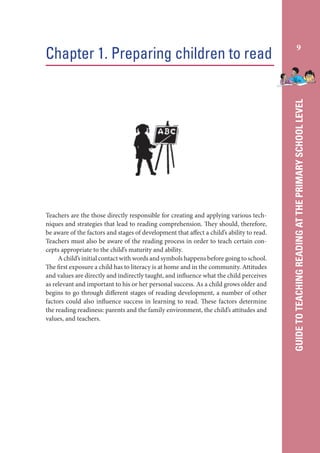
Teachers are the those directly responsible for creating and applying various techniques and strategies that lead to reading comprehension. They should, therefore,
be aware of the factors and stages of development that affect a child’s ability to read.
Teachers must also be aware of the reading process in order to teach certain concepts appropriate to the child’s maturity and ability.
A child’s initial contact with words and symbols happens before going to school.
The first exposure a child has to literacy is at home and in the community. Attitudes
and values are directly and indirectly taught, and influence what the child perceives
as relevant and important to his or her personal success. As a child grows older and
begins to go through different stages of reading development, a number of other
factors could also influence success in learning to read. These factors determine
the reading readiness: parents and the family environment, the child’s attitudes and
values, and teachers.

GUIDE TO TEACHING READING AT THE PRIMARY SCHOOL LEVEL

Chapter 1. Preparing children to read

9
Chapter 1. Preparing children to read

10

Factors
Parents and family background
Parents and the family environment play a significant role in preparing
children to read. Parents are the first teachers and spend the longest
time with them (Morrow, 1995). They provide the intellectual stimulation and the emotional atmosphere essential to reading achievement
(Irwin, 1967). The characteristics of homes have been found to be more closely related to measures of scholastic achievement, particularly in reading, than to measures
of general ability or verbal ability. Such practices as shared reading, reading aloud,
making print materials available and promoting positive attitudes towards literacy in
the home, have been found to have a significant effect on children’s literacy (Morrow,
1995, p. 7).
Parents who practise literacy at home with their children tend to participate in
the academic progress of their children by, for example, helping with homework and
reading with their children. Such parents tend to monitor the academic progress of
their children by talking with teachers about their children’s progress and observing their children work at home. Those who do not value reading or education as
a necessary tool generally do not become involved in the educational progress of
their children. It is the responsibility of educators to inform parents about the value
of their role in their children’s education and to collaborate and work with parents
in order to help their children better.
Parents may need to be taught how to participate constructively in the education of their children. Teachers should invite parents and families to participate in
the literacy process, not only to promote literacy in their children but also to enhance their own literacy (Braun, 1991). It helps to encourage parents to interact and
become involved with the school system, but it is also important to provide them
with concrete shared activities that can be practised at home.
Teachers can create activities specifically for the home environment that engage
the entire family, such as taking a family survey of favourite foods or making a family tree. Where parents are (or may be) illiterate, the home activities should include
drawing. If the teachers could create as much harmony possible between what is
taught in the classroom and what the children do and experience outside it, the
reading programme could become more meaningful for the children (Auerbach,
1995). Teachers could benefit from the help of parents to reinforce the ideas and
lessons taught in school. It benefits pupils, parents and teachers where there is parental involvement. The ultimate goal is for parents to be aware and prepared to lay
the foundations of literacy for their children before they enter primary school, and
throughout their education, at least at the primary level.
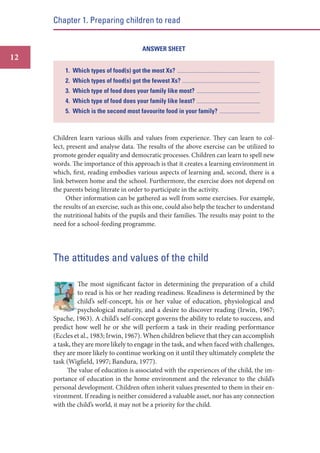
An example of a family activity is illustrated below. This is about favourite
foods. A list of possible foods should be developed in class, before they take the assignment home. The foods that we eat could be drawn.

11

Name: ..................................................................................
Date:.....................................................................................
Lesson: Food We Eat
Assignment: Find the most favourite food eaten in your family
Procedure: Interview your family members. Ask them their
favourite food and mark an X under the food and on
the same line as their name.

INTERVIEW SHEET
Name

Mama
Fofana

Papa
Fofana

Brother
Fofana

Me

Maize

Fish

Meat

Fruit

GUIDE TO TEACHING READING AT THE PRIMARY SCHOOL LEVEL

Example of a home activity that involves family participation
Chapter 1. Preparing children to read

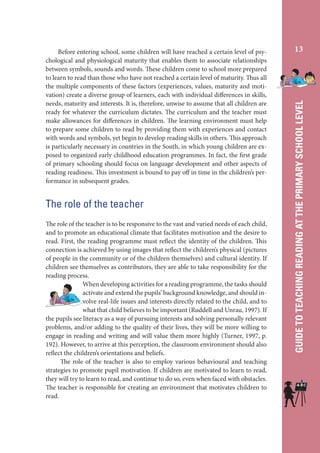
ANSWER SHEET

12
1. Which types of food(s) got the most Xs?

....................................................................................................................

2. Which types of food(s) got the fewest Xs? .............................................................................................................
3. Which type of food does your family like most?

.........................................................................................

4. Which type of food does your family like least? .........................................................................................
5. Which is the second most favourite food in your family?

.........................................................

Children learn various skills and values from experience. They can learn to collect, present and analyse data. The results of the above exercise can be utilized to
promote gender equality and democratic processes. Children can learn to spell new
words. The importance of this approach is that it creates a learning environment in
which, first, reading embodies various aspects of learning and, second, there is a
link between home and the school. Furthermore, the exercise does not depend on
the parents being literate in order to participate in the activity.
Other information can be gathered as well from some exercises. For example,
the results of an exercise, such as this one, could also help the teacher to understand
the nutritional habits of the pupils and their families. The results may point to the
need for a school-feeding programme.

The attitudes and values of the child
The most significant factor in determining the preparation of a child
to read is his or her reading readiness. Readiness is determined by the
child’s self-concept, his or her value of education, physiological and
psychological maturity, and a desire to discover reading (Irwin, 1967;
Spache, 1963). A child’s self-concept governs the ability to relate to success, and
predict how well he or she will perform a task in their reading performance
(Eccles et al., 1983; Irwin, 1967). When children believe that they can accomplish
a task, they are more likely to engage in the task, and when faced with challenges,
they are more likely to continue working on it until they ultimately complete the
task (Wigfield, 1997; Bandura, 1977).
The value of education is associated with the experiences of the child, the importance of education in the home environment and the relevance to the child’s
personal development. Children often inherit values presented to them in their environment. If reading is neither considered a valuable asset, nor has any connection
with the child’s world, it may not be a priority for the child.
The role of the teacher
The role of the teacher is to be responsive to the vast and varied needs of each child,
and to promote an educational climate that facilitates motivation and the desire to
read. First, the reading programme must reflect the identity of the children. This
connection is achieved by using images that reflect the children’s physical (pictures
of people in the community or of the children themselves) and cultural identity. If
children see themselves as contributors, they are able to take responsibility for the
reading process.
When developing activities for a reading programme, the tasks should
activate and extend the pupils’ background knowledge, and should involve real-life issues and interests directly related to the child, and to
what that child believes to be important (Ruddell and Unrau, 1997). If
the pupils see literacy as a way of pursuing interests and solving personally relevant
problems, and/or adding to the quality of their lives, they will be more willing to
engage in reading and writing and will value them more highly (Turner, 1997, p.
192). However, to arrive at this perception, the classroom environment should also
reflect the children’s orientations and beliefs.
The role of the teacher is also to employ various behavioural and teaching
strategies to promote pupil motivation. If children are motivated to learn to read,
they will try to learn to read, and continue to do so, even when faced with obstacles.
The teacher is responsible for creating an environment that motivates children to
read.

13

GUIDE TO TEACHING READING AT THE PRIMARY SCHOOL LEVEL

Before entering school, some children will have reached a certain level of psychological and physiological maturity that enables them to associate relationships
between symbols, sounds and words. These children come to school more prepared
to learn to read than those who have not reached a certain level of maturity. Thus all
the multiple components of these factors (experiences, values, maturity and motivation) create a diverse group of learners, each with individual differences in skills,
needs, maturity and interests. It is, therefore, unwise to assume that all children are
ready for whatever the curriculum dictates. The curriculum and the teacher must
make allowances for differences in children. The learning environment must help
to prepare some children to read by providing them with experiences and contact
with words and symbols, yet begin to develop reading skills in others. This approach
is particularly necessary in countries in the South, in which young children are exposed to organized early childhood education programmes. In fact, the first grade
of primary schooling should focus on language development and other aspects of
reading readiness. This investment is bound to pay off in time in the children’s performance in subsequent grades.
Chapter 1. Preparing children to read

14

The classroom environment should help pupils feel good about who they
are. For example, pupils may be given different classroom duties for
which they are responsible, such as noting attendance, collecting and
distributing books, and classroom sanitation. Giving responsibilities to
pupils helps to enhance their leadership skills and qualities.
Teachers should communicate positive beliefs and expectations and engage
in positive reinforcement towards pupils. Teachers should show that they love and
care about children. Pupils should feel valued and respected and supported by their
teachers.
The teacher helps pupils to establish reading goals and expectations appropriate for their respective capacities, and help them reach their goals (Ruddell and
Unrau, 1997; Schunk and Zimmerman, 1997). When pupils have reading goals,
they are better able to monitor their progress; these accomplishments demonstrate
to the pupils that they are capable of performing well, which ultimately enhances
their beliefs about their abilities, and what they expect from themselves. Positive
self-evaluations of progress increase pupils’ beliefs about their capabilities to learn
and sustain their motivation (Bandura, 1977; Schunk and Zimmerman, 1997).
Teachers can promote motivation by:
Showing enthusiasm about teaching, and by showing interest in their work.
Using innovative, creative, clear ways for presenting a concept, providing
examples, and allowing the opportunity to apply concepts in various contexts.
Giving learners the opportunity to gain a sense of ownership in the educational process. This means that students participate in decision-making activities that directly affect the classroom environment, such as collectively deciding
class rules. They help to make decisions that affect their education, such as
selecting texts to be used in a lesson, and/or giving suggestions about which
activities will be used in the reading programme.
Unfortunately, there is no sure way to determine reading readiness. Each child is
influenced by a variety of emotional and environmental factors that determine if
the child is prepared to learn to read. Teachers can help to facilitate or enhance factors that may be underdeveloped in a child, by providing an educational environment that nurtures the children’s intellect, interests, emotional development and
skills. It is important to re-emphasize that teachers can help by understanding that
learners do not reach certain levels of maturity at the same time, and that they have
not had the same experiences. However, this variety among learners, if creatively
utilized by the teacher, can itself be a source of motivational force.
There are generally five stages of reading development and teachers should be aware
of what is required at each stage. This awareness helps the teachers to understand
when, and how, to introduce various techniques into the programme at the various levels of growth and development of pupils. It should be noted that children
tend to master the various stages at different ages. To a large extent, the ability of
children to read depends on the quality of the learning environment provided by
the teacher and whether or not the language spoken in the school is the language
spoken by the child at home. Both of these factors can have a dramatic effect on
the time it takes a child to develop in each of the stages. In situations where the
language of the child is different, the language spoken in school the first year of
primary education should be devoted to language development and not to reading.
A child cannot learn to read in a language that he or she does not speak. After one
year of language development (becoming familiar with the language of the institution), the pupil should be better prepared for the reading development programme.

1. The pre-reading stage
The first stage of development is the pre-reading stage. The responsibility of the
teacher is to encourage reading interest with enjoyable experiences and activities,
with an emphasis on oral expression. The principal goal at this stage is to ensure
that the learner is socially, mentally, emotionally and physically ready to learn to
read. Spatial development is important at this stage. The pupil is taught to recognize
spaces between words and the descending order of the lines in a text. He or she
learns to read from left to right usually, or from right to left for instance in Arabic
(Carter, 2000). Oral expression is the focus of instruction, and the development
of sight vocabulary which is taught using sentences, signs, labels, etc. Simple ideas
are expressed and organized in order to create sentences. The formation of words,
starting with consonants, and the recognition of rhymes by word endings, are all
taught.

Examples of children’s activities
Telling stories: reading stories with lots of expression, in order to capture the attention of the children. The teacher asks questions about what is going on in the story
as the reading goes along, to make sure that they understand the meaning of the
story.

15

GUIDE TO TEACHING READING AT THE PRIMARY SCHOOL LEVEL

Stages of reading development
Chapter 1. Preparing children to read

16

Drawing pictures and afterwards sharing the meaning/content of the picture
with the class: the pupils may draw a picture of something of their choice and then
explain to the class what is going on in the picture. The picture may be a simple scene
(such as a family eating dinner) or it may be a full story. This depends on the pupil.
Looking at a painting, a photograph or a drawing, analysing the image and choosing a title: this may be done collectively, as a class, or in smaller groups if the class size
is very large. Pupils should be able to explain why they chose a specific title.
Using pictures and songs to arrive at a list of words: poems and jingles may
be used to recognize rhyme endings. Jingles may be also be used to introduce the
alphabet.

Example of using a poem to arrive at a list of words
Before learning the poem, pupils are asked to repeat sounds of three
words in the poem. Then, the teacher teaches them the poem or jingle
(without looking at the words). After pupils have learned the jingle,
they will study the written text of the poem to see the words’ relationship between what they say and what is written. The three words that are used are
the three words used at the beginning.
Poem

2. Beginning reading
At this stage of development, the learner must acquire an ability to recognize the letters of the alphabet, but not to memorize them. This is accomAa plished by varying the types of techniques used to teach the alphabet. The
modern approach is that children learn the alphabet in a literature context.
A card with a picture of an apple on it and the letter ‘a’ helps to give meaning to the
sound ‘a’.
Although traditional methods of teaching the alphabet do not involve teaching
the alphabet in a literary context, they do involve the participation of children in
creating ways to help them learn the alphabet. Methods such as children creating
their own jingles, or the teacher creating a jingle (or using a traditional jingle of the
community) are ways of teaching the alphabet, and may be helpful in introducing
and practising the alphabet. Children generally enjoy creating various rhythms and
melodies to help them memorize the alphabet. However, to ensure that they have
not just memorized but have actually learned the alphabet, the teacher will want to
also teach the alphabet in a literary context. A child must have a natural ease with
the alphabet in order to learn letter sounds and word spellings comfortably, and
exercises that are fun as well as instructive can facilitate learning it.
Four examples of children’s activities
Scavenger hunt: pupils divide up into small groups. There are several cards with
words with similar beginnings and endings hidden throughout the room or study
area. The groups each start with a set of cards given to them by the teacher. They
hunt around the area to find the matches. For example, a group may have the
cards: BAT, ME and TALL. They may find the matching cards CAT (matching
ending), MY (matching beginning) and BALL (matching ending) in designated
hiding spots.
Modelling: each pupil can be responsible for a specific letter (maybe the first
letter of their name, when possible, or something of interest to them, such as ‘s’
for soccer). They must be able to teach the class the letter ‘s’, for example, by using
pictures that they have drawn or acting out an action, such as swimming, that they

17

GUIDE TO TEACHING READING AT THE PRIMARY SCHOOL LEVEL

At this stage, teachers should promote pupil motivation constantly from
the start of a reading programme. Pupils react willingly to the text when
they are motivated. Texts that reflect the interests and environment of
the pupils increase motivation, especially if a pupil is having difficulty
beginning to read. It may be beneficial to select photographs of people they know
in the community or their family members, people who are a reflection of who they
are, so that they feel connected to the reading process.
Finally, teachers are encouraged to provide models for the children. This means
that the teacher (or possibly a pupil) performs an action, or expresses a thought,
that the class imitates (Irwin, 1967; Schunk, 1990). Modelling is one person setting
an example and the others following it. An example of modelling (the teacher in
this case is the model) is a child reading a poem, imitating the pronunciation and
expression a teacher used while reading the poem. Or, a pupil can be a model and
teach the class a small lesson or activity that he or she has learned. When pupils are
the models, it encourages self-empowerment. Children feel good about themselves
because they are able to share something they have learned with the class.
A child is ready to read after having comfortably mastered the alphabet and
having had lots of exposure to, and familiarity with, a variety of texts, such as books,
charts, pictures, signs, etc. The goal at this beginning stage is to develop reading
habits that continue to promote reading as an enjoyable activity. In order to reach
this goal, students must begin to identify words that have similar beginnings and
endings. Some phonetic practice begins at this stage, taught within the context of
the text, such as the consonants in rhymes and jingles. New words are introduced
and taught through phonetics and written activities. The pupils’ vocabulary is the
basis for the materials produced in the classroom. Words are recognized as a whole
and their relationship in combinations. Modelling at this stage of development can
even include peer models, who may demonstrate a task or activity in front of the
class, and the class then imitates the action.
Chapter 1. Preparing children to read

18

created about the letter. In classes that are very large, it may be easier to set up small
groups instead of doing this activity individually.
Listening and Reading: the teacher can record his or her voice on a cassette
tape. The pupils either individually or in groups can read along with the teacher as
the tape plays. The tape should include instructions to that allow pupils to physically interact with the text (the pictures in the book) or imitate an action (cited in
the book) in order to make sure that the pupils are following. For example, in a
story about a lion, the teacher may ask ‘Put your finger on the lion’s nose’. In the case
where there is not access to a cassette tape recorder, a teacher may do this activity
orally.
Word Bingo (variations): Pupils are given a chart with various letters and simple words (words or letters can go on the chart, depending on the lesson). They are
given wooden or plastic pieces that can cover each square on the chart. The teacher
calls out a word, for example, ‘SEE’. The pupils are to cover the block of the chart
that has the word ‘SEE’. Eventually, they may use a bingo chart with letters across
and numbers going down.

3. Developing reading fluency
The third stage of reading development is reading fluency. At this stage of development, the pupil is prepared to identify words that he or she cannot pronounce
and find the pronunciation independently, read simple stories and feel comfortable
learning new concepts. Pupils begin to use context clues, using information in the
story to guess the meaning of certain unknown words or ideas. Materials need to be
very diverse. The pupil is better able to make use of various texts, such as travel brochures, pictures, stamps from countries around the world and washing directions
on clothes labels. It is very important, therefore, to make sure that the materials
challenge the pupils and are relevant to the lessons, and that they continue to reflect
the images (instil pride about who they are) and the interests of the children.
19

Examples of materials
Postage stamps from the country, and other countries around
the world when possible.

Newspapers (carefully selected)

Crosswords and other puzzles
Clothing cleaning (for example wash in cold water)
or composition (for example cotton) labels

Materials that may be used at this stage of development include
puzzles, food boxes, riddles, plays, newspapers (carefully selected),
comic strips, drawings, pictures and children’s publications. The
stories the children tell should be written and edited by the teacher,
and given back to the pupils to read to the class. To aid in selecting materials and
activities that reflect the interests of the children, teachers may take an interest
inventory (Irwin, 1967). An interest inventory is an informal survey administered
by the teacher and given to learners to ask them what things they enjoy doing
and what activities they participate in after school. Examples of activities include
sports, playing with friends, music, talking with friends, taking the animals from
the field, etc.). The survey should also investigate what they would like to learn
in and out of school. The teacher will then be able to select materials that appeal
to the children and can also introduce new interests and ideas by building on
current interests.
The reading readiness of the child, and other internal and external factors, determine the amount of time a child takes to complete these early stages.Generally, a
child will go through these stages in three to five years, provided that they are ready
to learn, and that there are no differences between the language of the child and the
language of instruction. In the latter case, the process may take longer, because the
child is acquiring another language as well as learning how to read in that language.
Nonetheless, as indicated before, when the language of instruction is different from
the language of the home, there is a need for a school policy that delays the teaching
of reading until the second year of the primary level. Language development is a
crucial aspect of reading readiness. Thus the first year of primary education should
be dedicated to language development in preparation for reading in the language

GUIDE TO TEACHING READING AT THE PRIMARY SCHOOL LEVEL

Signs found in the environment
Chapter 1. Preparing children to read

20

of instruction. In any case, the child’s language should form the bridge to learning
a new language.
It is important to understand that children will master these three levels at
different times. It cannot be over-emphasized that classroom instruction must be
flexible in order to take into account the abilities of the children.

LESSON PLAN – Ms Veronica Smith
READING
Topic:
Grade:
Duration:

Word recognition
6
40 minutes

Aim
To show that reading and writing constitute a constructive process that that shares
common knowledge.
Objectives
Pupils will be able to:
• Participate in both oral and written story-building.
• Construct meanings.
• Identify sight words.
• Draw a favourite character. Write at least five sentences about a character.
• Read a story.
Skills
Reading, writing, comprehending, drawing, listening.
Activities
A. Brainstorming: Question pupils to find out:
i. If they have ever read or listened to anybody telling a story.
ii. The word(s) that are usually used to begin stories, e.g. ‘Once upon a time’,
‘Long ago’, etc.
iii. Who/what makes up a story, e.g. characters.
B. Engage pupils in a story-building exercise, e.g. start the story with one of the
words that was suggested in the brainstorming exercise.
Evaluation
Evaluation can be done while pupils read aloud what their classmates have written.

4. Increased reading ability
and the development of reading interest
Once the fundamental elements of reading have been mastered, pupils are able to
start reading for pleasure. They have the ability to combine different sounds in order to create new combinations with unfamiliar words. They have experience with
contractions and are able to recognize the use of contraction. They are able to recognize compound words and smaller words within larger words.
we are
we’re

Together
to get her

Many of the tools needed to be a fluent reader have been learned at this point
in development, so concentration is placed on motivating pupils to read for enjoyment and encouraging children to make reading a habit. Supplementary materials
for individual reading activities or free voluntary reading should be made available.
The children should be encouraged to make class books in addition added to the
supplementary materials.
As pupils are able to read faster and with more understanding, ample materials should therefore be available in the classroom library and/or the school library
for the children to choose from. If there are no libraries, as is the case in most rural
primary schools, teachers can build up box libraries over time. This box may include children’s writings the teacher’s writing, and other material the teacher has
collected.

21

GUIDE TO TEACHING READING AT THE PRIMARY SCHOOL LEVEL

• Ask individuals to suggest one word each that could be added to develop
the story.
• Pupils read the story and decide whether they want to add, change or delete
anything in it.
• After the final draft, distribute vip cards to pupils.
• Pupils write an unfamiliar word from the story on each card. Use words as
sight word activity.
• Question pupils about the story.
• Ask pupils to draw a favourite character and write at least five sentences
about the character.
• Pupils will share their writing with classmates by reading aloud what they
have written.
Chapter 1. Preparing children to read

Examples of children’s activities

22
Word Dig: pupils can pretend to be archaeologists and dig for ‘roots’ and words
within other words. Examples are words such as ‘whenever’ (when and ever) and
other less obvious words with different sounds such as ‘instead’ (in, tea).
Storytelling: pupils may have a designated time every day or during the week where
they read a story to the class.
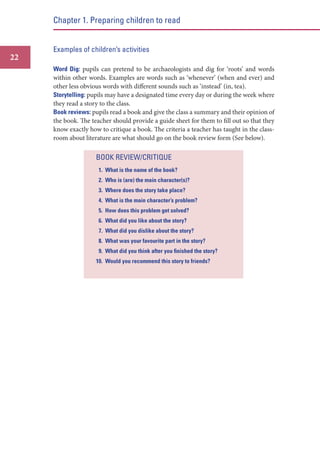
Book reviews: pupils read a book and give the class a summary and their opinion of
the book. The teacher should provide a guide sheet for them to fill out so that they
know exactly how to critique a book. The criteria a teacher has taught in the classroom about literature are what should go on the book review form (See below).

BOOK REVIEW/CRITIQUE
1. What is the name of the book?
2. Who is (are) the main character(s)?
3. Where does the story take place?
4. What is the main character’s problem?
5. How does this problem get solved?
6. What did you like about the story?
7. What did you dislike about the story?
8. What was your favourite part in the story?
9. What did you think after you finished the story?
10. Would you recommend this story to friends?
23

Reading comprehension requires pupils to be able to use the language of a text to
understand and explain the meaning. Pupils learn how to (a) identify the main
ideas in a text and (b) how to analyse and apply the information that they have
learned from a text. They are able to develop arguments and support those arguments based on information in the text, other sources of information or previous
knowledge. At this stage, there should be more emphasis on non-fiction materials,
such as diagrams, maps and encyclopaedias.
The ultimate goal is for pupils to be able to read a text and comprehend its
meaning. It is expected that pupils will have a facility with words that aid in communication, the form of communication they use with others and in self-expression.

Examples of activities
Creating a board game: pupils make a board game to be played with their peers. It is
best to follow the design of an existing game, such as Monopoly.
Research paper: pupils conduct an interview with knowledgeable (about a specific
topic) members of the community and/or consult books (when available) concerning a topic of interest. They learn to take notes and compile information, and at the
end write a report. This report may be read to the class aloud.

LESSON PLAN – Ms Veronica Smith
Grade

3

Objectives
Pupils should be able to:
• Read for information and enjoyment.
• Read fluently.
• Construct meaning.
• Rewrite sections of a story in their own words.
Skills
Writing, reading, decoding, comprehending

GUIDE TO TEACHING READING AT THE PRIMARY SCHOOL LEVEL

5. Enhancing and refining reading skills
Chapter 1. Preparing children to read

24

Activities
• Class discussion on the title of the story.
• Pupils will predict what they think the story is about.
• Teacher shows pupils flashcards with words from the passage.
• Pupils identify words.
• Pupils read a story in groups/individually.
• Teacher questions pupils (at intervals) to see if a prediction was true.
• Pupils choose a paragraph from the story then rewrite it in their own words.
• Pupils read their writing to classmates.
Evaluation
Pupils can test each other in word recognition.
A vision for enhancing reading
In many countries, teachers have often received a centrally developed curriculum.
It is then the responsibility of the school to discuss and create its programme for
improving reading achievement. However, before developing a programme, teachers must reflect on what they believe to be most important for teaching reading and
writing. This provides an opportunity for teachers to share personal experiences,
concerns and desires about what needs to be added, or changed, in the reading
or language arts programme. Teachers are able to compare and contrast ideas and
needs in order to construct a vision that addresses those ideas and concerns.
When teachers (and this means teachers of different subjects across the curriculum) work together, it enriches the learning environment. The teachers can create
a vision based on their educational experiences and the needs of their classrooms
synchronized across the reading programme and the curriculum. Pupils benefit
from the harmony of the curriculum, and are better able to recognize and participate in this vision. In this regard, the leadership of the school is very important for
creating and maintaining cooperation amongst the teachers.

25

GUIDE TO TEACHING READING AT THE PRIMARY SCHOOL LEVEL

Chapter 2: The reading approach

26

Teachers may begin constructing a vision by writing down ideas and experiences, using a questionnaire as a guide. Suggestions for clarifying the
vision and setting the stage for implementation are proposed below.
The following questions should be answered based on your thoughts, beliefs and experience as an educator.
What is the importance of the reading programme in the wider context of education?
What are the academic, social and emotional needs of the learners?
What can you do to help meet these needs?
What would you like see changed or improved in the programme?
What would you like to see added to the programme? Why?
What do you think is the most important attribute for teaching reading?
What do learners need from the teacher?
What do teachers need from the learners?
What are your goals for your learners?
What are your personal goals as a teacher?

Next, the teachers meet to discuss what they have written. The purpose
of this is to exchange different ideas. After sharing personal goals in
teaching reading, teachers try to create a common vision of how they
would like their reading programme to function and what they would
like the pupils to gain from it. Teachers discuss their beliefs, thoughts and concerns
in order to develop goals for the reading programme.
The reading programme should:
Enhance communication skills.
Create and develop new interests in pupils.
Produce pupils who continue to learn, even outside the institutional setting.
Produce pupils who are self-confident.
Produce pupils who are able to acknowledge and respect differences in cultures, religions, beliefs, values and interests.

After having defined the goals, teachers are able to move to the next step, that
of identifying the teaching and learning activities needed to achieve these goals.
Teachers will be able to identify the reading competencies to be achieved, prepare
appropriate lesson plans, and monitor the progress of pupils. An important aspect
of this exercise is for teachers to identify the environmental factors that enhance
reading. For example, in the community, there may be:
Reading approaches
Reading experts advocated various approaches over the years that were believed to
be the best methods for teaching children to learn how to read. During the 1930s
and 1940s, emphasis was placed on reading to gain meaning, using the ‘look and
say’ method. In the 1960s and 1970s, the emphasis changed to skill development,
which meant using tools, such as phonetics and other word decoding skills. The
early 1980s introduced the whole language approach, which focused on reading for
meaning; this approach expanded on the whole word method by integrating the
four components of language with literature: reading, writing, listening and speaking. The basic belief in using this method was that children can learn to read as naturally as they learn to speak; they will learn to read from exposure to reading skills
using literature without direct instruction in specific isolated reading skills. Direct
instruction means that the teacher creates an independent lesson specifically about,
for example, phonetics or sight vocabulary. The whole language approach, instead,
advocated the use of indirect instruction, where phonetics and sight vocabulary are
taught through literature.
Today teaching reading encompasses the integration of the four components
of language (reading, speaking, writing and listening) into other subjects of the curriculum (Irwin, 1967). Therefore, connections are made between disciplines, such
as science and language arts, and taught through conceptual themes, such as inventors or the weather. The contemporary view of reading is that the pupil is an active
learner. Learners interact with new information based on their previous knowledge

27

GUIDE TO TEACHING READING AT THE PRIMARY SCHOOL LEVEL

a traditional storyteller
an interesting tree about which the children have information
traditional musical instruments that can be used to
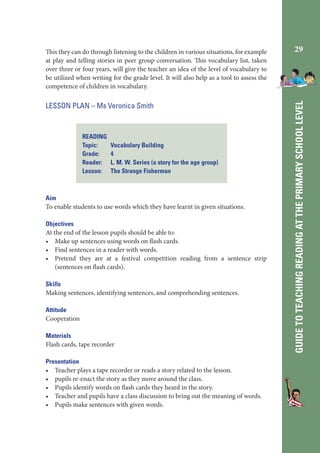
give a rhythmic beat to jingles and poems
dances that the children can talk and write about festivals that children can talk and write about, and make
drawings about
some materials from plants that children can bring
to the classroom in order to make their own teaching
and learning aids
an important folk character in the community
community folklore
community songs
Chapter 2: The reading approach

28

and experiences. They build their own knowledge base by deriving their own meanings from information, connecting new concepts and skills to what they already
know. Children do not always understand what precision in meaning demands and
are also unable to call to mind what words they require in speech and writing and
apply them correctly (Irwin, 1967). Therefore, emphasis is placed on helping pupils
learn how to draw on their experiences and previous knowledge in order to construct meaning. For example, understanding is easier when pupils living in a rural
area read a story about a family that lives in an area similar to theirs. Pupils living in
a large city may read a story about a character that lives in a large city. Pupils have
experiences that they can relate to in the characters and therefore begin the lesson
with some understanding of the story. Children begin learning about the world
using themselves and their culture as a reference point (speaking their language,
learning about their culture, using images that physically reflect the children’s identities, etc.). It is important that they have a point of reference in order to have a clear
understanding of their culture and identity. As they develop a sense of pride and
understanding of who they are, they are better able to understand and appreciate
other cultures, which is one of the main goals of reading.
The contemporary approach is a balanced one, which includes the
strengths of previous methods. The method uses literature to teach
skills and focuses on reading for meaning integrated with direct instruction in skill development for decoding and comprehension. Phonetics can be useful when incorporated into a balanced approach. However, it should
not share equal emphasis with reading comprehension. The purpose of phonetics and
other decoding strategies is to create additional means for improving reading comprehension and help learners understand the meaning of what they read. Phonetics
should not be viewed as skill pupils learn before using and interacting with authentic
literature, but rather is taught within the context of reading and writing (Irwin, 1967).
Skill instruction should be mixed in reading and writing activities, and not presented
as a separate activity. Children respond differently to different approaches. It is advantageous, therefore, to develop a method based on many methods in order to reach
all children and strengthen different aspects of learning.
Language and vocabulary knowledge also play an important role in a balanced
reading method. Teachers should seek to improve children’s vocabularies through
experience and this can be done not only by using existing interests, but also by
creating new ones (Irwin, 1967). Children should be able to learn sight vocabulary in context rather than in isolation. Teachers could use word lists in order to
compare and contrast, classify words or use tags and signs as a context for teaching
sight vocabulary. Learners may also learn vocabulary in activities such as games
and dramatizations that stimulate the imagination, and make reference to children’s
experiences.
Teachers could make a very valuable input, to both their own writing and that
of publishers of children’s books, by building a vocabulary list for each grade level.
LESSON PLAN – Ms Veronica Smith

READING
Topic:
Grade:
Reader:
Lesson:

Vocabulary Building
4
L. M. W. Series (a story for the age group)
The Strange Fisherman

Aim
To enable students to use words which they have learnt in given situations.
Objectives
At the end of the lesson pupils should be able to:
• Make up sentences using words on flash cards.
• Find sentences in a reader with words.
• Pretend they are at a festival competition reading from a sentence strip
(sentences on flash cards).
Skills
Making sentences, identifying sentences, and comprehending sentences.
Attitude
Cooperation
Materials
Flash cards, tape recorder
Presentation
• Teacher plays a tape recorder or reads a story related to the lesson.
• pupils re-enact the story as they move around the class.
• Pupils identify words on flash cards they heard in the story.
• Teacher and pupils have a class discussion to bring out the meaning of words.
• Pupils make sentences with given words.

29

GUIDE TO TEACHING READING AT THE PRIMARY SCHOOL LEVEL

This they can do through listening to the children in various situations, for example
at play and telling stories in peer group conversation. This vocabulary list, taken
over three or four years, will give the teacher an idea of the level of vocabulary to
be utilized when writing for the grade level. It will also help as a tool to assess the
competence of children in vocabulary.
Chapter 2: The reading approach

30

• Pupils identify a sentence in a reader with a given word.
• Teacher gives pupils a sentence strip with sentences from reader.
• Put pupils in three groups. Pupils in their groups will all pretend they are
at a festival making a presentation as they read the sentences they have.
• Presentations will be taped.
Evaluation
Pupils will make up other sentences using the key words they have learnt.
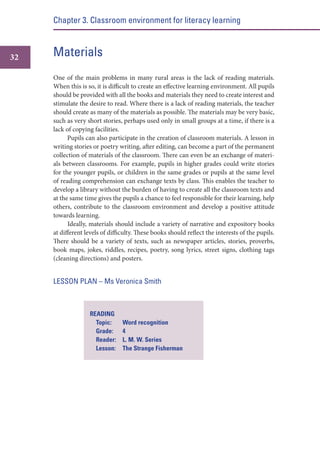
The classroom environment is one of the key elements in enhancing children’s
progress in learning to read. It should be an environment that provides opportunities for the integration of literacy with other areas of the curriculum and with all
aspects of language arts: reading, speaking, writing, viewing and listening. Both
social and physical factors are important for creating an appropriate environment
for success in literacy achievement and development. There should be ample opportunity for pupils to interact with their peers, and study texts; the teacher must
understand the functions of reading and writing.
A relaxed, yet structured ambiance is important in the classroom. Pupils should
feel comfortable in order to be able to concentrate on their studies. When possible,
the pupils should take part in the decoration of the classroom, which should reflect
the most recent lesson. It should include samples of all the children’s work, if not all
pupils at the same time, then in rotation. The images on the walls should reflect the
images of the children, their culture, their heritage and their customs. This helps
children to visualize their participation in literacy and as a result feel more compelled to learn about other cultures.
When possible, learning centres should be established to provide children with
the opportunity to work independently or in small groups. Learning centres are areas or classrooms designated for reading, writing, speaking and listening activities.
Children should be able to work on activities independent of the teacher, so explanation may be necessary to explain the different activities at the learning centre(s). For
example, a teacher may have cassette tapes of himself or herself reading a story. The
pupils would be able to play the cassette, reading aloud with the teacher. The activities should accommodate both individual pupils and small group activities. Learning centres may be particularly beneficial for large classes. The teacher can divide the
class into smaller groups of children with diverse skills and abilities. Each child is,
therefore, able to contribute to the group differently. The teacher guides each group
in rotation as they work on an activity.

31

GUIDE TO TEACHING READING AT THE PRIMARY SCHOOL LEVEL

Chapter 3. Classroom environment
for literacy learning
Chapter 3. Classroom environment for literacy learning

32

Materials
One of the main problems in many rural areas is the lack of reading materials.
When this is so, it is difficult to create an effective learning environment. All pupils
should be provided with all the books and materials they need to create interest and
stimulate the desire to read. Where there is a lack of reading materials, the teacher
should create as many of the materials as possible. The materials may be very basic,
such as very short stories, perhaps used only in small groups at a time, if there is a
lack of copying facilities.
Pupils can also participate in the creation of classroom materials. A lesson in
writing stories or poetry writing, after editing, can become a part of the permanent
collection of materials of the classroom. There can even be an exchange of materials between classrooms. For example, pupils in higher grades could write stories
for the younger pupils, or children in the same grades or pupils at the same level
of reading comprehension can exchange texts by class. This enables the teacher to
develop a library without the burden of having to create all the classroom texts and
at the same time gives the pupils a chance to feel responsible for their learning, help
others, contribute to the classroom environment and develop a positive attitude
towards learning.
Ideally, materials should include a variety of narrative and expository books
at different levels of difficulty. These books should reflect the interests of the pupils.
There should be a variety of texts, such as newspaper articles, stories, proverbs,
book maps, jokes, riddles, recipes, poetry, song lyrics, street signs, clothing tags
(cleaning directions) and posters.

LESSON PLAN – Ms Veronica Smith

READING
Topic:
Grade:
Reader:
Lesson:

Word recognition
4
L. M. W. Series
The Strange Fisherman
Objectives
At the end of the class pupils should be able to:
• Recognize and pronounce given words.
• Match words on flash cards to those on a chalkboard.
• Use songs and games to help in identifying words.
Skills
Identifying words, matching words.
Attitude
Cooperation, self-confidence.
Material
Flash cards, words in a bag, songs.
Presentation
Teacher and pupils sing song in their local dialect, e.g. ‘Come wi gu dung a sea side’.
Question pupils on song:
a. Have you ever been to the beach?
b. Do you know any fishermen?
c. What are some of the things they take to the beach?
List words on chalkboard, pupils identify and use words on flash cards to match
with them. Put pupils in groups and give instructions.
Group 1
Pupils identify given words on flash cards using song ‘The River Beng Cum
Dung’.
Group 2
Pupils identify given words on flash cards using ‘I am in a well’.
Group 3
Pupils identify words on flash cards using game ‘The Postman’.
Evaluation
Pupils identify words learnt, pretending they are on television doing a competition.

33

GUIDE TO TEACHING READING AT THE PRIMARY SCHOOL LEVEL

Aim
To enable pupils to recognize and pronounce words.
Chapter 3. Classroom environment for literacy learning

34

It is recommended that each classroom be equipped with the following:

Chalk board or dry erase board for writing and drawing for whole class
activities. A teacher may also use an easel, with a large notepad for writing. In either
case, the teacher will need chalk or markers and an eraser. An easel can be purchased or made using large branches and cord to attach the ends to create a stand.

Bulletin Board for posting any assignments. When a bulletin board is not
available, the teacher may provide a space of the classroom wall as a bulletin board.
It is also possible to paint a border, using chalkboard paint or the wall at the level of
the pupils. They can use this section of the wall for writing news or to practise writing. If this is done when the classroom is being constructed, it will be more refined.
Another possibility is to nail strips of wood along the wall in order to display the
children’s work.

Weather Chart to enable pupils to monitor the changes in the weather daily. This
helps pupils to learn the different terms for describing the weather. Cards with pictures of the weather and the description below could be used. The pupils responsible
for this activity may rotate daily or weekly. Others may be responsible for drawing
the weather cards for the classroom. An actual chart is not necessary; instead a card
can be posted on the wall each day.

Monday

Tuesday

Wednesday

Thursday

Friday

SUNNY

SUNNY

SUNNY

CLOUDY

RAINY
Current events board to highlight certain positive things going on in the community
and in the world. Pupils may be encouraged to share information with the class and
put it on the current events board.

35

Khalifah has a new baby sister!
A new primary school is being built in
a nearby village.
Government elections are today.

Globe (and/or world map) enables pupils should be able to see where they live and
their relationship to other countries. These are necessary for teaching about other
cultures and geography.
Health bulletin, a poster, either developed by health officials or the teacher, to inform pupils about healthy eating habits or to encourage positive health behaviours
in pupils. The teacher should read and explain the bulletin to the pupils firstly so
that they understand clearly the importance of the message and secondly in case
the vocabulary used on the poster includes words with which the pupils are not
familiar.

HEALTH BULLETIN

Protect Against Disease,
Get Your Vaccinations Today !

Monthly calendar of the current year. Pupils may be responsible for
updating the calendar each month. It may be helpful to make a ‘shell’
of a calendar (the chart with no months, nor numbers, only days of
the week) and have removable numbers and months (on cards, for
example). This prevents having to use a new sheet every day; it can be used for every
month and every year.
SEPTEMBER

S M T W T F
1 2 3 4 5
7 8 9

S
6

Duty list. Pupils share responsibilities for classroom management. This enables the children to practise responsibility and learn leadership skills, and helps the teacher’s classroom management. Children tend to like catchy titles, titles that rhyme or are comical.

GUIDE TO TEACHING READING AT THE PRIMARY SCHOOL LEVEL

DAILY NEWS :
Chapter 3. Classroom environment for literacy learning

36

Duties will vary according to different classroom settings and may be determined by the teacher and/or the pupils. The duration of each task should be long
enough for the pupils to learn the task, yet short enough to allow others an opportunity. Children may want to participate in creating either job titles that rhyme or
that are fun for them
NAME

ACTIVITY

Olaiyde

CLOUDY THE METEOROLOGIST
(manages the weather chart)

Hamady

CALENDAR CAPTAIN
(changes the calendar for the next month)

Dominique

THE JOURNALIST
(posts current events on the board or wall)

Kadidja and Assane

ATTENDANCE CAPTAINS
(take class attendance)

Franck and
Francis

THE ENVIRONMENTALISTS
(manage classroom sanitation)

Fulake

THE HOMEWORK OFFICER
(collects the homework for the teacher
when necessary)

Helena
and
Abbas

CLASS PARLIAMENTARIANS
(help teacher maintain discipline in the
classroom, for example by showing a sign
or symbol that means to be quiet)

Geoffrey

THE SUBSTITUTE
(when a pupil is absent, the substitute performs the duty of that person)

Many schools in some countries lack financial resources and cannot afford equipment.
However, the teacher is able to improvise. The teacher can have radio time in the class
for five minutes each day and one child reads the news. Another possibility is to make
a television using a cardboard to make the frame and cedar cloth to make the screen.
The teacher may write a story or may use pictures to generate discussions and various
class activities. Images are sewn or glued to the cloth. The pupils create a scroll by
rolling the cloth on a stick or a short pole. When it is television time, as they unroll
the scroll, image by image. The teacher can have pupils explain images that they see
on television or recite the news (reading what is on the scroll to the class), create the
news using current events and later take turns being the news anchor. Together with
the children, the teacher is able to make a collection of stories for future use.
A tape recorder is very helpful for listening activities, such as oral reading, taping
and listening to folk tales or songs. The teacher is able to tape stories to help pupils
who need guidance as they read independently. It also provides the children with an
opportunity to hear music or the voices of different people, other than the teacher.
When available, television, radio and a computer are assets for stimulating
viewing and listening skills. They enable teachers to make use of the interaction of
text, sound and visual texts at the same time. The television discussed earlier can
be beneficial for many teacher-led and pupil-led activities. Computer stations are
unique learning areas in classrooms, providing opportunities for children to acquire
knowledge about literacy socially. The computer station should be a focal area in the
classroom, which encourages children to engage in a variety of creative and imaginative activities, including printing children’s work, book jackets and classroom information. In the absence of computers, pupils still have the opportunity to create these
materials by hand and even perhaps learn a new skill or develop an old one. Some
examples include making their own book covers or using objects found in nature to
design and create frames for their published stories, poems, plays, songs, etc.
Pupils may also be taught how to recycle paper to use for other assignments or for presentations. This encourages the habit of recycling and
teaches the pupils a skill. It requires very little materials and is relatively
simple for pupils to do. In order to recycle paper, all used paper is soaked in water
until it becomes a thick pulp, with consistency of thick porridge. Pupils may mix
tiny grains, leaves or other natural materials in the pulp to add texture, style or colour. Next, the pulp is spread out on a square screen, with a wooden border. The pulp
should cover the entire screen. The screen will drain all excess water. After the water
drains, the pulp that is on the screen becomes dry enough to place on a flat surface
to dry. The pulp may take one to two days to completely dry. The only equipment
needed is a screen.

Accommodation, furnishing and lighting
Careful attention to the physical classroom design is essential for the success of
teaching and learning. Classroom space must be adequate to accommodate each
pupil comfortably when writing and engaging in whole class instruction. Ideally
there should be a sufficient number of chairs or benches, with ample space for writing on a desk or table. However, there are many schools without sufficient desks and
chairs. In this situation, teachers should try to find the most comfortable seating
arrangement possible to accommodate the pupils. In cultures where the children
sit on the floor or on stones, there should be ample space for the pupils to sit comfortably. What is most important is that children should be reasonably comfortable

37

GUIDE TO TEACHING READING AT THE PRIMARY SCHOOL LEVEL

Equipment
Chapter 3. Classroom environment for literacy learning

38

when they are in class. Otherwise, when they are uncomfortable, they tend to be
more disruptive, there is an increase in disciplinary problems and very little learning takes place.
It is recommended that the teacher move about the room during the lesson in
order to keep the attention of all the pupils in the classroom and not just of those sitting close to the teacher. The pupils should be seated in such a way that the teacher
has access to each child and can walk about the room freely during the lesson. Some
examples of seating arrangements include:
Two semi-circles. This formation makes it easy for the teacher to be closer to
everyone (instead of having rows going further and further away from the teacher).
This is particularly useful for larger classes of about 30 or 40 pupils. The teacher may
want to alternate where the board is used or alternate the seating arrangement from
time to time so that each pupil gets a chance to be near the teacher.
Learning centres. Pupils may be grouped in 3s or 4s up to 10 for larger classes
(of 40 or more pupils). This grouping helps allow teachers to promote cooperative
learning (group projects and assignments). In very large classes and/or active
classes, the teacher may have pupils working on the same project or assignment at
each learning centre. This may be easier for teachers to give their full attention to
each group and prevent them from being overwhelmed by overloading the number
of activities in the classroom at one time.
Lighting is very important, especially for children who may be visually impaired.
If the lighting is weak, it may cause problems for some pupils and even the teacher.
Doorways and windows should be clear of any obstacles that may block the light.

Discipline
One of the major challenges of teachers is classroom management
and managing discipline. One of the main reasons children misbehave in class is because they want something, such as to be the centre
of attention, or to boss others around (Albert, 1995). It is a particularly difficult problem when children are not provided with the necessary materials for lessons and class sizes are very large. It is recommended that the disruptive
child be engaged in the learning process. Various intervening techniques should be
used when a child begins to disrupt the classroom environment and a clear set of
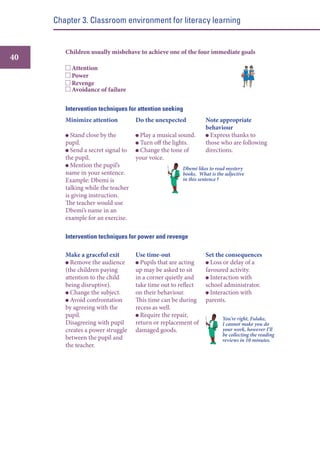
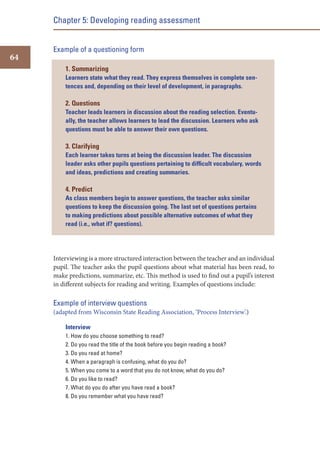
consequences established – that the children must accept – if the intervention does
not work. It must be kept in mind that using writing and reading exercises as punishment is counterproductive; it teaches the children that reading and writing are
punishments (e.g. writing ‘I will not talk’ 100 times on the board) and not a source
of pleasure. Children should not be punished with literary exercises, because they
start to associate literacy with something negative. Instead, children should accept
The four basic concepts of cooperative discipline (based on Albert, 1995)
Children choose their behaviour
Teachers need to learn how to interact with pupils so they will want to choose
the appropriate behaviour and comply with the rules.
The ultimate goal of pupil behaviour is to fulfil the need to belong
Pupils have to feel capable of completing assignments given by
the teacher. The teacher can provide: ample preparation for the
task by giving clear instruction, positive reinforcement by focusing on the successes of the pupil and an environment where
learners are not afraid to make mistakes.
Pupils have to connect successfully with teachers and classmates in
order to feel as though they belong. The teacher can provide a nurturing
and peaceful environment that must be maintained and encouraged in
the classroom. Also, the teacher should express his or her concern for
each pupil by showing interest in them (including listening and praising
them).
Pupils need to know that they contribute in a significant way to the
group. The teacher can have all pupils participate (not necessarily at
the same time, especially for large classes) in developing class activities
and sharing the responsibility for classroom management.

39

GUIDE TO TEACHING READING AT THE PRIMARY SCHOOL LEVEL

the consequences of their actions with (non-pleasurable) activities that are nevertheless instructive. For example, a child who scribbles on an undesignated point of a
wall may be responsible for cleaning the room for the week. Not only does the child
clean the wall, it is also the child’s responsibility to make sure the walls are completely clean and that no one writes on them. There is a direct relationship between
what the child did and the consequence of the action.
Children misbehave for different reasons. Some want attention, either from
the teacher or their classmates, so they distract the class to get an audience. Examples include making noises and using inappropriate language. Some children
want to be the boss – of themselves, the other pupils and/or the teacher. They want
everything done their way. Generally these pupils do not comply with class rules
and will argue and challenge teachers until they get their way (Albert, 1995). Sometimes they want revenge for being hurt or embarrassed by either a classmate or
a teacher. When children feel incapable of living up to their expectations, their
parents’ expectations, or the teacher’s, sometimes they may act to divert attention away from the (reading) problem, and change the focus to something else.
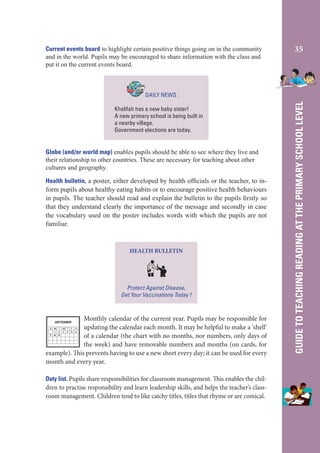
Chapter 3. Classroom environment for literacy learning

40

Children usually misbehave to achieve one of the four immediate goals
Attention
Power
Revenge
Avoidance of failure
Intervention techniques for attention seeking
Minimize attention

Do the unexpected

Stand close by the
pupil.
Send a secret signal to
the pupil.
Mention the pupil’s
name in your sentence.
Example: Dbemi is
talking while the teacher
is giving instruction.
The teacher would use
Dbemi’s name in an
example for an exercise.

Play a musical sound.
Turn off the lights.
Change the tone of
your voice.

Note appropriate
behaviour
Express thanks to
those who are following
directions.

Dbemi likes to read mystery
books. What is the adjective
in this sentence ?

Intervention techniques for power and revenge
Make a graceful exit
Remove the audience
(the children paying
attention to the child
being disruptive).
Change the subject.
Avoid confrontation
by agreeing with the
pupil.
Disagreeing with pupil
creates a power struggle
between the pupil and
the teacher.

Use time-out
Pupils that are acting
up may be asked to sit
in a corner quietly and
take time out to reflect
on their behaviour.
This time can be during
recess as well.
Require the repair,
return or replacement of
damaged goods.

Set the consequences
Loss or delay of a
favoured activity.
Interaction with
school administrator.
Interaction with
parents.
You’re right, Fulake,
I cannot make you do
your work, however I’ll
be collecting the reading
reviews in 10 minutes.
41

GUIDE TO TEACHING READING AT THE PRIMARY SCHOOL LEVEL

It is very important to understand that when pupils misbehave they are really in
search of something (attention, power, etc.). Alternately, they are bored. If a teacher
lectures everyday, without adding any diversity to the types of activities performed
in class, some children tend to become bored quickly and begin to act up. Using
only one method generally excludes pupils who respond to different methods of
instruction. The more varied the instruction and activities, the more the instruction
will engage all learners. If class activities are challenging, yet within the capabilities of the pupils, exciting, yet relevant to instruction, pupils tend to be engaged in
instruction.
Teachers must be accurate observers in order to pinpoint the behaviour and
describe the pupil’s behaviour. Identify the goals of the misbehaviour. Choose the
intervention techniques for the moment of behaviour. The purpose of using intervention is to stop the behaviour occurring and to influence the pupil to use more
appropriate behaviour in the future. Once the teacher identifies the reasons behind
the misbehaviour, he or she can immediately begin to deal with the pupil. The purpose is not to punish the pupil, but rather to stop the disruptive behaviour and to
discourage it in the future.
42

Chapter 4. Teaching reading
fluency: suggested approaches
and methods

Sequence concerns the order of the learners’ experiences as well as the organization
of subject materials. Two approaches to reading could be combined for ultimate results. The direct approach tailors the curriculum to the needs, interests and abilities
of the pupil. The goals of the programme remain constant, but the implementation
of activities to attain these goals is based on the learner’s knowledge and interests.
The indirect approach prepares the pupil for learning new information and to interact with new information. The pupil is taught various learning tools that help
in working with new information to construct meaning. The objective is to equip
pupils with the necessary tools to construct meaning with the information that they
encounter.
Teachers should develop a reading programme that follows a sequential approach. A sequential approach is that based on the pupils’ previous knowledge and
experiences. The teacher builds upon that knowledge to acquire new information,
while challenging the learner to analyse and process the information. This approach
develops mental processes by making pupils summarize previous information, integrate new knowledge with previous knowledge, analyse the new information, apply the information learned and create new information based on new knowledge.
The sequential approach develops critical thinking skills, by exercising the child’s
ability to think independently using analytical skills. Children in primary grades
are not always equipped with the thinking skills necessary to summarize and process information. They may lack the ability to differentiate the connotations of some
words and meanings, and are unable, therefore, to apply them correctly. The sequential approach develops their ability to think independently, to solve problems
independently and to form their own concepts.
Suggested reading programme
The suggested reading programme should be based on the following criteria:
A. Identify each child’s specific readiness for the reading programme through
classroom observation and diagnostic testing.
B. Develop a programme that facilitates readiness to learn new material based on
the children’s interests and abilities.
C. The reading readiness programme should focus on building reading comprehension by emphasizing the whole word meaning and whole language. The programme should integrate the four components of literacy: reading, writing, listening and speaking.
D. Develop ability in reading mechanics (such as developing the ability to sound
out the pronunciation of unknown words), reading comprehension skills and critical thinking skills, using both fictional and non-fictional texts.
E. Integrate into the curriculum an opportunity for reading for leisure.

Multiple intelligences
Howard Gardner (1983) developed the theory of multiple intelligences based on
the fact that children have different ways of learning and processing information.
Children have strengths in some areas and weaknesses in others, and are better
able to process information according to their type of intelligence. There are eight
intelligences (listed and described in sample form). There are generally eight different ways or styles that children use to absorb information. The use of this theory
helps teachers to understand differences in individuals, by allowing each pupil to
demonstrate their strongest assets. It creates an opportunity for pupils to use their
strengths to build up their weaknesses. This gives each child an opportunity to experience success and be motivated and creative in its own way. Teachers are encouraged to use most of the eight intelligences in the presentation of new materials, in
the daily lessons and in assessment.
A teacher may begin by observing pupils in various situations and then using
an assessment form to record their learning styles. This helps the teacher plan lessons and assist individual pupils with specific problems, perhaps by presenting the
information in a way that corresponds with their learning style.

43

GUIDE TO TEACHING READING AT THE PRIMARY SCHOOL LEVEL

The teacher’s major task in developing reading comprehension is in the careful selection of relevant materials and in creating experiences that enable children
to gain specific concepts that will facilitate word discrimination and generalization
(Irwin, 1967). Once pupils master concepts, they are prepared to analyse and apply
these concepts, as well as create new ones.
Chapter 4. Teaching reading fluency: suggested approaches and methods

Teacher learning-style assessment form

44

(based on Gardner’s multiple intelligences theory and developed
by Carmen N’Namdi)

Pupil Assessment Form
Pupil’s name:
Grade level:
VERBAL-LINGUISTIC
Loves talking, writing and reading almost anything
Expresses herself or himself very clearly in both writing and talking
Enjoys speaking in front of people (public speaking)
Is sensitive to the impact of words and language on others
Understands and enjoys plays on words and word games
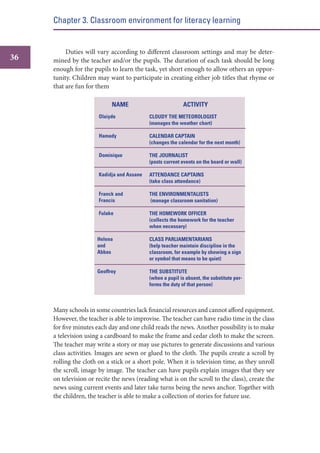
LOGICAL-MATHEMATICAL
Is good at finding and understanding patterns
Is quick at solving a variety of problems
Can remember thinking formulae and strategies
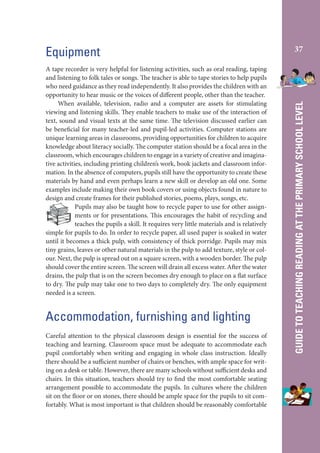
Likes to identify, create and sort things into categories
Is able to follow lines of reasoning and thought processes
VISUAL-SPATIAL
Frequently doodles during class activities
Is helped by visuals and manipulatives
Likes painting, drawing and working with clay
Has a good sense of direction and understanding of maps
Creates mental images easily; likes pretending
BODILY-KINAESTHETIC
Has difficulty sitting still or staying in a seat
Uses body gestures and physical movement to express himself or herself
Is good at sports; is well coordinated physically
Likes to invent things, put things together, and take them apart
Likes to make up songs and melodies
Senses musical elements in unusual or non-musical situations
INTERPERSONAL
Has an irresistible urge to discuss almost anything with others
Is good at listening and communicating
Is sensitive to the moods and feelings of others
Is a good, effective team player
Is able to figure out the motives and intentions of others
INTRAPERSONAL
Is highly intuitive
Is quiet, very self-reflective and aware
Asks questions relentlessly; has avid curiosity
Is able to express inner feelings in a variety of ways
Is individualistic and independent; is not concerned about others’ opinions
NATURAL
Loves animals and nature
Enjoys raising plants and animals
Draws or talks often about plants and animals
Likes stories about plants and animals

45

Verbal linguistic, encourage:
Reading
Vocabulary
Formal speaking
Journal/diary keeping
Creative writing
Poetry
Debate
Jokes
Storytelling
Logical-mathematical,
encourage:
Outlining
Number sequences/patterns
Deciphering codes
Problem solving
Practice ’if…then…’
deductions about a topic
Calculations
Logic/pattern games
Visual-spatial, encourage
Painting
Pretending/fantasy
Visualizing
Collages
Sculpting
Patterns and design

Bodily-kinaesthetic, encourage:
Dance
Drama
Sports games
Inventing
Gymnastic Routines
Musical-rhythmic, encourage:
Writing songs with the beat
Rapping
Drumming
Interpersonal, encourage:
Group projects
Expressing understanding from
someone else’s viewpoint
Accepting another’s input
Accepting positive criticism
Intrapersonal, encourage:
Independent projects
Working with diaries, reflective
journals
Natural
Write narratives using a plant or an
an animal as the main character
Write descriptions of natural
environment
Develop plays with animals as the
main characters

While there are no definite rules concerning the results of observation of the pupils, the multiple intelligences approach gives the teacher an opportunity to sort
the differences among children in manageable groups. For instance, when creating
groups for a project, a teacher may put pupils with complementary strengths in a
group together (a verbal-linguistic learner with a bodily-kinaesthetic learner) so
that each can contribute in his or her own way to the project. A teacher may also
decide to group pupils according to their learning styles to help explain a particular
lesson.

GUIDE TO TEACHING READING AT THE PRIMARY SCHOOL LEVEL

Now that you know your pupil
Chapter 4. Teaching reading fluency: suggested approaches and methods

46

Suggested methods and approaches
Comprehension work. Grammar, sentence structure and themes should be taught
using literature (from short stories to maps). Examples should be heavily oral based
and based on the eight multiple intelligences. Exercises developed should be both
deductive, meaning pupils are able to recite what is in the text, and inductive (thinking and evaluation), where pupils are able to guess or create possible outcomes,
based on information in the text. Examples are given below.
Body/kinaesthetic activity. Children transform a story (or stories) read by the class
into a play. They divide into groups and act out the play for the other groups in the
class.
During the performance, there should be a moment when the audience is asked
to guess what is going to happen next. After the performance, questions are asked in
reference to what the children saw in the play (summarize information ). The next
set of questions should be analytical (such as why did a character react in a certain
manner to a situation), and finally pupils should be able to tell what new information they learned from the play. They should be able to express new knowledge
based on the classroom activities.
Reading aloud stimulates listening skills. It helps to familiarize pupils with the
language of books and patterns. It builds listening skills and provides examples
(models) for children in pronunciation and expression. It is a good idea to incorporate
fiction as well as non-fiction texts. The intonation and tone used by the teacher
should be appropriate to the text being read. See cassette example.
Pre-reading activity: A story about a trip to the mountains.
Before reading the text, draw upon the pupils’ prior knowledge about the subject. Ask children, ‘Who has visited the mountains, and/or lives in the mountains’?
Ask them for descriptions of mountains using semantic mapping (see p. 54). Have
photographs of different mountains available for visual stimulation. Next, preview
two or three names, ideas or concepts that are to be recognized in the story (e.g.
Mount Everest, how to climb a mountain, the changes in the air in the mountains,
etc.). Ask them about mountains in their environment. If there are no mountains
in their environment, then a drawing or a photograph should be part of the class
materials. Pupils then are listening to the story, but also listening for specific information.
LANGUAGE ARTS
Topic:
Ourselves
Subtopic:
Myself
My body parts
Myself and others
My environment/culture

Objectives
Pupils should be able to:
Share factual information about themselves in clear concise language.
Identify and pronounce words with silent letters.
Use their syllabication skills to attack new words.
Write legibly in cursive form.
Use their phonetic skill to spell words.
Relate rule governing the addition of suffixes to certain words.
Use context clues.
Activities
Teacher introduces lesson with poem ‘Myself ’.
Teacher and pupils read poem twice.
Guided by teacher, pupils identify new words.
Pupils use new words in sentences.
Pupils play the game ‘I spy’ to identify words with silent letters.
Evaluation
Students will write down the words with silent letters that they have identified
in the ‘I spy’ game.
Reading activity: Learners are prepared to listen for specific information, as well as
listen to the story as a whole. The teacher wants to stop the story at intervals to check
comprehension and to keep attention alive. If attention seems to wane, learners may
be given a key word to listen for while the teacher reads and asked to perform as a
physical gesture, such as clapping their hands, when they hear the word.
Post-reading activity: After the reading, questions may be asked related to information presented in the pre-reading activity. The first set of questions reflects listening skills. The answers to these questions are found directly in the text. The second
set of questions requires processing information and deducting meaning from that
information. Eventually, the teacher may want the students to participate in reading aloud, using a story that the children selected or wrote themselves or a story
selected by the teacher.

47

GUIDE TO TEACHING READING AT THE PRIMARY SCHOOL LEVEL

LESSON PLAN – Ms Lesmond Henry
Chapter 4. Teaching reading fluency: suggested approaches and methods

48

Shared reading follows the same format as reading aloud, only the teacher reads the
text with the pupils. The reading includes pupils identifying key words, either by
circling or underlining the words and phrases that they know. This practice is continued on numerous occasions, until the learner can read more and more of the text
independently. This may be done individually, with the pupil using a tape recorder
with the story being read by the teacher on the cassette. This can also be classified
as an independent reading activity.
Paired reading. Children work in pairs and assist each other in reading and comprehending the text. This activity must be guided by the teacher by giving the pair
questions to answer based on the text information. It may be beneficial to have
older (but still close in age) learners work with the younger ones. This opportunity
is provided in multigrade classes.
Independent reading is a good opportunity for pupils to utilize a learning centre.
If there is a learning centre in the classroom, the students may go to that area and
select a reading activity of their choice, and begin reading and working on comprehension exercises. If it is time for leisurely reading, then the pupils may want to
bring in an appropriate book from home once a week or once a month to read during independent reading (otherwise, the books can come from the school library).
Learners can also make and exchange reading materials. This builds their home
libraries and thereby encourages reading at home, and also provides an opportunity
for pupils to share what is learned.
Language exploration. When creating reading activities, it is important to incorporate all the learning styles of the children. Children respond differently to different
teaching styles, and a variety of styles should, therefore, always be a part of the information presented. Some examples of literary activities that emphasize different
learning styles are:
1. Drama (kinetic/verbal): One pupil reads a poem or lyrics to a song, and another acts out the text (the words to the song).
2. Song writing (musical/linguistic): pupils write lyrics and the tune to a song,
either individually or in small groups. This could be a culminating activity after
having learned a poetry format, if the children are studying poetry. The pupils then
follow the same format for the poem in their song.

LESSON PLAN – Ms Elaine Patterson
LANGUAGE ARTS
Unit:
Focus question:

Poems
How do poems help me see, smell,
touch, taste and hear?
Objectives
Pupils will:
Speak clearly and distinctly in a natural easy manner.
Listen and speak with awareness of the audience and of situations.
Use diphthongs, e.g. ‘oi’, ‘ow’, ‘oy’, ‘ou’.
Use advanced syllabication principles to determine basic units of words,
e.g. gen/er/ate, sum/ma/ry.
Use grammatical and other clues to derive meanings of words in context.
Identify and use ideas and information at the literal and inferential levels.
Use a dictionary.
Apply comprehension skills across content areas, noting main points, key words.
Use correct cursive forms, upper and lower case, headings, margins, spacing.
Spell phonetically irregular words, e.g. ‘rough, cough, through’.
Demonstrate ability to generate own sentences and patterns.
Show understanding of the functions of the parts of speech (nouns and verbs)
Write poems that reflect the senses.
Write couplets.
Skills
Listening to, expressing the language of poetry.
Identifying sound patterns in poetry.
Creating sound patterns.
Creating verse using sense words.
Recognizing tone in poems.
Writing.
Activities
Pupils and teacher will:
Share favourite poems and talk freely about likes, dislikes and feelings
evoked in poems.
Collect poems and poetry books for class reading.
Pupils will:
Listen to, read and sing, and tap clap to rhythm of poems selected for sound
effect, alliteration in ‘Pickety Fence’.
Say poems to suggest word music and express sound quality.
Perform poems as a choral group.
Create rhymes, couplets, poems with similar rhythm. Check spelling
and punctuation.
Write legibly and neatly.
Talk about how images or word pictures work in poems, i.e., words that cause
them to hear, see, feel, touch, taste and smell, e.g. images in ‘cat’,
‘Big Waves and Little Waves’, ‘Farther than far’.

49

GUIDE TO TEACHING READING AT THE PRIMARY SCHOOL LEVEL

Attainment targets
Listen and speak with sensitivity to audience.
Apply relevant decoding skills to the reading process.
Read for meaning and for enjoyment.
Chapter 4. Teaching reading fluency: suggested approaches and methods

50

Read poems to suggest how these images should sound when reading poems.
Create similar sense verses about a dog, fast car or a shower of rain.
Listen to tones in poems and tell whether the poet is angry, pleased, sad, etc.
Discuss how they know by referring to words in poems (diction),
sound quality, etc.
Discuss themes of poems (main thing poet wants to say).
Evaluation
Pupils will write down one of the verses completed.

Writing used to teach reading
The reading process involves the development of listening, speaking, and
writing skills. It is not the opposite of reading but instead the complement to
reading. This means that reading development is dependent on writing development. Both should be practised daily as a part of the curriculum. Many
exercises can be integrated in the daily classroom environment that encourage the
constant use of writing and reading, such as journal writing.
Language experience approach. This approach is based on the view that children’s
experiences can be talked about and recorded (written down) by the teacher, and
form part of the reading material. The teacher records children’s thoughts using
their language, with the teacher and children reading during recording. Repeated
reading enables children to identify words and to read on their own. To provide
a shared reading experience, a child may describe to the class his or her favourite
animal. The teacher may write the five or so sentences the child says on the board
in complete sentences. The pupil then reads to the class what the teacher wrote. The
other pupils at this point may ask questions, share opinions or want to share their
personal stories.
Journal writing. Children are encouraged to write their thoughts and ideas about
anything they like. This is free writing, meaning that the writing in the journal is not
subject to teacher’s standards. It is an opportunity for the pupil to express himself or
herself freely. The advantage of journal writing is that it can serve as an emotional
outlet, yet at the same time exercise writing skills.
Guided writing. As the name implies, the teacher works with the individual pupil,
offering guidance in sound/symbol relationships, eliciting what the pupil knows
and giving guidance to help the pupil to experience success in the writing process
(Carter, 2000). In large classes, this may be done in small groups, where the teacher
guides the group to brainstorm (tell all the information they know about a particular topic). Next, the teacher shows the group how to guide each other by using a
standard set of questions. The teacher may want to first practise using these guide
questions with the entire class and again explain them to the smaller groups.
GUIDE QUESTIONS
1. What is it that you want to write about?
2. What do you already know about this topic?
3. What is the main idea that you want to express in your story?
4. Where does you story take place? A city? A village? In a house? In the forest?
At the river?
5. Who is the main character in your story?
6. Who are the other characters?
7. When does this story take place, now, or a long time ago?
8. The main character always has a problem that must be solved. What is the problem?
9. How does your character solve this problem?

Content writing encourages responses to a topic in an organized manner. Children
are able to use research skills, summarize facts and draw conclusions. Children are
taught how to organize an idea: an introduction, a body and a conclusion. The introduction states the problem, what the main characters need in order to do something. The body details how the characters go about trying to solve their problem.
The conclusion explains how the problem was solved and how the story ends.
Peer editing, Pupils editing the work of their classmates, is recommended for content writing. Pupils may follow a punctuation checklist, provided by the teacher (or
it may be on the wall in the classroom), when checking other pupils’ work. Peer editing teaches the children to become aware of punctuation and a sequence of ideas.
They practise looking for punctuation mistakes and establishing whether the story
is easy to understand or not. As children mature, they may participate in a discussion concerning the ideas of the text, text structure, and what additions and/or deletions need to be made. Remember that eventually the teacher still needs to edit all
the texts written, because the children editors may make a mistake themselves.

Strategies to foster reading comprehension
Preparing for the reading. The teacher selects a word, phrase or picture about a key
idea or concept in the text or topic. Next, the teacher begins a discussion with the
class around this subject in order that pupils see other ideas related to the idea being studied. Then the teacher may ask the pupils to look at the text, the title and the
pictures, and ask questions that may evoke relevant thoughts and memories related
to those items. The teacher builds background information by activating appropriate prior knowledge through self-questioning about what is known of the topic, the
vocabulary and the format of presentation. The teacher sets the purpose of reading
by asking questions about what the reader wants to know.

51

GUIDE TO TEACHING READING AT THE PRIMARY SCHOOL LEVEL

Example of guide questions for small groups
Chapter 4. Teaching reading fluency: suggested approaches and methods

52
Example: Topic - Protecting Our Environment (Carter, 2000).
What comes to mind when
you hear the word environment?
Why do we need to protect our environment?
Why do these ideas come to mind ?
Trees
Elephant
Birds
Goats
Teacher provokes
Background information

River
Grass

Responses are recorded

Because we need food
Because we need clean water

Reflection stage

The social interaction of this activity will help pupils understand and expand their
knowledge through listening to and interacting with the other pupils. In the final
stage pupils might be asked the following question:
Semantic mapping. Teachers may choose to present the information using semantic mapping. The key word or phrase is put on the board, and the children and the
teacher develop categories and subcategories of related words. Pupils may add to
the map as they read.

Semantic map example (Carter, 2000).
The reading process
During the reading of the text, the pupil:
Checks understanding of the text by paraphrasing the author’s words.
Monitors comprehension by using context clues to figure out new words
and by using images, inference, and prediction.
Integrates new concepts with existing knowledge and continually
reviews the purposes of reading.
Post-reading activities
After reading the text, the pupil:
Summarizes what has been read by retelling the plot of the story or
the main idea of the text.
Applies ideas in the text to other situations, broadening these ideas.

Various techniques or practices may be used to organize information after reading
the text. It is advised that diverse activities be used to allow pupils to express what
they have read. Pupils could return to their semantic map to include new ideas that
they learned after having read the text. Pupils could, for example, write summaries,
give oral presentations or act out the text in the form of a play. The pupils may use
other methods of organizing the text, such as those listed below.
Description: pupils describe either the setting (where the story takes place)
or the personality of one or more of the characters.
Narrative: pupils write a narrative about their reflections on the story or
some part of the story that relates to them or their experiences.
Cause and effect: a chart may be developed to show
why certain characters performed the way they did
in the story and the pupils look for the consequences
of those actions taken by the characters. This activity
CAUSE
EFFECT
plant seeds + sun is also good for explaining classroom management.
plants and
+ rain

vegetables

Compare and contrast permits pupils to see the similarities between two subjects.
They look for all the qualities two characters or two stories have in common. Next,
they look for all the differences between the two subjects. Once they are comfortable with this activity they may use more than two subjects.

53

GUIDE TO TEACHING READING AT THE PRIMARY SCHOOL LEVEL

Take note that the subcategories answer the questions Where? When? Why? What?
How? Pupils will predict the information that they believe will be in the text. Then
they read the text and compare their predictions with the information actually contained in the text. This active form of processing enhances the development of effective comprehension strategies.
Chapter 4. Teaching reading fluency: suggested approaches and methods
DOGS
Bark
Like to chase

54

CATS
Meow
Like to climb

Have four legs
Live with people

Problem and solution. Pupils identify the problem in the story. Keep in mind that
a problem is not necessarily negative. Often, children believe a problem in the story to be something negative, when it is not negative, but simply a goal that the
character(s) want to accomplish, such as teaching a sister or brother how to climb
a baobab tree.
Story structure and sequence. The practice of putting the story line in order of
events, or in sequence, is a good exercise for facilitating comprehension. It enables
pupils to practise thinking about the story in connected parts, as opposed to a series
of short thoughts. It also shows pupils the format of stories: beginning, middle and
end. Story circles are one way of helping pupils to put the story in sequence. Numbers are used in sequencing to put the events of the story in order. Pupils may also
use pictures that they draw, or make copies from the book that tell the story line in
order to put the story in sequence.
Example of a story circle

Pupils may also use pictures that they draw, or make copies from the book that tell
the story line in order to put the story in sequence.

8

1
2

7
6

3
5

4

In the small sections of the story, pupils illustrate the events in the order that corresponds to the number. Some pupils may be more comfortable writing a brief sentence that tells what happened in the story.
Information processing involves a chart that can be started before any
reading activity. Pupils begin by stating what they know on a chart, either
individually or as a class, what they already know and what they want to
know or learn from the text they are going to read. This activity helps pupils set a purpose for their reading. A chart design called the KWL (knowwant-learn) can be used by the teacher on the board or by pupils individu-
ally. After the activity is completed they will write in what they learned,
which may or may not be the information that they wanted to learn prior
to the activity.

55

WHAT I KNOW

WHAT I WANT TO KNOW

WHAT I LEARNED

Summarizing involves taking out information in the text that is not important and looking for the main points. This activity can and should
be combined with sequencing activities. For example, the teacher introduces a story and the pupils read it silently to see how the plot develops.
The teacher guides the pupils to develop a story frame and instructs the
class in writing one or two sentence summaries for a small portion of
the text.
Look for the most important ideas that help us know about the problem or the solution.
State the important ideas in your own words.
Combine the ideas into one or two sentences.
Take out anything that repeats information.
On the second reading of the text, the pupils will be assisted in determining the most important ideas, and how to combine these ideas and summarize them. After short summaries have been written, the children may
cut them out on small slips of paper and mix them. Then they rearrange
the slips of paper in order, in the sequence of the story. Children can make
their own summary strips from other texts as they become more familiar
with the process.
Note taking. Once pupils have mastered the ability to extract the main
ideas from a text, they may begin to develop note-taking skills. Notetaking skills involve pupils writing down the important elements from
a text they are reading or from what a teacher is saying. The teacher
may want to begin this activity orally, in order to better monitor the
success of the children. The teacher begins by stating a short informative paragraph. The pupils then orally try to find the main ideas. The

GUIDE TO TEACHING READING AT THE PRIMARY SCHOOL LEVEL

An adapted KWL design (Ogle, 1986).
Chapter 4. Teaching reading fluency: suggested approaches and methods

56

teacher increases the amount of information bit by bit until the pupils
are able to take notes from a short text (such as a short story).
Voluntary and recreational reading. Many children, particularly in rural areas, do not choose reading as a source of information or as a recreational activity. In order to enhance literacy, projects and programmes
involving voluntary reading should be developed in schools and public
libraries, by making available a variety of reading materials that reflect
the children’s interests. If schools have no libraries, then teachers may
want to begin by creating libraries using boxes. Box libraries can begin
by collecting the few books a school has access to, and little by little
adding more books to the box as they become available. The goal is
to eventually have enough books to start a library. The box should be
neatly decorated or made to look appealing to the children so that they
want to use the books or contribute books to the library.
This will motivate learners, foster the self-selection of materials by pupils
and instil a sense of pride in building their library. Teachers and pupils can
also write and display materials. Parents, friends and relatives should be
encouraged to give books to children as gifts, whenever possible, in order
to increase the amount of printed materials in their homes.
Assessment is a tool that measures a learner’s knowledge and ability. It shows the
areas in the reading programme where learners have weaknesses and strengths. It
shows how well they are able to extract information and analyse what they are reading. The purpose of using assessment is to test that learning objectives (and lesson
objectives) are being met. Forms of assessment should be based on, and reflect,
what is taught in the classroom. The forms of assessment must be as varied as the
lessons and relevant to the lessons, while addressing the different learning styles.
For example, in a lesson in styles of architecture, children are taught to recognize and distinguish between three different house styles. They are taught how to
draw a doorway that is characteristic of each of the three styles. They read and study
the history of each of the styles. If there are no books, the teacher may tell the history orally. The children can also question the older people in the community. They
are expected to know which country each style comes from and in what period it
began. The learners look for examples of the styles in their communities. The skills
that are learned and practised include drawing, reading for meaning, observing and
matching. The assessment of this lesson must correspond to what was taught and be
as varied in form as the lesson. Learners may be asked to identify different forms of
houses in pictures. They may be asked to match elements that are a part of the same
style. They may be given questions that ask for the dates and countries of origin of
each of the three styles.

57

GUIDE TO TEACHING READING AT THE PRIMARY SCHOOL LEVEL

Chapter 5: Developing reading
assessment
Chapter 5: Developing reading assessment

Sample lesson plan with assessment

58
LESSON PLAN
Title:
Students will be able to:
Materials:
Pre-activity:
Activity:
Post-activity:
Forms of assessment:

The teacher is not the only person who participates in assessment. Learners also
evaluate their performance in school. However, teacher guidance is still needed to
help pupils learn how to assess their own work and recognize progress. For example, a pupil who is performing poorly in reading comprehension, but has made
some progress, may not be able to recognize progress if he or she has not reached
his or her goal in reading comprehension.
The goal of assessment is to guide what is taught in the classroom (Irwin, 1967;
Carter, 2000; Ruddell and Unrau, 1997). Teachers base instruction on what proves
to be effective in their teaching and eliminate the parts that are ineffective. If a class
performs poorly when assessed, that means either that the instruction was not effective or that the form of assessment used does not correspond with the way the
lesson was taught. In either case, the teacher must make the necessary adjustments
so that the students can understand the information.
Below are guidelines to be considered in the evaluation process. These guidelines are based on research by Irwin, Carter and Langer.
Testing and interpreting test scores to identify and address learners’ academic
strengths and weaknesses
Observation
Using portfolio assessment to record academic progress, and personal growth
and development
Questioning and interviewing between the teacher and the learner
Self-evaluation (for teachers and learners)

Testing
Diagnostic testing is a tool often used to determine a student’s ability. Testing is intended to be used to show areas in which trainees are strong, and/or areas in which
they need improvement. It is used to show teachers what areas of instruction are
strong, and what areas of instruction need strengthening. Testing alone, however,
cannot accurately measure a learner’s performance. In fact, no form of assessment
Observations
Observing pupils is one of the most accessible forms of assessment for a teacher.
Teachers observe learners everyday in a more formal classroom setting, and out of
class casually interacting and playing with peers. When a teacher observes a pupil,
he or she is looking at what interests the child. The teacher is able to know how the
child interacts with peers and adults, and how the child interacts with learning. If
a child has a change in behaviour or begins to demonstrate unusual behaviour, the
teacher can immediately note the difference and try to address any possibility of a
problem.

59

GUIDE TO TEACHING READING AT THE PRIMARY SCHOOL LEVEL

used alone should be the basis of evaluation; all forms of assessment need to be
supplemented with various types of assessment. Although diagnostic testing is very
helpful in helping teachers find specific problems in reading difficulties, it must also
be supplemented with other forms of assessment.
Too often teachers rely solely on testing in general as a means to determine understanding, when in some cases it may simply determine a child’s test-taking skills.
Standard tests tend to emphasize low-level skills, factual knowledge, memorization
of procedures and skills. These aspects of performance are necessary, but by no
means provide an assessment of critical thinking skills.
As mentioned earlier, the forms of assessment should be a direct reflection of
instruction in the classroom. The skills that are practised during the lesson, such
as compare and contrast, identifying relationships, multiple choice, matching, etc.,
should be the skills tested. The information taught in the lesson should be the only
information evaluated. Children should not be assessed using a multiple-choice test
if that test-taking skill was neither learned nor practised during the lesson. Positive
assessment should satisfy the learning objectives.
It is to the advantage of the teacher to design tests that correspond to the needs
of the learners. The teacher is better able to set questions that correspond to what
was taught in a lesson, the skills practised and the students’ interests. However, it is
a very delicate process and rules must be followed in order to develop a well-made
test. The test-making process involves much revision and much interaction between
teachers and administrators. Examples and procedures for creating teacher-made
diagnostic and standardized tests are provided in Chapter 6.
Assessment must accommodate individual cultural differences. Children living in rural and agricultural areas will have a different relationship with reading
and comprehension. Teachers need to avoid labelling children as slow learners or
failures when they are actually in transition, learning a new language. The reading
process in some countries may need to focus on language development. A child
must be able to speak the language of the school, before reading the language of
the school. Most of the assessment at this time is, therefore, orally based.
Chapter 5: Developing reading assessment

60

There are many ways to document observations, such as noting what kinds of
books the children select, listening to conversations about current affairs or observing students before, during and after a lesson. Teachers may find it useful to create
their own checklists and surveys that specifically address the behaviour that they
would like to observe.

Class observation checklist.
The teacher elects what behaviour he or she is looking for in a particular lesson
and lists it on the left-hand side of the checklist. The pupils’ names go across the
top of the chart. This is an example, so only four names are used. During the
lesson, the teacher checks off observed behaviour on the part of listed pupils.
A= always
S= Sometimes
R= Rarely
N= Never
Olu

Geoffrey

Olaiyde

William

Participates in class discussion
Makes predictions about the reading
Confirms or refutes past predictions
Uses the reading to justify predictions
Reads fluently (smoothly)
Uses the context of the sentence
to determine the meaning of a word
Is able to summarize the reading in his
or her own words
Is able to work with others on
comprehension problems

Teachers may decide to use an observation record that allows for more notes to be
taken about what the teacher observes. This may be useful when a teacher is observing an individual child or a small group of children. In this example, the child is
presenting an oral assignment, such as a speech or reading aloud. This chart may be
used for reading, writing and listening exercises as well.
61

Name: Kouyaté KOUME
Action before speaking

19 June

Attention on other children Speaks very carefully,
and not the text to be read, slowly, pronouncing
avoiding the text
each word very clearly

Action during speaking Action after speaking
Seems more assured,
wants to read again to
correct mistakes

Self-directed uses
of literature
Sounds out words

The results of these checklists, charts and surveys help teachers select the areas of
instruction that will be emphasized in order to strengthen the weaknesses.

Portfolio assessment
Portfolio assessment is a compilation of reading and writing samples collected over
a period of weeks or months. It is a folder that contains a collection of materials that
document children’s development in reading and writing. These samples are analysed for growth in and challenges to reading development. The advantage of using
portfolio assessment, besides documenting the personal growth of a learner, is that
the learners themselves participate in this form of assessment. However, this will
require some guidance, especially with very young pupils. Portfolio assessment allows the pupils to treat learning as a process, a continuum. They are able to see how
concepts are linked to one another and develop into larger concepts, or how we use
skills and information from one lesson and apply it to another. They can trace their
development in reading ability and use reading in a variety of contexts.
Portfolio assessment must consist of a variety of samples. The samples may
include book summaries, journal entries, a list of books read and speeches. Pupils’
work samples also include assignments from written, oral and listening activities,
because all are used to assess reading. Teachers and learners look for differences in
writing, more elaborate ways of communicating, either orally or written, and evidence of improved comprehension (higher grades, more correct answers, the ability to write accurate summaries, etc.). Some questions will be general, used for all
students, while others will concentrate on the needs of a particular pupil:
Does Akissi express herself more clearly orally?
Has Akissi’s handwriting (word formation) improved?
Can Akissi recognize the main idea of a reading text and develop details about
the text?
Has she been able to recognize mistakes and willing to make changes?
Are there fewer common word errors?
Is Akissi reading more fluently in February than in September?
Has Akissi improved her use of capital letters and full stops?
Akissi’s spelling was strong in October. Has she made even more progress?

GUIDE TO TEACHING READING AT THE PRIMARY SCHOOL LEVEL

Date
Chapter 5: Developing reading assessment

62

Teachers and administrators will want to use a school form that documents the
child’s abilities for the first two years of school. This document is particularly important in areas where the language of the child is not the language of instruction.

Content of a first grade portfolio folder
(from Toward an Ecological Assessment of Reading Progress, Wisconsin State
Reading Association, 1990, p. 188.)
WORK SAMPLES
Lists of books read
Akissi’s books
Tape of oral reading
Journal samples

TEACHER OBSERVATIONS
AND ASSESSMENT
Notes and comments from observations
Interpretations of test scores
Notes and comments from interviews

PUPIL ASSESSMENT
Self-assessment conferences
Interest inventory

OUTSIDE THE CLASSROOM
Parents read to Akissi
Akissi reads to her parents

Questioning and interviewing
Questioning is a dialogue between the teacher and pupils about the text being read.
Generally, questioning takes place during the class time. It involves a teacher or
a pupil asking another pupil to summarize a text; it involves pupils asking each
other questions about the text to determine the meaning, to predict meaning, and
to clarify unclear vocabulary and concepts. The teacher or a pupil may ask questions
pertaining to the lesson. These questions usually refer to a text that has just been
read, or a film or play that has just been watched, or a poem just listened to.
LESSON PLAN – MS JUDITH NICELY

Poems
How do poems help me to hear, see,
touch, taste and smell?

Objectives
Children should be able to:
Listen to ideas and draw inferences.
Speak clearly and distinctly in a natural, easy manner.
Use diphthongs, e.g. ‘oi’, ‘ow’, ‘oy’, ‘ou’.
Use syllabication principles to determine basic unit words.
Use clues to derive meanings of words in context.
Apply comprehension skills.
Spell phonetically irregular words, e.g. rough, cough, etc.
Write own sentences.
Use punctuation marks.
Activities
Read poems and make pupils listen, then tap the rhythm or clap.
Have pupils read poem ‘Pickety Fence’ and ‘Sookey Dead’. Perform poem
as a class orchestra.
Talk about how images or words picture work in poems, e.g. words
hat make them see, feel, touch, taste and smell.
Read poems to suggest how these images should sound when reading a poem,
e.g. ‘Big waves, little Waves’.
Allow pupils to answer questions orally on poems.
Pupils write a poem on their own.

Evaluation
Students will list words using diphthongs.

GUIDE TO TEACHING READING AT THE PRIMARY SCHOOL LEVEL

LANGUAGE ARTS
Unit:
Focus Question:

63
Chapter 5: Developing reading assessment

Example of a questioning form

64
1. Summarizing
Learners state what they read. They express themselves in complete sentences and, depending on their level of development, in paragraphs.

2. Questions
Teacher leads learners in discussion about the reading selection. Eventually, the teacher allows learners to lead the discussion. Learners who ask
questions must be able to answer their own questions.

3. Clarifying
Each learner takes turns at being the discussion leader. The discussion
leader asks other pupils questions pertaining to difficult vocabulary, words
and ideas, predictions and creating summaries.

4. Predict
As class members begin to answer questions, the teacher asks similar
questions to keep the discussion going. The last set of questions pertains
to making predictions about possible alternative outcomes of what they
read (i.e., what if? questions).

Interviewing is a more structured interaction between the teacher and an individual
pupil. The teacher asks the pupil questions about what material has been read, to
make predictions, summarize, etc. This method is used to find out a pupil’s interest
in different subjects for reading and writing. Examples of questions include:

Example of interview questions
(adapted from Wisconsin State Reading Association, ‘Process Interview’.)
Interview
1. How do you choose something to read?
2. Do you read the title of the book before you begin reading a book?
3. Do you read at home?
4. When a paragraph is confusing, what do you do?
5. When you come to a word that you do not know, what do you do?
6. Do you like to read?
7. What do you do after you have read a book?
8. Do you remember what you have read?
Self-assessment
Pupils are taught to assess and evaluate their work and progress in order to take
responsibility for their learning. Pupils are taught strategies to learn a concept. They
must next appropriately apply these strategies. In order to evaluate whether or not
they have correctly applied these strategies, they must have a self-evaluation form,
or a set of guidelines provided by the teacher. In addition, reading journals or diaries are recommended ways of allowing pupils to express their thoughts and reflections, and note their challenges and successes (Irwin, 1967; Carter, 2000).
Before actively engaging in self-evaluation, a pupil should set personal
academic goals. A goal is an end that a person tries to reach, such as listing all the continents of the world in alphabetical order (Schunk, 1990).
Goals enable learners to set personal standards so they can determine
their progress (Irwin, 1967; Schunk, 1990). Goals motivate learners to put extra
time and effort into their work, and make use of strategies that help them learn (Irwin, 1967; Locke and Latham, 1990).

65

GUIDE TO TEACHING READING AT THE PRIMARY SCHOOL LEVEL

Questioning and interviewing encourage the teacher to interact with the learners, to talk to them and encourage them to respond and participate in classroom
discussions. It gives learners the opportunity to discuss what they think about a text
and practise expressing themselves clearly.
66

Chapter 6: Suggested procedure
for developing a diagnostic
reading achievement test

In order to create a reading programme and assessment for a reading programme
effectively, teachers, education officers and head teachers must work together to collect as much information as possible about the learners. There are several stages for
creating a diagnostic test based on a variety of reports by UNESCO.

1. School officials and/or teachers administer a preliminary study of the
pupils, the background of the school and the conditions of the school.
2. Educators are formally trained to create a diagnostic test, and to ensure the quality and validity of the test.
3. The educators who participated in and successfully completed the
training prepare the test.
4. Teachers administer the test in selected schools in both urban and
rural environments.
5. Educators analyse the test results.
6. Remedial work on the basis of the results undertaken over a threemonth period.
7. Educators administer the test for a second time to the same groups.
8. Educators analyse test results and identify persistent difficulties.
A sample preliminary study

67

1. Indicate the total number of learners in the school and the numbers by gender.
2. Indicate the number of learners in each grade by gender.
3. ndicate the number of learners who reach the highest grade in the school without repeating a grade by gender.
4. Indicate the number of learners who entered the school without knowing the
language of instruction, by gender.

Teacher data
1. Indicate the total number of teachers engaged in teaching reading, their qualifications and number of years of service.
2. List what type of training background the teachers have and state the type of
institution. Examples will include, but are not limited to, training colleges, inservice courses, distance education programmes, and training from supervisors, reading specialists, school principals, and/or teachers’ centres, etc.

Materials data
1. Make a list (book inventory) of all the reading materials used at each grade level,
such as textbooks, children’s magazines, supplementary readers, etc.
2. Indicate the number of pages in each text.
3. Indicate whether these texts are black and white or in colour.
4. Indicate if these texts come with pupil workbooks and/or teacher handbooks.
5. State whether the text is printed by a governmental organization or by a private
publisher.
6. Write comments on the relevance of the content, the information in the book, of
these materials for the age level and interests of the learners.
7. State whether or not there is space in the classroom or in the school for reading areas, such as libraries, reading corners, and bookshelves. Specify whether
these areas are accessible to the pupils or not.
8. Describe how books are ordered. Who determines what books and materials
are ordered? What is the process for ordering materials?
9. State where books are stored.
10. Describe how books are distributed. Who gets what book and why?
11. Take an inventory of all the supplies in the school (outside books and other reading texts). Supplies include crayons, chalk, chalkboards, etc. State each item
available and the number available.
12. Indicate the types of records teachers use to monitor reading progress. If different teachers use different types of assessment, indicate which classes use
which forms of assessment. The pupils’ grades or marks are included.

GUIDE TO TEACHING READING AT THE PRIMARY SCHOOL LEVEL

Pupil data
Chapter 6: Suggested procedure for developing a diagnostic reading
achievement test
68

13. Indicate whether or not homework is given. If homework is assigned, then how
much and how often? There may be differences between the practices of different teachers. In that case, list how each teacher treats homework separately.
14. State whether or not instruction is always by group, always individualized or a
mixture of both.
15. Indicate the type of teaching method that the teacher uses.
16. Give the amount of time given to teaching reading per day and per week. State
whether or not this time is flexible.
17. List and briefly explain the major obstacles encountered in teaching reading.
These may include absenteeism, large classes, a difference between the language spoken at home and the language spoken at school, a shortage of materials, disruptive children, lack of partitions between classes, etc.

QUESTIONNAIRE: Background data on school and pupils
Name of school:
Address of school:
Name of the principal:
Area (e.g. rural, urban, industrial, agricultural, semi-urban, etc.) :
Home backgrounds of pupils (professional, agricultural, manual workers,
varied, etc.)
Total number of pupils :
Number of pupils in Grade 1 :
Number of pupils in Grade 2 :
Number of pupils in Grade 3 :
Number of pupils in Grade 4 :
Number of pupils in Grade 5 :
Number of pupils in Grade 6 :

Boys :
Boys :
Boys :
Boys :
Boys :
Boys :

Girls :
Girls :
Girls :
Girls :
Girls :
Girls :

Number of drop-outs Grade 2 :
Number of drop-outs Grade 3 :
Number of drop-outs Grade 4 :
Number of drop-outs Grade 5 :
Number of drop-outs Grade 6 :

Boys :
Boys :
Boys :
Boys :
Boys :

Girls :
Girls :
Girls :
Girls :
Girls :

Number of repeaters Grade 2 :
Number of repeaters Grade 3 :
Number of repeaters Grade 4 :
Number of repeaters Grade 5 :
Number of repeaters Grade 6 :

Boys :
Boys :
Boys :
Boys :
Boys :

Girls :
Girls :
Girls :
Girls :
Girls :
69

Number in Grade 6 who completed the programme in 6 years:

Number of teachers who teach reading:
Sex:
Age:
Qualifications:
Names of teachers who have received special training in the teaching of reading or who
have had access to teacher guidance (such as teachers’ centres):
Titles of the texts used at each grade:
Titles of Grade 1 texts:
Titles of Grade 2 texts:
Titles of Grade 3 texts:
Titles of Grade 4 texts:
Titles of Grade 5 texts:
Titles of Grade 6 texts:

G= Government publication
P= Private publication (circle one)

G/P
G/P
G/P
G/P
G/P
G/P

Availability of teachers’ workbooks in Grade 1:
Availability of teachers’ workbooks in Grade 2:
Availability of teachers’ workbooks in Grade 3:
Availability of teachers’ workbooks in Grade 4:
Availability of teachers’ workbooks in Grade 5:
Availability of teachers’ workbooks in Grade 6:
State the number of supplementary reading materials:
State the number of copies of each of the materials:
Accessibility of materials for making reading materials: good
Availability of storage facilities for reading materials:
good
Availability of materials for making reading materials:
good

fair
fair
fair

Grades where grouping of pupils and individual attention are used:
Amount of time allotted to teaching reading in Grade 1:
Amount of time allotted to teaching reading in Grade 2:
Amount of time allotted to teaching reading in Grade 3:
Amount of time allotted to teaching reading in Grade 4:
Amount of time allotted to teaching reading in Grade 5:
Amount of time allotted to teaching reading in Grade 6:
State whether flexible timetabling is possible or not:
State the main methods of teaching reading by individual teachers:

poor
poor
poor

GUIDE TO TEACHING READING AT THE PRIMARY SCHOOL LEVEL

Number of pupils who started school with no knowledge of the language of instruction :
Chapter 6: Suggested procedure for developing a diagnostic reading
achievement test
Comments by the school principal and teachers on the teaching of reading

70

1. What are the main problems faced in the teaching of reading and what remedies
are suggested?
2. What steps should be taken at the national level?
3. What steps should be taken at the local level?
4. What steps should be taken to meet the needs of a) handicapped children and b)
gifted children?
5. What are the main causes of low level reading achievement?

After completing a preliminary study and collecting background information on
the school and its pupils, teachers and administrators are then able to administer
a diagnostic test. This test should be used at the end of the second year of primary
education and then again after the completion of each Grade. Pupils by that time
will have had one year of reading instruction. The teacher is better able to see what
aspects of instruction were effective and what aspects were not. It is recommended
not to wait until the end of the primary school years to administer diagnostic testing, because it is then too late to take any corrective measures in the instruction.
Instead, diagnostic testing should be made at the end of every year, to guide instruction for the following year. The following are examples of some of the skills children
should be able to perform at the end of their primary school years.
Word recognition
Vocabulary knowledge
Knowledge of synonyms and antonyms
Meaning of words from context clues
Understanding sentences that have similar meanings
Ability to describe the meanings and ideas expressed in a paragraph
Ability to create titles to reading passages
Ability to understand and evaluate reading passages in different texts
Individual records should be kept that document each pupil’s reading ability on
arrival at school and progress made. Once the pupils begin to learn how to read, a
reading record may be used to document their reading abilities and challenges. This
record helps the teacher analyse the difficulties of each pupil better. The following is
an example of a reading record:
71

Sample reading record
LESSON PLAN

Skill

Diagnosis

Remedial
measures

Progress

Remarks

Oral
expression and
communication
Reading ability
Vocabulary

Comprehension
Ability to draw
inferences
Challenges
General
behaviour

Diagnostic chart
Diagnosis of difficulties

Details of difficulties

Suggested remedial work

GUIDE TO TEACHING READING AT THE PRIMARY SCHOOL LEVEL

Name of pupil
Grade:
Age:
Attendance:
Home language (if home language is different from medium of instruction):
Chapter 6: Suggested procedure for developing a diagnostic reading
achievement test
Sample diagnostic test

72
1. Complete sentences with appropriate words selected from multiple choice.
The little girl
a) slept

b) laughed

in the ocean.
c) swam

d) crawled

2. After reading a sentence, choose from the multiple-choice a word of similar
meaning to the one given in the sentence.

LESSON PLAN
Objectives

Pupils will be able to:
• Hunt for a word.
• Fill in a missing word.
• Use letters to make words.
Material
Cards with ‘find a word’, flash cards, letters of the alphabet (sets).
Activities
• Pupils revise previous reading lesson playing the game ‘I spy’ with words.
• Put pupils in groups, and give them sets of letters of the alphabet to find
as many words as they can.
• List words on a chalkboard.
• Use these words to fill in missing spaces.
• Give each child in small groups a card. Make the pupils line up in the order
in which sentences should be read.
• List sentences on a chalkboard.
Assessment
Pupils copy sentences in books. Do ‘hunt a word’ exercise.
V
N
A
G
B
A
K
A
CAT
BE
POOL
BILLY

T
R
Y
O
R
K
I
B

L
R
R
R
U
N
T
I
NAG
CORE
TO
AT

C
A
T
F
S
B
V
L

T
B
S
J
L
T
C
L
RABBIT
DAY
PEEL
LOOP

X
B
A
K
E
T
O
Y

S
I
N
H
E
O
R
A
BIT
BAKE
ORE
HE

R
T
D
G
P
B
E
D
TAN
SAND
BEDE
KIT

E
A
D
L
B
J
D
H

B
N
S
F
E
Z
P
K
SLEEP
AND
PILL
AN

LESSON PLAN – Ms Veronica Smith and Ms Ann Grant
Objective

Pupils will be able to:
• Find a classmate with the same word.
• Match a word on flash cards with words on a chalkboard.
• Identify a missing word.
• Sing a song to the tune of ‘Solos Market’.
• Make sentences with a given word.
Materials
Flash cards
Activities
Guided by the teacher, pupils will:
• Sing a song in their local dialect to the tune of the folk song ‘Solos market’.
• Give instructions to help pupils find a matching word.
• Pupils will be told that when they find the word they will sing ‘Woi oh mi find eh’.
• List given words on the chalkboard.
• Use words on a chalkboard to help pupils to identify words better.
• Pupils close eyes as the teacher rubs off a word. Pupils open eyes
and show the word that is missing on a flash card.
Assessment
Pupils use the words they have to make sentences.
Children find word matches from a given set of words made up by song in their local language.

GUIDE TO TEACHING READING AT THE PRIMARY SCHOOL LEVEL

73

Evaluation
Chapter 6: Suggested procedure for developing a diagnostic reading
achievement test
74

(Tune to ‘Solos Market’)
Come we go dung a grade ) repeat
Fi go find me word match
Come we go dung ) repeat
Come we go find we word match
Come we go dung
Come we go dung fi go find we word match
Child’s response when the word is found: ‘Whai oh me find it!
3. After reading a sentence, from multiple choice select a word of opposite meaning to the one given in the sentence.
4. From a list of five words, shoose one that is different in association from the
other four.
5. Two sentences are given with the same sentence structure. One sentence has a
missing word which is to be selected from multiple choice so that two sentences
have the same meaning;
6. Five short reading passages are given and five titles. The most suitable title for
each passage is chosen.
7. A short narrative passage is given. Words are selected from multiple choice
which refer to elements in the passage.
8. Six rhymes are given and six titles. The most suitable title for each rhyme is chosen.
9. Pick out from multiple choice a correct statement after the reading of a passage.
10. Answer questions beginning with What? When? Where? Why? How? relating to
sentences in the paragraph.
11. Find the correct answers to questions from multiple choice after reading a short
narrative.
12. Identify incorrect statements relating to a narrative passage from multiple
choice.
13. Choose phrases that correspond best to other phrases from multiple choice.
14. After reading a narrative, choose words and phrases, which correspond in meaning to what is stated in it.

LESSON PLAN
Objectives

Pupils will be able to:
Identify words on flash cards.
Read sentences as instructed by the teacher with a given word.
Unscramble sentences.
Materials
Reader, sentence strips, flash cards.

75

1. Guided by the teacher, pupils will play the game:
I am in a well
(pupil)
How deep
(classmates)
Seven feet
(pupil)
Who would you like to take you out?
(classmates)
Call a name with the word ‘Come’
(student)
2. List words taken from the well on the chalkboard.
3. Pupils use words to constructs sentences.
4. Pupils read sentences as selected, e.g. read sentence with the word ‘beg’.
5. Pupils the read sentences from sentence strips.
6. Pupils again play a game using a sentence strip.

Assessment
Pupils will unscramble sentences, e.g. ‘Name My Tom Is’.
Evaluation
This will be determined by the teacher.

Developing a reading test
Teachers are encouraged, whenever possible, to develop their own reading tests for
the lessons. This, however, requires some formal training. It is suggested that teachers design tests that represent what has been taught in the classroom and that reflect
the learning styles of the pupils. Also, the activities on any test should be varied in
skills: multiple choice, true and false, fill in the blank, inferential questions, drawing
a visual design, creating a jingle, writing a story or a poem. The skills that are used
on the test are the skills that were practised during the lesson.
Directions should be written in very clear terms. Sometimes, pupils do not
perform well in tests simply because the directions were not clear. There should be
an example to accompany the directions so pupils can see how to respond correctly
to the questions being asked. The teacher should read the directions aloud so that
each pupil is sure to understand the directions. After having read the directions, the
teacher asks the pupils if they understood the directions (if there is any doubt, the
teacher may ask certain pupils to repeat the directions in their own words). Before
the actual test begins, the teacher tells the pupils the amount of time they have to
complete the test. A sample reading test created by Mavis Irwin is given below.

GUIDE TO TEACHING READING AT THE PRIMARY SCHOOL LEVEL

Activities
Chapter 6: Suggested procedure for developing a diagnostic reading
achievement test
76

A reading test
This test is an example of a reading diagnostic test. It is used to diagnose and analyse
individual differences in reading achievement for a group of pupils in Grade 7.
Test directions:
(to be given orally before work begins)
The allotted time for the test is one hour maximum.
1. Attempt all questions. If you cannot answer a question, do not lose time, but go
on to the next.
2. Make any alterations in your answers clearly.
3. The examples are to assist you to understand what is required.
4. Read and work carefully. Guessing will reduce your marks.
5. Ask no questions.
6. Raise your hand when you have finished.

I. Underline in the brackets ( ) the word that means most closely the same
as those underlined in the following sentences:
1. My father is rich.
2.
3.
4.
5.
6.

(proud, wealthy, grand, busy, happy)
She talked quietly in the same room where the sick boy slept.
(fearfully, hastily, sweetly, pleasantly, softly)
The king governed his people for ten years.
(taught, ruled, helped, worried, burdened)
Do not enquire about the lost books.
(speak, tell, explain, ask, complain)
The master will come here soon.
(today, fast, suddenly, early, quickly)
The thief stole some costly jewels.
(pretty, lovely, dainty, glittering, expensive)

II. Read the following passage:

The king was old and weak. He lived in a huge castle, guarded by many brave soldiers. A silly servant told the king’s secrets to his enemies who killed him. So ended
a long and peaceful reign.
Now answer these questions. Underline in the brackets ( ) the words that mean the
opposite of those in the capital letters:
III. Complete each sentence by underlining the most suitable word from those in the
brackets ( ). Here is an example:

Mr Smith, who paints beautiful pictures, is called a (painter, manufacturer, artist,
welder, photographer). ‘Artist’ is underlined because it makes sense. Now do these:
1 One day we watched the mother goat feeding her... (kitten, calf, cub, fawn, kid)
2. It is easy to find out the position of mountains and rivers by using my ...
(dictionary, atlas, journal, newspaper).
3. The writing material we need, can most readily be bought from the...
(accountant, printer, librarian, stationer, typist).
4. Every night I write an account of the day’s work in my ....
(timetable, register, diary, historybook, list)
5. A person whose special duty is to take ships into or out of harbour is called a ...
(sailor, pilot, boatman, diver, captain).
6. They ate the prisoners whom they had captured and because of this they were
called...
(cannibals, warriors, bushmen, hunters, chiefs).

IV. In the following lists of words four of the words are alike in some way and one is
different. Underline the different one. Look at this example:

Potato, carrot, cabbage, cheese, pumpkin
‘Cheese’ is underlined because it is not a vegetable. Now do these:
1.
2.
3.
4.
5.

Bicycle, automobile, diesel, kerosene, airplane
Lamp, tablet, bulb, candle, flashlight
Monday, Tuesday, January, Friday, Sunday
Clothes, stockings, trousers, blouses, skirts
Tailor, woman, teacher, postman, child

77

GUIDE TO TEACHING READING AT THE PRIMARY SCHOOL LEVEL

1. WEAK
(worthless, meek, strong, cruel, wonderful)
2. HUGE
(tiny, neat, fine, frail, medium-sized)
3. SILLY
(obedient, thoughtful, kind, sensible, great)
4. ENEMIES
(soldiers, friends, craftsmen, subjects, labourers)
5. PEACEFUL
(powerful, unhappy, warlike, useless, disappointing)
6. MANY
(any, few, some, all, several)
Chapter 6: Suggested procedure for developing a diagnostic reading
achievement test
78

V. Underline from among the words in the brackets the word which will make the
sentence in Section B mean the same as that in Section A. Here is an example:
A
B
The flower is pretty. The flower is (dainty, fine, beautiful, pink).
Beautiful’ is underlined because it means nearly the same as ‘pretty’.
Now do these:

A
1. My hat has three corners.
2. He left here at dawn.
3. He planted the tree in the centre
of the garden, means
4. The little man who sits at the
gate is so old.

B
It is (round, square, oblong, triangular, straight).
Dawn is the same as (morning, sunset, sunrise,
noon, morning).
The (end, front, middle, beginning, edge).
The little man is (needy, wealthy,
penniless, aged and grey, sad and lonely).

VI. Here are five passages and six headings lettered A, B, C, D, E, F.
Choose the heading that best fits each passage and put its letter in the bracket.
Headings:

1.
2.
3.

4.
5.

(A) The gardener
(B) Bird-hunting
(C) Well-punished
(D) At the butcher’s shop
(E) A blackout
(F) Morning duties
He was busy with saw, machete and knife while we stood by the counter looking
at the scale and waiting to be served.
He ploughed the land, removed the large stones and packed them in heaps, but
the weeds he put in a large hole.
Soon the room was in darkness. I could not see my way out. Father struck a
match and lit a candle that was on the table. We could not do our homework as
father said dim light would hurt our eyes.
Mr Brown carried a bag of shots and his long gun. I had my sling-shot. My dog,
Rover, wagged his tail and barked with glee as we tramped over the hills.
She had not done her home duties that morning so her mother was cross with
her when she returned home and gave her more work to do.

VII. Read the following:
Jim had a new bicycle that his father had given him on his birthday. Tom, who always wanted one, wished that Jim’s bicycle was his. Pat was always ready for a fight,
so he took the bicycle and rode it down the road. This made Jim angry and soon
the two boys began to fight. John, seeing the fight, decided not to accompany his
friends on the bike, and returned home where he finished reading Treasure Island.
Soon after John left, a savage-looking man appeared out of the bushes and glared at
the boys who escaped as fast as they could.
VIII. Read this passage:
Alice was beginning to get very tired of sitting by her sister on the bank and having
nothing to do; once or twice she had peeped into the book her sister was reading,
but it had no pictures or conversations in it. ‘What is the use of a book’, thought
Alice, ‘without pictures or conversations’? So she was considering in her mind
(as well as she could, for the hot day made her very sleepy and stupid) whether
the pleasure of making a daisy chain would be worth the trouble of getting up
and picking the daisies, when suddenly a white rabbit with pink eyes ran close by
her.
The following questions are about what you have read. Underline in the brackets the correct answer to each in order to complete the sentences.
1. Alice thought that her sister’s book was (interesting, attractive, dull, stupid, useless).
2. A daisy chain is made from (iron, steel, gold, flowers, pictures).
3. Alice could not think very clearly because (she wanted to make a daisy chain,
the heat made her feel drowsy, she wanted to read a book with pictures).
4. Alice did not enjoy sitting on the bank any longer because (she preferred making
daisy chains, she could see the words in her sister’s book, she wanted to chase the
rabbit, she was bored).

79

GUIDE TO TEACHING READING AT THE PRIMARY SCHOOL LEVEL

Now answer these questions:
1. Tom wished that Jim’s new bicycle was his.
Underline the word that best describes Tom.
generous/envious/sorrowful/anxious
2. Pat was always ready for a fight.
Underline the word that describes Pat.
artful/pugnacious/cruel/courageous
3. Treasure Island is not a true story.
Underline the word that best describes Treasure Island.
humorous/fictitious/uninteresting/foolish/ historical
4. John decided not to accompany his friends on the bike.
One of these words describes his feelings about going out with his friends.
Underline it.
reluctant/impatient/ignorant/comfortable/proud
5. The savage-looking man glared at the boys.
Underline the phrase that best describes how he looked at them.
stared long/ glanced shyly/ gazed with interest/
peeped cautiously/ looked crossly
Chapter 6: Suggested procedure for developing a diagnostic reading
achievement test
80

IX. Below are six titles. Each is marked with a number. You are also given five passages. Find the most suitable title for each passage from among those given and write
its number in the bracket underneath the passage.
Here are the titles:
1
2.
3.
4.
5.
6.

A nonsense verse
A stream’s song
Lost voice
Rainstorm
I love to travel
Be polite

Here are the passages:
(a) I trickle
I flow to the hills below
And vales that lie far under
From babblings low I louder grow
I shout, I roar, I thunder.

(b) One day a funny kind of man
Came walking down the street,
He had a shoe upon his head
And hats upon his feet.
He raised his shoe and smiled at me
His manners were polite.
Never have I seen before
Such a funny-sounding sight.

(c) I bought some food for myself and some corn for my horse
at the price of a button and was told that I should see the River Niger
early the next day. The lions here are very many. The gates are shut
a little after sunset.

(d) All through the football match, Jones had been cheering his side.
Suddenly his shouts died down. Then he turned to Smith at his side
and whispered, ‘My voice is all gone’. ‘Don’t worry’, replied Smith,
‘You’ll find it in my right ear’.

(e) It works in me like madness, dear,
To bid me say good-bye,
For the sea calls, and the stars call,
And oh! The call of the sky!
Birds were there in myriads – and such birds! Their feathers were gold and green and
scarlet and yellow and blue. The great toucan with a beak nearly as big as his body
flew clumsily from stem to stem. The tiny delicate hummingbirds, scarcely larger than
bees, fluttered from flower to flower like points of brilliant green. But they were irritable little creatures and quarrelled with each other and fought like wasps. Green paroquets swooped from tree to tree and chattered joyfully over their morning meal.
Underline the right answer from words in the brackets.
1. Which bird had a beak nearly as large as its body? (hummingbird, eagle,
toucan, robin, paroquet)
2. What was the colour of the hummingbird? (gold, scarlet, green, yellow, blue)
3. In what way did the hummingbirds show that they were irritable?
They: (fluttered from flower to flower, swooped from tree to tree, were not at
peace with one another, flew from stem to stem, darted from branch to branch).
4. Birds were there in myriads means that: (birds were big, they were few, they
were numerous, they were so many that they could not be counted,
they were large and plentiful).
5. Underline the word in the following list that does not describe the hummingbirds.
(tiny, elicate, scarlet, irritable, fluttering)

Conclusion
The results of the diagnostic tests are then used to create and implement corrective
treatments to reading difficulties for certain pupils. These results are also used to
help strengthen or refine reading skills, by allowing the teacher to create an instruction that builds on the background knowledge of the pupils. The diagnostic results,
used in conjunction with the results of the reading interest inventory, help guide
teachers in concentrating on pupils’ specific needs, while presenting the information in activities that appeal to the pupils.

81

GUIDE TO TEACHING READING AT THE PRIMARY SCHOOL LEVEL

X. Read the following passage carefully and then answer the questions below.
82

APPENDIX: Interest inventory
What I like…
Tick the appropriate box for yes or no.
Yes

No

1. Do you like to read?

Y

N

2. Do you like to write?

Y

N

3. Do you like to draw?

Y

N

4. Do you like to sing?

Y

N

5. Do you like to dance?

Y

N

6. Do you like to tell jokes?

Y

N

7. Do you like to tell stories?

Y

N

8. Do you like to paint?

Y

N

9. Do you like making or building things?

Y

N

10. Do you like performing in front of people?

Y

N

11. Do you like sports?

Y

N

12. Do you like inventing things?

Y

N

13. Do you like plants?

Y

N

14. Do you like animals?

Y

N

15. Do you like working on activities with other pupils?

Y

N

16. Do you like to be alone?

Y

N

18. Do you like to study?

Y

N

19. Do you like to listen to stories?

Y

N

20. Do you like to count things?

Y

N

The teacher should begin by explaining to the pupils the purpose of the reading
inventory to find out their interests. Next, the teacher reads the directions on the
inventory sheet. Make sure that all the children understand the directions before
beginning the activity. Once the teacher is ready to begin, he or she reads each question aloud as the pupils read the question silently. Then the teacher allows time for
them to mark their answers.
The next set of questions requires longer written responses. For older children, they may write in their answers in the blank spaces. For younger children, the
teacher may ask these questions orally in the form of a discussion and can record
the pupils’ responses.
What do you like to do after school? ...............................................................................
What is your favourite animal? .......................................................................................
What is your favourite song? ............................................................................................
What do you want to be when you grow up? .................................................................
What do you like about school? ........................................................................................
What is your favourite class? ...........................................................................................
What are you good at doing? ...........................................................................................
What is your favourite colour? ..........................................................................................
What do you want to learn in school? .............................................................................
Comments: ...........................................................................................................................
...........................................................................................................................
............................................................................................................................
............................................................................................................................
............................................................................................................................

83

GUIDE TO TEACHING READING AT THE PRIMARY SCHOOL LEVEL

What I like…
84

References and further reading
Albert, L. 1995. Discipline. Is it a dirty word? Learning, Vol. 24, No. 2, pp. 43-6.
Auerbach, E. R. 1995. Which way for family literacy: intervention or
empowerment? In: L. M. Morrow (ed.), Family Literacy Connections in
Schools and Communities, Newark, Del., International Reading Association,
pp. 11-27.
Bandura, A. 1977. Self-efficacy: toward a unifying theory of behavioural change.
Psychological Review. pp. 84, 191-215.
Braun, C. 1991. Commission on Family Literacy: Proposal to the International
Reading Association Board of Directors. Newark, Del., International Reading
Association.
Carter, V. E. 2000. New Approaches to Literacy Learning: A Guide for Teacher
Educators. Paris, UNESCO.
Corno, L. and Randi, J. 1997. Motivation, volition, and collaborative innovation
in classroom literacy. In: J. T. Guthrie and A. Wigfield (eds), Reading
Engagement: Motivating Readers through Integrated Instruction. Newark, Del.,
International Reading Association, pp. 51-67.
Eccles, J. S. et al. 1983. Expectancies, values and academic behaviours. In:
J. T. Spence (ed.), Achievement and Achievement Motives. San Francisco,
Calif., W. H. Freeman, pp. 75-146.
Gardner, Howard. 1983. Frames of Mind: The Theory of Multiple Intelligences,
New York, Basic Books. (2nd ed., 1993, Fontana Press, U.K.)
Guthrie, J. T. and McCann, A. D. 1997. Characteristics of classrooms that
promote motivations and strategies for learning. In: J. T. Guthrie and
A. Wigfield (eds), Reading Engagement: Motivating Readers through Integrated
Instruction. Newark, Del., International Reading Association, pp. 102-27.
Guthrie, J. T. and Wigfield, A. 1997. Reading engagement: a rationale for theory
and teaching. In: J. T. Guthrie and A. Wigfield (eds), Reading Engagement:
Motivating Readers through Integrated Instruction. Newark, Del., International
Reading Association, pp. 1-14.
Irwin, M. I. 1967. An Experiment in Reading Improvement for a Class of Seventh
Grade Pupils in a Jamaican Junior Secondary School. University of the West
Indies.
Langer, J. A. 1995. Envisioning Literature: Literary Understanding and Literature
Instruction. New York, Teacher’s College Press.
Locke, E. A. and Latham, G. P. 1990. A Theory of Goal Setting and Task
Performance. Englewood Cliffs, N. J., Prentice Hall.
Ogle, D. S. 1986. K-W-L group instructional strategy. In: A. S. Palinscar,
D. S. Ogle, B. F. Jones, and E. G. Carr (eds), Teaching Reading as Thinking.
Alexandria, Va., Association for Supervision and Curriculum Development,
pp. 11-17. (Teleconference Resource Guide)
Ruddell, R. B. and Unrau, N. J. 1997. The role of responsive teaching in focusing
reader intention and developing reader motivation. In: J. T. Guthrie and
A. Wigfield (eds), Reading Engagement: Motivating Readers through Integrated
Instruction. Newark, Del., International Reading Association, pp.102-127.
Schunk, D. H. 1990. Goal setting and self-efficacy during self-regulated learning.
Educational Psychologist, pp. 25, 71-86.
Schunk, D. H. and Zimmerman, B. A. 1997. Developing self-efficacious readers
and writers: the role of social and self-regulatory processes. In: J. T. Guthrie
and A. Wigfield (eds), Reading Engagement: Motivating Readers through
Integrated Instruction, Newark, Del., International Reading Association,
pp. 34-50.
Spache, G. 1963. Toward Better Reading. Champaign, Ill., Garrard Publishing Co.
Stipek, D. J. and Mac Iver, D. 1989. Developmental change in children’s
assessment of intellectual competence. Child Development, pp. 60, 521-38.
Sweet, A. P. 1997. Teacher perceptions of student motivation and their relation to
literacy learning. In: J. T. Guthrie and A. Wigfield (eds), Reading Engagement:
Motivating Readers through Integrated Instruction, Newark, Del., International
Reading Association, pp. 86-101.
Turner, J. C. 1999. Strategies for engaging literacy learners. In: J. T. Guthrie and
A. Wigfield (eds), Reading Engagement: Motivating Readers through Integrated
Instruction, Newark, Del., International Reading Association, pp.183-204.
Wigfield, A. 1997. Children’s motivations for reading and reading engagement.
In: J. T. Guthrie and A. Wigfield (eds), Reading Engagement: Motivating
Readers through Integrated Instruction. Newark, Del., International Reading
Association, pp. 14-33.
Wigfield, A. et al. 1995. Change in Children’s Competence Beliefs and Subjective
Task Values across the Elementary School Years: A Three-Year Study.
(Manuscript submitted for publication.)

85

GUIDE TO TEACHING READING AT THE PRIMARY SCHOOL LEVEL

Morrow, L. M. 1995. Family literacy: new perspectives, new practices. In: L.
M. Morrow (ed.), Family Literacy Connections in Schools and Communities.
Newark, Del., International Reading Association, pp. 5-10.

Teaching reading at primary level

  • 2.
    Guide to Teaching Reading atthe Primary School Level Kemba A. N’Namdi
  • 3.
    The author isresponsible for the choice and presentation of the facts contained in this book and for the opinions expressed therein, which are not necessarily those of UNESCO and do not commit the Organization. Published in 2005 by the United Nations Educational, Scientific and Cultural Organization 7, place de Fontenoy, 75352 PARIS 07 SP Composed and printed in the workshops of UNESCO © UNESCO 2005 Printed in France (ED-2005/WS/28 CLD 21709)
  • 4.
    PREFACE iteracy is themanipulation of thoughts and language to express ideas. It helps to build an understanding of various texts, people and situations, and promotes self-empowerment. Our global society depends increasingly on literacy as a major factor for progress. Unfortunately, at a time when the ability to read and write is becoming imperative in order to contribute actively to society, many children do not have access to education. Skills in reading enable learners to benefit from educational activities, and to participate fully in the social and economic activities in which they take part. In addition, reading is fundamental to progress and success in all other school subjects (Irwin, 1967). Reading development involves the participation of children, parents, educators and the community as a whole. This manual was developed to assist teachers in teaching reading at the primary school level. It is intended to help teachers create an educational vision for ensuring reading abilities and develop an edu-cational philosophy based on this vision. This philosophy should ultimately assist in the development of the scope and sequence of reading strategies used in the classroom. Reference is made to reading experts and specialists from as early as the 1960s to show that the thinking has persisted over a period of time. This manual is based on the results of work with teacher trainers with the technical support of Dr V. Elaine Carter. The reading methods have been complemented by the work of Mavis Irwin in Jamaica, and studies carried out by UNESCO in 1993 in China, Ethiopia, and Jamaica. The materials from these texts and others have been compiled to create a general guide to enhance reading achievement at the primary level. The reading programme integrates reading, writing, speaking and listening skills, so that they reinforce each other. Literacy can underlie every aspect of education across the grades, empowering all students to reflect on, and potentially reshape, themselves and their world (Langer, 1995, p. 1). The information in this manual provides a framework to help educators facilitate effective reading instruction and enable learners to acquire the necessary tools to become literate. L
  • 5.
    The Dakar Frameworkfor Action emanating from the World Education Forum (Dakar, Senegal, April 2000), reiterated the need for all children to have access to good quality primary education. In the 1960s, when many countries achieved independence, one of the principle concerns was education. However, today over 800 million adults are illiterate worldwide. A generation of adults has not been able to benefit from education. The Dakar Framework seeks to help prepare today’s children to reap the benefits of education, thus creating a new generation of literate adults. The target for the Dakar Framework is 100 per cent enrolment by 2015. In 1998, over 700 million children were enrolled in school. What difference would it make if all the children enrolled in schools were permanently literate? By 2015, the school system would have changed the lives of 1.5 billion young adults. Today, the challenge is to make a dramatic difference in the provision of education, so that the next generation of adults is permanently literate. In taking up this challenge, we cannot ignore the importance of the wider environment and of the community itself. The absence of ready support structures (e.g. libraries, electricity and flourishing publishing industries), language policies in multi-lingual situations and patterns of communication to reinforce reading are challenges in many communities. Nonetheless, the school can, and should, play its role as a force for change, ensuring that children not only learn to read, but also develop good reading habits. In many countries that have long-established education systems, there is a constant effort towards improving and towards undoing the wrongs of past educational approaches. Today, a lot more is known about the way children learn, the factors that affect their learning and the ways in which teachers can be most effective in teaching reading. Countries that are new at establishing reading programmes benefit from not having to reform their educational methods; rather, they are able to create a reading programme based on the latest and most progressive information from yesterday and today. UNESCO would like to thank Kemba A. N’Namdi for preparing this document as well as all those who worked with her, especially Elaine Carter and June Wallace. SECTION FOR PRIMARY EDUCATION DIVISION OF BASIC EDUCATION EDUCATION SECTOR
  • 6.
    CONTENTS INTRODUCTION ............................................................................................................................................................ CHAPTER 1.PREPARING CHILDREN TO READ .................................................................................................... FACTORS ........................................................................................................................................................... STAGES OF READING DEVELOPMENT ......................................................................................................... CHAPTER 2. THE READING APPROACH ............................................................................................................... A VISION FOR ENHANCING READING ........................................................................................................... READING APPROACHES.................................................................................................................................... CHAPTER 3. CLASSROOM ENVIRONMENT FOR LITERACY LEARNING .......................................................... MATERIALS ...................................................................................................................................................... EQUIPMENT ...................................................................................................................................................... ACCOMMODATION, FURNISHING AND LIGHTING ...................................................................................... DISCIPLINE ...................................................................................................................................................... CHAPTER 4. TEACHING READING FLUENCY: SUGGESTED APPROACHES AND METHODS ...................... SUGGESTED READING PROGRAMME ........................................................................................................... MULTIPLE INTELLIGENCES ........................................................................................................................... SUGGESTED METHODS AND APPROACHES ............................................................................................... WRITING USED TO TEACH READING ............................................................................................................ STRATEGIES TO FOSTER READING COMPREHENSION .............................................................................. CHAPTER 5. DEVELOPING READING ASSESSMENT ........................................................................................... TESTING ............................................................................................................................................................ OBSERVATIONS ................................................................................................................................................ PORTFOLIO ASSESSMENT ................................................................................................................................ QUESTIONING AND INTERVIEWING .............................................................................................................. SELF-ASSESSMENT ........................................................................................................................................... CHAPTER 6. SUGGESTED PROCEDURE FOR DEVELOPING A DIAGNOSTIC READING 7 9 10 15 25 25 27 31 32 37 37 38 42 43 43 46 50 51 57 58 59 61 62 65 ACHIEVEMENT TEST ......................................................................................................................................... 66 75 82 84 DEVELOPING A READING TEST....................................................................................................................... APPENDIX. INTEREST INVENTORY .......................................................................................................................... REFERENCES AND FURTHER READING ....................................................................................................................
  • 7.
    A s educators, wewant students to enjoy reading so that it promotes an interest in other subjects of the curriculum. They should leave the school as lifelong readers, writers and learners. Over many decades, educators have been drawing attention to the need for effective reading programmes. The purpose of an effective reading programme is to develop the child’s ability to grasp the meaning of what is read, by teaching him or her how to analyse a sequence of ideas and make logical conclusions (Irwin, 1967). The programme should appeal to every child, meeting his or her needs, abilities and interests by constructing a positive attitude towards reading (Irwin, 1967). Teachers should be able to develop clear learning objectives, and the scope and sequence of a reading programme that should lead to achieving them. This can be done by the use of appropriate learning activities, motivational materials and a variety of teaching approaches in which the children are actively involved. Suggestions are provided on how to prepare pupils to learn to read, and how to develop and maintain reading achievement. The manual explores various methods and activities that help pupils to maintain and continue to develop reading comprehension. Suggestions are made on how to create teacher-made diagnostic and reading comprehension tests. Strategies are given for using assessment as a guide to instruction. It is intended that teachers use this publication as a guide and, to the extent needed, ideas should be modified to suit the needs of individual classrooms better. If the programme is to address the needs of the pupils, the teachers have to diagnose, correct and prevent reading difficulties constantly, and/or enrich and refine reading abilities. Teachers’ perceptions and expectations of pupils should be positive. They should provide a wide range of experiences to permit all children to learn, and to do so at their own pace (Sweet, 1997). Teachers need to be constantly alert and to adjust learning experiences according to pupils’ progress or level of difficulties, before there is a significant drop in reading performance. Teachers need to develop accurate perceptions of their pupils and re-examine them continually, so they can recognize and act on pupil behaviour that is inconsistent with their initial expectations. Teachers are also responsible for assessing new methods and approaches to reading against the experiences and abilities of their pupils. 7 GUIDE TO TEACHING READING AT THE PRIMARY SCHOOL LEVEL INTRODUCTION
  • 8.
    8 New trends inthe use of local languages in the primary grades as the media for instruction raise new challenges for the teaching of reading and simultaneously open new avenues for more creativity in the promotion of reading. More of the cultural dimensions should be integrated in the teaching and learning process, permitting community members to play a more active role in the education of their children. At the primary level, all teachers must be teachers of reading. Regrettably, not all teachers are trained in the techniques of teaching reading. This undoubtedly calls for a review of national policies for the training of teachers. It is particularly important in the light of the various skills and social issues to be addressed during the primary cycle of education. The quality and variety of reading materials available to children in many developing countries is a major handicap for ensuring reading competence. A survey in which the Association for the Development of Education in Africa (ADEA) participated in 2000 identified pupil to book ratios ranging from 1:1 to 1:7, with rural areas having the poorest supplies of books. This situation will not be changed overnight; however, teachers can, and should, be trained to prepare reading materials along with their pupils. Advancement in the use of computers should be of great assistance but, unfortunately, the teachers who could benefit most are in the rural areas and have no access to such media. In this context, the priority of reading is very much related to other socio-economic priorities in a community. An effective reading programme must be planned to deal with many other obstacles in and around the school system. They include very large classes, frequent absences, illiterate parents, and few opportunities for reading out of school, since it is not a pastime for some communities. The programme should, therefore, include in and out of school activities, and should be sufficiently flexible to permit pupils/learners to read on their own. This guide should enable teachers to enhance and develop quality reading programmes that lead to achievement in recognized and measurable reading outcomes.
  • 9.
    Teachers are thethose directly responsible for creating and applying various techniques and strategies that lead to reading comprehension. They should, therefore, be aware of the factors and stages of development that affect a child’s ability to read. Teachers must also be aware of the reading process in order to teach certain concepts appropriate to the child’s maturity and ability. A child’s initial contact with words and symbols happens before going to school. The first exposure a child has to literacy is at home and in the community. Attitudes and values are directly and indirectly taught, and influence what the child perceives as relevant and important to his or her personal success. As a child grows older and begins to go through different stages of reading development, a number of other factors could also influence success in learning to read. These factors determine the reading readiness: parents and the family environment, the child’s attitudes and values, and teachers. GUIDE TO TEACHING READING AT THE PRIMARY SCHOOL LEVEL Chapter 1. Preparing children to read 9
  • 10.
    Chapter 1. Preparingchildren to read 10 Factors Parents and family background Parents and the family environment play a significant role in preparing children to read. Parents are the first teachers and spend the longest time with them (Morrow, 1995). They provide the intellectual stimulation and the emotional atmosphere essential to reading achievement (Irwin, 1967). The characteristics of homes have been found to be more closely related to measures of scholastic achievement, particularly in reading, than to measures of general ability or verbal ability. Such practices as shared reading, reading aloud, making print materials available and promoting positive attitudes towards literacy in the home, have been found to have a significant effect on children’s literacy (Morrow, 1995, p. 7). Parents who practise literacy at home with their children tend to participate in the academic progress of their children by, for example, helping with homework and reading with their children. Such parents tend to monitor the academic progress of their children by talking with teachers about their children’s progress and observing their children work at home. Those who do not value reading or education as a necessary tool generally do not become involved in the educational progress of their children. It is the responsibility of educators to inform parents about the value of their role in their children’s education and to collaborate and work with parents in order to help their children better. Parents may need to be taught how to participate constructively in the education of their children. Teachers should invite parents and families to participate in the literacy process, not only to promote literacy in their children but also to enhance their own literacy (Braun, 1991). It helps to encourage parents to interact and become involved with the school system, but it is also important to provide them with concrete shared activities that can be practised at home. Teachers can create activities specifically for the home environment that engage the entire family, such as taking a family survey of favourite foods or making a family tree. Where parents are (or may be) illiterate, the home activities should include drawing. If the teachers could create as much harmony possible between what is taught in the classroom and what the children do and experience outside it, the reading programme could become more meaningful for the children (Auerbach, 1995). Teachers could benefit from the help of parents to reinforce the ideas and lessons taught in school. It benefits pupils, parents and teachers where there is parental involvement. The ultimate goal is for parents to be aware and prepared to lay the foundations of literacy for their children before they enter primary school, and throughout their education, at least at the primary level.
  • 11.
    An example ofa family activity is illustrated below. This is about favourite foods. A list of possible foods should be developed in class, before they take the assignment home. The foods that we eat could be drawn. 11 Name: .................................................................................. Date:..................................................................................... Lesson: Food We Eat Assignment: Find the most favourite food eaten in your family Procedure: Interview your family members. Ask them their favourite food and mark an X under the food and on the same line as their name. INTERVIEW SHEET Name Mama Fofana Papa Fofana Brother Fofana Me Maize Fish Meat Fruit GUIDE TO TEACHING READING AT THE PRIMARY SCHOOL LEVEL Example of a home activity that involves family participation
  • 12.
    Chapter 1. Preparingchildren to read ANSWER SHEET 12 1. Which types of food(s) got the most Xs? .................................................................................................................... 2. Which types of food(s) got the fewest Xs? ............................................................................................................. 3. Which type of food does your family like most? ......................................................................................... 4. Which type of food does your family like least? ......................................................................................... 5. Which is the second most favourite food in your family? ......................................................... Children learn various skills and values from experience. They can learn to collect, present and analyse data. The results of the above exercise can be utilized to promote gender equality and democratic processes. Children can learn to spell new words. The importance of this approach is that it creates a learning environment in which, first, reading embodies various aspects of learning and, second, there is a link between home and the school. Furthermore, the exercise does not depend on the parents being literate in order to participate in the activity. Other information can be gathered as well from some exercises. For example, the results of an exercise, such as this one, could also help the teacher to understand the nutritional habits of the pupils and their families. The results may point to the need for a school-feeding programme. The attitudes and values of the child The most significant factor in determining the preparation of a child to read is his or her reading readiness. Readiness is determined by the child’s self-concept, his or her value of education, physiological and psychological maturity, and a desire to discover reading (Irwin, 1967; Spache, 1963). A child’s self-concept governs the ability to relate to success, and predict how well he or she will perform a task in their reading performance (Eccles et al., 1983; Irwin, 1967). When children believe that they can accomplish a task, they are more likely to engage in the task, and when faced with challenges, they are more likely to continue working on it until they ultimately complete the task (Wigfield, 1997; Bandura, 1977). The value of education is associated with the experiences of the child, the importance of education in the home environment and the relevance to the child’s personal development. Children often inherit values presented to them in their environment. If reading is neither considered a valuable asset, nor has any connection with the child’s world, it may not be a priority for the child.
  • 13.
    The role ofthe teacher The role of the teacher is to be responsive to the vast and varied needs of each child, and to promote an educational climate that facilitates motivation and the desire to read. First, the reading programme must reflect the identity of the children. This connection is achieved by using images that reflect the children’s physical (pictures of people in the community or of the children themselves) and cultural identity. If children see themselves as contributors, they are able to take responsibility for the reading process. When developing activities for a reading programme, the tasks should activate and extend the pupils’ background knowledge, and should involve real-life issues and interests directly related to the child, and to what that child believes to be important (Ruddell and Unrau, 1997). If the pupils see literacy as a way of pursuing interests and solving personally relevant problems, and/or adding to the quality of their lives, they will be more willing to engage in reading and writing and will value them more highly (Turner, 1997, p. 192). However, to arrive at this perception, the classroom environment should also reflect the children’s orientations and beliefs. The role of the teacher is also to employ various behavioural and teaching strategies to promote pupil motivation. If children are motivated to learn to read, they will try to learn to read, and continue to do so, even when faced with obstacles. The teacher is responsible for creating an environment that motivates children to read. 13 GUIDE TO TEACHING READING AT THE PRIMARY SCHOOL LEVEL Before entering school, some children will have reached a certain level of psychological and physiological maturity that enables them to associate relationships between symbols, sounds and words. These children come to school more prepared to learn to read than those who have not reached a certain level of maturity. Thus all the multiple components of these factors (experiences, values, maturity and motivation) create a diverse group of learners, each with individual differences in skills, needs, maturity and interests. It is, therefore, unwise to assume that all children are ready for whatever the curriculum dictates. The curriculum and the teacher must make allowances for differences in children. The learning environment must help to prepare some children to read by providing them with experiences and contact with words and symbols, yet begin to develop reading skills in others. This approach is particularly necessary in countries in the South, in which young children are exposed to organized early childhood education programmes. In fact, the first grade of primary schooling should focus on language development and other aspects of reading readiness. This investment is bound to pay off in time in the children’s performance in subsequent grades.
  • 14.
    Chapter 1. Preparingchildren to read 14 The classroom environment should help pupils feel good about who they are. For example, pupils may be given different classroom duties for which they are responsible, such as noting attendance, collecting and distributing books, and classroom sanitation. Giving responsibilities to pupils helps to enhance their leadership skills and qualities. Teachers should communicate positive beliefs and expectations and engage in positive reinforcement towards pupils. Teachers should show that they love and care about children. Pupils should feel valued and respected and supported by their teachers. The teacher helps pupils to establish reading goals and expectations appropriate for their respective capacities, and help them reach their goals (Ruddell and Unrau, 1997; Schunk and Zimmerman, 1997). When pupils have reading goals, they are better able to monitor their progress; these accomplishments demonstrate to the pupils that they are capable of performing well, which ultimately enhances their beliefs about their abilities, and what they expect from themselves. Positive self-evaluations of progress increase pupils’ beliefs about their capabilities to learn and sustain their motivation (Bandura, 1977; Schunk and Zimmerman, 1997). Teachers can promote motivation by: Showing enthusiasm about teaching, and by showing interest in their work. Using innovative, creative, clear ways for presenting a concept, providing examples, and allowing the opportunity to apply concepts in various contexts. Giving learners the opportunity to gain a sense of ownership in the educational process. This means that students participate in decision-making activities that directly affect the classroom environment, such as collectively deciding class rules. They help to make decisions that affect their education, such as selecting texts to be used in a lesson, and/or giving suggestions about which activities will be used in the reading programme. Unfortunately, there is no sure way to determine reading readiness. Each child is influenced by a variety of emotional and environmental factors that determine if the child is prepared to learn to read. Teachers can help to facilitate or enhance factors that may be underdeveloped in a child, by providing an educational environment that nurtures the children’s intellect, interests, emotional development and skills. It is important to re-emphasize that teachers can help by understanding that learners do not reach certain levels of maturity at the same time, and that they have not had the same experiences. However, this variety among learners, if creatively utilized by the teacher, can itself be a source of motivational force.
  • 15.
    There are generallyfive stages of reading development and teachers should be aware of what is required at each stage. This awareness helps the teachers to understand when, and how, to introduce various techniques into the programme at the various levels of growth and development of pupils. It should be noted that children tend to master the various stages at different ages. To a large extent, the ability of children to read depends on the quality of the learning environment provided by the teacher and whether or not the language spoken in the school is the language spoken by the child at home. Both of these factors can have a dramatic effect on the time it takes a child to develop in each of the stages. In situations where the language of the child is different, the language spoken in school the first year of primary education should be devoted to language development and not to reading. A child cannot learn to read in a language that he or she does not speak. After one year of language development (becoming familiar with the language of the institution), the pupil should be better prepared for the reading development programme. 1. The pre-reading stage The first stage of development is the pre-reading stage. The responsibility of the teacher is to encourage reading interest with enjoyable experiences and activities, with an emphasis on oral expression. The principal goal at this stage is to ensure that the learner is socially, mentally, emotionally and physically ready to learn to read. Spatial development is important at this stage. The pupil is taught to recognize spaces between words and the descending order of the lines in a text. He or she learns to read from left to right usually, or from right to left for instance in Arabic (Carter, 2000). Oral expression is the focus of instruction, and the development of sight vocabulary which is taught using sentences, signs, labels, etc. Simple ideas are expressed and organized in order to create sentences. The formation of words, starting with consonants, and the recognition of rhymes by word endings, are all taught. Examples of children’s activities Telling stories: reading stories with lots of expression, in order to capture the attention of the children. The teacher asks questions about what is going on in the story as the reading goes along, to make sure that they understand the meaning of the story. 15 GUIDE TO TEACHING READING AT THE PRIMARY SCHOOL LEVEL Stages of reading development
  • 16.
    Chapter 1. Preparingchildren to read 16 Drawing pictures and afterwards sharing the meaning/content of the picture with the class: the pupils may draw a picture of something of their choice and then explain to the class what is going on in the picture. The picture may be a simple scene (such as a family eating dinner) or it may be a full story. This depends on the pupil. Looking at a painting, a photograph or a drawing, analysing the image and choosing a title: this may be done collectively, as a class, or in smaller groups if the class size is very large. Pupils should be able to explain why they chose a specific title. Using pictures and songs to arrive at a list of words: poems and jingles may be used to recognize rhyme endings. Jingles may be also be used to introduce the alphabet. Example of using a poem to arrive at a list of words Before learning the poem, pupils are asked to repeat sounds of three words in the poem. Then, the teacher teaches them the poem or jingle (without looking at the words). After pupils have learned the jingle, they will study the written text of the poem to see the words’ relationship between what they say and what is written. The three words that are used are the three words used at the beginning. Poem 2. Beginning reading At this stage of development, the learner must acquire an ability to recognize the letters of the alphabet, but not to memorize them. This is accomAa plished by varying the types of techniques used to teach the alphabet. The modern approach is that children learn the alphabet in a literature context. A card with a picture of an apple on it and the letter ‘a’ helps to give meaning to the sound ‘a’. Although traditional methods of teaching the alphabet do not involve teaching the alphabet in a literary context, they do involve the participation of children in creating ways to help them learn the alphabet. Methods such as children creating their own jingles, or the teacher creating a jingle (or using a traditional jingle of the community) are ways of teaching the alphabet, and may be helpful in introducing and practising the alphabet. Children generally enjoy creating various rhythms and melodies to help them memorize the alphabet. However, to ensure that they have not just memorized but have actually learned the alphabet, the teacher will want to also teach the alphabet in a literary context. A child must have a natural ease with the alphabet in order to learn letter sounds and word spellings comfortably, and exercises that are fun as well as instructive can facilitate learning it.
  • 17.
    Four examples ofchildren’s activities Scavenger hunt: pupils divide up into small groups. There are several cards with words with similar beginnings and endings hidden throughout the room or study area. The groups each start with a set of cards given to them by the teacher. They hunt around the area to find the matches. For example, a group may have the cards: BAT, ME and TALL. They may find the matching cards CAT (matching ending), MY (matching beginning) and BALL (matching ending) in designated hiding spots. Modelling: each pupil can be responsible for a specific letter (maybe the first letter of their name, when possible, or something of interest to them, such as ‘s’ for soccer). They must be able to teach the class the letter ‘s’, for example, by using pictures that they have drawn or acting out an action, such as swimming, that they 17 GUIDE TO TEACHING READING AT THE PRIMARY SCHOOL LEVEL At this stage, teachers should promote pupil motivation constantly from the start of a reading programme. Pupils react willingly to the text when they are motivated. Texts that reflect the interests and environment of the pupils increase motivation, especially if a pupil is having difficulty beginning to read. It may be beneficial to select photographs of people they know in the community or their family members, people who are a reflection of who they are, so that they feel connected to the reading process. Finally, teachers are encouraged to provide models for the children. This means that the teacher (or possibly a pupil) performs an action, or expresses a thought, that the class imitates (Irwin, 1967; Schunk, 1990). Modelling is one person setting an example and the others following it. An example of modelling (the teacher in this case is the model) is a child reading a poem, imitating the pronunciation and expression a teacher used while reading the poem. Or, a pupil can be a model and teach the class a small lesson or activity that he or she has learned. When pupils are the models, it encourages self-empowerment. Children feel good about themselves because they are able to share something they have learned with the class. A child is ready to read after having comfortably mastered the alphabet and having had lots of exposure to, and familiarity with, a variety of texts, such as books, charts, pictures, signs, etc. The goal at this beginning stage is to develop reading habits that continue to promote reading as an enjoyable activity. In order to reach this goal, students must begin to identify words that have similar beginnings and endings. Some phonetic practice begins at this stage, taught within the context of the text, such as the consonants in rhymes and jingles. New words are introduced and taught through phonetics and written activities. The pupils’ vocabulary is the basis for the materials produced in the classroom. Words are recognized as a whole and their relationship in combinations. Modelling at this stage of development can even include peer models, who may demonstrate a task or activity in front of the class, and the class then imitates the action.
  • 18.
    Chapter 1. Preparingchildren to read 18 created about the letter. In classes that are very large, it may be easier to set up small groups instead of doing this activity individually. Listening and Reading: the teacher can record his or her voice on a cassette tape. The pupils either individually or in groups can read along with the teacher as the tape plays. The tape should include instructions to that allow pupils to physically interact with the text (the pictures in the book) or imitate an action (cited in the book) in order to make sure that the pupils are following. For example, in a story about a lion, the teacher may ask ‘Put your finger on the lion’s nose’. In the case where there is not access to a cassette tape recorder, a teacher may do this activity orally. Word Bingo (variations): Pupils are given a chart with various letters and simple words (words or letters can go on the chart, depending on the lesson). They are given wooden or plastic pieces that can cover each square on the chart. The teacher calls out a word, for example, ‘SEE’. The pupils are to cover the block of the chart that has the word ‘SEE’. Eventually, they may use a bingo chart with letters across and numbers going down. 3. Developing reading fluency The third stage of reading development is reading fluency. At this stage of development, the pupil is prepared to identify words that he or she cannot pronounce and find the pronunciation independently, read simple stories and feel comfortable learning new concepts. Pupils begin to use context clues, using information in the story to guess the meaning of certain unknown words or ideas. Materials need to be very diverse. The pupil is better able to make use of various texts, such as travel brochures, pictures, stamps from countries around the world and washing directions on clothes labels. It is very important, therefore, to make sure that the materials challenge the pupils and are relevant to the lessons, and that they continue to reflect the images (instil pride about who they are) and the interests of the children.
  • 19.
    19 Examples of materials Postagestamps from the country, and other countries around the world when possible. Newspapers (carefully selected) Crosswords and other puzzles Clothing cleaning (for example wash in cold water) or composition (for example cotton) labels Materials that may be used at this stage of development include puzzles, food boxes, riddles, plays, newspapers (carefully selected), comic strips, drawings, pictures and children’s publications. The stories the children tell should be written and edited by the teacher, and given back to the pupils to read to the class. To aid in selecting materials and activities that reflect the interests of the children, teachers may take an interest inventory (Irwin, 1967). An interest inventory is an informal survey administered by the teacher and given to learners to ask them what things they enjoy doing and what activities they participate in after school. Examples of activities include sports, playing with friends, music, talking with friends, taking the animals from the field, etc.). The survey should also investigate what they would like to learn in and out of school. The teacher will then be able to select materials that appeal to the children and can also introduce new interests and ideas by building on current interests. The reading readiness of the child, and other internal and external factors, determine the amount of time a child takes to complete these early stages.Generally, a child will go through these stages in three to five years, provided that they are ready to learn, and that there are no differences between the language of the child and the language of instruction. In the latter case, the process may take longer, because the child is acquiring another language as well as learning how to read in that language. Nonetheless, as indicated before, when the language of instruction is different from the language of the home, there is a need for a school policy that delays the teaching of reading until the second year of the primary level. Language development is a crucial aspect of reading readiness. Thus the first year of primary education should be dedicated to language development in preparation for reading in the language GUIDE TO TEACHING READING AT THE PRIMARY SCHOOL LEVEL Signs found in the environment
  • 20.
    Chapter 1. Preparingchildren to read 20 of instruction. In any case, the child’s language should form the bridge to learning a new language. It is important to understand that children will master these three levels at different times. It cannot be over-emphasized that classroom instruction must be flexible in order to take into account the abilities of the children. LESSON PLAN – Ms Veronica Smith READING Topic: Grade: Duration: Word recognition 6 40 minutes Aim To show that reading and writing constitute a constructive process that that shares common knowledge. Objectives Pupils will be able to: • Participate in both oral and written story-building. • Construct meanings. • Identify sight words. • Draw a favourite character. Write at least five sentences about a character. • Read a story. Skills Reading, writing, comprehending, drawing, listening. Activities A. Brainstorming: Question pupils to find out: i. If they have ever read or listened to anybody telling a story. ii. The word(s) that are usually used to begin stories, e.g. ‘Once upon a time’, ‘Long ago’, etc. iii. Who/what makes up a story, e.g. characters. B. Engage pupils in a story-building exercise, e.g. start the story with one of the words that was suggested in the brainstorming exercise.
  • 21.
    Evaluation Evaluation can bedone while pupils read aloud what their classmates have written. 4. Increased reading ability and the development of reading interest Once the fundamental elements of reading have been mastered, pupils are able to start reading for pleasure. They have the ability to combine different sounds in order to create new combinations with unfamiliar words. They have experience with contractions and are able to recognize the use of contraction. They are able to recognize compound words and smaller words within larger words. we are we’re Together to get her Many of the tools needed to be a fluent reader have been learned at this point in development, so concentration is placed on motivating pupils to read for enjoyment and encouraging children to make reading a habit. Supplementary materials for individual reading activities or free voluntary reading should be made available. The children should be encouraged to make class books in addition added to the supplementary materials. As pupils are able to read faster and with more understanding, ample materials should therefore be available in the classroom library and/or the school library for the children to choose from. If there are no libraries, as is the case in most rural primary schools, teachers can build up box libraries over time. This box may include children’s writings the teacher’s writing, and other material the teacher has collected. 21 GUIDE TO TEACHING READING AT THE PRIMARY SCHOOL LEVEL • Ask individuals to suggest one word each that could be added to develop the story. • Pupils read the story and decide whether they want to add, change or delete anything in it. • After the final draft, distribute vip cards to pupils. • Pupils write an unfamiliar word from the story on each card. Use words as sight word activity. • Question pupils about the story. • Ask pupils to draw a favourite character and write at least five sentences about the character. • Pupils will share their writing with classmates by reading aloud what they have written.
  • 22.
    Chapter 1. Preparingchildren to read Examples of children’s activities 22 Word Dig: pupils can pretend to be archaeologists and dig for ‘roots’ and words within other words. Examples are words such as ‘whenever’ (when and ever) and other less obvious words with different sounds such as ‘instead’ (in, tea). Storytelling: pupils may have a designated time every day or during the week where they read a story to the class. Book reviews: pupils read a book and give the class a summary and their opinion of the book. The teacher should provide a guide sheet for them to fill out so that they know exactly how to critique a book. The criteria a teacher has taught in the classroom about literature are what should go on the book review form (See below). BOOK REVIEW/CRITIQUE 1. What is the name of the book? 2. Who is (are) the main character(s)? 3. Where does the story take place? 4. What is the main character’s problem? 5. How does this problem get solved? 6. What did you like about the story? 7. What did you dislike about the story? 8. What was your favourite part in the story? 9. What did you think after you finished the story? 10. Would you recommend this story to friends?
  • 23.
    23 Reading comprehension requirespupils to be able to use the language of a text to understand and explain the meaning. Pupils learn how to (a) identify the main ideas in a text and (b) how to analyse and apply the information that they have learned from a text. They are able to develop arguments and support those arguments based on information in the text, other sources of information or previous knowledge. At this stage, there should be more emphasis on non-fiction materials, such as diagrams, maps and encyclopaedias. The ultimate goal is for pupils to be able to read a text and comprehend its meaning. It is expected that pupils will have a facility with words that aid in communication, the form of communication they use with others and in self-expression. Examples of activities Creating a board game: pupils make a board game to be played with their peers. It is best to follow the design of an existing game, such as Monopoly. Research paper: pupils conduct an interview with knowledgeable (about a specific topic) members of the community and/or consult books (when available) concerning a topic of interest. They learn to take notes and compile information, and at the end write a report. This report may be read to the class aloud. LESSON PLAN – Ms Veronica Smith Grade 3 Objectives Pupils should be able to: • Read for information and enjoyment. • Read fluently. • Construct meaning. • Rewrite sections of a story in their own words. Skills Writing, reading, decoding, comprehending GUIDE TO TEACHING READING AT THE PRIMARY SCHOOL LEVEL 5. Enhancing and refining reading skills
  • 24.
    Chapter 1. Preparingchildren to read 24 Activities • Class discussion on the title of the story. • Pupils will predict what they think the story is about. • Teacher shows pupils flashcards with words from the passage. • Pupils identify words. • Pupils read a story in groups/individually. • Teacher questions pupils (at intervals) to see if a prediction was true. • Pupils choose a paragraph from the story then rewrite it in their own words. • Pupils read their writing to classmates. Evaluation Pupils can test each other in word recognition.
  • 25.
    A vision forenhancing reading In many countries, teachers have often received a centrally developed curriculum. It is then the responsibility of the school to discuss and create its programme for improving reading achievement. However, before developing a programme, teachers must reflect on what they believe to be most important for teaching reading and writing. This provides an opportunity for teachers to share personal experiences, concerns and desires about what needs to be added, or changed, in the reading or language arts programme. Teachers are able to compare and contrast ideas and needs in order to construct a vision that addresses those ideas and concerns. When teachers (and this means teachers of different subjects across the curriculum) work together, it enriches the learning environment. The teachers can create a vision based on their educational experiences and the needs of their classrooms synchronized across the reading programme and the curriculum. Pupils benefit from the harmony of the curriculum, and are better able to recognize and participate in this vision. In this regard, the leadership of the school is very important for creating and maintaining cooperation amongst the teachers. 25 GUIDE TO TEACHING READING AT THE PRIMARY SCHOOL LEVEL Chapter 2: The reading approach
  • 26.
    Chapter 2: Thereading approach 26 Teachers may begin constructing a vision by writing down ideas and experiences, using a questionnaire as a guide. Suggestions for clarifying the vision and setting the stage for implementation are proposed below. The following questions should be answered based on your thoughts, beliefs and experience as an educator. What is the importance of the reading programme in the wider context of education? What are the academic, social and emotional needs of the learners? What can you do to help meet these needs? What would you like see changed or improved in the programme? What would you like to see added to the programme? Why? What do you think is the most important attribute for teaching reading? What do learners need from the teacher? What do teachers need from the learners? What are your goals for your learners? What are your personal goals as a teacher? Next, the teachers meet to discuss what they have written. The purpose of this is to exchange different ideas. After sharing personal goals in teaching reading, teachers try to create a common vision of how they would like their reading programme to function and what they would like the pupils to gain from it. Teachers discuss their beliefs, thoughts and concerns in order to develop goals for the reading programme. The reading programme should: Enhance communication skills. Create and develop new interests in pupils. Produce pupils who continue to learn, even outside the institutional setting. Produce pupils who are self-confident. Produce pupils who are able to acknowledge and respect differences in cultures, religions, beliefs, values and interests. After having defined the goals, teachers are able to move to the next step, that of identifying the teaching and learning activities needed to achieve these goals. Teachers will be able to identify the reading competencies to be achieved, prepare appropriate lesson plans, and monitor the progress of pupils. An important aspect of this exercise is for teachers to identify the environmental factors that enhance reading. For example, in the community, there may be:
  • 27.
    Reading approaches Reading expertsadvocated various approaches over the years that were believed to be the best methods for teaching children to learn how to read. During the 1930s and 1940s, emphasis was placed on reading to gain meaning, using the ‘look and say’ method. In the 1960s and 1970s, the emphasis changed to skill development, which meant using tools, such as phonetics and other word decoding skills. The early 1980s introduced the whole language approach, which focused on reading for meaning; this approach expanded on the whole word method by integrating the four components of language with literature: reading, writing, listening and speaking. The basic belief in using this method was that children can learn to read as naturally as they learn to speak; they will learn to read from exposure to reading skills using literature without direct instruction in specific isolated reading skills. Direct instruction means that the teacher creates an independent lesson specifically about, for example, phonetics or sight vocabulary. The whole language approach, instead, advocated the use of indirect instruction, where phonetics and sight vocabulary are taught through literature. Today teaching reading encompasses the integration of the four components of language (reading, speaking, writing and listening) into other subjects of the curriculum (Irwin, 1967). Therefore, connections are made between disciplines, such as science and language arts, and taught through conceptual themes, such as inventors or the weather. The contemporary view of reading is that the pupil is an active learner. Learners interact with new information based on their previous knowledge 27 GUIDE TO TEACHING READING AT THE PRIMARY SCHOOL LEVEL a traditional storyteller an interesting tree about which the children have information traditional musical instruments that can be used to give a rhythmic beat to jingles and poems dances that the children can talk and write about festivals that children can talk and write about, and make drawings about some materials from plants that children can bring to the classroom in order to make their own teaching and learning aids an important folk character in the community community folklore community songs
  • 28.
    Chapter 2: Thereading approach 28 and experiences. They build their own knowledge base by deriving their own meanings from information, connecting new concepts and skills to what they already know. Children do not always understand what precision in meaning demands and are also unable to call to mind what words they require in speech and writing and apply them correctly (Irwin, 1967). Therefore, emphasis is placed on helping pupils learn how to draw on their experiences and previous knowledge in order to construct meaning. For example, understanding is easier when pupils living in a rural area read a story about a family that lives in an area similar to theirs. Pupils living in a large city may read a story about a character that lives in a large city. Pupils have experiences that they can relate to in the characters and therefore begin the lesson with some understanding of the story. Children begin learning about the world using themselves and their culture as a reference point (speaking their language, learning about their culture, using images that physically reflect the children’s identities, etc.). It is important that they have a point of reference in order to have a clear understanding of their culture and identity. As they develop a sense of pride and understanding of who they are, they are better able to understand and appreciate other cultures, which is one of the main goals of reading. The contemporary approach is a balanced one, which includes the strengths of previous methods. The method uses literature to teach skills and focuses on reading for meaning integrated with direct instruction in skill development for decoding and comprehension. Phonetics can be useful when incorporated into a balanced approach. However, it should not share equal emphasis with reading comprehension. The purpose of phonetics and other decoding strategies is to create additional means for improving reading comprehension and help learners understand the meaning of what they read. Phonetics should not be viewed as skill pupils learn before using and interacting with authentic literature, but rather is taught within the context of reading and writing (Irwin, 1967). Skill instruction should be mixed in reading and writing activities, and not presented as a separate activity. Children respond differently to different approaches. It is advantageous, therefore, to develop a method based on many methods in order to reach all children and strengthen different aspects of learning. Language and vocabulary knowledge also play an important role in a balanced reading method. Teachers should seek to improve children’s vocabularies through experience and this can be done not only by using existing interests, but also by creating new ones (Irwin, 1967). Children should be able to learn sight vocabulary in context rather than in isolation. Teachers could use word lists in order to compare and contrast, classify words or use tags and signs as a context for teaching sight vocabulary. Learners may also learn vocabulary in activities such as games and dramatizations that stimulate the imagination, and make reference to children’s experiences. Teachers could make a very valuable input, to both their own writing and that of publishers of children’s books, by building a vocabulary list for each grade level.
  • 29.
    LESSON PLAN –Ms Veronica Smith READING Topic: Grade: Reader: Lesson: Vocabulary Building 4 L. M. W. Series (a story for the age group) The Strange Fisherman Aim To enable students to use words which they have learnt in given situations. Objectives At the end of the lesson pupils should be able to: • Make up sentences using words on flash cards. • Find sentences in a reader with words. • Pretend they are at a festival competition reading from a sentence strip (sentences on flash cards). Skills Making sentences, identifying sentences, and comprehending sentences. Attitude Cooperation Materials Flash cards, tape recorder Presentation • Teacher plays a tape recorder or reads a story related to the lesson. • pupils re-enact the story as they move around the class. • Pupils identify words on flash cards they heard in the story. • Teacher and pupils have a class discussion to bring out the meaning of words. • Pupils make sentences with given words. 29 GUIDE TO TEACHING READING AT THE PRIMARY SCHOOL LEVEL This they can do through listening to the children in various situations, for example at play and telling stories in peer group conversation. This vocabulary list, taken over three or four years, will give the teacher an idea of the level of vocabulary to be utilized when writing for the grade level. It will also help as a tool to assess the competence of children in vocabulary.
  • 30.
    Chapter 2: Thereading approach 30 • Pupils identify a sentence in a reader with a given word. • Teacher gives pupils a sentence strip with sentences from reader. • Put pupils in three groups. Pupils in their groups will all pretend they are at a festival making a presentation as they read the sentences they have. • Presentations will be taped. Evaluation Pupils will make up other sentences using the key words they have learnt.
  • 31.
    The classroom environmentis one of the key elements in enhancing children’s progress in learning to read. It should be an environment that provides opportunities for the integration of literacy with other areas of the curriculum and with all aspects of language arts: reading, speaking, writing, viewing and listening. Both social and physical factors are important for creating an appropriate environment for success in literacy achievement and development. There should be ample opportunity for pupils to interact with their peers, and study texts; the teacher must understand the functions of reading and writing. A relaxed, yet structured ambiance is important in the classroom. Pupils should feel comfortable in order to be able to concentrate on their studies. When possible, the pupils should take part in the decoration of the classroom, which should reflect the most recent lesson. It should include samples of all the children’s work, if not all pupils at the same time, then in rotation. The images on the walls should reflect the images of the children, their culture, their heritage and their customs. This helps children to visualize their participation in literacy and as a result feel more compelled to learn about other cultures. When possible, learning centres should be established to provide children with the opportunity to work independently or in small groups. Learning centres are areas or classrooms designated for reading, writing, speaking and listening activities. Children should be able to work on activities independent of the teacher, so explanation may be necessary to explain the different activities at the learning centre(s). For example, a teacher may have cassette tapes of himself or herself reading a story. The pupils would be able to play the cassette, reading aloud with the teacher. The activities should accommodate both individual pupils and small group activities. Learning centres may be particularly beneficial for large classes. The teacher can divide the class into smaller groups of children with diverse skills and abilities. Each child is, therefore, able to contribute to the group differently. The teacher guides each group in rotation as they work on an activity. 31 GUIDE TO TEACHING READING AT THE PRIMARY SCHOOL LEVEL Chapter 3. Classroom environment for literacy learning
  • 32.
    Chapter 3. Classroomenvironment for literacy learning 32 Materials One of the main problems in many rural areas is the lack of reading materials. When this is so, it is difficult to create an effective learning environment. All pupils should be provided with all the books and materials they need to create interest and stimulate the desire to read. Where there is a lack of reading materials, the teacher should create as many of the materials as possible. The materials may be very basic, such as very short stories, perhaps used only in small groups at a time, if there is a lack of copying facilities. Pupils can also participate in the creation of classroom materials. A lesson in writing stories or poetry writing, after editing, can become a part of the permanent collection of materials of the classroom. There can even be an exchange of materials between classrooms. For example, pupils in higher grades could write stories for the younger pupils, or children in the same grades or pupils at the same level of reading comprehension can exchange texts by class. This enables the teacher to develop a library without the burden of having to create all the classroom texts and at the same time gives the pupils a chance to feel responsible for their learning, help others, contribute to the classroom environment and develop a positive attitude towards learning. Ideally, materials should include a variety of narrative and expository books at different levels of difficulty. These books should reflect the interests of the pupils. There should be a variety of texts, such as newspaper articles, stories, proverbs, book maps, jokes, riddles, recipes, poetry, song lyrics, street signs, clothing tags (cleaning directions) and posters. LESSON PLAN – Ms Veronica Smith READING Topic: Grade: Reader: Lesson: Word recognition 4 L. M. W. Series The Strange Fisherman
  • 33.
    Objectives At the endof the class pupils should be able to: • Recognize and pronounce given words. • Match words on flash cards to those on a chalkboard. • Use songs and games to help in identifying words. Skills Identifying words, matching words. Attitude Cooperation, self-confidence. Material Flash cards, words in a bag, songs. Presentation Teacher and pupils sing song in their local dialect, e.g. ‘Come wi gu dung a sea side’. Question pupils on song: a. Have you ever been to the beach? b. Do you know any fishermen? c. What are some of the things they take to the beach? List words on chalkboard, pupils identify and use words on flash cards to match with them. Put pupils in groups and give instructions. Group 1 Pupils identify given words on flash cards using song ‘The River Beng Cum Dung’. Group 2 Pupils identify given words on flash cards using ‘I am in a well’. Group 3 Pupils identify words on flash cards using game ‘The Postman’. Evaluation Pupils identify words learnt, pretending they are on television doing a competition. 33 GUIDE TO TEACHING READING AT THE PRIMARY SCHOOL LEVEL Aim To enable pupils to recognize and pronounce words.
  • 34.
    Chapter 3. Classroomenvironment for literacy learning 34 It is recommended that each classroom be equipped with the following: Chalk board or dry erase board for writing and drawing for whole class activities. A teacher may also use an easel, with a large notepad for writing. In either case, the teacher will need chalk or markers and an eraser. An easel can be purchased or made using large branches and cord to attach the ends to create a stand. Bulletin Board for posting any assignments. When a bulletin board is not available, the teacher may provide a space of the classroom wall as a bulletin board. It is also possible to paint a border, using chalkboard paint or the wall at the level of the pupils. They can use this section of the wall for writing news or to practise writing. If this is done when the classroom is being constructed, it will be more refined. Another possibility is to nail strips of wood along the wall in order to display the children’s work. Weather Chart to enable pupils to monitor the changes in the weather daily. This helps pupils to learn the different terms for describing the weather. Cards with pictures of the weather and the description below could be used. The pupils responsible for this activity may rotate daily or weekly. Others may be responsible for drawing the weather cards for the classroom. An actual chart is not necessary; instead a card can be posted on the wall each day. Monday Tuesday Wednesday Thursday Friday SUNNY SUNNY SUNNY CLOUDY RAINY
  • 35.
    Current events boardto highlight certain positive things going on in the community and in the world. Pupils may be encouraged to share information with the class and put it on the current events board. 35 Khalifah has a new baby sister! A new primary school is being built in a nearby village. Government elections are today. Globe (and/or world map) enables pupils should be able to see where they live and their relationship to other countries. These are necessary for teaching about other cultures and geography. Health bulletin, a poster, either developed by health officials or the teacher, to inform pupils about healthy eating habits or to encourage positive health behaviours in pupils. The teacher should read and explain the bulletin to the pupils firstly so that they understand clearly the importance of the message and secondly in case the vocabulary used on the poster includes words with which the pupils are not familiar. HEALTH BULLETIN Protect Against Disease, Get Your Vaccinations Today ! Monthly calendar of the current year. Pupils may be responsible for updating the calendar each month. It may be helpful to make a ‘shell’ of a calendar (the chart with no months, nor numbers, only days of the week) and have removable numbers and months (on cards, for example). This prevents having to use a new sheet every day; it can be used for every month and every year. SEPTEMBER S M T W T F 1 2 3 4 5 7 8 9 S 6 Duty list. Pupils share responsibilities for classroom management. This enables the children to practise responsibility and learn leadership skills, and helps the teacher’s classroom management. Children tend to like catchy titles, titles that rhyme or are comical. GUIDE TO TEACHING READING AT THE PRIMARY SCHOOL LEVEL DAILY NEWS :
  • 36.
    Chapter 3. Classroomenvironment for literacy learning 36 Duties will vary according to different classroom settings and may be determined by the teacher and/or the pupils. The duration of each task should be long enough for the pupils to learn the task, yet short enough to allow others an opportunity. Children may want to participate in creating either job titles that rhyme or that are fun for them NAME ACTIVITY Olaiyde CLOUDY THE METEOROLOGIST (manages the weather chart) Hamady CALENDAR CAPTAIN (changes the calendar for the next month) Dominique THE JOURNALIST (posts current events on the board or wall) Kadidja and Assane ATTENDANCE CAPTAINS (take class attendance) Franck and Francis THE ENVIRONMENTALISTS (manage classroom sanitation) Fulake THE HOMEWORK OFFICER (collects the homework for the teacher when necessary) Helena and Abbas CLASS PARLIAMENTARIANS (help teacher maintain discipline in the classroom, for example by showing a sign or symbol that means to be quiet) Geoffrey THE SUBSTITUTE (when a pupil is absent, the substitute performs the duty of that person) Many schools in some countries lack financial resources and cannot afford equipment. However, the teacher is able to improvise. The teacher can have radio time in the class for five minutes each day and one child reads the news. Another possibility is to make a television using a cardboard to make the frame and cedar cloth to make the screen. The teacher may write a story or may use pictures to generate discussions and various class activities. Images are sewn or glued to the cloth. The pupils create a scroll by rolling the cloth on a stick or a short pole. When it is television time, as they unroll the scroll, image by image. The teacher can have pupils explain images that they see on television or recite the news (reading what is on the scroll to the class), create the news using current events and later take turns being the news anchor. Together with the children, the teacher is able to make a collection of stories for future use.
  • 37.
    A tape recorderis very helpful for listening activities, such as oral reading, taping and listening to folk tales or songs. The teacher is able to tape stories to help pupils who need guidance as they read independently. It also provides the children with an opportunity to hear music or the voices of different people, other than the teacher. When available, television, radio and a computer are assets for stimulating viewing and listening skills. They enable teachers to make use of the interaction of text, sound and visual texts at the same time. The television discussed earlier can be beneficial for many teacher-led and pupil-led activities. Computer stations are unique learning areas in classrooms, providing opportunities for children to acquire knowledge about literacy socially. The computer station should be a focal area in the classroom, which encourages children to engage in a variety of creative and imaginative activities, including printing children’s work, book jackets and classroom information. In the absence of computers, pupils still have the opportunity to create these materials by hand and even perhaps learn a new skill or develop an old one. Some examples include making their own book covers or using objects found in nature to design and create frames for their published stories, poems, plays, songs, etc. Pupils may also be taught how to recycle paper to use for other assignments or for presentations. This encourages the habit of recycling and teaches the pupils a skill. It requires very little materials and is relatively simple for pupils to do. In order to recycle paper, all used paper is soaked in water until it becomes a thick pulp, with consistency of thick porridge. Pupils may mix tiny grains, leaves or other natural materials in the pulp to add texture, style or colour. Next, the pulp is spread out on a square screen, with a wooden border. The pulp should cover the entire screen. The screen will drain all excess water. After the water drains, the pulp that is on the screen becomes dry enough to place on a flat surface to dry. The pulp may take one to two days to completely dry. The only equipment needed is a screen. Accommodation, furnishing and lighting Careful attention to the physical classroom design is essential for the success of teaching and learning. Classroom space must be adequate to accommodate each pupil comfortably when writing and engaging in whole class instruction. Ideally there should be a sufficient number of chairs or benches, with ample space for writing on a desk or table. However, there are many schools without sufficient desks and chairs. In this situation, teachers should try to find the most comfortable seating arrangement possible to accommodate the pupils. In cultures where the children sit on the floor or on stones, there should be ample space for the pupils to sit comfortably. What is most important is that children should be reasonably comfortable 37 GUIDE TO TEACHING READING AT THE PRIMARY SCHOOL LEVEL Equipment
  • 38.
    Chapter 3. Classroomenvironment for literacy learning 38 when they are in class. Otherwise, when they are uncomfortable, they tend to be more disruptive, there is an increase in disciplinary problems and very little learning takes place. It is recommended that the teacher move about the room during the lesson in order to keep the attention of all the pupils in the classroom and not just of those sitting close to the teacher. The pupils should be seated in such a way that the teacher has access to each child and can walk about the room freely during the lesson. Some examples of seating arrangements include: Two semi-circles. This formation makes it easy for the teacher to be closer to everyone (instead of having rows going further and further away from the teacher). This is particularly useful for larger classes of about 30 or 40 pupils. The teacher may want to alternate where the board is used or alternate the seating arrangement from time to time so that each pupil gets a chance to be near the teacher. Learning centres. Pupils may be grouped in 3s or 4s up to 10 for larger classes (of 40 or more pupils). This grouping helps allow teachers to promote cooperative learning (group projects and assignments). In very large classes and/or active classes, the teacher may have pupils working on the same project or assignment at each learning centre. This may be easier for teachers to give their full attention to each group and prevent them from being overwhelmed by overloading the number of activities in the classroom at one time. Lighting is very important, especially for children who may be visually impaired. If the lighting is weak, it may cause problems for some pupils and even the teacher. Doorways and windows should be clear of any obstacles that may block the light. Discipline One of the major challenges of teachers is classroom management and managing discipline. One of the main reasons children misbehave in class is because they want something, such as to be the centre of attention, or to boss others around (Albert, 1995). It is a particularly difficult problem when children are not provided with the necessary materials for lessons and class sizes are very large. It is recommended that the disruptive child be engaged in the learning process. Various intervening techniques should be used when a child begins to disrupt the classroom environment and a clear set of consequences established – that the children must accept – if the intervention does not work. It must be kept in mind that using writing and reading exercises as punishment is counterproductive; it teaches the children that reading and writing are punishments (e.g. writing ‘I will not talk’ 100 times on the board) and not a source of pleasure. Children should not be punished with literary exercises, because they start to associate literacy with something negative. Instead, children should accept
  • 39.
    The four basicconcepts of cooperative discipline (based on Albert, 1995) Children choose their behaviour Teachers need to learn how to interact with pupils so they will want to choose the appropriate behaviour and comply with the rules. The ultimate goal of pupil behaviour is to fulfil the need to belong Pupils have to feel capable of completing assignments given by the teacher. The teacher can provide: ample preparation for the task by giving clear instruction, positive reinforcement by focusing on the successes of the pupil and an environment where learners are not afraid to make mistakes. Pupils have to connect successfully with teachers and classmates in order to feel as though they belong. The teacher can provide a nurturing and peaceful environment that must be maintained and encouraged in the classroom. Also, the teacher should express his or her concern for each pupil by showing interest in them (including listening and praising them). Pupils need to know that they contribute in a significant way to the group. The teacher can have all pupils participate (not necessarily at the same time, especially for large classes) in developing class activities and sharing the responsibility for classroom management. 39 GUIDE TO TEACHING READING AT THE PRIMARY SCHOOL LEVEL the consequences of their actions with (non-pleasurable) activities that are nevertheless instructive. For example, a child who scribbles on an undesignated point of a wall may be responsible for cleaning the room for the week. Not only does the child clean the wall, it is also the child’s responsibility to make sure the walls are completely clean and that no one writes on them. There is a direct relationship between what the child did and the consequence of the action. Children misbehave for different reasons. Some want attention, either from the teacher or their classmates, so they distract the class to get an audience. Examples include making noises and using inappropriate language. Some children want to be the boss – of themselves, the other pupils and/or the teacher. They want everything done their way. Generally these pupils do not comply with class rules and will argue and challenge teachers until they get their way (Albert, 1995). Sometimes they want revenge for being hurt or embarrassed by either a classmate or a teacher. When children feel incapable of living up to their expectations, their parents’ expectations, or the teacher’s, sometimes they may act to divert attention away from the (reading) problem, and change the focus to something else.
  • 40.
    Chapter 3. Classroomenvironment for literacy learning 40 Children usually misbehave to achieve one of the four immediate goals Attention Power Revenge Avoidance of failure Intervention techniques for attention seeking Minimize attention Do the unexpected Stand close by the pupil. Send a secret signal to the pupil. Mention the pupil’s name in your sentence. Example: Dbemi is talking while the teacher is giving instruction. The teacher would use Dbemi’s name in an example for an exercise. Play a musical sound. Turn off the lights. Change the tone of your voice. Note appropriate behaviour Express thanks to those who are following directions. Dbemi likes to read mystery books. What is the adjective in this sentence ? Intervention techniques for power and revenge Make a graceful exit Remove the audience (the children paying attention to the child being disruptive). Change the subject. Avoid confrontation by agreeing with the pupil. Disagreeing with pupil creates a power struggle between the pupil and the teacher. Use time-out Pupils that are acting up may be asked to sit in a corner quietly and take time out to reflect on their behaviour. This time can be during recess as well. Require the repair, return or replacement of damaged goods. Set the consequences Loss or delay of a favoured activity. Interaction with school administrator. Interaction with parents. You’re right, Fulake, I cannot make you do your work, however I’ll be collecting the reading reviews in 10 minutes.
  • 41.
    41 GUIDE TO TEACHINGREADING AT THE PRIMARY SCHOOL LEVEL It is very important to understand that when pupils misbehave they are really in search of something (attention, power, etc.). Alternately, they are bored. If a teacher lectures everyday, without adding any diversity to the types of activities performed in class, some children tend to become bored quickly and begin to act up. Using only one method generally excludes pupils who respond to different methods of instruction. The more varied the instruction and activities, the more the instruction will engage all learners. If class activities are challenging, yet within the capabilities of the pupils, exciting, yet relevant to instruction, pupils tend to be engaged in instruction. Teachers must be accurate observers in order to pinpoint the behaviour and describe the pupil’s behaviour. Identify the goals of the misbehaviour. Choose the intervention techniques for the moment of behaviour. The purpose of using intervention is to stop the behaviour occurring and to influence the pupil to use more appropriate behaviour in the future. Once the teacher identifies the reasons behind the misbehaviour, he or she can immediately begin to deal with the pupil. The purpose is not to punish the pupil, but rather to stop the disruptive behaviour and to discourage it in the future.
  • 42.
    42 Chapter 4. Teachingreading fluency: suggested approaches and methods Sequence concerns the order of the learners’ experiences as well as the organization of subject materials. Two approaches to reading could be combined for ultimate results. The direct approach tailors the curriculum to the needs, interests and abilities of the pupil. The goals of the programme remain constant, but the implementation of activities to attain these goals is based on the learner’s knowledge and interests. The indirect approach prepares the pupil for learning new information and to interact with new information. The pupil is taught various learning tools that help in working with new information to construct meaning. The objective is to equip pupils with the necessary tools to construct meaning with the information that they encounter. Teachers should develop a reading programme that follows a sequential approach. A sequential approach is that based on the pupils’ previous knowledge and experiences. The teacher builds upon that knowledge to acquire new information, while challenging the learner to analyse and process the information. This approach develops mental processes by making pupils summarize previous information, integrate new knowledge with previous knowledge, analyse the new information, apply the information learned and create new information based on new knowledge. The sequential approach develops critical thinking skills, by exercising the child’s ability to think independently using analytical skills. Children in primary grades are not always equipped with the thinking skills necessary to summarize and process information. They may lack the ability to differentiate the connotations of some words and meanings, and are unable, therefore, to apply them correctly. The sequential approach develops their ability to think independently, to solve problems independently and to form their own concepts.
  • 43.
    Suggested reading programme Thesuggested reading programme should be based on the following criteria: A. Identify each child’s specific readiness for the reading programme through classroom observation and diagnostic testing. B. Develop a programme that facilitates readiness to learn new material based on the children’s interests and abilities. C. The reading readiness programme should focus on building reading comprehension by emphasizing the whole word meaning and whole language. The programme should integrate the four components of literacy: reading, writing, listening and speaking. D. Develop ability in reading mechanics (such as developing the ability to sound out the pronunciation of unknown words), reading comprehension skills and critical thinking skills, using both fictional and non-fictional texts. E. Integrate into the curriculum an opportunity for reading for leisure. Multiple intelligences Howard Gardner (1983) developed the theory of multiple intelligences based on the fact that children have different ways of learning and processing information. Children have strengths in some areas and weaknesses in others, and are better able to process information according to their type of intelligence. There are eight intelligences (listed and described in sample form). There are generally eight different ways or styles that children use to absorb information. The use of this theory helps teachers to understand differences in individuals, by allowing each pupil to demonstrate their strongest assets. It creates an opportunity for pupils to use their strengths to build up their weaknesses. This gives each child an opportunity to experience success and be motivated and creative in its own way. Teachers are encouraged to use most of the eight intelligences in the presentation of new materials, in the daily lessons and in assessment. A teacher may begin by observing pupils in various situations and then using an assessment form to record their learning styles. This helps the teacher plan lessons and assist individual pupils with specific problems, perhaps by presenting the information in a way that corresponds with their learning style. 43 GUIDE TO TEACHING READING AT THE PRIMARY SCHOOL LEVEL The teacher’s major task in developing reading comprehension is in the careful selection of relevant materials and in creating experiences that enable children to gain specific concepts that will facilitate word discrimination and generalization (Irwin, 1967). Once pupils master concepts, they are prepared to analyse and apply these concepts, as well as create new ones.
  • 44.
    Chapter 4. Teachingreading fluency: suggested approaches and methods Teacher learning-style assessment form 44 (based on Gardner’s multiple intelligences theory and developed by Carmen N’Namdi) Pupil Assessment Form Pupil’s name: Grade level: VERBAL-LINGUISTIC Loves talking, writing and reading almost anything Expresses herself or himself very clearly in both writing and talking Enjoys speaking in front of people (public speaking) Is sensitive to the impact of words and language on others Understands and enjoys plays on words and word games LOGICAL-MATHEMATICAL Is good at finding and understanding patterns Is quick at solving a variety of problems Can remember thinking formulae and strategies Likes to identify, create and sort things into categories Is able to follow lines of reasoning and thought processes VISUAL-SPATIAL Frequently doodles during class activities Is helped by visuals and manipulatives Likes painting, drawing and working with clay Has a good sense of direction and understanding of maps Creates mental images easily; likes pretending BODILY-KINAESTHETIC Has difficulty sitting still or staying in a seat Uses body gestures and physical movement to express himself or herself Is good at sports; is well coordinated physically Likes to invent things, put things together, and take them apart Likes to make up songs and melodies Senses musical elements in unusual or non-musical situations INTERPERSONAL Has an irresistible urge to discuss almost anything with others Is good at listening and communicating Is sensitive to the moods and feelings of others Is a good, effective team player Is able to figure out the motives and intentions of others INTRAPERSONAL Is highly intuitive Is quiet, very self-reflective and aware Asks questions relentlessly; has avid curiosity Is able to express inner feelings in a variety of ways Is individualistic and independent; is not concerned about others’ opinions
  • 45.
    NATURAL Loves animals andnature Enjoys raising plants and animals Draws or talks often about plants and animals Likes stories about plants and animals 45 Verbal linguistic, encourage: Reading Vocabulary Formal speaking Journal/diary keeping Creative writing Poetry Debate Jokes Storytelling Logical-mathematical, encourage: Outlining Number sequences/patterns Deciphering codes Problem solving Practice ’if…then…’ deductions about a topic Calculations Logic/pattern games Visual-spatial, encourage Painting Pretending/fantasy Visualizing Collages Sculpting Patterns and design Bodily-kinaesthetic, encourage: Dance Drama Sports games Inventing Gymnastic Routines Musical-rhythmic, encourage: Writing songs with the beat Rapping Drumming Interpersonal, encourage: Group projects Expressing understanding from someone else’s viewpoint Accepting another’s input Accepting positive criticism Intrapersonal, encourage: Independent projects Working with diaries, reflective journals Natural Write narratives using a plant or an an animal as the main character Write descriptions of natural environment Develop plays with animals as the main characters While there are no definite rules concerning the results of observation of the pupils, the multiple intelligences approach gives the teacher an opportunity to sort the differences among children in manageable groups. For instance, when creating groups for a project, a teacher may put pupils with complementary strengths in a group together (a verbal-linguistic learner with a bodily-kinaesthetic learner) so that each can contribute in his or her own way to the project. A teacher may also decide to group pupils according to their learning styles to help explain a particular lesson. GUIDE TO TEACHING READING AT THE PRIMARY SCHOOL LEVEL Now that you know your pupil
  • 46.
    Chapter 4. Teachingreading fluency: suggested approaches and methods 46 Suggested methods and approaches Comprehension work. Grammar, sentence structure and themes should be taught using literature (from short stories to maps). Examples should be heavily oral based and based on the eight multiple intelligences. Exercises developed should be both deductive, meaning pupils are able to recite what is in the text, and inductive (thinking and evaluation), where pupils are able to guess or create possible outcomes, based on information in the text. Examples are given below. Body/kinaesthetic activity. Children transform a story (or stories) read by the class into a play. They divide into groups and act out the play for the other groups in the class. During the performance, there should be a moment when the audience is asked to guess what is going to happen next. After the performance, questions are asked in reference to what the children saw in the play (summarize information ). The next set of questions should be analytical (such as why did a character react in a certain manner to a situation), and finally pupils should be able to tell what new information they learned from the play. They should be able to express new knowledge based on the classroom activities. Reading aloud stimulates listening skills. It helps to familiarize pupils with the language of books and patterns. It builds listening skills and provides examples (models) for children in pronunciation and expression. It is a good idea to incorporate fiction as well as non-fiction texts. The intonation and tone used by the teacher should be appropriate to the text being read. See cassette example. Pre-reading activity: A story about a trip to the mountains. Before reading the text, draw upon the pupils’ prior knowledge about the subject. Ask children, ‘Who has visited the mountains, and/or lives in the mountains’? Ask them for descriptions of mountains using semantic mapping (see p. 54). Have photographs of different mountains available for visual stimulation. Next, preview two or three names, ideas or concepts that are to be recognized in the story (e.g. Mount Everest, how to climb a mountain, the changes in the air in the mountains, etc.). Ask them about mountains in their environment. If there are no mountains in their environment, then a drawing or a photograph should be part of the class materials. Pupils then are listening to the story, but also listening for specific information.
  • 47.
    LANGUAGE ARTS Topic: Ourselves Subtopic: Myself My bodyparts Myself and others My environment/culture Objectives Pupils should be able to: Share factual information about themselves in clear concise language. Identify and pronounce words with silent letters. Use their syllabication skills to attack new words. Write legibly in cursive form. Use their phonetic skill to spell words. Relate rule governing the addition of suffixes to certain words. Use context clues. Activities Teacher introduces lesson with poem ‘Myself ’. Teacher and pupils read poem twice. Guided by teacher, pupils identify new words. Pupils use new words in sentences. Pupils play the game ‘I spy’ to identify words with silent letters. Evaluation Students will write down the words with silent letters that they have identified in the ‘I spy’ game. Reading activity: Learners are prepared to listen for specific information, as well as listen to the story as a whole. The teacher wants to stop the story at intervals to check comprehension and to keep attention alive. If attention seems to wane, learners may be given a key word to listen for while the teacher reads and asked to perform as a physical gesture, such as clapping their hands, when they hear the word. Post-reading activity: After the reading, questions may be asked related to information presented in the pre-reading activity. The first set of questions reflects listening skills. The answers to these questions are found directly in the text. The second set of questions requires processing information and deducting meaning from that information. Eventually, the teacher may want the students to participate in reading aloud, using a story that the children selected or wrote themselves or a story selected by the teacher. 47 GUIDE TO TEACHING READING AT THE PRIMARY SCHOOL LEVEL LESSON PLAN – Ms Lesmond Henry
  • 48.
    Chapter 4. Teachingreading fluency: suggested approaches and methods 48 Shared reading follows the same format as reading aloud, only the teacher reads the text with the pupils. The reading includes pupils identifying key words, either by circling or underlining the words and phrases that they know. This practice is continued on numerous occasions, until the learner can read more and more of the text independently. This may be done individually, with the pupil using a tape recorder with the story being read by the teacher on the cassette. This can also be classified as an independent reading activity. Paired reading. Children work in pairs and assist each other in reading and comprehending the text. This activity must be guided by the teacher by giving the pair questions to answer based on the text information. It may be beneficial to have older (but still close in age) learners work with the younger ones. This opportunity is provided in multigrade classes. Independent reading is a good opportunity for pupils to utilize a learning centre. If there is a learning centre in the classroom, the students may go to that area and select a reading activity of their choice, and begin reading and working on comprehension exercises. If it is time for leisurely reading, then the pupils may want to bring in an appropriate book from home once a week or once a month to read during independent reading (otherwise, the books can come from the school library). Learners can also make and exchange reading materials. This builds their home libraries and thereby encourages reading at home, and also provides an opportunity for pupils to share what is learned. Language exploration. When creating reading activities, it is important to incorporate all the learning styles of the children. Children respond differently to different teaching styles, and a variety of styles should, therefore, always be a part of the information presented. Some examples of literary activities that emphasize different learning styles are: 1. Drama (kinetic/verbal): One pupil reads a poem or lyrics to a song, and another acts out the text (the words to the song). 2. Song writing (musical/linguistic): pupils write lyrics and the tune to a song, either individually or in small groups. This could be a culminating activity after having learned a poetry format, if the children are studying poetry. The pupils then follow the same format for the poem in their song. LESSON PLAN – Ms Elaine Patterson LANGUAGE ARTS Unit: Focus question: Poems How do poems help me see, smell, touch, taste and hear?
  • 49.
    Objectives Pupils will: Speak clearlyand distinctly in a natural easy manner. Listen and speak with awareness of the audience and of situations. Use diphthongs, e.g. ‘oi’, ‘ow’, ‘oy’, ‘ou’. Use advanced syllabication principles to determine basic units of words, e.g. gen/er/ate, sum/ma/ry. Use grammatical and other clues to derive meanings of words in context. Identify and use ideas and information at the literal and inferential levels. Use a dictionary. Apply comprehension skills across content areas, noting main points, key words. Use correct cursive forms, upper and lower case, headings, margins, spacing. Spell phonetically irregular words, e.g. ‘rough, cough, through’. Demonstrate ability to generate own sentences and patterns. Show understanding of the functions of the parts of speech (nouns and verbs) Write poems that reflect the senses. Write couplets. Skills Listening to, expressing the language of poetry. Identifying sound patterns in poetry. Creating sound patterns. Creating verse using sense words. Recognizing tone in poems. Writing. Activities Pupils and teacher will: Share favourite poems and talk freely about likes, dislikes and feelings evoked in poems. Collect poems and poetry books for class reading. Pupils will: Listen to, read and sing, and tap clap to rhythm of poems selected for sound effect, alliteration in ‘Pickety Fence’. Say poems to suggest word music and express sound quality. Perform poems as a choral group. Create rhymes, couplets, poems with similar rhythm. Check spelling and punctuation. Write legibly and neatly. Talk about how images or word pictures work in poems, i.e., words that cause them to hear, see, feel, touch, taste and smell, e.g. images in ‘cat’, ‘Big Waves and Little Waves’, ‘Farther than far’. 49 GUIDE TO TEACHING READING AT THE PRIMARY SCHOOL LEVEL Attainment targets Listen and speak with sensitivity to audience. Apply relevant decoding skills to the reading process. Read for meaning and for enjoyment.
  • 50.
    Chapter 4. Teachingreading fluency: suggested approaches and methods 50 Read poems to suggest how these images should sound when reading poems. Create similar sense verses about a dog, fast car or a shower of rain. Listen to tones in poems and tell whether the poet is angry, pleased, sad, etc. Discuss how they know by referring to words in poems (diction), sound quality, etc. Discuss themes of poems (main thing poet wants to say). Evaluation Pupils will write down one of the verses completed. Writing used to teach reading The reading process involves the development of listening, speaking, and writing skills. It is not the opposite of reading but instead the complement to reading. This means that reading development is dependent on writing development. Both should be practised daily as a part of the curriculum. Many exercises can be integrated in the daily classroom environment that encourage the constant use of writing and reading, such as journal writing. Language experience approach. This approach is based on the view that children’s experiences can be talked about and recorded (written down) by the teacher, and form part of the reading material. The teacher records children’s thoughts using their language, with the teacher and children reading during recording. Repeated reading enables children to identify words and to read on their own. To provide a shared reading experience, a child may describe to the class his or her favourite animal. The teacher may write the five or so sentences the child says on the board in complete sentences. The pupil then reads to the class what the teacher wrote. The other pupils at this point may ask questions, share opinions or want to share their personal stories. Journal writing. Children are encouraged to write their thoughts and ideas about anything they like. This is free writing, meaning that the writing in the journal is not subject to teacher’s standards. It is an opportunity for the pupil to express himself or herself freely. The advantage of journal writing is that it can serve as an emotional outlet, yet at the same time exercise writing skills. Guided writing. As the name implies, the teacher works with the individual pupil, offering guidance in sound/symbol relationships, eliciting what the pupil knows and giving guidance to help the pupil to experience success in the writing process (Carter, 2000). In large classes, this may be done in small groups, where the teacher guides the group to brainstorm (tell all the information they know about a particular topic). Next, the teacher shows the group how to guide each other by using a standard set of questions. The teacher may want to first practise using these guide questions with the entire class and again explain them to the smaller groups.
  • 51.
    GUIDE QUESTIONS 1. Whatis it that you want to write about? 2. What do you already know about this topic? 3. What is the main idea that you want to express in your story? 4. Where does you story take place? A city? A village? In a house? In the forest? At the river? 5. Who is the main character in your story? 6. Who are the other characters? 7. When does this story take place, now, or a long time ago? 8. The main character always has a problem that must be solved. What is the problem? 9. How does your character solve this problem? Content writing encourages responses to a topic in an organized manner. Children are able to use research skills, summarize facts and draw conclusions. Children are taught how to organize an idea: an introduction, a body and a conclusion. The introduction states the problem, what the main characters need in order to do something. The body details how the characters go about trying to solve their problem. The conclusion explains how the problem was solved and how the story ends. Peer editing, Pupils editing the work of their classmates, is recommended for content writing. Pupils may follow a punctuation checklist, provided by the teacher (or it may be on the wall in the classroom), when checking other pupils’ work. Peer editing teaches the children to become aware of punctuation and a sequence of ideas. They practise looking for punctuation mistakes and establishing whether the story is easy to understand or not. As children mature, they may participate in a discussion concerning the ideas of the text, text structure, and what additions and/or deletions need to be made. Remember that eventually the teacher still needs to edit all the texts written, because the children editors may make a mistake themselves. Strategies to foster reading comprehension Preparing for the reading. The teacher selects a word, phrase or picture about a key idea or concept in the text or topic. Next, the teacher begins a discussion with the class around this subject in order that pupils see other ideas related to the idea being studied. Then the teacher may ask the pupils to look at the text, the title and the pictures, and ask questions that may evoke relevant thoughts and memories related to those items. The teacher builds background information by activating appropriate prior knowledge through self-questioning about what is known of the topic, the vocabulary and the format of presentation. The teacher sets the purpose of reading by asking questions about what the reader wants to know. 51 GUIDE TO TEACHING READING AT THE PRIMARY SCHOOL LEVEL Example of guide questions for small groups
  • 52.
    Chapter 4. Teachingreading fluency: suggested approaches and methods 52 Example: Topic - Protecting Our Environment (Carter, 2000). What comes to mind when you hear the word environment? Why do we need to protect our environment? Why do these ideas come to mind ? Trees Elephant Birds Goats Teacher provokes Background information River Grass Responses are recorded Because we need food Because we need clean water Reflection stage The social interaction of this activity will help pupils understand and expand their knowledge through listening to and interacting with the other pupils. In the final stage pupils might be asked the following question: Semantic mapping. Teachers may choose to present the information using semantic mapping. The key word or phrase is put on the board, and the children and the teacher develop categories and subcategories of related words. Pupils may add to the map as they read. Semantic map example (Carter, 2000).
  • 53.
    The reading process Duringthe reading of the text, the pupil: Checks understanding of the text by paraphrasing the author’s words. Monitors comprehension by using context clues to figure out new words and by using images, inference, and prediction. Integrates new concepts with existing knowledge and continually reviews the purposes of reading. Post-reading activities After reading the text, the pupil: Summarizes what has been read by retelling the plot of the story or the main idea of the text. Applies ideas in the text to other situations, broadening these ideas. Various techniques or practices may be used to organize information after reading the text. It is advised that diverse activities be used to allow pupils to express what they have read. Pupils could return to their semantic map to include new ideas that they learned after having read the text. Pupils could, for example, write summaries, give oral presentations or act out the text in the form of a play. The pupils may use other methods of organizing the text, such as those listed below. Description: pupils describe either the setting (where the story takes place) or the personality of one or more of the characters. Narrative: pupils write a narrative about their reflections on the story or some part of the story that relates to them or their experiences. Cause and effect: a chart may be developed to show why certain characters performed the way they did in the story and the pupils look for the consequences of those actions taken by the characters. This activity CAUSE EFFECT plant seeds + sun is also good for explaining classroom management. plants and + rain vegetables Compare and contrast permits pupils to see the similarities between two subjects. They look for all the qualities two characters or two stories have in common. Next, they look for all the differences between the two subjects. Once they are comfortable with this activity they may use more than two subjects. 53 GUIDE TO TEACHING READING AT THE PRIMARY SCHOOL LEVEL Take note that the subcategories answer the questions Where? When? Why? What? How? Pupils will predict the information that they believe will be in the text. Then they read the text and compare their predictions with the information actually contained in the text. This active form of processing enhances the development of effective comprehension strategies.
  • 54.
    Chapter 4. Teachingreading fluency: suggested approaches and methods DOGS Bark Like to chase 54 CATS Meow Like to climb Have four legs Live with people Problem and solution. Pupils identify the problem in the story. Keep in mind that a problem is not necessarily negative. Often, children believe a problem in the story to be something negative, when it is not negative, but simply a goal that the character(s) want to accomplish, such as teaching a sister or brother how to climb a baobab tree. Story structure and sequence. The practice of putting the story line in order of events, or in sequence, is a good exercise for facilitating comprehension. It enables pupils to practise thinking about the story in connected parts, as opposed to a series of short thoughts. It also shows pupils the format of stories: beginning, middle and end. Story circles are one way of helping pupils to put the story in sequence. Numbers are used in sequencing to put the events of the story in order. Pupils may also use pictures that they draw, or make copies from the book that tell the story line in order to put the story in sequence. Example of a story circle Pupils may also use pictures that they draw, or make copies from the book that tell the story line in order to put the story in sequence. 8 1 2 7 6 3 5 4 In the small sections of the story, pupils illustrate the events in the order that corresponds to the number. Some pupils may be more comfortable writing a brief sentence that tells what happened in the story. Information processing involves a chart that can be started before any reading activity. Pupils begin by stating what they know on a chart, either individually or as a class, what they already know and what they want to know or learn from the text they are going to read. This activity helps pupils set a purpose for their reading. A chart design called the KWL (knowwant-learn) can be used by the teacher on the board or by pupils individu-
  • 55.
    ally. After theactivity is completed they will write in what they learned, which may or may not be the information that they wanted to learn prior to the activity. 55 WHAT I KNOW WHAT I WANT TO KNOW WHAT I LEARNED Summarizing involves taking out information in the text that is not important and looking for the main points. This activity can and should be combined with sequencing activities. For example, the teacher introduces a story and the pupils read it silently to see how the plot develops. The teacher guides the pupils to develop a story frame and instructs the class in writing one or two sentence summaries for a small portion of the text. Look for the most important ideas that help us know about the problem or the solution. State the important ideas in your own words. Combine the ideas into one or two sentences. Take out anything that repeats information. On the second reading of the text, the pupils will be assisted in determining the most important ideas, and how to combine these ideas and summarize them. After short summaries have been written, the children may cut them out on small slips of paper and mix them. Then they rearrange the slips of paper in order, in the sequence of the story. Children can make their own summary strips from other texts as they become more familiar with the process. Note taking. Once pupils have mastered the ability to extract the main ideas from a text, they may begin to develop note-taking skills. Notetaking skills involve pupils writing down the important elements from a text they are reading or from what a teacher is saying. The teacher may want to begin this activity orally, in order to better monitor the success of the children. The teacher begins by stating a short informative paragraph. The pupils then orally try to find the main ideas. The GUIDE TO TEACHING READING AT THE PRIMARY SCHOOL LEVEL An adapted KWL design (Ogle, 1986).
  • 56.
    Chapter 4. Teachingreading fluency: suggested approaches and methods 56 teacher increases the amount of information bit by bit until the pupils are able to take notes from a short text (such as a short story). Voluntary and recreational reading. Many children, particularly in rural areas, do not choose reading as a source of information or as a recreational activity. In order to enhance literacy, projects and programmes involving voluntary reading should be developed in schools and public libraries, by making available a variety of reading materials that reflect the children’s interests. If schools have no libraries, then teachers may want to begin by creating libraries using boxes. Box libraries can begin by collecting the few books a school has access to, and little by little adding more books to the box as they become available. The goal is to eventually have enough books to start a library. The box should be neatly decorated or made to look appealing to the children so that they want to use the books or contribute books to the library. This will motivate learners, foster the self-selection of materials by pupils and instil a sense of pride in building their library. Teachers and pupils can also write and display materials. Parents, friends and relatives should be encouraged to give books to children as gifts, whenever possible, in order to increase the amount of printed materials in their homes.
  • 57.
    Assessment is atool that measures a learner’s knowledge and ability. It shows the areas in the reading programme where learners have weaknesses and strengths. It shows how well they are able to extract information and analyse what they are reading. The purpose of using assessment is to test that learning objectives (and lesson objectives) are being met. Forms of assessment should be based on, and reflect, what is taught in the classroom. The forms of assessment must be as varied as the lessons and relevant to the lessons, while addressing the different learning styles. For example, in a lesson in styles of architecture, children are taught to recognize and distinguish between three different house styles. They are taught how to draw a doorway that is characteristic of each of the three styles. They read and study the history of each of the styles. If there are no books, the teacher may tell the history orally. The children can also question the older people in the community. They are expected to know which country each style comes from and in what period it began. The learners look for examples of the styles in their communities. The skills that are learned and practised include drawing, reading for meaning, observing and matching. The assessment of this lesson must correspond to what was taught and be as varied in form as the lesson. Learners may be asked to identify different forms of houses in pictures. They may be asked to match elements that are a part of the same style. They may be given questions that ask for the dates and countries of origin of each of the three styles. 57 GUIDE TO TEACHING READING AT THE PRIMARY SCHOOL LEVEL Chapter 5: Developing reading assessment
  • 58.
    Chapter 5: Developingreading assessment Sample lesson plan with assessment 58 LESSON PLAN Title: Students will be able to: Materials: Pre-activity: Activity: Post-activity: Forms of assessment: The teacher is not the only person who participates in assessment. Learners also evaluate their performance in school. However, teacher guidance is still needed to help pupils learn how to assess their own work and recognize progress. For example, a pupil who is performing poorly in reading comprehension, but has made some progress, may not be able to recognize progress if he or she has not reached his or her goal in reading comprehension. The goal of assessment is to guide what is taught in the classroom (Irwin, 1967; Carter, 2000; Ruddell and Unrau, 1997). Teachers base instruction on what proves to be effective in their teaching and eliminate the parts that are ineffective. If a class performs poorly when assessed, that means either that the instruction was not effective or that the form of assessment used does not correspond with the way the lesson was taught. In either case, the teacher must make the necessary adjustments so that the students can understand the information. Below are guidelines to be considered in the evaluation process. These guidelines are based on research by Irwin, Carter and Langer. Testing and interpreting test scores to identify and address learners’ academic strengths and weaknesses Observation Using portfolio assessment to record academic progress, and personal growth and development Questioning and interviewing between the teacher and the learner Self-evaluation (for teachers and learners) Testing Diagnostic testing is a tool often used to determine a student’s ability. Testing is intended to be used to show areas in which trainees are strong, and/or areas in which they need improvement. It is used to show teachers what areas of instruction are strong, and what areas of instruction need strengthening. Testing alone, however, cannot accurately measure a learner’s performance. In fact, no form of assessment
  • 59.
    Observations Observing pupils isone of the most accessible forms of assessment for a teacher. Teachers observe learners everyday in a more formal classroom setting, and out of class casually interacting and playing with peers. When a teacher observes a pupil, he or she is looking at what interests the child. The teacher is able to know how the child interacts with peers and adults, and how the child interacts with learning. If a child has a change in behaviour or begins to demonstrate unusual behaviour, the teacher can immediately note the difference and try to address any possibility of a problem. 59 GUIDE TO TEACHING READING AT THE PRIMARY SCHOOL LEVEL used alone should be the basis of evaluation; all forms of assessment need to be supplemented with various types of assessment. Although diagnostic testing is very helpful in helping teachers find specific problems in reading difficulties, it must also be supplemented with other forms of assessment. Too often teachers rely solely on testing in general as a means to determine understanding, when in some cases it may simply determine a child’s test-taking skills. Standard tests tend to emphasize low-level skills, factual knowledge, memorization of procedures and skills. These aspects of performance are necessary, but by no means provide an assessment of critical thinking skills. As mentioned earlier, the forms of assessment should be a direct reflection of instruction in the classroom. The skills that are practised during the lesson, such as compare and contrast, identifying relationships, multiple choice, matching, etc., should be the skills tested. The information taught in the lesson should be the only information evaluated. Children should not be assessed using a multiple-choice test if that test-taking skill was neither learned nor practised during the lesson. Positive assessment should satisfy the learning objectives. It is to the advantage of the teacher to design tests that correspond to the needs of the learners. The teacher is better able to set questions that correspond to what was taught in a lesson, the skills practised and the students’ interests. However, it is a very delicate process and rules must be followed in order to develop a well-made test. The test-making process involves much revision and much interaction between teachers and administrators. Examples and procedures for creating teacher-made diagnostic and standardized tests are provided in Chapter 6. Assessment must accommodate individual cultural differences. Children living in rural and agricultural areas will have a different relationship with reading and comprehension. Teachers need to avoid labelling children as slow learners or failures when they are actually in transition, learning a new language. The reading process in some countries may need to focus on language development. A child must be able to speak the language of the school, before reading the language of the school. Most of the assessment at this time is, therefore, orally based.
  • 60.
    Chapter 5: Developingreading assessment 60 There are many ways to document observations, such as noting what kinds of books the children select, listening to conversations about current affairs or observing students before, during and after a lesson. Teachers may find it useful to create their own checklists and surveys that specifically address the behaviour that they would like to observe. Class observation checklist. The teacher elects what behaviour he or she is looking for in a particular lesson and lists it on the left-hand side of the checklist. The pupils’ names go across the top of the chart. This is an example, so only four names are used. During the lesson, the teacher checks off observed behaviour on the part of listed pupils. A= always S= Sometimes R= Rarely N= Never Olu Geoffrey Olaiyde William Participates in class discussion Makes predictions about the reading Confirms or refutes past predictions Uses the reading to justify predictions Reads fluently (smoothly) Uses the context of the sentence to determine the meaning of a word Is able to summarize the reading in his or her own words Is able to work with others on comprehension problems Teachers may decide to use an observation record that allows for more notes to be taken about what the teacher observes. This may be useful when a teacher is observing an individual child or a small group of children. In this example, the child is presenting an oral assignment, such as a speech or reading aloud. This chart may be used for reading, writing and listening exercises as well.
  • 61.
    61 Name: Kouyaté KOUME Actionbefore speaking 19 June Attention on other children Speaks very carefully, and not the text to be read, slowly, pronouncing avoiding the text each word very clearly Action during speaking Action after speaking Seems more assured, wants to read again to correct mistakes Self-directed uses of literature Sounds out words The results of these checklists, charts and surveys help teachers select the areas of instruction that will be emphasized in order to strengthen the weaknesses. Portfolio assessment Portfolio assessment is a compilation of reading and writing samples collected over a period of weeks or months. It is a folder that contains a collection of materials that document children’s development in reading and writing. These samples are analysed for growth in and challenges to reading development. The advantage of using portfolio assessment, besides documenting the personal growth of a learner, is that the learners themselves participate in this form of assessment. However, this will require some guidance, especially with very young pupils. Portfolio assessment allows the pupils to treat learning as a process, a continuum. They are able to see how concepts are linked to one another and develop into larger concepts, or how we use skills and information from one lesson and apply it to another. They can trace their development in reading ability and use reading in a variety of contexts. Portfolio assessment must consist of a variety of samples. The samples may include book summaries, journal entries, a list of books read and speeches. Pupils’ work samples also include assignments from written, oral and listening activities, because all are used to assess reading. Teachers and learners look for differences in writing, more elaborate ways of communicating, either orally or written, and evidence of improved comprehension (higher grades, more correct answers, the ability to write accurate summaries, etc.). Some questions will be general, used for all students, while others will concentrate on the needs of a particular pupil: Does Akissi express herself more clearly orally? Has Akissi’s handwriting (word formation) improved? Can Akissi recognize the main idea of a reading text and develop details about the text? Has she been able to recognize mistakes and willing to make changes? Are there fewer common word errors? Is Akissi reading more fluently in February than in September? Has Akissi improved her use of capital letters and full stops? Akissi’s spelling was strong in October. Has she made even more progress? GUIDE TO TEACHING READING AT THE PRIMARY SCHOOL LEVEL Date
  • 62.
    Chapter 5: Developingreading assessment 62 Teachers and administrators will want to use a school form that documents the child’s abilities for the first two years of school. This document is particularly important in areas where the language of the child is not the language of instruction. Content of a first grade portfolio folder (from Toward an Ecological Assessment of Reading Progress, Wisconsin State Reading Association, 1990, p. 188.) WORK SAMPLES Lists of books read Akissi’s books Tape of oral reading Journal samples TEACHER OBSERVATIONS AND ASSESSMENT Notes and comments from observations Interpretations of test scores Notes and comments from interviews PUPIL ASSESSMENT Self-assessment conferences Interest inventory OUTSIDE THE CLASSROOM Parents read to Akissi Akissi reads to her parents Questioning and interviewing Questioning is a dialogue between the teacher and pupils about the text being read. Generally, questioning takes place during the class time. It involves a teacher or a pupil asking another pupil to summarize a text; it involves pupils asking each other questions about the text to determine the meaning, to predict meaning, and to clarify unclear vocabulary and concepts. The teacher or a pupil may ask questions pertaining to the lesson. These questions usually refer to a text that has just been read, or a film or play that has just been watched, or a poem just listened to.
  • 63.
    LESSON PLAN –MS JUDITH NICELY Poems How do poems help me to hear, see, touch, taste and smell? Objectives Children should be able to: Listen to ideas and draw inferences. Speak clearly and distinctly in a natural, easy manner. Use diphthongs, e.g. ‘oi’, ‘ow’, ‘oy’, ‘ou’. Use syllabication principles to determine basic unit words. Use clues to derive meanings of words in context. Apply comprehension skills. Spell phonetically irregular words, e.g. rough, cough, etc. Write own sentences. Use punctuation marks. Activities Read poems and make pupils listen, then tap the rhythm or clap. Have pupils read poem ‘Pickety Fence’ and ‘Sookey Dead’. Perform poem as a class orchestra. Talk about how images or words picture work in poems, e.g. words hat make them see, feel, touch, taste and smell. Read poems to suggest how these images should sound when reading a poem, e.g. ‘Big waves, little Waves’. Allow pupils to answer questions orally on poems. Pupils write a poem on their own. Evaluation Students will list words using diphthongs. GUIDE TO TEACHING READING AT THE PRIMARY SCHOOL LEVEL LANGUAGE ARTS Unit: Focus Question: 63
  • 64.
    Chapter 5: Developingreading assessment Example of a questioning form 64 1. Summarizing Learners state what they read. They express themselves in complete sentences and, depending on their level of development, in paragraphs. 2. Questions Teacher leads learners in discussion about the reading selection. Eventually, the teacher allows learners to lead the discussion. Learners who ask questions must be able to answer their own questions. 3. Clarifying Each learner takes turns at being the discussion leader. The discussion leader asks other pupils questions pertaining to difficult vocabulary, words and ideas, predictions and creating summaries. 4. Predict As class members begin to answer questions, the teacher asks similar questions to keep the discussion going. The last set of questions pertains to making predictions about possible alternative outcomes of what they read (i.e., what if? questions). Interviewing is a more structured interaction between the teacher and an individual pupil. The teacher asks the pupil questions about what material has been read, to make predictions, summarize, etc. This method is used to find out a pupil’s interest in different subjects for reading and writing. Examples of questions include: Example of interview questions (adapted from Wisconsin State Reading Association, ‘Process Interview’.) Interview 1. How do you choose something to read? 2. Do you read the title of the book before you begin reading a book? 3. Do you read at home? 4. When a paragraph is confusing, what do you do? 5. When you come to a word that you do not know, what do you do? 6. Do you like to read? 7. What do you do after you have read a book? 8. Do you remember what you have read?
  • 65.
    Self-assessment Pupils are taughtto assess and evaluate their work and progress in order to take responsibility for their learning. Pupils are taught strategies to learn a concept. They must next appropriately apply these strategies. In order to evaluate whether or not they have correctly applied these strategies, they must have a self-evaluation form, or a set of guidelines provided by the teacher. In addition, reading journals or diaries are recommended ways of allowing pupils to express their thoughts and reflections, and note their challenges and successes (Irwin, 1967; Carter, 2000). Before actively engaging in self-evaluation, a pupil should set personal academic goals. A goal is an end that a person tries to reach, such as listing all the continents of the world in alphabetical order (Schunk, 1990). Goals enable learners to set personal standards so they can determine their progress (Irwin, 1967; Schunk, 1990). Goals motivate learners to put extra time and effort into their work, and make use of strategies that help them learn (Irwin, 1967; Locke and Latham, 1990). 65 GUIDE TO TEACHING READING AT THE PRIMARY SCHOOL LEVEL Questioning and interviewing encourage the teacher to interact with the learners, to talk to them and encourage them to respond and participate in classroom discussions. It gives learners the opportunity to discuss what they think about a text and practise expressing themselves clearly.
  • 66.
    66 Chapter 6: Suggestedprocedure for developing a diagnostic reading achievement test In order to create a reading programme and assessment for a reading programme effectively, teachers, education officers and head teachers must work together to collect as much information as possible about the learners. There are several stages for creating a diagnostic test based on a variety of reports by UNESCO. 1. School officials and/or teachers administer a preliminary study of the pupils, the background of the school and the conditions of the school. 2. Educators are formally trained to create a diagnostic test, and to ensure the quality and validity of the test. 3. The educators who participated in and successfully completed the training prepare the test. 4. Teachers administer the test in selected schools in both urban and rural environments. 5. Educators analyse the test results. 6. Remedial work on the basis of the results undertaken over a threemonth period. 7. Educators administer the test for a second time to the same groups. 8. Educators analyse test results and identify persistent difficulties.
  • 67.
    A sample preliminarystudy 67 1. Indicate the total number of learners in the school and the numbers by gender. 2. Indicate the number of learners in each grade by gender. 3. ndicate the number of learners who reach the highest grade in the school without repeating a grade by gender. 4. Indicate the number of learners who entered the school without knowing the language of instruction, by gender. Teacher data 1. Indicate the total number of teachers engaged in teaching reading, their qualifications and number of years of service. 2. List what type of training background the teachers have and state the type of institution. Examples will include, but are not limited to, training colleges, inservice courses, distance education programmes, and training from supervisors, reading specialists, school principals, and/or teachers’ centres, etc. Materials data 1. Make a list (book inventory) of all the reading materials used at each grade level, such as textbooks, children’s magazines, supplementary readers, etc. 2. Indicate the number of pages in each text. 3. Indicate whether these texts are black and white or in colour. 4. Indicate if these texts come with pupil workbooks and/or teacher handbooks. 5. State whether the text is printed by a governmental organization or by a private publisher. 6. Write comments on the relevance of the content, the information in the book, of these materials for the age level and interests of the learners. 7. State whether or not there is space in the classroom or in the school for reading areas, such as libraries, reading corners, and bookshelves. Specify whether these areas are accessible to the pupils or not. 8. Describe how books are ordered. Who determines what books and materials are ordered? What is the process for ordering materials? 9. State where books are stored. 10. Describe how books are distributed. Who gets what book and why? 11. Take an inventory of all the supplies in the school (outside books and other reading texts). Supplies include crayons, chalk, chalkboards, etc. State each item available and the number available. 12. Indicate the types of records teachers use to monitor reading progress. If different teachers use different types of assessment, indicate which classes use which forms of assessment. The pupils’ grades or marks are included. GUIDE TO TEACHING READING AT THE PRIMARY SCHOOL LEVEL Pupil data
  • 68.
    Chapter 6: Suggestedprocedure for developing a diagnostic reading achievement test 68 13. Indicate whether or not homework is given. If homework is assigned, then how much and how often? There may be differences between the practices of different teachers. In that case, list how each teacher treats homework separately. 14. State whether or not instruction is always by group, always individualized or a mixture of both. 15. Indicate the type of teaching method that the teacher uses. 16. Give the amount of time given to teaching reading per day and per week. State whether or not this time is flexible. 17. List and briefly explain the major obstacles encountered in teaching reading. These may include absenteeism, large classes, a difference between the language spoken at home and the language spoken at school, a shortage of materials, disruptive children, lack of partitions between classes, etc. QUESTIONNAIRE: Background data on school and pupils Name of school: Address of school: Name of the principal: Area (e.g. rural, urban, industrial, agricultural, semi-urban, etc.) : Home backgrounds of pupils (professional, agricultural, manual workers, varied, etc.) Total number of pupils : Number of pupils in Grade 1 : Number of pupils in Grade 2 : Number of pupils in Grade 3 : Number of pupils in Grade 4 : Number of pupils in Grade 5 : Number of pupils in Grade 6 : Boys : Boys : Boys : Boys : Boys : Boys : Girls : Girls : Girls : Girls : Girls : Girls : Number of drop-outs Grade 2 : Number of drop-outs Grade 3 : Number of drop-outs Grade 4 : Number of drop-outs Grade 5 : Number of drop-outs Grade 6 : Boys : Boys : Boys : Boys : Boys : Girls : Girls : Girls : Girls : Girls : Number of repeaters Grade 2 : Number of repeaters Grade 3 : Number of repeaters Grade 4 : Number of repeaters Grade 5 : Number of repeaters Grade 6 : Boys : Boys : Boys : Boys : Boys : Girls : Girls : Girls : Girls : Girls :
  • 69.
    69 Number in Grade6 who completed the programme in 6 years: Number of teachers who teach reading: Sex: Age: Qualifications: Names of teachers who have received special training in the teaching of reading or who have had access to teacher guidance (such as teachers’ centres): Titles of the texts used at each grade: Titles of Grade 1 texts: Titles of Grade 2 texts: Titles of Grade 3 texts: Titles of Grade 4 texts: Titles of Grade 5 texts: Titles of Grade 6 texts: G= Government publication P= Private publication (circle one) G/P G/P G/P G/P G/P G/P Availability of teachers’ workbooks in Grade 1: Availability of teachers’ workbooks in Grade 2: Availability of teachers’ workbooks in Grade 3: Availability of teachers’ workbooks in Grade 4: Availability of teachers’ workbooks in Grade 5: Availability of teachers’ workbooks in Grade 6: State the number of supplementary reading materials: State the number of copies of each of the materials: Accessibility of materials for making reading materials: good Availability of storage facilities for reading materials: good Availability of materials for making reading materials: good fair fair fair Grades where grouping of pupils and individual attention are used: Amount of time allotted to teaching reading in Grade 1: Amount of time allotted to teaching reading in Grade 2: Amount of time allotted to teaching reading in Grade 3: Amount of time allotted to teaching reading in Grade 4: Amount of time allotted to teaching reading in Grade 5: Amount of time allotted to teaching reading in Grade 6: State whether flexible timetabling is possible or not: State the main methods of teaching reading by individual teachers: poor poor poor GUIDE TO TEACHING READING AT THE PRIMARY SCHOOL LEVEL Number of pupils who started school with no knowledge of the language of instruction :
  • 70.
    Chapter 6: Suggestedprocedure for developing a diagnostic reading achievement test Comments by the school principal and teachers on the teaching of reading 70 1. What are the main problems faced in the teaching of reading and what remedies are suggested? 2. What steps should be taken at the national level? 3. What steps should be taken at the local level? 4. What steps should be taken to meet the needs of a) handicapped children and b) gifted children? 5. What are the main causes of low level reading achievement? After completing a preliminary study and collecting background information on the school and its pupils, teachers and administrators are then able to administer a diagnostic test. This test should be used at the end of the second year of primary education and then again after the completion of each Grade. Pupils by that time will have had one year of reading instruction. The teacher is better able to see what aspects of instruction were effective and what aspects were not. It is recommended not to wait until the end of the primary school years to administer diagnostic testing, because it is then too late to take any corrective measures in the instruction. Instead, diagnostic testing should be made at the end of every year, to guide instruction for the following year. The following are examples of some of the skills children should be able to perform at the end of their primary school years. Word recognition Vocabulary knowledge Knowledge of synonyms and antonyms Meaning of words from context clues Understanding sentences that have similar meanings Ability to describe the meanings and ideas expressed in a paragraph Ability to create titles to reading passages Ability to understand and evaluate reading passages in different texts Individual records should be kept that document each pupil’s reading ability on arrival at school and progress made. Once the pupils begin to learn how to read, a reading record may be used to document their reading abilities and challenges. This record helps the teacher analyse the difficulties of each pupil better. The following is an example of a reading record:
  • 71.
    71 Sample reading record LESSONPLAN Skill Diagnosis Remedial measures Progress Remarks Oral expression and communication Reading ability Vocabulary Comprehension Ability to draw inferences Challenges General behaviour Diagnostic chart Diagnosis of difficulties Details of difficulties Suggested remedial work GUIDE TO TEACHING READING AT THE PRIMARY SCHOOL LEVEL Name of pupil Grade: Age: Attendance: Home language (if home language is different from medium of instruction):
  • 72.
    Chapter 6: Suggestedprocedure for developing a diagnostic reading achievement test Sample diagnostic test 72 1. Complete sentences with appropriate words selected from multiple choice. The little girl a) slept b) laughed in the ocean. c) swam d) crawled 2. After reading a sentence, choose from the multiple-choice a word of similar meaning to the one given in the sentence. LESSON PLAN Objectives Pupils will be able to: • Hunt for a word. • Fill in a missing word. • Use letters to make words. Material Cards with ‘find a word’, flash cards, letters of the alphabet (sets). Activities • Pupils revise previous reading lesson playing the game ‘I spy’ with words. • Put pupils in groups, and give them sets of letters of the alphabet to find as many words as they can. • List words on a chalkboard. • Use these words to fill in missing spaces. • Give each child in small groups a card. Make the pupils line up in the order in which sentences should be read. • List sentences on a chalkboard. Assessment Pupils copy sentences in books. Do ‘hunt a word’ exercise.
  • 73.
    V N A G B A K A CAT BE POOL BILLY T R Y O R K I B L R R R U N T I NAG CORE TO AT C A T F S B V L T B S J L T C L RABBIT DAY PEEL LOOP X B A K E T O Y S I N H E O R A BIT BAKE ORE HE R T D G P B E D TAN SAND BEDE KIT E A D L B J D H B N S F E Z P K SLEEP AND PILL AN LESSON PLAN –Ms Veronica Smith and Ms Ann Grant Objective Pupils will be able to: • Find a classmate with the same word. • Match a word on flash cards with words on a chalkboard. • Identify a missing word. • Sing a song to the tune of ‘Solos Market’. • Make sentences with a given word. Materials Flash cards Activities Guided by the teacher, pupils will: • Sing a song in their local dialect to the tune of the folk song ‘Solos market’. • Give instructions to help pupils find a matching word. • Pupils will be told that when they find the word they will sing ‘Woi oh mi find eh’. • List given words on the chalkboard. • Use words on a chalkboard to help pupils to identify words better. • Pupils close eyes as the teacher rubs off a word. Pupils open eyes and show the word that is missing on a flash card. Assessment Pupils use the words they have to make sentences. Children find word matches from a given set of words made up by song in their local language. GUIDE TO TEACHING READING AT THE PRIMARY SCHOOL LEVEL 73 Evaluation
  • 74.
    Chapter 6: Suggestedprocedure for developing a diagnostic reading achievement test 74 (Tune to ‘Solos Market’) Come we go dung a grade ) repeat Fi go find me word match Come we go dung ) repeat Come we go find we word match Come we go dung Come we go dung fi go find we word match Child’s response when the word is found: ‘Whai oh me find it! 3. After reading a sentence, from multiple choice select a word of opposite meaning to the one given in the sentence. 4. From a list of five words, shoose one that is different in association from the other four. 5. Two sentences are given with the same sentence structure. One sentence has a missing word which is to be selected from multiple choice so that two sentences have the same meaning; 6. Five short reading passages are given and five titles. The most suitable title for each passage is chosen. 7. A short narrative passage is given. Words are selected from multiple choice which refer to elements in the passage. 8. Six rhymes are given and six titles. The most suitable title for each rhyme is chosen. 9. Pick out from multiple choice a correct statement after the reading of a passage. 10. Answer questions beginning with What? When? Where? Why? How? relating to sentences in the paragraph. 11. Find the correct answers to questions from multiple choice after reading a short narrative. 12. Identify incorrect statements relating to a narrative passage from multiple choice. 13. Choose phrases that correspond best to other phrases from multiple choice. 14. After reading a narrative, choose words and phrases, which correspond in meaning to what is stated in it. LESSON PLAN Objectives Pupils will be able to: Identify words on flash cards. Read sentences as instructed by the teacher with a given word. Unscramble sentences.
  • 75.
    Materials Reader, sentence strips,flash cards. 75 1. Guided by the teacher, pupils will play the game: I am in a well (pupil) How deep (classmates) Seven feet (pupil) Who would you like to take you out? (classmates) Call a name with the word ‘Come’ (student) 2. List words taken from the well on the chalkboard. 3. Pupils use words to constructs sentences. 4. Pupils read sentences as selected, e.g. read sentence with the word ‘beg’. 5. Pupils the read sentences from sentence strips. 6. Pupils again play a game using a sentence strip. Assessment Pupils will unscramble sentences, e.g. ‘Name My Tom Is’. Evaluation This will be determined by the teacher. Developing a reading test Teachers are encouraged, whenever possible, to develop their own reading tests for the lessons. This, however, requires some formal training. It is suggested that teachers design tests that represent what has been taught in the classroom and that reflect the learning styles of the pupils. Also, the activities on any test should be varied in skills: multiple choice, true and false, fill in the blank, inferential questions, drawing a visual design, creating a jingle, writing a story or a poem. The skills that are used on the test are the skills that were practised during the lesson. Directions should be written in very clear terms. Sometimes, pupils do not perform well in tests simply because the directions were not clear. There should be an example to accompany the directions so pupils can see how to respond correctly to the questions being asked. The teacher should read the directions aloud so that each pupil is sure to understand the directions. After having read the directions, the teacher asks the pupils if they understood the directions (if there is any doubt, the teacher may ask certain pupils to repeat the directions in their own words). Before the actual test begins, the teacher tells the pupils the amount of time they have to complete the test. A sample reading test created by Mavis Irwin is given below. GUIDE TO TEACHING READING AT THE PRIMARY SCHOOL LEVEL Activities
  • 76.
    Chapter 6: Suggestedprocedure for developing a diagnostic reading achievement test 76 A reading test This test is an example of a reading diagnostic test. It is used to diagnose and analyse individual differences in reading achievement for a group of pupils in Grade 7. Test directions: (to be given orally before work begins) The allotted time for the test is one hour maximum. 1. Attempt all questions. If you cannot answer a question, do not lose time, but go on to the next. 2. Make any alterations in your answers clearly. 3. The examples are to assist you to understand what is required. 4. Read and work carefully. Guessing will reduce your marks. 5. Ask no questions. 6. Raise your hand when you have finished. I. Underline in the brackets ( ) the word that means most closely the same as those underlined in the following sentences: 1. My father is rich. 2. 3. 4. 5. 6. (proud, wealthy, grand, busy, happy) She talked quietly in the same room where the sick boy slept. (fearfully, hastily, sweetly, pleasantly, softly) The king governed his people for ten years. (taught, ruled, helped, worried, burdened) Do not enquire about the lost books. (speak, tell, explain, ask, complain) The master will come here soon. (today, fast, suddenly, early, quickly) The thief stole some costly jewels. (pretty, lovely, dainty, glittering, expensive) II. Read the following passage: The king was old and weak. He lived in a huge castle, guarded by many brave soldiers. A silly servant told the king’s secrets to his enemies who killed him. So ended a long and peaceful reign. Now answer these questions. Underline in the brackets ( ) the words that mean the opposite of those in the capital letters:
  • 77.
    III. Complete eachsentence by underlining the most suitable word from those in the brackets ( ). Here is an example: Mr Smith, who paints beautiful pictures, is called a (painter, manufacturer, artist, welder, photographer). ‘Artist’ is underlined because it makes sense. Now do these: 1 One day we watched the mother goat feeding her... (kitten, calf, cub, fawn, kid) 2. It is easy to find out the position of mountains and rivers by using my ... (dictionary, atlas, journal, newspaper). 3. The writing material we need, can most readily be bought from the... (accountant, printer, librarian, stationer, typist). 4. Every night I write an account of the day’s work in my .... (timetable, register, diary, historybook, list) 5. A person whose special duty is to take ships into or out of harbour is called a ... (sailor, pilot, boatman, diver, captain). 6. They ate the prisoners whom they had captured and because of this they were called... (cannibals, warriors, bushmen, hunters, chiefs). IV. In the following lists of words four of the words are alike in some way and one is different. Underline the different one. Look at this example: Potato, carrot, cabbage, cheese, pumpkin ‘Cheese’ is underlined because it is not a vegetable. Now do these: 1. 2. 3. 4. 5. Bicycle, automobile, diesel, kerosene, airplane Lamp, tablet, bulb, candle, flashlight Monday, Tuesday, January, Friday, Sunday Clothes, stockings, trousers, blouses, skirts Tailor, woman, teacher, postman, child 77 GUIDE TO TEACHING READING AT THE PRIMARY SCHOOL LEVEL 1. WEAK (worthless, meek, strong, cruel, wonderful) 2. HUGE (tiny, neat, fine, frail, medium-sized) 3. SILLY (obedient, thoughtful, kind, sensible, great) 4. ENEMIES (soldiers, friends, craftsmen, subjects, labourers) 5. PEACEFUL (powerful, unhappy, warlike, useless, disappointing) 6. MANY (any, few, some, all, several)
  • 78.
    Chapter 6: Suggestedprocedure for developing a diagnostic reading achievement test 78 V. Underline from among the words in the brackets the word which will make the sentence in Section B mean the same as that in Section A. Here is an example: A B The flower is pretty. The flower is (dainty, fine, beautiful, pink). Beautiful’ is underlined because it means nearly the same as ‘pretty’. Now do these: A 1. My hat has three corners. 2. He left here at dawn. 3. He planted the tree in the centre of the garden, means 4. The little man who sits at the gate is so old. B It is (round, square, oblong, triangular, straight). Dawn is the same as (morning, sunset, sunrise, noon, morning). The (end, front, middle, beginning, edge). The little man is (needy, wealthy, penniless, aged and grey, sad and lonely). VI. Here are five passages and six headings lettered A, B, C, D, E, F. Choose the heading that best fits each passage and put its letter in the bracket. Headings: 1. 2. 3. 4. 5. (A) The gardener (B) Bird-hunting (C) Well-punished (D) At the butcher’s shop (E) A blackout (F) Morning duties He was busy with saw, machete and knife while we stood by the counter looking at the scale and waiting to be served. He ploughed the land, removed the large stones and packed them in heaps, but the weeds he put in a large hole. Soon the room was in darkness. I could not see my way out. Father struck a match and lit a candle that was on the table. We could not do our homework as father said dim light would hurt our eyes. Mr Brown carried a bag of shots and his long gun. I had my sling-shot. My dog, Rover, wagged his tail and barked with glee as we tramped over the hills. She had not done her home duties that morning so her mother was cross with her when she returned home and gave her more work to do. VII. Read the following: Jim had a new bicycle that his father had given him on his birthday. Tom, who always wanted one, wished that Jim’s bicycle was his. Pat was always ready for a fight, so he took the bicycle and rode it down the road. This made Jim angry and soon the two boys began to fight. John, seeing the fight, decided not to accompany his friends on the bike, and returned home where he finished reading Treasure Island. Soon after John left, a savage-looking man appeared out of the bushes and glared at the boys who escaped as fast as they could.
  • 79.
    VIII. Read thispassage: Alice was beginning to get very tired of sitting by her sister on the bank and having nothing to do; once or twice she had peeped into the book her sister was reading, but it had no pictures or conversations in it. ‘What is the use of a book’, thought Alice, ‘without pictures or conversations’? So she was considering in her mind (as well as she could, for the hot day made her very sleepy and stupid) whether the pleasure of making a daisy chain would be worth the trouble of getting up and picking the daisies, when suddenly a white rabbit with pink eyes ran close by her. The following questions are about what you have read. Underline in the brackets the correct answer to each in order to complete the sentences. 1. Alice thought that her sister’s book was (interesting, attractive, dull, stupid, useless). 2. A daisy chain is made from (iron, steel, gold, flowers, pictures). 3. Alice could not think very clearly because (she wanted to make a daisy chain, the heat made her feel drowsy, she wanted to read a book with pictures). 4. Alice did not enjoy sitting on the bank any longer because (she preferred making daisy chains, she could see the words in her sister’s book, she wanted to chase the rabbit, she was bored). 79 GUIDE TO TEACHING READING AT THE PRIMARY SCHOOL LEVEL Now answer these questions: 1. Tom wished that Jim’s new bicycle was his. Underline the word that best describes Tom. generous/envious/sorrowful/anxious 2. Pat was always ready for a fight. Underline the word that describes Pat. artful/pugnacious/cruel/courageous 3. Treasure Island is not a true story. Underline the word that best describes Treasure Island. humorous/fictitious/uninteresting/foolish/ historical 4. John decided not to accompany his friends on the bike. One of these words describes his feelings about going out with his friends. Underline it. reluctant/impatient/ignorant/comfortable/proud 5. The savage-looking man glared at the boys. Underline the phrase that best describes how he looked at them. stared long/ glanced shyly/ gazed with interest/ peeped cautiously/ looked crossly
  • 80.
    Chapter 6: Suggestedprocedure for developing a diagnostic reading achievement test 80 IX. Below are six titles. Each is marked with a number. You are also given five passages. Find the most suitable title for each passage from among those given and write its number in the bracket underneath the passage. Here are the titles: 1 2. 3. 4. 5. 6. A nonsense verse A stream’s song Lost voice Rainstorm I love to travel Be polite Here are the passages: (a) I trickle I flow to the hills below And vales that lie far under From babblings low I louder grow I shout, I roar, I thunder. (b) One day a funny kind of man Came walking down the street, He had a shoe upon his head And hats upon his feet. He raised his shoe and smiled at me His manners were polite. Never have I seen before Such a funny-sounding sight. (c) I bought some food for myself and some corn for my horse at the price of a button and was told that I should see the River Niger early the next day. The lions here are very many. The gates are shut a little after sunset. (d) All through the football match, Jones had been cheering his side. Suddenly his shouts died down. Then he turned to Smith at his side and whispered, ‘My voice is all gone’. ‘Don’t worry’, replied Smith, ‘You’ll find it in my right ear’. (e) It works in me like madness, dear, To bid me say good-bye, For the sea calls, and the stars call, And oh! The call of the sky!
  • 81.
    Birds were therein myriads – and such birds! Their feathers were gold and green and scarlet and yellow and blue. The great toucan with a beak nearly as big as his body flew clumsily from stem to stem. The tiny delicate hummingbirds, scarcely larger than bees, fluttered from flower to flower like points of brilliant green. But they were irritable little creatures and quarrelled with each other and fought like wasps. Green paroquets swooped from tree to tree and chattered joyfully over their morning meal. Underline the right answer from words in the brackets. 1. Which bird had a beak nearly as large as its body? (hummingbird, eagle, toucan, robin, paroquet) 2. What was the colour of the hummingbird? (gold, scarlet, green, yellow, blue) 3. In what way did the hummingbirds show that they were irritable? They: (fluttered from flower to flower, swooped from tree to tree, were not at peace with one another, flew from stem to stem, darted from branch to branch). 4. Birds were there in myriads means that: (birds were big, they were few, they were numerous, they were so many that they could not be counted, they were large and plentiful). 5. Underline the word in the following list that does not describe the hummingbirds. (tiny, elicate, scarlet, irritable, fluttering) Conclusion The results of the diagnostic tests are then used to create and implement corrective treatments to reading difficulties for certain pupils. These results are also used to help strengthen or refine reading skills, by allowing the teacher to create an instruction that builds on the background knowledge of the pupils. The diagnostic results, used in conjunction with the results of the reading interest inventory, help guide teachers in concentrating on pupils’ specific needs, while presenting the information in activities that appeal to the pupils. 81 GUIDE TO TEACHING READING AT THE PRIMARY SCHOOL LEVEL X. Read the following passage carefully and then answer the questions below.
  • 82.
    82 APPENDIX: Interest inventory WhatI like… Tick the appropriate box for yes or no. Yes No 1. Do you like to read? Y N 2. Do you like to write? Y N 3. Do you like to draw? Y N 4. Do you like to sing? Y N 5. Do you like to dance? Y N 6. Do you like to tell jokes? Y N 7. Do you like to tell stories? Y N 8. Do you like to paint? Y N 9. Do you like making or building things? Y N 10. Do you like performing in front of people? Y N 11. Do you like sports? Y N 12. Do you like inventing things? Y N 13. Do you like plants? Y N 14. Do you like animals? Y N 15. Do you like working on activities with other pupils? Y N 16. Do you like to be alone? Y N 18. Do you like to study? Y N 19. Do you like to listen to stories? Y N 20. Do you like to count things? Y N The teacher should begin by explaining to the pupils the purpose of the reading inventory to find out their interests. Next, the teacher reads the directions on the inventory sheet. Make sure that all the children understand the directions before beginning the activity. Once the teacher is ready to begin, he or she reads each question aloud as the pupils read the question silently. Then the teacher allows time for them to mark their answers. The next set of questions requires longer written responses. For older children, they may write in their answers in the blank spaces. For younger children, the teacher may ask these questions orally in the form of a discussion and can record the pupils’ responses.
  • 83.
    What do youlike to do after school? ............................................................................... What is your favourite animal? ....................................................................................... What is your favourite song? ............................................................................................ What do you want to be when you grow up? ................................................................. What do you like about school? ........................................................................................ What is your favourite class? ........................................................................................... What are you good at doing? ........................................................................................... What is your favourite colour? .......................................................................................... What do you want to learn in school? ............................................................................. Comments: ........................................................................................................................... ........................................................................................................................... ............................................................................................................................ ............................................................................................................................ ............................................................................................................................ 83 GUIDE TO TEACHING READING AT THE PRIMARY SCHOOL LEVEL What I like…
  • 84.
    84 References and furtherreading Albert, L. 1995. Discipline. Is it a dirty word? Learning, Vol. 24, No. 2, pp. 43-6. Auerbach, E. R. 1995. Which way for family literacy: intervention or empowerment? In: L. M. Morrow (ed.), Family Literacy Connections in Schools and Communities, Newark, Del., International Reading Association, pp. 11-27. Bandura, A. 1977. Self-efficacy: toward a unifying theory of behavioural change. Psychological Review. pp. 84, 191-215. Braun, C. 1991. Commission on Family Literacy: Proposal to the International Reading Association Board of Directors. Newark, Del., International Reading Association. Carter, V. E. 2000. New Approaches to Literacy Learning: A Guide for Teacher Educators. Paris, UNESCO. Corno, L. and Randi, J. 1997. Motivation, volition, and collaborative innovation in classroom literacy. In: J. T. Guthrie and A. Wigfield (eds), Reading Engagement: Motivating Readers through Integrated Instruction. Newark, Del., International Reading Association, pp. 51-67. Eccles, J. S. et al. 1983. Expectancies, values and academic behaviours. In: J. T. Spence (ed.), Achievement and Achievement Motives. San Francisco, Calif., W. H. Freeman, pp. 75-146. Gardner, Howard. 1983. Frames of Mind: The Theory of Multiple Intelligences, New York, Basic Books. (2nd ed., 1993, Fontana Press, U.K.) Guthrie, J. T. and McCann, A. D. 1997. Characteristics of classrooms that promote motivations and strategies for learning. In: J. T. Guthrie and A. Wigfield (eds), Reading Engagement: Motivating Readers through Integrated Instruction. Newark, Del., International Reading Association, pp. 102-27. Guthrie, J. T. and Wigfield, A. 1997. Reading engagement: a rationale for theory and teaching. In: J. T. Guthrie and A. Wigfield (eds), Reading Engagement: Motivating Readers through Integrated Instruction. Newark, Del., International Reading Association, pp. 1-14. Irwin, M. I. 1967. An Experiment in Reading Improvement for a Class of Seventh Grade Pupils in a Jamaican Junior Secondary School. University of the West Indies. Langer, J. A. 1995. Envisioning Literature: Literary Understanding and Literature Instruction. New York, Teacher’s College Press. Locke, E. A. and Latham, G. P. 1990. A Theory of Goal Setting and Task Performance. Englewood Cliffs, N. J., Prentice Hall.
  • 85.
    Ogle, D. S.1986. K-W-L group instructional strategy. In: A. S. Palinscar, D. S. Ogle, B. F. Jones, and E. G. Carr (eds), Teaching Reading as Thinking. Alexandria, Va., Association for Supervision and Curriculum Development, pp. 11-17. (Teleconference Resource Guide) Ruddell, R. B. and Unrau, N. J. 1997. The role of responsive teaching in focusing reader intention and developing reader motivation. In: J. T. Guthrie and A. Wigfield (eds), Reading Engagement: Motivating Readers through Integrated Instruction. Newark, Del., International Reading Association, pp.102-127. Schunk, D. H. 1990. Goal setting and self-efficacy during self-regulated learning. Educational Psychologist, pp. 25, 71-86. Schunk, D. H. and Zimmerman, B. A. 1997. Developing self-efficacious readers and writers: the role of social and self-regulatory processes. In: J. T. Guthrie and A. Wigfield (eds), Reading Engagement: Motivating Readers through Integrated Instruction, Newark, Del., International Reading Association, pp. 34-50. Spache, G. 1963. Toward Better Reading. Champaign, Ill., Garrard Publishing Co. Stipek, D. J. and Mac Iver, D. 1989. Developmental change in children’s assessment of intellectual competence. Child Development, pp. 60, 521-38. Sweet, A. P. 1997. Teacher perceptions of student motivation and their relation to literacy learning. In: J. T. Guthrie and A. Wigfield (eds), Reading Engagement: Motivating Readers through Integrated Instruction, Newark, Del., International Reading Association, pp. 86-101. Turner, J. C. 1999. Strategies for engaging literacy learners. In: J. T. Guthrie and A. Wigfield (eds), Reading Engagement: Motivating Readers through Integrated Instruction, Newark, Del., International Reading Association, pp.183-204. Wigfield, A. 1997. Children’s motivations for reading and reading engagement. In: J. T. Guthrie and A. Wigfield (eds), Reading Engagement: Motivating Readers through Integrated Instruction. Newark, Del., International Reading Association, pp. 14-33. Wigfield, A. et al. 1995. Change in Children’s Competence Beliefs and Subjective Task Values across the Elementary School Years: A Three-Year Study. (Manuscript submitted for publication.) 85 GUIDE TO TEACHING READING AT THE PRIMARY SCHOOL LEVEL Morrow, L. M. 1995. Family literacy: new perspectives, new practices. In: L. M. Morrow (ed.), Family Literacy Connections in Schools and Communities. Newark, Del., International Reading Association, pp. 5-10.