Reading Approaches For An EFL Classroom

Editor's Notes

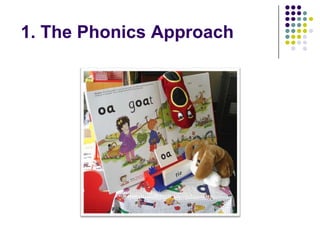
  • #3 integrated phonic instruction (analytic and synthetic) Use and practice the letters through meaningful context: stories. Can you think of any other ideas yourself?
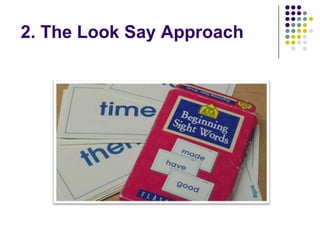
  • #4 Looking at your cards, which level do you think this approach is at? Which theory does it support? Words are learnt as a whole, without too much attention to individual letters. I like…
  • #7 This is at the word level, moving towards the sentence level.
  • #11 Looking at your cards, which level do you think this approach is at? Which theory does it support?
  • #15 Looking at your cards, which level do you think this approach is at? Which theory does it support?
  • #20 Looking at your cards, which level do you think this approach is at? Which theory does it support?
  • #23 Looking at your cards, which level do you think this approach is at? Which theory does it support?
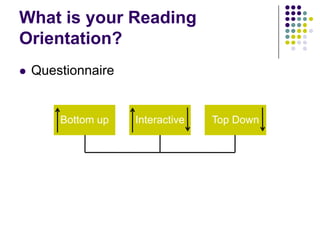
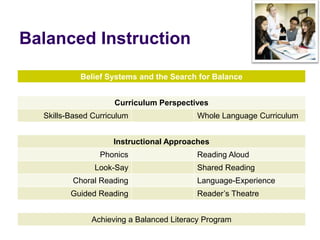
  • #24 Referred to as the reading wars – a clash between two beliefs systems e.g. skills based and whole language (holistic approach to teaching reading).Often it is a subconscious process that is focilized based on our previous learning experiences, known as the apprenticeship of observation (lortie). Schemata reflects prior knowledge, experiences, concleptual understandings, attitudes, values, skills, personality, ability to accommodate new approaches. Schema describes how we organize our thoughts and construct meaning. Different beliefs, different instructional decisions. The rest of this presentation will discuss the different instructional approaches to EFL reading that we can present to student teachers. Once student teachers have the knowledge of different approaches, then then combine these with their beliefs about reading to adapt instructionThe bottom-up model emphasizes reading as decoding from letter/sound, to word, to sentence, to paragraph, to text. Reading schemes follow a step by step bottom up model of reading that focus on phonics and sight words. They also recycle and add to this vocabulary from level to level.The top-down model emphasizes comprehension of larger chunks of meaning. Meaning is deduced from context. The reader scans the text based on previous knowledge (schemata), focuses on graphic information (print) and also uses syntactic, semantic and phonological input from his own mind to make predictions about the text. The whole language approach is an example of a top-down approach to reading.EFL readers may not recognize key words, may not have schemata to predict and therefore rely more on graphophonic information, deal with text as it comes, need a context to aid understanding, May not recognize a miscue and may be unable to correct itInteractionist Model: Reading is viewed as an interaction between the text, the reader and the context and prior knowledge. It merges bottomup and top down, focusing on both meaning and phonics.I could give another presentation on this but today am going to focus on more practical applications of approaches to reading in an EFL context.Phonics and skills based approaches – bottom-up beliefs about reading; a whole language orientation is associated with top-down beliefs. A teacher who enacts a phonics curriculum is likely to hold different beliefs than one who enacts a whole language curriculum.
  • #27 Looking at your cards, which level do you think this approach is at? Which theory does it support?
  • #28 Children may add to shared writing by adding a few extra lines themselves. Acquiring a reading vocabulary that is “personally meaningful and immediately useful” (Dixon & Nessel, 1983).
  • #29 Sentence level? Extra slides for your reference.
  • #34 Changing curriculum – ADEC indicators too broad, first language focus, genre based approach to writing as children have difficulty writing; extensive writing; phonics based approach to reading. PPP/Model schools doing this.
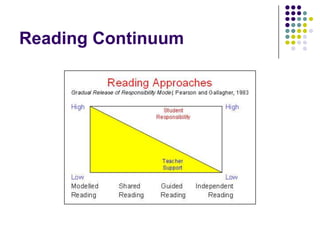
  • #35 Theories - approaches – strategies towards freerer readingAdd theories in Diagram p.45 MariaDepending on your reading orientation, you will support different theories of reading: bottom-up; top-down or interactive. However, in the EFL classroom, you will probably need a combination of all types as each one has its advantages. Will need to develop word attack skills; using contextual clues to get meaning; picture cues; high frequency words. The mechanics of reading.Also depending on your reading orientation, students will develop at the word, sentence and text levels.
  • #36 Using formal reading records may be unrealistic.
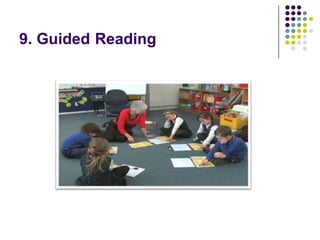
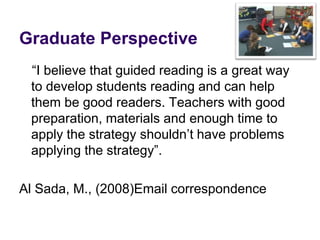
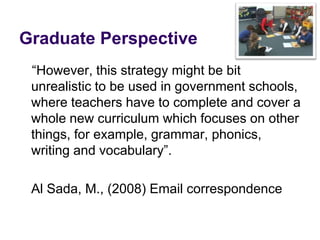
  • #37 So I think it differs from a situation to another. Being a teacher in a flexible school where they are open minded to try and apply different strategies guided reading will work for them. Schools which are very restrict to traditional teaching and covering curriculums will not gain the results. Moreover , trying the strategy for more than once and setting it as part of the routine for example applying it once a week for a whole semester will gain results more than applying it for two or three times.
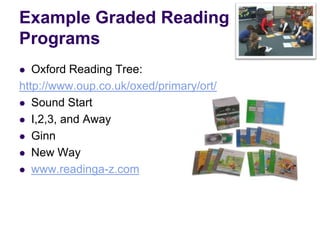
  • #38 Example: www.readinga-z.comReading A-Z is a complete online guided reading program with downloadable leveled books, lesson plans, worksheets, and reading assessments. The scheme aims to teach guided reading, phonics, phonemic awareness, reading comprehension, reading fluency, alphabet, and vocabulary.
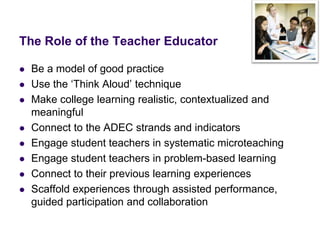
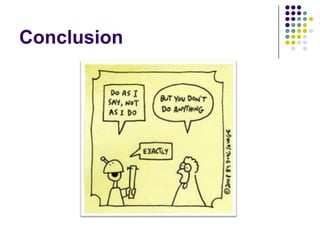
  • #40 If how we teach is as important as what we teach, then its important to be a model of good practice. Try to practice what you preach. The curriculum will be changing, rather than complain about it, encourage student teachers to embrace new policies and curricula, giving them experience to adapt, become life long learners and critical thinkers. Give them scenarios. Korthagen’s realistic model of teacher education. Seen primarily as the inculcation of knowledge and skills, the potentially powerful effects of teacher educators’ teaching styles on student teachers’ practices have mostly remained unrecognized and unexamined to date, (Korthagen et al, 2001, Kane, 2002; Russell, 2001; Lunenberg et al, 2007), let alone in an Arabic context (McNally et al, 2002;Taha-Thomure, 2003). engage student teachers in different contexts of teaching, including those that are sheltered and involve limited risk, like micro-teaching or guided practice or those involving monitored apprenticeships or team teaching in the school environment (Fosnot, 1989; Freeman, 1989). Other contexts may challenge previous conceptions of teaching and learning, as in problem-based learning. Through the interaction, reflection and critical thinking involved in problem-based learning, students actively resolve complex problems in realistic teaching situations. Bruner (1986) and Vygotsky (1978) Vygotskian approach to teacher education is one of ‘assisted performance’ (Bodrova & Leong, 1996). As highlighted in section 1.2.1, the area between “maximally assisted performance and independent performance lies varying degrees of partially assisted performance” (Bodrova & Leong, 1996, p.35), is known as the zone of Proximal development (ZPD). Based on a small body of available literature, four forms of modeling were identified by Lunenberg et al (2007, p.597) as potentially shaping student teachers’ beliefs and practices, despite contextual differences between universities and schools: implicit modeling of attitudes; explicit modeling; explicit modeling and transfer to student teachers’ own teaching practices; connecting exemplary behavior with theory. The teacher educator may discuss his/her thinking behind the lesson, using the example lesson as an opportunity to connect the approach back to theory or to expose the underlying rationale using the ‘think aloud approach’ (Loughran, 1996). However, Lunenberg et al (2007) state, that student teachers often don not extensively learn from the examples of their teacher educators, because they do not recognize those examples. However, if student teachers are invited backstage (Grossman, 1991) as in the concept of cognitive apprenticeship (Collins, Brown & Holum, 1991) in which they can dissect, discuss and reflect on the meaning of this modeling and how it can scaffold their own teaching practices, then student teachers may be better able to recognize those examples and shape their own practices accordingly. Drawing on Rogoff; Bodrova and Leong,Vygotsky, Bruner. Meaningful collaborative activities that engage, extend student teachers, challenge and acknowledge. Reflect on their values and respect them e.g. if a teacher values order, the their classroom will probably be orderly.
  • #41 Examine the pamplet, in pairs. Teachers in schools say – great ideas but without resources, difficult to implement approaches or it takes a year to order resources. I have put together a list of some publishers, suppliers of literacy resources in the Middle East, Conferences, foundations and libraries. What could you ask student teachers to do with this pamplet?
  • #43 Two sides of the room. EFL students need a combination of reading approaches to help them develop as competent readers.Principled eclectic instruction allows teachers to use approaches and strategies that are associated with different curricular perspectives.
  • #47 Looking at your cards, which level do you think this approach is at? Which theory does it support? This is at the sound/letter level aiming to move towards words.Which level – sound, word, sentence, text?
  • #49 Published phonics programmes include: Jolly phonics (It teaches the letter sounds in an enjoyable, multisensory way, and enables children to use them to read and write words; learning the irregular or 'tricky words' such as said, was and the. Together with these materials you should also use storybooks; Learning the letter sounds 2. Learning letter formation 3. Blending 4. Identifying sounds in words 5. Spelling the tricky words ), Each sound has an action which helps children remember the letter(s) that represent it. As a child progresses you can point to the letters and see how quickly they can do the action and say the sound. One letter sound can be taught each day. As a child becomes more confident, the actions are no longer necessary. Children should learn each letter by its sound, not its name.Letterland: relate sounds to characters, accompanying stories, adventures, hats. Friendly letter characters provide strong visual memory clues (or mnemonics) so your children learn and retain phoneme/grapheme correspondences Daily blending and segmenting activities make word-building fast and effective Focused multi-sensory activities appeal to all learners and activate all learning channels.teacher's guides, readers, software, posters and audio CDs.Phonographix, an American programme (Drill and practice programme, segmenting and blending sound pictures) all teach the above in different order, using different methods.
  • #50 Zainab’s paper