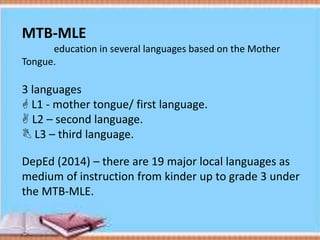
MTB-MLE
education in several languages based on the Mother
Tongue.
3 languages
 L1 - mother tongue/ first language.
 L2 – second language.
 L3 – third language.
DepEd (2014) – there are 19 major local languages as
medium of instruction from kinder up to grade 3 under
the MTB-MLE.
DepEd (2014) – there are 19 major local languages as medium of
instruction from kinder up to grade 3 under the MTB-MLE.
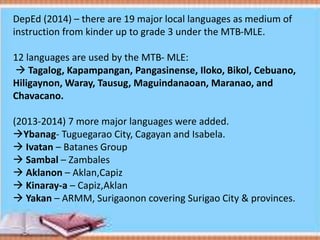
12 languages are used by the MTB- MLE:
 Tagalog, Kapampangan, Pangasinense, Iloko, Bikol, Cebuano,
Hiligaynon, Waray, Tausug, Maguindanaoan, Maranao, and
Chavacano.
(2013-2014) 7 more major languages were added.
Ybanag- Tuguegarao City, Cagayan and Isabela.
 Ivatan – Batanes Group
 Sambal – Zambales
 Aklanon – Aklan,Capiz
 Kinaray-a – Capiz,Aklan
 Yakan – ARMM, Surigaonon covering Surigao City & provinces.
What is meant by MTB- MLE?
Sec. 4 of the Implementing Rules and Regulations of R.A.
10533(Enhance Basic Education Act of 2013) – “the language/
languages first learned by a child, w/c he/she identifies with,
identified as a native language user by others, w/c he/she knows
best, or uses most.”
Lifelong learning- learning that is pursued throughout life…
Communicative competence – the other end goal and it means the
ability of the learner to understand and used language appropriately
to communicate in authentic situations.
in MTB- MLE , it includes two or more than two languages.
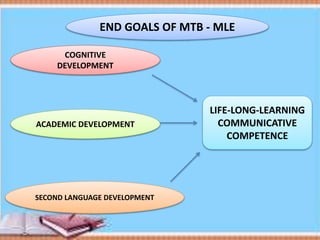
SECOND LANGUAGE DEVELOPMENT
ACADEMIC DEVELOPMENT
COGNITIVE
DEVELOPMENT
LIFE-LONG-LEARNING
COMMUNICATIVE
COMPETENCE
END GOALS OF MTB - MLE
Learning Area Standard Of MTB – MLE
DepEd Curriculum Guide of MTB – MLE states that “use Mother
Tongue appropriately and effectively in oral, visual, and written
communications in a variety of situations and a variety of
audiences, contexts and purposes including learning other content
subjects and languages, demonstrate appreciation of various forms
of literary genres and take pride on one’s cultural heritage.”
MTB – MLE includes to study of local literature wherein it is
narrated or written in the learner’s first language that he/she is
given the opportunity to connect to his/her very own cultural
heritage and so is expected to develop appreciation for the same
and take pride in it.
Malone(2007) claims that….”the loss of language is
part of the loss of whole cultures and knowledge
systems, including philosophical systems, oral literary
and music traditions, environmental knowledge
systems medical knowledge , and important cultural
practices and artistic skills.”
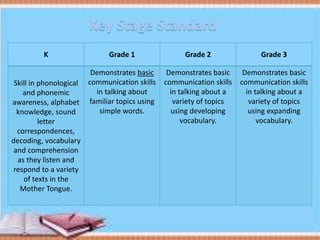
K Grade 1 Grade 2 Grade 3
Skill in phonological
and phonemic
awareness, alphabet
knowledge, sound
letter
correspondences,
decoding, vocabulary
and comprehension
as they listen and
respond to a variety
of texts in the
Mother Tongue.
Demonstrates basic
communication skills
in talking about
familiar topics using
simple words.
Demonstrates basic
communication skills
in talking about a
variety of topics
using developing
vocabulary.
Demonstrates basic
communication skills
in talking about a
variety of topics
using expanding
vocabulary.
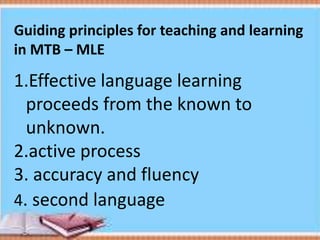
Guiding principles for teaching and learning
in MTB – MLE
1.Effective language learning
proceeds from the known to
unknown.
2.active process
3. accuracy and fluency
4. second language
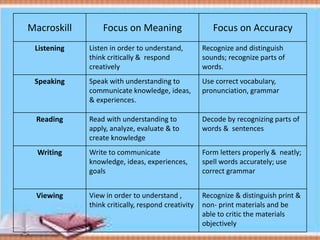
Macroskill Focus on Meaning Focus on Accuracy
Listening Listen in order to understand,
think critically & respond
creatively
Recognize and distinguish
sounds; recognize parts of
words.
Speaking Speak with understanding to
communicate knowledge, ideas,
& experiences.
Use correct vocabulary,
pronunciation, grammar
Reading Read with understanding to
apply, analyze, evaluate & to
create knowledge
Decode by recognizing parts of
words & sentences
Writing Write to communicate
knowledge, ideas, experiences,
goals
Form letters properly & neatly;
spell words accurately; use
correct grammar
Viewing View in order to understand ,
think critically, respond creativity
Recognize & distinguish print &
non- print materials and be
able to critic the materials
objectively
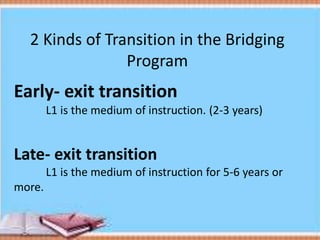
2 Kinds of Transition in the Bridging
Program
Early- exit transition
L1 is the medium of instruction. (2-3 years)
Late- exit transition
L1 is the medium of instruction for 5-6 years or
more.
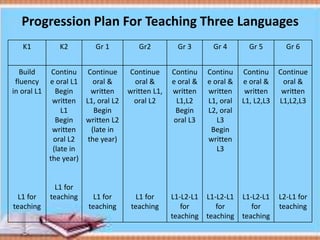
K1 K2 Gr 1 Gr2 Gr 3 Gr 4 Gr 5 Gr 6
Build
fluency
in oral L1
L1 for
teaching
Continu
e oral L1
Begin
written
L1
Begin
written
oral L2
(late in
the year)
L1 for
teaching
Continue
oral &
written
L1, oral L2
Begin
written L2
(late in
the year)
L1 for
teaching
Continue
oral &
written L1,
oral L2
L1 for
teaching
Continu
e oral &
written
L1,L2
Begin
oral L3
L1-L2-L1
for
teaching
Continu
e oral &
written
L1, oral
L2, oral
L3
Begin
written
L3
L1-L2-L1
for
teaching
Continu
e oral &
written
L1, L2,L3
L1-L2-L1
for
teaching
Continue
oral &
written
L1,L2,L3
L2-L1 for
teaching
Progression Plan For Teaching Three Languages
By:
Jardael, Celeste S. BEED - III

MTB- MLE

  • 2.
    MTB-MLE education in severallanguages based on the Mother Tongue. 3 languages  L1 - mother tongue/ first language.  L2 – second language.  L3 – third language. DepEd (2014) – there are 19 major local languages as medium of instruction from kinder up to grade 3 under the MTB-MLE.
  • 3.
    DepEd (2014) –there are 19 major local languages as medium of instruction from kinder up to grade 3 under the MTB-MLE. 12 languages are used by the MTB- MLE:  Tagalog, Kapampangan, Pangasinense, Iloko, Bikol, Cebuano, Hiligaynon, Waray, Tausug, Maguindanaoan, Maranao, and Chavacano. (2013-2014) 7 more major languages were added. Ybanag- Tuguegarao City, Cagayan and Isabela.  Ivatan – Batanes Group  Sambal – Zambales  Aklanon – Aklan,Capiz  Kinaray-a – Capiz,Aklan  Yakan – ARMM, Surigaonon covering Surigao City & provinces.
  • 4.
    What is meantby MTB- MLE? Sec. 4 of the Implementing Rules and Regulations of R.A. 10533(Enhance Basic Education Act of 2013) – “the language/ languages first learned by a child, w/c he/she identifies with, identified as a native language user by others, w/c he/she knows best, or uses most.” Lifelong learning- learning that is pursued throughout life… Communicative competence – the other end goal and it means the ability of the learner to understand and used language appropriately to communicate in authentic situations. in MTB- MLE , it includes two or more than two languages.
  • 5.
    SECOND LANGUAGE DEVELOPMENT ACADEMICDEVELOPMENT COGNITIVE DEVELOPMENT LIFE-LONG-LEARNING COMMUNICATIVE COMPETENCE END GOALS OF MTB - MLE
  • 6.
    Learning Area StandardOf MTB – MLE DepEd Curriculum Guide of MTB – MLE states that “use Mother Tongue appropriately and effectively in oral, visual, and written communications in a variety of situations and a variety of audiences, contexts and purposes including learning other content subjects and languages, demonstrate appreciation of various forms of literary genres and take pride on one’s cultural heritage.” MTB – MLE includes to study of local literature wherein it is narrated or written in the learner’s first language that he/she is given the opportunity to connect to his/her very own cultural heritage and so is expected to develop appreciation for the same and take pride in it.
  • 7.
    Malone(2007) claims that….”theloss of language is part of the loss of whole cultures and knowledge systems, including philosophical systems, oral literary and music traditions, environmental knowledge systems medical knowledge , and important cultural practices and artistic skills.”
  • 8.
    K Grade 1Grade 2 Grade 3 Skill in phonological and phonemic awareness, alphabet knowledge, sound letter correspondences, decoding, vocabulary and comprehension as they listen and respond to a variety of texts in the Mother Tongue. Demonstrates basic communication skills in talking about familiar topics using simple words. Demonstrates basic communication skills in talking about a variety of topics using developing vocabulary. Demonstrates basic communication skills in talking about a variety of topics using expanding vocabulary.
  • 9.
    Guiding principles forteaching and learning in MTB – MLE 1.Effective language learning proceeds from the known to unknown. 2.active process 3. accuracy and fluency 4. second language
  • 10.
    Macroskill Focus onMeaning Focus on Accuracy Listening Listen in order to understand, think critically & respond creatively Recognize and distinguish sounds; recognize parts of words. Speaking Speak with understanding to communicate knowledge, ideas, & experiences. Use correct vocabulary, pronunciation, grammar Reading Read with understanding to apply, analyze, evaluate & to create knowledge Decode by recognizing parts of words & sentences Writing Write to communicate knowledge, ideas, experiences, goals Form letters properly & neatly; spell words accurately; use correct grammar Viewing View in order to understand , think critically, respond creativity Recognize & distinguish print & non- print materials and be able to critic the materials objectively
  • 11.
    2 Kinds ofTransition in the Bridging Program Early- exit transition L1 is the medium of instruction. (2-3 years) Late- exit transition L1 is the medium of instruction for 5-6 years or more.
  • 12.
    K1 K2 Gr1 Gr2 Gr 3 Gr 4 Gr 5 Gr 6 Build fluency in oral L1 L1 for teaching Continu e oral L1 Begin written L1 Begin written oral L2 (late in the year) L1 for teaching Continue oral & written L1, oral L2 Begin written L2 (late in the year) L1 for teaching Continue oral & written L1, oral L2 L1 for teaching Continu e oral & written L1,L2 Begin oral L3 L1-L2-L1 for teaching Continu e oral & written L1, oral L2, oral L3 Begin written L3 L1-L2-L1 for teaching Continu e oral & written L1, L2,L3 L1-L2-L1 for teaching Continue oral & written L1,L2,L3 L2-L1 for teaching Progression Plan For Teaching Three Languages
  • 13.