Des Floyd
Gross Misinterpretations: Ten of the Tallest

               Common Core
                     Tales Ever Told


mis   -


a prefix applied to various parts of speech, meaning
ill, mistaken, wrong, incorrectly, or
simply negating.
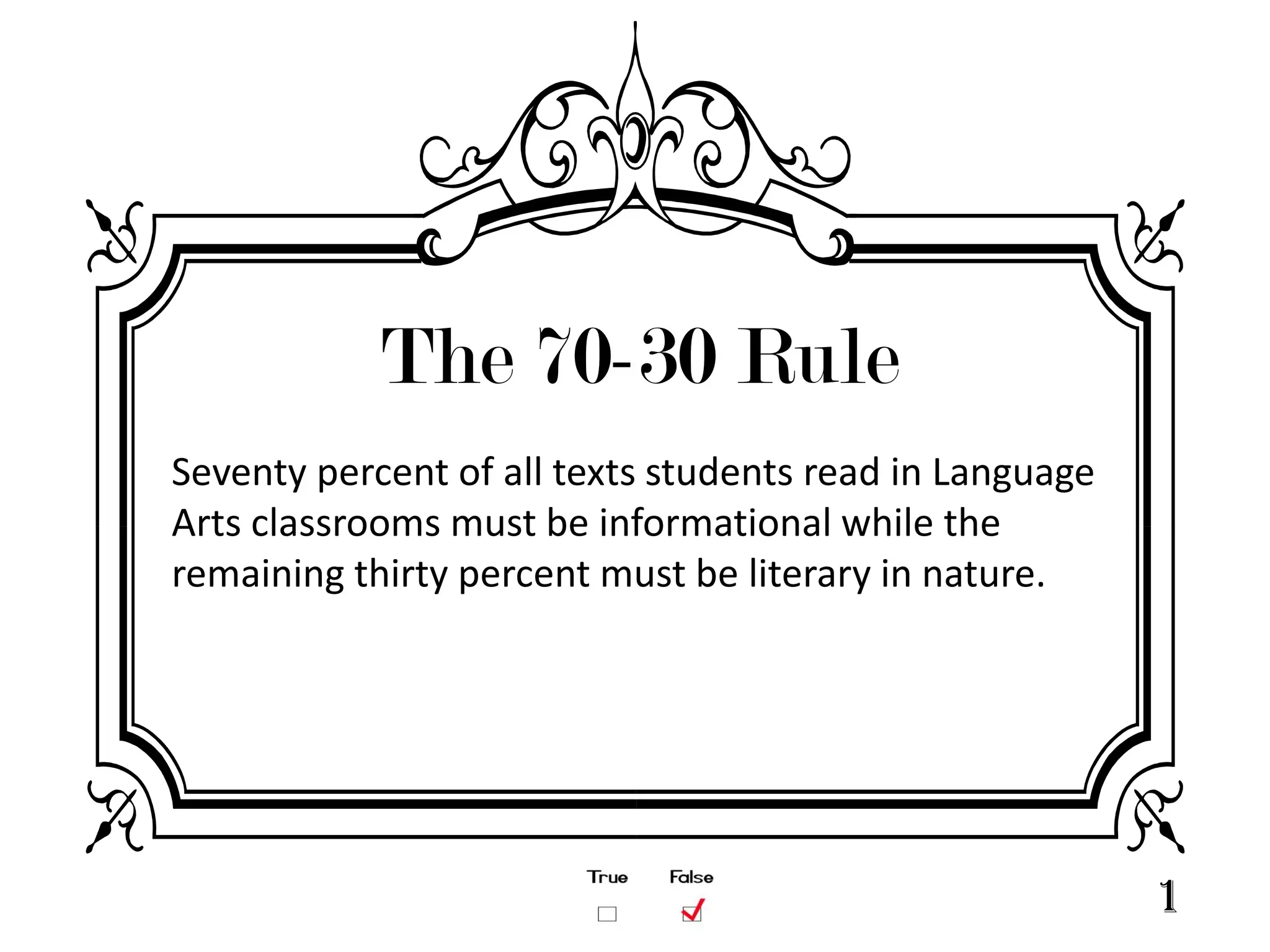
The 70-30 Rule
Seventy percent of all texts students read in Language
Arts classrooms must be informational while the
remaining thirty percent must be literary in nature.


                                                         1
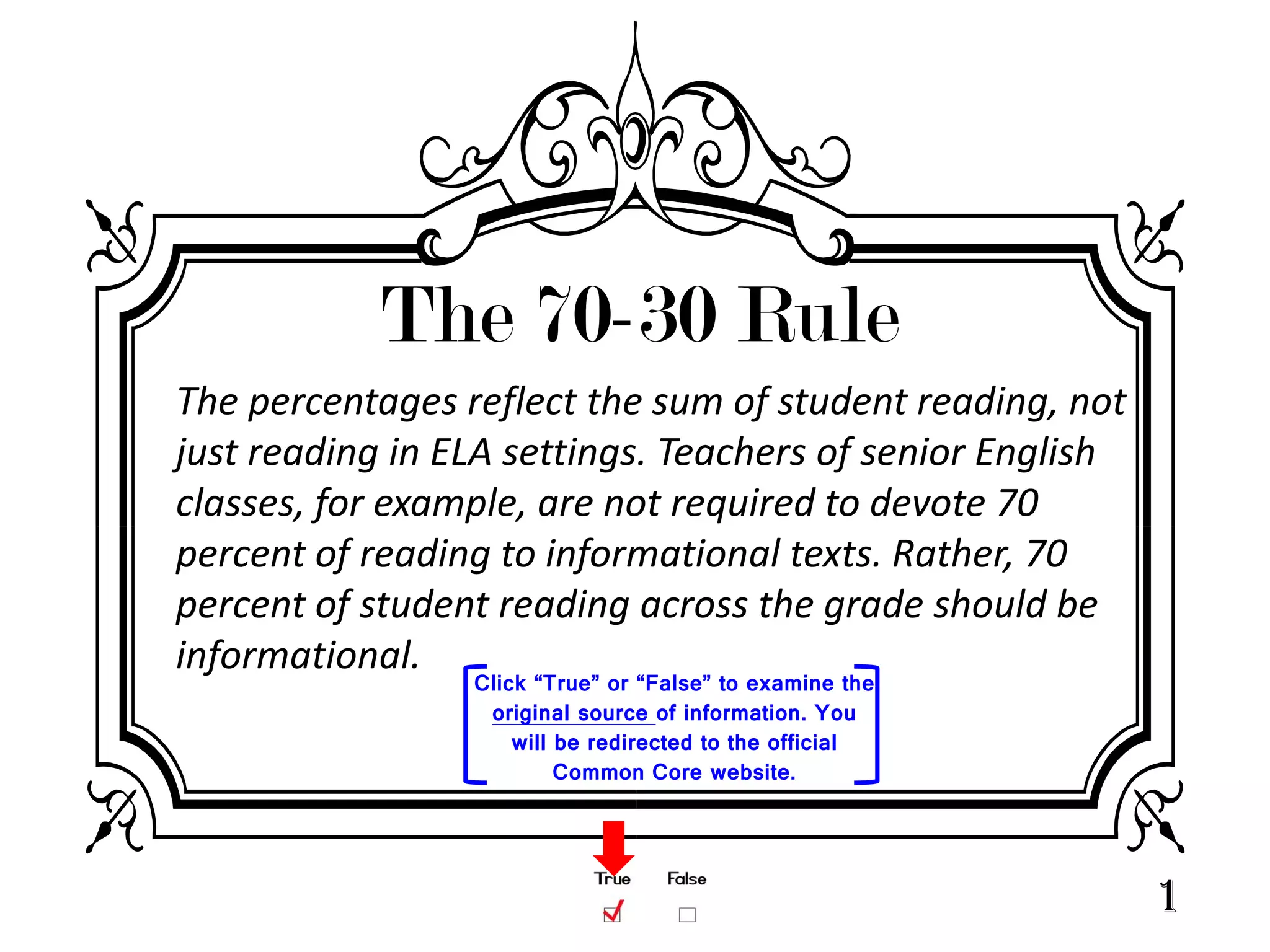
The 70-30 Rule
The percentages reflect the sum of student reading, not
just reading in ELA settings. Teachers of senior English
classes, for example, are not required to devote 70
percent of reading to informational texts. Rather, 70
percent of student reading across the grade should be
informational.
                 Click “True” or “False” to examine the
                  original source of information. You
                     will be redirected to the official
                          Common Core website.


                                                           1
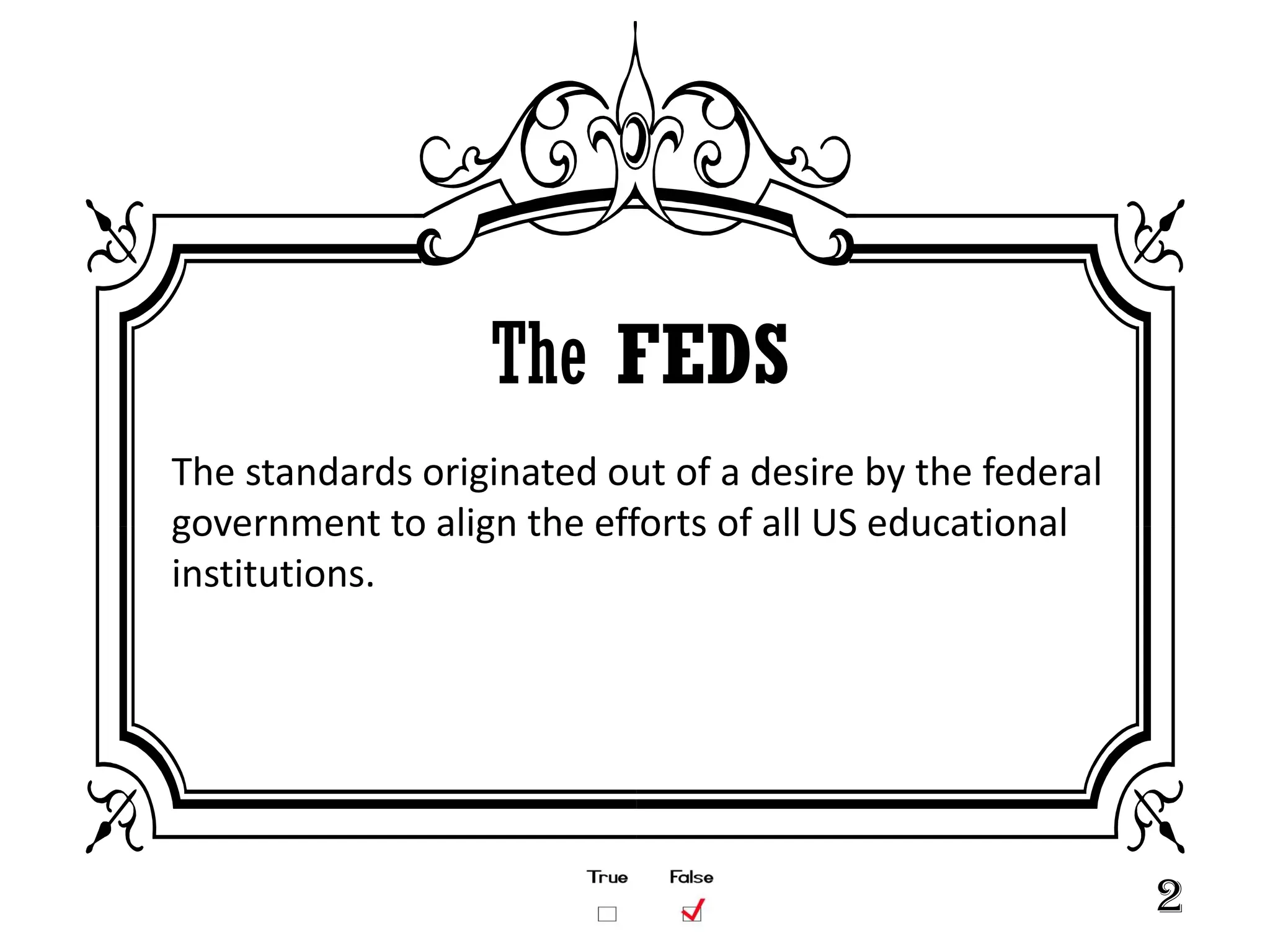
The FEDS
The standards originated out of a desire by the federal
government to align the efforts of all US educational
institutions.


                                                          2
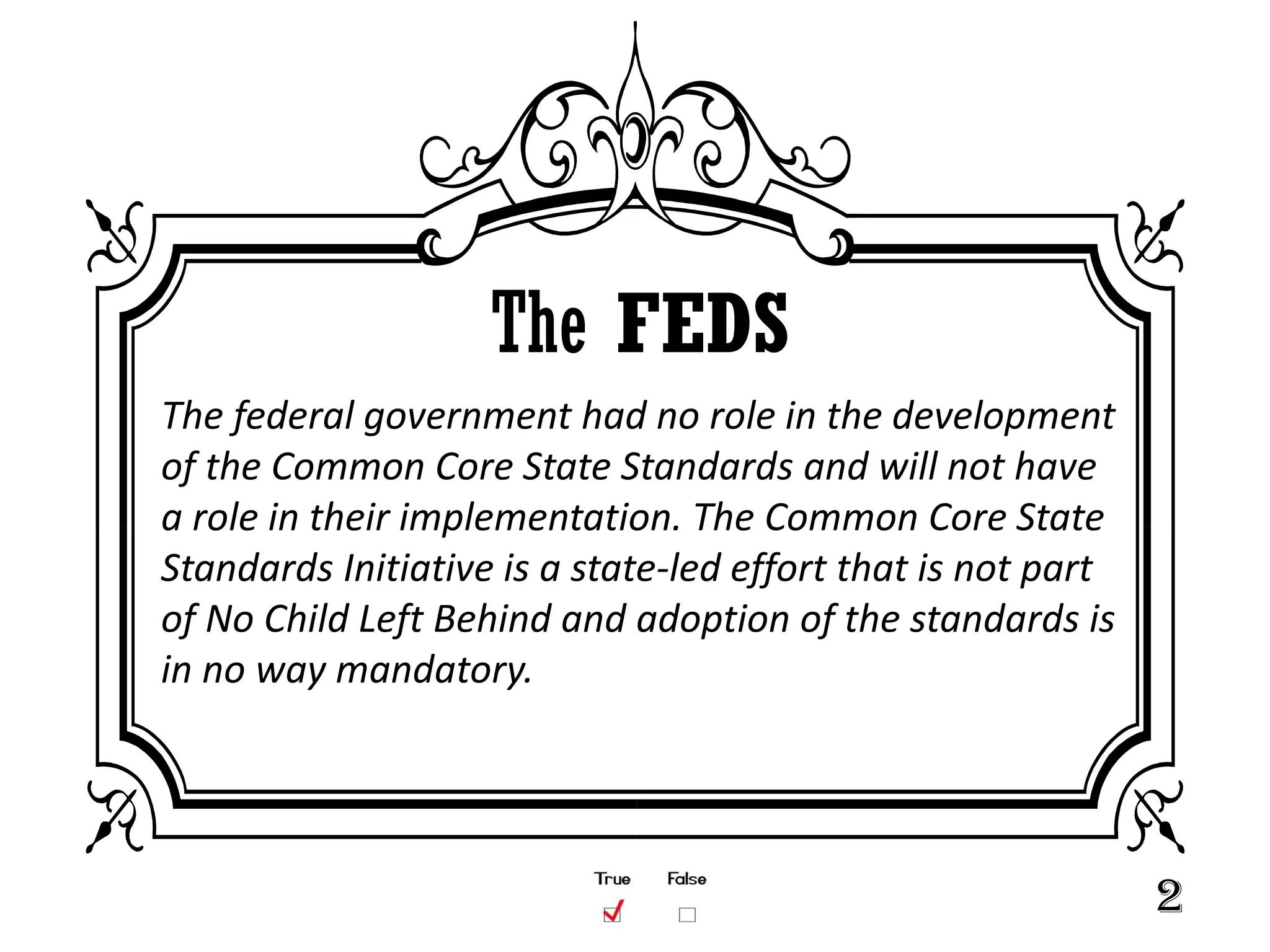
The FEDS
The federal government had no role in the development
of the Common Core State Standards and will not have
a role in their implementation. The Common Core State
Standards Initiative is a state-led effort that is not part
of No Child Left Behind and adoption of the standards is
in no way mandatory.


                                                              2
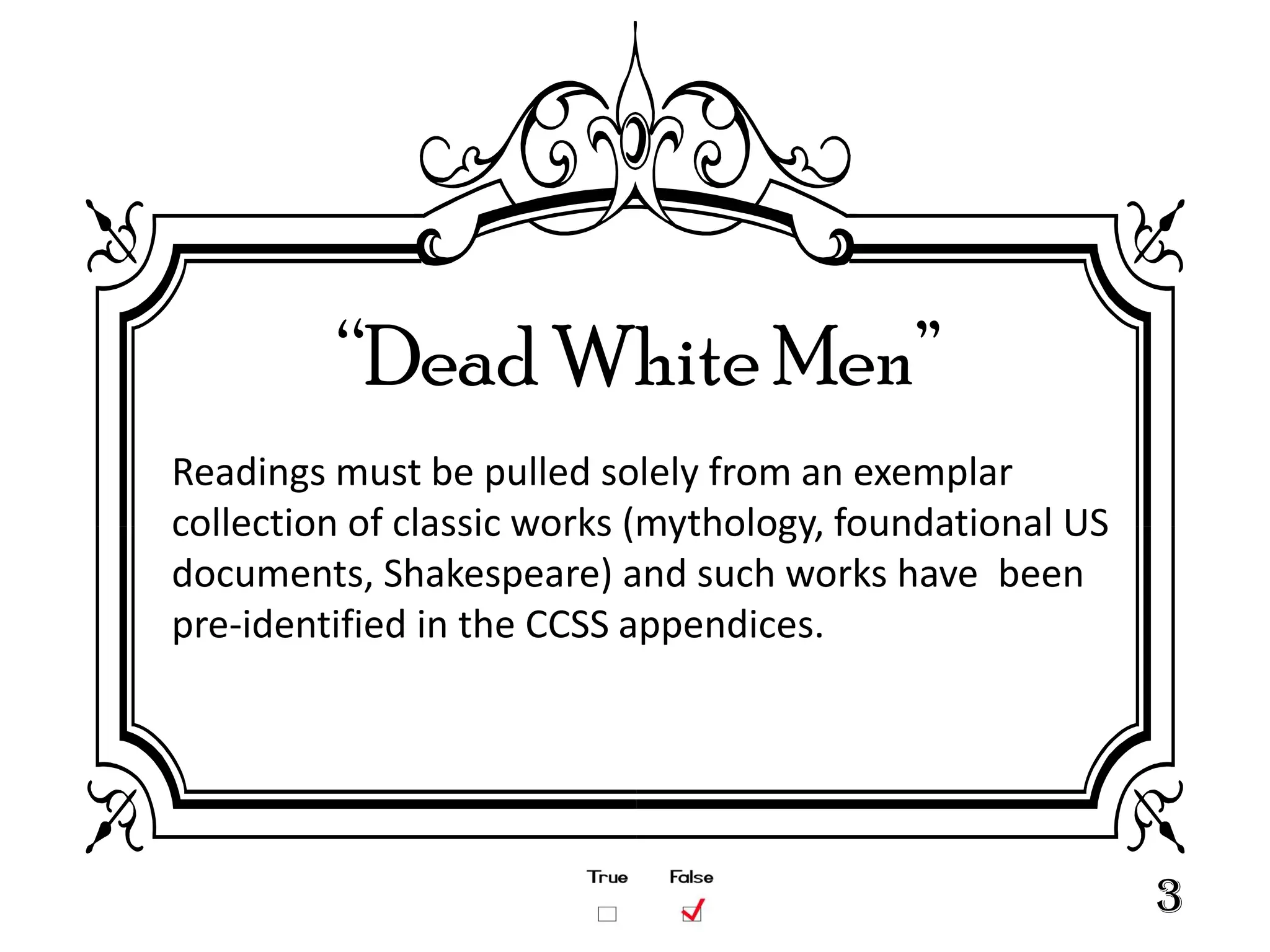
“Dead White Men”
Readings must be pulled solely from an exemplar
collection of classic works (mythology, foundational US
documents, Shakespeare) and such works have been
pre-identified in the CCSS appendices.


                                                          3
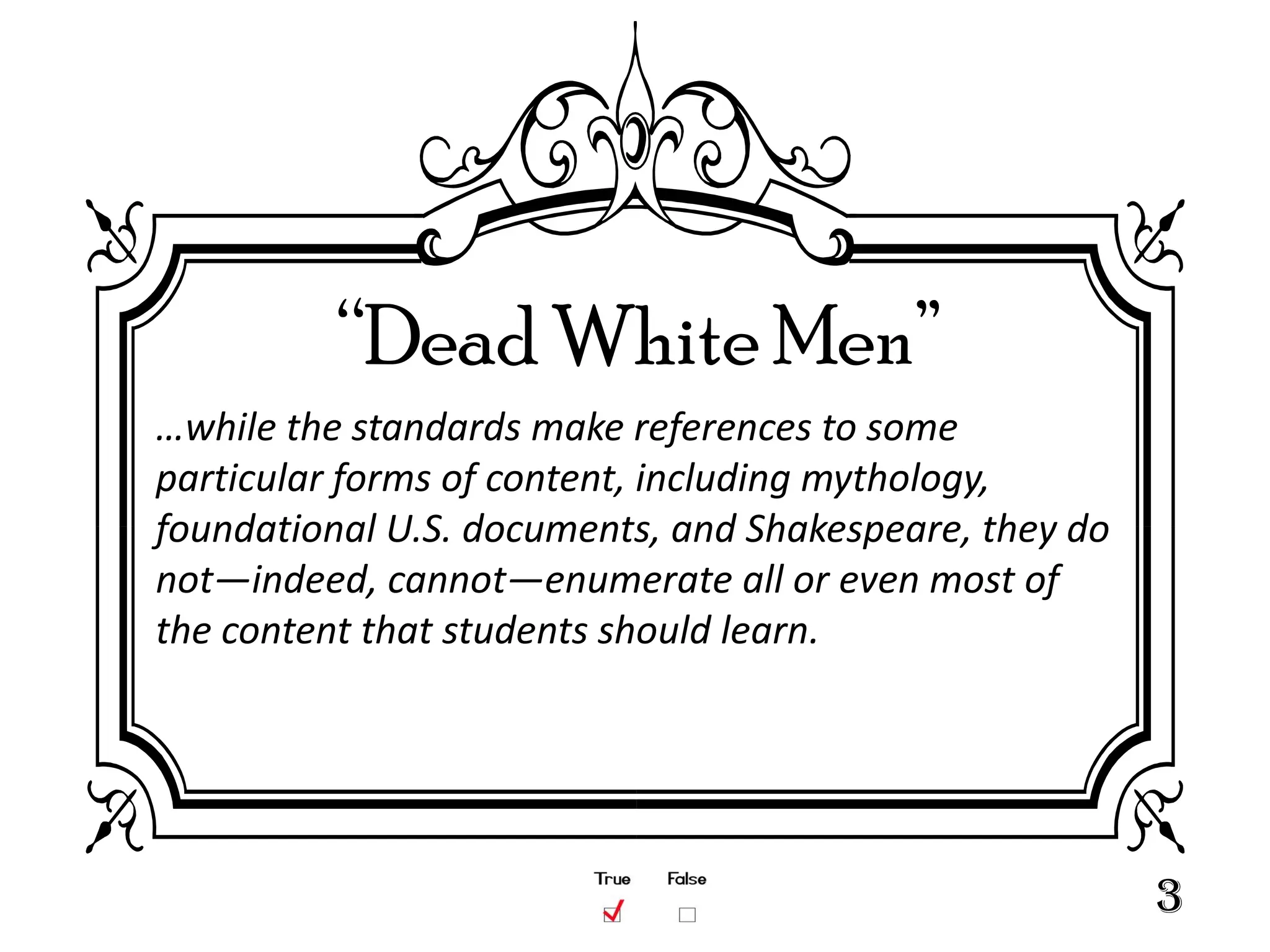
“Dead White Men”
…while the standards make references to some
particular forms of content, including mythology,
foundational U.S. documents, and Shakespeare, they do
not—indeed, cannot—enumerate all or even most of
the content that students should learn.


                                                        3
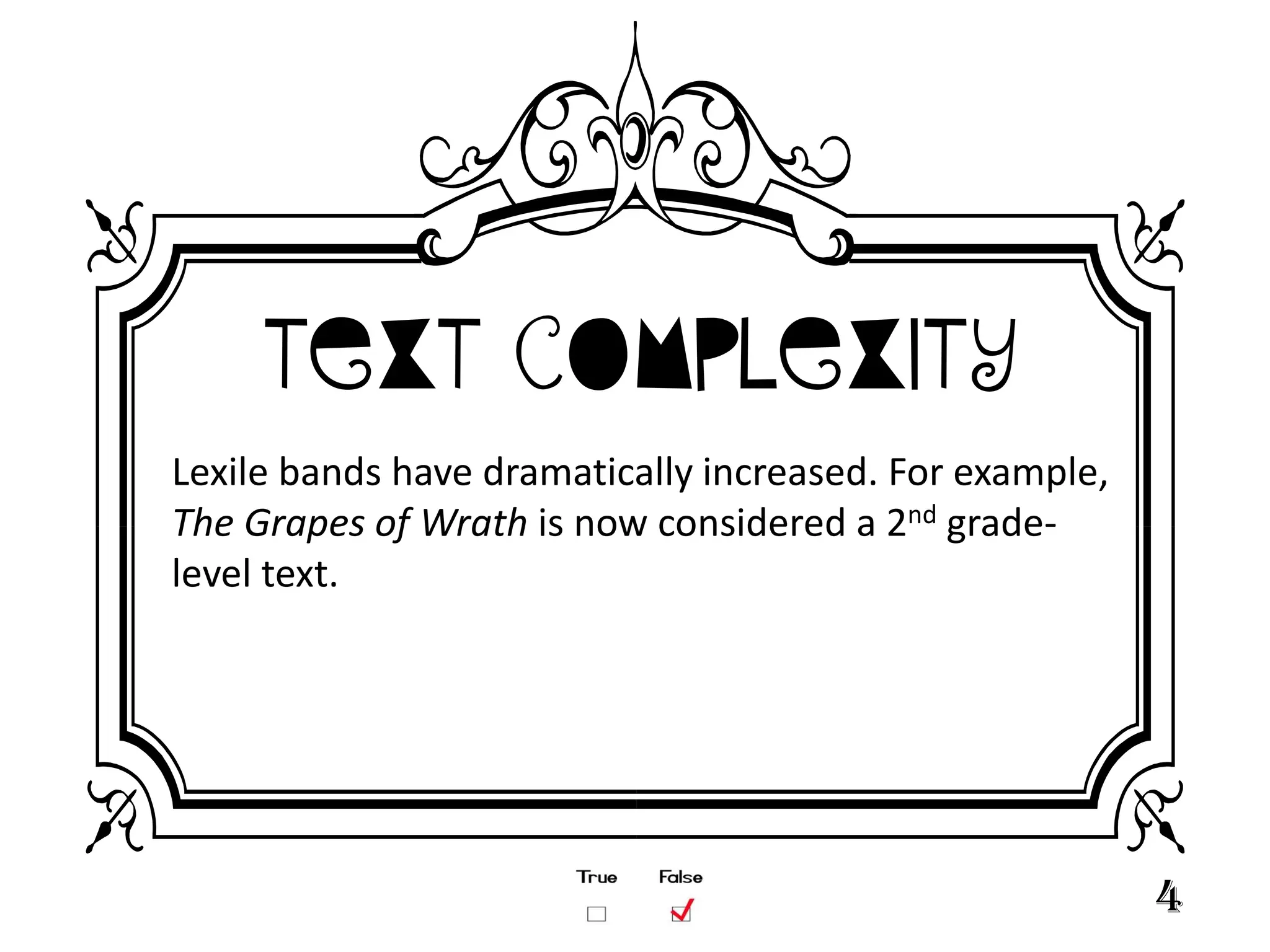
Text Complexity
Lexile bands have dramatically increased. For example,
The Grapes of Wrath is now considered a 2nd grade-
level text.


                                                         4
Text Complexity
The ELA Standards suggest “Grapes of Wrath” as a text
that would be appropriate for 9th or 10th grade
readers...Common Core supports an approach that
considers 3 aspects of text complexity: quantitative (e.g.,
Lexiles), qualitative (e.g., levels of meaning, structure,
knowledge demands/requisites), and reader/task
considerations (motivation, knowledge, experience).


                                                              4
Digital Learning
Altogether absent from the standards is an emphasis
on digital literacy or technology as a tool for learning.


                                                            5
Digital Learning
To be ready for college, workforce training, and life in a
technological society, students need the ability to gather,
comprehend, evaluate, synthesize, and report on
information and ideas, to conduct original research in
order to answer questions or solve problems, and to
analyze and create a high volume and extensive range of
print and nonprint texts in media forms old and new.


                                                              5
PAUSE AND REFLECT


             Exercise #1, next page 
Did you hold any of the beliefs previously-mentioned?
        What new information did you acquire?
Will this change a current practice/approach in any way?


  Does your curriculum incorporate multiple forms of
 digital/media literacy? What examples can you share?
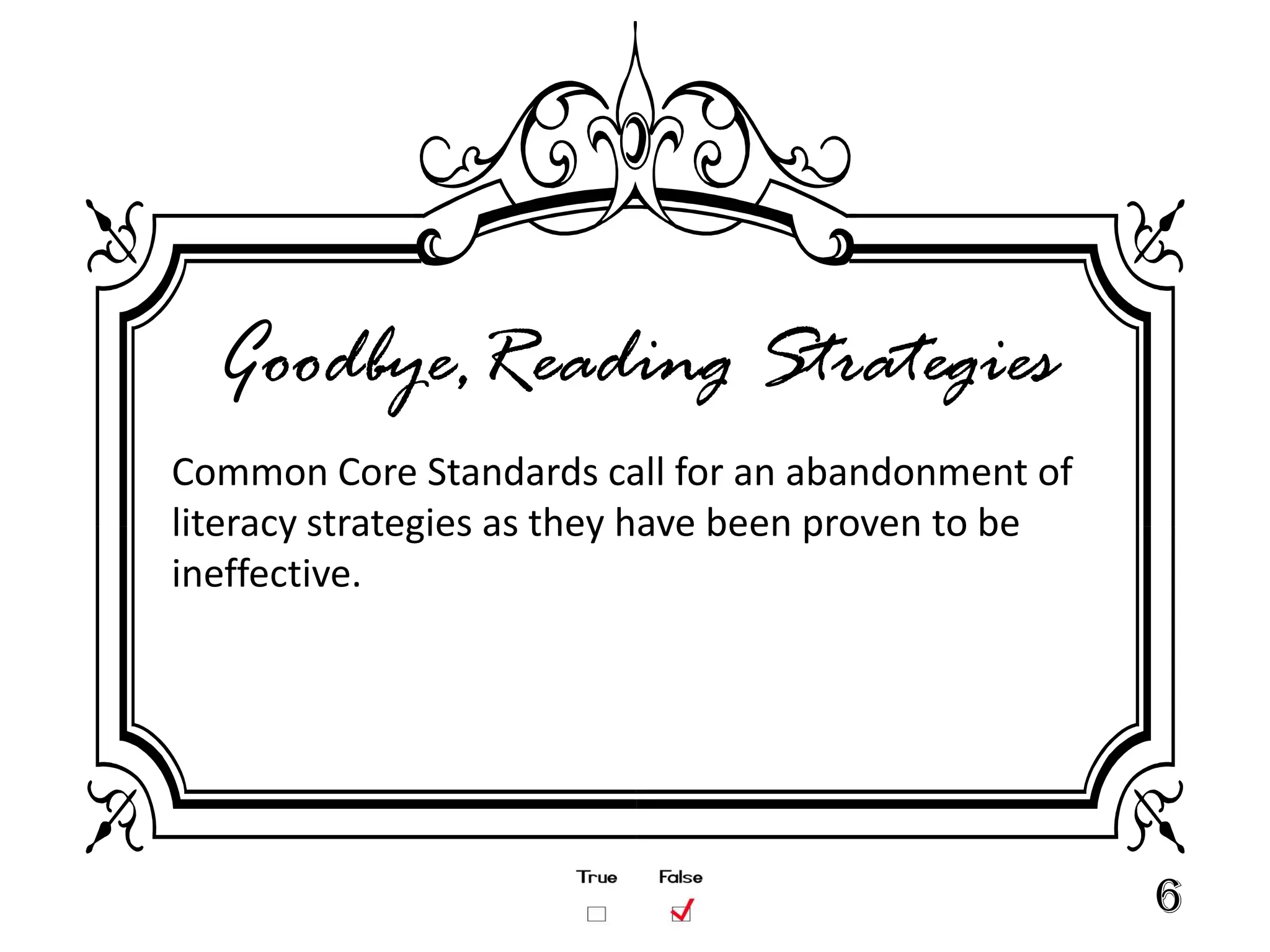
Goodbye,Reading Strategies
Common Core Standards call for an abandonment of
literacy strategies as they have been proven to be
ineffective.


                                                     6
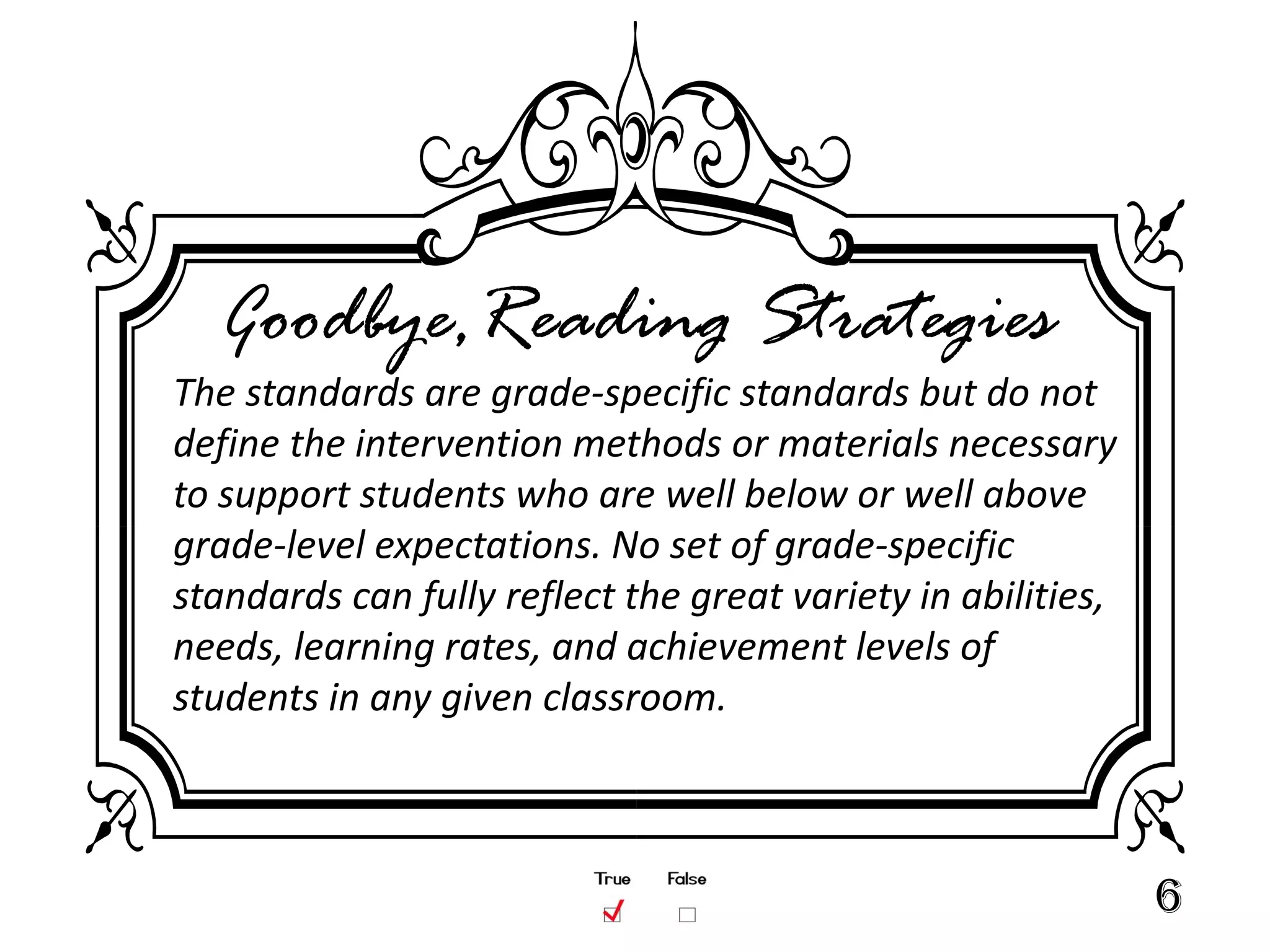
Goodbye,Reading Strategies
The standards are grade-specific standards but do not
define the intervention methods or materials necessary
to support students who are well below or well above
grade-level expectations. No set of grade-specific
standards can fully reflect the great variety in abilities,
needs, learning rates, and achievement levels of
students in any given classroom.


                                                              6
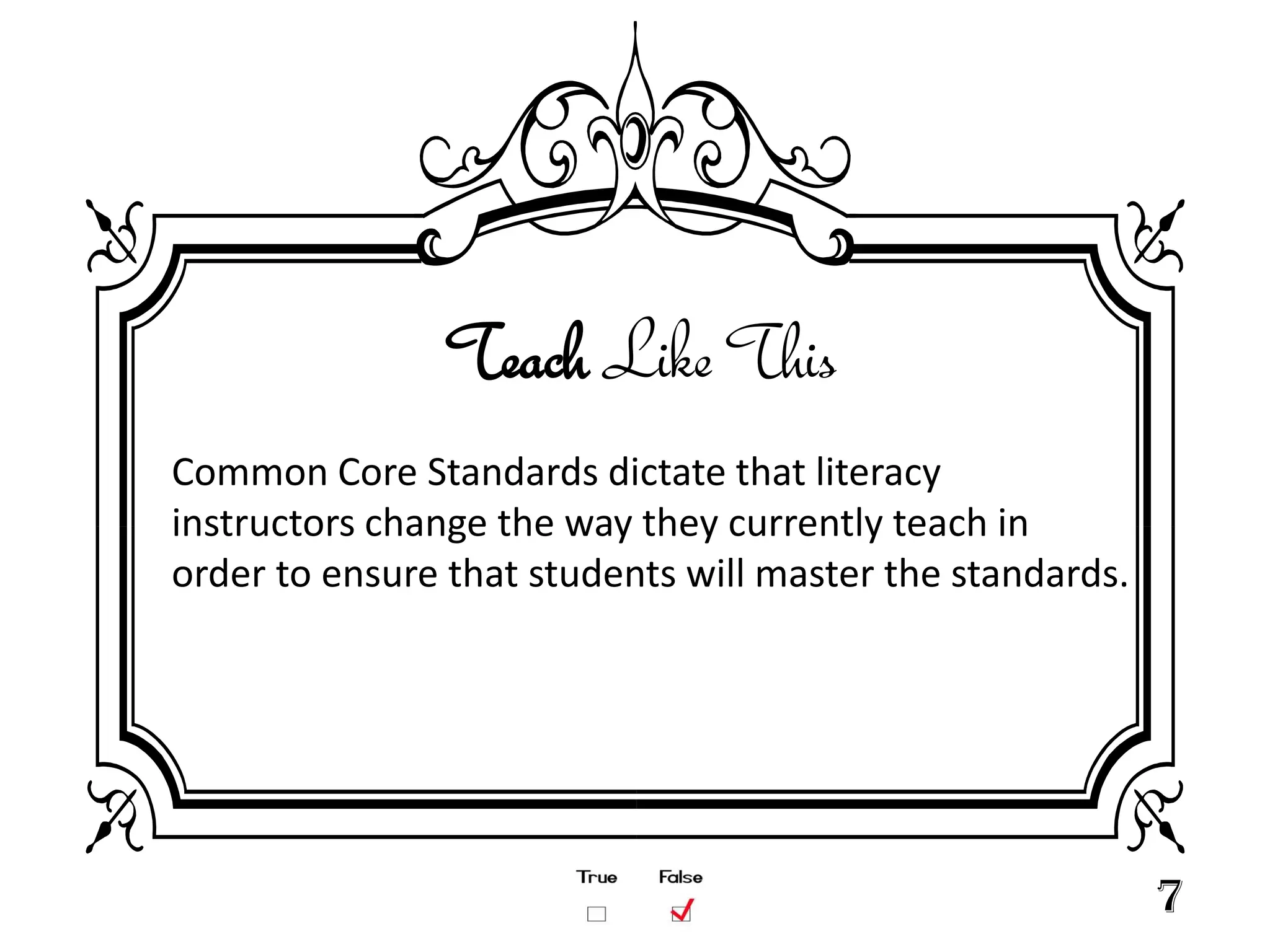
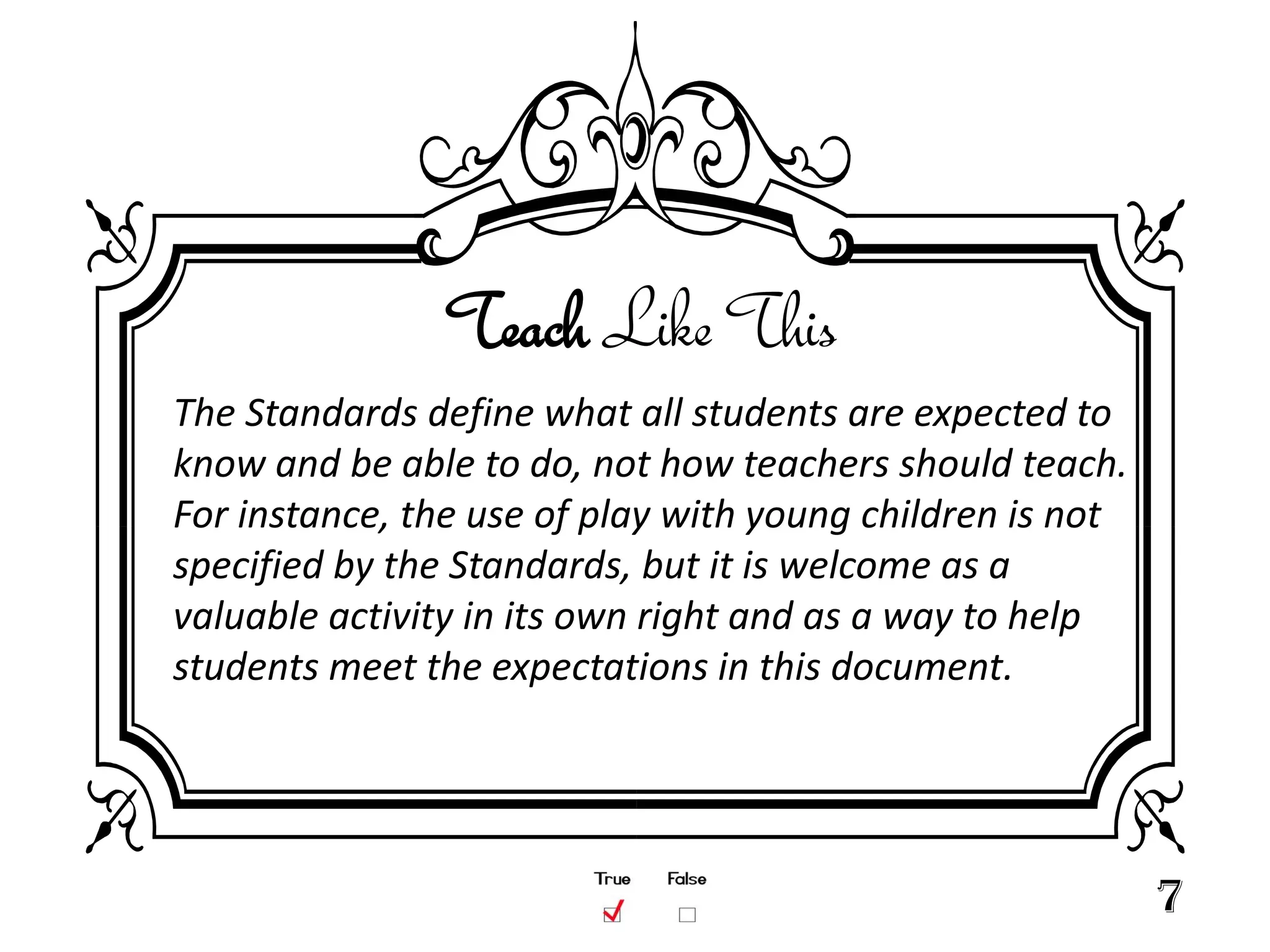
Teach Like This
Common Core Standards dictate that literacy
instructors change the way they currently teach in
order to ensure that students will master the standards.


                                                           7
Teach Like This
The Standards define what all students are expected to
know and be able to do, not how teachers should teach.
For instance, the use of play with young children is not
specified by the Standards, but it is welcome as a
valuable activity in its own right and as a way to help
students meet the expectations in this document.


                                                           7
PAUSE AND REFLECT


             Exercise #2, next page 
While the Common Core State Standards DO NOT
mandate how teachers will teach, the shift to college and
career readiness for all may call for dramatic changes in
                     how we teach.


What changes in your current attitude/belief system will
      be necessary for successful implementation?
What specific changes will you need to make in order to
better prepare your students for college/career readiness?
   What support will you need to make such changes?
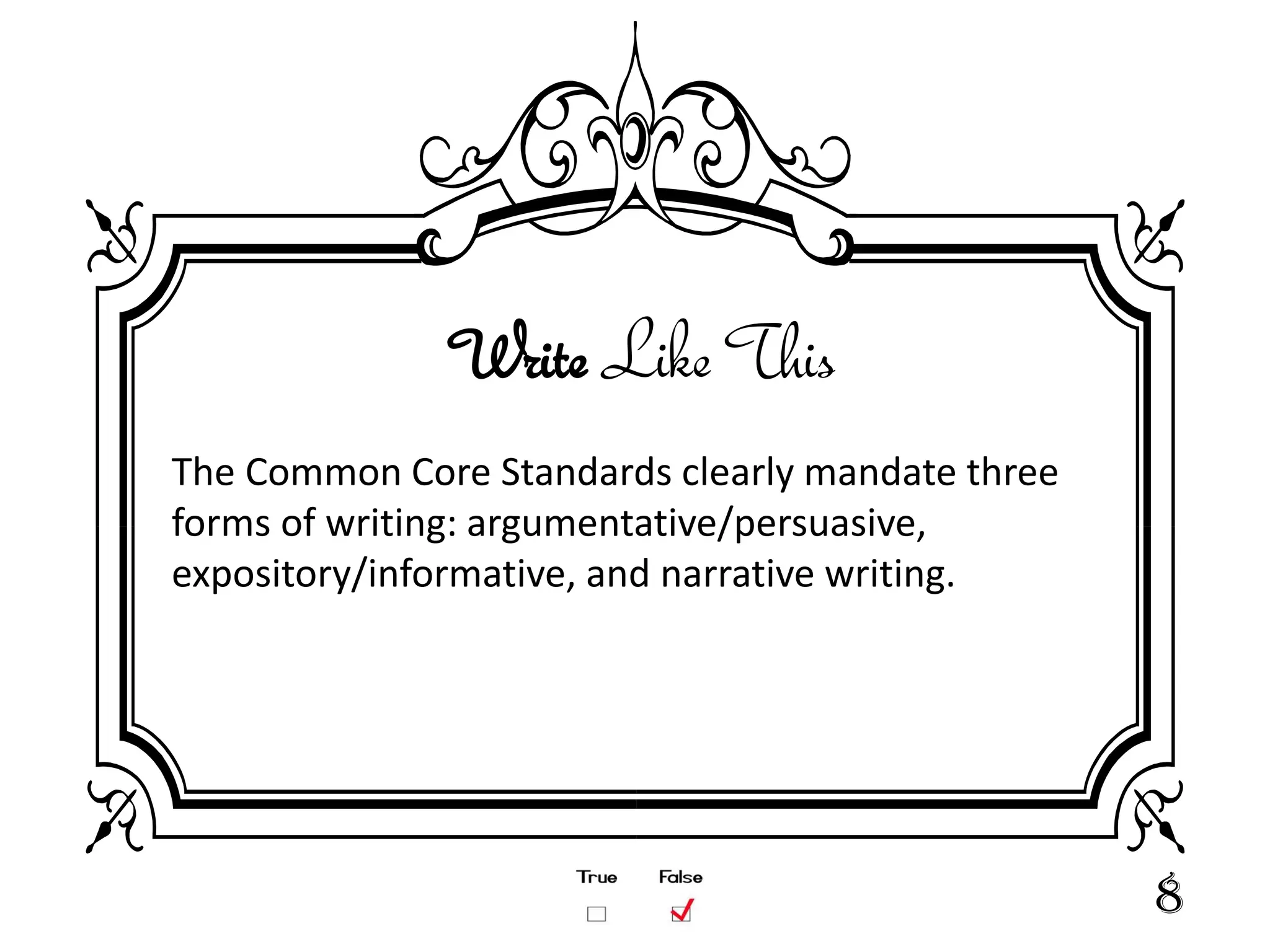
Write Like This
The Common Core Standards clearly mandate three
forms of writing: argumentative/persuasive,
expository/informative, and narrative writing.


                                                  8
Write Like This
While there is a focus on those 3 forms…by emphasizing
required achievements, the standards leave room for
teachers, curriculum developers, and states to determine
how those goals should be reached and what additional
topics should be addressed. Thus, the standards do not
mandate such things as a particular writing process or the
full range of metacognitive strategies that students may
need to monitor and direct their thinking and learning.


                                                             8
Text-based Answers
Reading, writing, and speaking/listening must be
grounded in answers that can be found in texts.


                                                   9
Text-based Answers
“Finding answers” and “supporting answers with evidence”
are not the same…Whatever they are reading, students must
also show a steadily growing ability to discern more from
and make fuller use of text, including making an increasing
number of connections among ideas and between texts,
considering a wider range of textual evidence, and becoming
more sensitive to inconsistencies, ambiguities, and poor
reasoning in texts.


                                                              9
In the Name of College Prep
The intention of standards developers was to equip
educators with the tools necessary to prepare students
for college.


                                                         10
In the Name of College Prep
The Standards are designed to build upon the most
advanced current thinking about preparing all students
for success in college AND their careers.


                                                         10
The End
     o http://www.corestandards.org/ELA-Literacy
     o http://www.achievethecore.org/steal-these-tools
     o http://www.corestandards.org/resources/myths-vs-
       facts
     o http://www.corestandards.org/ELA-
       Literacy/introduction/key-design-consideration
     o http://www.corestandards.org/ELA-
       Literacy/introduction/how-to-read-the-standards
     o http://www.corestandards.org/ELA-
       Literacy/introduction/students-who-are-college-
       and-career-ready-in-reading-writing-speaking-
       listening-language


              Authors: National Governors Association
               Center for Best Practices, Council of Chief
               State School Officers
                Common Core State Standards (ELA)
                National Governors Association Center for
                Best Practices, Council of Chief State School
                Officers, Washington D.C.                                   Dessalines.Floyd@FLDOE.org
                                                                                               04/13/2013
                Copyright Date: 2010


Please note: The views expressed in this presentation do not necessarily reflect the views of the Florida Department of Education.

A Common Core Tale

  • 1.
  • 2.
    Gross Misinterpretations: Tenof the Tallest Common Core Tales Ever Told mis - a prefix applied to various parts of speech, meaning ill, mistaken, wrong, incorrectly, or simply negating.
  • 3.
    The 70-30 Rule Seventypercent of all texts students read in Language Arts classrooms must be informational while the remaining thirty percent must be literary in nature. 1
  • 4.
    The 70-30 Rule Thepercentages reflect the sum of student reading, not just reading in ELA settings. Teachers of senior English classes, for example, are not required to devote 70 percent of reading to informational texts. Rather, 70 percent of student reading across the grade should be informational. Click “True” or “False” to examine the original source of information. You will be redirected to the official Common Core website. 1
  • 5.
    The FEDS The standardsoriginated out of a desire by the federal government to align the efforts of all US educational institutions. 2
  • 6.
    The FEDS The federalgovernment had no role in the development of the Common Core State Standards and will not have a role in their implementation. The Common Core State Standards Initiative is a state-led effort that is not part of No Child Left Behind and adoption of the standards is in no way mandatory. 2
  • 7.
    “Dead White Men” Readingsmust be pulled solely from an exemplar collection of classic works (mythology, foundational US documents, Shakespeare) and such works have been pre-identified in the CCSS appendices. 3
  • 8.
    “Dead White Men” …whilethe standards make references to some particular forms of content, including mythology, foundational U.S. documents, and Shakespeare, they do not—indeed, cannot—enumerate all or even most of the content that students should learn. 3
  • 9.
    Text Complexity Lexile bandshave dramatically increased. For example, The Grapes of Wrath is now considered a 2nd grade- level text. 4
  • 10.
    Text Complexity The ELAStandards suggest “Grapes of Wrath” as a text that would be appropriate for 9th or 10th grade readers...Common Core supports an approach that considers 3 aspects of text complexity: quantitative (e.g., Lexiles), qualitative (e.g., levels of meaning, structure, knowledge demands/requisites), and reader/task considerations (motivation, knowledge, experience). 4
  • 11.
    Digital Learning Altogether absentfrom the standards is an emphasis on digital literacy or technology as a tool for learning. 5
  • 12.
    Digital Learning To beready for college, workforce training, and life in a technological society, students need the ability to gather, comprehend, evaluate, synthesize, and report on information and ideas, to conduct original research in order to answer questions or solve problems, and to analyze and create a high volume and extensive range of print and nonprint texts in media forms old and new. 5
  • 13.
    PAUSE AND REFLECT Exercise #1, next page 
  • 14.
    Did you holdany of the beliefs previously-mentioned? What new information did you acquire? Will this change a current practice/approach in any way? Does your curriculum incorporate multiple forms of digital/media literacy? What examples can you share?
  • 15.
    Goodbye,Reading Strategies Common CoreStandards call for an abandonment of literacy strategies as they have been proven to be ineffective. 6
  • 16.
    Goodbye,Reading Strategies The standardsare grade-specific standards but do not define the intervention methods or materials necessary to support students who are well below or well above grade-level expectations. No set of grade-specific standards can fully reflect the great variety in abilities, needs, learning rates, and achievement levels of students in any given classroom. 6
  • 17.
    Teach Like This CommonCore Standards dictate that literacy instructors change the way they currently teach in order to ensure that students will master the standards. 7
  • 18.
    Teach Like This TheStandards define what all students are expected to know and be able to do, not how teachers should teach. For instance, the use of play with young children is not specified by the Standards, but it is welcome as a valuable activity in its own right and as a way to help students meet the expectations in this document. 7
  • 19.
    PAUSE AND REFLECT Exercise #2, next page 
  • 20.
    While the CommonCore State Standards DO NOT mandate how teachers will teach, the shift to college and career readiness for all may call for dramatic changes in how we teach. What changes in your current attitude/belief system will be necessary for successful implementation? What specific changes will you need to make in order to better prepare your students for college/career readiness? What support will you need to make such changes?
  • 21.
    Write Like This TheCommon Core Standards clearly mandate three forms of writing: argumentative/persuasive, expository/informative, and narrative writing. 8
  • 22.
    Write Like This Whilethere is a focus on those 3 forms…by emphasizing required achievements, the standards leave room for teachers, curriculum developers, and states to determine how those goals should be reached and what additional topics should be addressed. Thus, the standards do not mandate such things as a particular writing process or the full range of metacognitive strategies that students may need to monitor and direct their thinking and learning. 8
  • 23.
    Text-based Answers Reading, writing,and speaking/listening must be grounded in answers that can be found in texts. 9
  • 24.
    Text-based Answers “Finding answers”and “supporting answers with evidence” are not the same…Whatever they are reading, students must also show a steadily growing ability to discern more from and make fuller use of text, including making an increasing number of connections among ideas and between texts, considering a wider range of textual evidence, and becoming more sensitive to inconsistencies, ambiguities, and poor reasoning in texts. 9
  • 25.
    In the Nameof College Prep The intention of standards developers was to equip educators with the tools necessary to prepare students for college. 10
  • 26.
    In the Nameof College Prep The Standards are designed to build upon the most advanced current thinking about preparing all students for success in college AND their careers. 10
  • 27.
    The End o http://www.corestandards.org/ELA-Literacy o http://www.achievethecore.org/steal-these-tools o http://www.corestandards.org/resources/myths-vs- facts o http://www.corestandards.org/ELA- Literacy/introduction/key-design-consideration o http://www.corestandards.org/ELA- Literacy/introduction/how-to-read-the-standards o http://www.corestandards.org/ELA- Literacy/introduction/students-who-are-college- and-career-ready-in-reading-writing-speaking- listening-language  Authors: National Governors Association Center for Best Practices, Council of Chief State School Officers Common Core State Standards (ELA) National Governors Association Center for Best Practices, Council of Chief State School Officers, Washington D.C. Dessalines.Floyd@FLDOE.org 04/13/2013 Copyright Date: 2010 Please note: The views expressed in this presentation do not necessarily reflect the views of the Florida Department of Education.