MOTHER TONGUE BASED-MULTILINGUAL 
EDUCATION 
(MTB-MLE) 
PREPARED BY: 
ARISA M. MENDOZA AND 
JOSEFA R. ABESA
Language is in fact the foundation of 
every culture, language is an abstract 
system of word meaning and symbols 
for all aspects of culture. It includes 
speech, written, characters, numerals, 
symbols, and gesture and expression of 
non verbal communication. According 
to Sapir Whorf hypothesis, language 
does more than simply described 
reality; it also serves to shape the 
reality of a culture.
UNESCOS PRINCIPLE OF LANGUAGE AND 
EDUCATION 
 Principle 1: 
 - UNESCO supports mother tongue instruction as a 
means of improving educational quality by building 
upon the knowledge and experience of the learners 
and teachers. 
Principle 2: 
- Supports bilingual and/or multi lingual 
education at all level of education as means 
of promoting both social and gender equality 
and as a key element of linguistically diverse 
societies.
Principle 3: 
- UNESCO supports language as an 
essential component of inter cultural 
education in order to encourage 
understanding between different population 
groups and ensure respect for fundamental 
rights. 
MOTHER TONGUE means ones native 
language; the language learned by children 
and pass from one generation to the next.
WHAT IS MOTHER-TONGUE BASE MULTI 
LINGUAL EDUCATION OR MLE 
 Multi lingual education typically refers to 
“first- language-first “education, that is 
schooling which begins in the mother tongue 
and transition to additional languages. 
 MLE is the use of more than two languages 
for literacy and instruction. It starts from 
where the learners are , from what they 
already know. 

TYPICALLY MLE PROGRAMS ARE: 
• *Strong foundation- research shows that 
children whose early education is in the 
language of their home tend to do better in the 
later years of their education.(Thomas and 
Collier, 1997) 
• * Strong bridge- as essential difference 
between MLE programs and rural “Mother 
Tongue Education” programs is the inclusion of 
a guided transition from learning through 
another tongue. 
•
STAGES OF AN MLE PROGRAM (UNESCO, 2003, 
2005) 
 Stage1- learning takes place entirely in the 
child’s home language . 
 Stage2- Building fluency in the mother 
tongue. Introduction of oral L2. 
 Stage3- Building oral fluency in L2. 
 Stage 4- Using both L1 and L2 for life long 
learning.
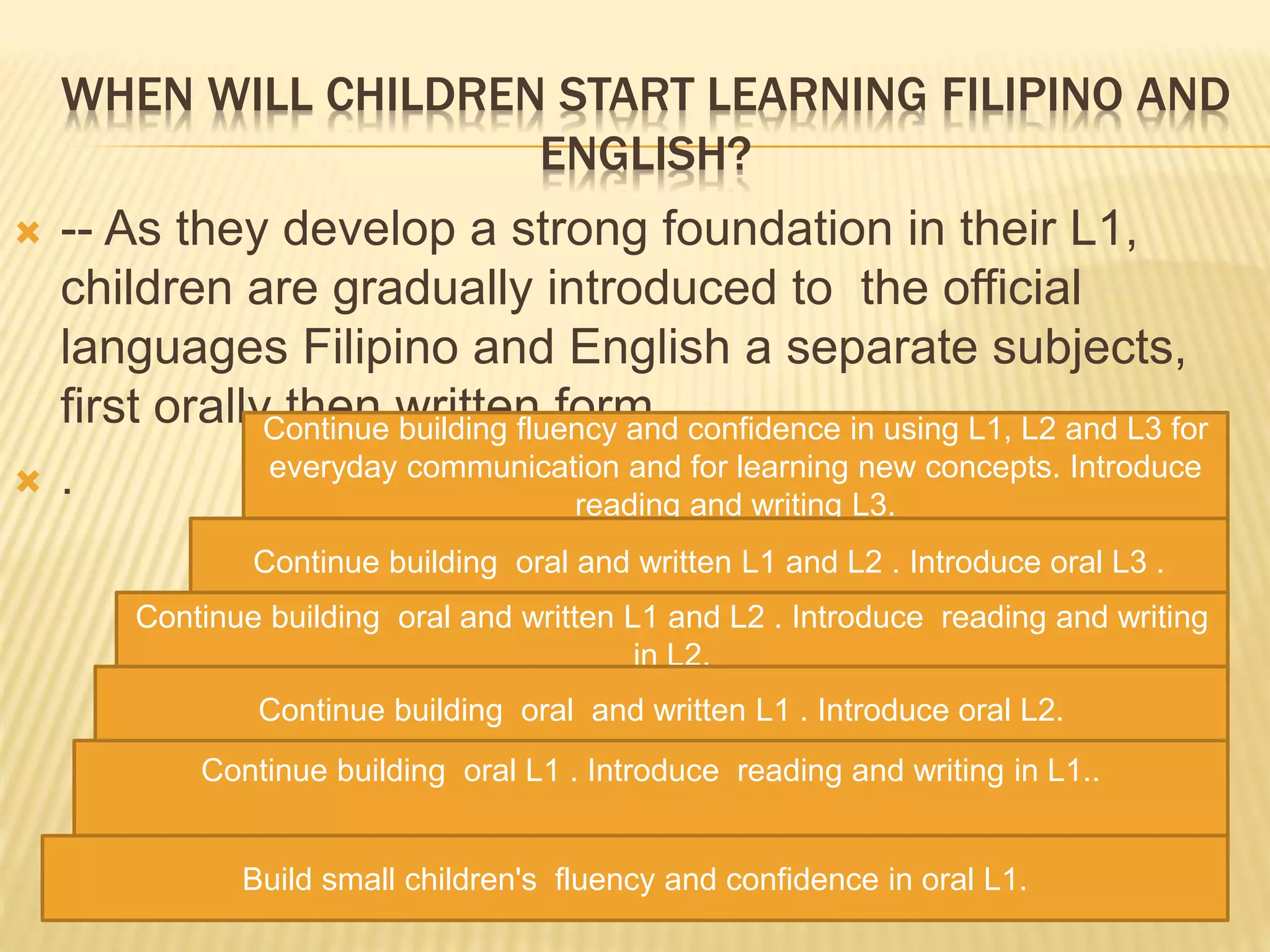
WHEN WILL CHILDREN START LEARNING FILIPINO AND 
ENGLISH? 
 -- As they develop a strong foundation in their L1, 
children are gradually introduced to the official 
languages Filipino and English a separate subjects, 
first orally then written form 
 . 
Continue building fluency and confidence in using L1, L2 and L3 for 
everyday communication and for learning new concepts. Introduce 
reading and writing L3. 
Continue building oral and written L1 and L2 . Introduce oral L3 . 
Continue building oral and written L1 and L2 . Introduce reading and writing 
in L2. 
Continue building oral and written L1 . Introduce oral L2. 
Continue building oral L1 . Introduce reading and writing in L1.. 
Build small children's fluency and confidence in oral L1.
WHAT KIND OF LEARNER’S DOES MLE INTEND 
TO PRODUCE 
 - MLE aims to produce learner’s who are: 
 Multi-Literate they can read and write competently 
in the local language, the national language, and 
one or more languages of wider communication, 
such as English; 
 Multi-Lingual they can use this languages in 
various situation and interaction for learning in 
school. 
 Multi-Cultural they can live and work 
harmoniously with people of cultural backgrounds 
and are different from their own, they are 
comfortable living and working with people from 
outside their community while maintaining their 
love and respect for their home culture and
WHY USE THE MOTHER TONGUE OR THEE FIRST 
LANGUAGE L1 IN SCHOOL? 
 One’s own language enables a child to 
express him/her self easily, as there is no 
fear of making mistakes. 
 MLE encourages active participation by 
children in the learning process because they 
understand what is being discussed and 
what is being asked of them. 
 Children can immediately use the L1 to 
construct and explain their world, articulate 
their thoughts and add new concepts to what 
they already know.
IS IT COSTLY TO PRACTICE MLE? 
 Contrary to popular belief, L1-based education 
may actually cost less than a system that is 
base on L2. 
 If we consider the money wasted on drop-outs, 
repeaters, and failures, as well as added costs, 
studies show that L2-based education system 
are more costly than L1 systems. 
 A Guatemalan study, for instance, showed that it 
is more expensive to produce a grade level 
passer(in Grades 1-6) in Spanish medium 
school($6,013) than in a Mayan school($4,496).
THE IMPORTANT TASK IN FORMULATING A 
COMMUNITY –BASED MLE PROGRAM INCLUDE 
THE FOLLOWING: 
 1. Conduct preliminary research. 
 2. Mobilize resources and develop linkages . 
 3. Recruit and train staff. 
 4. Develop a writing system. 
 5. Develop curriculum and instructional 
materials. 
 6. Develop literature . 
 7. Evaluate the program and document 
progress .
EDUCATIONAL IMPLICATIONS 
 The learners must be exposed to 
meaningful use of the L2 outside the 
classroom situations. The meaningful 
exposure which comes from: 
 1. Meaningful reading in a variety of genres. 
 2. Focusing in the language itself-how it 
works, it is used. 
 3. Using the language orally and in writing.
However the problem in most school 
situations (L1, L2,andnsible input L3), 
there is not enough time given for 
comprehensible input( oral and written) 
The use of MTB-MLE should result 
to children who are multi lingual , multi-cultural 
and multi-literate and children 
who are confident and capable in the 
languages and who maintain their love 
and respect for their linguistic and 
cultural heritage.
ESSENTIAL FEATURES OF A 
STRONG MLE PROGRAM 
(SUSAN MALONE, SIL)
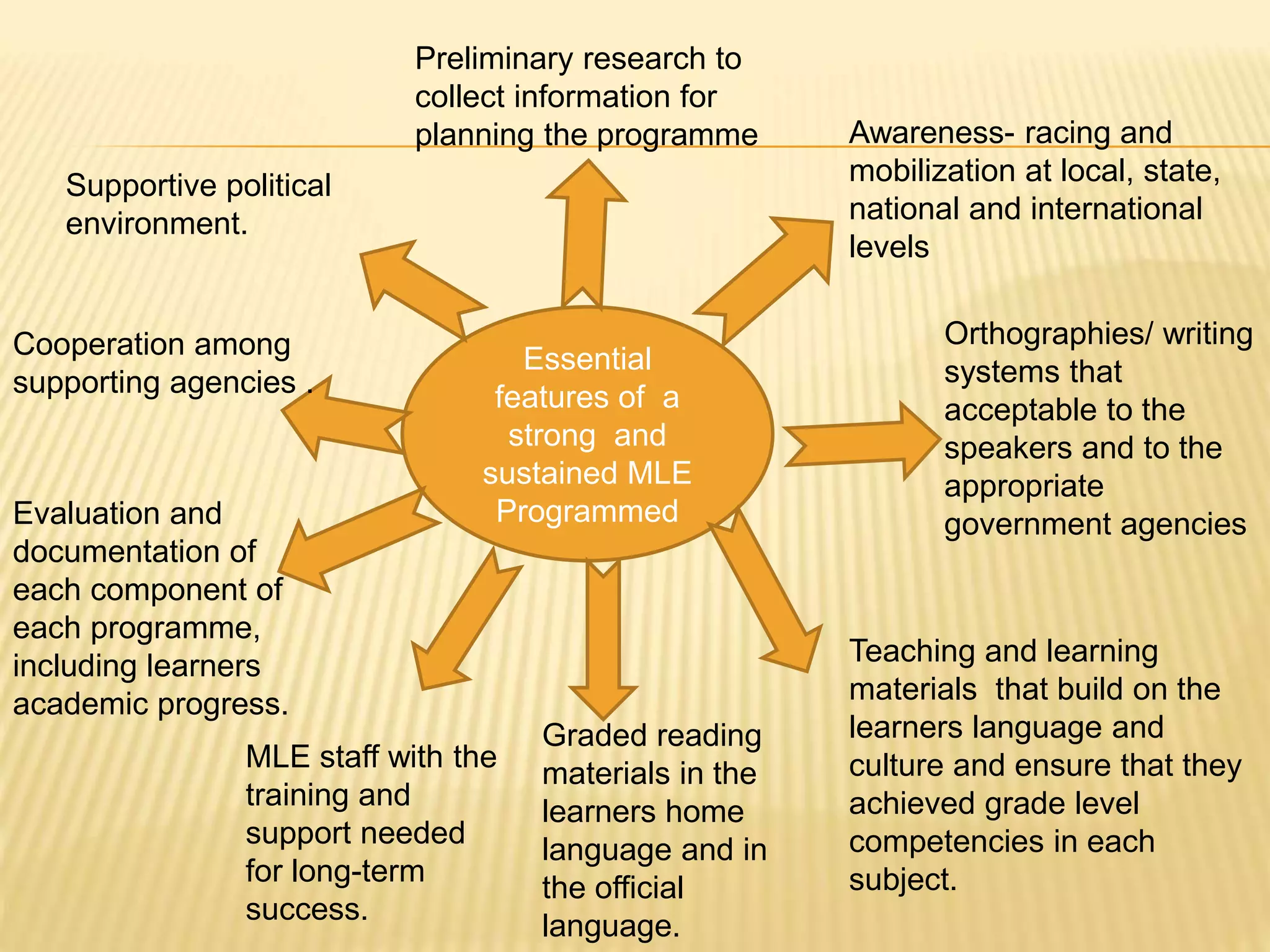
Preliminary research to 
collect information for 
planning the programme Awareness- racing and 
Essential 
features of a 
strong and 
sustained MLE 
Programmed 
mobilization at local, state, 
national and international 
levels 
Orthographies/ writing 
systems that 
acceptable to the 
speakers and to the 
appropriate 
government agencies 
Teaching and learning 
materials that build on the 
learners language and 
culture and ensure that they 
achieved grade level 
competencies in each 
subject. 
Graded reading 
materials in the 
learners home 
language and in 
the official 
language. 
Supportive political 
environment. 
Cooperation among 
supporting agencies . 
Evaluation and 
documentation of 
each component of 
each programme, 
including learners 
academic progress. 
MLE staff with the 
training and 
support needed 
for long-term 
success.
WILL USING THE MOTHER TONGUE AS 
LANGUAGE OF INSTRUCTION HINDER THE 
LEARNING OF A SECOND LANGUAGE LIKE 
ENGLISH? 
 No. Many studies indicate the student 
first taught to read in their L1, and then 
later in an L2, outperform those taught 
to read exclusively in an L2. Learning to 
in one’s own language provides learner 
with a solid foundation for learning to 
read in any L2.
THANK YOU! 


Mother tongue based multilingual education

  • 1.
    MOTHER TONGUE BASED-MULTILINGUAL EDUCATION (MTB-MLE) PREPARED BY: ARISA M. MENDOZA AND JOSEFA R. ABESA
  • 2.
    Language is infact the foundation of every culture, language is an abstract system of word meaning and symbols for all aspects of culture. It includes speech, written, characters, numerals, symbols, and gesture and expression of non verbal communication. According to Sapir Whorf hypothesis, language does more than simply described reality; it also serves to shape the reality of a culture.
  • 3.
    UNESCOS PRINCIPLE OFLANGUAGE AND EDUCATION  Principle 1:  - UNESCO supports mother tongue instruction as a means of improving educational quality by building upon the knowledge and experience of the learners and teachers. Principle 2: - Supports bilingual and/or multi lingual education at all level of education as means of promoting both social and gender equality and as a key element of linguistically diverse societies.
  • 4.
    Principle 3: -UNESCO supports language as an essential component of inter cultural education in order to encourage understanding between different population groups and ensure respect for fundamental rights. MOTHER TONGUE means ones native language; the language learned by children and pass from one generation to the next.
  • 5.
    WHAT IS MOTHER-TONGUEBASE MULTI LINGUAL EDUCATION OR MLE  Multi lingual education typically refers to “first- language-first “education, that is schooling which begins in the mother tongue and transition to additional languages.  MLE is the use of more than two languages for literacy and instruction. It starts from where the learners are , from what they already know. 
  • 6.
    TYPICALLY MLE PROGRAMSARE: • *Strong foundation- research shows that children whose early education is in the language of their home tend to do better in the later years of their education.(Thomas and Collier, 1997) • * Strong bridge- as essential difference between MLE programs and rural “Mother Tongue Education” programs is the inclusion of a guided transition from learning through another tongue. •
  • 7.
    STAGES OF ANMLE PROGRAM (UNESCO, 2003, 2005)  Stage1- learning takes place entirely in the child’s home language .  Stage2- Building fluency in the mother tongue. Introduction of oral L2.  Stage3- Building oral fluency in L2.  Stage 4- Using both L1 and L2 for life long learning.
  • 8.
    WHEN WILL CHILDRENSTART LEARNING FILIPINO AND ENGLISH?  -- As they develop a strong foundation in their L1, children are gradually introduced to the official languages Filipino and English a separate subjects, first orally then written form  . Continue building fluency and confidence in using L1, L2 and L3 for everyday communication and for learning new concepts. Introduce reading and writing L3. Continue building oral and written L1 and L2 . Introduce oral L3 . Continue building oral and written L1 and L2 . Introduce reading and writing in L2. Continue building oral and written L1 . Introduce oral L2. Continue building oral L1 . Introduce reading and writing in L1.. Build small children's fluency and confidence in oral L1.
  • 9.
    WHAT KIND OFLEARNER’S DOES MLE INTEND TO PRODUCE  - MLE aims to produce learner’s who are:  Multi-Literate they can read and write competently in the local language, the national language, and one or more languages of wider communication, such as English;  Multi-Lingual they can use this languages in various situation and interaction for learning in school.  Multi-Cultural they can live and work harmoniously with people of cultural backgrounds and are different from their own, they are comfortable living and working with people from outside their community while maintaining their love and respect for their home culture and
  • 10.
    WHY USE THEMOTHER TONGUE OR THEE FIRST LANGUAGE L1 IN SCHOOL?  One’s own language enables a child to express him/her self easily, as there is no fear of making mistakes.  MLE encourages active participation by children in the learning process because they understand what is being discussed and what is being asked of them.  Children can immediately use the L1 to construct and explain their world, articulate their thoughts and add new concepts to what they already know.
  • 11.
    IS IT COSTLYTO PRACTICE MLE?  Contrary to popular belief, L1-based education may actually cost less than a system that is base on L2.  If we consider the money wasted on drop-outs, repeaters, and failures, as well as added costs, studies show that L2-based education system are more costly than L1 systems.  A Guatemalan study, for instance, showed that it is more expensive to produce a grade level passer(in Grades 1-6) in Spanish medium school($6,013) than in a Mayan school($4,496).
  • 12.
    THE IMPORTANT TASKIN FORMULATING A COMMUNITY –BASED MLE PROGRAM INCLUDE THE FOLLOWING:  1. Conduct preliminary research.  2. Mobilize resources and develop linkages .  3. Recruit and train staff.  4. Develop a writing system.  5. Develop curriculum and instructional materials.  6. Develop literature .  7. Evaluate the program and document progress .
  • 13.
    EDUCATIONAL IMPLICATIONS The learners must be exposed to meaningful use of the L2 outside the classroom situations. The meaningful exposure which comes from:  1. Meaningful reading in a variety of genres.  2. Focusing in the language itself-how it works, it is used.  3. Using the language orally and in writing.
  • 14.
    However the problemin most school situations (L1, L2,andnsible input L3), there is not enough time given for comprehensible input( oral and written) The use of MTB-MLE should result to children who are multi lingual , multi-cultural and multi-literate and children who are confident and capable in the languages and who maintain their love and respect for their linguistic and cultural heritage.
  • 15.
    ESSENTIAL FEATURES OFA STRONG MLE PROGRAM (SUSAN MALONE, SIL)
  • 16.
    Preliminary research to collect information for planning the programme Awareness- racing and Essential features of a strong and sustained MLE Programmed mobilization at local, state, national and international levels Orthographies/ writing systems that acceptable to the speakers and to the appropriate government agencies Teaching and learning materials that build on the learners language and culture and ensure that they achieved grade level competencies in each subject. Graded reading materials in the learners home language and in the official language. Supportive political environment. Cooperation among supporting agencies . Evaluation and documentation of each component of each programme, including learners academic progress. MLE staff with the training and support needed for long-term success.
  • 17.
    WILL USING THEMOTHER TONGUE AS LANGUAGE OF INSTRUCTION HINDER THE LEARNING OF A SECOND LANGUAGE LIKE ENGLISH?  No. Many studies indicate the student first taught to read in their L1, and then later in an L2, outperform those taught to read exclusively in an L2. Learning to in one’s own language provides learner with a solid foundation for learning to read in any L2.
  • 18.