Functional-notional
Approach
Nohemi Cardenas
Andrea Muros
Carolina Gaxiola
TEAM # 4
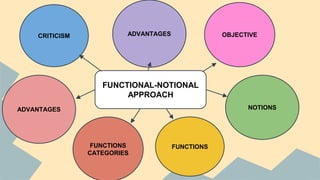
OBJECTIVE
FUNCTIONAL-NOTIONAL
APPROACH
NOTIONS
FUNCTIONS
ADVANTAGES
ADVANTAGESCRITICISM
FUNCTIONS
CATEGORIES
FUNCTIONS
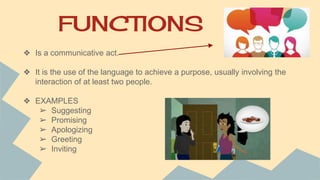
❖ Is a communicative act.
❖ It is the use of the language to achieve a purpose, usually involving the
interaction of at least two people.
❖ EXAMPLES
➢ Suggesting
➢ Promising
➢ Apologizing
➢ Greeting
➢ Inviting
OBJECTIVES
❖Explain the language in terms of what
people do with it.
❖How they use the language to live.
Criticism
❖ Order:
➢ Criticisms of functional approaches include the difficulty in deciding
the order in which different functions should be presented.
➢ Another problem lies in the wide range of grammatical structures
needed to manipulate basic functions at different levels of
formality.
❖ No structures syllabus
➢ There is also the apparently random nature of the language used,
which may frustrate learners used to the more analytical and
“building-block” approach that a grammatical syllabus can offer.
➢ Another apparent weakness is the question of what to do at higher
levels.
Advantages
❖Communicatively useful expressions
❖Focus on communication
❖Suitable to beginners
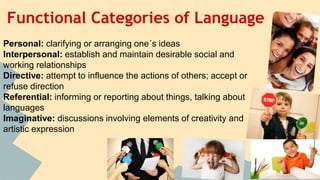
Functional Categories of Language
Personal: clarifying or arranging one´s ideas
Interpersonal: establish and maintain desirable social and
working relationships
Directive: attempt to influence the actions of others; accept or
refuse direction
Referential: informing or reporting about things, talking about
languages
Imaginative: discussions involving elements of creativity and
artistic expression
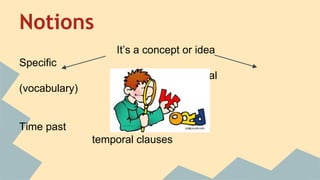
Notions
It’s a concept or idea
Specific
General
(vocabulary)
(topics)
Time past
temporal clauses

Functional notional approach