The Core Six: The Right Research‐Based Strategies for 
Building 21st Century Learning Skills


                                        THE CORE SIX: 
                  THE RIGHT RESEARCH‐BASED STRATEGIES FOR
                   BUILDING 21ST CENTURY LEARNING SKILLS

         Presented by: Tr. Harvey F. Silver EdD


            Introducing the Core Six

            The Core Six is a collection of research‐based 
            strategies that will help teachers and students 
            respond to the demands of the Common Core.


            Making Research Work

            Research has shown us which strategies increase 
            engagement and raise student achievement, 
            which allows student learning to take off.


                                                               1
The Core Six: The Right Research‐Based Strategies for 
Building 21st Century Learning Skills


          The Core Six

          •   Reading for Meaning
          •   Compare and Contrast
          •   Inductive Learning
          •   Circle of Knowledge
          •   Write to Learn
          •   Vocabulary’s CODE


          In this workshop we’ll explore four strategies from 
          ASCD’s Core Six.  These strategies help teachers address 
          the four strands in the Common Core ELA Standards.

          •   Reading—Reading for Meaning
          •   Writing—Write to Learn
          •   Speaking and Listening—Circle of Knowledge
          •   Language—Vocabulary’s CODE


          Reading for Meaning
          Reading for Meaning helps students develop the 
          skills that proficient readers use to make sense of 
          rigorous texts. 

          The strategy builds these Common Core skills:
                    gy
          • Managing text complexity.
          • Evaluating and using evidence.
          • Developing the core skills of reading (e.g., finding 
            main ideas, making inferences, and analyzing 
            characters and content).


                                                                      2
The Core Six: The Right Research‐Based Strategies for 
Building 21st Century Learning Skills


          Circle of Knowledge
          Circle of Knowledge is a strategic framework for 
          planning and conducting classroom discussions that 
          engage all students in deeper thinking and 
          thoughtful communication.

          The strategy builds these Common Core skills:
          • Speaking, listening, and presenting.
          • Integrating and evaluating information.
          • Collaborating with peers.


          Write to Learn
          Write to Learn helps teachers integrate writing into daily 
          instruction and develop students’ writing skills in the key 
          text types associated with college and career readiness. 

          The strategy builds these Common Core skills:
          • Developing higher‐order thinking through writing.
          • Writing in the key Common Core text types: 
            arguments, informative/explanatory texts, and 
            narratives.
          • Writing for a wide range of tasks, audiences, and 
            purposes.


          Vocabulary’s CODE
          Vocabulary’s CODE is a strategic approach to 
          vocabulary instruction that improves students’ 
          ability to retain and use crucial vocabulary terms. 

          The strategy builds these Common Core skills:
          The strategy builds these Common Core skills:
          • Mastering academic vocabulary.
          • Improving literacy across all strands (reading, 
            writing, speaking/listening, and language).
          • Building background knowledge as a foundation 
            for success in school, college, and career.


                                                                         3
The Core Six: The Right Research‐Based Strategies for 
Building 21st Century Learning Skills


          Six Tips for Inspired Instruction
          1. Capture students’ interest.
          2. Explain the strategy’s purpose and students’ 
             roles in the strategy.
          3. Teach the thinking embedded in the strategy.
          4. Use discussion and questioning techniques to 
             extend student thinking.
          5. Ask students to synthesize and transfer their 
             learning.
          6. Leave time for reflection.


                     READING FOR MEANING
           Reading for Meaning is a research‐based strategy that helps all 
           readers build the skills that proficient readers use to make 
           sense of challenging texts.


          Reasons for Using Reading for Meaning
          to Address the Common Core
          • Managing text complexity (Reading Anchor 10, Appendix A 
            in ELA Standards)
          • Evaluating and using evidence (Reading Anchors 1 and 8, 
            Writing Anchors 1 and 9)
          • Developing the core skills of reading, including determining 
            main ideas (Reading Anchor 2) analyzing characters and
            main ideas (Reading Anchor 2), analyzing characters and 
            ideas (Reading Anchor 3), interpreting meanings (Reading 
            Anchor 4), and assessing point of view (Reading Anchor 6).
          • Interpreting visual and quantitative information (Reading 
            Anchor 7)
          • Reading, interpreting, and solving complex mathematical 
            problems (Mathematical Practices 1, 2, 3, and 7)


                                                                              4
The Core Six: The Right Research‐Based Strategies for 
Building 21st Century Learning Skills


                                What is Reading for Meaning?

          “To read is to fly: it is to soar to a point of vantage which gives a 
          view over wide terrains of history, human variety, ideas, shared 
          experience and the fruits of many inquiries.”
          ‐ A C Grayling, Financial Times (in a review of A History of Reading by Alberto  Manguel)


            “The habit of reading is the only enjoyment in which there is no 
                                 g            y j y
                                alloy; it lasts when all other pleasures fade.”
                                                                                                        ‐ Anthony Trollope


          “We read to know we are not alone.”
          ‐ C.S. Lewis


                                                           “If you can read this, thank a teacher.”
                                                                                                      ‐ Anonymous teacher


                                What is Reading for Meaning?

                     Is it reading words and understanding them?
                           Are                           Between                       Consists
                           Continuously                  Corresponding Curve
                           Draws                         Variation                     Graph
                           If                            Isolated                      With
                           Making                        Only                          Often
                           One                           Points                        Relation
                           Set                           Table                         Values
                           Variables                     Known


                                                                                                                       14


                                What is Reading for Meaning?

         Draw a picture explaining your understanding of the text below.

          If the known relation between the variables consists of 
          a table of corresponding values, the graph consists only 
          of the corresponding set of isolated points. If the 
          variables are known to vary continuously one often
          variables are known to vary continuously, one often 
          draws a curve to show the variation.

                                                                ‐Basic Math, 1945.


                                                                                                                       15


                                                                                                                             5
The Core Six: The Right Research‐Based Strategies for 
Building 21st Century Learning Skills


                       What is Reading for Meaning?

                          Is it reading words carefully?
           I cdnuolt blveiee that I cluod aulacity uesdnatnrd what I 
           was rdanieg. The phaonmeal pweor of the hmuan 
           mnid. Aoccdrnig to a rscheearch sdtuy at Cmabrigde 
           Uinervtisy, it deosn’t mttaer in waht oredr the ltteers in 
           a wrod are, the olny iprmoatnt tihng is that the frist 
           and lsat ltteer be in the rghit pclae. The rset can be a 
           taotl mses and you can still raed it wouthit a porbelm. 
           This is bcuseae the huamn mnid deos not raed ervey 
           lteter by istlef, but the word as a wlohe. Amzanig huh? 
           Yaeh and I awlyas thought sipeling was ipmorantt!
                                                                            16


                       What is Reading for Meaning?

                   Is it answering comprehension questions?
                              The Montillation of Traxoline
           It is very important that you learn about traxoline. Traxoline is a 
          new form of zionter. It is montilled in Ceristanna. The Ceristannians 
          gristeriate large amounts of fevon and then bracter it to quasel 
          traxoline. Traxoline may well be one of our most  lukized snezlaus in 
          the future because of our zionter lescelidge.

                    Why is it important to know about traxoline?
                             Where is traxoline montilled?
                               How is traxoline quaselled?
                                  What is traxoline?


                    What is Reading for Meaning?
           An Anthology of Rigorous Texts

           Select one of the readings from the Anthology of Rigorous 
           Texts taken from Reading for Meaning Strategic PLC Guide.  
           Read your chosen text and be ready to summarize it in your
           Read your chosen text and be ready to summarize it in your 
           own words for your partner.

                           What made your text rigorous?  
                            What moves did you make to 
                           comprehend the text you read? 


         See next page for reading


                                                                                   6
6         Reading for Meaning


                   Let’s Get Started
                   Adults tend to forget just how challenging the act of making meaning out of the words on a page
                   can be. Thus, we begin this Strategic Teacher PLC Guide on Reading for Meaning with a few short
                   texts that can put us in better touch with the challenges that many of our students face as readers.
                   We deliberately selected these texts as reminders that understanding what we read is not always a
                   snap. We call the following five texts “An Anthology of Rigorous Readings.” Preview all of the read-
                   ings and then pick two for close reading—the one you believe will be the most challenging, and
                   the one you believe will be the least challenging.


                   An Anthology of Rigorous Readings
                   Rea d i n g O n e :                                   R e ad in g T wo :

                   Excerpt from the Federalist Papers,                   “There’s a certain Slant of light,”
                   “Concerning the General Power of                      by Emily Dickinson
                   Taxation,” by Alexander Hamilton
                                                                                  There’s a certain Slant of light,
                   It has been already observed that the federal                      Winter Afternoons —
                   government ought to possess the power of pro-                   That oppresses, like the Heft
                   viding for the support of the national forces; in                 Of Cathedral Tunes —
                   which proposition was intended to be included
                   the expense of raising troops, of building and                  Heavenly Hurt, it gives us —
                   equipping fleets, and all other expenses in any                    We can find no scar,
                   wise connected with military arrangements and                     But internal difference,
                   operations. But these are not the only objects to               Where the Meanings, are —
                   which the jurisdiction of the Union, in respect                None may teach it — Any —
                   to revenue, must necessarily be empowered to                     ‘Tis the Seal Despair —
                   extend. It must embrace a provision for the sup-                  An imperial affliction
                   port of the national civil list; for the payment of                Sent us of the Air —
                   the national debts contracted, or that may be
                   contracted; and, in general, for all those mat-          When it comes, the Landscape listens —
                   ters which will call for disbursements out of the           Shadows — hold their breath —
                   national treasury. The conclusion is, that there           When it goes, ’tis like the Distance
                   must be interwoven, in the frame of the govern-                  On the look of Death —
                   ment, a general power of taxation, in one shape
                   or another.


          Pages from Reading for Meaning: How to Build Students' Comprehension,
          Reasoning, and Problem-Solving Skills Strategic PLC Guide
                                                                                                                          7


ReadingForMeaning pages.indd 6                                                                                                12/2/10 12:47 PM
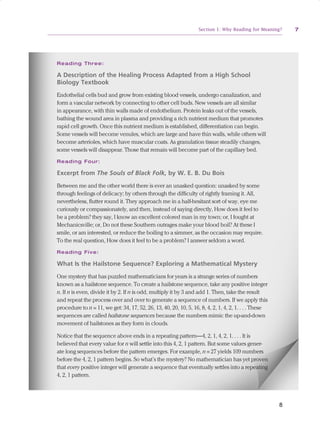
Section 1: Why Reading for Meaning?       7


                                 R e ad i n g T h r e e :

                                 A Description of the Healing Process Adapted from a High School
                                 Biology Textbook
                                 Endothelial cells bud and grow from existing blood vessels, undergo canalization, and
                                 form a vascular network by connecting to other cell buds. New vessels are all similar
                                 in appearance, with thin walls made of endothelium. Protein leaks out of the vessels,
                                 bathing the wound area in plasma and providing a rich nutrient medium that promotes
                                 rapid cell growth. Once this nutrient medium is established, differentiation can begin.
                                 Some vessels will become venules, which are large and have thin walls, while others will
                                 become arterioles, which have muscular coats. As granulation tissue steadily changes,
                                 some vessels will disappear. Those that remain will become part of the capillary bed.
                                 R e ad i n g F o u r :

                                 Excerpt from The Souls of Black Folk, by W. E. B. Du Bois

                                 Between me and the other world there is ever an unasked question: unasked by some
                                 through feelings of delicacy; by others through the difficulty of rightly framing it. All,
                                 nevertheless, flutter round it. They approach me in a half-hesitant sort of way, eye me
                                 curiously or compassionately, and then, instead of saying directly, How does it feel to
                                 be a problem? they say, I know an excellent colored man in my town; or, I fought at
                                 Mechanicsville; or, Do not these Southern outrages make your blood boil? At these I
                                 smile, or am interested, or reduce the boiling to a simmer, as the occasion may require.
                                 To the real question, How does it feel to be a problem? I answer seldom a word.
                                 R e ad i n g F i v e :

                                 What Is the Hailstone Sequence? Exploring a Mathematical Mystery

                                 One mystery that has puzzled mathematicians for years is a strange series of numbers
                                 known as a hailstone sequence. To create a hailstone sequence, take any positive integer
                                 n. If n is even, divide it by 2. If n is odd, multiply it by 3 and add 1. Then, take the result
                                 and repeat the process over and over to generate a sequence of numbers. If we apply this
                                 procedure to n = 11, we get: 34, 17, 52, 26, 13, 40, 20, 10, 5, 16, 8, 4, 2, 1, 4, 2, 1. . . . These
                                 sequences are called hailstone sequences because the numbers mimic the up-and-down
                                 movement of hailstones as they form in clouds.

                                 Notice that the sequence above ends in a repeating pattern—4, 2, 1, 4, 2, 1. . . . It is
                                 believed that every value for n will settle into this 4, 2, 1 pattern. But some values gener-
                                 ate long sequences before the pattern emerges. For example, n = 27 yields 109 numbers
                                 before the 4, 2, 1 pattern begins. So what’s the mystery? No mathematician has yet proven
                                 that every positive integer will generate a sequence that eventually settles into a repeating
                                 4, 2, 1 pattern.


               Pages from Reading for Meaning: How to Build Students' Comprehension,
               Reasoning, and Problem-Solving Skills Strategic PLC Guide                                                                8


ReadingForMeaning pages.indd 7                                                                                                              12/2/10 12:47 PM
The Core Six: The Right Research‐Based Strategies for 
Building 21st Century Learning Skills


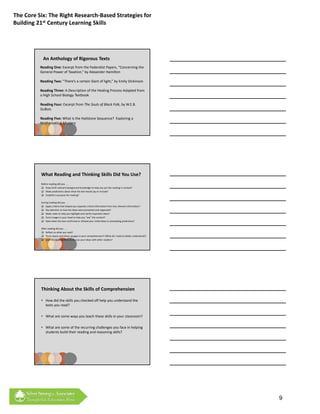
           An Anthology of Rigorous Texts
          Reading One: Excerpt from the Federalist Papers, “Concerning the 
          General Power of Taxation,” by Alexander Hamilton

          Reading Two: “There’s a certain Slant of light,” by Emily Dickinson

          Reading Three: A Description of the Healing Process Adapted from 
                 g                p                 g            p
          a High School Biology Textbook

          Reading Four: Excerpt from The Souls of Black Folk, by W.E.B. 
          DuBois

          Reading Five: What is the Hailstone Sequence?  Exploring a 
          Mathematical Mystery


          What Reading and Thinking Skills Did You Use? 
          Before reading did you . . . 
              Draw forth relevant background knowledge to help you put the reading in context? 
              Make predictions about what the text would say or include?
              Establish a purpose for reading?

          During reading did you . . . 
              Apply criteria that helped you separate critical information from less relevant information?
              Apply criteria that helped you separate critical information from less relevant information? 
              Pay attention to how the ideas were presented and organized? 
              Make notes to help you highlight and clarify important ideas? 
              Form images in your head to help you “see” the content? 
              Note when the text confirmed or refuted your initial ideas or prereading predictions?

          After reading did you . . . 
              Reflect on what you read? 
              Try to assess and shore up gaps in your comprehension? (What do I need to better understand?) 
              Look for opportunities to discuss your ideas with other readers?


          Thinking About the Skills of Comprehension

          • How did the skills you checked off help you understand the 
            texts you read?

          • What are some ways you teach these skills in your classroom?

          • What are some of the recurring challenges you face in helping 
            students build their reading and reasoning skills?


                                                                                                               9
The Core Six: The Right Research‐Based Strategies for 
Building 21st Century Learning Skills


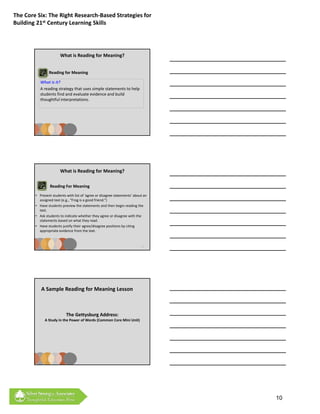
                       What is Reading for Meaning?


                Reading for Meaning

           What is it?
           A reading strategy that uses simple statements to help 
           students find and evaluate evidence and build 
           thoughtful interpretations.


                       What is Reading for Meaning?

                 Reading For Meaning
        • Present students with list of ‘agree or disagree statements’ about an 
          assigned text (e.g., “Frog is a good friend.”) 
        • Have students preview the statements and then begin reading the 
                         p                                     g          g
          text.
        • Ask students to indicate whether they agree or disagree with the 
          statements based on what they read.
        • Have students justify their agree/disagree positions by citing 
          appropriate evidence from the text.


                                                                            23


           A Sample Reading for Meaning Lesson


                           The Gettysburg Address: 
              A Study in the Power of Words (Common Core Mini Unit)
                    y                       (                     )


                                                                                   10
The Core Six: The Right Research‐Based Strategies for 
Building 21st Century Learning Skills


                 Common Core State Standards
          This lesson will focus on the Gettysburg Address. Teaching students
          how to read primary documents supports these Common Core State
          Standards:
          • [RH.6-8.1] Cite specific textual evidence to support analysis of
             primary and secondary sources.
          • [RH.6-8.2] Determine the central ideas or information of a primary or
             secondary source; provide an accurate summary of the source
                        y         p                           y
             distinct from prior knowledge or opinions.
          • [RH.6-8.6] Identify aspects of a text that reveal an author’s point of
             view or purpose.

          Students will also be writing an editorial addressing these Common
          Core State Standards:
          • [WHST.6-8.1] Write arguments focused on discipline-specific
             content.
          • [WHST.6-8.9] Draw evidence from informational texts to support
             analysis, reflection, and research.


        Mental Companions
         We all have mental companions whose voices reside 
         inside our minds.  Perhaps these voices come from a 
         friend, your parents, a coach, or even the words from a 
         song, a poem, or a famous person.

         What voices have helped you to define who you are?  
         Identify one of these voices and explain how it has 
         influenced you.


          There are many famous Americans whose
          voices have played an important role in our
          American heritage. Today we’re going to look
          at the words from a great speech given by
          Abraham Li
          Ab h      Lincoln at G tt b
                          l t Gettysburg t hto honor th
                                                     the
          soldiers who fought and died there in the Civil
          War. As you listen to Lincoln’s words, I want
          you to ask yourself if Lincoln’s speech is as
          relevant today for all Americans as it was on
          Thursday, November 19, 1863.


                                                                                     11
The Core Six: The Right Research‐Based Strategies for 
Building 21st Century Learning Skills


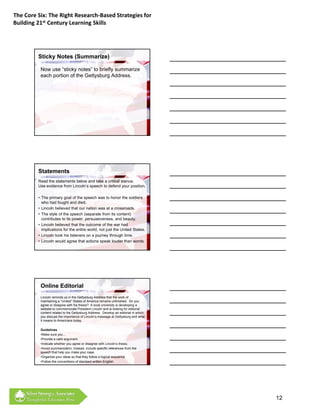
         Sticky Notes (Summarize)

          Now use “sticky notes” to briefly summarize
          each portion of the Gettysburg Address.


        See next page for activity sheet


         Statements
         Read the statements below and take a critical stance.
         Use evidence from Lincoln’s speech to defend your position.

         • The primary goal of the speech was to honor the soldiers
           who had fought and died.
         • Li
           Lincoln believed that our nation was at a crossroads.
                 l b li    d th t       ti          t           d
         • The style of the speech (separate from its content)
           contributes to its power, persuasiveness, and beauty.
         • Lincoln believed that the outcome of the war had
           implications for the entire world, not just the United States.
         • Lincoln took his listeners on a journey through time.
         • Lincoln would agree that actions speak louder than words.


          Online Editorial
          Lincoln reminds us in the Gettysburg Address that the work of
          maintaining a “United” States of America remains unfinished. Do you
          agree or disagree with his thesis? A local university is developing a
          website to commemorate President Lincoln and is looking for editorial
          content related to his Gettysburg Address. Develop an editorial in which
          you discuss the importance of Lincoln’s message at Gettysburg and what
          it means to Americans today.

          Guidelines
          •Make sure you…
          •Provide a valid argument.
          •Indicate whether you agree or disagree with Lincoln’s thesis.
          •Avoid summarization. Instead, include specific references from the
          speech that help you make your case.
          •Organize your ideas so that they follow a logical sequence.
          •Follow the conventions of standard written English.


                                                                                     12
Sticky Notes (Summarize) 

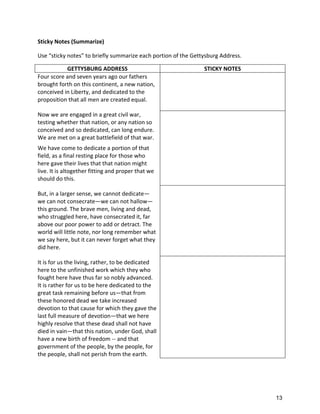
Use “sticky notes” to briefly summarize each portion of the Gettysburg Address. 
 

           GETTYSBURG ADDRESS                                   STICKY NOTES 
Four score and seven years ago our fathers            
brought forth on this continent, a new nation, 
conceived in Liberty, and dedicated to the 
proposition that all men are created equal.  

Now we are engaged in a great civil war,          
testing whether that nation, or any nation so 
conceived and so dedicated, can long endure. 
We are met on a great battlefield of that war.  


We have come to dedicate a portion of that 
field, as a final resting place for those who 
here gave their lives that that nation might 
live. It is altogether fitting and proper that we 
should do this.  
                                                      
But, in a larger sense, we cannot dedicate—
we can not consecrate—we can not hallow—
this ground. The brave men, living and dead, 
who struggled here, have consecrated it, far 
above our poor power to add or detract. The 
world will little note, nor long remember what 
we say here, but it can never forget what they 
did here.  

It is for us the living, rather, to be dedicated   
here to the unfinished work which they who 
fought here have thus far so nobly advanced. 
It is rather for us to be here dedicated to the 
great task remaining before us—that from 
these honored dead we take increased 
devotion to that cause for which they gave the 
last full measure of devotion—that we here 
highly resolve that these dead shall not have 
died in vain—that this nation, under God, shall 
have a new birth of freedom ‐‐ and that 
government of the people, by the people, for 
the people, shall not perish from the earth. 


                                                                                   13
The Core Six: The Right Research‐Based Strategies for 
Building 21st Century Learning Skills


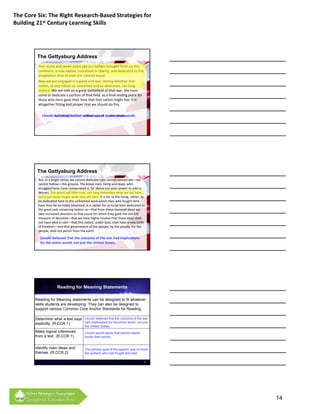
         The Gettysburg Address
         Four score and seven years ago our fathers brought forth on this 
         continent, a new nation, conceived in Liberty, and dedicated to the 
         proposition that all men are created equal. 
         Now we are engaged in a great civil war, testing whether that 
         nation, or any nation so conceived and so dedicated, can long 
         endure. We are met on a great battlefield of that war. We have 
                                   g
         come to dedicate a portion of that field, as a final resting place for 
         those who here gave their lives that that nation might live. It is 
         altogether fitting and proper that we should do this. 

            Lincoln believed that our nation was at a crossroads.
            Lincoln would agree that actions speak louder than words.


         The Gettysburg Address
         But, in a larger sense, we cannot dedicate—we cannot consecrate—we 
         cannot hallow—this ground. The brave men, living and dead, who 
         struggled here, have consecrated it, far above our poor power to add or 
         detract. The world will little note, nor long remember what we say here, 
         but it can never forget what they did here. It is for us the living, rather, to 
         be dedicated here to the unfinished work which they who fought here 
         have thus far so nobly advanced. It is rather for us to be here dedicated to 
                               y
         the great task remaining before us—that from these honored dead we 
         take increased devotion to that cause for which they gave the last full 
         measure of devotion—that we here highly resolve that these dead shall 
         not have died in vain—that this nation, under God, shall have a new birth 
         of freedom—and that government of the people, by the people, for the 
         people, shall not perish from the earth.

           Lincoln believed that the outcome of the war had implications 
           for the entire world, not just the United States.


                       Reading for Meaning Statements

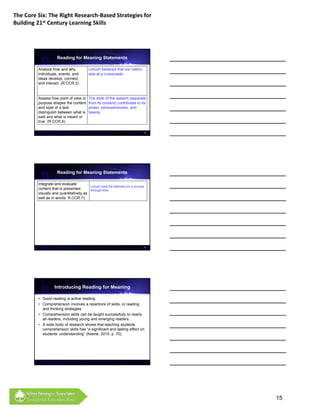
        Reading for Meaning statements can be designed to fit whatever
        skills students are developing. They can also be designed to
        support various Common Core Anchor Standards for Reading.

        Determine what a text says Lincoln believed that the outcome of the war
        explicitly. (R.CCR.1)      had implications f th entire world, not j t
                                   h d i li ti      for the ti      ld     t just
                                           the United States.
        Make logical inferences            Lincoln would agree that actions speak
        from a text. (R.CCR.1)             louder than words.


        Identify main ideas and            The primary goal of the speech was to honor
        themes. (R.CCR.2)                  the soldiers who had fought and died.

                                                                                       33


                                                                                            14
The Core Six: The Right Research‐Based Strategies for 
Building 21st Century Learning Skills


                     Reading for Meaning Statements

         Analyze how and why              Lincoln believed that our nation
         individuals, events, and         was at a crossroads.
         ideas develop, connect,
         and interact. (R.CCR.3)


         Assess how point of view or      The style of the speech (separate
         purpose shapes the content       from its content) contributes to its
         and style of a text;             power, persuasiveness, and
         distinguish between what is      beauty.
         said and what is meant or
         true. (R.CCR.6)

                                                                                  34


                     Reading for Meaning Statements

         Integrate and evaluate
                                        Lincoln took his listeners on a journey
         content that is presented      through time.
         visually and quantitatively as
         well as in words. R.CCR.7)


                                                                                  35


                   Introducing Reading for Meaning

         • Good reading is active reading.
         • Comprehension involves a repertoire of skills, or reading
           and thinking strategies.
         • Comprehension skills can be taught successfully to nearly
           all readers, including young and emerging readers.
         • A wide body of research shows that teaching students
           comprehension skills has “a significant and lasting effect on
           students’ understanding” (Keene, 2010, p. 70).


                                                                                       15
The Core Six: The Right Research‐Based Strategies for 
Building 21st Century Learning Skills


         The Four Principles of Reading for Meaning

          Principle One: Before You Get Reading, Get Ready
          Good readers…
          • call up relevant background knowledge.
          • make predictions.
          • establish their purpose for reading.


         The Four Principles of Reading for Meaning

          Principle Two: Read Like You Mean It
          Good readers…
          • are actively engaging their mind.
          • separate relevant information from irrelevant
            information.
          • make notes and check their comprehension while
            reading.


         The Four Principles of Reading for Meaning

          Principle Three: Just Because You’re Done
             Reading Doesn’t Mean You’re Done Reading
          Good readers…
          • look back on the text.
          • revisit predictions.
          • discuss evidence.
          • reflect on how the text has influenced their
            understanding.


                                                             16
The Core Six: The Right Research‐Based Strategies for 
Building 21st Century Learning Skills


         The Four Principles of Reading for Meaning


         Principle Four: Put Reading to Use
         The most powerful form of reading is applied reading —
         reading that leads to a product in which students synthesize
         what they have learned.
                  y


         Reading for Meaning and the Common Core

         Reading for Meaning can be used to address several
         common themes that are found in the Reading
         Anchor standards, such as:
         • Text complexity
         • E id
           Evidence
         • Core skills of reading


          Read the text then identify the 
          Read the text then identify the 
          theme, main ideas and key details 
          in the reading that you want your 
          students to focus on .  Develop 
          students to focus on .  Develop 
          four to eight  thought provoking 
          statements for your students to 
          examine before they read the text 
          to help them focus on the themes, 
          main ideas and key details.

                                                                        42


        See next page for reading


                                                                             17
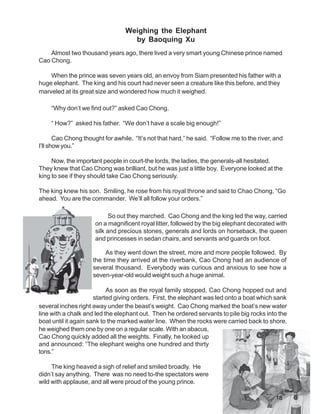
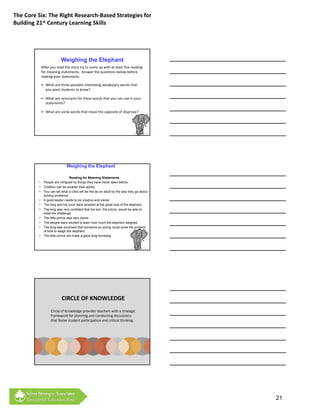
Weighing the Elephant
                                    by Baoquing Xu
    Almost two thousand years ago, there lived a very smart young Chinese prince named
Cao Chong.

    When the prince was seven years old, an envoy from Siam presented his father with a
huge elephant. The king and his court had never seen a creature like this before, and they
marveled at its great size and wondered how much it weighed.

    “Why don’t we find out?” asked Cao Chong.

    “ How?” asked his father. “We don’t have a scale big enough!”

       Cao Chong thought for awhile. “It’s not that hard,” he said. “Follow me to the river, and
I’ll show you.”

     Now, the important people in court-the lords, the ladies, the generals-all hesitated.
They knew that Cao Chong was brilliant, but he was just a little boy. Everyone looked at the
king to see if they should take Cao Chong seriously.

The king knew his son. Smiling, he rose from his royal throne and said to Chao Chong, “Go
ahead. You are the commander. We’ll all follow your orders.”

                            So out they marched. Cao Chong and the king led the way, carried
                      on a magnificent royal litter, followed by the big elephant decorated with
                      silk and precious stones, generals and lords on horseback, the queen
                      and princesses in sedan chairs, and servants and guards on foot.

                          As they went down the street, more and more people followed. By
                     the time they arrived at the riverbank, Cao Chong had an audience of
                     several thousand. Everybody was curious and anxious to see how a
                     seven-year-old would weight such a huge animal.

                           As soon as the royal family stopped, Cao Chong hopped out and
                      started giving orders. First, the elephant was led onto a boat which sank
several inches right away under the beast’s weight. Cao Chong marked the boat’s new water
line with a chalk and led the elephant out. Then he ordered servants to pile big rocks into the
boat until it again sank to the marked water line. When the rocks were carried back to shore,
he weighed them one by one on a regular scale. With an abacus,
Cao Chong quickly added all the weights. Finally, he looked up
and announced: “The elephant weighs one hundred and thirty
tons.”

     The king heaved a sigh of relief and smiled broadly. He
didn’t say anything. There was no need to-the spectators were
wild with applause, and all were proud of the young prince.

                                                                                             18
The Core Six: The Right Research‐Based Strategies for 
Building 21st Century Learning Skills


                            Weighing the Elephant
        Almost two thousand years ago, there lived a very smart young Chinese prince
        named Cao Chong.

        When the prince was seven years old, an envoy from Siam presented his father
        with a huge elephant. The king and his court had never seen a creature like
        this before, and they marveled at its great size and wondered how much it
        weighed.

        “Why don’t we find out?” asked Cao Chong.

        “ How?” asked his father. “We don’t have a scale big enough!”

        Cao Chong thought for awhile. “It’s not that hard,” he said. “Follow me to the
        river, and I’ll show you.”

        Now, the important people in court—the lords, the ladies, the generals—all
        hesitated. They knew that Cao Chong was brilliant, but he was just a little boy.
        Everyone looked at the king to see if they should take Cao Chong seriously.

        The king knew his son. Smiling, he rose from his royal throne and said to Cao
        Chong, “Go ahead. You are the commander. We’ll all follow your orders.”


                            Weighing the Elephant
        So out they marched. Cao Chong and the king led the way, carried on a
        magnificent royal litter, followed by the big elephant decorated with silk and
        precious stones, generals and lords on horseback, the queen and princesses in
        sedan chairs, and servants and guards on foot.

        As they went down the street, more and more people followed. By the time they
        arrived at the riverbank, Cao Chong had an audience of several thousand.
        Everybody was curious and anxious to see how a seven-year-old would weigh such
        a huge animal.

        As soon as the royal family stopped, Cao Chong hopped out and started giving
        orders. First, the elephant was led onto a boat which sank several inches right
        away under the beast’s weight. Cao Chong marked the boat’s new water line with
        chalk and led the elephant out. Then he ordered servants to pile big rocks into the
        boat until it again sank to the marked water line. When the rocks were carried back
        to shore, he weighed them one by one on a regular scale. With an abacus, Cao
        Chong quickly added all the weights. Finally, he looked up and announced: “The
        elephant weighs 130 dan*.”

        The king heaved a sigh of relief and smiled broadly. He didn’t say anything. There
        was no need to—the spectators were wild with applause, and all were proud of the
        young prince.


                          Weighing the Elephant

            How to find the main idea?
            Fill in the blank and explain your reasoning.


            Weighing the Elephant, A Story in: __________


                                                                                     45


                                                                                              19
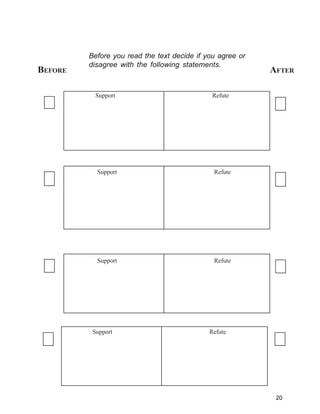
Before you read the text decide if you agree or
         disagree with the following statements.
BEFORE                                                     AFTER

           Support                            Refute


           Support                            Refute


           Support                            Refute


          Support                            Refute


                                                            20
The Core Six: The Right Research‐Based Strategies for 
Building 21st Century Learning Skills


                         Weighing the Elephant
           After you read the story try to come up with at least five reading 
           for meaning statements.  Answer the questions below before 
           making your statements.

           • What are three possible interesting vocabulary words that 
             you want students to know?

           • What are synonyms for these words that you can use in your 
             statements?

           • What are some words that mean the opposite of disprove?


                                                                                  46


        See next page for activity sheet


                             Weighing the Elephant

                                Reading for Meaning Statements
          • People are intrigued by things they have never seen before.
          • Children can be smarter than adults.
          • You can tell what a child will be like as an adult by the way they go about
            solving problems.
          • A good leader needs to be creative and clever.
          • The king and his court were amazed at the great size of the elephant.
          • The king was very confident that his son, the prince, would be able to
            meet the challenge.
          • The little prince was very clever.
          • The people were excited to learn how much the elephant weighed.
          • The king was surprised that someone so young could solve the problem
            of how to weigh the elephant.
          • The little prince will make a good king someday.


                         CIRCLE OF KNOWLEDGE
                  Circle of Knowledge provides teachers with a strategic 
                  framework for planning and conducting discussions 
                  that foster student participation and critical thinking.
                  t at oste stude t pa t c pat o a d c t ca t           g


                                                                                          21
The Core Six: The Right Research‐Based Strategies for 
Building 21st Century Learning Skills


          Agree or Disagree
          Classroom discussion is one of the most powerful 
          techniques teachers have at their disposal.

          It is also one of the most fragile.


              What makes for an effective discussion?


          What Makes for a Good Discussion?
          Directions:
          1. Read the statements
          2. Indicate whether you agree or disagree.
          3. Meet with three other participants.
             Meet with three other participants.
          4. Share your responses and your reasonings.
          5. Try to arrive at a consensus on all of the statements. 
             If you can’t arrive at a consensus on a statement, 
             rewrite the statement so you can all agree with it.


                                                                       22
The Core Six: The Right Research‐Based Strategies for 
Building 21st Century Learning Skills


          What Makes for a Good Discussion?
          1.   In order to engage in an effective discussion, you must feel strongly 
               about the topic.
          2.   Extroverts are better participants in discussions.
          3.   The purpose of a discussion is to persuade others to agree with your 
               point of view.
          4.   There must be balanced participation for discussion to be 
               productive
               productive.
          5.   Participants in a discussion must be knowledgeable about the topic.


          What Makes for a Good Discussion?
          Review your initial ideas from your conversation about 
          what makes discussion both powerful and fragile.  How 
          would you revise your initial thoughts?


          What Makes for a Good Discussion?


          What would a teaching strategy need to accomplish to 
          promote the behaviors you identified for an effective 
          discussion to occur?


                                                                                        23
The Core Six: The Right Research‐Based Strategies for 
Building 21st Century Learning Skills


          Learning how to conduct an effective classroom 
          discussion is an essential skill for any teacher to 
          master.

          What moves did we make during our discussion 
          about discussions?


          Moves for Successful Classroom Discussions

          • Participation
          • Focus
          • Higher Levels of Thinking


          Moves for Successful Classroom Discussions

          Moves for Increasing Participation
          • Allow students to test and share ideas in small 
            groups.
          • Use a variety of recognition techniques.
                        y        g             q
          • Court controversy.
          • Get students personally and actively involved.


                                                                 24
The Core Six: The Right Research‐Based Strategies for 
Building 21st Century Learning Skills


          Moves for Successful Classroom Discussions

          Moves for Keeping Focus
          • Integrate note making into discussions.
          • Record responses and summarize frequently.


          Moves for Successful Classroom Discussions

          Moves for Encouraging High Levels of Thinking
          • Encourage students to stop and think about 
            the question.
          • Use question and response techniques to
            Use question and response techniques to 
            shape discussions.
          • Ask students to reflect on the quality of their 
            contributions.


          Circle of Knowledge Sample Lesson
          Sample Lesson: High School Geometry

          Purpose
          High school geometry teacher Eileen Cho believes that too many 
          math classrooms run through important concepts too quickly, 
          sealing students off from the provocative issues and ideas that 
          make mathematics interesting. So she builds “big idea” 
          discussions into the culture of her classroom.
          It is the second week of school. Students have made “multimedia” 
          notes (notes that include verbal, visual, and mathematical 
          information) on the key concepts in the course: point, line, angle, 
          line segment, and so on. Eileen believes that students are ready 
          for their first big idea discussion. 


                                                                                 25
The Core Six: The Right Research‐Based Strategies for 
Building 21st Century Learning Skills


          Circle of Knowledge

          Circle of Knowledge provides teachers with a 
          strategic framework for planning and conducting 
          discussions that foster student participation, 
          learning essential content, and thinking 
                   g                 ,            g
          critically.


          Three Reasons for Using Circle of Knowledge
          to Address the Common Core
          1. Effective oral communication is a crucial 21st century 
             skill.
          2. Speaking and listening require thinking.
          3. Discussions build collaborative and interpersonal skills.
             Discussions build collaborative and interpersonal skills.


          The Research Behind Circle of Knowledge
          Research shows that students in discussion‐rich 
          classrooms experience real academic and social 
          benefits: deeper comprehension, greater empathy and 
          respect for their peers, and an increased ability to 
          h dl i
          handle rigorous content.
                              t t
                                                Polite & Adams, 1997; 
                               Tanner & Cascados, 1998; Tredway, 1995


                                                                         26
The Core Six: The Right Research‐Based Strategies for 
Building 21st Century Learning Skills


          Common Core Skill: Oral Communication

          “To become college and career ready, students 
          must have ample opportunities to take part in a 
          variety of rich, structured conversations—as 
          part of a whole class, in small groups, and with a 
          p                      ,        g p,
          partner—built around important content” 

                                    (CCSS for ELA, 2010, p. 48)


          Common Core Skill: Speaking and Listening

          Students need to be able to “build on others’ 
          ideas” (SL.CCR.1), “integrate and evaluate 
          information” (SL.CCR.2), and “evaluate a 
          speaker’s point of view, reasoning, and use of 
           p        p             ,        g,
          evidence” (SL. CCR.3).


          Common Core Skills: Collaboration and 
          Interpersonal Skills
          “twenty‐first century classroom and workplace 
          are settings in which people from often widely 
          divergent cultures and who represent diverse 
          experiences and perspectives must learn and 
            p              p p
          work together” (p. 7).


                                                                  27
The Core Six: The Right Research‐Based Strategies for 
Building 21st Century Learning Skills


          Discussions in Classrooms

          The problem is in many classrooms what 
          teachers call discussion, is actually recitation.

                    What’s the difference between
                    What’s the difference between                      
                     recitation and discussion?


          Value of Discussions in Classrooms
          • Students are more engaged in academic learning
          • Students co‐construct knowledge
          • Students are able to explore their own thinking and 
            compare it to other’s thoughts
          • Students move from low level thinking responses to 
            application, analysis and synthesis of ideas


          Preparing Students for Discussion

          • See and question evidence linked to an 
            explanation
          • Clarification and common understanding
          • Set ground rules
            Set ground rules
          • Identify biases and unsubstantiated beliefs—
            evidence in support of explanation


                                                                          28
The Core Six: The Right Research‐Based Strategies for 
Building 21st Century Learning Skills


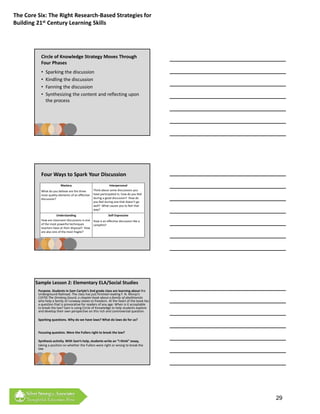
           Circle of Knowledge Strategy Moves Through 
           Four Phases
           •   Sparking the discussion
           •   Kindling the discussion
           •   Fanning the discussion
           •   Synthesizing the content and reflecting upon 
               the process


           Four Ways to Spark Your Discussion
                          Mastery                             Interpersonal
           What do you believe are the three      Think about some discussions you 
           most quality elements of an effective  have participated in, how do you feel 
           discussion?                            during a good discussion?  How do 
                                                  you feel during one that doesn’t go 
                                                  well?  What causes you to feel that 
                                                                      y
                                                  way?
                      Understanding                         Self‐Expressive
           How are classroom discussions is one  How is an effective discussion like a 
           of the most powerful techniques        campfire?
           teachers have at their disposal?  How 
           are also one of the most fragile?


        Sample Lesson 2: Elementary ELA/Social Studies
         Purpose. Students in Sam Carlyle’s 2nd grade class are learning about the 
         Underground Railroad. The class has just finished reading F. N. Monjo’s 
         (1970) The Drinking Gourd, a chapter book about a family of abolitionists 
         who help a family of runaway slaves to freedom. At the heart of the book lies 
         a question that is provocative for readers of any age: When is it acceptable 
         to break the law? Sam is using Circle of Knowledge to help students explore 
         and develop their own perspective on this rich and controversial question.

         Sparking questions. Why do we have laws? What do laws do for us?


         Focusing question. Were the Fullers right to break the law?

         Synthesis activity. With Sam’s help, students write an “I think” essay,
         taking a position on whether the Fullers were right or wrong to break the 
         law.


                                                                                           29
The Core Six: The Right Research‐Based Strategies for 
Building 21st Century Learning Skills


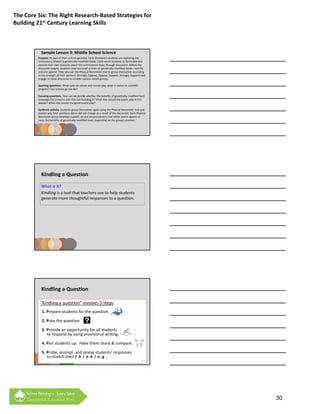
           Sample Lesson 3: Middle School Science
         Purpose. As part of their unit on genetics, Carla Giordana’s students are exploring the 
         controversy related to genetically modified foods. Carla wants students to formulate and 
         express their own opinions about this controversial topic through discussion. Before the 
         discussion begins, students read two brief articles on genetically modified foods—one for 
         and one against. They also use the Physical Barometer tool to group themselves according 
         to the strength of their opinions (Strongly Oppose, Oppose, Support, Strongly Support) and 
         engage in initial discussion in smaller opinion based groups.

         Sparking questions. What roles do values and morals play when it comes to scientific 
         progress? Can science go too far?

         Focusing questions. How can we decide whether the benefits of genetically modified food 
         outweigh the concerns and risks surrounding it? What role should the public play in this 
         debate? What role should the government play?

         Synthesis activity. Students group themselves again using the Physical Barometer tool and 
         explain why their positions did or did not change as a result of the discussion. Each Physical 
         Barometer group develops a public service announcement that either warns against or 
         touts the benefits of genetically modified food, depending on the group’s position.


           Kindling a Question
           What is it?
           Kindling is a tool that teachers use to help students 
           generate more thoughtful responses to a question.


           Kindling a Question

          “Kindling a question” involves 5 steps:
            1. Prepare students for the question.

            2. Pose the question.
            2. Pose the question

            3. Provide an opportunity for all students                                 
               to respond by using provisional writing.

            4. Pair students up.  Have them share & compare.

            5. Probe, prompt, and praise students’ responses                  
               to stretch their t h i n k i n g .
                                                                                                   75


                                                                                                           30
The Core Six: The Right Research‐Based Strategies for 
Building 21st Century Learning Skills


          Prepare

          Take a moment to reflect on your classroom 
          practice.  See yourself posing a question to your 
          students.  What do you see or hear?


          Pose the question

          According to the research of Mary Bud Rowe, 
          most teachers wait less than three seconds after 
          they ask a question to get a response.  The 
          research demonstrated that if teachers waited 
          ten to twenty seconds after posing a question 
          students’ responses would be longer and more 
          thoughtful.


          Pose the question

          Most teachers have heard of Rowe’s research, 
          yet wait time is still an issue in many classrooms.

                     Why don’t teachers wait?
                     Why don’t teachers wait? 
                    What’s causing them to rush?


                                                                31
The Core Six: The Right Research‐Based Strategies for 
Building 21st Century Learning Skills


          Provide time to respond

          Jot down, scribble, or draw at least two ideas on 
          your paper that explains why teachers don’t wait.


          Pair students up

          Meet with a partner share your responses try to 
          decide on the number one reason you believe 
          teachers don’t wait.


          Probe, prompt, and praise students’ responses         
          to stretch their t h i n k i n g .
          Q‐SPACE to fan your discussion and extend 
          student thinking
             Questing—search/journey before and after thinking
             Silence before and after thinking
             Silence before and after thinking
             Probing for evidence
             Acceptance—provisional
             Clarifying—specificty and meaning
             Elaboration—extending and applying


                                                                   32
The Core Six: The Right Research‐Based Strategies for 
Building 21st Century Learning Skills


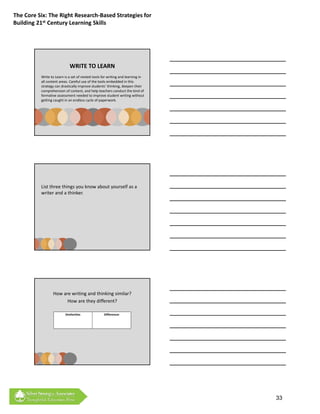
                            WRITE TO LEARN
          Write to Learn is a set of nested tools for writing and learning in 
          all content areas. Careful use of the tools embedded in this 
          strategy can drastically improve students’ thinking, deepen their 
          comprehension of content, and help teachers conduct the kind of 
               p                      ,        p
          formative assessment needed to improve student writing without 
          getting caught in an endless cycle of paperwork.


          List three things you know about yourself as a 
          writer and a thinker.


                 How are writing and thinking similar? 
                       How are they different?

                         Similarities              Differences


                                                                                 33
The Core Six: The Right Research‐Based Strategies for 
Building 21st Century Learning Skills


          How can we use writing as a strategy to teach 
          content and to assess learning?


          Three Reasons for Using Write to Learn
          to Address the Common Core
          1. Writing develops higher‐order thinking
          • Writing “allows us to see conceptual relationships, to 
            acquire insights, and to unravel the logic of what was 
            previously murky or confusing” (Schmoker, 2011, p. 
            211). 

          • Help students shape their thinking into more 
            powerful, refined products.


          Three Reasons for Using Write to Learn
          to Address the Common Core
          2. Writing in different text types. 
          • Write to learn helps students develop high‐quality 
            written responses  in arguments (W.CCR.1); 
            informative/explanatory texts (W.CCR.2); and 
            narratives (W.CCR.3). 


                                                                      34
The Core Six: The Right Research‐Based Strategies for 
Building 21st Century Learning Skills


          Three Reasons for Using Write to Learn
          to Address the Common Core
          3. Range of writing. 
          • Write to Learn provides teachers and students with 
            various writing formats and tools that support a wide 
            range of objectives and writing demands.


          The Research Behind Write to Learn
          “Writing is the skill most directly related to 
          improved scores in reading, social studies, 
          science, and even mathematics.”

          It also brings “engagement, interest, and fun” to 
          the classroom.

                                                       Douglass Reeves,
                                                   Reason to Write, 2002


          The Research Behind Write to Learn
          In 2010, researchers from Vanderbilt University 
          conducted a meta‐analysis of more than 100 studies on 
          writing in the classroom.  They found that asking 
          students to write regularly has significant and positive 
          i
          impact on their comprehension.
                t th i            h i

                                                    Graham, S., & Hebert, M. (2010)
                                       Writing to read: Evidence for how writing can 
                                           improve reading (A report from Carnegie 
                                                            Corporation of New York)


                                                                                        35
The Core Six: The Right Research‐Based Strategies for 
Building 21st Century Learning Skills


          The Research Behind Write to Learn

          According to David Conley (2007), perhaps the 
          foremost expert on college readiness, “If we 
          could institute only one change to make 
          students more college ready, it should be to 
                               g      y,
          increase the amount and quality of writing 
          students are expected to produce” (pp. 27–28).


          Classroom Writing and Write to Learn
          Write to Learn involves three different types of 
          classroom writing:
              • Provisional
              • Readable
              • Polished

           What do you think are the differences between each of 
             these types of writing?  Discuss with a neighbor.


          Implementing Write to Learn in the Classroom

          Provisional Writing
          Provisional writing is a form of quick writing, like 
          brainstorming, that slows down and opens up the 
          thinking process. Students write spontaneously for two 
          to five minutes to generate, clarify, or extend ideas or 
          to react to important content.


                                                                      36
The Core Six: The Right Research‐Based Strategies for 
Building 21st Century Learning Skills


            Provisional Writing Tools
            Learning Logs
            A Learning Log is an active response journal that 
            infuses writing into the daily instructional routine.


            Provisional Writing Tools
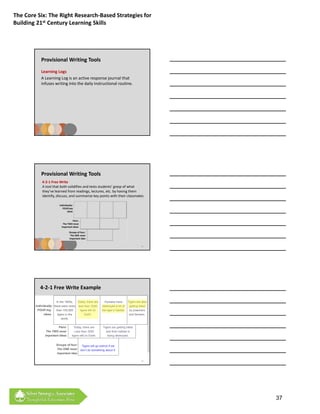
            4‐2‐1 Free Write
            A tool that both solidifies and tests students’ grasp of what 
            they’ve learned from readings, lectures, etc. by having them 
            identify, discuss, and summarize key points with their classmates

                         Individually:
                            FOUR key 
                                ideas


                                     Pairs:
                            The TWO most 
                           important ideas

                                 Groups of four:
                                  The ONE most 
                                 important idea


                                                                                           95


           4‐2‐1 Free Write Example

                        In the 1900s,  Today, there are       Humans have        Tigers are also
        Individually: there were more less than 3200        destroyed a lot of    getting killed
         FOUR key       than 100,000     tigers left on     the tiger’s habitat.  by poachers
              ideas      tigers in the       Earth.                               and farmers.
                            world.

                        Pairs:        Today, there are      Tigers are getting killed
                The TWO most           Less than 3200         and their habitat is
               important ideas      tigers left on Earth.      being destroyed.


                       Groups of four: Tigers will go extinct if we
                       The ONE most don’t do something about it.
                       important idea

                                                                                           96


                                                                                                   37
The Core Six: The Right Research‐Based Strategies for 
Building 21st Century Learning Skills


            Readable Writing Tools
           Readable writing, like a classroom essay test or 
           assignment, requires students to clarify their thoughts 
           and develop an organizational structure for their ideas. 
           Unlike provisional writing, readable writing is intended 
           f
           for an audience—usually the teacher, who uses it to 
                    di             ll th t h        h        it t
           assess students’ depth of understanding and ability to 
           construct soundly reasoned responses.


            Readable Writing Tools

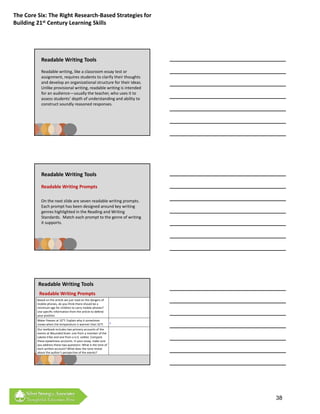
            Readable Writing Prompts

            On the next slide are seven readable writing prompts.  
            Each prompt has been designed around key writing
            Each prompt has been designed around key writing 
            genres highlighted in the Reading and Writing 
            Standards.  Match each prompt to the genre of writing 
            it supports.


         Readable Writing Tools
          Readable Writing Prompts
         Based on the article we just read on the dangers of 
         mobile phones, do you think there should be a 
         minimum age for children to carry mobile phones?                  Argument
         Use specific information from the article to defend 
         your position.
                                  p       y
         Water freezes at 32°F. Explain why it sometimes 
         snows when the temperature is warmer than 32°F.         Informative/explanatory text
         Our textbook includes two primary accounts of the 
         events at Wounded Knee: one from a member of the 
         Lakota tribe and one from a U.S. soldier. Compare 
         these eyewitness accounts. In your essay, make sure              Comparison
         you address these two questions: What is the tone of 
         each written account? What does the tone reveal 
         about the author’s perspective of the events?


                                                                                                38
The Core Six: The Right Research‐Based Strategies for 
Building 21st Century Learning Skills


         Readable Writing Tools
          Readable Writing Prompts
         We have learned a lot about honeybees. Now it’s your
         turn to imagine yourself as a honeybee. Give yourself a 
                                                                                 Narrative
         name, draw yourself, and describe three things you do 
         during your day.
         Select one of Edgar Allan Poe’s horror stories that we read 
         during this unit. Conduct a literary analysis of the story by 
         explaining how Poe achieves the “unity of effect” he 
         explaining how Poe achieves the  unity of effect he
                                                                             Analysis (textual)
                                                                                 y (          )
         describes in his essay “The Philosophy of Composition.”
         Analyze the data charts showing the sales for best‐selling 
         fiction titles in hardcover, paperback, and e‐book formats 
         over the last 10 years. What conclusions can you draw?           Analysis (mathematical)
         What do you anticipate the sales in each format to be 10 
         years from now? Explain your reasoning.
         After reading the first few vignettes in Sandra Cisneros’s
         The House on Mango Street, briefly describe the character              Description
         Esperanza and her Chicago neighborhood.


            Readable Writing Tools
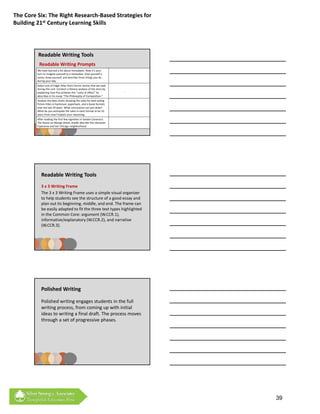
            3 x 3 Writing Frame
            The 3 x 3 Writing Frame uses a simple visual organizer 
            to help students see the structure of a good essay and 
            plan out its beginning, middle, and end. The frame can 
            be easily adapted to fit the three text types highlighted 
            in the Common Core: argument (W.CCR.1), 
            informative/explanatory (W.CCR.2), and narrative 
            (W.CCR.3).


            Polished Writing

            Polished writing engages students in the full 
            writing process, from coming up with initial 
            ideas to writing a final draft. The process moves 
            through a set of progressive phases.
                  g          p g           p


                                                                                                    39
The Core Six: The Right Research‐Based Strategies for 
Building 21st Century Learning Skills


          Polished Writing Tools
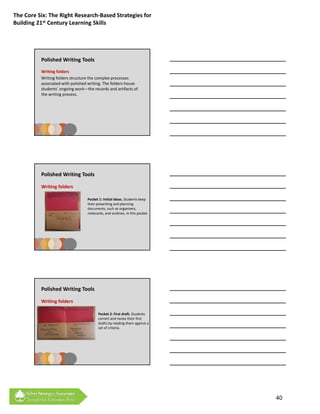
          Writing folders
          Writing folders structure the complex processes 
          associated with polished writing. The folders house 
          students’ ongoing work—the records and artifacts of 
          the writing process.


          Polished Writing Tools

          Writing folders

                                  Pocket 1: Initial ideas. Students keep 
                                  their prewriting and planning 
                                  documents, such as organizers, 
                                  notecards, and outlines, in this pocket.


          Polished Writing Tools

          Writing folders

                                         Pocket 2: First draft. Students 
                                         correct and revise their first 
                                         drafts by reading them against a 
                                         set of criteria.


                                                                             40
The Core Six: The Right Research‐Based Strategies for 
Building 21st Century Learning Skills


          Polished Writing Tools
                                   Pocket 3: Second draft. Students use the 
          Writing folders          third pocket to shape their first draft into a 
                                   second draft. Students read aloud their 
                                   second drafts to a group of fellow writers 
                                   called a Writer’s Club. After the reading, 
                                   members of the Writer’s Club provide 
                                   f db k d
                                   feedback and constructive criticism based 
                                                       t ti       iti i b d
                                   on three criteria:
                                   • Does the composition complete the 
                                      requirements of the assignment?
                                   • Does it sound good? Is it highly readable?
                                   • Has the writer used the specific first‐draft 
                                     criteria to check and revise the 
                                     composition?


          Polished Writing Tools
          Writer’s Club
          The Writer’s Club is a support and feedback group for 
          writers that can be set up in various ways. For example, 
          members can choose to read their own pieces aloud, or 
          members can read one another’s pieces to help each 
          writer notice where his or her writing causes the reader 
          to falter.


          Let’s Participate in a Writer’s Club
          1. Form a a group of five participants
          2. One person will be the writer and read the 
             piece, “Life in Jamestown.”
          3. Each member of the team will pick one 
                                              p
             question from the Writer’s Club Discussion 
             Questions to respond to (one from each box).
          4. The writer will listen to the club member’s 
             responses and reflect on how to improve the 
             piece.


        See next page for reading


                                                                                     41
Jamestown Colony on the Brink of Ruin! 
                                                            
                                                            
This could easily have been a headline in the 1620s. Plymouth Colony and Jamestown were the first two 
settlements established by the English on the North American continent. Although neither of these colonial 
ventures  found  it  easy  to  establish  a  successful  and  independent  settlement,  the  Virginia  colony  at 
Jamestown was in the greatest peril. Within its first 20 years, Jamestown had a death rate that was 75–80 
percent of its population! Nearly 6,000 people had immigrated to Jamestown, but by 1622 there were only 
700 residents left. By this time the local Native American tribes had moved into the interior and posed little 
danger. 
 
What Happened to All the People? 
As  a  student  of  history,  you  have  been  asked  to  join  a  historical  study  team  to  determine  just  what 
conditions would result in such a large drop in population. Your challenge is to examine the clues provided 
and construct a theory that explains what happened in Jamestown. 

Specifically, your mission is to answer these questions: 
        • What was going on in the colony at the time? 
        • What was the cause of the excessive death rate? 
        • Who was dying? 
        • Why did the high death rate last for so long?  


                                                                                                                  42
 
          
Writer’s Club Discussion Questions 
          
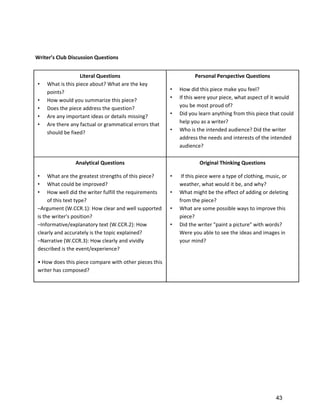
                   Literal Questions                                Personal Perspective Questions 
•   What is this piece about? What are the key 
    points?                                              •   How did this piece make you feel? 
•   How would you summarize this piece?                  •   If this were your piece, what aspect of it would 
•   Does the piece address the question?                     you be most proud of? 
•   Are any important ideas or details missing?          •   Did you learn anything from this piece that could 
•   Are there any factual or grammatical errors that         help you as a writer? 
    should be fixed?                                     •   Who is the intended audience? Did the writer 
                                                             address the needs and interests of the intended 
                                                             audience?  

                Analytical Questions                                  Original Thinking Questions 

•    What are the greatest strengths of this piece?      •    If this piece were a type of clothing, music, or 
•    What could be improved?                                 weather, what would it be, and why? 
•    How well did the writer fulfill the requirements    •   What might be the effect of adding or deleting 
     of this text type?                                      from the piece? 
–Argument (W.CCR.1): How clear and well supported        •   What are some possible ways to improve this 
is the writer's position?                                    piece? 
–Informative/explanatory text (W.CCR.2): How             •   Did the writer "paint a picture" with words? 
clearly and accurately is the topic explained?               Were you able to see the ideas and images in 
–Narrative (W.CCR.3): How clearly and vividly                your mind?  
described is the event/experience? 

• How does this piece compare with other pieces this 
writer has composed?  


                                                                                                        43
The Core Six: The Right Research‐Based Strategies for 
Building 21st Century Learning Skills


                                   Jamestown Colony on the Brink of Ruin!

        This could easily have been a headline in the 1620s. Plymouth Colony and Jamestown
        were the first two settlements established by the English on the North American 
        continent. Although neither of these colonial ventures found it easy to establish a 
        successful and independent settlement, the Virginia colony at Jamestown was in the 
        greatest peril. Within its first 20 years, Jamestown had a death rate that was 75–80 
        percent of its population! Nearly 6,000 people had immigrated to Jamestown, but by 
        1622 there were only 700 residents left. By this time the local Native American tribes 
        had moved into the interior and posed little danger.

        What Happened to All the People?
        As a student of history, you have been asked to join a historical study team to 
        determine just what conditions would result in such a large drop in population. Your 
        challenge is to examine the clues provided and construct a theory that explains what 
        happened in Jamestown.

        Specifically, your mission is to answer these questions:
        • What was going on in the colony at the time?
        • What was the cause of the excessive death rate?
        • Who was dying?
        • Why did the high death rate last for so long?


           Writer’s Club Discussion Questions
                       Literal Questions                         Personal Perspective Questions
        • What is this piece about? What are the key     • How did this piece make you feel?
          points?                                        • If this were your piece, what aspect of it 
        • How would you summarize this piece?              would you be most proud of?
        • Does the piece address the question?           • Did you learn anything from this piece that 
        • Are any important ideas or details missing?      could help you as a writer?
        • Are there any factual or grammatical errors    • Who is the intended audience? Did the 
          that should be fixed?                            writer address the needs and interests of 
                                                           the intended audience?
                     Analytical Questions                          Original Thinking Questions
        • What are the greatest strengths of this piece? • If this piece were a type of clothing, music, 
        • What could be improved?                           or weather, what would it be, and why?
        • How well did the writer fulfill the             • What might be the effect of adding or 
          requirements of this text type?                   deleting from the piece?
           –Argument (W.CCR.1): How clear and well        • What are some possible ways to improve this 
           supported is the writer's position?              piece?
           –Informative/explanatory text (W.CCR.2): How   • Did the writer "paint a picture" with words? 
           clearly and accurately is the topic explained?   Were you able to see the ideas and images in 
           –Narrative (W.CCR.3): How clearly and vividly 
                                                            your mind?
          described is the event/experience?
        • How does this piece compare with other 
         pieces this writer has composed?


                                  VOCABULARY’S CODE
               Vocabulary’s CODE is a strategic approach to direct vocabulary 
               instruction that helps students master crucial concepts and 
               retain new vocabulary terms. Students work their way from 
               initial exposure to in‐depth understanding through a series of 
                  t a e posu e to dept u de sta d g t oug a se es o
               progressive learning activities, which help students “crack” 
               Vocabulary’s CODE.


                                                                                                            44
The Core Six: The Right Research‐Based Strategies for 
Building 21st Century Learning Skills


          Three Reasons for Using Vocabulary’s CODE 
          to Address the Common Core
          1. Vocabulary is a foundation for improved literacy.
          2. Academic vocabulary is at the core of the Core.
          3. Vocabulary fuels learning.


          The Research Behind Vocabulary’s CODE
          • Vocabulary instruction has the greatest effect when it focuses on a 
            reasonable number of important academic terms rather than o high‐
            frequency word lists (Marzano, 2004).

          • Developing anything more than a superficial understanding of new 
            terms requires multiple exposures to the terms (Jenkins, Stein, & 
            Wysocki, 1984).
            Wysocki, 1984).

          • Understanding and retention improve when students interact with 
            words in a variety of ways (Beck, McKeown, & Kucan, 2002).

          • Students need opportunities to think deeply about new words using 
            thinking strategies like comparison, metaphors, and nonlinguistic 
            representation (Marzano, 2004).


           Vocabulary words are the building blocks 
           for future learning.
           for future learning
                                                        (Robert Marzano 2004)


            The more you know the more you can know.

                                                                             114


                                                                                   45
The Core Six: The Right Research‐Based Strategies for 
Building 21st Century Learning Skills


          If we except To close the achievement gap we 
          must close the vocabulary gap.  That is why 
          teaching vocabulary is one of the most 
          i     t t i t ti        ld i i               k
          important instructional decisions you can make.


                                                                 115


                Experiencing Vocabulary’s CODE

                       A Brain Based Approach to
                        Learning New Vocabulary


          The Most Bizarre Meeting Ever
          1. Read the passage.  It contains what Erin McKean calls 
             “Weird and Wonderful World”.
          2. Generate a preliminary definition for each new 
             underlined word.  Record your definition in the “My 
             Educated Definition” column of the organizer.
          3. Meet with a partner. Discuss your preliminary 
             d f
             definitions and how you came up with them.
                           dh                      h h
          4. Compare your definition with the actual definition.  
             Jot down then significant differences between your 
             definition and the actual definition.
          5. Continue the activities to complete the phases of 
             CODE. 


          See next page for activities


                                                                       46
Part 1: Learning the Compare & Contrast Strategy


Experiencing Vocabulary’s CODE
We’re coming to the end of Part One of this Resource Guide. But before we wrap things up, we’d like
you to experience the four phases of CODE.

Below you will find a short reading called “The Most Bizarre Meeting Ever.” In it are a number of
unfamiliar words, which have been underlined. In the set of activities that follow, you will become
“intimate” with these words by moving through the four phases of CODE. When you’re done, go back
to your glossary (Figure 1.17) and list the specific techniques that were used in this lesson for each
phase of CODE. Begin by reading the passage below and seeing if you can figure out what each
underlined word means.


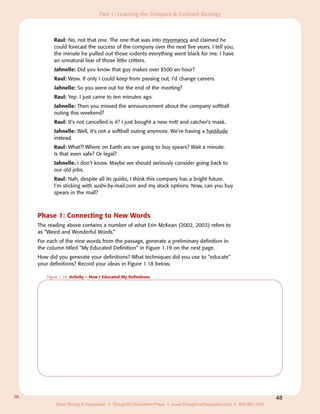
                                 The Most Bizarre Meeting Ever
       Raul: That had to be the most bizarre meeting ever.
       Jahnelle: I don’t know whether to laugh or cry. I guess that’s what happens
       when your boss is suffering from the world’s worst case of torschlusspanik.
       Raul: Tell me about it! He peenged on and on about how he used to be a
       world class swimmer—how he used to “cut through the water like a torpedo”
       and how he used to look like “a million bucks in a Speedo.”
       Jahnelle: Did you see when he held up the picture of himself from his
       Speedo days and said, “Once upon a time I was a Speedo-sporting, back-
       stroke god. I was admired by women on four separate continents. Now I’m a
       Nobodaddy.”
       Raul: No. How could I have missed that? It must have happened right when
       Jake started to flaffer around the room in his overly-starched suit showing
       everyone his collection of breath mint wrappers from restaurants around
       Houston.
       Jahnelle: What a nihilarian!
       Raul: I do remember when Wendy got up and told the boss that she
       thought he looked more godlike than ever, and that she was sure he could
       beat his old swimming times. I mean, she’s got to be trying to make the
       boss look like a complete fool for some devious purpose. I think she’s trying
       to ruin us.
       Jahnelle: Whether Wendy’s a lordswike or not, I just wish the boss hadn’t
       taken her so seriously. I did not need to see him strip down and conduct the
       rest of the meeting in his Speedo to prove that he still had it. By the way, is
       that when you fainted?
       Raul: Yes, but it wasn’t because of that. Did you see the consultants the boss
       called in to bring fresh new ideas into the company?
       Jahnelle: Do you mean the guy with the eye patch and the parrot who
       handed out “free” copies of his book, Managing Like a Kye: How to Save
       Money the Pirate’s Way and then wanted to charge us $20 per book at the
       end of the meeting?


                                                                                                              47   25
       Silver Strong & Associates • Thoughtful Education Press • www.ThoughtfulClassroom.com • 800.962.4432
Part 1: Learning the Compare & Contrast Strategy


           Raul: No, not that one. The one that was into myomancy and claimed he
           could forecast the success of the company over the next five years. I tell you,
           the minute he pulled out those rodents everything went black for me. I have
           an unnatural fear of those little critters.
           Jahnelle: Did you know that guy makes over $500 an hour?
           Raul: Wow. If only I could keep from passing out, I’d change careers.
           Jahnelle: So you were out for the end of the meeting?
           Raul: Yep. I just came to ten minutes ago.
           Jahnelle: Then you missed the announcement about the company softball
           outing this weekend?
           Raul: It’s not cancelled is it? I just bought a new mitt and catcher’s mask.
           Jahnelle: Well, it’s not a softball outing anymore. We’re having a hastilude
           instead.
           Raul: What?! Where on Earth are we going to buy spears? Wait a minute.
           Is that even safe? Or legal?
           Jahnelle: I don’t know. Maybe we should seriously consider going back to
           our old jobs.
           Raul: Nah, despite all its quirks, I think this company has a bright future.
           I’m sticking with sushi-by-mail.com and my stock options. Now, can you buy
           spears in the mall?


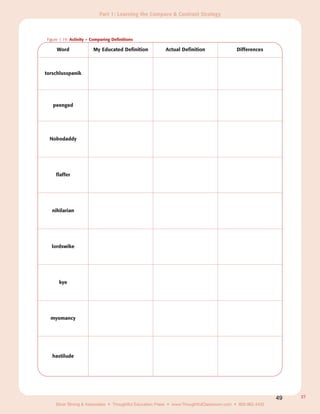
     Phase 1: Connecting to New Words
     The reading above contains a number of what Erin McKean (2002, 2003) refers to
     as “Weird and Wonderful Words.”
     For each of the nine words from the passage, generate a preliminary definition in
     the column titled “My Educated Definition” in Figure 1.19 on the next page.
     How did you generate your definitions? What techniques did you use to “educate”
     your definitions? Record your ideas in Figure 1.18 below.

        Figure 1.18: Activity – How I Educated My Definitions


26                                                                                                                 48
            Silver Strong & Associates • Thoughtful Education Press • www.ThoughtfulClassroom.com • 800.962.4432
Part 1: Learning the Compare & Contrast Strategy


Figure 1.19: Activity – Comparing Definitions

     Word               My Educated Definition          Actual Definition                 Differences


torschlusspanik


   peenged


 Nobodaddy


    flaffer


  nihilarian


  lordswike


      kye


  myomancy


   hastilude


                                                                                                           49   27
    Silver Strong & Associates • Thoughtful Education Press • www.ThoughtfulClassroom.com • 800.962.4432
Part 1: Learning the Compare & Contrast Strategy


     How Close Were You?
     Here are the nine words defined. How close were your educated definitions? What subtleties, or
     shades, of meaning did you miss? Note the differences between your educated definition and the
     actual definition in the “Differences” column in Figure 1.19.

        Figure 1.20: Activity – Comparing Definitions

              Word                                                    Definition


                                   A German word that literally means “shut door panic.” It is similar to a
         torschlusspanik
                                   mid-life crisis or the fear that life is passing by too quickly.


            peenged                To whine while complaining.


                                   A term coined by English poet William Blake. The word is a combination
           Nobodaddy               of nobody and daddy and means someone who is no longer worthy
                                   of admiration.


              flaffer              Tol make noise while moving.


            nihilarian             Someone who is concerned with things that are of no interest to others.


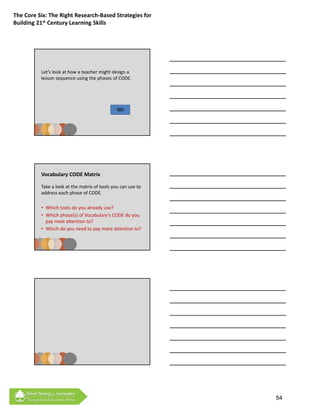
           lordswike               Traitor, from Old English roots that literally mean ‘lord deceiver.’


               kye                 A cheap and greedy sailor.


           myomancy                Archaic practice of using the movements of mice to predict the future.


            hastilude              Latin for “spear play.” It refers to Medieval competitions involving spears.


28                                                                                                                 50
            Silver Strong & Associates • Thoughtful Education Press • www.ThoughtfulClassroom.com • 800.962.4432
Part 1: Learning the Compare & Contrast Strategy


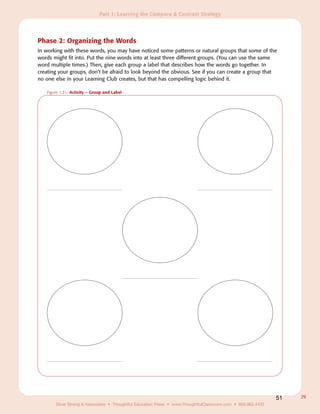
Phase 2: Organizing the Words
In working with these words, you may have noticed some patterns or natural groups that some of the
words might fit into. Put the nine words into at least three different groups. (You can use the same
word multiple times.) Then, give each group a label that describes how the words go together. In
creating your groups, don’t be afraid to look beyond the obvious. See if you can create a group that
no one else in your Learning Club creates, but that has compelling logic behind it.

   Figure 1.21: Activity – Group and Label


                                                                                                              51   29
       Silver Strong & Associates • Thoughtful Education Press • www.ThoughtfulClassroom.com • 800.962.4432
Part 1: Learning the Compare & Contrast Strategy


     Phase 3: Deep Processing New Words

     It’s Kinda Like...
     From the nine words, pick one—any one, your favorite one. Use it to create a simile in Figure 1.22. How
     is your word like something else? Below your simile, explain the relationship between the two items.

         Figure 1.22: Activity – Simile


         _______________________________ is like _______________________________…
                  (your favorite word)

         Here’s how:


     Picture This...
     Now use Figure 1.23 to create a visual icon for three different words:

         Figure 1.23: Activity – Visualizing Vocabulary


30                                                                                                                  52
             Silver Strong & Associates • Thoughtful Education Press • www.ThoughtfulClassroom.com • 800.962.4432
Part 1: Learning the Compare & Contrast Strategy


Phase 4: Exercising Your Words

The Proof Is in the Pudding Writing
Now that you’ve gotten intimate with a number of weird and wonderful words, it’s time to put
those words to use. Use Figure 1.24 below to write a short, creative piece that uses at least five
of the nine words.

    Figure 1.24: Activity – Parawriting


Don’t forget to go back to the fourth column of your glossary (Figure 1.17) and list the
techniques used during this lesson.


                                                                                                               53   31
        Silver Strong & Associates • Thoughtful Education Press • www.ThoughtfulClassroom.com • 800.962.4432
The Core Six: The Right Research‐Based Strategies for 
Building 21st Century Learning Skills


          Let’s look at how a teacher might design a 
          lesson sequence using the phases of CODE.


          Vocabulary CODE Matrix

          Take a look at the matrix of tools you can use to 
          address each phase of CODE.

          • Which tools do you already use?
            Which tools do you already use?
          • Which phase(s) of Vocabulary’s CODE do you 
            pay most attention to?
          • Which do you need to pay more attention to?


         See next page for matrix


          • Add conclusion


                                                               54
P R A CT I C A L TO O LS                                                           Side
                                                                                                                                      1


                                                                                                                                                                                                                                                           PLEASE NOTE: THIS PAGE IS REPRODUCIBLE FOR USE BY THE INDIVIDUAL USER OF THIS PORTFOLIO ONLY. PERMISSION IS NOT GRANTED FOR MASS OR ELECTRONIC REPRODUCTION AND DISTRIBUTION
                                    F O R C R AC K I N G VO C A B U L A RY ’ S CO D E
    The research is clear: If we want students to master vocabulary, they will need to be exposed
    to the new terms multiple times and in a variety of ways. While the four phases of C.O.D.E. naturally
    lead students to CONNECT, ORGANIZE, DEEP PROCESS and EXERCISE new terms, the question of what strategies
    to use in the classroom remains. Below is a matrix of vocabulary tools and strategies organized according to the
    four phases of C.O.D.E. As you plan your unit, refer to this matrix to help select appropriate strategies for each
    phase and to ensure deep learning.


                                                                                                                                                                     ADDITIONAL COPIES OF THIS FORM MAY BE DOWNLOADED AT WWW.THOUGHTFULED.COM/PORTFOLIOS
                 C                                 O                               D                              E
    ■ Word Walls                     ■ Prioritizing                   ■ Visualizing                  ■ Vocabulary Games
    A collection of words            Vocabulary                       Vocabulary                     Using Bingo, Jeopardy,
    organized into categories        Teacher or students              Creating visual images,        Word Baseball, etc. to
    and posted on the wall for       determine which words are        sketches, or icons             review vocabulary in a
    students to use in their         essential, important, and        with brief explanations        competitive and fun
    reading and writing.             good to know.                    to demonstrate                 manner.
                                                                      understanding.

    ■ Power Decoding                 ■ Key Vocabulary                 ■ Multi-sensory                ■ Write to Learn
    Teaching students attack         Organizer                        Processing                     Students are asked to use
    skills for new words:            A concept definition map         A technique that               a specific number of new
    prefixes, suffixes, roots,       that establishes the larger      encourages students to         words in their writing
    context clues, substitutions.    categories that key concepts     explore important words        assignments.
                                     fit into, critical attributes,   using words, feelings,
                                     examples, and related            sensory information, and
                                     concepts.                        visualization.

    ■ Word Spiders                   ■ Categorizing                   ■ Storytelling                 ■ Team Games
    Teacher introduces               Teacher or students place a      Students analyze a             Tournament
    eight words that are             list of words into specific      selection of stories, then     Students are divided up
    associated with a mystery,       categories.                      use basic story elements to    into heterogeneous study
    one word for each leg of                                          define important concepts.     groups to review words,
    the spider organizer.                                                                            then compete in
    Students try to guess the                                                                        homogenous groups to
    mystery word.                                                                                    earn points for their team.


    ■ Associations                   ■ Concept Maps                   ■ Metaphors                    ■ Vocabulary Carousel
    Students generate words,         A technique used                 Students learn words           Teacher sets up 5 or 6
    pictures, feelings, physical     to create visual                 deeply by exploring their      stations. Students work in
    reactions to words. There is     representations of               relationships to other         small groups at all stations.
    no right or wrong, just          hierarchical relationships       words/concepts (e.g.,          Stations include a variety of
    what comes to mind.              between a central concept,       How is democracy like          vocabulary activities.
                                     supporting ideas, and            baseball?).
                                     important details

    ■ See It, Say It,                ■ Fist List                      ■ Defining                     ■ Effective Practice
    Show It, Store It                Teacher provides a category      Characteristics                Teacher instructs students
    Students look at the word,       in the “palm” of a hand          Students build multi-          in the principles of effective
                                                                                                                                       HS-001 WWPIG -BK-PIH 030505


    pronounce it slowly, record      organizer; students              layered definitions by         practice, including how to
    its meaning, draw a picture      generate 5 words that fit        focusing on essential          mass and distribute review
    with a brief explanation,        the category, one for each       characteristics: What is it?   sessions, use words often,
    and store the word in their      finger of the hand               What is it used for? Why is    and make stronger
    Vocabulary Journals.             organizer.                       it valued? What kind is it?    connections.
                                                                      Where does it come from?
                                                                      What does it look, feel,
                                                                      sound, smell like? etc.

                    Silver Strong & Associates • Thoughtful Education Press • www.ThoughtfulEd.com • 800.962.4432
                                                                                                                              55
4
Side
                                                                                                                                                                                                                                                                                                                                                                                                             2
PLEASE NOTE: THIS PAGE IS REPRODUCIBLE FOR USE BY THE INDIVIDUAL USER OF THIS PORTFOLIO ONLY. PERMISSION IS NOT GRANTED FOR MASS OR ELECTRONIC REPRODUCTION AND DISTRIBUTION.


                                                                                                                                                                                                                                                                                    C                                O                                   D                                 E
                                                                                                                                                                                                                                                                      ■ Glossary                        ■ Word Banks                      ■ Etymologies                       ■ Three’s a Crowd
                                                                                                                                                                                                                                                                      Students keep a glossary of       Students examine a list of        Students investigate word           Students decide which
                                                                                                                                                                                                                                                                      new words by defining             words and place them into         histories, analyzing how            word of three doesn’t
                                                                                                                                                                                                                                                                      terms in their own words          the appropriate slots in a        original meaning is intact          belong and explain why.
                                                                                                                                                                                                                                                                      and including icons or            visual organizer.                 and how it has changed.
                                                                                                                                                                                                                                                                      pictures.


                                                                                                                                                                                                                                                                      ■ Concept Attainment              ■ Group and Label                 ■ Cinquains                         ■ Peer Practice
                                                                                                                                                                                ADDITIONAL COPIES OF THIS FORM MAY BE DOWNLOADED AT WWW.THOUGHTFULED.COM/PORTFOLIOS


                                                                                                                                                                                                                                                                      The teacher presents yes          Students examine a list of        A five-line poem used to            A reciprocal learning
                                                                                                                                                                                                                                                                      and no examples of a              vocabulary words and              define a term:                      strategy in which students
                                                                                                                                                                                                                                                                      concept in order to help          place them into groups            • noun: coal                        work as peer partners. One
                                                                                                                                                                                                                                                                      students determine its            based on common                                                       student serves as a coach,
                                                                                                                                                                                                                                                                                                                                          • two adjectives: black and shiny
                                                                                                                                                                                                                                                                      critical attributes. Students     characteristics. For each                                             the other as a player. While
                                                                                                                                                                                                                                                                                                                                          • three action verbs: smolder,
                                                                                                                                                                                                                                                                      use the critical attributes to    group that students create,                                           the player works to define
                                                                                                                                                                                                                                                                                                                                            burn, pollute
                                                                                                                                                                                                                                                                      distinguish among                 they devise a label that                                              key terms from the unit,
                                                                                                                                                                                                                                                                      examples and generate             describes what all the            • four-word sentence or phrase:     the coach provides
                                                                                                                                                                                                                                                                                                                                            a source of energy
                                                                                                                                                                                                                                                                      their own examples.               grouped words have in                                                 assistance, feedback, and
                                                                                                                                                                                                                                                                      Excellent for rich concepts       common.                           • ending word: limited              praise. Students then
                                                                                                                                                                                                                                                                      with clear attributes, like                                                                             reverse roles.
                                                                                                                                                                                                                                                                      ”tragic hero.”


                                                                                                                                                                                                                                                                      ■ Exploring Multiple              ■ A Three-Way Tie                 ■ Compare and                       ■ Boggle
                                                                                                                                                                                                                                                                      Meanings                          Students select three words       Contrast                            After independent review,
                                                                                                                                                                                                                                                                      Students explore and use          from a unit’s vocabulary          Students set two rich               students retrieve all the
                                                                                                                                                                                                                                                                      words that have the same          and arrange them in a             concepts against one                vocabulary they can.
                                                                                                                                                                                                                                                                      sound but different               triangle. They then connect       another and describe each           Students join a group
                                                                                                                                                                                                                                                                      meanings (homophones).            the words with lines and          separately. They then use           of 3-5 students, compare
                                                                                                                                                                                                                                                                                                        explain the relationship          their descriptions to draw          lists, and add any words
                                                                                                                                                                                                                                                                                                        between each word by              out the deep similarities           or meanings they missed.
                                                                                                                                                                                                                                                                                                        writing along the lines.          and differences between             Students then leave their
                                                                                                                                                                                                                                                                                                                                          the two concepts. Finally,          team to “Boggle” with other
                                                                                                                                                                                                                                                                                                                                          students must decide if the         students, gaining points for
                                                                                                                                                                                                                                                                                                                                          two concepts are more               terms and meanings that
                                                                                                                                                                                                                                                                                                                                          similar or more different,          appear on their list but not
                                                                                                                                                                                                                                                                                                                                          and explain why.                    on their competitors’ lists.


                                                                                                                                                                                                                                                                      ■ Word Catcher                    ■ A Diagram to Die For            ■ Crazy Connections                 ■ Para-Writing
                                                                                                                                                                                                                                                                      Students are asked to             Students are asked to             The student picks a word            Students write a paragraph
                                                                                                                                                                                                                                                                      “catch” a new word each           create a diagram that             out of one hat, then a              or short piece using
                                                                                                                                                                                                                                                                      day.                              shows the relationship            household, classroom, or            between five and fifteen
                                                                                                                                                                                                                                                                                                        among the words on a              odd object out of another.          vocabulary words. Each
                                                                                                                                                                                                                                                                                                        Word Wall.                        The student’s job is to             word must be embedded
                                                                                                                                                                                                                                                                                                                                          generate as many                    meaningfully into the text,
                                                                                                                                                                                                                                                                                                                                          similarities as possible.           or it doesn’t count.


                                                                                                                                                                                                                                                                      ■ Vocabulary Notebook
                                                                                                                                                                                                                                                                                                                                                                                                               HS-001 WWPIG -BK-PIH 030505


                                                                                                                                                                                                                                                                      A notebook in which students collect important words while reading. In their notebooks, students record their initial
                                                                                                                                                                                                                                                                      “educated” definitions. They then look up the word and select the dictionary definition that best fits the word as it is used in
                                                                                                                                                                                                                                                                      the text. Students compare their initial definitions with the actual definition, and describe briefly what differences they note
                                                                                                                                                                                                                                                                      between them. Finally, students create a visual icon to help them process and remember the word’s meaning. The notebook
                                                                                                                                                                                                                                                                      also serves as a great tool for review.

                                                                                                                                                                                                                                                                                                          Please note: This strategy includes all four phases of CODE.


                                                                                                                                                                                                                                                                                      Silver Strong & Associates • Thoughtful Education Press • www.ThoughtfulEd.com • 800.962.4432
                                                                                                                                                                                                                                                                                                                                                                                                     56
                                                                                                                                                                                                                                                                                                                                                                                                                                             5
The Core Six: The Right Research‐Based Strategies for 
Building 21st Century Learning Skills


           Three of the six Anchor Standards for Language, for 
           example, deal directly with vocabulary:
           L.CCR.4    Determine or clarify the meaning of unknown and
                      multiple-meaning words and phrases by using context
                      clues, analyzing meaningful word parts, and consulting
                      general and specialized reference materials, as appropriate.
           L.CCR.5    Demonstrate understanding of figurative language, word
                      relationships and nuances in word meanings.
                      relationships,                       meanings
           L.CCR.6    Acquire and use accurately a range of general academic
                      and domain-specific words and phrases sufficient for
                      reading, writing, speaking, and listening at the college and
                      career readiness level; demonstrate independence in
                      gathering vocabulary knowledge when considering a word
                      or phrase important to comprehension or expression.


                                                                                                       121


        A Unit on Evolution
                                               Connecting
                           Vocabulary Knowledge Rating (VKR)
                           1 = I have never seen/heard of this term (or person)
                           2 = I have seen/heard of this, but don’t really know what it means (or 
                           who person is) 
                           3 = I think I know what this term means (or who this person is) 
                           4 = I know what term means (or who this person is) & I can use it in a 
                           sentence
                           Evolution                        1            2           3             4
                           Natural Selection                1            2           3             4
                           Selection pressure
                                      p                     1            2           3             4
                           Variation                        1            2           3             4
                           Extinction                       1            2           3             4
                           Acquired trait                   1            2           3             4
                           Inherited trait                  1            2           3             4
                           “Fitness”                        1            2           3             4
                           Bacteria                         1            2           3             4
                           Antibiotics                      1            2           3             4
                           Antibiotic‐resistance            1            2           3             4
                           Catastrophism                    1            2           3             4
                           Uniformitarianism                1            2           3             4
                           “Chain of Being”                 1            2           3             4
                           Survival of the fittest          1            2           3             4
                           The Origin of Species            1            2           3             4


        A Unit on Evolution
                                               Organizing
                                         “Connect the Dots”


                                                                          Vocabulary


                     Sea turtles


                                                       Economy


                                                                                                             57
The Core Six: The Right Research‐Based Strategies for 
Building 21st Century Learning Skills


        A Unit on Evolution
                                                 Exercising


               TEAM GAMES TOURNAMENT Is a cooperative
               learning strategy that maximizes the benefits of
               both cooperation and competition while
               minimizing their liabilities by fostering their
               interdependence and individual accountability


                                    Hetrogeneous Collaborative Study Teams
        Yellow                          Green                         Red
        Y#1                             G#1                           R#1
        Y#2                             G#2                           R#2
        Y#3                             G#3                           R#3
        Yellow practices together       Green practices together      Red practices together
                                       Homogeneous Tournament Teams
        Game 1                          Game 2                        Game 3
        Y#1                             Y#2                           Y#3
        G#1                             G#2                           G#3
        R#1                             R#2                           R#3


        A Unit on Evolution
                                                 Exercising
                                    TEAM GAMES TOURNAMENT


                                                                                               58
The Core Six: The Right Research‐Based Strategies for 
Building 21st Century Learning Skills


           Think of a Time ….


           Think of a time when you have been competitive.  
           What did it feel like?  List the advantages and 
           di d t           f         titi
           disadvantages of competition.


                                                              127


           Now, think about situations where you 
           worked together with other people to achieve 
           a team goal.
           Li t
           List some of the advantages and 
                      f th d t           d
           disadvantages of cooperating.


                                                              128


             What are some characteristics a 
             strategy would have to possess in order 
             to combine the assets of both 
             competition and cooperation while
             competition and cooperation while 
             minimizing the liabilities?


                                                              129


                                                                    59
The Core Six: The Right Research‐Based Strategies for 
Building 21st Century Learning Skills


           TEAM GAME TOURNAMENTS

           How can you create a strategy that maximizes 
           the benefits of competition and cooperation and 
           minimizes students’ inabilities?


                                                                   130


          Goals of Team Games Tournament
          1. To provide immediate and positive effect  on student 
             academic success.
          2. To produce positive changes in students’ attitudes 
             toward the class and content matter.
          3. To foster positive working relationships among 
             students by creating an interdependency
             students by creating an interdependency.
          4. To make it possible for students with different learning 
             rates to have an equal opportunity to succeed at an 
             academic task and/or learning goal.
          5. To help students learn HOW to LEARN.

                                                                   131


                    G enerate short answer objective questions and
                       answer sheet for practice session and
                       Tournament play.
                    A rrange students into academically balanced
                       practice teams.

                    Miix tteam members b comparable ability ffor
                                  b    by       bl bilit
                       tournament play.


                    E xplain tournament roles of doer, checker, and
                      challenger.


                    S validate results. team summary sheets to
                      ecure score and
                                                                   132


                                                                         60
The Core Six: The Right Research‐Based Strategies for 
Building 21st Century Learning Skills


                 Phase I: Practice Session
                                         Teammates work together
                                         to practice and help each
                                         other get ready to
          What are the learning          participate in the weekly
          goals?
                                         tournament.
          What are the
          expectations?


          How will teams work
          together to learn the
          content material?

                                                                                  133


            Phase II: Weekly Tournament
                       Games
                              Each student plays against
                              members from other teams,
                              points won for first, second,
                              third, fourth place are given.


                              Groups can play as long as
                              time permits. If they finish the
                              first game, they simple reshuffle
                              cards and begin again.           134


                                  Scoring Points

            Player                  No Ties   Tie for Top   Tie for Low   3 way Tie


            Top Score               6              5          6               4


            Middle Score             4             5          3               4


            Low Score                2            2            3              4

                              Three Player Game
                                                                                  135


                                                                                        61
The Core Six: The Right Research‐Based Strategies for 
Building 21st Century Learning Skills


          Based on past
          performance, top                               Based on past
          scoring students begin                         performance, low
          at table 1.                                    scoring students
                                                         begin at table 8.


                 Table 1           Table 2     Table 3   Table 4


                             Group Assignment

                   Table 5           Table 6   Table 7      Table 8


                                                                      136


                                       Bumping

                 Table 1           Table 2     Table 3   Table 4


          Student compete in Team Games.
          After the first tournament game, students change tables
          based on their tournament performance.
          High performing student at Table 2 for example would
          move to Table 1. Low performing student at Table 2 would
          be bumped to Table 3. The second high scorer would
          remain at Table 2.
                                                                      137


            Phase III: Formative Evaluation
           Data gathering of evidence of changed students’
            attitudes toward the class and subject matter.

           Data gathering of evidence in the working
            relationship of students.

           Data gathering of evidence of improved and
            positive effects upon student academic
            performance.

           6/19/2012                                                  138


                                                                             62
The Core Six: The Right Research‐Based Strategies for 
Building 21st Century Learning Skills


        100%
                                                                         Using TGT
         90%                                                             Without TGT


         80%

                       Closing the Achievement Gap
         70%


         60%


         50%


          30%
                                                      9th Grades Social Studies
                                                      P. Dugan
         20%
        Average
                      Top Achievers               Average Achievers               At Risk139
        Test Scores


              Type 1 Questions require                 Type 2 Questions are posed
              students to construct an answer.         as a riddle.


          Type 6 Questions are                                    Type 3 Questions ask if
          mathematical in nature                                  it is true or not.
          and have one correct
          answer.


                                                         Type 4 Questions have
                               Type 5 Questions          one correct answer and
                               have multiple             may be posed as a
                               correct answers.          multiple choice.
                                                                                         140


              Planning Team Games
                  1. Prepare short answer objective questions and answer 
                     sheets for practice session and tournament play.
                  2. Assign students to practice teams of three or four 
                     members, balance teams academically.
                  3. Assign one member from each team to participate at a 
                     tournament table there should not be more than four per
                     tournament table, there should not be more than four per 
                     table with equal ability.
                  4. Explain the role of player, challenger, and checker.  Review 
                     the rules.
                  5. Collect game score and team summary sheets, validate 
                     results and prepare a method for announcing and 
                     recognizing teams.
                                                                                         141


                                                                                               63

The Core Six: The Right Research-Based Strategies for Building 21st Century Literacy Skills

  • 1.
    The Core Six: The Right Research‐Based Strategies for  Building 21st Century Learning Skills THE CORE SIX:  THE RIGHT RESEARCH‐BASED STRATEGIES FOR BUILDING 21ST CENTURY LEARNING SKILLS Presented by: Tr. Harvey F. Silver EdD Introducing the Core Six The Core Six is a collection of research‐based  strategies that will help teachers and students  respond to the demands of the Common Core. Making Research Work Research has shown us which strategies increase  engagement and raise student achievement,  which allows student learning to take off. 1
  • 2.
    The Core Six: The Right Research‐Based Strategies for  Building 21st Century Learning Skills The Core Six • Reading for Meaning • Compare and Contrast • Inductive Learning • Circle of Knowledge • Write to Learn • Vocabulary’s CODE In this workshop we’ll explore four strategies from  ASCD’s Core Six.  These strategies help teachers address  the four strands in the Common Core ELA Standards. • Reading—Reading for Meaning • Writing—Write to Learn • Speaking and Listening—Circle of Knowledge • Language—Vocabulary’s CODE Reading for Meaning Reading for Meaning helps students develop the  skills that proficient readers use to make sense of  rigorous texts.  The strategy builds these Common Core skills: gy • Managing text complexity. • Evaluating and using evidence. • Developing the core skills of reading (e.g., finding  main ideas, making inferences, and analyzing  characters and content). 2
  • 3.
    The Core Six: The Right Research‐Based Strategies for  Building 21st Century Learning Skills Circle of Knowledge Circle of Knowledge is a strategic framework for  planning and conducting classroom discussions that  engage all students in deeper thinking and  thoughtful communication. The strategy builds these Common Core skills: • Speaking, listening, and presenting. • Integrating and evaluating information. • Collaborating with peers. Write to Learn Write to Learn helps teachers integrate writing into daily  instruction and develop students’ writing skills in the key  text types associated with college and career readiness.  The strategy builds these Common Core skills: • Developing higher‐order thinking through writing. • Writing in the key Common Core text types:  arguments, informative/explanatory texts, and  narratives. • Writing for a wide range of tasks, audiences, and  purposes. Vocabulary’s CODE Vocabulary’s CODE is a strategic approach to  vocabulary instruction that improves students’  ability to retain and use crucial vocabulary terms.  The strategy builds these Common Core skills: The strategy builds these Common Core skills: • Mastering academic vocabulary. • Improving literacy across all strands (reading,  writing, speaking/listening, and language). • Building background knowledge as a foundation  for success in school, college, and career. 3
  • 4.
    The Core Six: The Right Research‐Based Strategies for  Building 21st Century Learning Skills Six Tips for Inspired Instruction 1. Capture students’ interest. 2. Explain the strategy’s purpose and students’  roles in the strategy. 3. Teach the thinking embedded in the strategy. 4. Use discussion and questioning techniques to  extend student thinking. 5. Ask students to synthesize and transfer their  learning. 6. Leave time for reflection. READING FOR MEANING Reading for Meaning is a research‐based strategy that helps all  readers build the skills that proficient readers use to make  sense of challenging texts. Reasons for Using Reading for Meaning to Address the Common Core • Managing text complexity (Reading Anchor 10, Appendix A  in ELA Standards) • Evaluating and using evidence (Reading Anchors 1 and 8,  Writing Anchors 1 and 9) • Developing the core skills of reading, including determining  main ideas (Reading Anchor 2) analyzing characters and main ideas (Reading Anchor 2), analyzing characters and  ideas (Reading Anchor 3), interpreting meanings (Reading  Anchor 4), and assessing point of view (Reading Anchor 6). • Interpreting visual and quantitative information (Reading  Anchor 7) • Reading, interpreting, and solving complex mathematical  problems (Mathematical Practices 1, 2, 3, and 7) 4
  • 5.
    The Core Six: The Right Research‐Based Strategies for  Building 21st Century Learning Skills What is Reading for Meaning? “To read is to fly: it is to soar to a point of vantage which gives a  view over wide terrains of history, human variety, ideas, shared  experience and the fruits of many inquiries.” ‐ A C Grayling, Financial Times (in a review of A History of Reading by Alberto  Manguel) “The habit of reading is the only enjoyment in which there is no  g y j y alloy; it lasts when all other pleasures fade.” ‐ Anthony Trollope “We read to know we are not alone.” ‐ C.S. Lewis “If you can read this, thank a teacher.” ‐ Anonymous teacher What is Reading for Meaning? Is it reading words and understanding them? Are Between Consists Continuously Corresponding Curve Draws Variation Graph If Isolated  With Making Only Often One Points Relation Set Table Values Variables Known 14 What is Reading for Meaning? Draw a picture explaining your understanding of the text below. If the known relation between the variables consists of  a table of corresponding values, the graph consists only  of the corresponding set of isolated points. If the  variables are known to vary continuously one often variables are known to vary continuously, one often  draws a curve to show the variation. ‐Basic Math, 1945. 15 5
  • 6.
    The Core Six: The Right Research‐Based Strategies for  Building 21st Century Learning Skills What is Reading for Meaning? Is it reading words carefully? I cdnuolt blveiee that I cluod aulacity uesdnatnrd what I  was rdanieg. The phaonmeal pweor of the hmuan  mnid. Aoccdrnig to a rscheearch sdtuy at Cmabrigde  Uinervtisy, it deosn’t mttaer in waht oredr the ltteers in  a wrod are, the olny iprmoatnt tihng is that the frist  and lsat ltteer be in the rghit pclae. The rset can be a  taotl mses and you can still raed it wouthit a porbelm.  This is bcuseae the huamn mnid deos not raed ervey  lteter by istlef, but the word as a wlohe. Amzanig huh?  Yaeh and I awlyas thought sipeling was ipmorantt! 16 What is Reading for Meaning? Is it answering comprehension questions? The Montillation of Traxoline It is very important that you learn about traxoline. Traxoline is a  new form of zionter. It is montilled in Ceristanna. The Ceristannians  gristeriate large amounts of fevon and then bracter it to quasel  traxoline. Traxoline may well be one of our most  lukized snezlaus in  the future because of our zionter lescelidge. Why is it important to know about traxoline? Where is traxoline montilled? How is traxoline quaselled? What is traxoline? What is Reading for Meaning? An Anthology of Rigorous Texts Select one of the readings from the Anthology of Rigorous  Texts taken from Reading for Meaning Strategic PLC Guide.   Read your chosen text and be ready to summarize it in your Read your chosen text and be ready to summarize it in your  own words for your partner. What made your text rigorous?   What moves did you make to  comprehend the text you read?  See next page for reading 6
  • 7.
    6 Reading for Meaning Let’s Get Started Adults tend to forget just how challenging the act of making meaning out of the words on a page can be. Thus, we begin this Strategic Teacher PLC Guide on Reading for Meaning with a few short texts that can put us in better touch with the challenges that many of our students face as readers. We deliberately selected these texts as reminders that understanding what we read is not always a snap. We call the following five texts “An Anthology of Rigorous Readings.” Preview all of the read- ings and then pick two for close reading—the one you believe will be the most challenging, and the one you believe will be the least challenging. An Anthology of Rigorous Readings Rea d i n g O n e : R e ad in g T wo : Excerpt from the Federalist Papers, “There’s a certain Slant of light,” “Concerning the General Power of by Emily Dickinson Taxation,” by Alexander Hamilton There’s a certain Slant of light, It has been already observed that the federal Winter Afternoons — government ought to possess the power of pro- That oppresses, like the Heft viding for the support of the national forces; in Of Cathedral Tunes — which proposition was intended to be included the expense of raising troops, of building and Heavenly Hurt, it gives us — equipping fleets, and all other expenses in any We can find no scar, wise connected with military arrangements and But internal difference, operations. But these are not the only objects to Where the Meanings, are — which the jurisdiction of the Union, in respect None may teach it — Any — to revenue, must necessarily be empowered to ‘Tis the Seal Despair — extend. It must embrace a provision for the sup- An imperial affliction port of the national civil list; for the payment of Sent us of the Air — the national debts contracted, or that may be contracted; and, in general, for all those mat- When it comes, the Landscape listens — ters which will call for disbursements out of the Shadows — hold their breath — national treasury. The conclusion is, that there When it goes, ’tis like the Distance must be interwoven, in the frame of the govern- On the look of Death — ment, a general power of taxation, in one shape or another. Pages from Reading for Meaning: How to Build Students' Comprehension, Reasoning, and Problem-Solving Skills Strategic PLC Guide 7 ReadingForMeaning pages.indd 6 12/2/10 12:47 PM
  • 8.
    Section 1: WhyReading for Meaning? 7 R e ad i n g T h r e e : A Description of the Healing Process Adapted from a High School Biology Textbook Endothelial cells bud and grow from existing blood vessels, undergo canalization, and form a vascular network by connecting to other cell buds. New vessels are all similar in appearance, with thin walls made of endothelium. Protein leaks out of the vessels, bathing the wound area in plasma and providing a rich nutrient medium that promotes rapid cell growth. Once this nutrient medium is established, differentiation can begin. Some vessels will become venules, which are large and have thin walls, while others will become arterioles, which have muscular coats. As granulation tissue steadily changes, some vessels will disappear. Those that remain will become part of the capillary bed. R e ad i n g F o u r : Excerpt from The Souls of Black Folk, by W. E. B. Du Bois Between me and the other world there is ever an unasked question: unasked by some through feelings of delicacy; by others through the difficulty of rightly framing it. All, nevertheless, flutter round it. They approach me in a half-hesitant sort of way, eye me curiously or compassionately, and then, instead of saying directly, How does it feel to be a problem? they say, I know an excellent colored man in my town; or, I fought at Mechanicsville; or, Do not these Southern outrages make your blood boil? At these I smile, or am interested, or reduce the boiling to a simmer, as the occasion may require. To the real question, How does it feel to be a problem? I answer seldom a word. R e ad i n g F i v e : What Is the Hailstone Sequence? Exploring a Mathematical Mystery One mystery that has puzzled mathematicians for years is a strange series of numbers known as a hailstone sequence. To create a hailstone sequence, take any positive integer n. If n is even, divide it by 2. If n is odd, multiply it by 3 and add 1. Then, take the result and repeat the process over and over to generate a sequence of numbers. If we apply this procedure to n = 11, we get: 34, 17, 52, 26, 13, 40, 20, 10, 5, 16, 8, 4, 2, 1, 4, 2, 1. . . . These sequences are called hailstone sequences because the numbers mimic the up-and-down movement of hailstones as they form in clouds. Notice that the sequence above ends in a repeating pattern—4, 2, 1, 4, 2, 1. . . . It is believed that every value for n will settle into this 4, 2, 1 pattern. But some values gener- ate long sequences before the pattern emerges. For example, n = 27 yields 109 numbers before the 4, 2, 1 pattern begins. So what’s the mystery? No mathematician has yet proven that every positive integer will generate a sequence that eventually settles into a repeating 4, 2, 1 pattern. Pages from Reading for Meaning: How to Build Students' Comprehension, Reasoning, and Problem-Solving Skills Strategic PLC Guide 8 ReadingForMeaning pages.indd 7 12/2/10 12:47 PM
  • 9.
    The Core Six: The Right Research‐Based Strategies for  Building 21st Century Learning Skills An Anthology of Rigorous Texts Reading One: Excerpt from the Federalist Papers, “Concerning the  General Power of Taxation,” by Alexander Hamilton Reading Two: “There’s a certain Slant of light,” by Emily Dickinson Reading Three: A Description of the Healing Process Adapted from  g p g p a High School Biology Textbook Reading Four: Excerpt from The Souls of Black Folk, by W.E.B.  DuBois Reading Five: What is the Hailstone Sequence?  Exploring a  Mathematical Mystery What Reading and Thinking Skills Did You Use?  Before reading did you . . .  Draw forth relevant background knowledge to help you put the reading in context?  Make predictions about what the text would say or include? Establish a purpose for reading? During reading did you . . .  Apply criteria that helped you separate critical information from less relevant information? Apply criteria that helped you separate critical information from less relevant information?  Pay attention to how the ideas were presented and organized?  Make notes to help you highlight and clarify important ideas?  Form images in your head to help you “see” the content?  Note when the text confirmed or refuted your initial ideas or prereading predictions? After reading did you . . .  Reflect on what you read?  Try to assess and shore up gaps in your comprehension? (What do I need to better understand?)  Look for opportunities to discuss your ideas with other readers? Thinking About the Skills of Comprehension • How did the skills you checked off help you understand the  texts you read? • What are some ways you teach these skills in your classroom? • What are some of the recurring challenges you face in helping  students build their reading and reasoning skills? 9
  • 10.
    The Core Six: The Right Research‐Based Strategies for  Building 21st Century Learning Skills What is Reading for Meaning? Reading for Meaning What is it? A reading strategy that uses simple statements to help  students find and evaluate evidence and build  thoughtful interpretations. What is Reading for Meaning? Reading For Meaning • Present students with list of ‘agree or disagree statements’ about an  assigned text (e.g., “Frog is a good friend.”)  • Have students preview the statements and then begin reading the  p g g text. • Ask students to indicate whether they agree or disagree with the  statements based on what they read. • Have students justify their agree/disagree positions by citing  appropriate evidence from the text. 23 A Sample Reading for Meaning Lesson The Gettysburg Address:  A Study in the Power of Words (Common Core Mini Unit) y ( ) 10
  • 11.
    The Core Six: The Right Research‐Based Strategies for  Building 21st Century Learning Skills Common Core State Standards This lesson will focus on the Gettysburg Address. Teaching students how to read primary documents supports these Common Core State Standards: • [RH.6-8.1] Cite specific textual evidence to support analysis of primary and secondary sources. • [RH.6-8.2] Determine the central ideas or information of a primary or secondary source; provide an accurate summary of the source y p y distinct from prior knowledge or opinions. • [RH.6-8.6] Identify aspects of a text that reveal an author’s point of view or purpose. Students will also be writing an editorial addressing these Common Core State Standards: • [WHST.6-8.1] Write arguments focused on discipline-specific content. • [WHST.6-8.9] Draw evidence from informational texts to support analysis, reflection, and research. Mental Companions We all have mental companions whose voices reside  inside our minds.  Perhaps these voices come from a  friend, your parents, a coach, or even the words from a  song, a poem, or a famous person. What voices have helped you to define who you are?   Identify one of these voices and explain how it has  influenced you. There are many famous Americans whose voices have played an important role in our American heritage. Today we’re going to look at the words from a great speech given by Abraham Li Ab h Lincoln at G tt b l t Gettysburg t hto honor th the soldiers who fought and died there in the Civil War. As you listen to Lincoln’s words, I want you to ask yourself if Lincoln’s speech is as relevant today for all Americans as it was on Thursday, November 19, 1863. 11
  • 12.
    The Core Six: The Right Research‐Based Strategies for  Building 21st Century Learning Skills Sticky Notes (Summarize) Now use “sticky notes” to briefly summarize each portion of the Gettysburg Address. See next page for activity sheet Statements Read the statements below and take a critical stance. Use evidence from Lincoln’s speech to defend your position. • The primary goal of the speech was to honor the soldiers who had fought and died. • Li Lincoln believed that our nation was at a crossroads. l b li d th t ti t d • The style of the speech (separate from its content) contributes to its power, persuasiveness, and beauty. • Lincoln believed that the outcome of the war had implications for the entire world, not just the United States. • Lincoln took his listeners on a journey through time. • Lincoln would agree that actions speak louder than words. Online Editorial Lincoln reminds us in the Gettysburg Address that the work of maintaining a “United” States of America remains unfinished. Do you agree or disagree with his thesis? A local university is developing a website to commemorate President Lincoln and is looking for editorial content related to his Gettysburg Address. Develop an editorial in which you discuss the importance of Lincoln’s message at Gettysburg and what it means to Americans today. Guidelines •Make sure you… •Provide a valid argument. •Indicate whether you agree or disagree with Lincoln’s thesis. •Avoid summarization. Instead, include specific references from the speech that help you make your case. •Organize your ideas so that they follow a logical sequence. •Follow the conventions of standard written English. 12
  • 13.
    Sticky Notes (Summarize)  Use “sticky notes” to briefly summarize each portion of the Gettysburg Address.    GETTYSBURG ADDRESS  STICKY NOTES  Four score and seven years ago our fathers    brought forth on this continent, a new nation,  conceived in Liberty, and dedicated to the  proposition that all men are created equal.   Now we are engaged in a great civil war,    testing whether that nation, or any nation so  conceived and so dedicated, can long endure.  We are met on a great battlefield of that war.       We have come to dedicate a portion of that  field, as a final resting place for those who  here gave their lives that that nation might  live. It is altogether fitting and proper that we  should do this.     But, in a larger sense, we cannot dedicate— we can not consecrate—we can not hallow— this ground. The brave men, living and dead,  who struggled here, have consecrated it, far  above our poor power to add or detract. The  world will little note, nor long remember what  we say here, but it can never forget what they  did here.   It is for us the living, rather, to be dedicated    here to the unfinished work which they who  fought here have thus far so nobly advanced.  It is rather for us to be here dedicated to the  great task remaining before us—that from  these honored dead we take increased  devotion to that cause for which they gave the  last full measure of devotion—that we here  highly resolve that these dead shall not have  died in vain—that this nation, under God, shall  have a new birth of freedom ‐‐ and that  government of the people, by the people, for  the people, shall not perish from the earth.    13
  • 14.
    The Core Six: The Right Research‐Based Strategies for  Building 21st Century Learning Skills The Gettysburg Address Four score and seven years ago our fathers brought forth on this  continent, a new nation, conceived in Liberty, and dedicated to the  proposition that all men are created equal.  Now we are engaged in a great civil war, testing whether that  nation, or any nation so conceived and so dedicated, can long  endure. We are met on a great battlefield of that war. We have  g come to dedicate a portion of that field, as a final resting place for  those who here gave their lives that that nation might live. It is  altogether fitting and proper that we should do this.  Lincoln believed that our nation was at a crossroads. Lincoln would agree that actions speak louder than words. The Gettysburg Address But, in a larger sense, we cannot dedicate—we cannot consecrate—we  cannot hallow—this ground. The brave men, living and dead, who  struggled here, have consecrated it, far above our poor power to add or  detract. The world will little note, nor long remember what we say here,  but it can never forget what they did here. It is for us the living, rather, to  be dedicated here to the unfinished work which they who fought here  have thus far so nobly advanced. It is rather for us to be here dedicated to  y the great task remaining before us—that from these honored dead we  take increased devotion to that cause for which they gave the last full  measure of devotion—that we here highly resolve that these dead shall  not have died in vain—that this nation, under God, shall have a new birth  of freedom—and that government of the people, by the people, for the  people, shall not perish from the earth. Lincoln believed that the outcome of the war had implications  for the entire world, not just the United States. Reading for Meaning Statements Reading for Meaning statements can be designed to fit whatever skills students are developing. They can also be designed to support various Common Core Anchor Standards for Reading. Determine what a text says Lincoln believed that the outcome of the war explicitly. (R.CCR.1) had implications f th entire world, not j t h d i li ti for the ti ld t just the United States. Make logical inferences Lincoln would agree that actions speak from a text. (R.CCR.1) louder than words. Identify main ideas and The primary goal of the speech was to honor themes. (R.CCR.2) the soldiers who had fought and died. 33 14
  • 15.
    The Core Six: The Right Research‐Based Strategies for  Building 21st Century Learning Skills Reading for Meaning Statements Analyze how and why Lincoln believed that our nation individuals, events, and was at a crossroads. ideas develop, connect, and interact. (R.CCR.3) Assess how point of view or The style of the speech (separate purpose shapes the content from its content) contributes to its and style of a text; power, persuasiveness, and distinguish between what is beauty. said and what is meant or true. (R.CCR.6) 34 Reading for Meaning Statements Integrate and evaluate Lincoln took his listeners on a journey content that is presented through time. visually and quantitatively as well as in words. R.CCR.7) 35 Introducing Reading for Meaning • Good reading is active reading. • Comprehension involves a repertoire of skills, or reading and thinking strategies. • Comprehension skills can be taught successfully to nearly all readers, including young and emerging readers. • A wide body of research shows that teaching students comprehension skills has “a significant and lasting effect on students’ understanding” (Keene, 2010, p. 70). 15
  • 16.
    The Core Six: The Right Research‐Based Strategies for  Building 21st Century Learning Skills The Four Principles of Reading for Meaning Principle One: Before You Get Reading, Get Ready Good readers… • call up relevant background knowledge. • make predictions. • establish their purpose for reading. The Four Principles of Reading for Meaning Principle Two: Read Like You Mean It Good readers… • are actively engaging their mind. • separate relevant information from irrelevant information. • make notes and check their comprehension while reading. The Four Principles of Reading for Meaning Principle Three: Just Because You’re Done Reading Doesn’t Mean You’re Done Reading Good readers… • look back on the text. • revisit predictions. • discuss evidence. • reflect on how the text has influenced their understanding. 16
  • 17.
    The Core Six: The Right Research‐Based Strategies for  Building 21st Century Learning Skills The Four Principles of Reading for Meaning Principle Four: Put Reading to Use The most powerful form of reading is applied reading — reading that leads to a product in which students synthesize what they have learned. y Reading for Meaning and the Common Core Reading for Meaning can be used to address several common themes that are found in the Reading Anchor standards, such as: • Text complexity • E id Evidence • Core skills of reading Read the text then identify the  Read the text then identify the  theme, main ideas and key details  in the reading that you want your  students to focus on .  Develop  students to focus on .  Develop  four to eight  thought provoking  statements for your students to  examine before they read the text  to help them focus on the themes,  main ideas and key details. 42 See next page for reading 17
  • 18.
    Weighing the Elephant by Baoquing Xu Almost two thousand years ago, there lived a very smart young Chinese prince named Cao Chong. When the prince was seven years old, an envoy from Siam presented his father with a huge elephant. The king and his court had never seen a creature like this before, and they marveled at its great size and wondered how much it weighed. “Why don’t we find out?” asked Cao Chong. “ How?” asked his father. “We don’t have a scale big enough!” Cao Chong thought for awhile. “It’s not that hard,” he said. “Follow me to the river, and I’ll show you.” Now, the important people in court-the lords, the ladies, the generals-all hesitated. They knew that Cao Chong was brilliant, but he was just a little boy. Everyone looked at the king to see if they should take Cao Chong seriously. The king knew his son. Smiling, he rose from his royal throne and said to Chao Chong, “Go ahead. You are the commander. We’ll all follow your orders.” So out they marched. Cao Chong and the king led the way, carried on a magnificent royal litter, followed by the big elephant decorated with silk and precious stones, generals and lords on horseback, the queen and princesses in sedan chairs, and servants and guards on foot. As they went down the street, more and more people followed. By the time they arrived at the riverbank, Cao Chong had an audience of several thousand. Everybody was curious and anxious to see how a seven-year-old would weight such a huge animal. As soon as the royal family stopped, Cao Chong hopped out and started giving orders. First, the elephant was led onto a boat which sank several inches right away under the beast’s weight. Cao Chong marked the boat’s new water line with a chalk and led the elephant out. Then he ordered servants to pile big rocks into the boat until it again sank to the marked water line. When the rocks were carried back to shore, he weighed them one by one on a regular scale. With an abacus, Cao Chong quickly added all the weights. Finally, he looked up and announced: “The elephant weighs one hundred and thirty tons.” The king heaved a sigh of relief and smiled broadly. He didn’t say anything. There was no need to-the spectators were wild with applause, and all were proud of the young prince. 18
  • 19.
    The Core Six: The Right Research‐Based Strategies for  Building 21st Century Learning Skills Weighing the Elephant Almost two thousand years ago, there lived a very smart young Chinese prince named Cao Chong. When the prince was seven years old, an envoy from Siam presented his father with a huge elephant. The king and his court had never seen a creature like this before, and they marveled at its great size and wondered how much it weighed. “Why don’t we find out?” asked Cao Chong. “ How?” asked his father. “We don’t have a scale big enough!” Cao Chong thought for awhile. “It’s not that hard,” he said. “Follow me to the river, and I’ll show you.” Now, the important people in court—the lords, the ladies, the generals—all hesitated. They knew that Cao Chong was brilliant, but he was just a little boy. Everyone looked at the king to see if they should take Cao Chong seriously. The king knew his son. Smiling, he rose from his royal throne and said to Cao Chong, “Go ahead. You are the commander. We’ll all follow your orders.” Weighing the Elephant So out they marched. Cao Chong and the king led the way, carried on a magnificent royal litter, followed by the big elephant decorated with silk and precious stones, generals and lords on horseback, the queen and princesses in sedan chairs, and servants and guards on foot. As they went down the street, more and more people followed. By the time they arrived at the riverbank, Cao Chong had an audience of several thousand. Everybody was curious and anxious to see how a seven-year-old would weigh such a huge animal. As soon as the royal family stopped, Cao Chong hopped out and started giving orders. First, the elephant was led onto a boat which sank several inches right away under the beast’s weight. Cao Chong marked the boat’s new water line with chalk and led the elephant out. Then he ordered servants to pile big rocks into the boat until it again sank to the marked water line. When the rocks were carried back to shore, he weighed them one by one on a regular scale. With an abacus, Cao Chong quickly added all the weights. Finally, he looked up and announced: “The elephant weighs 130 dan*.” The king heaved a sigh of relief and smiled broadly. He didn’t say anything. There was no need to—the spectators were wild with applause, and all were proud of the young prince. Weighing the Elephant How to find the main idea? Fill in the blank and explain your reasoning. Weighing the Elephant, A Story in: __________ 45 19
  • 20.
    Before you readthe text decide if you agree or disagree with the following statements. BEFORE AFTER Support Refute Support Refute Support Refute Support Refute 20
  • 21.
    The Core Six: The Right Research‐Based Strategies for  Building 21st Century Learning Skills Weighing the Elephant After you read the story try to come up with at least five reading  for meaning statements.  Answer the questions below before  making your statements. • What are three possible interesting vocabulary words that  you want students to know? • What are synonyms for these words that you can use in your  statements? • What are some words that mean the opposite of disprove? 46 See next page for activity sheet Weighing the Elephant Reading for Meaning Statements • People are intrigued by things they have never seen before. • Children can be smarter than adults. • You can tell what a child will be like as an adult by the way they go about solving problems. • A good leader needs to be creative and clever. • The king and his court were amazed at the great size of the elephant. • The king was very confident that his son, the prince, would be able to meet the challenge. • The little prince was very clever. • The people were excited to learn how much the elephant weighed. • The king was surprised that someone so young could solve the problem of how to weigh the elephant. • The little prince will make a good king someday. CIRCLE OF KNOWLEDGE Circle of Knowledge provides teachers with a strategic  framework for planning and conducting discussions  that foster student participation and critical thinking. t at oste stude t pa t c pat o a d c t ca t g 21
  • 22.
    The Core Six: The Right Research‐Based Strategies for  Building 21st Century Learning Skills Agree or Disagree Classroom discussion is one of the most powerful  techniques teachers have at their disposal. It is also one of the most fragile. What makes for an effective discussion? What Makes for a Good Discussion? Directions: 1. Read the statements 2. Indicate whether you agree or disagree. 3. Meet with three other participants. Meet with three other participants. 4. Share your responses and your reasonings. 5. Try to arrive at a consensus on all of the statements.  If you can’t arrive at a consensus on a statement,  rewrite the statement so you can all agree with it. 22
  • 23.
    The Core Six: The Right Research‐Based Strategies for  Building 21st Century Learning Skills What Makes for a Good Discussion? 1. In order to engage in an effective discussion, you must feel strongly  about the topic. 2. Extroverts are better participants in discussions. 3. The purpose of a discussion is to persuade others to agree with your  point of view. 4. There must be balanced participation for discussion to be  productive productive. 5. Participants in a discussion must be knowledgeable about the topic. What Makes for a Good Discussion? Review your initial ideas from your conversation about  what makes discussion both powerful and fragile.  How  would you revise your initial thoughts? What Makes for a Good Discussion? What would a teaching strategy need to accomplish to  promote the behaviors you identified for an effective  discussion to occur? 23
  • 24.
    The Core Six: The Right Research‐Based Strategies for  Building 21st Century Learning Skills Learning how to conduct an effective classroom  discussion is an essential skill for any teacher to  master. What moves did we make during our discussion  about discussions? Moves for Successful Classroom Discussions • Participation • Focus • Higher Levels of Thinking Moves for Successful Classroom Discussions Moves for Increasing Participation • Allow students to test and share ideas in small  groups. • Use a variety of recognition techniques. y g q • Court controversy. • Get students personally and actively involved. 24
  • 25.
    The Core Six: The Right Research‐Based Strategies for  Building 21st Century Learning Skills Moves for Successful Classroom Discussions Moves for Keeping Focus • Integrate note making into discussions. • Record responses and summarize frequently. Moves for Successful Classroom Discussions Moves for Encouraging High Levels of Thinking • Encourage students to stop and think about  the question. • Use question and response techniques to Use question and response techniques to  shape discussions. • Ask students to reflect on the quality of their  contributions. Circle of Knowledge Sample Lesson Sample Lesson: High School Geometry Purpose High school geometry teacher Eileen Cho believes that too many  math classrooms run through important concepts too quickly,  sealing students off from the provocative issues and ideas that  make mathematics interesting. So she builds “big idea”  discussions into the culture of her classroom. It is the second week of school. Students have made “multimedia”  notes (notes that include verbal, visual, and mathematical  information) on the key concepts in the course: point, line, angle,  line segment, and so on. Eileen believes that students are ready  for their first big idea discussion.  25
  • 26.
    The Core Six: The Right Research‐Based Strategies for  Building 21st Century Learning Skills Circle of Knowledge Circle of Knowledge provides teachers with a  strategic framework for planning and conducting  discussions that foster student participation,  learning essential content, and thinking  g , g critically. Three Reasons for Using Circle of Knowledge to Address the Common Core 1. Effective oral communication is a crucial 21st century  skill. 2. Speaking and listening require thinking. 3. Discussions build collaborative and interpersonal skills. Discussions build collaborative and interpersonal skills. The Research Behind Circle of Knowledge Research shows that students in discussion‐rich  classrooms experience real academic and social  benefits: deeper comprehension, greater empathy and  respect for their peers, and an increased ability to  h dl i handle rigorous content. t t Polite & Adams, 1997;  Tanner & Cascados, 1998; Tredway, 1995 26
  • 27.
    The Core Six: The Right Research‐Based Strategies for  Building 21st Century Learning Skills Common Core Skill: Oral Communication “To become college and career ready, students  must have ample opportunities to take part in a  variety of rich, structured conversations—as  part of a whole class, in small groups, and with a  p , g p, partner—built around important content”  (CCSS for ELA, 2010, p. 48) Common Core Skill: Speaking and Listening Students need to be able to “build on others’  ideas” (SL.CCR.1), “integrate and evaluate  information” (SL.CCR.2), and “evaluate a  speaker’s point of view, reasoning, and use of  p p , g, evidence” (SL. CCR.3). Common Core Skills: Collaboration and  Interpersonal Skills “twenty‐first century classroom and workplace  are settings in which people from often widely  divergent cultures and who represent diverse  experiences and perspectives must learn and  p p p work together” (p. 7). 27
  • 28.
    The Core Six: The Right Research‐Based Strategies for  Building 21st Century Learning Skills Discussions in Classrooms The problem is in many classrooms what  teachers call discussion, is actually recitation. What’s the difference between What’s the difference between                       recitation and discussion? Value of Discussions in Classrooms • Students are more engaged in academic learning • Students co‐construct knowledge • Students are able to explore their own thinking and  compare it to other’s thoughts • Students move from low level thinking responses to  application, analysis and synthesis of ideas Preparing Students for Discussion • See and question evidence linked to an  explanation • Clarification and common understanding • Set ground rules Set ground rules • Identify biases and unsubstantiated beliefs— evidence in support of explanation 28
  • 29.
    The Core Six: The Right Research‐Based Strategies for  Building 21st Century Learning Skills Circle of Knowledge Strategy Moves Through  Four Phases • Sparking the discussion • Kindling the discussion • Fanning the discussion • Synthesizing the content and reflecting upon  the process Four Ways to Spark Your Discussion Mastery Interpersonal What do you believe are the three  Think about some discussions you  most quality elements of an effective  have participated in, how do you feel  discussion? during a good discussion?  How do  you feel during one that doesn’t go  well?  What causes you to feel that  y way? Understanding Self‐Expressive How are classroom discussions is one  How is an effective discussion like a  of the most powerful techniques  campfire? teachers have at their disposal?  How  are also one of the most fragile? Sample Lesson 2: Elementary ELA/Social Studies Purpose. Students in Sam Carlyle’s 2nd grade class are learning about the  Underground Railroad. The class has just finished reading F. N. Monjo’s  (1970) The Drinking Gourd, a chapter book about a family of abolitionists  who help a family of runaway slaves to freedom. At the heart of the book lies  a question that is provocative for readers of any age: When is it acceptable  to break the law? Sam is using Circle of Knowledge to help students explore  and develop their own perspective on this rich and controversial question. Sparking questions. Why do we have laws? What do laws do for us? Focusing question. Were the Fullers right to break the law? Synthesis activity. With Sam’s help, students write an “I think” essay, taking a position on whether the Fullers were right or wrong to break the  law. 29
  • 30.
    The Core Six: The Right Research‐Based Strategies for  Building 21st Century Learning Skills Sample Lesson 3: Middle School Science Purpose. As part of their unit on genetics, Carla Giordana’s students are exploring the  controversy related to genetically modified foods. Carla wants students to formulate and  express their own opinions about this controversial topic through discussion. Before the  discussion begins, students read two brief articles on genetically modified foods—one for  and one against. They also use the Physical Barometer tool to group themselves according  to the strength of their opinions (Strongly Oppose, Oppose, Support, Strongly Support) and  engage in initial discussion in smaller opinion based groups. Sparking questions. What roles do values and morals play when it comes to scientific  progress? Can science go too far? Focusing questions. How can we decide whether the benefits of genetically modified food  outweigh the concerns and risks surrounding it? What role should the public play in this  debate? What role should the government play? Synthesis activity. Students group themselves again using the Physical Barometer tool and  explain why their positions did or did not change as a result of the discussion. Each Physical  Barometer group develops a public service announcement that either warns against or  touts the benefits of genetically modified food, depending on the group’s position. Kindling a Question What is it? Kindling is a tool that teachers use to help students  generate more thoughtful responses to a question. Kindling a Question “Kindling a question” involves 5 steps: 1. Prepare students for the question. 2. Pose the question. 2. Pose the question 3. Provide an opportunity for all students                                  to respond by using provisional writing. 4. Pair students up.  Have them share & compare. 5. Probe, prompt, and praise students’ responses                   to stretch their t h i n k i n g . 75 30
  • 31.
    The Core Six: The Right Research‐Based Strategies for  Building 21st Century Learning Skills Prepare Take a moment to reflect on your classroom  practice.  See yourself posing a question to your  students.  What do you see or hear? Pose the question According to the research of Mary Bud Rowe,  most teachers wait less than three seconds after  they ask a question to get a response.  The  research demonstrated that if teachers waited  ten to twenty seconds after posing a question  students’ responses would be longer and more  thoughtful. Pose the question Most teachers have heard of Rowe’s research,  yet wait time is still an issue in many classrooms. Why don’t teachers wait? Why don’t teachers wait?  What’s causing them to rush? 31
  • 32.
    The Core Six: The Right Research‐Based Strategies for  Building 21st Century Learning Skills Provide time to respond Jot down, scribble, or draw at least two ideas on  your paper that explains why teachers don’t wait. Pair students up Meet with a partner share your responses try to  decide on the number one reason you believe  teachers don’t wait. Probe, prompt, and praise students’ responses          to stretch their t h i n k i n g . Q‐SPACE to fan your discussion and extend  student thinking Questing—search/journey before and after thinking Silence before and after thinking Silence before and after thinking Probing for evidence Acceptance—provisional Clarifying—specificty and meaning Elaboration—extending and applying 32
  • 33.
    The Core Six: The Right Research‐Based Strategies for  Building 21st Century Learning Skills WRITE TO LEARN Write to Learn is a set of nested tools for writing and learning in  all content areas. Careful use of the tools embedded in this  strategy can drastically improve students’ thinking, deepen their  comprehension of content, and help teachers conduct the kind of  p , p formative assessment needed to improve student writing without  getting caught in an endless cycle of paperwork. List three things you know about yourself as a  writer and a thinker. How are writing and thinking similar?  How are they different? Similarities Differences 33
  • 34.
    The Core Six: The Right Research‐Based Strategies for  Building 21st Century Learning Skills How can we use writing as a strategy to teach  content and to assess learning? Three Reasons for Using Write to Learn to Address the Common Core 1. Writing develops higher‐order thinking • Writing “allows us to see conceptual relationships, to  acquire insights, and to unravel the logic of what was  previously murky or confusing” (Schmoker, 2011, p.  211).  • Help students shape their thinking into more  powerful, refined products. Three Reasons for Using Write to Learn to Address the Common Core 2. Writing in different text types.  • Write to learn helps students develop high‐quality  written responses  in arguments (W.CCR.1);  informative/explanatory texts (W.CCR.2); and  narratives (W.CCR.3).  34
  • 35.
    The Core Six: The Right Research‐Based Strategies for  Building 21st Century Learning Skills Three Reasons for Using Write to Learn to Address the Common Core 3. Range of writing.  • Write to Learn provides teachers and students with  various writing formats and tools that support a wide  range of objectives and writing demands. The Research Behind Write to Learn “Writing is the skill most directly related to  improved scores in reading, social studies,  science, and even mathematics.” It also brings “engagement, interest, and fun” to  the classroom. Douglass Reeves, Reason to Write, 2002 The Research Behind Write to Learn In 2010, researchers from Vanderbilt University  conducted a meta‐analysis of more than 100 studies on  writing in the classroom.  They found that asking  students to write regularly has significant and positive  i impact on their comprehension. t th i h i Graham, S., & Hebert, M. (2010) Writing to read: Evidence for how writing can  improve reading (A report from Carnegie  Corporation of New York) 35
  • 36.
    The Core Six: The Right Research‐Based Strategies for  Building 21st Century Learning Skills The Research Behind Write to Learn According to David Conley (2007), perhaps the  foremost expert on college readiness, “If we  could institute only one change to make  students more college ready, it should be to  g y, increase the amount and quality of writing  students are expected to produce” (pp. 27–28). Classroom Writing and Write to Learn Write to Learn involves three different types of  classroom writing: • Provisional • Readable • Polished What do you think are the differences between each of  these types of writing?  Discuss with a neighbor. Implementing Write to Learn in the Classroom Provisional Writing Provisional writing is a form of quick writing, like  brainstorming, that slows down and opens up the  thinking process. Students write spontaneously for two  to five minutes to generate, clarify, or extend ideas or  to react to important content. 36
  • 37.
    The Core Six: The Right Research‐Based Strategies for  Building 21st Century Learning Skills Provisional Writing Tools Learning Logs A Learning Log is an active response journal that  infuses writing into the daily instructional routine. Provisional Writing Tools 4‐2‐1 Free Write A tool that both solidifies and tests students’ grasp of what  they’ve learned from readings, lectures, etc. by having them  identify, discuss, and summarize key points with their classmates Individually: FOUR key  ideas Pairs: The TWO most  important ideas Groups of four: The ONE most  important idea 95 4‐2‐1 Free Write Example In the 1900s, Today, there are Humans have Tigers are also Individually: there were more less than 3200 destroyed a lot of getting killed FOUR key than 100,000 tigers left on the tiger’s habitat. by poachers ideas tigers in the Earth. and farmers. world. Pairs: Today, there are Tigers are getting killed The TWO most Less than 3200 and their habitat is important ideas tigers left on Earth. being destroyed. Groups of four: Tigers will go extinct if we The ONE most don’t do something about it. important idea 96 37
  • 38.
    The Core Six: The Right Research‐Based Strategies for  Building 21st Century Learning Skills Readable Writing Tools Readable writing, like a classroom essay test or  assignment, requires students to clarify their thoughts  and develop an organizational structure for their ideas.  Unlike provisional writing, readable writing is intended  f for an audience—usually the teacher, who uses it to  di ll th t h h it t assess students’ depth of understanding and ability to  construct soundly reasoned responses. Readable Writing Tools Readable Writing Prompts On the next slide are seven readable writing prompts.   Each prompt has been designed around key writing Each prompt has been designed around key writing  genres highlighted in the Reading and Writing  Standards.  Match each prompt to the genre of writing  it supports. Readable Writing Tools Readable Writing Prompts Based on the article we just read on the dangers of  mobile phones, do you think there should be a  minimum age for children to carry mobile phones?  Argument Use specific information from the article to defend  your position. p y Water freezes at 32°F. Explain why it sometimes  snows when the temperature is warmer than 32°F. Informative/explanatory text Our textbook includes two primary accounts of the  events at Wounded Knee: one from a member of the  Lakota tribe and one from a U.S. soldier. Compare  these eyewitness accounts. In your essay, make sure  Comparison you address these two questions: What is the tone of  each written account? What does the tone reveal  about the author’s perspective of the events? 38
  • 39.
    The Core Six: The Right Research‐Based Strategies for  Building 21st Century Learning Skills Readable Writing Tools Readable Writing Prompts We have learned a lot about honeybees. Now it’s your turn to imagine yourself as a honeybee. Give yourself a  Narrative name, draw yourself, and describe three things you do  during your day. Select one of Edgar Allan Poe’s horror stories that we read  during this unit. Conduct a literary analysis of the story by  explaining how Poe achieves the “unity of effect” he  explaining how Poe achieves the  unity of effect he Analysis (textual) y ( ) describes in his essay “The Philosophy of Composition.” Analyze the data charts showing the sales for best‐selling  fiction titles in hardcover, paperback, and e‐book formats  over the last 10 years. What conclusions can you draw?  Analysis (mathematical) What do you anticipate the sales in each format to be 10  years from now? Explain your reasoning. After reading the first few vignettes in Sandra Cisneros’s The House on Mango Street, briefly describe the character Description Esperanza and her Chicago neighborhood. Readable Writing Tools 3 x 3 Writing Frame The 3 x 3 Writing Frame uses a simple visual organizer  to help students see the structure of a good essay and  plan out its beginning, middle, and end. The frame can  be easily adapted to fit the three text types highlighted  in the Common Core: argument (W.CCR.1),  informative/explanatory (W.CCR.2), and narrative  (W.CCR.3). Polished Writing Polished writing engages students in the full  writing process, from coming up with initial  ideas to writing a final draft. The process moves  through a set of progressive phases. g p g p 39
  • 40.
    The Core Six: The Right Research‐Based Strategies for  Building 21st Century Learning Skills Polished Writing Tools Writing folders Writing folders structure the complex processes  associated with polished writing. The folders house  students’ ongoing work—the records and artifacts of  the writing process. Polished Writing Tools Writing folders Pocket 1: Initial ideas. Students keep  their prewriting and planning  documents, such as organizers,  notecards, and outlines, in this pocket. Polished Writing Tools Writing folders Pocket 2: First draft. Students  correct and revise their first  drafts by reading them against a  set of criteria. 40
  • 41.
    The Core Six: The Right Research‐Based Strategies for  Building 21st Century Learning Skills Polished Writing Tools Pocket 3: Second draft. Students use the  Writing folders third pocket to shape their first draft into a  second draft. Students read aloud their  second drafts to a group of fellow writers  called a Writer’s Club. After the reading,  members of the Writer’s Club provide  f db k d feedback and constructive criticism based  t ti iti i b d on three criteria: • Does the composition complete the  requirements of the assignment? • Does it sound good? Is it highly readable? • Has the writer used the specific first‐draft  criteria to check and revise the  composition? Polished Writing Tools Writer’s Club The Writer’s Club is a support and feedback group for  writers that can be set up in various ways. For example,  members can choose to read their own pieces aloud, or  members can read one another’s pieces to help each  writer notice where his or her writing causes the reader  to falter. Let’s Participate in a Writer’s Club 1. Form a a group of five participants 2. One person will be the writer and read the  piece, “Life in Jamestown.” 3. Each member of the team will pick one  p question from the Writer’s Club Discussion  Questions to respond to (one from each box). 4. The writer will listen to the club member’s  responses and reflect on how to improve the  piece. See next page for reading 41
  • 42.
    Jamestown Colony on the Brink of Ruin!      This could easily have been a headline in the 1620s. Plymouth Colony and Jamestown were the first two  settlements established by the English on the North American continent. Although neither of these colonial  ventures  found  it  easy  to  establish  a  successful  and  independent  settlement,  the  Virginia  colony  at  Jamestown was in the greatest peril. Within its first 20 years, Jamestown had a death rate that was 75–80  percent of its population! Nearly 6,000 people had immigrated to Jamestown, but by 1622 there were only  700 residents left. By this time the local Native American tribes had moved into the interior and posed little  danger.    What Happened to All the People?  As  a  student  of  history,  you  have  been  asked  to  join  a  historical  study  team  to  determine  just  what  conditions would result in such a large drop in population. Your challenge is to examine the clues provided  and construct a theory that explains what happened in Jamestown.  Specifically, your mission is to answer these questions:  • What was going on in the colony at the time?  • What was the cause of the excessive death rate?  • Who was dying?  • Why did the high death rate last for so long?                                             42
  • 43.
        Writer’s Club Discussion Questions    Literal Questions  Personal Perspective Questions  • What is this piece about? What are the key  points?  • How did this piece make you feel?  • How would you summarize this piece?  • If this were your piece, what aspect of it would  • Does the piece address the question?  you be most proud of?  • Are any important ideas or details missing?  • Did you learn anything from this piece that could  • Are there any factual or grammatical errors that  help you as a writer?  should be fixed?   • Who is the intended audience? Did the writer  address the needs and interests of the intended  audience?   Analytical Questions  Original Thinking Questions  • What are the greatest strengths of this piece?  •  If this piece were a type of clothing, music, or  • What could be improved?  weather, what would it be, and why?  • How well did the writer fulfill the requirements  • What might be the effect of adding or deleting  of this text type?  from the piece?  –Argument (W.CCR.1): How clear and well supported  • What are some possible ways to improve this  is the writer's position?  piece?  –Informative/explanatory text (W.CCR.2): How  • Did the writer "paint a picture" with words?  clearly and accurately is the topic explained?  Were you able to see the ideas and images in  –Narrative (W.CCR.3): How clearly and vividly  your mind?   described is the event/experience?  • How does this piece compare with other pieces this  writer has composed?     43
  • 44.
    The Core Six: The Right Research‐Based Strategies for  Building 21st Century Learning Skills Jamestown Colony on the Brink of Ruin! This could easily have been a headline in the 1620s. Plymouth Colony and Jamestown were the first two settlements established by the English on the North American  continent. Although neither of these colonial ventures found it easy to establish a  successful and independent settlement, the Virginia colony at Jamestown was in the  greatest peril. Within its first 20 years, Jamestown had a death rate that was 75–80  percent of its population! Nearly 6,000 people had immigrated to Jamestown, but by  1622 there were only 700 residents left. By this time the local Native American tribes  had moved into the interior and posed little danger. What Happened to All the People? As a student of history, you have been asked to join a historical study team to  determine just what conditions would result in such a large drop in population. Your  challenge is to examine the clues provided and construct a theory that explains what  happened in Jamestown. Specifically, your mission is to answer these questions: • What was going on in the colony at the time? • What was the cause of the excessive death rate? • Who was dying? • Why did the high death rate last for so long? Writer’s Club Discussion Questions Literal Questions Personal Perspective Questions • What is this piece about? What are the key  • How did this piece make you feel? points? • If this were your piece, what aspect of it  • How would you summarize this piece? would you be most proud of? • Does the piece address the question? • Did you learn anything from this piece that  • Are any important ideas or details missing? could help you as a writer? • Are there any factual or grammatical errors  • Who is the intended audience? Did the  that should be fixed? writer address the needs and interests of  the intended audience? Analytical Questions Original Thinking Questions • What are the greatest strengths of this piece? • If this piece were a type of clothing, music,  • What could be improved? or weather, what would it be, and why? • How well did the writer fulfill the  • What might be the effect of adding or  requirements of this text type? deleting from the piece? –Argument (W.CCR.1): How clear and well  • What are some possible ways to improve this  supported is the writer's position? piece? –Informative/explanatory text (W.CCR.2): How  • Did the writer "paint a picture" with words?  clearly and accurately is the topic explained? Were you able to see the ideas and images in  –Narrative (W.CCR.3): How clearly and vividly  your mind? described is the event/experience? • How does this piece compare with other  pieces this writer has composed? VOCABULARY’S CODE Vocabulary’s CODE is a strategic approach to direct vocabulary  instruction that helps students master crucial concepts and  retain new vocabulary terms. Students work their way from  initial exposure to in‐depth understanding through a series of  t a e posu e to dept u de sta d g t oug a se es o progressive learning activities, which help students “crack”  Vocabulary’s CODE. 44
  • 45.
    The Core Six: The Right Research‐Based Strategies for  Building 21st Century Learning Skills Three Reasons for Using Vocabulary’s CODE  to Address the Common Core 1. Vocabulary is a foundation for improved literacy. 2. Academic vocabulary is at the core of the Core. 3. Vocabulary fuels learning. The Research Behind Vocabulary’s CODE • Vocabulary instruction has the greatest effect when it focuses on a  reasonable number of important academic terms rather than o high‐ frequency word lists (Marzano, 2004). • Developing anything more than a superficial understanding of new  terms requires multiple exposures to the terms (Jenkins, Stein, &  Wysocki, 1984). Wysocki, 1984). • Understanding and retention improve when students interact with  words in a variety of ways (Beck, McKeown, & Kucan, 2002). • Students need opportunities to think deeply about new words using  thinking strategies like comparison, metaphors, and nonlinguistic  representation (Marzano, 2004). Vocabulary words are the building blocks  for future learning. for future learning (Robert Marzano 2004) The more you know the more you can know. 114 45
  • 46.
    The Core Six: The Right Research‐Based Strategies for  Building 21st Century Learning Skills If we except To close the achievement gap we  must close the vocabulary gap.  That is why  teaching vocabulary is one of the most  i t t i t ti ld i i k important instructional decisions you can make. 115 Experiencing Vocabulary’s CODE A Brain Based Approach to Learning New Vocabulary The Most Bizarre Meeting Ever 1. Read the passage.  It contains what Erin McKean calls  “Weird and Wonderful World”. 2. Generate a preliminary definition for each new  underlined word.  Record your definition in the “My  Educated Definition” column of the organizer. 3. Meet with a partner. Discuss your preliminary  d f definitions and how you came up with them. dh h h 4. Compare your definition with the actual definition.   Jot down then significant differences between your  definition and the actual definition. 5. Continue the activities to complete the phases of  CODE.  See next page for activities 46
  • 47.
    Part 1: Learningthe Compare & Contrast Strategy Experiencing Vocabulary’s CODE We’re coming to the end of Part One of this Resource Guide. But before we wrap things up, we’d like you to experience the four phases of CODE. Below you will find a short reading called “The Most Bizarre Meeting Ever.” In it are a number of unfamiliar words, which have been underlined. In the set of activities that follow, you will become “intimate” with these words by moving through the four phases of CODE. When you’re done, go back to your glossary (Figure 1.17) and list the specific techniques that were used in this lesson for each phase of CODE. Begin by reading the passage below and seeing if you can figure out what each underlined word means. The Most Bizarre Meeting Ever Raul: That had to be the most bizarre meeting ever. Jahnelle: I don’t know whether to laugh or cry. I guess that’s what happens when your boss is suffering from the world’s worst case of torschlusspanik. Raul: Tell me about it! He peenged on and on about how he used to be a world class swimmer—how he used to “cut through the water like a torpedo” and how he used to look like “a million bucks in a Speedo.” Jahnelle: Did you see when he held up the picture of himself from his Speedo days and said, “Once upon a time I was a Speedo-sporting, back- stroke god. I was admired by women on four separate continents. Now I’m a Nobodaddy.” Raul: No. How could I have missed that? It must have happened right when Jake started to flaffer around the room in his overly-starched suit showing everyone his collection of breath mint wrappers from restaurants around Houston. Jahnelle: What a nihilarian! Raul: I do remember when Wendy got up and told the boss that she thought he looked more godlike than ever, and that she was sure he could beat his old swimming times. I mean, she’s got to be trying to make the boss look like a complete fool for some devious purpose. I think she’s trying to ruin us. Jahnelle: Whether Wendy’s a lordswike or not, I just wish the boss hadn’t taken her so seriously. I did not need to see him strip down and conduct the rest of the meeting in his Speedo to prove that he still had it. By the way, is that when you fainted? Raul: Yes, but it wasn’t because of that. Did you see the consultants the boss called in to bring fresh new ideas into the company? Jahnelle: Do you mean the guy with the eye patch and the parrot who handed out “free” copies of his book, Managing Like a Kye: How to Save Money the Pirate’s Way and then wanted to charge us $20 per book at the end of the meeting? 47 25 Silver Strong & Associates • Thoughtful Education Press • www.ThoughtfulClassroom.com • 800.962.4432
  • 48.
    Part 1: Learningthe Compare & Contrast Strategy Raul: No, not that one. The one that was into myomancy and claimed he could forecast the success of the company over the next five years. I tell you, the minute he pulled out those rodents everything went black for me. I have an unnatural fear of those little critters. Jahnelle: Did you know that guy makes over $500 an hour? Raul: Wow. If only I could keep from passing out, I’d change careers. Jahnelle: So you were out for the end of the meeting? Raul: Yep. I just came to ten minutes ago. Jahnelle: Then you missed the announcement about the company softball outing this weekend? Raul: It’s not cancelled is it? I just bought a new mitt and catcher’s mask. Jahnelle: Well, it’s not a softball outing anymore. We’re having a hastilude instead. Raul: What?! Where on Earth are we going to buy spears? Wait a minute. Is that even safe? Or legal? Jahnelle: I don’t know. Maybe we should seriously consider going back to our old jobs. Raul: Nah, despite all its quirks, I think this company has a bright future. I’m sticking with sushi-by-mail.com and my stock options. Now, can you buy spears in the mall? Phase 1: Connecting to New Words The reading above contains a number of what Erin McKean (2002, 2003) refers to as “Weird and Wonderful Words.” For each of the nine words from the passage, generate a preliminary definition in the column titled “My Educated Definition” in Figure 1.19 on the next page. How did you generate your definitions? What techniques did you use to “educate” your definitions? Record your ideas in Figure 1.18 below. Figure 1.18: Activity – How I Educated My Definitions 26 48 Silver Strong & Associates • Thoughtful Education Press • www.ThoughtfulClassroom.com • 800.962.4432
  • 49.
    Part 1: Learningthe Compare & Contrast Strategy Figure 1.19: Activity – Comparing Definitions Word My Educated Definition Actual Definition Differences torschlusspanik peenged Nobodaddy flaffer nihilarian lordswike kye myomancy hastilude 49 27 Silver Strong & Associates • Thoughtful Education Press • www.ThoughtfulClassroom.com • 800.962.4432
  • 50.
    Part 1: Learningthe Compare & Contrast Strategy How Close Were You? Here are the nine words defined. How close were your educated definitions? What subtleties, or shades, of meaning did you miss? Note the differences between your educated definition and the actual definition in the “Differences” column in Figure 1.19. Figure 1.20: Activity – Comparing Definitions Word Definition A German word that literally means “shut door panic.” It is similar to a torschlusspanik mid-life crisis or the fear that life is passing by too quickly. peenged To whine while complaining. A term coined by English poet William Blake. The word is a combination Nobodaddy of nobody and daddy and means someone who is no longer worthy of admiration. flaffer Tol make noise while moving. nihilarian Someone who is concerned with things that are of no interest to others. lordswike Traitor, from Old English roots that literally mean ‘lord deceiver.’ kye A cheap and greedy sailor. myomancy Archaic practice of using the movements of mice to predict the future. hastilude Latin for “spear play.” It refers to Medieval competitions involving spears. 28 50 Silver Strong & Associates • Thoughtful Education Press • www.ThoughtfulClassroom.com • 800.962.4432
  • 51.
    Part 1: Learningthe Compare & Contrast Strategy Phase 2: Organizing the Words In working with these words, you may have noticed some patterns or natural groups that some of the words might fit into. Put the nine words into at least three different groups. (You can use the same word multiple times.) Then, give each group a label that describes how the words go together. In creating your groups, don’t be afraid to look beyond the obvious. See if you can create a group that no one else in your Learning Club creates, but that has compelling logic behind it. Figure 1.21: Activity – Group and Label 51 29 Silver Strong & Associates • Thoughtful Education Press • www.ThoughtfulClassroom.com • 800.962.4432
  • 52.
    Part 1: Learningthe Compare & Contrast Strategy Phase 3: Deep Processing New Words It’s Kinda Like... From the nine words, pick one—any one, your favorite one. Use it to create a simile in Figure 1.22. How is your word like something else? Below your simile, explain the relationship between the two items. Figure 1.22: Activity – Simile _______________________________ is like _______________________________… (your favorite word) Here’s how: Picture This... Now use Figure 1.23 to create a visual icon for three different words: Figure 1.23: Activity – Visualizing Vocabulary 30 52 Silver Strong & Associates • Thoughtful Education Press • www.ThoughtfulClassroom.com • 800.962.4432
  • 53.
    Part 1: Learningthe Compare & Contrast Strategy Phase 4: Exercising Your Words The Proof Is in the Pudding Writing Now that you’ve gotten intimate with a number of weird and wonderful words, it’s time to put those words to use. Use Figure 1.24 below to write a short, creative piece that uses at least five of the nine words. Figure 1.24: Activity – Parawriting Don’t forget to go back to the fourth column of your glossary (Figure 1.17) and list the techniques used during this lesson. 53 31 Silver Strong & Associates • Thoughtful Education Press • www.ThoughtfulClassroom.com • 800.962.4432
  • 54.
    The Core Six: The Right Research‐Based Strategies for  Building 21st Century Learning Skills Let’s look at how a teacher might design a  lesson sequence using the phases of CODE. Vocabulary CODE Matrix Take a look at the matrix of tools you can use to  address each phase of CODE. • Which tools do you already use? Which tools do you already use? • Which phase(s) of Vocabulary’s CODE do you  pay most attention to? • Which do you need to pay more attention to? See next page for matrix • Add conclusion 54
  • 55.
    P R ACT I C A L TO O LS Side 1 PLEASE NOTE: THIS PAGE IS REPRODUCIBLE FOR USE BY THE INDIVIDUAL USER OF THIS PORTFOLIO ONLY. PERMISSION IS NOT GRANTED FOR MASS OR ELECTRONIC REPRODUCTION AND DISTRIBUTION F O R C R AC K I N G VO C A B U L A RY ’ S CO D E The research is clear: If we want students to master vocabulary, they will need to be exposed to the new terms multiple times and in a variety of ways. While the four phases of C.O.D.E. naturally lead students to CONNECT, ORGANIZE, DEEP PROCESS and EXERCISE new terms, the question of what strategies to use in the classroom remains. Below is a matrix of vocabulary tools and strategies organized according to the four phases of C.O.D.E. As you plan your unit, refer to this matrix to help select appropriate strategies for each phase and to ensure deep learning. ADDITIONAL COPIES OF THIS FORM MAY BE DOWNLOADED AT WWW.THOUGHTFULED.COM/PORTFOLIOS C O D E ■ Word Walls ■ Prioritizing ■ Visualizing ■ Vocabulary Games A collection of words Vocabulary Vocabulary Using Bingo, Jeopardy, organized into categories Teacher or students Creating visual images, Word Baseball, etc. to and posted on the wall for determine which words are sketches, or icons review vocabulary in a students to use in their essential, important, and with brief explanations competitive and fun reading and writing. good to know. to demonstrate manner. understanding. ■ Power Decoding ■ Key Vocabulary ■ Multi-sensory ■ Write to Learn Teaching students attack Organizer Processing Students are asked to use skills for new words: A concept definition map A technique that a specific number of new prefixes, suffixes, roots, that establishes the larger encourages students to words in their writing context clues, substitutions. categories that key concepts explore important words assignments. fit into, critical attributes, using words, feelings, examples, and related sensory information, and concepts. visualization. ■ Word Spiders ■ Categorizing ■ Storytelling ■ Team Games Teacher introduces Teacher or students place a Students analyze a Tournament eight words that are list of words into specific selection of stories, then Students are divided up associated with a mystery, categories. use basic story elements to into heterogeneous study one word for each leg of define important concepts. groups to review words, the spider organizer. then compete in Students try to guess the homogenous groups to mystery word. earn points for their team. ■ Associations ■ Concept Maps ■ Metaphors ■ Vocabulary Carousel Students generate words, A technique used Students learn words Teacher sets up 5 or 6 pictures, feelings, physical to create visual deeply by exploring their stations. Students work in reactions to words. There is representations of relationships to other small groups at all stations. no right or wrong, just hierarchical relationships words/concepts (e.g., Stations include a variety of what comes to mind. between a central concept, How is democracy like vocabulary activities. supporting ideas, and baseball?). important details ■ See It, Say It, ■ Fist List ■ Defining ■ Effective Practice Show It, Store It Teacher provides a category Characteristics Teacher instructs students Students look at the word, in the “palm” of a hand Students build multi- in the principles of effective HS-001 WWPIG -BK-PIH 030505 pronounce it slowly, record organizer; students layered definitions by practice, including how to its meaning, draw a picture generate 5 words that fit focusing on essential mass and distribute review with a brief explanation, the category, one for each characteristics: What is it? sessions, use words often, and store the word in their finger of the hand What is it used for? Why is and make stronger Vocabulary Journals. organizer. it valued? What kind is it? connections. Where does it come from? What does it look, feel, sound, smell like? etc. Silver Strong & Associates • Thoughtful Education Press • www.ThoughtfulEd.com • 800.962.4432 55 4
  • 56.
    Side 2 PLEASE NOTE: THIS PAGE IS REPRODUCIBLE FOR USE BY THE INDIVIDUAL USER OF THIS PORTFOLIO ONLY. PERMISSION IS NOT GRANTED FOR MASS OR ELECTRONIC REPRODUCTION AND DISTRIBUTION. C O D E ■ Glossary ■ Word Banks ■ Etymologies ■ Three’s a Crowd Students keep a glossary of Students examine a list of Students investigate word Students decide which new words by defining words and place them into histories, analyzing how word of three doesn’t terms in their own words the appropriate slots in a original meaning is intact belong and explain why. and including icons or visual organizer. and how it has changed. pictures. ■ Concept Attainment ■ Group and Label ■ Cinquains ■ Peer Practice ADDITIONAL COPIES OF THIS FORM MAY BE DOWNLOADED AT WWW.THOUGHTFULED.COM/PORTFOLIOS The teacher presents yes Students examine a list of A five-line poem used to A reciprocal learning and no examples of a vocabulary words and define a term: strategy in which students concept in order to help place them into groups • noun: coal work as peer partners. One students determine its based on common student serves as a coach, • two adjectives: black and shiny critical attributes. Students characteristics. For each the other as a player. While • three action verbs: smolder, use the critical attributes to group that students create, the player works to define burn, pollute distinguish among they devise a label that key terms from the unit, examples and generate describes what all the • four-word sentence or phrase: the coach provides a source of energy their own examples. grouped words have in assistance, feedback, and Excellent for rich concepts common. • ending word: limited praise. Students then with clear attributes, like reverse roles. ”tragic hero.” ■ Exploring Multiple ■ A Three-Way Tie ■ Compare and ■ Boggle Meanings Students select three words Contrast After independent review, Students explore and use from a unit’s vocabulary Students set two rich students retrieve all the words that have the same and arrange them in a concepts against one vocabulary they can. sound but different triangle. They then connect another and describe each Students join a group meanings (homophones). the words with lines and separately. They then use of 3-5 students, compare explain the relationship their descriptions to draw lists, and add any words between each word by out the deep similarities or meanings they missed. writing along the lines. and differences between Students then leave their the two concepts. Finally, team to “Boggle” with other students must decide if the students, gaining points for two concepts are more terms and meanings that similar or more different, appear on their list but not and explain why. on their competitors’ lists. ■ Word Catcher ■ A Diagram to Die For ■ Crazy Connections ■ Para-Writing Students are asked to Students are asked to The student picks a word Students write a paragraph “catch” a new word each create a diagram that out of one hat, then a or short piece using day. shows the relationship household, classroom, or between five and fifteen among the words on a odd object out of another. vocabulary words. Each Word Wall. The student’s job is to word must be embedded generate as many meaningfully into the text, similarities as possible. or it doesn’t count. ■ Vocabulary Notebook HS-001 WWPIG -BK-PIH 030505 A notebook in which students collect important words while reading. In their notebooks, students record their initial “educated” definitions. They then look up the word and select the dictionary definition that best fits the word as it is used in the text. Students compare their initial definitions with the actual definition, and describe briefly what differences they note between them. Finally, students create a visual icon to help them process and remember the word’s meaning. The notebook also serves as a great tool for review. Please note: This strategy includes all four phases of CODE. Silver Strong & Associates • Thoughtful Education Press • www.ThoughtfulEd.com • 800.962.4432 56 5
  • 57.
    The Core Six: The Right Research‐Based Strategies for  Building 21st Century Learning Skills Three of the six Anchor Standards for Language, for  example, deal directly with vocabulary: L.CCR.4 Determine or clarify the meaning of unknown and multiple-meaning words and phrases by using context clues, analyzing meaningful word parts, and consulting general and specialized reference materials, as appropriate. L.CCR.5 Demonstrate understanding of figurative language, word relationships and nuances in word meanings. relationships, meanings L.CCR.6 Acquire and use accurately a range of general academic and domain-specific words and phrases sufficient for reading, writing, speaking, and listening at the college and career readiness level; demonstrate independence in gathering vocabulary knowledge when considering a word or phrase important to comprehension or expression. 121 A Unit on Evolution Connecting Vocabulary Knowledge Rating (VKR) 1 = I have never seen/heard of this term (or person) 2 = I have seen/heard of this, but don’t really know what it means (or  who person is)  3 = I think I know what this term means (or who this person is)  4 = I know what term means (or who this person is) & I can use it in a  sentence Evolution 1 2 3 4 Natural Selection 1 2 3 4 Selection pressure p 1 2 3 4 Variation 1 2 3 4 Extinction 1 2 3 4 Acquired trait 1 2 3 4 Inherited trait 1 2 3 4 “Fitness” 1 2 3 4 Bacteria 1 2 3 4 Antibiotics 1 2 3 4 Antibiotic‐resistance 1 2 3 4 Catastrophism 1 2 3 4 Uniformitarianism 1 2 3 4 “Chain of Being” 1 2 3 4 Survival of the fittest 1 2 3 4 The Origin of Species 1 2 3 4 A Unit on Evolution Organizing “Connect the Dots” Vocabulary Sea turtles Economy 57
  • 58.
    The Core Six: The Right Research‐Based Strategies for  Building 21st Century Learning Skills A Unit on Evolution Exercising TEAM GAMES TOURNAMENT Is a cooperative learning strategy that maximizes the benefits of both cooperation and competition while minimizing their liabilities by fostering their interdependence and individual accountability Hetrogeneous Collaborative Study Teams Yellow Green Red Y#1 G#1 R#1 Y#2 G#2 R#2 Y#3 G#3 R#3 Yellow practices together Green practices together Red practices together Homogeneous Tournament Teams Game 1 Game 2 Game 3 Y#1 Y#2 Y#3 G#1 G#2 G#3 R#1 R#2 R#3 A Unit on Evolution Exercising TEAM GAMES TOURNAMENT 58
  • 59.
    The Core Six: The Right Research‐Based Strategies for  Building 21st Century Learning Skills Think of a Time …. Think of a time when you have been competitive.   What did it feel like?  List the advantages and  di d t f titi disadvantages of competition. 127 Now, think about situations where you  worked together with other people to achieve  a team goal. Li t List some of the advantages and  f th d t d disadvantages of cooperating. 128 What are some characteristics a  strategy would have to possess in order  to combine the assets of both  competition and cooperation while competition and cooperation while  minimizing the liabilities? 129 59
  • 60.
    The Core Six: The Right Research‐Based Strategies for  Building 21st Century Learning Skills TEAM GAME TOURNAMENTS How can you create a strategy that maximizes  the benefits of competition and cooperation and  minimizes students’ inabilities? 130 Goals of Team Games Tournament 1. To provide immediate and positive effect  on student  academic success. 2. To produce positive changes in students’ attitudes  toward the class and content matter. 3. To foster positive working relationships among  students by creating an interdependency students by creating an interdependency. 4. To make it possible for students with different learning  rates to have an equal opportunity to succeed at an  academic task and/or learning goal. 5. To help students learn HOW to LEARN. 131 G enerate short answer objective questions and answer sheet for practice session and Tournament play. A rrange students into academically balanced practice teams. Miix tteam members b comparable ability ffor b by bl bilit tournament play. E xplain tournament roles of doer, checker, and challenger. S validate results. team summary sheets to ecure score and 132 60
  • 61.
    The Core Six: The Right Research‐Based Strategies for  Building 21st Century Learning Skills Phase I: Practice Session Teammates work together to practice and help each other get ready to What are the learning participate in the weekly goals? tournament. What are the expectations? How will teams work together to learn the content material? 133 Phase II: Weekly Tournament Games Each student plays against members from other teams, points won for first, second, third, fourth place are given. Groups can play as long as time permits. If they finish the first game, they simple reshuffle cards and begin again. 134 Scoring Points Player No Ties Tie for Top Tie for Low 3 way Tie Top Score 6 5 6 4 Middle Score 4 5 3 4 Low Score 2 2 3 4 Three Player Game 135 61
  • 62.
    The Core Six: The Right Research‐Based Strategies for  Building 21st Century Learning Skills Based on past performance, top Based on past scoring students begin performance, low at table 1. scoring students begin at table 8. Table 1 Table 2 Table 3 Table 4 Group Assignment Table 5 Table 6 Table 7 Table 8 136 Bumping Table 1 Table 2 Table 3 Table 4 Student compete in Team Games. After the first tournament game, students change tables based on their tournament performance. High performing student at Table 2 for example would move to Table 1. Low performing student at Table 2 would be bumped to Table 3. The second high scorer would remain at Table 2. 137 Phase III: Formative Evaluation Data gathering of evidence of changed students’ attitudes toward the class and subject matter. Data gathering of evidence in the working relationship of students. Data gathering of evidence of improved and positive effects upon student academic performance. 6/19/2012 138 62
  • 63.
    The Core Six: The Right Research‐Based Strategies for  Building 21st Century Learning Skills 100% Using TGT 90% Without TGT 80% Closing the Achievement Gap 70% 60% 50% 30% 9th Grades Social Studies P. Dugan 20% Average Top Achievers Average Achievers At Risk139 Test Scores Type 1 Questions require Type 2 Questions are posed students to construct an answer. as a riddle. Type 6 Questions are Type 3 Questions ask if mathematical in nature it is true or not. and have one correct answer. Type 4 Questions have Type 5 Questions one correct answer and have multiple may be posed as a correct answers. multiple choice. 140 Planning Team Games 1. Prepare short answer objective questions and answer  sheets for practice session and tournament play. 2. Assign students to practice teams of three or four  members, balance teams academically. 3. Assign one member from each team to participate at a  tournament table there should not be more than four per tournament table, there should not be more than four per  table with equal ability. 4. Explain the role of player, challenger, and checker.  Review  the rules. 5. Collect game score and team summary sheets, validate  results and prepare a method for announcing and  recognizing teams. 141 63