
BACTERIAL VACCINE
INTRODUCTION
• There are two types of immunization:-
 Active immunity:- is induced by vaccines prepared from
bacteria or their products
– Methods of acquisition include natural infection, vaccines (many
types), and toxoids
– Relatively permanent
 Passive immunity :- is provided by the administration of
preformed antibody in preparations called immune –globulins
– Methods of acquisition include natural maternal antibodies,
antitoxins, and immune globulins
– Protection transferred from another person or animal
VACCINATION
• Vaccine is a biological preparation that provides
artificial active immunity to a particular disease
• The administration of vaccines is called vaccination
• It can be used as
 prophylactic:- to ameliorate the effect of future
infection
 therapeutic:- e.g to treat disease vaccine against
cancer
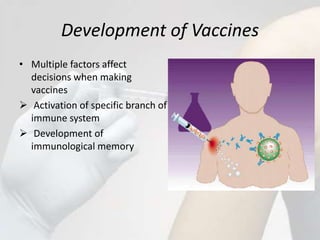
Development of Vaccines
• Multiple factors affect
decisions when making
vaccines
 Activation of specific branch of
immune system
 Development of
immunological memory
Role of Memory Cells
• Depends on incubation period of pathogen
– Short Incubation Periods
• ex. Influenza
• Symptoms already under way by the time memory cells are
activated
• Repeated immunizations with neutralizing antibodies
– Long Incubation Periods
• ex. Poliovirus
• Enough time to allow memory B cells to respond
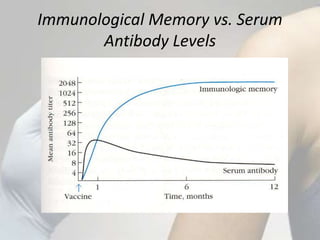
Immunological Memory vs. Serum
Antibody Levels
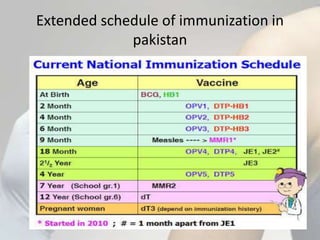
Extended schedule of immunization in
pakistan
TYPES OF BACTERIAL VACCINES
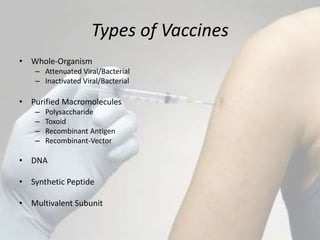
Types of Vaccines
• Whole-Organism
– Attenuated Viral/Bacterial
– Inactivated Viral/Bacterial
• Purified Macromolecules
– Polysaccharide
– Toxoid
– Recombinant Antigen
– Recombinant-Vector
• DNA
• Synthetic Peptide
• Multivalent Subunit
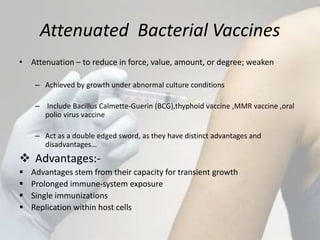
Attenuated Bacterial Vaccines
• Attenuation – to reduce in force, value, amount, or degree; weaken
– Achieved by growth under abnormal culture conditions
– Include Bacillus Calmette-Guerin (BCG),thyphoid vaccine ,MMR vaccine ,oral
polio virus vaccine
– Act as a double edged sword, as they have distinct advantages and
disadvantages…
 Advantages:-
 Advantages stem from their capacity for transient growth
 Prolonged immune-system exposure
 Single immunizations
 Replication within host cells
KILLED BACTERIAL VACCINES:
• Methods of inactivation include heat or chemical agents
– End result…. Loss of replication ability
• Difficult to inactivate due to potential for denaturation of
epitopes
– Dependence on higher order levels of protein structure
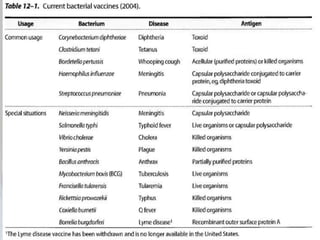
• (1) Vibrio cholerae vaccine
– contains killed organisms and is given to persons traveling
to areas where cholera is endemic.
• (2) Yersinia pestis vaccine
– contains killed organisms and is indicated for persons at
high risk for contracting plague.
• (3) The vaccine against typhus
– contains killed Rickettsia rickettsiae organisms and is used
primarily to immunize members of the armed forces.
PURIFIED PROTEIN VACCINES
• 1) There are two types of B. pertussis
vaccines:
• an acellular vaccine containing purified
proteins
• a vaccine containing whole killed bacteria.
• The principal antigen in the acellular vaccine is
(pertussis toxoid), but other proteins, such as
filamentous hemagglutinin and pertactin, are
also required for full protection.
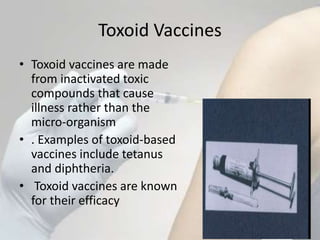
Toxoid Vaccines
• Toxoid vaccines are made
from inactivated toxic
compounds that cause
illness rather than the
micro-organism
• . Examples of toxoid-based
vaccines include tetanus
and diphtheria.
• Toxoid vaccines are known
for their efficacy
. CAPSULAR POLYSACCHARIDE
VACCINES
• Protein subunit – a fragment of bacteria rather than
whole organism can create an immune response.
• Examples include:-
 The subunit vaccine against Hepatitis B virus that is
composed of only the surface proteins of the virus and
 The virus-like particle (VLP) vaccine against human
papillomavirus (HPV) that is composed of the viral
major capsid protein,
 The hemagglutinin and neuraminidase subunits of the
influenza virus.
 Subunit vaccine is being used for plague immunization.
Thank you

Bacterial vaccines

  • 1.
  • 2.
    INTRODUCTION • There aretwo types of immunization:-  Active immunity:- is induced by vaccines prepared from bacteria or their products – Methods of acquisition include natural infection, vaccines (many types), and toxoids – Relatively permanent  Passive immunity :- is provided by the administration of preformed antibody in preparations called immune –globulins – Methods of acquisition include natural maternal antibodies, antitoxins, and immune globulins – Protection transferred from another person or animal
  • 3.
    VACCINATION • Vaccine isa biological preparation that provides artificial active immunity to a particular disease • The administration of vaccines is called vaccination • It can be used as  prophylactic:- to ameliorate the effect of future infection  therapeutic:- e.g to treat disease vaccine against cancer
  • 4.
    Development of Vaccines •Multiple factors affect decisions when making vaccines  Activation of specific branch of immune system  Development of immunological memory
  • 5.
    Role of MemoryCells • Depends on incubation period of pathogen – Short Incubation Periods • ex. Influenza • Symptoms already under way by the time memory cells are activated • Repeated immunizations with neutralizing antibodies – Long Incubation Periods • ex. Poliovirus • Enough time to allow memory B cells to respond
  • 6.
    Immunological Memory vs.Serum Antibody Levels
  • 7.
    Extended schedule ofimmunization in pakistan
  • 9.
  • 10.
    Types of Vaccines •Whole-Organism – Attenuated Viral/Bacterial – Inactivated Viral/Bacterial • Purified Macromolecules – Polysaccharide – Toxoid – Recombinant Antigen – Recombinant-Vector • DNA • Synthetic Peptide • Multivalent Subunit
  • 11.
    Attenuated Bacterial Vaccines •Attenuation – to reduce in force, value, amount, or degree; weaken – Achieved by growth under abnormal culture conditions – Include Bacillus Calmette-Guerin (BCG),thyphoid vaccine ,MMR vaccine ,oral polio virus vaccine – Act as a double edged sword, as they have distinct advantages and disadvantages…  Advantages:-  Advantages stem from their capacity for transient growth  Prolonged immune-system exposure  Single immunizations  Replication within host cells
  • 12.
    KILLED BACTERIAL VACCINES: •Methods of inactivation include heat or chemical agents – End result…. Loss of replication ability • Difficult to inactivate due to potential for denaturation of epitopes – Dependence on higher order levels of protein structure
  • 13.
    • (1) Vibriocholerae vaccine – contains killed organisms and is given to persons traveling to areas where cholera is endemic. • (2) Yersinia pestis vaccine – contains killed organisms and is indicated for persons at high risk for contracting plague. • (3) The vaccine against typhus – contains killed Rickettsia rickettsiae organisms and is used primarily to immunize members of the armed forces.
  • 14.
    PURIFIED PROTEIN VACCINES •1) There are two types of B. pertussis vaccines: • an acellular vaccine containing purified proteins • a vaccine containing whole killed bacteria. • The principal antigen in the acellular vaccine is (pertussis toxoid), but other proteins, such as filamentous hemagglutinin and pertactin, are also required for full protection.
  • 15.
    Toxoid Vaccines • Toxoidvaccines are made from inactivated toxic compounds that cause illness rather than the micro-organism • . Examples of toxoid-based vaccines include tetanus and diphtheria. • Toxoid vaccines are known for their efficacy
  • 16.
    . CAPSULAR POLYSACCHARIDE VACCINES •Protein subunit – a fragment of bacteria rather than whole organism can create an immune response. • Examples include:-  The subunit vaccine against Hepatitis B virus that is composed of only the surface proteins of the virus and  The virus-like particle (VLP) vaccine against human papillomavirus (HPV) that is composed of the viral major capsid protein,  The hemagglutinin and neuraminidase subunits of the influenza virus.  Subunit vaccine is being used for plague immunization.
  • 17.