VACCINES
BY,
G. STEPHY AROKIYA MARY
24PBO106
SUBJECT : MICROBIOLOGY, IMMUNOLOGY
AND PLANT PATHOLOGY
TABLE OF CONTENTS
• INTRODUCTION
• WHAT ARE VACCINES ?
• PROPERTIES
• HISTORY
• TYPES OF VACCINES
• VACCINES FROM PURIFIED MACROMOLECULES
• VACCINES IN THE FORM OF TOXOIDS
• VACCINES FROM RECOMBINANT VECTORS
• DNAAS VACCINES
• DNAADJUVANTS
• GENETIC ADJUVANTS
• CONCLUSION
INTRODUCTION
• Edward Jenner and Louis Pasteur made the first attempt of vaccination for
human diseases.
• The diseases such as diphtheria, mumps, measles, rubella and tetanus has
declined sufficiently due to WORLD HEALTH ORGANISATION (WHO)
policy of vaccination of children.
• One of the best example of successful of vaccination is the eradication of small
pox has been reported anywhere in the world.
• Genetic engineering techniques have been introduced and improved in vaccines
to maximize the immune response to selected antigenic determinants.
WHAT ARE VACCINES?
• Vaccine is a suspension of weakened, killed or fragmented microbes or toxins or
of antibodies that is administered primarily to prevent diseases.
• A Vaccine can confer active immunity (artificial active immunity) against a
specific harmful agent by stimulating the immune system to attack the pathogen.
• The term “VACCINE” was derived in 1796 from Edward Jenner’s use of the
term “COW POX”.
• Vaccination is the most effective method of preventing infectious diseases.
• Vaccination given during childhood is generally safe.
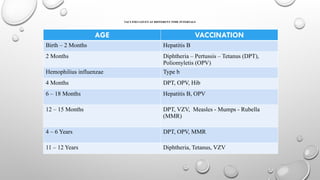
VACCINES GIVEN AT DIFFERENT TIME INTERVALS
AGE VACCINATION
Birth – 2 Months Hepatitis B
2 Months Diphtheria – Pertussis – Tetanus (DPT),
Poliomyletis (OPV)
Hemophilius influenzae Type b
4 Months DPT, OPV, Hib
6 – 18 Months Hepatitis B, OPV
12 – 15 Months DPT, VZV, Measles - Mumps - Rubella
(MMR)
4 – 6 Years DPT, OPV, MMR
11 – 12 Years Diphtheria, Tetanus, VZV
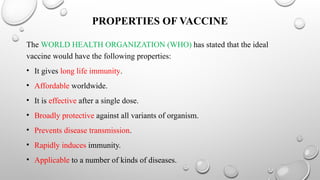
PROPERTIES OF VACCINE
The WORLD HEALTH ORGANIZATION (WHO) has stated that the ideal
vaccine would have the following properties:
• It gives long life immunity.
• Affordable worldwide.
• It is effective after a single dose.
• Broadly protective against all variants of organism.
• Prevents disease transmission.
• Rapidly induces immunity.
• Applicable to a number of kinds of diseases.
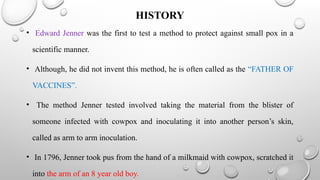
HISTORY
• Edward Jenner was the first to test a method to protect against small pox in a
scientific manner.
• Although, he did not invent this method, he is often called as the “FATHER OF
VACCINES”.
• The method Jenner tested involved taking the material from the blister of
someone infected with cowpox and inoculating it into another person’s skin,
called as arm to arm inoculation.
• In 1796, Jenner took pus from the hand of a milkmaid with cowpox, scratched it
into the arm of an 8 year old boy.
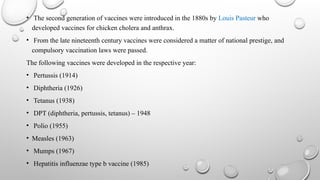
• The second generation of vaccines were introduced in the 1880s by Louis Pasteur who
developed vaccines for chicken cholera and anthrax.
• From the late nineteenth century vaccines were considered a matter of national prestige, and
compulsory vaccination laws were passed.
The following vaccines were developed in the respective year:
• Pertussis (1914)
• Diphtheria (1926)
• Tetanus (1938)
• DPT (diphtheria, pertussis, tetanus) – 1948
• Polio (1955)
• Measles (1963)
• Mumps (1967)
• Hepatitis influenzae type b vaccine (1985)
LIVE, ATTENUATED VACCINES
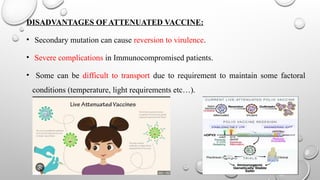
• Live, attenuated vaccines contains the version of the living microbe that has
been weakened in the lab so that it can’t cause disease.
• Pathogenicity of the certain microorganisms can be attenuated so that they lose
their ability to cause disease.
• These vaccines acts as a “GOOD TEACHERS” of the immune system.
• There are both advantages and disadvantages from the attenuated vaccines.
• The SABIN ORAL POLIO vaccine consists of 3 strains of the attenuated
viruses.
• Some of the disadvantages of attenuated vaccines are the possibility of reversion into
virulent forms.
• The rate of reversion of the SABIN ORAL POLIO vaccine is 1 in 4 million dose of
vaccines.
• In some cases, Post vaccine side effects may occur.
ADMINISTRATION:
• In an attenuated vaccine, live virus particles with very low virulence are
administered. They will reproduce, but very slowly.
• There is a small risk of reversion of Virulence back into the attenuated vaccine after
insertion.
ADVANTAGES OF ATTENUATED VACCINES:
• Activates all phases of the Immune system (instantly Ig A local antibodies are
produced).
• Provides more Durable immunity; boosters are required less frequently.
• Low cost and Quick immunity.
• Easy to administer (can be taken orally, rather than injecting a sterile injection).
• These vaccines are very much effective.
DISADVANTAGES OF ATTENUATED VACCINE:
• Secondary mutation can cause reversion to virulence.
• Severe complications in Immunocompromised patients.
• Some can be difficult to transport due to requirement to maintain some factoral
conditions (temperature, light requirements etc…).
INACTIVATED BACTERIAL / VIRAL VACCINES
• The pathogen is inactivated by heat or chemicals, hence it is no longer capable
of replicating in the host.
• During the inactivation process, it is critically important to maintain the
structures of the epitopes on the surface antigens.
• Heat inactivation generally leads to protein denaturation, which may lead to the
alternation in the epitope structure and failure in immune recognition.
• These vaccines are more stable and safer than live vaccines as dead/killed
microbes can’t mutate back to their disease – causing state.
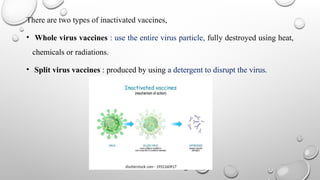
There are two types of inactivated vaccines,
• Whole virus vaccines : use the entire virus particle, fully destroyed using heat,
chemicals or radiations.
• Split virus vaccines : produced by using a detergent to disrupt the virus.
VACCINES FROM PURIFIED MACROMOLECULES
• The risks associated with attenuated or killed whole organism vaccines can be
overcome by purified macromolecule vaccines of pathogens.
I. POLYSACCAHRIDE VACCINES:
• Polysaccharides contains the repeated units of epitopes within one molecule.
• This can result in cross linking of antigen receptors on the surface of B –
lymphocytes.
• Polysaccharide capsule has the antiphagocytic properties, coating of capsules by
antibody increases it’s ability.
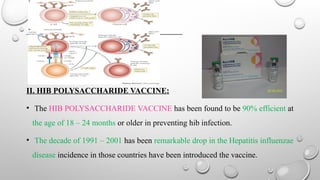
II. HIB POLYSACCHARIDE VACCINE:
• The HIB POLYSACCHARIDE VACCINE has been found to be 90% efficient at
the age of 18 – 24 months or older in preventing hib infection.
• The decade of 1991 – 2001 has been remarkable drop in the Hepatitis influenzae
disease incidence in those countries have been introduced the vaccine.
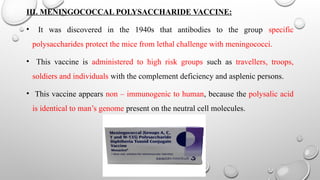
III. MENINGOCOCCAL POLYSACCHARIDE VACCINE:
• It was discovered in the 1940s that antibodies to the group specific
polysaccharides protect the mice from lethal challenge with meningococci.
• This vaccine is administered to high risk groups such as travellers, troops,
soldiers and individuals with the complement deficiency and asplenic persons.
• This vaccine appears non – immunogenic to human, because the polysalic acid
is identical to man’s genome present on the neutral cell molecules.
IV. PNEUMOCOCCAL POLYSACCHARIDE VACCINE:
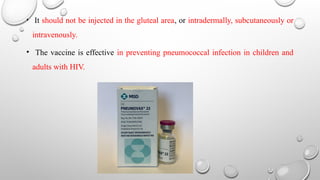
• The Pneumococcal polysaccharide vaccine is a type of vaccine that protects
against Pneumococcal bacteria, which can cause illness like Pneumonia,
meningitis and bacteremia.
• The vaccine joins a protein to an antigen to improve protection. The
Polysaccharides are chemically activated and then covalently linked to a protein
carrier.
• The vaccine is administered intramuscularly, preferably in the upper thigh.
• It should not be injected in the gluteal area, or intradermally, subcutaneously or
intravenously.
• The vaccine is effective in preventing pneumococcal infection in children and
adults with HIV.
VACCINES IN THE FORM OF TOXOIDS
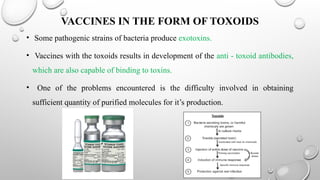
• Some pathogenic strains of bacteria produce exotoxins.
• Vaccines with the toxoids results in development of the anti - toxoid antibodies,
which are also capable of binding to toxins.
• One of the problems encountered is the difficulty involved in obtaining
sufficient quantity of purified molecules for it’s production.
MULTIVALENT SUBUNIT VACCINES
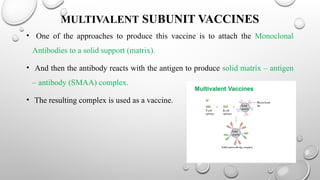
• One of the approaches to produce this vaccine is to attach the Monoclonal
Antibodies to a solid support (matrix).
• And then the antibody reacts with the antigen to produce solid matrix – antigen
– antibody (SMAA) complex.
• The resulting complex is used as a vaccine.
VACCINES FROM RECOMBINANT VECTORS
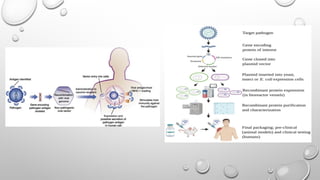
• Recombinant vector vaccines (RVVs) are a type of vaccine that uses a live viral or
bacterial vectors to carry genes from a pathogen.
• The genes are used to produce proteins that trigger the immune system to create an
Immune Response.
• This technique is designed to mimic a natural infection, which helps the immune
system learn how to fight germs.
• Genes encoding major antigens of virulent pathogens can be introduced into
alternated viruses/bacteria which serves as a vector.
• The vectors replicate in the host cell, expressing the genes encoding the antigens of
the pathogens.
• The degree of expression of the inserted foreign pathogenic gene is quite high in
vaccinia virus, which is a potent immunogen in an inoculated host.
• Vaccines produced from other attenuated vectors may prove to be safer than the
vaccinia vaccines, because vaccinia may become virulent in individuals suffering
from severe immune supression.
• The Salmonella is capable of infecting the muscle lining of the intestine. Hence,
it is capable of secreting the Ig A production.
DNAAS VACCINES
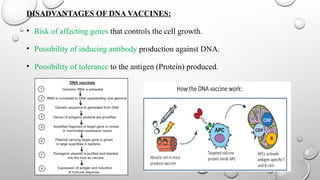
• In this vaccination strategy, the Plasmid DNA encoding an antigen of the
pathogen is injected directly into the muscles.
• Muscle tissues shows highest levels of the protein expression.
• The muscle cell takes up the injected gene and express the gene in the form of
protein antigen.
• The expressed protein antigen is capable of stimulating both humoral and cell
mediated immune response.
• This is one of the greatest advantages of DNA vaccines compared to other
vaccines.
• In addition, DNA vaccines allow prolonged expression hence generate
significant immune memory.
• DNA vaccines have many benefits – They are inexpensive to produce, Easily
manipulated, Non – infectious, Can induce both cellular and humoral immune
response and They only express the protein of interest.
• Although DNA vaccine can induce the strong cellular immune response in the
mouse, the response in humans and large mammals are comparatively weak and
require multiple immune with high dose of DNA.
ADVANTAGES OF DNA VACCINE:
• No risk for infection
• Ease of development and production
• Stability for storage and shipping
• Long – term persistent of the immunogen
• Encoded protein is expressed in the host in its natural form – there is no
denaturation or modification.
• Refrigeration is not required for the handling and storage of the plasmid dna, a
feature that greatly lowers the cost.
DISADVANTAGES OF DNA VACCINES:
• Risk of affecting genes that controls the cell growth.
• Possibility of inducing antibody production against DNA.
• Possibility of tolerance to the antigen (Protein) produced.
ANTI – IDIOTYPE VACCINE
• A vaccine made of antibodies that see other antibodies as antigen and binds to it.
• Anti – idiotype vaccines can stimulate the body to produce antibodies against
the tumour cells.
• This type of vaccines were produced in the late 1970s.
• These vaccines have been used to induce immunity against a wide range of
viruses, including Hib, rabies, polioviruses and retro viruses etc…
CONCLUSION
• Vaccines are safe and effective.
• Vaccines help people live longer and also healthier.
• Vaccines helps stop the spread of diseases.
• Vaccines are important for the people’s health.
THANK YOU

VACCINES AND IT'S IMPORTANTS CHARACTERS

  • 1.
    VACCINES BY, G. STEPHY AROKIYAMARY 24PBO106 SUBJECT : MICROBIOLOGY, IMMUNOLOGY AND PLANT PATHOLOGY
  • 2.
    TABLE OF CONTENTS •INTRODUCTION • WHAT ARE VACCINES ? • PROPERTIES • HISTORY • TYPES OF VACCINES • VACCINES FROM PURIFIED MACROMOLECULES • VACCINES IN THE FORM OF TOXOIDS • VACCINES FROM RECOMBINANT VECTORS • DNAAS VACCINES • DNAADJUVANTS • GENETIC ADJUVANTS • CONCLUSION
  • 3.
    INTRODUCTION • Edward Jennerand Louis Pasteur made the first attempt of vaccination for human diseases. • The diseases such as diphtheria, mumps, measles, rubella and tetanus has declined sufficiently due to WORLD HEALTH ORGANISATION (WHO) policy of vaccination of children. • One of the best example of successful of vaccination is the eradication of small pox has been reported anywhere in the world. • Genetic engineering techniques have been introduced and improved in vaccines to maximize the immune response to selected antigenic determinants.
  • 4.
    WHAT ARE VACCINES? •Vaccine is a suspension of weakened, killed or fragmented microbes or toxins or of antibodies that is administered primarily to prevent diseases. • A Vaccine can confer active immunity (artificial active immunity) against a specific harmful agent by stimulating the immune system to attack the pathogen. • The term “VACCINE” was derived in 1796 from Edward Jenner’s use of the term “COW POX”. • Vaccination is the most effective method of preventing infectious diseases. • Vaccination given during childhood is generally safe.
  • 5.
    VACCINES GIVEN ATDIFFERENT TIME INTERVALS AGE VACCINATION Birth – 2 Months Hepatitis B 2 Months Diphtheria – Pertussis – Tetanus (DPT), Poliomyletis (OPV) Hemophilius influenzae Type b 4 Months DPT, OPV, Hib 6 – 18 Months Hepatitis B, OPV 12 – 15 Months DPT, VZV, Measles - Mumps - Rubella (MMR) 4 – 6 Years DPT, OPV, MMR 11 – 12 Years Diphtheria, Tetanus, VZV
  • 6.
    PROPERTIES OF VACCINE TheWORLD HEALTH ORGANIZATION (WHO) has stated that the ideal vaccine would have the following properties: • It gives long life immunity. • Affordable worldwide. • It is effective after a single dose. • Broadly protective against all variants of organism. • Prevents disease transmission. • Rapidly induces immunity. • Applicable to a number of kinds of diseases.
  • 7.
    HISTORY • Edward Jennerwas the first to test a method to protect against small pox in a scientific manner. • Although, he did not invent this method, he is often called as the “FATHER OF VACCINES”. • The method Jenner tested involved taking the material from the blister of someone infected with cowpox and inoculating it into another person’s skin, called as arm to arm inoculation. • In 1796, Jenner took pus from the hand of a milkmaid with cowpox, scratched it into the arm of an 8 year old boy.
  • 8.
    • The secondgeneration of vaccines were introduced in the 1880s by Louis Pasteur who developed vaccines for chicken cholera and anthrax. • From the late nineteenth century vaccines were considered a matter of national prestige, and compulsory vaccination laws were passed. The following vaccines were developed in the respective year: • Pertussis (1914) • Diphtheria (1926) • Tetanus (1938) • DPT (diphtheria, pertussis, tetanus) – 1948 • Polio (1955) • Measles (1963) • Mumps (1967) • Hepatitis influenzae type b vaccine (1985)
  • 9.
    LIVE, ATTENUATED VACCINES •Live, attenuated vaccines contains the version of the living microbe that has been weakened in the lab so that it can’t cause disease. • Pathogenicity of the certain microorganisms can be attenuated so that they lose their ability to cause disease. • These vaccines acts as a “GOOD TEACHERS” of the immune system. • There are both advantages and disadvantages from the attenuated vaccines. • The SABIN ORAL POLIO vaccine consists of 3 strains of the attenuated viruses.
  • 10.
    • Some ofthe disadvantages of attenuated vaccines are the possibility of reversion into virulent forms. • The rate of reversion of the SABIN ORAL POLIO vaccine is 1 in 4 million dose of vaccines. • In some cases, Post vaccine side effects may occur. ADMINISTRATION: • In an attenuated vaccine, live virus particles with very low virulence are administered. They will reproduce, but very slowly. • There is a small risk of reversion of Virulence back into the attenuated vaccine after insertion.
  • 11.
    ADVANTAGES OF ATTENUATEDVACCINES: • Activates all phases of the Immune system (instantly Ig A local antibodies are produced). • Provides more Durable immunity; boosters are required less frequently. • Low cost and Quick immunity. • Easy to administer (can be taken orally, rather than injecting a sterile injection). • These vaccines are very much effective.
  • 12.
    DISADVANTAGES OF ATTENUATEDVACCINE: • Secondary mutation can cause reversion to virulence. • Severe complications in Immunocompromised patients. • Some can be difficult to transport due to requirement to maintain some factoral conditions (temperature, light requirements etc…).
  • 13.
    INACTIVATED BACTERIAL /VIRAL VACCINES • The pathogen is inactivated by heat or chemicals, hence it is no longer capable of replicating in the host. • During the inactivation process, it is critically important to maintain the structures of the epitopes on the surface antigens. • Heat inactivation generally leads to protein denaturation, which may lead to the alternation in the epitope structure and failure in immune recognition. • These vaccines are more stable and safer than live vaccines as dead/killed microbes can’t mutate back to their disease – causing state.
  • 14.
    There are twotypes of inactivated vaccines, • Whole virus vaccines : use the entire virus particle, fully destroyed using heat, chemicals or radiations. • Split virus vaccines : produced by using a detergent to disrupt the virus.
  • 15.
    VACCINES FROM PURIFIEDMACROMOLECULES • The risks associated with attenuated or killed whole organism vaccines can be overcome by purified macromolecule vaccines of pathogens. I. POLYSACCAHRIDE VACCINES: • Polysaccharides contains the repeated units of epitopes within one molecule. • This can result in cross linking of antigen receptors on the surface of B – lymphocytes. • Polysaccharide capsule has the antiphagocytic properties, coating of capsules by antibody increases it’s ability.
  • 16.
    II. HIB POLYSACCHARIDEVACCINE: • The HIB POLYSACCHARIDE VACCINE has been found to be 90% efficient at the age of 18 – 24 months or older in preventing hib infection. • The decade of 1991 – 2001 has been remarkable drop in the Hepatitis influenzae disease incidence in those countries have been introduced the vaccine.
  • 17.
    III. MENINGOCOCCAL POLYSACCHARIDEVACCINE: • It was discovered in the 1940s that antibodies to the group specific polysaccharides protect the mice from lethal challenge with meningococci. • This vaccine is administered to high risk groups such as travellers, troops, soldiers and individuals with the complement deficiency and asplenic persons. • This vaccine appears non – immunogenic to human, because the polysalic acid is identical to man’s genome present on the neutral cell molecules.
  • 18.
    IV. PNEUMOCOCCAL POLYSACCHARIDEVACCINE: • The Pneumococcal polysaccharide vaccine is a type of vaccine that protects against Pneumococcal bacteria, which can cause illness like Pneumonia, meningitis and bacteremia. • The vaccine joins a protein to an antigen to improve protection. The Polysaccharides are chemically activated and then covalently linked to a protein carrier. • The vaccine is administered intramuscularly, preferably in the upper thigh.
  • 19.
    • It shouldnot be injected in the gluteal area, or intradermally, subcutaneously or intravenously. • The vaccine is effective in preventing pneumococcal infection in children and adults with HIV.
  • 20.
    VACCINES IN THEFORM OF TOXOIDS • Some pathogenic strains of bacteria produce exotoxins. • Vaccines with the toxoids results in development of the anti - toxoid antibodies, which are also capable of binding to toxins. • One of the problems encountered is the difficulty involved in obtaining sufficient quantity of purified molecules for it’s production.
  • 21.
    MULTIVALENT SUBUNIT VACCINES •One of the approaches to produce this vaccine is to attach the Monoclonal Antibodies to a solid support (matrix). • And then the antibody reacts with the antigen to produce solid matrix – antigen – antibody (SMAA) complex. • The resulting complex is used as a vaccine.
  • 22.
    VACCINES FROM RECOMBINANTVECTORS • Recombinant vector vaccines (RVVs) are a type of vaccine that uses a live viral or bacterial vectors to carry genes from a pathogen. • The genes are used to produce proteins that trigger the immune system to create an Immune Response. • This technique is designed to mimic a natural infection, which helps the immune system learn how to fight germs. • Genes encoding major antigens of virulent pathogens can be introduced into alternated viruses/bacteria which serves as a vector. • The vectors replicate in the host cell, expressing the genes encoding the antigens of the pathogens.
  • 23.
    • The degreeof expression of the inserted foreign pathogenic gene is quite high in vaccinia virus, which is a potent immunogen in an inoculated host. • Vaccines produced from other attenuated vectors may prove to be safer than the vaccinia vaccines, because vaccinia may become virulent in individuals suffering from severe immune supression. • The Salmonella is capable of infecting the muscle lining of the intestine. Hence, it is capable of secreting the Ig A production.
  • 25.
    DNAAS VACCINES • Inthis vaccination strategy, the Plasmid DNA encoding an antigen of the pathogen is injected directly into the muscles. • Muscle tissues shows highest levels of the protein expression. • The muscle cell takes up the injected gene and express the gene in the form of protein antigen. • The expressed protein antigen is capable of stimulating both humoral and cell mediated immune response. • This is one of the greatest advantages of DNA vaccines compared to other vaccines.
  • 26.
    • In addition,DNA vaccines allow prolonged expression hence generate significant immune memory. • DNA vaccines have many benefits – They are inexpensive to produce, Easily manipulated, Non – infectious, Can induce both cellular and humoral immune response and They only express the protein of interest. • Although DNA vaccine can induce the strong cellular immune response in the mouse, the response in humans and large mammals are comparatively weak and require multiple immune with high dose of DNA.
  • 27.
    ADVANTAGES OF DNAVACCINE: • No risk for infection • Ease of development and production • Stability for storage and shipping • Long – term persistent of the immunogen • Encoded protein is expressed in the host in its natural form – there is no denaturation or modification. • Refrigeration is not required for the handling and storage of the plasmid dna, a feature that greatly lowers the cost.
  • 28.
    DISADVANTAGES OF DNAVACCINES: • Risk of affecting genes that controls the cell growth. • Possibility of inducing antibody production against DNA. • Possibility of tolerance to the antigen (Protein) produced.
  • 29.
    ANTI – IDIOTYPEVACCINE • A vaccine made of antibodies that see other antibodies as antigen and binds to it. • Anti – idiotype vaccines can stimulate the body to produce antibodies against the tumour cells. • This type of vaccines were produced in the late 1970s. • These vaccines have been used to induce immunity against a wide range of viruses, including Hib, rabies, polioviruses and retro viruses etc…
  • 30.
    CONCLUSION • Vaccines aresafe and effective. • Vaccines help people live longer and also healthier. • Vaccines helps stop the spread of diseases. • Vaccines are important for the people’s health.
  • 31.