BACTERIAL VACCINES
DR. BIMAL KUMAR DAS, M.D.
DEPARETMENT OF MICROBIOLOGY
ALL INDIA INSTITUTE OF MEDICAL SCIENCES
NEW DELHI
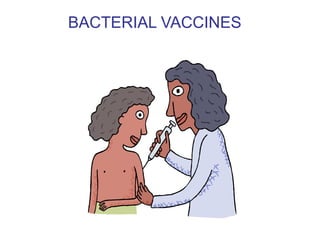
BACTERIAL VACCINES
History and Achievements
of Vaccines
During the 15th century, an early form of smallpox vaccination was
practiced in China and other parts of the world. Healthy people were
intentionally infected with substances from the pustules of people suffering
from smallpox, a technique called variolation. A mild form of smallpox
usually resulted from this practice.
An English doctor, Edward Jenner, improved the variolation technique to
create the first vaccine in 1796. Dr. Jenner had heard that dairymaids who
had been infected with cowpox, a disease related to but milder than
smallpox, were not susceptible to smallpox, and decided to test the idea.
He performed the first vaccination
on a boy with material taken from lesions of cowpox. In fact, the word
vaccination comes from the Latin word for cow, vacca.
Benefits of Vaccines
• Smallpox eradicated
– In 1900 - >20,000 cases and 1,000 deaths
• Polio eliminated
• Control or near elimination of
– Measles
– Mumps
– Rubella
– Tetanus
– Diphtheria
– Pertussis
– Haemophilus influenzae type b (Hib)
Vaccine Preventable
Bacterial Diseases
Diphtheria
Pneumococcal disease
Hib disease
Meningococcal meningitis
Pertussis (Whooping Cough)
Tetanus (Lockjaw)
Typhoid
Cholera
Anthrax
Plague
Terms
•Vaccination & Vaccine
–Derive from the term vaccinia, the virus once used as
smallpox vaccine. Originally, the term vaccine only meant
protection from smallpox.
•Immunization
–The process of inducing or providing immunity artificially by
administering an immunobiologic. May be passive or active
Vocabulary Terms
• Immunobiologic
– Antigenic substances (vaccines and toxoids) or antibody-co
• Vaccine
• Toxoid
• Immune globulin (IG)
• Intravenous immune globulin (IGIV)
• Specific immune globulin
• Antitoxin
How Vaccines Work
1. Active Immunization
2. Passive Immunization
3. Community immunity or “herd immunity” is an important part of
protecting the community against disease
Principles of Vaccination
General Rule
The more similar a vaccine is to
the natural disease, the better the
immune response to the vaccine.
Immunity
• Active Immunization
– Production of
antibody (humoral
immune response)
through the
administration of a
vaccine or toxoid.
• Passive
Immunization
– Provision of
temporary immunity
by the
administration of
preformed
antibodies
• Pooled human IG or IGIV
• Specific immune globulin
preparations
• antitoxins
Active
Immunity from person's own immune system. Generally long-
lasting, even a lifetime
• Protection after disease--immunologic memory. Memory B-cells
circulate in blood and reside in bone marrow
•Vaccine
Factors that influence immune response to
vaccination
·Presence of maternal antibody.
•·Nature and dose of antigen.
•·Route of administration
•·Presence of adjuvants (aluminum containing materials to
improve immunogenicity, also gold).
Properties of an ideal vaccine
1. 100% safe
2. Do not cause disease in others
3. No residual pathogenicity
4. Will prevent disease
5. Effective against all strains
6. Only one dose required
7. Compatibility with other vaccines
8. Deliverable without hypodermic syringe
9. Indefinite room temperature storage
10. Cheap to manufacture
11. Capable of inducing effective herd immunity
There are two general categories of vaccines
whole-cell vaccines
subunit vaccines
Whole-cell vaccines
Whole-cell vaccines consist of entire organisms that have been modified in
some manner so that they are unable (or drastically less able) to cause
disease.
Whole-agent vaccines consist of two general categories:
inactivated (whole killed)
genetically attenuated (live-attenuated)
Subunit vaccines
Vaccines made from well defined components of microorganisms are
called a subunit vaccine
Recombinant vaccines
A subunit vaccine that is produced using recombinant techniques is
called a recombinant vaccine.
Newer vaccines – Still Experimental
•DNA vaccine
•Peptide vaccine
•Anti-idiotype vaccine
Advantages of DNA vaccines
1) Plasmids are easily manufactured in large amounts
2) DNA is very stable
3) DNA resists temperature extremes so storage and transport are straight forward
4) DNA sequence can be changed easily in the laboratory.
5) By using the plasmid in the vaccinee to code for antigen synthesis,
6) Mixtures of plasmids could be used that encode many protein fragments from a
virus/viruses so that a broad spectrum vaccine could be produced
7) The plasmid does not replicate and encodes only the proteins of interest
8) There is no protein component and so there will be no immune response against
the vector itself
9) there is a CTL response
Possible Problems
1) Potential integration of plasmid into host genome leading to
insertional mutagenesis
2) Induction of autoimmune responses (e.g. pathogenic anti-DNA
antibodies)
3) Induction of immunologic tolerance (e.g. where the expression
of the antigen in the host may lead to specific non-
responsiveness to that antigen)
Immunogiologic components
• Suspending fluids
– Sterile water, saline, or fluids
containing proteins
• Preservatives, stabilizers,
antibiotics
– Inhibit or prevent bacterial
growth in viral cultures, or to
stabilize the antigens or
antibodies
• Allergic reactions can occur if
the recipient is sensitive to one
of these additives
– Thimerosal, phenol, albumin,
glycine, neomycin
• Adjuvants
– Components used
to enhance the
immunogenicity of
the immunogiologic
• Aluminum
phosphate,
aluminum hydroxide
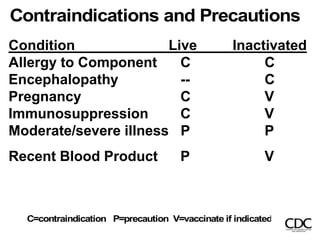
Contraindications and Precautions
Condition Live Inactivated
Allergy to Component C C
Encephalopathy -- C
Pregnancy C V
Immunosuppression C V
Moderate/severe illness P P
Recent Blood Product P V
C=contraindication P=precaution V=vaccinate if indicated
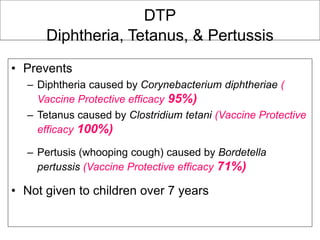
DTP
Diphtheria, Tetanus, & Pertussis
• Prevents
– Diphtheria caused by Corynebacterium diphtheriae (
Vaccine Protective efficacy 95%)
– Tetanus caused by Clostridium tetani (Vaccine Protective
efficacy 100%)
– Pertusis (whooping cough) caused by Bordetella
pertussis (Vaccine Protective efficacy 71%)
• Not given to children over 7 years
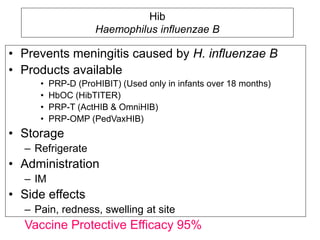
Hib
Haemophilus influenzae B
• Prevents meningitis caused by H. influenzae B
• Products available
• PRP-D (ProHIBIT) (Used only in infants over 18 months)
• HbOC (HibTITER)
• PRP-T (ActHIB & OmniHIB)
• PRP-OMP (PedVaxHIB)
• Storage
– Refrigerate
• Administration
– IM
• Side effects
– Pain, redness, swelling at site
Vaccine Protective Efficacy 95%
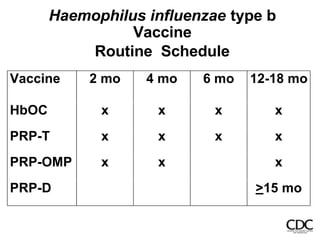
Haemophilus influenzae type b
Vaccine
Routine Schedule
Vaccine 2 mo 4 mo 6 mo 12-18 mo
HbOC x x x x
PRP-T x x x x
PRP-OMP x x x
PRP-D >15 mo
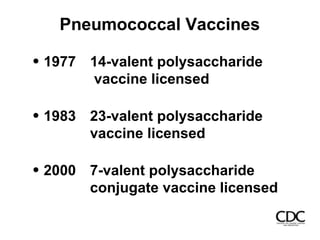
Pneumococcal Vaccines
1977 14-valent polysaccharide
vaccine licensed
1983 23-valent polysaccharide
vaccine licensed
2000 7-valent polysaccharide
conjugate vaccine licensed
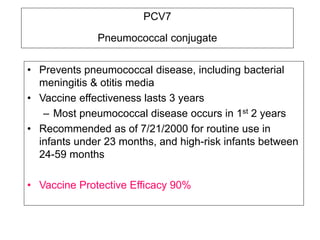
PCV7
Pneumococcal conjugate
• Prevents pneumococcal disease, including bacterial
meningitis & otitis media
• Vaccine effectiveness lasts 3 years
– Most pneumococcal disease occurs in 1st 2 years
• Recommended as of 7/21/2000 for routine use in
infants under 23 months, and high-risk infants between
24-59 months
• Vaccine Protective Efficacy 90%
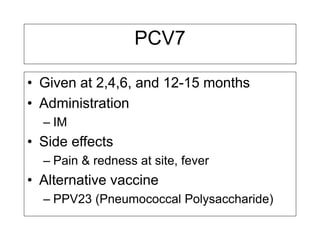
PCV7
• Given at 2,4,6, and 12-15 months
• Administration
– IM
• Side effects
– Pain & redness at site, fever
• Alternative vaccine
– PPV23 (Pneumococcal Polysaccharide)
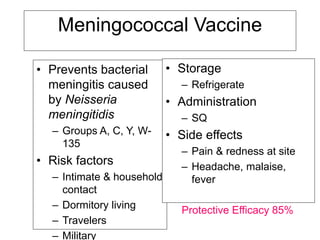
Meningococcal Vaccine
• Prevents bacterial
meningitis caused
by Neisseria
meningitidis
– Groups A, C, Y, W-
135
• Risk factors
– Intimate & household
contact
– Dormitory living
– Travelers
– Military
• Storage
– Refrigerate
• Administration
– SQ
• Side effects
– Pain & redness at site
– Headache, malaise,
fever
Protective Efficacy 85%
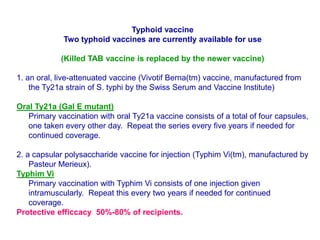
Typhoid vaccine
Two typhoid vaccines are currently available for use
(Killed TAB vaccine is replaced by the newer vaccine)
1. an oral, live-attenuated vaccine (Vivotif Berna(tm) vaccine, manufactured from
the Ty21a strain of S. typhi by the Swiss Serum and Vaccine Institute)
Oral Ty21a (Gal E mutant)
Primary vaccination with oral Ty21a vaccine consists of a total of four capsules,
one taken every other day. Repeat the series every five years if needed for
continued coverage.
2. a capsular polysaccharide vaccine for injection (Typhim Vi(tm), manufactured by
Pasteur Merieux).
Typhim Vi
Primary vaccination with Typhim Vi consists of one injection given
intramuscularly. Repeat this every two years if needed for continued
coverage.
Protective efficcacy 50%-80% of recipients.
Bacillus of Calmette and Guérin (BCG)
vaccine
Reduce mortality and morbidity in Children< 5years old
Two meta-analyses of the published results of BCG
vaccine clinical trials and case-control studies confirmed
that the protective efficacy of BCG for preventing serious
forms of TB in children is high ( >80%).
These analyses, however, did not clarify the protective
efficacy of BCG for preventing pulmonary TB in
adolescents and adults; this protective efficacy is
variable and equivocal.
Cholera vaccine
Whole cell killed vaccine
Whole cell killed vaccine + B subunit vaccine (WC/rBS)
Live attenuated vaccine CVDHg103R
Two recently developed vaccines for cholera are licensed and
available are
- Dukoral®, Biotec AB
- Mutacol®, Berna.
Both vaccines appear to provide a somewhat better immunity and
fewer side-effects than the previously available vaccine.
Vaccine Protective Efficacy in the first six months
Vaccine Protective Efficacy 50-60% in three years ( Also
effective against ETEC)
Not effective against O139
Lyme disease
• Prevents Lyme disease caused by Borrelia
burgdorferi transmitted by ticks
– Used in persons over 15 years
– Vaccine not 100% effective; Tick bite protection
recommended
• Series of 3 vaccines should be completed
before tick season (before April)
• Storage
– Refrigerate
• Administration - IM
Vaccine against Anthrax
Vaccine for humans: ( avirulent and nonencapsulated) sublethal amounts of the
toxin produced
Licensed in the U.S. is a preparation of the protective antigen (PA)
Dose: A. 3 doses subcutaneously at the interval of 2 wks
B. Followed by three additional doses at 6,12 and 18 months
C. Annual booster dose
Professionals ( Veternarians, butcher, Zoo keeper, Wild life workers, Forest
guards, Military personnels )
Vaccine against Plague
Available since 1896
Efficacy not determined in proper studies
Two vaccines :
Killed vaccine : 2 dose at 7-14 days interval, booster at 6 months
Live vaccine : Y. pestis ( Otten’s Tjiwidej, EV 76 strain) – No longer used
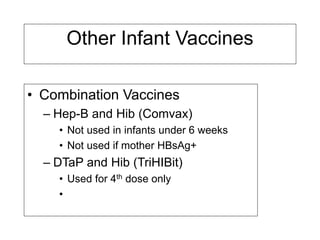
Other Infant Vaccines
• Combination Vaccines
– Hep-B and Hib (Comvax)
• Not used in infants under 6 weeks
• Not used if mother HBsAg+
– DTaP and Hib (TriHIBit)
• Used for 4th dose only
•
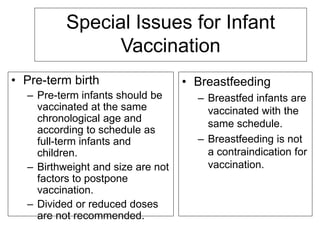
Special Issues for Infant
Vaccination
• Pre-term birth
– Pre-term infants should be
vaccinated at the same
chronological age and
according to schedule as
full-term infants and
children.
– Birthweight and size are not
factors to postpone
vaccination.
– Divided or reduced doses
are not recommended.
• Breastfeeding
– Breastfed infants are
vaccinated with the
same schedule.
– Breastfeeding is not
a contraindication for
vaccination.
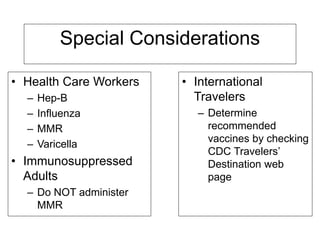
Special Considerations
• Health Care Workers
– Hep-B
– Influenza
– MMR
– Varicella
• Immunosuppressed
Adults
– Do NOT administer
MMR
• International
Travelers
– Determine
recommended
vaccines by checking
CDC Travelers’
Destination web
page
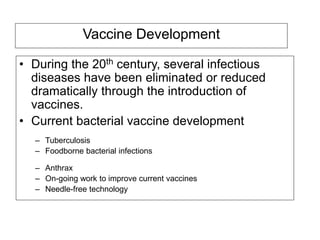
Vaccine Development
• During the 20th century, several infectious
diseases have been eliminated or reduced
dramatically through the introduction of
vaccines.
• Current bacterial vaccine development
– Tuberculosis
– Foodborne bacterial infections
– Anthrax
– On-going work to improve current vaccines
– Needle-free technology
Adverse Events
• Adverse Event
– Any event following a
vaccine
• May be a true adverse
reaction, or only
coincidental
• May be local,
systemic, or allergic
• Adverse Reaction
– Unintended effect
caused by the vaccine
– May be
contraindication for
future doses
• Side Effect
– Common event to be
expected in percentage
of recipients
– Usually not serious
– Not contraindication for
future doses
VACCINE DEVELOPOMENT
Vaccine licensure is a lengthy process that may last up to 10 years.
1. Laboratory studies : Safety and Immunogenicity Studies
Clinical trials
2. Phase I trial : Phase One trials are small, involving only 20-100 volunteers. To
continue to gather information on efficacy and safety of each vaccine,
3. Phase II trial : Phase Two trials are larger (with several hundred
volunteers), and last anywhere from a few months to a few years.
4. Phase III trial : Phase Three trials have several hundred to several thousand
participants and typically last many years.
5. Phase IV trial: Vaccine is licensed and marketed. Data regarding side effects
are collected
Inherent Weaknesses
Of current vaccine
• Vaccines prevent disease, not infection
• Vaccination against a disease which does not induce
natural immunity, even given exposure to the wild
pathogen, is difficult
• Vaccines against toxins for various reasons must be
boosted from time to time
• Because vaccines are biological materials, they suffer
from the inherent lability of such materials and therefore
are difficult to deliver intact to geographically remote locals
Edward Jenner
Live Attenuated Vaccines
Attenuated (weakened) form of
the "wild" virus or bacteria
Must replicate to be effective
Immune response similar to
natural infection
Usually effective with one dose
Advantages:
Very close to infectious agent
Immune response similar to natural infection
Disadvantages:
Severe or fatal reactions possible
Reversion to pathogenic (wild) form
Interference from circulating antibody
Stability
Currently available live attenuated vaccines:
Viral: measles, mumps, rubella, yellow fever, vaccinia, varicella
Bacterial: BCG
Recombinant Typhoid vaccine
Inactivated Vaccines
Generally require 3-5 doses
Immune response mostly humoral
Antibody titer falls over time
Principal antigen may not be
defined
Advantages:
Nonreplicating
Noninfectious
Minimal interference from circulating antibody
Disadvantages:
Immune response mostly humoral
Antibody titer falls over time
Principal antigen may not be well defined
Require multiple doses.
The first primes the immune system.
The protective response after occurs after the second or third dose.
Boosters are often necessary.
Currently available inactivated vaccines:
Viral: influenza, polio, rabies, hepatitis A
Bacterial: typhoid, cholera, plague
Fractional vaccines: hepatitis B, influenza, acellular pertussis
Toxoids: diphtheria, tetanus, botulism, acellular pertussis
Pure polysaccharides: pneumococcal, meningococcal
Polysaccharide conjugates: Haemophilus influenzae type b, pneumococcal
Combination Vaccines
Whole cell DTP - Hib
- Tetramune
- ActHIB/DTP
DTaP - Hib (for 4th dose)
- TriHIBit
Hepatitis B - Hib
- COMVAX

Bacterialvaccine (1).ppt

  • 1.
    BACTERIAL VACCINES DR. BIMALKUMAR DAS, M.D. DEPARETMENT OF MICROBIOLOGY ALL INDIA INSTITUTE OF MEDICAL SCIENCES NEW DELHI
  • 2.
  • 3.
    History and Achievements ofVaccines During the 15th century, an early form of smallpox vaccination was practiced in China and other parts of the world. Healthy people were intentionally infected with substances from the pustules of people suffering from smallpox, a technique called variolation. A mild form of smallpox usually resulted from this practice. An English doctor, Edward Jenner, improved the variolation technique to create the first vaccine in 1796. Dr. Jenner had heard that dairymaids who had been infected with cowpox, a disease related to but milder than smallpox, were not susceptible to smallpox, and decided to test the idea. He performed the first vaccination on a boy with material taken from lesions of cowpox. In fact, the word vaccination comes from the Latin word for cow, vacca.
  • 4.
    Benefits of Vaccines •Smallpox eradicated – In 1900 - >20,000 cases and 1,000 deaths • Polio eliminated • Control or near elimination of – Measles – Mumps – Rubella – Tetanus – Diphtheria – Pertussis – Haemophilus influenzae type b (Hib)
  • 5.
    Vaccine Preventable Bacterial Diseases Diphtheria Pneumococcaldisease Hib disease Meningococcal meningitis Pertussis (Whooping Cough) Tetanus (Lockjaw) Typhoid Cholera Anthrax Plague
  • 6.
    Terms •Vaccination & Vaccine –Derivefrom the term vaccinia, the virus once used as smallpox vaccine. Originally, the term vaccine only meant protection from smallpox. •Immunization –The process of inducing or providing immunity artificially by administering an immunobiologic. May be passive or active
  • 7.
    Vocabulary Terms • Immunobiologic –Antigenic substances (vaccines and toxoids) or antibody-co • Vaccine • Toxoid • Immune globulin (IG) • Intravenous immune globulin (IGIV) • Specific immune globulin • Antitoxin
  • 8.
    How Vaccines Work 1.Active Immunization 2. Passive Immunization 3. Community immunity or “herd immunity” is an important part of protecting the community against disease
  • 9.
    Principles of Vaccination GeneralRule The more similar a vaccine is to the natural disease, the better the immune response to the vaccine.
  • 10.
    Immunity • Active Immunization –Production of antibody (humoral immune response) through the administration of a vaccine or toxoid. • Passive Immunization – Provision of temporary immunity by the administration of preformed antibodies • Pooled human IG or IGIV • Specific immune globulin preparations • antitoxins
  • 11.
    Active Immunity from person'sown immune system. Generally long- lasting, even a lifetime • Protection after disease--immunologic memory. Memory B-cells circulate in blood and reside in bone marrow •Vaccine Factors that influence immune response to vaccination ·Presence of maternal antibody. •·Nature and dose of antigen. •·Route of administration •·Presence of adjuvants (aluminum containing materials to improve immunogenicity, also gold).
  • 12.
    Properties of anideal vaccine 1. 100% safe 2. Do not cause disease in others 3. No residual pathogenicity 4. Will prevent disease 5. Effective against all strains 6. Only one dose required 7. Compatibility with other vaccines 8. Deliverable without hypodermic syringe 9. Indefinite room temperature storage 10. Cheap to manufacture 11. Capable of inducing effective herd immunity
  • 13.
    There are twogeneral categories of vaccines whole-cell vaccines subunit vaccines
  • 14.
    Whole-cell vaccines Whole-cell vaccinesconsist of entire organisms that have been modified in some manner so that they are unable (or drastically less able) to cause disease. Whole-agent vaccines consist of two general categories: inactivated (whole killed) genetically attenuated (live-attenuated) Subunit vaccines Vaccines made from well defined components of microorganisms are called a subunit vaccine Recombinant vaccines A subunit vaccine that is produced using recombinant techniques is called a recombinant vaccine.
  • 15.
    Newer vaccines –Still Experimental •DNA vaccine •Peptide vaccine •Anti-idiotype vaccine
  • 16.
    Advantages of DNAvaccines 1) Plasmids are easily manufactured in large amounts 2) DNA is very stable 3) DNA resists temperature extremes so storage and transport are straight forward 4) DNA sequence can be changed easily in the laboratory. 5) By using the plasmid in the vaccinee to code for antigen synthesis, 6) Mixtures of plasmids could be used that encode many protein fragments from a virus/viruses so that a broad spectrum vaccine could be produced 7) The plasmid does not replicate and encodes only the proteins of interest 8) There is no protein component and so there will be no immune response against the vector itself 9) there is a CTL response
  • 17.
    Possible Problems 1) Potentialintegration of plasmid into host genome leading to insertional mutagenesis 2) Induction of autoimmune responses (e.g. pathogenic anti-DNA antibodies) 3) Induction of immunologic tolerance (e.g. where the expression of the antigen in the host may lead to specific non- responsiveness to that antigen)
  • 18.
    Immunogiologic components • Suspendingfluids – Sterile water, saline, or fluids containing proteins • Preservatives, stabilizers, antibiotics – Inhibit or prevent bacterial growth in viral cultures, or to stabilize the antigens or antibodies • Allergic reactions can occur if the recipient is sensitive to one of these additives – Thimerosal, phenol, albumin, glycine, neomycin • Adjuvants – Components used to enhance the immunogenicity of the immunogiologic • Aluminum phosphate, aluminum hydroxide
  • 19.
    Contraindications and Precautions ConditionLive Inactivated Allergy to Component C C Encephalopathy -- C Pregnancy C V Immunosuppression C V Moderate/severe illness P P Recent Blood Product P V C=contraindication P=precaution V=vaccinate if indicated
  • 20.
    DTP Diphtheria, Tetanus, &Pertussis • Prevents – Diphtheria caused by Corynebacterium diphtheriae ( Vaccine Protective efficacy 95%) – Tetanus caused by Clostridium tetani (Vaccine Protective efficacy 100%) – Pertusis (whooping cough) caused by Bordetella pertussis (Vaccine Protective efficacy 71%) • Not given to children over 7 years
  • 21.
    Hib Haemophilus influenzae B •Prevents meningitis caused by H. influenzae B • Products available • PRP-D (ProHIBIT) (Used only in infants over 18 months) • HbOC (HibTITER) • PRP-T (ActHIB & OmniHIB) • PRP-OMP (PedVaxHIB) • Storage – Refrigerate • Administration – IM • Side effects – Pain, redness, swelling at site Vaccine Protective Efficacy 95%
  • 22.
    Haemophilus influenzae typeb Vaccine Routine Schedule Vaccine 2 mo 4 mo 6 mo 12-18 mo HbOC x x x x PRP-T x x x x PRP-OMP x x x PRP-D >15 mo
  • 23.
    Pneumococcal Vaccines 1977 14-valentpolysaccharide vaccine licensed 1983 23-valent polysaccharide vaccine licensed 2000 7-valent polysaccharide conjugate vaccine licensed
  • 24.
    PCV7 Pneumococcal conjugate • Preventspneumococcal disease, including bacterial meningitis & otitis media • Vaccine effectiveness lasts 3 years – Most pneumococcal disease occurs in 1st 2 years • Recommended as of 7/21/2000 for routine use in infants under 23 months, and high-risk infants between 24-59 months • Vaccine Protective Efficacy 90%
  • 25.
    PCV7 • Given at2,4,6, and 12-15 months • Administration – IM • Side effects – Pain & redness at site, fever • Alternative vaccine – PPV23 (Pneumococcal Polysaccharide)
  • 26.
    Meningococcal Vaccine • Preventsbacterial meningitis caused by Neisseria meningitidis – Groups A, C, Y, W- 135 • Risk factors – Intimate & household contact – Dormitory living – Travelers – Military • Storage – Refrigerate • Administration – SQ • Side effects – Pain & redness at site – Headache, malaise, fever Protective Efficacy 85%
  • 27.
    Typhoid vaccine Two typhoidvaccines are currently available for use (Killed TAB vaccine is replaced by the newer vaccine) 1. an oral, live-attenuated vaccine (Vivotif Berna(tm) vaccine, manufactured from the Ty21a strain of S. typhi by the Swiss Serum and Vaccine Institute) Oral Ty21a (Gal E mutant) Primary vaccination with oral Ty21a vaccine consists of a total of four capsules, one taken every other day. Repeat the series every five years if needed for continued coverage. 2. a capsular polysaccharide vaccine for injection (Typhim Vi(tm), manufactured by Pasteur Merieux). Typhim Vi Primary vaccination with Typhim Vi consists of one injection given intramuscularly. Repeat this every two years if needed for continued coverage. Protective efficcacy 50%-80% of recipients.
  • 28.
    Bacillus of Calmetteand Guérin (BCG) vaccine Reduce mortality and morbidity in Children< 5years old Two meta-analyses of the published results of BCG vaccine clinical trials and case-control studies confirmed that the protective efficacy of BCG for preventing serious forms of TB in children is high ( >80%). These analyses, however, did not clarify the protective efficacy of BCG for preventing pulmonary TB in adolescents and adults; this protective efficacy is variable and equivocal.
  • 29.
    Cholera vaccine Whole cellkilled vaccine Whole cell killed vaccine + B subunit vaccine (WC/rBS) Live attenuated vaccine CVDHg103R Two recently developed vaccines for cholera are licensed and available are - Dukoral®, Biotec AB - Mutacol®, Berna. Both vaccines appear to provide a somewhat better immunity and fewer side-effects than the previously available vaccine. Vaccine Protective Efficacy in the first six months Vaccine Protective Efficacy 50-60% in three years ( Also effective against ETEC) Not effective against O139
  • 30.
    Lyme disease • PreventsLyme disease caused by Borrelia burgdorferi transmitted by ticks – Used in persons over 15 years – Vaccine not 100% effective; Tick bite protection recommended • Series of 3 vaccines should be completed before tick season (before April) • Storage – Refrigerate • Administration - IM
  • 31.
    Vaccine against Anthrax Vaccinefor humans: ( avirulent and nonencapsulated) sublethal amounts of the toxin produced Licensed in the U.S. is a preparation of the protective antigen (PA) Dose: A. 3 doses subcutaneously at the interval of 2 wks B. Followed by three additional doses at 6,12 and 18 months C. Annual booster dose Professionals ( Veternarians, butcher, Zoo keeper, Wild life workers, Forest guards, Military personnels ) Vaccine against Plague Available since 1896 Efficacy not determined in proper studies Two vaccines : Killed vaccine : 2 dose at 7-14 days interval, booster at 6 months Live vaccine : Y. pestis ( Otten’s Tjiwidej, EV 76 strain) – No longer used
  • 32.
    Other Infant Vaccines •Combination Vaccines – Hep-B and Hib (Comvax) • Not used in infants under 6 weeks • Not used if mother HBsAg+ – DTaP and Hib (TriHIBit) • Used for 4th dose only •
  • 33.
    Special Issues forInfant Vaccination • Pre-term birth – Pre-term infants should be vaccinated at the same chronological age and according to schedule as full-term infants and children. – Birthweight and size are not factors to postpone vaccination. – Divided or reduced doses are not recommended. • Breastfeeding – Breastfed infants are vaccinated with the same schedule. – Breastfeeding is not a contraindication for vaccination.
  • 34.
    Special Considerations • HealthCare Workers – Hep-B – Influenza – MMR – Varicella • Immunosuppressed Adults – Do NOT administer MMR • International Travelers – Determine recommended vaccines by checking CDC Travelers’ Destination web page
  • 35.
    Vaccine Development • Duringthe 20th century, several infectious diseases have been eliminated or reduced dramatically through the introduction of vaccines. • Current bacterial vaccine development – Tuberculosis – Foodborne bacterial infections – Anthrax – On-going work to improve current vaccines – Needle-free technology
  • 36.
    Adverse Events • AdverseEvent – Any event following a vaccine • May be a true adverse reaction, or only coincidental • May be local, systemic, or allergic • Adverse Reaction – Unintended effect caused by the vaccine – May be contraindication for future doses • Side Effect – Common event to be expected in percentage of recipients – Usually not serious – Not contraindication for future doses
  • 37.
    VACCINE DEVELOPOMENT Vaccine licensureis a lengthy process that may last up to 10 years. 1. Laboratory studies : Safety and Immunogenicity Studies Clinical trials 2. Phase I trial : Phase One trials are small, involving only 20-100 volunteers. To continue to gather information on efficacy and safety of each vaccine, 3. Phase II trial : Phase Two trials are larger (with several hundred volunteers), and last anywhere from a few months to a few years. 4. Phase III trial : Phase Three trials have several hundred to several thousand participants and typically last many years. 5. Phase IV trial: Vaccine is licensed and marketed. Data regarding side effects are collected
  • 38.
    Inherent Weaknesses Of currentvaccine • Vaccines prevent disease, not infection • Vaccination against a disease which does not induce natural immunity, even given exposure to the wild pathogen, is difficult • Vaccines against toxins for various reasons must be boosted from time to time • Because vaccines are biological materials, they suffer from the inherent lability of such materials and therefore are difficult to deliver intact to geographically remote locals
  • 39.
  • 40.
    Live Attenuated Vaccines Attenuated(weakened) form of the "wild" virus or bacteria Must replicate to be effective Immune response similar to natural infection Usually effective with one dose
  • 41.
    Advantages: Very close toinfectious agent Immune response similar to natural infection Disadvantages: Severe or fatal reactions possible Reversion to pathogenic (wild) form Interference from circulating antibody Stability Currently available live attenuated vaccines: Viral: measles, mumps, rubella, yellow fever, vaccinia, varicella Bacterial: BCG Recombinant Typhoid vaccine
  • 42.
    Inactivated Vaccines Generally require3-5 doses Immune response mostly humoral Antibody titer falls over time Principal antigen may not be defined
  • 43.
    Advantages: Nonreplicating Noninfectious Minimal interference fromcirculating antibody Disadvantages: Immune response mostly humoral Antibody titer falls over time Principal antigen may not be well defined Require multiple doses. The first primes the immune system. The protective response after occurs after the second or third dose. Boosters are often necessary. Currently available inactivated vaccines: Viral: influenza, polio, rabies, hepatitis A Bacterial: typhoid, cholera, plague Fractional vaccines: hepatitis B, influenza, acellular pertussis Toxoids: diphtheria, tetanus, botulism, acellular pertussis Pure polysaccharides: pneumococcal, meningococcal Polysaccharide conjugates: Haemophilus influenzae type b, pneumococcal
  • 44.
    Combination Vaccines Whole cellDTP - Hib - Tetramune - ActHIB/DTP DTaP - Hib (for 4th dose) - TriHIBit Hepatitis B - Hib - COMVAX