Made By :
SUNNY RATHEE
VACCINE PRODUCTION AND QUALITY
CONTROL
Flow of Presentation
 INTRODUCTION OF VACCINES
 HISTORY OF VACCINES
 CLASSIFICATION OF VACCINES
 PROPERTIES OF IDEAL VACCINE
 DIFFERENCES BETWEEN CONVENTIONAL AND NOVEL
VACCINES
 PREPARATION AND STANDARDIZATION OF POLIO
VACCINE
 PREPARATION OF SMALL POX VACCINE
 TYPHOID VACCINE AND ITS PREPARATION
 BCG VACCINE AND ITS PREPARATION
 CHOLERA VACCINE
 PRODUCTION OF VACCINES
 REFERENCES
INTRODUCTION OF VACCINES
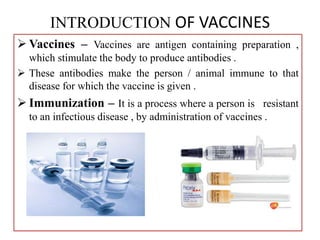
 Vaccines – Vaccines are antigen containing preparation ,
which stimulate the body to produce antibodies .
 These antibodies make the person / animal immune to that
disease for which the vaccine is given .
 Immunization – It is a process where a person is resistant
to an infectious disease , by administration of vaccines .
HISTORY
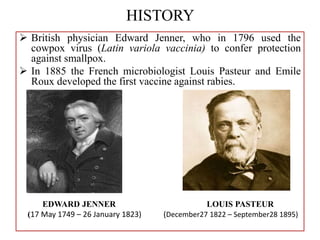
 British physician Edward Jenner, who in 1796 used the
cowpox virus (Latin variola vaccinia) to confer protection
against smallpox.
 In 1885 the French microbiologist Louis Pasteur and Emile
Roux developed the first vaccine against rabies.
EDWARD JENNER LOUIS PASTEUR
(17 May 1749 – 26 January 1823) (December27 1822 – September28 1895)
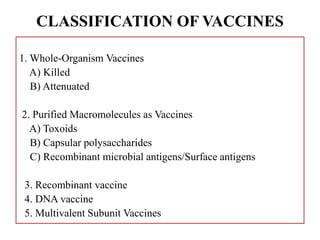
CLASSIFICATION OF VACCINES
1. Whole-Organism Vaccines
A) Killed
B) Attenuated
2. Purified Macromolecules as Vaccines
A) Toxoids
B) Capsular polysaccharides
C) Recombinant microbial antigens/Surface antigens
3. Recombinant vaccine
4. DNA vaccine
5. Multivalent Subunit Vaccines
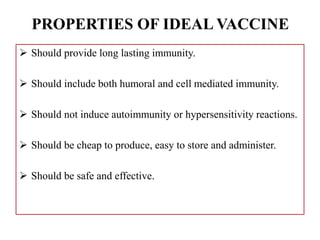
PROPERTIES OF IDEAL VACCINE
 Should provide long lasting immunity.
 Should include both humoral and cell mediated immunity.
 Should not induce autoimmunity or hypersensitivity reactions.
 Should be cheap to produce, easy to store and administer.
 Should be safe and effective.
I. LIVE ATTENUATED VACCINES
 To produce a live vaccine, the wild or disease causing virus is
attenuated (weakened), traditionally by repeated culture in the
laboratory .
 The virulence properties of the virus are reduced so that it does
not cause disease in healthy individuals. The attenuated
vaccine virus multiplies to a limited extent in host tissue and
induces an immune response similar to wild virus infection in
the majority of subjects. Live vaccines are generally very
effective and induce long-lived immunity.
 EXAMPLE. Measles, Mumps, Rubella , Varicella , Rotavirus,
Tuberculosis (BCG)
 II. KILLED AND INACTIVATED VACCINES
The term ‘killed’ is generally used for bacterial vaccines and
the term ‘inactivated’ for viral vaccines. These vaccines are
prepared by treating the whole cell or virus with chemicals that
cause inactivation. Generally these organisms remain intact
and whole. They generate an immune response (to a broad
range of antigens) but cannot cause an infection because they
are dead and so cannot reproduce.
• EXAMPLE . Hepatitis A, Some influenza vaccines
 III. SUBUNIT VACCINES
Subunit vaccines are developed using only the antigens known
to elicit protective immunity. They can be further categorised
as follows.
A . TOXOID VACCINES
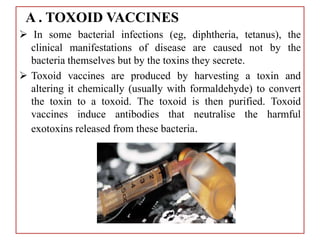
 In some bacterial infections (eg, diphtheria, tetanus), the
clinical manifestations of disease are caused not by the
bacteria themselves but by the toxins they secrete.
 Toxoid vaccines are produced by harvesting a toxin and
altering it chemically (usually with formaldehyde) to convert
the toxin to a toxoid. The toxoid is then purified. Toxoid
vaccines induce antibodies that neutralise the harmful
exotoxins released from these bacteria.
B. RECOMBINANT VACCINES
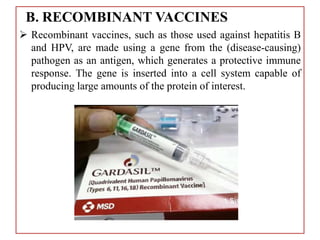
 Recombinant vaccines, such as those used against hepatitis B
and HPV, are made using a gene from the (disease-causing)
pathogen as an antigen, which generates a protective immune
response. The gene is inserted into a cell system capable of
producing large amounts of the protein of interest.
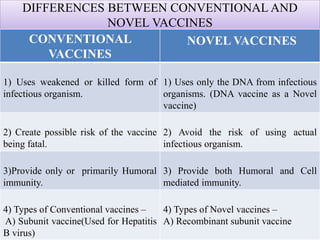
DIFFERENCES BETWEEN CONVENTIONAL AND
NOVEL VACCINES
CONVENTIONAL
VACCINES
NOVEL VACCINES
1) Uses weakened or killed form of
infectious organism.
1) Uses only the DNA from infectious
organisms. (DNA vaccine as a Novel
vaccine)
2) Create possible risk of the vaccine
being fatal.
2) Avoid the risk of using actual
infectious organism.
3)Provide only or primarily Humoral
immunity.
3) Provide both Humoral and Cell
mediated immunity.
4) Types of Conventional vaccines –
A) Subunit vaccine(Used for Hepatitis
B virus)
4) Types of Novel vaccines –
A) Recombinant subunit vaccine
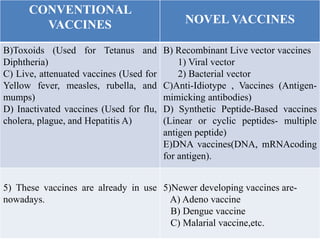
CONVENTIONAL
VACCINES NOVEL VACCINES
B)Toxoids (Used for Tetanus and
Diphtheria)
C) Live, attenuated vaccines (Used for
Yellow fever, measles, rubella, and
mumps)
D) Inactivated vaccines (Used for flu,
cholera, plague, and Hepatitis A)
B) Recombinant Live vector vaccines
1) Viral vector
2) Bacterial vector
C)Anti-Idiotype , Vaccines (Antigen-
mimicking antibodies)
D) Synthetic Peptide-Based vaccines
(Linear or cyclic peptides- multiple
antigen peptide)
E)DNA vaccines(DNA, mRNAcoding
for antigen).
5) These vaccines are already in use
nowadays.
5)Newer developing vaccines are-
A) Adeno vaccine
B) Dengue vaccine
C) Malarial vaccine,etc.
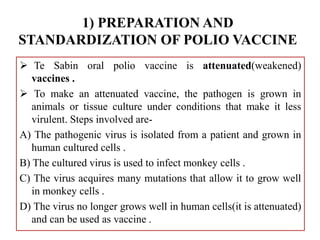
1) PREPARATION AND
STANDARDIZATION OF POLIO VACCINE
 Te Sabin oral polio vaccine is attenuated(weakened)
vaccines .
 To make an attenuated vaccine, the pathogen is grown in
animals or tissue culture under conditions that make it less
virulent. Steps involved are-
A) The pathogenic virus is isolated from a patient and grown in
human cultured cells .
B) The cultured virus is used to infect monkey cells .
C) The virus acquires many mutations that allow it to grow well
in monkey cells .
D) The virus no longer grows well in human cells(it is attenuated)
and can be used as vaccine .
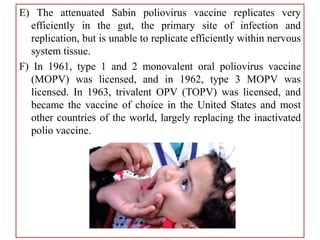
E) The attenuated Sabin poliovirus vaccine replicates very
efficiently in the gut, the primary site of infection and
replication, but is unable to replicate efficiently within nervous
system tissue.
F) In 1961, type 1 and 2 monovalent oral poliovirus vaccine
(MOPV) was licensed, and in 1962, type 3 MOPV was
licensed. In 1963, trivalent OPV (TOPV) was licensed, and
became the vaccine of choice in the United States and most
other countries of the world, largely replacing the inactivated
polio vaccine.
 Based on EP and WHO guidelines following tests are used for
the evaluation (standardization) of OPV and IPV products.
 General assays: e.g. Free formalin test, Sterility test etc.
• Free formalin test: Inactivation may lead to the presence of
free formalin may not exceed 0.02% which is estimated by
colour development with acetyl acetone.
• Sterility test: Vaccines must be bacteriologically and
micrologicaly sterile. In each batch of product the number of
containers to be tested depends on the batch size and the
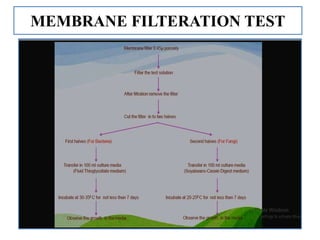
subject of pharmacopoeial regulation. Membrane filtration is
commonly used for sterility testing.
 Specific assays :
• Batch release for OPV:
Potency test in cell culture: the potency of the live viral
vaccines is estimated by using substrates of living cells.
Dilutions of vaccines are inoculated on tissue culture
monolayers in petriplates and the live count of vaccines are
calculated from the infectivity of dilutions and dilution factor
involved .
MEMBRANE FILTERATION TEST
 MAPREC test Molecular biological test, Mutant
Analysis by PCR and Restriction Enzyme
Cleavage: The MAPREC assay is a molecular biological
method used to determine the proportion of a 5 single base
mutation at a given point within the viral RNA. If the
calculated value of the 6 mutation at this site is greater than
acceptable the vaccine will fail the MAPREC test.
Transgenic mouse neurovirulence test
(TgmNVT) TgPVR mice developed by introducing
into genome the human gene encoding the cellular receptor of
poliovirus When infected with poliovirus, TgPVr mice develop
flaccid paralysis and then death in some cases with histological
lesions in central nervous system similar to those observed in
monkey
• Batch release for IPV:
 ELISA test
 D-antigen test
 Rat potency test
 An improved ELISA test for determination of potency of
Inactivated Poliovirus Vaccine (IPV) is proposed.
 The method is based on the use of IgG purified from
immune rabbit serum conjugated with biotin.
 The assay is based on direct ("sandwich") ELISA
scheme, in which antigens are captured on ELISA plates
coated with purified rabbit polyclonal D antigen
specific IgG raised against wild polioviruses of three
serotypes. D-antigen specificity of the IgG was at least
10 times higher than to H-antigen (heat inactivated
virus).
2) PREPARATION OF SMALL POX
VACCINE (FREEZE DRIED )
• Two methods – 1) By using animals
2) By using eggs
1) Preparation of small pox vaccine using animals- Small
pox vaccines are prepared by using calves or sheep . The
method of preparation can be divided into following steps –
A) Selection of animal free from disease : Healthy calves or
sheeps are used for the production of vaccines . The animals
are kept for 10 -14 days in an isolated area under observation
B) Preparation of animals for sacrification : The abdomen
and flanks are thoroughly scrubbed , washed and disinfected .
C) Inoculation : Light incision are made in the cleared skin
without drawing blood with the help of scarifier . The
scarified area is an then rubbed with some of seed vaccine of
known potency.
D) Incubation : During next 7-9 days pustules or vesicles
form along the line of sacrification . During the incubation
period , every precaution is taken to keep the animal as clean
and aseptic as possible .
E) Collection of viruses : Animals is taken to the operation
table and killed . A postmortem on the animals is made to
check the absence of disease . The abdomen and flanks are
then washed with sterile water . Material in the postules is
withdrawn with the help of a sharp edged spoon under aseptic
condition .
F) Purification : The contents of postules are mixed with
equal volume of glycerine , cooled and then finally ground to
form homogenous mixture . It is then stored for a long time at
low temperature .
G) Filling sealing and storage : It is filled into final
container under aseptic condition and freeze dried .
TYPHOID VACCINES
 Typhoid vaccine is white or creamy white turbid liquid free from
clumps.
 It is a sterile suspension prepared from one or more strains of
SALMONELLA TYPHI
 Typhoid vaccines are vaccines that prevent typhoid fever.
Several types are widely available:
1)Typhoid Conjugate vaccine,
2)Ty21a Typhoid vaccine (oral vaccine)&
3)Vi capsular polysaccharide vaccine.
 Monovalent typhoid vaccines: Vi polysaccharide is a well
standardized antigen that is effective in a single parenteral dose,
is safer than whole-cell vaccine, and may be used in children 2
years of age or older.
Preparation of Typhoid Vaccine
The vaccine must comply with tests for sterility and the tests for undue
toxicity for vaccine.
SALMONELLA TYPHI organisms are grown on a
suitable media .
The bacteria are killed by heat or by a bactericide such
as phenol, formaldehyde, or by a chemical such as
acetone.
It is then standardized, so that 1.0mL of the typhoid
vaccine contains not less than 1000 millions of bacteria
(S.TYPHI).
BCG VACCINE(FREEZE- DRIED)
 Developed by Albert Calmette and camile Guerin.
 BCG vaccine should be prepared from a freeze dried seed lot by as
few cultural passages as possible.
 Availability- BCG Vaccine is in the form of white pellet which when
reconstituted yields an opalescent suspension.
 It is a freeze dried preparation containing live culture of the bacillus
of calmette and guerin strain of MYCOBACTERIUM
TUBERCULOSIS.
 Bacillus Calmette- Guerin(BCG) vaccine is a vaccine primarily used
against tuberculosis(TB).
 Storage:- In completely sealed, light resistant glass container.
 Temperature :- 2-8 °C
 Dose:- Single dose 0.1 ml (intracutaneous)
PREPARATION OF BCG VACCINE
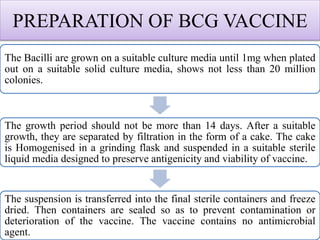
The Bacilli are grown on a suitable culture media until 1mg when plated
out on a suitable solid culture media, shows not less than 20 million
colonies.
The growth period should not be more than 14 days. After a suitable
growth, they are separated by filtration in the form of a cake. The cake
is Homogenised in a grinding flask and suspended in a suitable sterile
liquid media designed to preserve antigenicity and viability of vaccine.
The suspension is transferred into the final sterile containers and freeze
dried. Then containers are sealed so as to prevent contamination or
deterioration of the vaccine. The vaccine contains no antimicrobial
agent.
CHOLERA VACCINE
 Cholera vaccine is a colourless, whitish or slightly coloured
opalescent liquid.
 It is a sterile suspension of killed cholera vibrios (VIBRIO
CHOLERA) of a strain selected for high antigenic property
and purity.
 For the first 6 months after vaccination they provide about
85percent protection, which decreases to 50-62percent
during the first year. After 2years the level of protection
decreases to less than 50percent. When enough of the
population is immunized(known as HERD IMMUNITY).
PREPARATION OF CHOLERA VACCINE
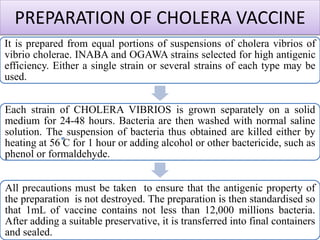
It is prepared from equal portions of suspensions of cholera vibrios of
vibrio cholerae. INABA and OGAWA strains selected for high antigenic
efficiency. Either a single strain or several strains of each type may be
used.
Each strain of CHOLERA VIBRIOS is grown separately on a solid
medium for 24-48 hours. Bacteria are then washed with normal saline
solution. The suspension of bacteria thus obtained are killed either by
heating at 56 C for 1 hour or adding alcohol or other bactericide, such as
phenol or formaldehyde.
All precautions must be taken to ensure that the antigenic property of
the preparation is not destroyed. The preparation is then standardised so
that 1mL of vaccine contains not less than 12,000 millions bacteria.
After adding a suitable preservative, it is transferred into final containers
and sealed.
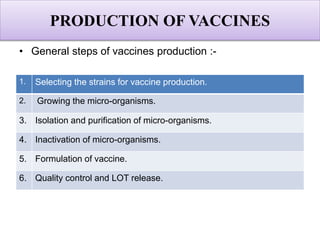
PRODUCTION OF VACCINES
• General steps of vaccines production :-
1. Selecting the strains for vaccine production.
2. Growing the micro-organisms.
3. Isolation and purification of micro-organisms.
4. Inactivation of micro-organisms.
5. Formulation of vaccine.
6. Quality control and LOT release.
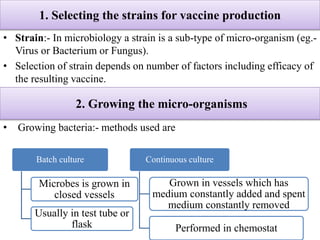
1. Selecting the strains for vaccine production
• Strain:- In microbiology a strain is a sub-type of micro-organism (eg.-
Virus or Bacterium or Fungus).
• Selection of strain depends on number of factors including efficacy of
the resulting vaccine.
• Growing bacteria:- methods used are
Batch culture
Microbes is grown in
closed vessels
Usually in test tube or
flask
Continuous culture
Grown in vessels which has
medium constantly added and spent
medium constantly removed
Performed in chemostat
2. Growing the micro-organisms
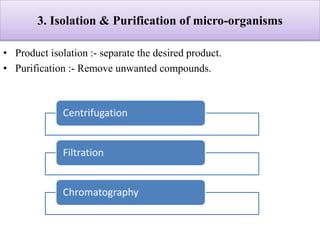
3. Isolation & Purification of micro-organisms
• Product isolation :- separate the desired product.
• Purification :- Remove unwanted compounds.
Centrifugation
Filtration
Chromatography
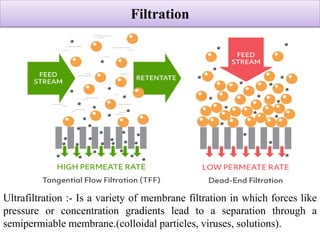
Filtration
Ultrafiltration :- Is a variety of membrane filtration in which forces like
pressure or concentration gradients lead to a separation through a
semipermiable membrane.(colloidal particles, viruses, solutions).
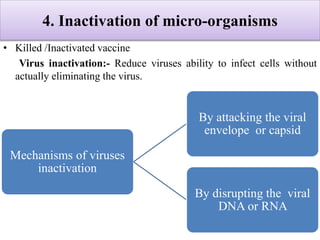
4. Inactivation of micro-organisms
• Killed /Inactivated vaccine
Virus inactivation:- Reduce viruses ability to infect cells without
actually eliminating the virus.
Mechanisms of viruses
inactivation
By attacking the viral
envelope or capsid
By disrupting the viral
DNA or RNA
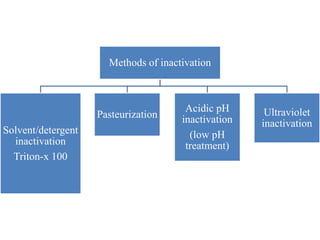
Methods of inactivation
Solvent/detergent
inactivation
Triton-x 100
Pasteurization
Acidic pH
inactivation
(low pH
treatment)
Ultraviolet
inactivation
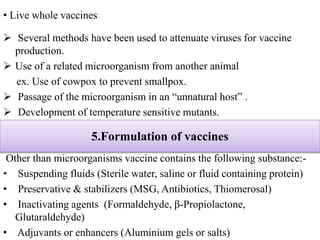
• Live whole vaccines
 Several methods have been used to attenuate viruses for vaccine
production.
 Use of a related microorganism from another animal
ex. Use of cowpox to prevent smallpox.
 Passage of the microorganism in an “unnatural host” .
 Development of temperature sensitive mutants.
Other than microorganisms vaccine contains the following substance:-
• Suspending fluids (Sterile water, saline or fluid containing protein)
• Preservative & stabilizers (MSG, Antibiotics, Thiomerosal)
• Inactivating agents (Formaldehyde, β-Propiolactone,
Glutaraldehyde)
• Adjuvants or enhancers (Aluminium gels or salts)
5.Formulation of vaccines
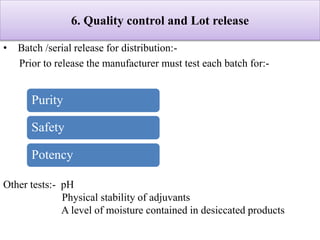
6. Quality control and Lot release
• Batch /serial release for distribution:-
Prior to release the manufacturer must test each batch for:-
Purity
Safety
Potency
Other tests:- pH
Physical stability of adjuvants
A level of moisture contained in desiccated products
REFERENCES :
1. Mehta R.M. Pharmaceutics – 1 , Revised Fifth Edition
, Vallabh Prakashan, Page No. 295-306
2. World Health Organisation, http://www.who.int
/topics/vaccines/en/ A federal government Website
managed by the U.S.Department of Health and
Human Services.
3. http://www.vaccines.gov/more_info/types/
4. http://www.ncbi.nlm.nih.gov/pmc/articles/PMC1810
383/
5. http://www.niaid.nih.gov/topics/hivaids/research/vac
cines/Pages/default.aspx
6. http://www.ncbi.nlm.nih.gov/pubmed/19208455
Thank You……..