TETRACYCLINE
CONTENTS
• Introduction
• Classification
• Structure of tetracycline
• Mechanism of action
• Mechanism of resistance
• Production
• Uses of tetracycline
• Storage
INTRODUCTION
• Tetracycline are broad spectrum antibiotics, which are
chemical substances produced by a microorganism that are
able to kill other microorganisms without being toxic to the
person, animal or plant.
• Tetracyclines were derived from Streptomyces bacteria.
• Tetracyclines were discovered as natural products by
Benjamin Minge Duggar in 1945 and first prescribed in 1948.
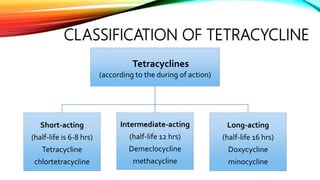
CLASSIFICATION OF TETRACYCLINE
Tetracyclines
)(according to the during of action
Short-acting
half( -life is 6-8 hrs)
Tetracycline
chlortetracycline
Intermediate-acting
(half-life 12 hrs)
Demeclocycline
methacycline
Long-acting
(half-life 16 hrs)
Doxycycline
minocycline
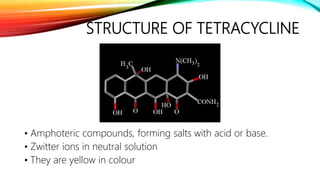
STRUCTURE OF TETRACYCLINE
• Amphoteric compounds, forming salts with acid or base.
• Zwitter ions in neutral solution
• They are yellow in colour
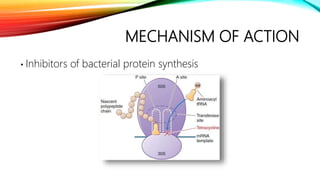
MECHANISM OF ACTION
• Inhibitors of bacterial protein synthesis
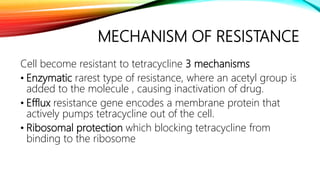
MECHANISM OF RESISTANCE
Cell become resistant to tetracycline 3 mechanisms
• Enzymatic rarest type of resistance, where an acetyl group is
added to the molecule , causing inactivation of drug.
• Efflux resistance gene encodes a membrane protein that
actively pumps tetracycline out of the cell.
• Ribosomal protection which blocking tetracycline from
binding to the ribosome
USES OF TETRACYCLINE
• Antibacterial resistance
• Non antibacterial resistance like inflammation
• Tissue destructive disease like antifibrilogenics
• Parkinson and other neurodegeneration disease
• Antiviral and anti cancer
• Upper/lower respiratory tract infections
• Skin and soft tissue infections
• Relapsing fever
• Cholera
• Urinary tract infection
• anthrax
STORAGE
• Keep at room temperature 65-85 °F (18-29 °C)
• Keep away from heat, moisture and light.
Tetracycline

Tetracycline

  • 1.
  • 2.
    CONTENTS • Introduction • Classification •Structure of tetracycline • Mechanism of action • Mechanism of resistance • Production • Uses of tetracycline • Storage
  • 3.
    INTRODUCTION • Tetracycline arebroad spectrum antibiotics, which are chemical substances produced by a microorganism that are able to kill other microorganisms without being toxic to the person, animal or plant. • Tetracyclines were derived from Streptomyces bacteria. • Tetracyclines were discovered as natural products by Benjamin Minge Duggar in 1945 and first prescribed in 1948.
  • 4.
    CLASSIFICATION OF TETRACYCLINE Tetracyclines )(accordingto the during of action Short-acting half( -life is 6-8 hrs) Tetracycline chlortetracycline Intermediate-acting (half-life 12 hrs) Demeclocycline methacycline Long-acting (half-life 16 hrs) Doxycycline minocycline
  • 5.
    STRUCTURE OF TETRACYCLINE •Amphoteric compounds, forming salts with acid or base. • Zwitter ions in neutral solution • They are yellow in colour
  • 6.
    MECHANISM OF ACTION •Inhibitors of bacterial protein synthesis
  • 7.
    MECHANISM OF RESISTANCE Cellbecome resistant to tetracycline 3 mechanisms • Enzymatic rarest type of resistance, where an acetyl group is added to the molecule , causing inactivation of drug. • Efflux resistance gene encodes a membrane protein that actively pumps tetracycline out of the cell. • Ribosomal protection which blocking tetracycline from binding to the ribosome
  • 9.
    USES OF TETRACYCLINE •Antibacterial resistance • Non antibacterial resistance like inflammation • Tissue destructive disease like antifibrilogenics • Parkinson and other neurodegeneration disease • Antiviral and anti cancer • Upper/lower respiratory tract infections • Skin and soft tissue infections • Relapsing fever • Cholera • Urinary tract infection • anthrax
  • 10.
    STORAGE • Keep atroom temperature 65-85 °F (18-29 °C) • Keep away from heat, moisture and light.