ABSCISIC ACID
(ABA)
DR. R. RENUKA, M.SC.,M.PHIL.,PH.D.
ASSOCIATE PROFESSOR OF BIOCHEMISTRY
V.V.VANNIAPERUMAL COLLEGE FOR WOMEN
VIRUDHUNAGAR, TAMILNAD, INDIA.
Abscisic acid (ABA)
• ABA is a natural plant growth inhibitor produced by aged
leaves and fruits and also when plants are under stress
condition. So, it is also called as Stress Hormone.
Abscisic acid (ABA)
• Abscisic acid (ABA) is the major phytohormone that controls plant’s
ability to survive in harsh, changing environment.
• ABA promotes abscission of leaves and fruits; hence it is this action that
gave rise to the name of this hormone ‘abscisic acid’.
• ABA is a naturally occurring compound in plants. ABA is found in leaves
(where it is partially synthesized), stems, and green fruits.
• It is generally associated with negative-feedback interactions or stress-
related environmental signals such as drought, freezing temperatures
and environmental pollutants
DISCOVERY OF ABA
• In 1963, abscisic acid was first identified and characterized by Frederick Addicott
and his associates in University of California. They were studying compounds
responsible for the abscission of cotton fruits. Two compounds were isolated and
called abscisin I and abscisin II.
• Two other groups in UK at about the same time discovered the same compound.
One group headed by Philip Wareing was studying bud dormancy in woody plants
and named the substance responsible for bud dormancy as ‘Dormin’ The other
group led by Van Steveninck was studying abscission of flowers and fruits from
lupine.
• Each group found their compounds within a few days of each other. When they
compared notes, they found they had isolated the same compound.
• Eventually, they decided to fix on the name abscisic acid.
CHEMICAL STRUCTURE OF ABA
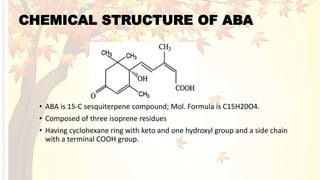
• ABA is 15-C sesquiterpene compound; Mol. Formula is C15H20O4.
• Composed of three isoprene residues
• Having cyclohexane ring with keto and one hydroxyl group and a side chain
with a terminal COOH group.
Site of synthesis of ABA
ABA is an ubiquitous plant hormone in vascular plants
It is synthesized in all types of cells that contain chloroplast or other
plastids.
It occurs predominantly in mature leaves.
It has been detected in all major organic or living tissues from root
cap to apical buds..
Transport of ABA in plants
• Externally applied ABA can be distributed in all directions.
• Synthesized ABA is exported from roots in the xylem and from leaves
in the phloem.
• Cell to cell transport is slow.
• Transport is mostly in its free form and rarely in a conjugated form as
ABA-ß-D-glucosyl ester.
• Redistribution of ABA among plant cell compartments is controlled
by pH gradients.
Physiological role of ABA
Stimulates the closure of stomata.
used as anti - transpirant - In drought prone areas , water stress is serious problem in
agriculture production. so sprays of ABA are suggested that cause partial closure of
stomata for few days , to reduce transpirational loss of water
Induce bud dormancy and seed dormancy.
Delays fruit ripening and softening.
Promotes root growth and inhibits shoot growth in water stress conditions.
 Downregulates enzymes needed for photosynthesis.
Induces seeds to synthesize storage proteins.
Inhibits (counteracts) the effect of gibberellins on stimulating de novo synthesis of
𝛾-amylase.
Inhibit cell division
Promotes leaf senescence
Increase in ABA in response to wounding Induces gene transcription especially for
proteinase inhibitors, so it may be involved in defense against insects and pathogens.
Closing of stomata
• Stomatal closure decreasing transpiration and prevent water loss.
Abscission
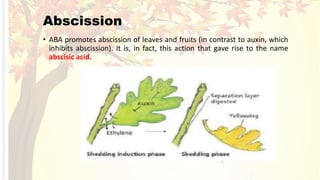
• ABA promotes abscission of leaves and fruits (in contrast to auxin, which
inhibits abscission). It is, in fact, this action that gave rise to the name
abscisic acid.
Apical dominance
Bud dormancy
Seed dormancy
• The shoot buds of temperate tree species become dormant in
autumn season. Similarly, freshly harvested seeds of apple and peach
do not germinate. The potato tubers fail to sprout soon after
harvesting. All these are caused by accumulation of large amount of
ABA in these organs. The concentration of ABA decreases and
concentration of gibberellins increase in spring or after the rain as
the ABA is metabolized away with water. Therefore, shoot buds
sprout and the seeds start germinating in spring. By this way, ABA
prevent the premature germination and helps the plant make sure
that it’s seeds germinate in the right time of the year.
Inhibits precocious germination and
vivipary
• During seed development, embryos of monocot and dicot plants
may fail to complete maturation and germinate while the immature
seed is still attached to the maternal tissue. This phenomenon is
referred to as vivipary or preharvest or precocious sprouting.
• ABA inhibits precocious germination.
• The level of endogenous ABA is high during mid- to late seed
development which suggested that ABA is the natural constraint
that keeps developing embryos in their embryogenic state.
• Vivipary in ABA deficient mutants can be partially prevented by
treatment with exogenous ABA.
Promotes desiccation tolerance in the
embryo
• These proteins prevent the seeds from drying out.
Effect of Drought
• A large quantity of ABA accumulates in plant during
drought or water deficiency. It has a biological
advantage for the plant. ABA closes the stomata. It
prevents further loss of water,. Thus plant is able to
conserve available moisture and withstand the
drought.
Abscisic acid i

Abscisic acid i

  • 1.
    ABSCISIC ACID (ABA) DR. R.RENUKA, M.SC.,M.PHIL.,PH.D. ASSOCIATE PROFESSOR OF BIOCHEMISTRY V.V.VANNIAPERUMAL COLLEGE FOR WOMEN VIRUDHUNAGAR, TAMILNAD, INDIA.
  • 2.
    Abscisic acid (ABA) •ABA is a natural plant growth inhibitor produced by aged leaves and fruits and also when plants are under stress condition. So, it is also called as Stress Hormone.
  • 3.
    Abscisic acid (ABA) •Abscisic acid (ABA) is the major phytohormone that controls plant’s ability to survive in harsh, changing environment. • ABA promotes abscission of leaves and fruits; hence it is this action that gave rise to the name of this hormone ‘abscisic acid’. • ABA is a naturally occurring compound in plants. ABA is found in leaves (where it is partially synthesized), stems, and green fruits. • It is generally associated with negative-feedback interactions or stress- related environmental signals such as drought, freezing temperatures and environmental pollutants
  • 4.
    DISCOVERY OF ABA •In 1963, abscisic acid was first identified and characterized by Frederick Addicott and his associates in University of California. They were studying compounds responsible for the abscission of cotton fruits. Two compounds were isolated and called abscisin I and abscisin II. • Two other groups in UK at about the same time discovered the same compound. One group headed by Philip Wareing was studying bud dormancy in woody plants and named the substance responsible for bud dormancy as ‘Dormin’ The other group led by Van Steveninck was studying abscission of flowers and fruits from lupine. • Each group found their compounds within a few days of each other. When they compared notes, they found they had isolated the same compound. • Eventually, they decided to fix on the name abscisic acid.
  • 5.
    CHEMICAL STRUCTURE OFABA • ABA is 15-C sesquiterpene compound; Mol. Formula is C15H20O4. • Composed of three isoprene residues • Having cyclohexane ring with keto and one hydroxyl group and a side chain with a terminal COOH group.
  • 6.
    Site of synthesisof ABA ABA is an ubiquitous plant hormone in vascular plants It is synthesized in all types of cells that contain chloroplast or other plastids. It occurs predominantly in mature leaves. It has been detected in all major organic or living tissues from root cap to apical buds..
  • 7.
    Transport of ABAin plants • Externally applied ABA can be distributed in all directions. • Synthesized ABA is exported from roots in the xylem and from leaves in the phloem. • Cell to cell transport is slow. • Transport is mostly in its free form and rarely in a conjugated form as ABA-ß-D-glucosyl ester. • Redistribution of ABA among plant cell compartments is controlled by pH gradients.
  • 8.
    Physiological role ofABA Stimulates the closure of stomata. used as anti - transpirant - In drought prone areas , water stress is serious problem in agriculture production. so sprays of ABA are suggested that cause partial closure of stomata for few days , to reduce transpirational loss of water Induce bud dormancy and seed dormancy. Delays fruit ripening and softening. Promotes root growth and inhibits shoot growth in water stress conditions.  Downregulates enzymes needed for photosynthesis. Induces seeds to synthesize storage proteins. Inhibits (counteracts) the effect of gibberellins on stimulating de novo synthesis of 𝛾-amylase. Inhibit cell division Promotes leaf senescence Increase in ABA in response to wounding Induces gene transcription especially for proteinase inhibitors, so it may be involved in defense against insects and pathogens.
  • 9.
    Closing of stomata •Stomatal closure decreasing transpiration and prevent water loss.
  • 10.
    Abscission • ABA promotesabscission of leaves and fruits (in contrast to auxin, which inhibits abscission). It is, in fact, this action that gave rise to the name abscisic acid.
  • 11.
  • 12.
  • 13.
    Seed dormancy • Theshoot buds of temperate tree species become dormant in autumn season. Similarly, freshly harvested seeds of apple and peach do not germinate. The potato tubers fail to sprout soon after harvesting. All these are caused by accumulation of large amount of ABA in these organs. The concentration of ABA decreases and concentration of gibberellins increase in spring or after the rain as the ABA is metabolized away with water. Therefore, shoot buds sprout and the seeds start germinating in spring. By this way, ABA prevent the premature germination and helps the plant make sure that it’s seeds germinate in the right time of the year.
  • 14.
    Inhibits precocious germinationand vivipary • During seed development, embryos of monocot and dicot plants may fail to complete maturation and germinate while the immature seed is still attached to the maternal tissue. This phenomenon is referred to as vivipary or preharvest or precocious sprouting. • ABA inhibits precocious germination. • The level of endogenous ABA is high during mid- to late seed development which suggested that ABA is the natural constraint that keeps developing embryos in their embryogenic state. • Vivipary in ABA deficient mutants can be partially prevented by treatment with exogenous ABA.
  • 15.
    Promotes desiccation tolerancein the embryo • These proteins prevent the seeds from drying out.
  • 16.
    Effect of Drought •A large quantity of ABA accumulates in plant during drought or water deficiency. It has a biological advantage for the plant. ABA closes the stomata. It prevents further loss of water,. Thus plant is able to conserve available moisture and withstand the drought.