Cotton
Presented by
ZUBY GOHAR
ANSARI
TAM/14/026
Introduction
• Cotton- King of fibres
• Cotton-white gold, one of
the most important
commercial crops of the
world.
• Cotton is derived from
Arabic word “qutun”.
• Cotton remains the
backbone of Indian rural
economy especially in
dry land areas.
 Types of cotton:
 4 cultivated species in cotton
 Gossypium hirsutum(34% area) new world cotton
 G .barbadense(<1% area) (n=26)
 G .arboreum(15% area) old world cotton
 G .herbaceum(6% area) (n=13)
 Hybrids (45%area).
 Origin:
• arboreum: India
• herbaceum: Arabia, Persia
• barbadense: South America
• hirsutum: Mexico and Gautemela
Area, production and productivity of cotton
Region Area(M ha) Production(M.t) Productivity(t/ha)
World 35 23 650
India 8.87 23.2 444
States in India Maharashtra (2.89) Gujarat (8.9) Gujarat (729)
Gujarat (2.08) Maharashtra (3.6) TN (688)
AP (1.04) AP (3.2) Punjab (641)
Climate:
• Warm season (tropical) crop.
• Cotton can be profitably grown
in regions with rainfall of 900-
1000 mm.
 Temperature:
• Germination: 32 to 34 0C
• Crop growth: 43 to 46 0C
• Night temperature: 15 to 20 0C
 Altitude:
• 1200 to 1500 m
 Light intensity:
• 400 to 500 Cal Cm-2day-1
 SOILS:
• Cotton is grown in a wide variety
of soils
• Grown as rained crop in deep
black soils and medium black
soils.
• Grown under irrigation in
alluvial soils and other light soils.
• Sensitive to water logging.
• Moderately acid tolerant PH=5.5
to 6.0
• Saline tolerant (7.7 ds/m-salinity
threshold).
• Ideal depth of soil is 0.6m
Physiology of cotton
Seed germination
Mobilization of assimilates
Physiology of vegetative growth
Physiology of reproductive
growth
Botany
• Warm season
• Perennial (grown as an
annual though)
• Woody shrub
• C3
• Indeterminate
• Dicot with
cotyledonary leaves
• Malvaceae family
Botany – Two main groups.
- Old World cotton
- diploids (2n)
- G. arboreum
- G. herbaceum
- New World cotton
- allo tetraploids (4n)
- G. hirsutum
- G. barbadense
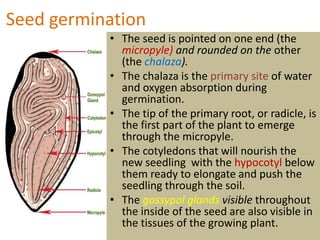
Seed germination
• The seed is pointed on one end (the
micropyle) and rounded on the other
(the chalaza).
• The chalaza is the primary site of water
and oxygen absorption during
germination.
• The tip of the primary root, or radicle, is
the first part of the plant to emerge
through the micropyle.
• The cotyledons that will nourish the
new seedling with the hypocotyl below
them ready to elongate and push the
seedling through the soil.
• The gossypol glands visible throughout
the inside of the seed are also visible in
the tissues of the growing plant.
Germination and Seedling Development
• Germination begins as the seed absorbs water
and oxygen through its chalaza after planting.
• The water swells the dormant tissues, and cell
growth and division begin to take place.
• The radicle emerges through the micropyle, and
grows deeper into the soil, providing a taproot
that will supply water and nutrients throughout
the life of the plant.
• The hypocotyl elongates from the radicle and
forms an arch or crook that begins to push up
through the soil, a brief period often referred to
as the “crook stage”(c).
Germination and Seedling Development
Seedling emergence normally takes place 4 to 14 days
after planting. At the soil surface, the hypocotyl
straightens and pulls the folded cotyledons out of the
soil (d), a process known as epigeal germination.
After the cotyledons are pulled through the soil
surface, they unfold and expose the epicotyl and the
apical meristem, or growing point, which will be the
source of subsequent growth (Figure e-f).
 At this point, germination and seedling emergence
are complete and the plant begins its active vegetative
growth.
The Cotyledons and First True
Leaves
 The cotyledons (Figure 3) serve a
dual role in germination.
 Before they unfold, they supply
stored food to the germinating
seedling.
 After the cotyledons unfold, they
produce chlorophyll, become green,
and produce energy through
photosynthesis.
 The apical meristem emerges at the
base of the cotyledons and all
further vegetative and reproductive
growth of the plant occurs through
the meristems.
 A week or so after
seedling establishment,
the first true leaf appears
above the cotyledons .
 The first leaf shifts the
plant’s primary energy
source from storage to
photosynthesis and signals
the move from emergence
to vegetative growth.
Factors affecting seed and seedling development
• SOIL: Cotton emerges the quickest from warm, moist soil.
• TEMPARATURE: Low temperatures (below 60 degrees F)
hinder germination by slowing metabolic processes.
• LIGHT: High or low temparatures also affect the seed and
seedling germination process. Light pigment -Phytochrome
seen in two forms Pr and Pfr forms.
• Other factors: Physical impedance, such as crusting, does not
slow germination, but it can prevent the hypocotyl from
emerging.
• This often causes thickening of the hypocotyl and a condition
referred to as “big shank” or “thicklegged” cotton, resulting in
reduced seedling vigor.
• Generally, the longer it takes for emergence to occur, the
greater the risk of plant death and yield loss.
Mobilization of seed reserves
• During early stages dicot sps obtain nutrients from
endosperm and in later stages assimilates deposited
from mother plant.
• This is facilitated by vascular strand which branches
from vascular tissue running through pod and passes
through funiculus in to integuments.
• Passage of assimilates through the funiculus and
from seed coat in to cotyledons by fission aided by
transfer cells.
• There is no symplastic connection between seed
coat and embryo and the assimilates pass in to
apoplast.
• Then they are taken up by embryo and redistributed
symplastically and utilized in reserve synthesis.
• Stages of Growth
• The developmental phases for cotton can be
divided into five main growth stages:
• (1) Germination and emergence
• (2) Seedling establishment
• (3) Leaf area and canopy development
• (4) Flowering and boll development and
• (5) Maturation
Growth Stage Days
Planting to Emergence 4 to 9
Emergence to First Square 27 to 38
Square to Flower 20 to 25
Planting to First Flower 60 to 70
Flower to Open Boll 45 to 65
Planting to Harvest Ready 130 to 160
Root development
• As the plant grows, the radicle that originally emerged from
the seed becomes a taproot, from which lateral roots begin
to form and grow which makes the basal root system.
• Other “higher order” roots then develop from this basal
root system which have a functional life of about 3 weeks.
• They form when environmental conditions are good, and
then dies when unfavourable conditions prevails.
• As the plant matures, the roots continue to spread and
probe deeper in the soil profile for water and nutrients.
• Most of the roots found between 1 and 3 feet deep in the
soil, but large quantities of roots can still be found more
than 4 feet deep in the soil.
• The amount of roots generally peaks during the cotton
flowering phase then declines as the plant partitions more
carbohydrates to the developing bolls (Figure b).
Development of root
Root development
Vegetative Growth of cotton
• Cotton has an indeterminate growth habit and can
grow very tall under favourable conditions.
• Growth regulators, such as mepiquat chloride, are
generally applied to cotton to slow internode
elongation, especially for well-fertilized irrigated
cotton.
• Otherwise,vigorous cotton varieties
with plenty of water and nutrients
can develop very tall, heavy vegetative
growth.
• The first vegetative structures that appear on the main stem
are main stem leaves are called nodes.
• Leaves that arise directly from the main stem are referred to
as main stem leaves, are referred as subtending leaves.
• The fruit produced by a branch will primarily receive
carbohydrates produced by the leaf subtending that fruit.
• Fruit produced closer to the main stem will receive more
carbohydrates from the main stem leaf than fruit produced at
more distal positions.
• A fruiting bud, called a square,
begins to form fruiting branch.
• As this square develops, the portion
of the fruiting branch between the
main stem and the square also elongates.
• This portion of the
fruiting branch is also
called the internode,
similar to the portion of
the main stem between
main-stem nodes.
• The axillary meristem
produces a second
position square and
subtending leaf.
• As many as four squares
may be produced in this
fashion on a fruiting
branch.
Leaf and Canopy Development
 Initially the carbohydrates produced by the leaves
are used to produce roots and more leaves.
 Once reproductive structures begin to develop, carbohydrate
supplies are slowly shifted to the developing fruit.
 As the fruit load on the plant increases and ages, the
carbohydrate demand increases, and development of leaves
steadily declines.
 Therefore, fruit development occurs
with a leaf population that is steadily aging.
 Leaf photosynthesis does not remain
constant as the leaf grows and develops.
 A cotton leaf reaches its maximum
photosynthetic capacity at about 20 days
of age, after which it declines.
Development of Fruiting and
Vegetative Branches
• The branches on a cotton plant
can be classified as either
vegetative branches (monopodia
first 4-6 nodes) or fruiting
branches (sympodia 5-7+ nodes).
• Vegetative branches, like the main
stem, are referred to as
monopodia (meaning “single
foot”) since they have only one
meristem.
• Because vegetative branches have
only one meristem, they grow
straight and erect, much like the
main stem. Vegetative branches
can also produce fruiting
branches.
• The branches from which fruiting buds arise
are called fruiting branches, or sympodia
(meaning “multiple feet”), because each
fruiting branch contains multiple meristems.
• Fruiting branches have a “zig-zag” growth
habit, as opposed to the straight growth habit
of the vegetative branches.
• The “zig-zag” growth habit is a consequence
of the stop-and-go growth of the fruiting
branch.
• Vegetative branches are produced after
fruiting branches, and develop at nodes
directly below the node at which the first
fruiting branch was developed.
• For instance, if the first fruiting branch is initiated at
main-stem node 5, a vegetative branch may develop at
main-stem node 4.
• The cotyledons are oriented opposite each other on
the stem, but the true leaves and branches of the
cotton plant occur in a 3/8th alternate phyllotaxy,
meaning the distance from one leaf to the next is 3/8th
of a complete turn around the stem.
• Branches on the main stem also show this 3/8th
alternate arrangement, since they grow adjacent to the
leaves.
• Nodes are numbered in the same order the leaves are
numbered where the cotyledonary node is considered
node 0.
• New fruiting branches
are generally believed to
develop approximately
every 3 days, although
recent studies show that
this developmental rate
varies.
• Squares are produced at
new positions on a
fruiting branch
approximately every 6
days.
• The age of fruiting
structures on a cotton
plant can be mapped
according to this time
sequence.
Formation of the Cotton Bud From Square to Bloom
 During the 21-day period from square to bloom, there are
several recognized developmental stages of the cotton flower
bud.
 A “pinhead” square is the first stage at which the square can
be identified.
 The next stage of square growth is “match-head” or “one-
third grown”square.
 Just prior to the time the flower opens, a candle shape.
 Period of square development prior to bloom is “squaring.”
 A cotton plant typically blooms or flowers for about 6 weeks.
The Cotton Flower
• First visible structures of square are the leaf-like bracts, or
epicalyx.
• Three bracts surround the flower bud in a pyramid-like shape.
• The cotton plant produces perfect flowers, meaning the
flower contains both male and female organs.
• The first square is typically visible on node 5 to 7 about 35
days after planting.
• Anthesis, or a flower bloom, occurs
approximately 21 days after the
first square appears.
• When a pollen grain reaches the
stigma, it germinates into a pollen tube.
• The pollen tube grows through the style,
the micropyle, and into the ovule
chamber, where fertilization takes place.
Stages of Flowering
• Flowering is important to cotton production because pollinated
flowers form cotton bolls.
• The bloom process takes several days, and bloom age can be
estimated by the bloom characteristics.
• On the day a flower opens it is white in color.
• Pollination of that flower usually
occurs within a few hours after the
white flower opens.
• On the second day the flower will
have a pink-like color, and a red color
on the third day.
• Approximately 5 - 7 days after a flower
appears it usually dries and falls from the
plant exposing the developing boll.
• Occasionally a flower will stay attached
to the developing boll for a longer period.
• This is referred to as a bloom tag.
• A phenomenon often seen in a cotton field is square
shedding . The shedding of squares may be the result
of several factors, including water stress, shading,
nutrient deficiencies, high temperatures, high plant
populations, high percent fruit set and insect damage.
• Inaddition, the reproductive cells
formed during square development
are very sensitive to environmental
conditions.
• High temperatures and humidity, and
nutrient deficiencies can inhibit gamete
production and result in flower sterility
and ultimately square loss.
Fruit Shedding
• Sterility may also decrease seeds per boll and locks per boll.
• One cause of pollen sterilization and subsequent yield loss
is misapplication of glyphosate in Roundup Ready® cotton.
• Flowers and young bolls may also be shed from the plant
due to the same factors that lead to square shedding.
• Generally, though, the sensitivity of squares, flowers and
bolls to shedding can be related to their age. Young fruiting
forms are more likely to be shed than are more developed
squares and bolls.
• Boll Development
• After pollination occurs the boll begins to develop. Under
optimum conditions it requires approximately 50 days for a boll to
“open”. Boll development can be characterized by three phases:
• Enlargement, Filling, and Maturation.
• The enlargement phase is seen for 3 weeks. During this time the
fibers produced on the seed are elongating and the maximum
volume of the boll and seeds contained there in are attained.
• Also during this time, the fiber is basically a thin walled tubular
structure, similar to a straw. Each fiber develops from a single
epidermal cell on the seed coat. During the boll enlargement and
fiber elongation phase, the development of the fiber is very
sensitive to adverse environmental conditions.
• The filling phase of boll development begins during the fourth
week after flowering . At this time, fiber elongation ceases
and secondary wall formation of the fiber begins. This process
is also known as fiber filling, or deposition.
• Cellulose is deposited inside the elongated fiber for every 24
hours and the deposition of cellulose into the fiber cell is also
sensitive to environmental conditions.
• The filling phase of boll development continues into the sixth
week after pollination.
• The boll maturation phase begins as the boll reaches its full
size and maximum weight.
• During this phase, fiber and seed maturation take place and
boll dehiscence occurs.
• The capsule walls of the boll dry, causing the cells adjacent to
the dorsal suture to shrink unevenly.
• This shrinking causes the suture between the carpel walls to
split, and the boll opens.
Defoliation and Harvest Timing
• Defoliants, or harvest aids, are
used to defoliate cotton,
enhance boll opening, and
control regrowth prior to
harvest.
• These chemicals also give the
producer some control over
harvest timing and increase
harvest efficiency.
• Cotton harvest aids can be
classified into two modes of
action, herbicidal and hormonal.
• Herbicidal harvest aids injure
the leaf, stimulating the
production of ethylene.
• Hormonal harvest-aids increase
the ethylene concentration in
the leaves without causing any
injury.
Photosynthesis- Source to Sink Relationship
• Most of the cotton plant’s carbohydrate energy is
directed to root growth prior to the time
reproductive growth begins.
• This is a function of carbohydrate source to sink
relationships.
• Carbohydrates are transported from supply areas,
called sources, to areas of growth or storage, called
sinks.
• The leaves are the primary source of carbohydrate
production during the early vegetative growth of
cotton.
• Carbohydrates are produced through photosynthesis in the
leaves and channeled through the phloem to the roots,
which act as the main carbohydrate sinks during this phase.
• The source-to-sink phenomenon also applies to the
transport of inorganic nutrients and water.
• The roots are the source for all inorganic nutrients and
water, which are transported through the xylem to sinks
throughout the plant.
• Thus, root and shoot systems are very interdependent, and
damage to either system slows growth and decreases yield.
• As bolls begin to develop, they become much stronger
carbohydrate sinks than roots and shoots.
• At this stage, root and shoot growth slow, and boll
development dominates plant growth, and the widely
established roots continue to supply large quantities of
water and nutrients to the shoot.
Physiological analysis of yield
• The contribution of a single
fruiting structure to the
overall yield of the cotton
plant depends largely upon its
position on the plant.
• First position bolls are heavier
and produced in higher
quantities than bolls at any
other position.
• First position bolls contribute
from 66 to 75 percent of the
total yield of the plant, and
second position bolls
contribute 18 to 21 percent.
• Yield distribution research
is an intensive, detailed
process that involves
counting and weighing
bolls from each fruiting
position on many plants.
• First position bolls tend to
fill out more and be
heavier than bolls from
other positions, so the
majority of boll weight on
plants generally comes
from the first position fruit
between nodes 7 and 20.
LIGHT INTERACTION WITH COTTON LEAVES
• Phytochrome plus the blue light receptors, cryptochromes
and phototropins, cause alterations in plant growth and
development called photomorphogenesis.
• In addition, UV light can negatively affect cotton
photosynthesis and growth when present at a sufficient
intensity.
• Both too little light and too much light can have negative
effects on cotton growth through effects on photosynthesis.
• Too little light fails to produce photosynthate in sufficient
quantity to maximize growth thus leading to fruiting form
shedding.
• Too much light, especially in the presence of low
temperatures, causes reduced photosynthesis through
photoinhibition.
• In either case, crop productivity is reduced.
• One thing is for sure, changing light environments will bring
about change either through direct effects on photosynthetic
capacity or through photomorphogenesis.
Limitations in yield
• Major limitations for yield are:
High vegetative growth and poor reproductive
growth due to heavy application of nitrogen.
Heavy attack of pests and disease during crop
growth.
Unfavourable environment conditions during
flower and boll development stages.
Physiological disorders.
Nutrient deficiencies.
PHYSIOLOGICAL DISORDERS
• Physiological disorders appear in cotton as a
reflex of plant response to environmental
stresses, nutritional imbalances and chemical
factors.
• Their effect on productivity depends upon the
crop growth stage, intensity of incidence and
loss of reproductive parts during ontogeny.
LEAF REDDENING
• Leaf reddening in cotton is also known as red leaf
disease (lal patti).
• This disorder is an outcome of interaction of
location, variety, environmental condition and
nitrogen supply.
• Apperance of red leaf symptom is
primarily, due to accumulation
of anthocyanin pigment.
• Leaf reddening may occur at any
growth stage of the crop.
Symptoms
• Leaf reddening is initially seen in the mature leaves
and gradually spreads throughout the canopy.
• Initially leaf margin turns yellow and later red
pigmentation is formed on the whole leaf area . In
due course of time the leaf becomes dry and
subsequently prone to shedding.
Intensity of leaf reddening as compared to normal leaf
• Causes of leaf reddening:
• Impaired uptake of neutrients under water deficit
and waterlogging conditions
• Diversion of N to the developing bolls
• Synchronized boll development and high boll
demand
• Desiccation caused by high wind velocity
• Anthocyanin (red) pigmentation due to -
• Abrupt changes or drop in night temperature
(below 15° C)
• Nitrogen deficiency
• Magnesium deficiency
• Chlorophyll degradation
• Management
• Adjustment of sowing time to skip over the adverse
environmental condition during boll development
stage.
• One or two sprays of urea (1 %) at appropriate times.
• Application of magnesium sulphate (0.5%)
• Adequate drainage to avoid waterlogging of the fields
• Sprayingrecommended insecticides
• Boll load management
• Supply of adequate nutrients during flowering and boll
development particularly in hybrids
• Timely inter-culture and weeding operations and other
agronomic practices and suitable cultivars.
• Adoption of crop rotation and growing of intercrop to
maintain the soil health and nutritional status
PARAWILT/NEW WILT
• In early 1980s a wilt like malady referred to as new wilt or
parawilt caused considerable concern amongst cotton
growers across the country.
• It is also called as Adilabad wilt or sudden wilt. Unlike
pathogenic wilt, which occurs in groups of plants in fields,
this malady was noticed to be sporadic (random) in
distribution.
Symptoms
• The wilt may develop either slow or quick. The
incidence is particularly high in plants with large canopy
and heavy boll load (Fig. a and b).
• In the affected plants, leaves show wilt like drooping,
become chlorotic and turn bronze or red followed by
drying.
• Premature abscission of leaves and fruiting parts may
occur.
• Leaves lose turgidity due to enhanced transpiration.
• Squares and young bolls are shed and immature bolls
are forcefully opened. Wilted plants show development
of anthocyanin pigment.
• Most of the wilted plants gradually recover and
produce new flushes, however their contribution to
yield is negligible.
Parawilt affected plants with a) large canopy and
b) heavy boll load
Causes
 Cultivation of susceptible
varieties/hybrids
 Higher demand for nutrients
and moisture
 Prolonged dry spell followed
by soil saturation due to heavy
irrigation.
 Heavy clayey and deep soils
 Incidence is more in ill
drained soils as compared to
well drained soils
Management
• Planting of wilt tolerant
genotypes.
• G.herbaceum genotypes.
Hybrids like JKHY 1, DCH 32,
NHH 44 a
• Varieties such as LRA 5166, LRK
516 (Anjali), SRT1, MCU 5 VT,
AKH 4, G 27
• Provision of adequate drainage
to avoid waterlogging
• Irrigation if available may be
provided during grand growth
phase to avoid prolonged
• Exposure of plants to dry
condition
• Excessive use of farm yard
manure and fertilizers
LEAF DRYING / BURN
• Leaf drying is of common occurrence in Asiatic
cotton.
• It is generally seen during boll development
with the prevalence of prolonged high day and
night temperatures coupled with bright
sunshine hours.
• Moisture limitations at flowering and boll
development augment the incidence.
Symptoms
• Initially the young
leaves at the top of
the canopy show
necrosis near leaf
margins and become
dry.
• Under prolonged
conditions, the
necrosis gradually
moves inward and
dried leaves shed.
Causes
• Specific reasons for the leaf
drying has not been assigned.
• However, it is possible that
the higher transpiration loss of
water due to the characteristic
deep root system of Asiatic
cotton.
• It is more common in
problematic soils.
• Under extreme conditions, the
squares and developing bolls
also become vulnerable and
start drying up.
Management
• Selection of heat tolerant
genotypes.
• Protective irrigation may be
given if irrigation facility is
available at boll development
stage.
• Application of soil mulch to
reduce the evaporative loss of
water from the soil surface.
BUD AND BOLL DRYING
• This disorder is very much restricted to a few
varieties, with short fruiting branches and cluster boll
habit.
• However, the disorder may occur in other varieties
under extreme environmental aberrations.
Symptoms
• The developing buds and bolls start drying up
slowly. The dried buds and bolls become black
in color and immature bolls may crack.
• Dried fruiting bodies get retained on the plant.
• Lint and seed qualities are affected.
a) Bud and boll drying in hirsutum and
b) bud drying in arboreum
Causes
• Non-availability of requisite
photo- assimilates to the
developing bolls led to boll
drying.
• Starch accumulates due to the
impaired amylase (starch
hydrolysing enzyme) activity in
the leaves of these plants.
• Common in soils with
salinity/alkalinity and also in
light sandy soils with low
nitrogen status.
• High temperature and dry
weather during flowering
enhanced this effect.
Management
• Selection of suitable
genotypes: Variation is seen
between the species and
varieties for boll drying.
• G.hirsutum genotypes are
more prone to boll drying.
• Adjustment of sowing dates.
• Timely correction of nutrient
deficiency (particularly N).
• Frequent irrigation in saline
soils.
BAD BOLL OPENING
• Bad boll opening is also called as Tirak.
• The problem is basically concerned with premature
and improper cracking of bolls, instead of normal
fluffy opening .
Symptoms
• Initially the leaves turn yellow and subsequently
become red. The capsule wall of the
• bolls become tight and do not open completely.
The affected bolls may turn black in color with
• time. The fibre as well as seed quality are affected.
Improper boll opening-a) bad boll and b)
normal boll
Causes
• Soil with subsoil salinity
• Light sandy soil
• Nitrogen deficiency
• Prevalence of low humidity,
warm and dry weather
during fruiting period
• Low moisture and nutrient
availability during boll
formation
Management
• Adjusting sowing dates so that
the boll formation stage is not
affected by any environmental
stress or nutritional deficiency.
• Appropriate nitrogen
management at critical growth
stages
• Frequent irrigations to reduce
effect of subsoil salinity/
alkalinity.
• Timely application of nitrogen
in light sandy soil.
• Use of growth retardant to
check excessive vegetative
growth.
CRAZY TOP
• Crazy top depicts the uneven growth and
development, particularly in the meristematic
region.
• The occurrence is mostly restricted to calcareous
soils and often noticed in areas of irregular
irrigation practices.
Symptoms
• Abnormal branching and fruiting in the upper
canopy leading to crazy appearance of the plant.
• Typical symptoms include distortion of plant
parts, leaves become small, rounded, cupped and
thickened and shedding of fruiting forms.
Causes
• Common in calcareous soils
• Irregular irrigation practices or uneven trends
in the available water
Management
• Timely irrigation if facilities are available
• Application of sufficient organic matter
• Adequate nutrient supply
CRINKLE LEAF
• This disorder is not of common occurrence.
Sometimes, when the available nutrient contents
in the soil are too high or under specific
conditions some of the nutrients are taken up in
large quantity, these nutrients in turn may cause
toxicity to the plants.
• Manganese is one such element
which is taken up in large quantity
under waterlogged condition or in
acidic soils leading to development
of chlorosis and crinkled leaf
symptoms.
Symptoms
• Mottling, chlorosis and distortion of leaves.
Initially the symptoms are seen in the young
leaves
Causes
• Acidic soils
• Calcium deficiency
• Manganese toxicity
Management
• Application of gypsum to neutralize manganese
toxicity and to overcome calcium deficiency
• Adequate drainage to avoid waterlogging.
Bt cotton
• Bt cotton is a genetically engineered form of natural cotton
which is produced by inserting a synthetic version of a gene
from the naturally occurring soil bacterium Bacillus
thuringiensis, into cotton.
• The primary reason this is done is to induce the plant to
produce its own Bt toxin to destroy the bollworm, a major
cotton pest.
• The gene causes the production of Bt toxin in all parts of the
cotton plant throughout its entire life span.
• As of now some 62 Bt cotton hybrids have been developed by
private seed companies, which are under commercial
cultivation.
Cotton botanical aspects

Cotton botanical aspects

  • 2.
  • 3.
    Introduction • Cotton- Kingof fibres • Cotton-white gold, one of the most important commercial crops of the world. • Cotton is derived from Arabic word “qutun”. • Cotton remains the backbone of Indian rural economy especially in dry land areas.
  • 6.
     Types ofcotton:  4 cultivated species in cotton  Gossypium hirsutum(34% area) new world cotton  G .barbadense(<1% area) (n=26)  G .arboreum(15% area) old world cotton  G .herbaceum(6% area) (n=13)  Hybrids (45%area).  Origin: • arboreum: India • herbaceum: Arabia, Persia • barbadense: South America • hirsutum: Mexico and Gautemela
  • 7.
    Area, production andproductivity of cotton Region Area(M ha) Production(M.t) Productivity(t/ha) World 35 23 650 India 8.87 23.2 444 States in India Maharashtra (2.89) Gujarat (8.9) Gujarat (729) Gujarat (2.08) Maharashtra (3.6) TN (688) AP (1.04) AP (3.2) Punjab (641)
  • 9.
    Climate: • Warm season(tropical) crop. • Cotton can be profitably grown in regions with rainfall of 900- 1000 mm.  Temperature: • Germination: 32 to 34 0C • Crop growth: 43 to 46 0C • Night temperature: 15 to 20 0C  Altitude: • 1200 to 1500 m  Light intensity: • 400 to 500 Cal Cm-2day-1
  • 10.
     SOILS: • Cottonis grown in a wide variety of soils • Grown as rained crop in deep black soils and medium black soils. • Grown under irrigation in alluvial soils and other light soils. • Sensitive to water logging. • Moderately acid tolerant PH=5.5 to 6.0 • Saline tolerant (7.7 ds/m-salinity threshold). • Ideal depth of soil is 0.6m
  • 11.
    Physiology of cotton Seedgermination Mobilization of assimilates Physiology of vegetative growth Physiology of reproductive growth
  • 12.
    Botany • Warm season •Perennial (grown as an annual though) • Woody shrub • C3 • Indeterminate • Dicot with cotyledonary leaves • Malvaceae family
  • 13.
    Botany – Twomain groups. - Old World cotton - diploids (2n) - G. arboreum - G. herbaceum - New World cotton - allo tetraploids (4n) - G. hirsutum - G. barbadense
  • 14.
    Seed germination • Theseed is pointed on one end (the micropyle) and rounded on the other (the chalaza). • The chalaza is the primary site of water and oxygen absorption during germination. • The tip of the primary root, or radicle, is the first part of the plant to emerge through the micropyle. • The cotyledons that will nourish the new seedling with the hypocotyl below them ready to elongate and push the seedling through the soil. • The gossypol glands visible throughout the inside of the seed are also visible in the tissues of the growing plant.
  • 15.
    Germination and SeedlingDevelopment • Germination begins as the seed absorbs water and oxygen through its chalaza after planting. • The water swells the dormant tissues, and cell growth and division begin to take place. • The radicle emerges through the micropyle, and grows deeper into the soil, providing a taproot that will supply water and nutrients throughout the life of the plant. • The hypocotyl elongates from the radicle and forms an arch or crook that begins to push up through the soil, a brief period often referred to as the “crook stage”(c).
  • 16.
  • 17.
    Seedling emergence normallytakes place 4 to 14 days after planting. At the soil surface, the hypocotyl straightens and pulls the folded cotyledons out of the soil (d), a process known as epigeal germination. After the cotyledons are pulled through the soil surface, they unfold and expose the epicotyl and the apical meristem, or growing point, which will be the source of subsequent growth (Figure e-f).  At this point, germination and seedling emergence are complete and the plant begins its active vegetative growth.
  • 18.
    The Cotyledons andFirst True Leaves  The cotyledons (Figure 3) serve a dual role in germination.  Before they unfold, they supply stored food to the germinating seedling.  After the cotyledons unfold, they produce chlorophyll, become green, and produce energy through photosynthesis.  The apical meristem emerges at the base of the cotyledons and all further vegetative and reproductive growth of the plant occurs through the meristems.
  • 19.
     A weekor so after seedling establishment, the first true leaf appears above the cotyledons .  The first leaf shifts the plant’s primary energy source from storage to photosynthesis and signals the move from emergence to vegetative growth.
  • 20.
    Factors affecting seedand seedling development • SOIL: Cotton emerges the quickest from warm, moist soil. • TEMPARATURE: Low temperatures (below 60 degrees F) hinder germination by slowing metabolic processes. • LIGHT: High or low temparatures also affect the seed and seedling germination process. Light pigment -Phytochrome seen in two forms Pr and Pfr forms. • Other factors: Physical impedance, such as crusting, does not slow germination, but it can prevent the hypocotyl from emerging. • This often causes thickening of the hypocotyl and a condition referred to as “big shank” or “thicklegged” cotton, resulting in reduced seedling vigor. • Generally, the longer it takes for emergence to occur, the greater the risk of plant death and yield loss.
  • 21.
    Mobilization of seedreserves • During early stages dicot sps obtain nutrients from endosperm and in later stages assimilates deposited from mother plant. • This is facilitated by vascular strand which branches from vascular tissue running through pod and passes through funiculus in to integuments. • Passage of assimilates through the funiculus and from seed coat in to cotyledons by fission aided by transfer cells. • There is no symplastic connection between seed coat and embryo and the assimilates pass in to apoplast. • Then they are taken up by embryo and redistributed symplastically and utilized in reserve synthesis.
  • 22.
    • Stages ofGrowth • The developmental phases for cotton can be divided into five main growth stages: • (1) Germination and emergence • (2) Seedling establishment • (3) Leaf area and canopy development • (4) Flowering and boll development and • (5) Maturation
  • 23.
    Growth Stage Days Plantingto Emergence 4 to 9 Emergence to First Square 27 to 38 Square to Flower 20 to 25 Planting to First Flower 60 to 70 Flower to Open Boll 45 to 65 Planting to Harvest Ready 130 to 160
  • 24.
    Root development • Asthe plant grows, the radicle that originally emerged from the seed becomes a taproot, from which lateral roots begin to form and grow which makes the basal root system. • Other “higher order” roots then develop from this basal root system which have a functional life of about 3 weeks. • They form when environmental conditions are good, and then dies when unfavourable conditions prevails. • As the plant matures, the roots continue to spread and probe deeper in the soil profile for water and nutrients. • Most of the roots found between 1 and 3 feet deep in the soil, but large quantities of roots can still be found more than 4 feet deep in the soil. • The amount of roots generally peaks during the cotton flowering phase then declines as the plant partitions more carbohydrates to the developing bolls (Figure b).
  • 25.
  • 26.
  • 27.
    Vegetative Growth ofcotton • Cotton has an indeterminate growth habit and can grow very tall under favourable conditions. • Growth regulators, such as mepiquat chloride, are generally applied to cotton to slow internode elongation, especially for well-fertilized irrigated cotton. • Otherwise,vigorous cotton varieties with plenty of water and nutrients can develop very tall, heavy vegetative growth.
  • 28.
    • The firstvegetative structures that appear on the main stem are main stem leaves are called nodes. • Leaves that arise directly from the main stem are referred to as main stem leaves, are referred as subtending leaves. • The fruit produced by a branch will primarily receive carbohydrates produced by the leaf subtending that fruit. • Fruit produced closer to the main stem will receive more carbohydrates from the main stem leaf than fruit produced at more distal positions. • A fruiting bud, called a square, begins to form fruiting branch. • As this square develops, the portion of the fruiting branch between the main stem and the square also elongates.
  • 29.
    • This portionof the fruiting branch is also called the internode, similar to the portion of the main stem between main-stem nodes. • The axillary meristem produces a second position square and subtending leaf. • As many as four squares may be produced in this fashion on a fruiting branch.
  • 30.
    Leaf and CanopyDevelopment  Initially the carbohydrates produced by the leaves are used to produce roots and more leaves.  Once reproductive structures begin to develop, carbohydrate supplies are slowly shifted to the developing fruit.  As the fruit load on the plant increases and ages, the carbohydrate demand increases, and development of leaves steadily declines.  Therefore, fruit development occurs with a leaf population that is steadily aging.  Leaf photosynthesis does not remain constant as the leaf grows and develops.  A cotton leaf reaches its maximum photosynthetic capacity at about 20 days of age, after which it declines.
  • 31.
    Development of Fruitingand Vegetative Branches • The branches on a cotton plant can be classified as either vegetative branches (monopodia first 4-6 nodes) or fruiting branches (sympodia 5-7+ nodes). • Vegetative branches, like the main stem, are referred to as monopodia (meaning “single foot”) since they have only one meristem. • Because vegetative branches have only one meristem, they grow straight and erect, much like the main stem. Vegetative branches can also produce fruiting branches.
  • 32.
    • The branchesfrom which fruiting buds arise are called fruiting branches, or sympodia (meaning “multiple feet”), because each fruiting branch contains multiple meristems. • Fruiting branches have a “zig-zag” growth habit, as opposed to the straight growth habit of the vegetative branches. • The “zig-zag” growth habit is a consequence of the stop-and-go growth of the fruiting branch. • Vegetative branches are produced after fruiting branches, and develop at nodes directly below the node at which the first fruiting branch was developed.
  • 33.
    • For instance,if the first fruiting branch is initiated at main-stem node 5, a vegetative branch may develop at main-stem node 4. • The cotyledons are oriented opposite each other on the stem, but the true leaves and branches of the cotton plant occur in a 3/8th alternate phyllotaxy, meaning the distance from one leaf to the next is 3/8th of a complete turn around the stem. • Branches on the main stem also show this 3/8th alternate arrangement, since they grow adjacent to the leaves. • Nodes are numbered in the same order the leaves are numbered where the cotyledonary node is considered node 0.
  • 34.
    • New fruitingbranches are generally believed to develop approximately every 3 days, although recent studies show that this developmental rate varies. • Squares are produced at new positions on a fruiting branch approximately every 6 days. • The age of fruiting structures on a cotton plant can be mapped according to this time sequence.
  • 35.
    Formation of theCotton Bud From Square to Bloom  During the 21-day period from square to bloom, there are several recognized developmental stages of the cotton flower bud.  A “pinhead” square is the first stage at which the square can be identified.  The next stage of square growth is “match-head” or “one- third grown”square.  Just prior to the time the flower opens, a candle shape.  Period of square development prior to bloom is “squaring.”  A cotton plant typically blooms or flowers for about 6 weeks.
  • 36.
    The Cotton Flower •First visible structures of square are the leaf-like bracts, or epicalyx. • Three bracts surround the flower bud in a pyramid-like shape. • The cotton plant produces perfect flowers, meaning the flower contains both male and female organs. • The first square is typically visible on node 5 to 7 about 35 days after planting. • Anthesis, or a flower bloom, occurs approximately 21 days after the first square appears. • When a pollen grain reaches the stigma, it germinates into a pollen tube. • The pollen tube grows through the style, the micropyle, and into the ovule chamber, where fertilization takes place.
  • 37.
    Stages of Flowering •Flowering is important to cotton production because pollinated flowers form cotton bolls. • The bloom process takes several days, and bloom age can be estimated by the bloom characteristics. • On the day a flower opens it is white in color. • Pollination of that flower usually occurs within a few hours after the white flower opens. • On the second day the flower will have a pink-like color, and a red color on the third day. • Approximately 5 - 7 days after a flower appears it usually dries and falls from the plant exposing the developing boll. • Occasionally a flower will stay attached to the developing boll for a longer period. • This is referred to as a bloom tag.
  • 38.
    • A phenomenonoften seen in a cotton field is square shedding . The shedding of squares may be the result of several factors, including water stress, shading, nutrient deficiencies, high temperatures, high plant populations, high percent fruit set and insect damage. • Inaddition, the reproductive cells formed during square development are very sensitive to environmental conditions. • High temperatures and humidity, and nutrient deficiencies can inhibit gamete production and result in flower sterility and ultimately square loss. Fruit Shedding
  • 39.
    • Sterility mayalso decrease seeds per boll and locks per boll. • One cause of pollen sterilization and subsequent yield loss is misapplication of glyphosate in Roundup Ready® cotton. • Flowers and young bolls may also be shed from the plant due to the same factors that lead to square shedding. • Generally, though, the sensitivity of squares, flowers and bolls to shedding can be related to their age. Young fruiting forms are more likely to be shed than are more developed squares and bolls.
  • 40.
    • Boll Development •After pollination occurs the boll begins to develop. Under optimum conditions it requires approximately 50 days for a boll to “open”. Boll development can be characterized by three phases: • Enlargement, Filling, and Maturation. • The enlargement phase is seen for 3 weeks. During this time the fibers produced on the seed are elongating and the maximum volume of the boll and seeds contained there in are attained. • Also during this time, the fiber is basically a thin walled tubular structure, similar to a straw. Each fiber develops from a single epidermal cell on the seed coat. During the boll enlargement and fiber elongation phase, the development of the fiber is very sensitive to adverse environmental conditions.
  • 41.
    • The fillingphase of boll development begins during the fourth week after flowering . At this time, fiber elongation ceases and secondary wall formation of the fiber begins. This process is also known as fiber filling, or deposition. • Cellulose is deposited inside the elongated fiber for every 24 hours and the deposition of cellulose into the fiber cell is also sensitive to environmental conditions. • The filling phase of boll development continues into the sixth week after pollination. • The boll maturation phase begins as the boll reaches its full size and maximum weight. • During this phase, fiber and seed maturation take place and boll dehiscence occurs. • The capsule walls of the boll dry, causing the cells adjacent to the dorsal suture to shrink unevenly. • This shrinking causes the suture between the carpel walls to split, and the boll opens.
  • 42.
    Defoliation and HarvestTiming • Defoliants, or harvest aids, are used to defoliate cotton, enhance boll opening, and control regrowth prior to harvest. • These chemicals also give the producer some control over harvest timing and increase harvest efficiency. • Cotton harvest aids can be classified into two modes of action, herbicidal and hormonal. • Herbicidal harvest aids injure the leaf, stimulating the production of ethylene. • Hormonal harvest-aids increase the ethylene concentration in the leaves without causing any injury.
  • 43.
    Photosynthesis- Source toSink Relationship • Most of the cotton plant’s carbohydrate energy is directed to root growth prior to the time reproductive growth begins. • This is a function of carbohydrate source to sink relationships. • Carbohydrates are transported from supply areas, called sources, to areas of growth or storage, called sinks. • The leaves are the primary source of carbohydrate production during the early vegetative growth of cotton.
  • 45.
    • Carbohydrates areproduced through photosynthesis in the leaves and channeled through the phloem to the roots, which act as the main carbohydrate sinks during this phase. • The source-to-sink phenomenon also applies to the transport of inorganic nutrients and water. • The roots are the source for all inorganic nutrients and water, which are transported through the xylem to sinks throughout the plant. • Thus, root and shoot systems are very interdependent, and damage to either system slows growth and decreases yield. • As bolls begin to develop, they become much stronger carbohydrate sinks than roots and shoots. • At this stage, root and shoot growth slow, and boll development dominates plant growth, and the widely established roots continue to supply large quantities of water and nutrients to the shoot.
  • 46.
    Physiological analysis ofyield • The contribution of a single fruiting structure to the overall yield of the cotton plant depends largely upon its position on the plant. • First position bolls are heavier and produced in higher quantities than bolls at any other position. • First position bolls contribute from 66 to 75 percent of the total yield of the plant, and second position bolls contribute 18 to 21 percent.
  • 47.
    • Yield distributionresearch is an intensive, detailed process that involves counting and weighing bolls from each fruiting position on many plants. • First position bolls tend to fill out more and be heavier than bolls from other positions, so the majority of boll weight on plants generally comes from the first position fruit between nodes 7 and 20.
  • 48.
  • 49.
    • Phytochrome plusthe blue light receptors, cryptochromes and phototropins, cause alterations in plant growth and development called photomorphogenesis. • In addition, UV light can negatively affect cotton photosynthesis and growth when present at a sufficient intensity. • Both too little light and too much light can have negative effects on cotton growth through effects on photosynthesis. • Too little light fails to produce photosynthate in sufficient quantity to maximize growth thus leading to fruiting form shedding. • Too much light, especially in the presence of low temperatures, causes reduced photosynthesis through photoinhibition. • In either case, crop productivity is reduced. • One thing is for sure, changing light environments will bring about change either through direct effects on photosynthetic capacity or through photomorphogenesis.
  • 50.
    Limitations in yield •Major limitations for yield are: High vegetative growth and poor reproductive growth due to heavy application of nitrogen. Heavy attack of pests and disease during crop growth. Unfavourable environment conditions during flower and boll development stages. Physiological disorders. Nutrient deficiencies.
  • 51.
    PHYSIOLOGICAL DISORDERS • Physiologicaldisorders appear in cotton as a reflex of plant response to environmental stresses, nutritional imbalances and chemical factors. • Their effect on productivity depends upon the crop growth stage, intensity of incidence and loss of reproductive parts during ontogeny.
  • 52.
    LEAF REDDENING • Leafreddening in cotton is also known as red leaf disease (lal patti). • This disorder is an outcome of interaction of location, variety, environmental condition and nitrogen supply. • Apperance of red leaf symptom is primarily, due to accumulation of anthocyanin pigment. • Leaf reddening may occur at any growth stage of the crop.
  • 53.
    Symptoms • Leaf reddeningis initially seen in the mature leaves and gradually spreads throughout the canopy. • Initially leaf margin turns yellow and later red pigmentation is formed on the whole leaf area . In due course of time the leaf becomes dry and subsequently prone to shedding. Intensity of leaf reddening as compared to normal leaf
  • 54.
    • Causes ofleaf reddening: • Impaired uptake of neutrients under water deficit and waterlogging conditions • Diversion of N to the developing bolls • Synchronized boll development and high boll demand • Desiccation caused by high wind velocity • Anthocyanin (red) pigmentation due to - • Abrupt changes or drop in night temperature (below 15° C) • Nitrogen deficiency • Magnesium deficiency • Chlorophyll degradation
  • 55.
    • Management • Adjustmentof sowing time to skip over the adverse environmental condition during boll development stage. • One or two sprays of urea (1 %) at appropriate times. • Application of magnesium sulphate (0.5%) • Adequate drainage to avoid waterlogging of the fields • Sprayingrecommended insecticides • Boll load management • Supply of adequate nutrients during flowering and boll development particularly in hybrids • Timely inter-culture and weeding operations and other agronomic practices and suitable cultivars. • Adoption of crop rotation and growing of intercrop to maintain the soil health and nutritional status
  • 56.
    PARAWILT/NEW WILT • Inearly 1980s a wilt like malady referred to as new wilt or parawilt caused considerable concern amongst cotton growers across the country. • It is also called as Adilabad wilt or sudden wilt. Unlike pathogenic wilt, which occurs in groups of plants in fields, this malady was noticed to be sporadic (random) in distribution.
  • 57.
    Symptoms • The wiltmay develop either slow or quick. The incidence is particularly high in plants with large canopy and heavy boll load (Fig. a and b). • In the affected plants, leaves show wilt like drooping, become chlorotic and turn bronze or red followed by drying. • Premature abscission of leaves and fruiting parts may occur. • Leaves lose turgidity due to enhanced transpiration. • Squares and young bolls are shed and immature bolls are forcefully opened. Wilted plants show development of anthocyanin pigment. • Most of the wilted plants gradually recover and produce new flushes, however their contribution to yield is negligible.
  • 58.
    Parawilt affected plantswith a) large canopy and b) heavy boll load
  • 59.
    Causes  Cultivation ofsusceptible varieties/hybrids  Higher demand for nutrients and moisture  Prolonged dry spell followed by soil saturation due to heavy irrigation.  Heavy clayey and deep soils  Incidence is more in ill drained soils as compared to well drained soils Management • Planting of wilt tolerant genotypes. • G.herbaceum genotypes. Hybrids like JKHY 1, DCH 32, NHH 44 a • Varieties such as LRA 5166, LRK 516 (Anjali), SRT1, MCU 5 VT, AKH 4, G 27 • Provision of adequate drainage to avoid waterlogging • Irrigation if available may be provided during grand growth phase to avoid prolonged • Exposure of plants to dry condition • Excessive use of farm yard manure and fertilizers
  • 60.
    LEAF DRYING /BURN • Leaf drying is of common occurrence in Asiatic cotton. • It is generally seen during boll development with the prevalence of prolonged high day and night temperatures coupled with bright sunshine hours. • Moisture limitations at flowering and boll development augment the incidence.
  • 61.
    Symptoms • Initially theyoung leaves at the top of the canopy show necrosis near leaf margins and become dry. • Under prolonged conditions, the necrosis gradually moves inward and dried leaves shed.
  • 62.
    Causes • Specific reasonsfor the leaf drying has not been assigned. • However, it is possible that the higher transpiration loss of water due to the characteristic deep root system of Asiatic cotton. • It is more common in problematic soils. • Under extreme conditions, the squares and developing bolls also become vulnerable and start drying up. Management • Selection of heat tolerant genotypes. • Protective irrigation may be given if irrigation facility is available at boll development stage. • Application of soil mulch to reduce the evaporative loss of water from the soil surface.
  • 63.
    BUD AND BOLLDRYING • This disorder is very much restricted to a few varieties, with short fruiting branches and cluster boll habit. • However, the disorder may occur in other varieties under extreme environmental aberrations. Symptoms • The developing buds and bolls start drying up slowly. The dried buds and bolls become black in color and immature bolls may crack. • Dried fruiting bodies get retained on the plant. • Lint and seed qualities are affected.
  • 64.
    a) Bud andboll drying in hirsutum and b) bud drying in arboreum
  • 65.
    Causes • Non-availability ofrequisite photo- assimilates to the developing bolls led to boll drying. • Starch accumulates due to the impaired amylase (starch hydrolysing enzyme) activity in the leaves of these plants. • Common in soils with salinity/alkalinity and also in light sandy soils with low nitrogen status. • High temperature and dry weather during flowering enhanced this effect. Management • Selection of suitable genotypes: Variation is seen between the species and varieties for boll drying. • G.hirsutum genotypes are more prone to boll drying. • Adjustment of sowing dates. • Timely correction of nutrient deficiency (particularly N). • Frequent irrigation in saline soils.
  • 66.
    BAD BOLL OPENING •Bad boll opening is also called as Tirak. • The problem is basically concerned with premature and improper cracking of bolls, instead of normal fluffy opening . Symptoms • Initially the leaves turn yellow and subsequently become red. The capsule wall of the • bolls become tight and do not open completely. The affected bolls may turn black in color with • time. The fibre as well as seed quality are affected.
  • 67.
    Improper boll opening-a)bad boll and b) normal boll
  • 68.
    Causes • Soil withsubsoil salinity • Light sandy soil • Nitrogen deficiency • Prevalence of low humidity, warm and dry weather during fruiting period • Low moisture and nutrient availability during boll formation Management • Adjusting sowing dates so that the boll formation stage is not affected by any environmental stress or nutritional deficiency. • Appropriate nitrogen management at critical growth stages • Frequent irrigations to reduce effect of subsoil salinity/ alkalinity. • Timely application of nitrogen in light sandy soil. • Use of growth retardant to check excessive vegetative growth.
  • 69.
    CRAZY TOP • Crazytop depicts the uneven growth and development, particularly in the meristematic region. • The occurrence is mostly restricted to calcareous soils and often noticed in areas of irregular irrigation practices. Symptoms • Abnormal branching and fruiting in the upper canopy leading to crazy appearance of the plant. • Typical symptoms include distortion of plant parts, leaves become small, rounded, cupped and thickened and shedding of fruiting forms.
  • 70.
    Causes • Common incalcareous soils • Irregular irrigation practices or uneven trends in the available water Management • Timely irrigation if facilities are available • Application of sufficient organic matter • Adequate nutrient supply
  • 71.
    CRINKLE LEAF • Thisdisorder is not of common occurrence. Sometimes, when the available nutrient contents in the soil are too high or under specific conditions some of the nutrients are taken up in large quantity, these nutrients in turn may cause toxicity to the plants. • Manganese is one such element which is taken up in large quantity under waterlogged condition or in acidic soils leading to development of chlorosis and crinkled leaf symptoms.
  • 72.
    Symptoms • Mottling, chlorosisand distortion of leaves. Initially the symptoms are seen in the young leaves Causes • Acidic soils • Calcium deficiency • Manganese toxicity Management • Application of gypsum to neutralize manganese toxicity and to overcome calcium deficiency • Adequate drainage to avoid waterlogging.
  • 73.
  • 74.
    • Bt cottonis a genetically engineered form of natural cotton which is produced by inserting a synthetic version of a gene from the naturally occurring soil bacterium Bacillus thuringiensis, into cotton. • The primary reason this is done is to induce the plant to produce its own Bt toxin to destroy the bollworm, a major cotton pest. • The gene causes the production of Bt toxin in all parts of the cotton plant throughout its entire life span. • As of now some 62 Bt cotton hybrids have been developed by private seed companies, which are under commercial cultivation.