Dr. Balasaheb Sawant Konkan Krishi
Vidyapeeth, Dapoli.
Course title: Hormonal regulation of plant growth and
development
Submitted to : Dr. M.M. Burondkar
Submitted by : Mr. Chavan Mahadeo
Rajaram
Course No : PP-504 ( 2+1)
Department of Agricultural Botany
Cytokinin are a class of plant growth
substances (phytohormones) that promote
cell division, or cytokinesis, in plant roots
and shoots. They are involved primarily in
cell growth and differentiation.
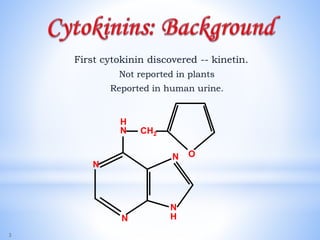
First cytokinin discovered -- kinetin.
Not reported in plants
Reported in human urine.
3
N
N
N
N
H
CH2N
H
O
*Coconut endosperm (coconut milk) – supported continued
division of mature, differentiated cells
*1940s-50s – Adenine had some effect
*Aged herring sperm …..
*Kinetin
Corn endosperm (1973) – zeatin
*Notice the double bond …..
4
5
*Primary site of synthesis -- root tips.
*High concentrations -- immature seeds and
developing fruits
*synthesis *OR* transport?
*Evidence indicates that locally produced cytokinins
required to release buds from dormancy
6
 Adenosine phosphate-isopentenyltransferase (IPT)
catalyses the first reaction in the biosynthesis of isoprene
cytokinins.
 It may use ATP, ADP, or AMP as substrates and may use
dimethylallyl pyrophosphate (DMAPP) or
hydroxymethylbutenyl pyrophosphate (HMBPP) as prenyl
donors.
 This reaction is the rate-limiting step in cytokinin
biosynthesis.
 DMADP and HMBDP used in cytokinin biosynthesis are
produced by the methylerythritol phosphate pathway
(MEP).
 Cytokinins can also be produced by recycled tRNAs in
plants and bacteria.
 tRNAs with anticodons that start with a uridine and
carrying an already-prenylated adenosine adjacent to
the anticodon release on degradation the adenosine as
a cytokinin.
 The prenylation of these adenines is carried out by
tRNA-isopentenyltransferase.
 Auxin is known to regulate the biosynthesis of
cytokinin.
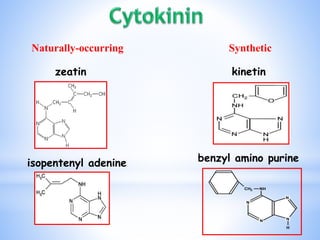
Naturally-occurring Synthetic
zeatin
isopentenyl adenine
kinetin
NN
N
N
H
NHCH2
benzyl amino purine
*Cytokinins extracted from coconut milk, Tomato juice
*Flowers and fruits of pear, plum
*Cambium tissues of Eucalyptus, Nicotina
*Immature fruits of Zea Mays, Musa sp.
*Root exudates of Sunflower
Cytokinins found in plants
1. Ribosylzeatin,
2. Zeatin,
3. Dihydrozeatin.
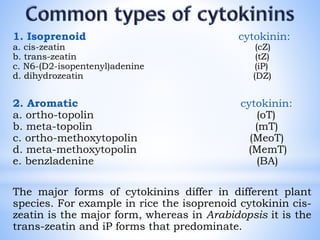
1. Isoprenoid cytokinin:
a. cis-zeatin (cZ)
b. trans-zeatin (tZ)
c. N6-(D2-isopentenyl)adenine (iP)
d. dihydrozeatin (DZ)
2. Aromatic cytokinin:
a. ortho-topolin (oT)
b. meta-topolin (mT)
c. ortho-methoxytopolin (MeoT)
d. meta-methoxytopolin (MemT)
e. benzladenine (BA)
The major forms of cytokinins differ in different plant
species. For example in rice the isoprenoid cytokinin cis-
zeatin is the major form, whereas in Arabidopsis it is the
trans-zeatin and iP forms that predominate.
Synthesis
Root Apex
Transport
Upward in Xylem
Transport of cytokinins from roots to shoot via
xylem
cytokinins in xylem exudates are mainly in form
of zeatin ribosides via xylem (transpiration
stream) in peas, a signal from the leaves may
signal/regulate transport of cytokinins from the
roots zeatin ribosides are the main transport
form; converted to the free base or glucosides in
the leaves some cytokinin also moves in the
phloem.
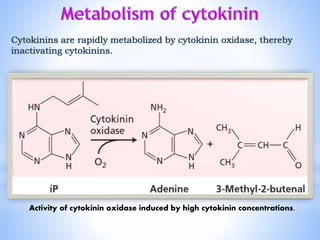
Activity of cytokinin oxidase induced by high cytokinin concentrations.
Initially the cytokinin signal binds to a receptor's
CHASE domain. This triggers a cascade of
phosphorylations of proteins, ultimately ending in
phosphorylation of a shuttle protein, AHP.
The phosphorylated AHP protein enters the nucleus,
phosphorylates type B ARR proteins, that turn on the
synthesis of type A ARR proteins. When these gene
products are, in turn, phosporylated, they influence
other effectors that result in cytokinin responses.
There is also a negative feedback loop here to shut
down the system when enough phosphorylated ARR is
present.
1. Promote cell division in target cells.
2. Promote axillary bud out growth.
3. Balance root/shoot growth so vigorous roots can support
greater shoot system.
4. Important in seed development - find in endosperm
(including coconut milk) and in cotyledons.
5. May delay senescence in leaves – lab experiment!
6. May play role in differentiation of vascular cambium in
spring in conjunction with auxin Stimulates.
7. Morphogenesis (shoot initiation/bud formation) in tissue
culture.
8. Stimulates the growth of lateral buds-release of apical
dominance.
9. Stimulates leaf expansion resulting from cell enlargement.
10. May enhance stomatal opening in some species.
11. Promotes the conversion of etioplasts into chloroplasts via
stimulation of chlorophyll synthesis.
12. Resistance against extreme temperature.
Cytokinins: Activity, Biosynthesis, and Translocation
Hitoshi Sakakibara
Abstract
Cytokinins (CKs) play a crucial role in various phases of plant growth and
development, but the basic molecular mechanisms of their biosynthesis and
signal transduction only recently became clear. The progress was achieved by
identifying a series of key genes en- coding enzymes and proteins controlling
critical steps in biosynthesis, translocation, and signaling. Basic schemes for
CK homeostasis and root/shoot communication at the whole-plant level can
now be devised. This review summarizes recent findings on the relationship
between CK structural variation and activity, distinct features in CK
biosynthesis between higher plants and Agrobacterium infected plants, CK
translocation at whole-plant and cellular levels, and CKs as signaling
molecules for nutrient status via root-shoot communication
Case study
Reference's
Sakakibara H (2006). "Cytokinins: activity, biosynthesis, and translocation".
Annu Rev Plant Biol 57 (1): 431–49.
doi:10.1146/annurev.arplant.57.032905.105231. PMID 16669769.
Chen CM, Ertl JR, Leisner SM, Chang CC (July 1985). "Localization of
cytokinin biosynthetic sites in pea plants and carrot roots". Plant Physiol.
78 (3): 510–3. doi:10.1104/pp.78.3.510. PMC 1064767. PMID 16664274.
Organo-genesis

Cytokinin

  • 1.
    Dr. Balasaheb SawantKonkan Krishi Vidyapeeth, Dapoli. Course title: Hormonal regulation of plant growth and development Submitted to : Dr. M.M. Burondkar Submitted by : Mr. Chavan Mahadeo Rajaram Course No : PP-504 ( 2+1) Department of Agricultural Botany
  • 2.
    Cytokinin are aclass of plant growth substances (phytohormones) that promote cell division, or cytokinesis, in plant roots and shoots. They are involved primarily in cell growth and differentiation.
  • 3.
    First cytokinin discovered-- kinetin. Not reported in plants Reported in human urine. 3 N N N N H CH2N H O
  • 4.
    *Coconut endosperm (coconutmilk) – supported continued division of mature, differentiated cells *1940s-50s – Adenine had some effect *Aged herring sperm ….. *Kinetin Corn endosperm (1973) – zeatin *Notice the double bond ….. 4
  • 5.
  • 6.
    *Primary site ofsynthesis -- root tips. *High concentrations -- immature seeds and developing fruits *synthesis *OR* transport? *Evidence indicates that locally produced cytokinins required to release buds from dormancy 6
  • 7.
     Adenosine phosphate-isopentenyltransferase(IPT) catalyses the first reaction in the biosynthesis of isoprene cytokinins.  It may use ATP, ADP, or AMP as substrates and may use dimethylallyl pyrophosphate (DMAPP) or hydroxymethylbutenyl pyrophosphate (HMBPP) as prenyl donors.  This reaction is the rate-limiting step in cytokinin biosynthesis.  DMADP and HMBDP used in cytokinin biosynthesis are produced by the methylerythritol phosphate pathway (MEP).
  • 8.
     Cytokinins canalso be produced by recycled tRNAs in plants and bacteria.  tRNAs with anticodons that start with a uridine and carrying an already-prenylated adenosine adjacent to the anticodon release on degradation the adenosine as a cytokinin.  The prenylation of these adenines is carried out by tRNA-isopentenyltransferase.  Auxin is known to regulate the biosynthesis of cytokinin.
  • 10.
  • 11.
    *Cytokinins extracted fromcoconut milk, Tomato juice *Flowers and fruits of pear, plum *Cambium tissues of Eucalyptus, Nicotina *Immature fruits of Zea Mays, Musa sp. *Root exudates of Sunflower Cytokinins found in plants 1. Ribosylzeatin, 2. Zeatin, 3. Dihydrozeatin.
  • 12.
    1. Isoprenoid cytokinin: a.cis-zeatin (cZ) b. trans-zeatin (tZ) c. N6-(D2-isopentenyl)adenine (iP) d. dihydrozeatin (DZ) 2. Aromatic cytokinin: a. ortho-topolin (oT) b. meta-topolin (mT) c. ortho-methoxytopolin (MeoT) d. meta-methoxytopolin (MemT) e. benzladenine (BA) The major forms of cytokinins differ in different plant species. For example in rice the isoprenoid cytokinin cis- zeatin is the major form, whereas in Arabidopsis it is the trans-zeatin and iP forms that predominate.
  • 13.
  • 14.
    Transport of cytokininsfrom roots to shoot via xylem cytokinins in xylem exudates are mainly in form of zeatin ribosides via xylem (transpiration stream) in peas, a signal from the leaves may signal/regulate transport of cytokinins from the roots zeatin ribosides are the main transport form; converted to the free base or glucosides in the leaves some cytokinin also moves in the phloem.
  • 15.
    Activity of cytokininoxidase induced by high cytokinin concentrations.
  • 16.
    Initially the cytokininsignal binds to a receptor's CHASE domain. This triggers a cascade of phosphorylations of proteins, ultimately ending in phosphorylation of a shuttle protein, AHP. The phosphorylated AHP protein enters the nucleus, phosphorylates type B ARR proteins, that turn on the synthesis of type A ARR proteins. When these gene products are, in turn, phosporylated, they influence other effectors that result in cytokinin responses. There is also a negative feedback loop here to shut down the system when enough phosphorylated ARR is present.
  • 17.
    1. Promote celldivision in target cells. 2. Promote axillary bud out growth. 3. Balance root/shoot growth so vigorous roots can support greater shoot system. 4. Important in seed development - find in endosperm (including coconut milk) and in cotyledons. 5. May delay senescence in leaves – lab experiment! 6. May play role in differentiation of vascular cambium in spring in conjunction with auxin Stimulates.
  • 18.
    7. Morphogenesis (shootinitiation/bud formation) in tissue culture. 8. Stimulates the growth of lateral buds-release of apical dominance. 9. Stimulates leaf expansion resulting from cell enlargement. 10. May enhance stomatal opening in some species. 11. Promotes the conversion of etioplasts into chloroplasts via stimulation of chlorophyll synthesis. 12. Resistance against extreme temperature.
  • 19.
    Cytokinins: Activity, Biosynthesis,and Translocation Hitoshi Sakakibara Abstract Cytokinins (CKs) play a crucial role in various phases of plant growth and development, but the basic molecular mechanisms of their biosynthesis and signal transduction only recently became clear. The progress was achieved by identifying a series of key genes en- coding enzymes and proteins controlling critical steps in biosynthesis, translocation, and signaling. Basic schemes for CK homeostasis and root/shoot communication at the whole-plant level can now be devised. This review summarizes recent findings on the relationship between CK structural variation and activity, distinct features in CK biosynthesis between higher plants and Agrobacterium infected plants, CK translocation at whole-plant and cellular levels, and CKs as signaling molecules for nutrient status via root-shoot communication Case study
  • 20.
    Reference's Sakakibara H (2006)."Cytokinins: activity, biosynthesis, and translocation". Annu Rev Plant Biol 57 (1): 431–49. doi:10.1146/annurev.arplant.57.032905.105231. PMID 16669769. Chen CM, Ertl JR, Leisner SM, Chang CC (July 1985). "Localization of cytokinin biosynthetic sites in pea plants and carrot roots". Plant Physiol. 78 (3): 510–3. doi:10.1104/pp.78.3.510. PMC 1064767. PMID 16664274.
  • 21.