The document discusses auxin, a key plant hormone first discovered by Frits Went, which promotes growth and elongation in plants. It details the biosynthesis of auxin, primarily through the tryptophan-dependent pathway, and various physiological effects, including root development and apical dominance. Additionally, the document explores auxin's role in fruit development and tropic responses in plants.
Plant hormones
“Planthormones are small organic compounds,
synthesized by specific plant cells/tissues, active in low
concentration and
.”
Naturally occurring organic substances that affect
physiological processes at low concentration.
3.
Types of planthormones
The concept of plant hormones originates from a classical
experiment on phototropism, carried out by
, using oat seedlings
exposed to a lateral light source results bending.
Based on function or chemical structure, there are five
major groups of plant hormones- such as
.
In addition, there is a variety of other plant hormones
including the
.
4.
Introduction
Auxin is thefirst plant hormone was discovered by
Frits Went - as a growth promoting chemical in the tip
of oat (Avena sativa) coleoptiles.
Promoted the elongation of the coleoptile
and
Eventually named as auxin
(derived from the Greek word auxein,
meaning to increase).
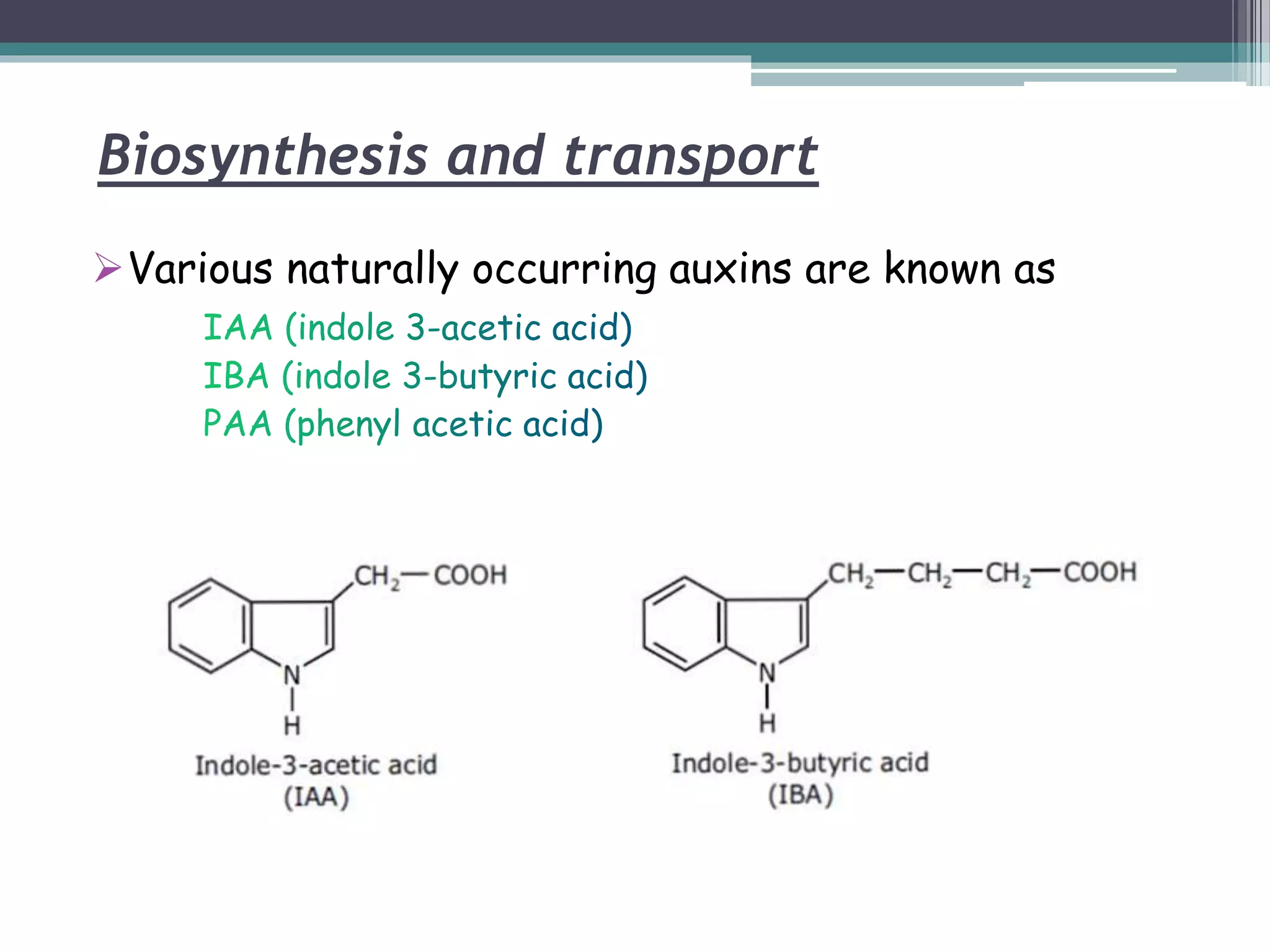
The principalnaturally occurring auxin in higher plants-
(IAA)
There are more than with different
chemical structures known to have the common auxin
activity.
The only common features shared by these compounds
are and
.
7.
Major (primary) sitesfor IAA synthesis
•
•
•
Intracellularly it is found in the
.
IAA occurs in both conjugated and free forms.
Conjugated forms are found in both-
high (such as glycoproteins) and low-molecular-weight
compounds (such as glucose)
IAA conjugates are located exclusively in the cytosol.
8.
Pathways forthe biosynthesis of IAA-
•
•
serve as precursor of auxin biosynthesis
because of its structural similarity.
The indole-3-pyruvic acid pathway is the most
common tryptophan dependent pathway.
9.
Overall, the conversionof involves:
Deamination of tryptophan, (
).
Decarboxylation of indole-3-pyruvic acid (
).
Oxidation of indole-3-acetaldehyde (
).
10.
In additionto the tryptophan-dependent pathways,
recent genetic studies have provided evidence that
plants can synthesize IAA via one or more
This route
to the formation of auxin.
The precise pathway for tryptophan-independent
IAA synthesis is not known.
11.
Physiological effects
Auxinsstimulate -
According to the
Auxin also stimulates
, H+-ATPase,
present on the plasma membrane. As a result, the pH
of the cell wall falls as low as 4.5.
12.
The higher concentrationof auxin on the shaded side
.
Auxin causes elongation probably:
By increasing osmotic solutes,
By wall pressure,
By increasing permeability to water,
By inducing synthesis of specific DNA dependent new m-RNA
and specific enzymic proteins
13.
The differentiationof relative amounts of xylem and phloem are
regulated by auxin concentration.
In general,
.
Auxin , but
(adventitious roots) and
.
Lateral roots are commonly found above the root hair zone and
originate from cells present in the pericycle.
Auxin stimulates these . The dividing cells
gradually give rise to the lateral root.
14.
In mostplants,
—a phenomenon called apical dominance.
Removal of the shoot apex usually results in the growth of lateral buds.
In the presence of apical bud, the outgrowth of the lateral bud is inhibited by
auxin that is transported basipetally from the apical bud.
Auxin .
After fertilization, fruit growth may depend on auxin produced in
developing seeds.
Auxin is and .
15.
In someplant species,
The production
of such seedless fruits is called parthenocarpy.
Auxin in plant organs under the
influence of directional stimuli (i.e. light, gravity). This is termed as
tropic response.








![Biosynthesis of auxin[1]](https://cdn.slidesharecdn.com/ss_thumbnails/biosynthesisofauxin1-170505044723-thumbnail.jpg?width=640&height=640&fit=bounds)


