ETHYLENE
DR. R. RENUKA, M.SC.,M.PHIL.,PH.D.
ASSOCIATE PROFESSOR OF BIOCHEMISTRY
V.V.VANNIAPERUMAL COLLEGE FOR WOMEN
VIRUDHUNAGAR, TAMILNAD, INDIA.
ETHYLENE
• Ethylene (C2H4) is a simple, natural, gaseous plant hormone.
• It is produced by higher plants, bacteria, and fungi and influences
many aspects of plant growth and development.
• It is also called as Ripening Hormone as it plays an important role on
ripening process.
• Low concentration of 0.1 – 1.0 microliters is sufficient to trigger the
ripening process in climacteric fruits.
HISTORY OF ETHYLENE
• Ethylene has been used since the ancient Egyptians, who would gash figs in order to
stimulate ripening (wounding stimulates ethylene production by plant tissues).
• The ancient Chinese would burn incense in closed rooms to enhance the ripening of
pears.
• Even in India, smoke has been used to stimulate ripening in banana and mango from
ancient times.
• In 1864, it was discovered that gas leaks from street lights led to stunting of growth,
twisting of plants, and abnormal thickening of stems in plants near by.
• In 1874 it was discovered that smoke caused pineapple fields to bloom.
HISTORY OF ETHYLENE
• In 1901, a Russian scientist named Dimitry Neljubow showed that the active component
which regulate the growth of the plant in smoke was ethylene.
• Farmers in Florida would commonly get their crops to ripen in sheds by lighting kerosene
lamps, which was originally thought to induce ripening from the heat.
• In 1924, Frank E. Denny discovered that it was the molecule ethylene emitted by the
kerosene lamps that induced the ripening.
• It was not until 1934 that Gane reported that plants synthesize ethylene.
• In 1935, Crocker and Knight proposed that ethylene was the plant hormone responsible
for fruit ripening as well as senescence of vegetative tissues.
• in addition to fruit ripening , ethylene is now known to have many other functions as well.
• Ethylene
 Stimulates the release of dormancy.
 Stimulates shoot and root growth and differentiation (triple response)
 May have a role in adventitious root formation.
 Maintains apical hook in seedlings.
 Stimulates leaf and fruit abscission.
 Stimulates Bromeliads flower induction.
 Induce femaleness in dioecious flowers.
 Stimulates flower opening.
 Stimulates flower and leaf senescence.
 Stimulates respiration rate
 Stimulates fruit ripening.
CHEMISTRY OF ETHYLENE
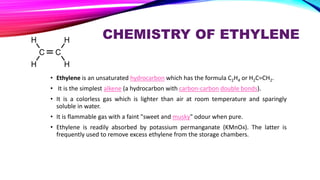
• Ethylene is an unsaturated hydrocarbon which has the formula C2H4 or H2C=CH2.
• It is the simplest alkene (a hydrocarbon with carbon-carbon double bonds).
• It is a colorless gas which is lighter than air at room temperature and sparingly
soluble in water.
• It is flammable gas with a faint "sweet and musky" odour when pure.
• Ethylene is readily absorbed by potassium permanganate (KMnO4). The latter is
frequently used to remove excess ethylene from the storage chambers.
OCCURRENCE, DISTRIBUTION AND
TRANSPORT OF ETHYLENE
• (Being a gas, ethylene moves by diffusion from its site of synthesis).
BIOSYNTHESIS OF ETHYLENE
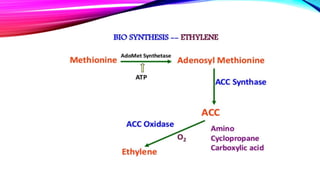
• Ethylene is derived from amino acid Methionine.
• A non – protein amino acid, 1 – amino cyclopropane- 1- carboxylic acid (ACC)
is an important intermediate and also immediate precursor of ethylene
biosynthesis
PHYSIOLOGICAL EFFECTS OF
ETHYLENE
• In addition to fruit ripening, ethylene is now known to have many other functions
as well. Ethylene;
 Stimulates the release of dormancy.
 Stimulates shoot and root growth and differentiation (triple response)
 May have a role in adventitious root formation.
 Stimulates leaf and fruit abscission.
 Stimulates Bromeliads flower induction.
 Induction of femaleness in dioecious flowers.
 Stimulates flower opening.
 Stimulates flower and leaf senescence.
 Stimulates respiration rate
 Stimulates fruit ripening.
PHYSIOLOGICAL EFFECTS OF ETHYLENE
• Break seed and Bud dormancy
• The dormancy of many seeds such as cereals can be broken by application of ethylene.
Ethylene application increases the rate of germination.
• Ethylene treatment sometimes used to promote bud sprouting in potato and other tubers.
• Fruit ripening
• It stimulates fruit ripening in most plants including banana, apple, tomato etc.
• Growth inhibition
• Exogenous application of ethylene inhibits the plant growth. In most dicots, growth of
stem, root and leaves inhibited but the hormone enhances radial growth as a result both
stem and root swell in response to ethylene.
CONT… PHYSIOLOGICAL EFFECTS OF ETHYLENE
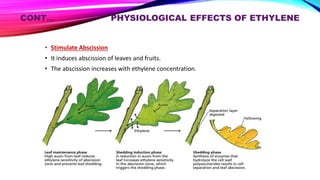
• Stimulate Abscission
• It induces abscission of leaves and fruits.
• The abscission increases with ethylene concentration.
CONT… PHYSIOLOGICAL EFFECTS OF ETHYLENE
• Induce Flowering
• In most cases ethylene inhibits flowering but in pineapple (Bromeliaceae family) , mango
and litchi it stimulates flowering.
• Sex expression
• Ethylene stimulate femaleness in plant like cucumber and melons (dioecious). Normally
these plants produce male flowers earlier than female flowers. Ethylene stimulate the
early production of female flowers in these plants.
• Plumular Hook Formation
• In etiolated dicot seedlings, the plumular tip (shoot apex) is usually bent like a hook. This
hook shape is advantageous to seedling for penetration through the soil, protecting the
tender apical growing point from being injured.
CONT… PHYSIOLOGICAL EFFECTS OF ETHYLENE
• Formation of Adventitious Root Hairs
• Ethylene induces formation of adventitious roots in plants by diffusing from
different plant parts such as leaf, stem, peduncle and even other roots.
• Triple response
• Ethylene causes ‘triple response’ of etiolated seedling (such as in pea) which
consists of:
• i) Inhibition of stem elongation (short shoots)
• Ii) Stimulation of radial swelling of stems (fat shoots)
• Iii)Increased lateral growth of roots and Horizontal growth of stems with respect
to gravity (Diageo tropism)
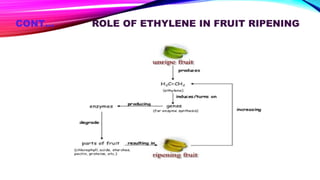
ROLE OF ETHYLENE IN FRUIT RIPENING
CONT… ROLE OF ETHYLENE IN FRUIT RIPENING
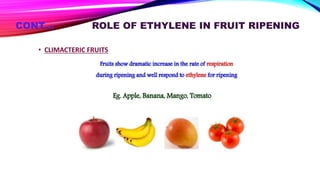
• CLIMACTERIC FRUITS
CONT… ROLE OF ETHYLENE IN FRUIT RIPENING
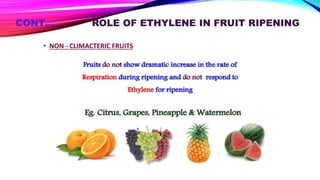
• NON - CLIMACTERIC FRUITS
CONT… ROLE OF ETHYLENE IN FRUIT RIPENING
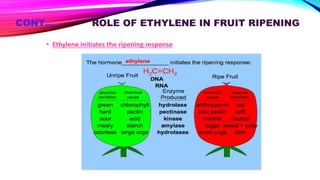
• Ethylene initiates the ripening response
CONT… ROLE OF ETHYLENE IN FRUIT RIPENING
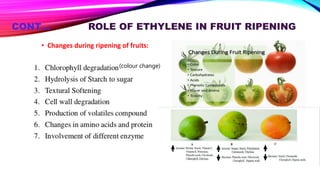
• Changes during ripening of fruits:
(colour change)
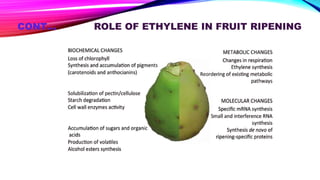
CONT… ROLE OF ETHYLENE IN FRUIT RIPENING
INHIBITORS OF ETHYLENE
Aminoethoxy- vinylglycine (AVG)
Aminooxyacetic acid (AOA)
Silver ions
Carbondioxide at high concentration (5-10%)
Trans-cyclo octane
1- methylcyclopropene (1-MCP)
Silver thiosulphate (STS)
Silver nitrate and silver chloride
Ethylene

Ethylene

  • 1.
    ETHYLENE DR. R. RENUKA,M.SC.,M.PHIL.,PH.D. ASSOCIATE PROFESSOR OF BIOCHEMISTRY V.V.VANNIAPERUMAL COLLEGE FOR WOMEN VIRUDHUNAGAR, TAMILNAD, INDIA.
  • 2.
    ETHYLENE • Ethylene (C2H4)is a simple, natural, gaseous plant hormone. • It is produced by higher plants, bacteria, and fungi and influences many aspects of plant growth and development. • It is also called as Ripening Hormone as it plays an important role on ripening process. • Low concentration of 0.1 – 1.0 microliters is sufficient to trigger the ripening process in climacteric fruits.
  • 3.
    HISTORY OF ETHYLENE •Ethylene has been used since the ancient Egyptians, who would gash figs in order to stimulate ripening (wounding stimulates ethylene production by plant tissues). • The ancient Chinese would burn incense in closed rooms to enhance the ripening of pears. • Even in India, smoke has been used to stimulate ripening in banana and mango from ancient times. • In 1864, it was discovered that gas leaks from street lights led to stunting of growth, twisting of plants, and abnormal thickening of stems in plants near by. • In 1874 it was discovered that smoke caused pineapple fields to bloom.
  • 4.
    HISTORY OF ETHYLENE •In 1901, a Russian scientist named Dimitry Neljubow showed that the active component which regulate the growth of the plant in smoke was ethylene. • Farmers in Florida would commonly get their crops to ripen in sheds by lighting kerosene lamps, which was originally thought to induce ripening from the heat. • In 1924, Frank E. Denny discovered that it was the molecule ethylene emitted by the kerosene lamps that induced the ripening. • It was not until 1934 that Gane reported that plants synthesize ethylene. • In 1935, Crocker and Knight proposed that ethylene was the plant hormone responsible for fruit ripening as well as senescence of vegetative tissues.
  • 5.
    • in additionto fruit ripening , ethylene is now known to have many other functions as well. • Ethylene  Stimulates the release of dormancy.  Stimulates shoot and root growth and differentiation (triple response)  May have a role in adventitious root formation.  Maintains apical hook in seedlings.  Stimulates leaf and fruit abscission.  Stimulates Bromeliads flower induction.  Induce femaleness in dioecious flowers.  Stimulates flower opening.  Stimulates flower and leaf senescence.  Stimulates respiration rate  Stimulates fruit ripening.
  • 6.
    CHEMISTRY OF ETHYLENE •Ethylene is an unsaturated hydrocarbon which has the formula C2H4 or H2C=CH2. • It is the simplest alkene (a hydrocarbon with carbon-carbon double bonds). • It is a colorless gas which is lighter than air at room temperature and sparingly soluble in water. • It is flammable gas with a faint "sweet and musky" odour when pure. • Ethylene is readily absorbed by potassium permanganate (KMnO4). The latter is frequently used to remove excess ethylene from the storage chambers.
  • 7.
    OCCURRENCE, DISTRIBUTION AND TRANSPORTOF ETHYLENE • (Being a gas, ethylene moves by diffusion from its site of synthesis).
  • 8.
    BIOSYNTHESIS OF ETHYLENE •Ethylene is derived from amino acid Methionine. • A non – protein amino acid, 1 – amino cyclopropane- 1- carboxylic acid (ACC) is an important intermediate and also immediate precursor of ethylene biosynthesis
  • 10.
    PHYSIOLOGICAL EFFECTS OF ETHYLENE •In addition to fruit ripening, ethylene is now known to have many other functions as well. Ethylene;  Stimulates the release of dormancy.  Stimulates shoot and root growth and differentiation (triple response)  May have a role in adventitious root formation.  Stimulates leaf and fruit abscission.  Stimulates Bromeliads flower induction.  Induction of femaleness in dioecious flowers.  Stimulates flower opening.  Stimulates flower and leaf senescence.  Stimulates respiration rate  Stimulates fruit ripening.
  • 11.
    PHYSIOLOGICAL EFFECTS OFETHYLENE • Break seed and Bud dormancy • The dormancy of many seeds such as cereals can be broken by application of ethylene. Ethylene application increases the rate of germination. • Ethylene treatment sometimes used to promote bud sprouting in potato and other tubers. • Fruit ripening • It stimulates fruit ripening in most plants including banana, apple, tomato etc. • Growth inhibition • Exogenous application of ethylene inhibits the plant growth. In most dicots, growth of stem, root and leaves inhibited but the hormone enhances radial growth as a result both stem and root swell in response to ethylene.
  • 12.
    CONT… PHYSIOLOGICAL EFFECTSOF ETHYLENE • Stimulate Abscission • It induces abscission of leaves and fruits. • The abscission increases with ethylene concentration.
  • 13.
    CONT… PHYSIOLOGICAL EFFECTSOF ETHYLENE • Induce Flowering • In most cases ethylene inhibits flowering but in pineapple (Bromeliaceae family) , mango and litchi it stimulates flowering. • Sex expression • Ethylene stimulate femaleness in plant like cucumber and melons (dioecious). Normally these plants produce male flowers earlier than female flowers. Ethylene stimulate the early production of female flowers in these plants. • Plumular Hook Formation • In etiolated dicot seedlings, the plumular tip (shoot apex) is usually bent like a hook. This hook shape is advantageous to seedling for penetration through the soil, protecting the tender apical growing point from being injured.
  • 14.
    CONT… PHYSIOLOGICAL EFFECTSOF ETHYLENE • Formation of Adventitious Root Hairs • Ethylene induces formation of adventitious roots in plants by diffusing from different plant parts such as leaf, stem, peduncle and even other roots. • Triple response • Ethylene causes ‘triple response’ of etiolated seedling (such as in pea) which consists of: • i) Inhibition of stem elongation (short shoots) • Ii) Stimulation of radial swelling of stems (fat shoots) • Iii)Increased lateral growth of roots and Horizontal growth of stems with respect to gravity (Diageo tropism)
  • 15.
    ROLE OF ETHYLENEIN FRUIT RIPENING
  • 16.
    CONT… ROLE OFETHYLENE IN FRUIT RIPENING • CLIMACTERIC FRUITS
  • 17.
    CONT… ROLE OFETHYLENE IN FRUIT RIPENING • NON - CLIMACTERIC FRUITS
  • 18.
    CONT… ROLE OFETHYLENE IN FRUIT RIPENING
  • 19.
    CONT… ROLE OFETHYLENE IN FRUIT RIPENING • Ethylene initiates the ripening response
  • 20.
    CONT… ROLE OFETHYLENE IN FRUIT RIPENING • Changes during ripening of fruits: (colour change)
  • 21.
    CONT… ROLE OFETHYLENE IN FRUIT RIPENING
  • 22.
    INHIBITORS OF ETHYLENE Aminoethoxy-vinylglycine (AVG) Aminooxyacetic acid (AOA) Silver ions Carbondioxide at high concentration (5-10%) Trans-cyclo octane 1- methylcyclopropene (1-MCP) Silver thiosulphate (STS) Silver nitrate and silver chloride