WEL COME
TOPIC: FOLIAR NUTRITION UPTAKE
&FACTORS AFFECTING FOLIAR NUTRITION
PRESENTED BY
P.SREELATHA
TAM/2014-24
Introduction
• Ability of leaf to absorb nutrients was first recorded
by Gris (1844)
• Floyd was able to control the Cu deficiency disease
“Die – back” by spraying of Bordeaux-mixture
• The conditions for the use of foliar fertilizers
include:
1) when soil conditions limit availability of soil applied nutrients
2) In conditions when high loss rates of soil applied nutrients may
occur
3) when the stage of plant growth, the internal plant demand and
the environment conditions interact to limit delivery of nutrients to
critical plant organs
Definition
• Mineral nutrients can be applied to the leaves
as sprays in a process is known as foliar
application
Stages in foliar up take of nutrients
• Penetration : through stomata or cuticle
• Translocation: transport of ions from cell to
cell through vascular channels (xylem,phloem)
from the leaves to where they are consumed
penetration
• Role of plant morphology and structure
• All aerial plant parts are covered by a hydrophobic cuticle that
limits the bidirectional exchange of water, solutes and gases
between the plant and the surrounding environment
• The cuticle proves an effective barrier against the loss of water
and yet, at the same time, it proves an equally effective one against
the uptake of foliar applied chemicals.
• A foliar applied chemical may cross the plant leaf surface via the
cuticle along cuticular cracks or imperfections, or through
modified epidermal structures such as stomata, trichomes or
lenticels
Pathways and mechanisms of penetration
• The structure and chemistry of the plant surface will affect the
bi-directional diffusion of substances between the plant, the
leaf surface and the surrounding environment and hence and
therefore the rate of uptake of foliar fertilizers
• Cuticular permeability
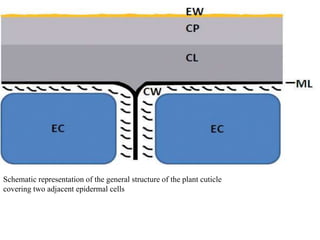
• The cuticle consists of three layers
Epicuticular wax layer (EW),
Cuticle proper (CP)
Cuticular layer (CL)
Schematic representation of the general structure of the plant cuticle
covering two adjacent epidermal cells
• A gradual increase in negative charge from the epicuticular wax to
the pectin layer creates an electrochemical gradient that may
increase the movement of cations and water molecules
• The intra-cuticular waxes limit the exchange of water and solutes
between the plant and the surrounding environment while the
epicuticular waxes influence the wettability, light reflectance
• The lipophilic and hydrophobic nature of the structural
components of the cuticle make it an effective barrier against the
diffusion of hydrophilic, polar compounds
• lipophilic and a-polar compounds may penetrate the hydrophobic
cuticular membrane at high rates compared to polar electrolyte
solutions which have not had surface-active agents added to them
• The penetration of lipophilic, apolar substances through the plant
cuticle follow a dissolution-diffusion process
• movement of a lipophilic, apolar molecule from a solution
deposited onto the plant surface into the cuticle precedes the
diffusion of the molecule through the cuticle
• diffusion of a lipophilic molecule its penetration rate will be
proportional to the solubility and mobility of the compound in the
cuticle
• Fick´s first law, the diffusive flux is related to the
concentration gradient with solutes moving from regions of
high to low concentration with a magnitude that is proportional
to the concentration gradient
• According to the cuticular diffusion model diffusive flux J is
proportional to the permeability of the membrane multiplied
by the concentration difference between the inner and the outer
sides of the cuticle
• J= P * (Ci-Co)
Permeability of stomata
• Stomata play a major role in the absorption of nutrient
solutions applied to the foliage.
• Foliar applied nutrients are penetrate in to the leaf through
stomata via mass flow process
• higher foliar penetration rates through the abaxial as compared
to the adaxial side
• higher penetration rates in the presence of stomata have been
attributed to the increased permeability of the peristomatal
cuticle and the guard cells
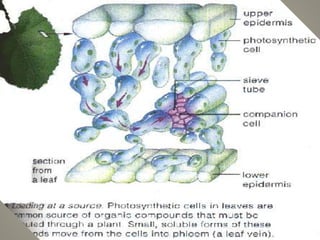
Up take by the leaf cells & transport from the leaf
• Plasma tubules provide connection from leaf cells to
vascular system.
• The transport within the leaf follows two roots to
reach the vascular tissues
Symplast
Apoplast
SECTION FROM A LEAF
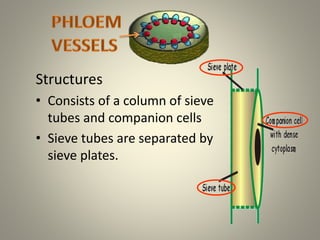
Phloem
Structures
• Consists of a column of sieve
tubes and companion cells
• Sieve tubes are separated by
sieve plates.
Physico – Chemical properties of spray solutions
and their impact on penetration
• The Physico-chemical characteristics of the specific nutrient
compound in aqueous solution, will have a major influence on the rate
of absorption of the element by the leaf.
I concentration
II. Solubility
III.Molecular weight
IV. Solution ph
V. Point of deliquesence (POD)
Concentration
• The concentration of a nutrient present in a foliar spray will always be
significantly higher than the concentration found within the plant
organ.
• concentration gradient will be established when a nutrient solution is
applied onto the plant surface and this will potentially lead to the
diffusion of the nutrient across the surface
• The ideal concentration range of mineral nutrient solutions for foliar
application should be selected according to factors such as the
I. kind of nutrient
II. plant species,
III. plant age,
IV.nutritional status and weather conditions
Solubility
• Water solubility of the applied substance is a key factor for foliar
uptake, since absorption will occur only when the applied compound
is dissolved in a liquid phase on the plant surface that will
subsequently diffuse into the plant organs.
• The solubility of a chemical compound in a specific solvent at a given
temperature is a physical property which can be altered through use of
additives
• The highest limit of the solubility of a substance in a solvent is
referred to as the saturation concentration
Molecular weight
• The size of the nutrient molecule in solution will affect the rate of
penetration of a foliar fertilizer as a consequence of the mechanism
of cuticular absorption.
• foliar uptake pathway is less size selective than would be predicted
by the cuticular penetration route of entry which may indicate that
there is a stomatal pathway.
• the process of stomatal uptake is also size-selective since particles
with a diameter of 1 μm did not enter the stomatal pore whereas
particles of 43 nm diameter did penetrate into the stomata
Solution pH
• Since plant cuticles are poly-electrolytes, their ion exchange capacity
will be altered with pH fluctuations
• Cuticles were shown to have iso-electric points around pH 3 and when
solution pH values are higher than this they will render the cuticle
negatively charged and the cuticular carboxyl groups will then readily
bind positively charged cations
• Frequently foliar spray salts dissolved in pure water will alter spray
solution pH and some formulations may have extreme pH values and
hence will affect the uptake process of by the foliage.
Point of deliquescence
• The processes of hydration and dissolution of a salt are determined
by its point of deliquescence (POD) which is a physical property
associated with a compound at a given temperature
• The point of deliquescence is defined as the relative humidity value
at which the salt becomes a solute.
• lower the point of deliquescence of a salt is, the sooner it will
dissolve upon exposure to ambient relative humidity When ambient
relative humidity is higher than the point of deliquescence of the
foliar applied compound,the substance will dissolve and will be
available for absorption by the leaf.
Formulations and adjuvants
• Commercial foliar nutrient sprays are generally composed of at least
two major components the active ingredient and the inert material
or adjuvant.
• Adjuvants help to improve the spreading and persistence of the
active ingredient on the leaf surface as well as promote the rate of
uptake
Environmental factors
• Relative humidity
• Temperature.
• Precipitation
• Light intensity
Relative humidity
• At high relative humidity permeability may be increased due
to cuticular hydration and the delayed drying of the salt
deposited onto the plant surface following the application of a
foliar spray
• Salts with points of deliquescence above the prevailing relative
humidity in the phyllosphere will theoretically remain as
solutes and leaf penetration will be prolonged.
Temperature
• increasing temperature range (e.g. from 0 to 40°C)
• solubility of the active ingredients, adjuvants ↑
• viscosity, surface tension and point of deliquescence↓
• high temperatures will speed the rate of evaporation from the
spray solutions deposited onto the foliage reducing the time
until solution dryness occurs when leaf penetration can no
longer occur.
Light intensity
• Thickness of cuticle and amount of cuticular waxes increases under
high light intensity
Practical importance of foliar application
mineral nutrients
• Low nutrient availability in soils
• Dry top soil
• Decrease in root activity during the reproductive
stage
• Increase in protein content of cereal grains

Foliar nutrion new

  • 1.
  • 2.
    TOPIC: FOLIAR NUTRITIONUPTAKE &FACTORS AFFECTING FOLIAR NUTRITION PRESENTED BY P.SREELATHA TAM/2014-24
  • 3.
    Introduction • Ability ofleaf to absorb nutrients was first recorded by Gris (1844) • Floyd was able to control the Cu deficiency disease “Die – back” by spraying of Bordeaux-mixture
  • 4.
    • The conditionsfor the use of foliar fertilizers include: 1) when soil conditions limit availability of soil applied nutrients 2) In conditions when high loss rates of soil applied nutrients may occur 3) when the stage of plant growth, the internal plant demand and the environment conditions interact to limit delivery of nutrients to critical plant organs
  • 5.
    Definition • Mineral nutrientscan be applied to the leaves as sprays in a process is known as foliar application
  • 6.
    Stages in foliarup take of nutrients • Penetration : through stomata or cuticle • Translocation: transport of ions from cell to cell through vascular channels (xylem,phloem) from the leaves to where they are consumed
  • 7.
    penetration • Role ofplant morphology and structure • All aerial plant parts are covered by a hydrophobic cuticle that limits the bidirectional exchange of water, solutes and gases between the plant and the surrounding environment • The cuticle proves an effective barrier against the loss of water and yet, at the same time, it proves an equally effective one against the uptake of foliar applied chemicals. • A foliar applied chemical may cross the plant leaf surface via the cuticle along cuticular cracks or imperfections, or through modified epidermal structures such as stomata, trichomes or lenticels
  • 8.
    Pathways and mechanismsof penetration • The structure and chemistry of the plant surface will affect the bi-directional diffusion of substances between the plant, the leaf surface and the surrounding environment and hence and therefore the rate of uptake of foliar fertilizers • Cuticular permeability • The cuticle consists of three layers Epicuticular wax layer (EW), Cuticle proper (CP) Cuticular layer (CL)
  • 9.
    Schematic representation ofthe general structure of the plant cuticle covering two adjacent epidermal cells
  • 10.
    • A gradualincrease in negative charge from the epicuticular wax to the pectin layer creates an electrochemical gradient that may increase the movement of cations and water molecules • The intra-cuticular waxes limit the exchange of water and solutes between the plant and the surrounding environment while the epicuticular waxes influence the wettability, light reflectance • The lipophilic and hydrophobic nature of the structural components of the cuticle make it an effective barrier against the diffusion of hydrophilic, polar compounds
  • 11.
    • lipophilic anda-polar compounds may penetrate the hydrophobic cuticular membrane at high rates compared to polar electrolyte solutions which have not had surface-active agents added to them • The penetration of lipophilic, apolar substances through the plant cuticle follow a dissolution-diffusion process • movement of a lipophilic, apolar molecule from a solution deposited onto the plant surface into the cuticle precedes the diffusion of the molecule through the cuticle • diffusion of a lipophilic molecule its penetration rate will be proportional to the solubility and mobility of the compound in the cuticle
  • 12.
    • Fick´s firstlaw, the diffusive flux is related to the concentration gradient with solutes moving from regions of high to low concentration with a magnitude that is proportional to the concentration gradient • According to the cuticular diffusion model diffusive flux J is proportional to the permeability of the membrane multiplied by the concentration difference between the inner and the outer sides of the cuticle • J= P * (Ci-Co)
  • 13.
    Permeability of stomata •Stomata play a major role in the absorption of nutrient solutions applied to the foliage. • Foliar applied nutrients are penetrate in to the leaf through stomata via mass flow process • higher foliar penetration rates through the abaxial as compared to the adaxial side • higher penetration rates in the presence of stomata have been attributed to the increased permeability of the peristomatal cuticle and the guard cells
  • 14.
    Up take bythe leaf cells & transport from the leaf • Plasma tubules provide connection from leaf cells to vascular system. • The transport within the leaf follows two roots to reach the vascular tissues Symplast Apoplast
  • 15.
  • 16.
    Phloem Structures • Consists ofa column of sieve tubes and companion cells • Sieve tubes are separated by sieve plates.
  • 17.
    Physico – Chemicalproperties of spray solutions and their impact on penetration • The Physico-chemical characteristics of the specific nutrient compound in aqueous solution, will have a major influence on the rate of absorption of the element by the leaf. I concentration II. Solubility III.Molecular weight IV. Solution ph V. Point of deliquesence (POD)
  • 18.
    Concentration • The concentrationof a nutrient present in a foliar spray will always be significantly higher than the concentration found within the plant organ. • concentration gradient will be established when a nutrient solution is applied onto the plant surface and this will potentially lead to the diffusion of the nutrient across the surface • The ideal concentration range of mineral nutrient solutions for foliar application should be selected according to factors such as the I. kind of nutrient II. plant species, III. plant age, IV.nutritional status and weather conditions
  • 20.
    Solubility • Water solubilityof the applied substance is a key factor for foliar uptake, since absorption will occur only when the applied compound is dissolved in a liquid phase on the plant surface that will subsequently diffuse into the plant organs. • The solubility of a chemical compound in a specific solvent at a given temperature is a physical property which can be altered through use of additives • The highest limit of the solubility of a substance in a solvent is referred to as the saturation concentration
  • 21.
    Molecular weight • Thesize of the nutrient molecule in solution will affect the rate of penetration of a foliar fertilizer as a consequence of the mechanism of cuticular absorption. • foliar uptake pathway is less size selective than would be predicted by the cuticular penetration route of entry which may indicate that there is a stomatal pathway. • the process of stomatal uptake is also size-selective since particles with a diameter of 1 μm did not enter the stomatal pore whereas particles of 43 nm diameter did penetrate into the stomata
  • 22.
    Solution pH • Sinceplant cuticles are poly-electrolytes, their ion exchange capacity will be altered with pH fluctuations • Cuticles were shown to have iso-electric points around pH 3 and when solution pH values are higher than this they will render the cuticle negatively charged and the cuticular carboxyl groups will then readily bind positively charged cations • Frequently foliar spray salts dissolved in pure water will alter spray solution pH and some formulations may have extreme pH values and hence will affect the uptake process of by the foliage.
  • 23.
    Point of deliquescence •The processes of hydration and dissolution of a salt are determined by its point of deliquescence (POD) which is a physical property associated with a compound at a given temperature • The point of deliquescence is defined as the relative humidity value at which the salt becomes a solute. • lower the point of deliquescence of a salt is, the sooner it will dissolve upon exposure to ambient relative humidity When ambient relative humidity is higher than the point of deliquescence of the foliar applied compound,the substance will dissolve and will be available for absorption by the leaf.
  • 24.
    Formulations and adjuvants •Commercial foliar nutrient sprays are generally composed of at least two major components the active ingredient and the inert material or adjuvant. • Adjuvants help to improve the spreading and persistence of the active ingredient on the leaf surface as well as promote the rate of uptake
  • 26.
    Environmental factors • Relativehumidity • Temperature. • Precipitation • Light intensity
  • 27.
    Relative humidity • Athigh relative humidity permeability may be increased due to cuticular hydration and the delayed drying of the salt deposited onto the plant surface following the application of a foliar spray • Salts with points of deliquescence above the prevailing relative humidity in the phyllosphere will theoretically remain as solutes and leaf penetration will be prolonged.
  • 28.
    Temperature • increasing temperaturerange (e.g. from 0 to 40°C) • solubility of the active ingredients, adjuvants ↑ • viscosity, surface tension and point of deliquescence↓ • high temperatures will speed the rate of evaporation from the spray solutions deposited onto the foliage reducing the time until solution dryness occurs when leaf penetration can no longer occur.
  • 29.
    Light intensity • Thicknessof cuticle and amount of cuticular waxes increases under high light intensity
  • 30.
    Practical importance offoliar application mineral nutrients • Low nutrient availability in soils • Dry top soil • Decrease in root activity during the reproductive stage • Increase in protein content of cereal grains