Auxin
PREPARED BY: JAY JANI
CONTENT
 Polar auxin transport.
 Chemiosmotic model.
 Acid theory.
 Model for gene regulation.
 Derepression of early auxin genes.
 Applications.
Auxin transport
 Transport polarly.
 auxins are not synthesized in all cells,
 the shoot apical meristerm is primary source of auxin in plant.
 Auxin will transported through the vascular parenchyma tissue most likely
xylema and phloem.
 Auxin synthesized via tryptophan-dependent pathways.
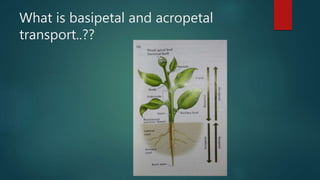
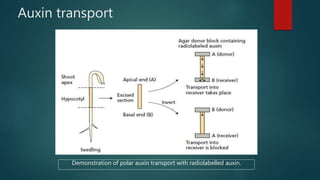
 Dr.Went discovered that IAA moves mainly from the apical to basal end
(basipetally)[coleoptile curvature test]
 This type of unidirectional transport is termed polar transport
What is basipetal and acropetal
transport..??
Auxin transport
Demonstration of polar auxin transport with radiolabelled auxin.
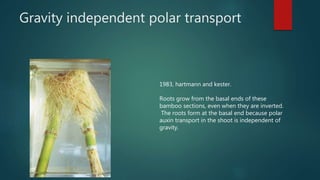
Gravity independent polar transport
1983, hartmann and kester.
Roots grow from the basal ends of these
bamboo sections, even when they are inverted.
The roots form at the basal end because polar
auxin transport in the shoot is independent of
gravity.
Polar transport
 Polar transport proceed into cell to cell fashion.
 Auxin exits the cell via the cell membrane.
 Diffuse across the complex middle lamella.
 Enters in next cell through plasma membrane.
 The export of auxin from the cell termed as auxin efflux.
 The entry of auxin in cell called auxin influx.
 The overall process requires metabolic energy. Polar auxin transport is faster
then diffusion(3mm/hour).
Chemiosmotic model
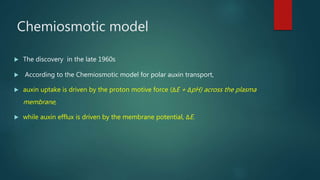
 The discovery in the late 1960s
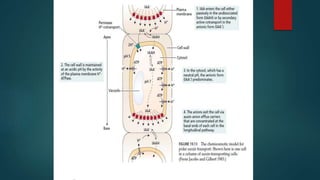
 According to the Chemiosmotic model for polar auxin transport,
 auxin uptake is driven by the proton motive force (ΔE + ΔpH) across the plasma
membrane,
 while auxin efflux is driven by the membrane potential, ΔE.
A chemiosmotic Model
POLAR AUXIN TRANSPORT
ACID GROWTH THEORY
HOW CELL WILL ELONGATE…???
Acid theory and cell elongation
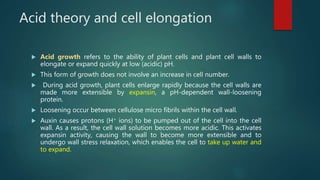
 Acid growth refers to the ability of plant cells and plant cell walls to
elongate or expand quickly at low (acidic) pH.
 This form of growth does not involve an increase in cell number.
 During acid growth, plant cells enlarge rapidly because the cell walls are
made more extensible by expansin, a pH-dependent wall-loosening
protein.
 Loosening occur between cellulose micro fibrils within the cell wall.
 Auxin causes protons (H+ ions) to be pumped out of the cell into the cell
wall. As a result, the cell wall solution becomes more acidic. This activates
expansin activity, causing the wall to become more extensible and to
undergo wall stress relaxation, which enables the cell to take up water and
to expand.
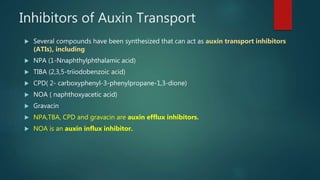
Inhibitors of Auxin Transport
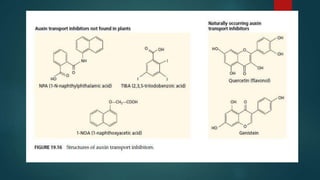
 Several compounds have been synthesized that can act as auxin transport inhibitors
(ATIs), including
 NPA (1-Nnaphthylphthalamic acid)
 TIBA (2,3,5-triiodobenzoic acid)
 CPD( 2- carboxyphenyl-3-phenylpropane-1,3-dione)
 NOA ( naphthoxyacetic acid)
 Gravacin
 NPA,TBA, CPD and gravacin are auxin efflux inhibitors.
 NOA is an auxin influx inhibitor.
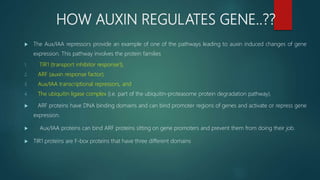
HOW AUXIN REGULATES GENE..??
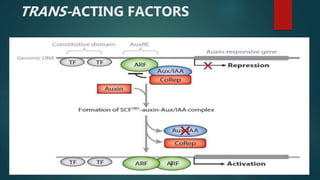
 The Aux/IAA repressors provide an example of one of the pathways leading to auxin induced changes of gene
expression. This pathway involves the protein families
1. TIR1 (transport inhibitor response1),
2. ARF (auxin response factor),
3. Aux/IAA transcriptional repressors, and
4. The ubiquitin ligase complex (i.e. part of the ubiquitin-proteasome protein degradation pathway).
 ARF proteins have DNA binding domains and can bind promoter regions of genes and activate or repress gene
expression.
 Aux/IAA proteins can bind ARF proteins sitting on gene promoters and prevent them from doing their job.
 TIR1 proteins are F-box proteins that have three different domains
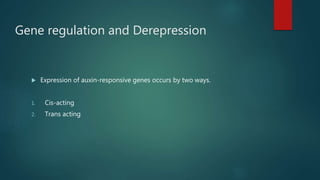
Gene regulation and Derepression
 Expression of auxin-responsive genes occurs by two ways.
1. Cis-acting
2. Trans acting
TRANS-ACTING FACTORS
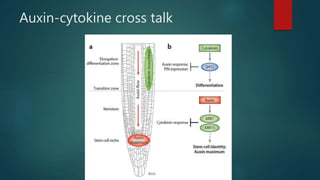
Auxin-cytokine cross talk
Application of Auxin
1. Cell division: Auxins induce cell division.
2. Root initiation.
3. Preventing of lodging.
4. Initiation of flowering.
5. Parthenocarpy.
6. Eradication of weeds.
7. Apical dominance.
8. Abscission and senescence.
9. Shortening of internodes
References
 Books:
 lincoin Taiz and Eduardo Zeiger.
 Biochemistry and molecular biology of plant(by:buchanan)
 Research paper:
 Annu. Rev. Genet. 2009. 43
 David L. Plant Physiol. (1992) 99
Thank you

Auxin

  • 1.
  • 2.
    CONTENT  Polar auxintransport.  Chemiosmotic model.  Acid theory.  Model for gene regulation.  Derepression of early auxin genes.  Applications.
  • 3.
    Auxin transport  Transportpolarly.  auxins are not synthesized in all cells,  the shoot apical meristerm is primary source of auxin in plant.  Auxin will transported through the vascular parenchyma tissue most likely xylema and phloem.  Auxin synthesized via tryptophan-dependent pathways.  Dr.Went discovered that IAA moves mainly from the apical to basal end (basipetally)[coleoptile curvature test]  This type of unidirectional transport is termed polar transport
  • 4.
    What is basipetaland acropetal transport..??
  • 5.
    Auxin transport Demonstration ofpolar auxin transport with radiolabelled auxin.
  • 6.
    Gravity independent polartransport 1983, hartmann and kester. Roots grow from the basal ends of these bamboo sections, even when they are inverted. The roots form at the basal end because polar auxin transport in the shoot is independent of gravity.
  • 7.
    Polar transport  Polartransport proceed into cell to cell fashion.  Auxin exits the cell via the cell membrane.  Diffuse across the complex middle lamella.  Enters in next cell through plasma membrane.  The export of auxin from the cell termed as auxin efflux.  The entry of auxin in cell called auxin influx.  The overall process requires metabolic energy. Polar auxin transport is faster then diffusion(3mm/hour).
  • 8.
    Chemiosmotic model  Thediscovery in the late 1960s  According to the Chemiosmotic model for polar auxin transport,  auxin uptake is driven by the proton motive force (ΔE + ΔpH) across the plasma membrane,  while auxin efflux is driven by the membrane potential, ΔE.
  • 9.
  • 11.
    ACID GROWTH THEORY HOWCELL WILL ELONGATE…???
  • 12.
    Acid theory andcell elongation  Acid growth refers to the ability of plant cells and plant cell walls to elongate or expand quickly at low (acidic) pH.  This form of growth does not involve an increase in cell number.  During acid growth, plant cells enlarge rapidly because the cell walls are made more extensible by expansin, a pH-dependent wall-loosening protein.  Loosening occur between cellulose micro fibrils within the cell wall.  Auxin causes protons (H+ ions) to be pumped out of the cell into the cell wall. As a result, the cell wall solution becomes more acidic. This activates expansin activity, causing the wall to become more extensible and to undergo wall stress relaxation, which enables the cell to take up water and to expand.
  • 13.
    Inhibitors of AuxinTransport  Several compounds have been synthesized that can act as auxin transport inhibitors (ATIs), including  NPA (1-Nnaphthylphthalamic acid)  TIBA (2,3,5-triiodobenzoic acid)  CPD( 2- carboxyphenyl-3-phenylpropane-1,3-dione)  NOA ( naphthoxyacetic acid)  Gravacin  NPA,TBA, CPD and gravacin are auxin efflux inhibitors.  NOA is an auxin influx inhibitor.
  • 15.
    HOW AUXIN REGULATESGENE..??  The Aux/IAA repressors provide an example of one of the pathways leading to auxin induced changes of gene expression. This pathway involves the protein families 1. TIR1 (transport inhibitor response1), 2. ARF (auxin response factor), 3. Aux/IAA transcriptional repressors, and 4. The ubiquitin ligase complex (i.e. part of the ubiquitin-proteasome protein degradation pathway).  ARF proteins have DNA binding domains and can bind promoter regions of genes and activate or repress gene expression.  Aux/IAA proteins can bind ARF proteins sitting on gene promoters and prevent them from doing their job.  TIR1 proteins are F-box proteins that have three different domains
  • 16.
    Gene regulation andDerepression  Expression of auxin-responsive genes occurs by two ways. 1. Cis-acting 2. Trans acting
  • 17.
  • 18.
  • 19.
    Application of Auxin 1.Cell division: Auxins induce cell division. 2. Root initiation. 3. Preventing of lodging. 4. Initiation of flowering. 5. Parthenocarpy. 6. Eradication of weeds. 7. Apical dominance. 8. Abscission and senescence. 9. Shortening of internodes
  • 20.
    References  Books:  lincoinTaiz and Eduardo Zeiger.  Biochemistry and molecular biology of plant(by:buchanan)  Research paper:  Annu. Rev. Genet. 2009. 43  David L. Plant Physiol. (1992) 99
  • 21.

Editor's Notes

  • #16 TIR1 proteins are F-box proteins that have three different domains. giving them the ability to bind to three different ligands: an SCFTIR1 ubiquitin ligase complex (using the F-box domain), auxin (so TIR1 proteins are auxin receptors), and Aux/IAA proteins (via a degron domain). Upon binding of auxin, a TIR1 protein's degron domain has increased affinity for Aux/IAA repressor proteins, which when bound to TIR1 and its SCF complex undergo ubiquitination and subsequent degradation by a proteasome. The degradation of Aux/IAA proteins frees ARF proteins to activate or repress genes at whose promoters they are bound.
  • #18 (ARF) resident at AuxRE-containing promoters of auxin-responsive genes are in a complex with Aux/IAA proteins at low auxin concentrations. Promoter activity is repressed through activities of Aux/IAA proteins and associated transcriptional corepressors (CoRep). Auxin binding by the Aux/IAA-SCFTIR1 complex triggers ubiquitylation and degradation of the Aux/IAA proteins. This derepresses ARF activity and enables promoter activation at constitutive elements. Transcription may be supported and further regulated by transcription factors (TF) bound at adjacent elements or interacting with ARF proteins. Double line, genomic DNA; bent arrow, transcription start site and direction of transcription.
  • #19 In the Arabidopsis root, an auxin maximum in the stem cell niche is required for stem cell specification and meristem formation. Cytokinin biosynthesis genes are expressed in the elongation-differentiation zone, where meristem cells differentiate and begin to elongate . In the meristem, cytokinin response is repressed by the auxin-mediated expression of ARR7 and ARR15, repressors of cytokinin signaling. This is required for maintenance of meristem identity. In the elongation-differentiation zone, auxin response and redistribution are repressed by the cytokinin-mediated expression of SHY2, a repressor of auxin response and PIN expression. Meristem size is controlled through the effects of auxin and cytokinin in the meristematic and differentiation zones of the root and by antagonism between the two hormones.