BOTANY
2021
Topic : Auxin : Biosynthesis & Effects
~ ADITYA ARYA
B.SC. B.ED (CBZ) 6 SEMESTER
Biosynthesis Of Auxin
▪ In 1935, Thimann demonstrated that a fungus
Rhizopus suinus could convert an amino acid
tryptophan (trp) into indole-3-acetic acid (IAA).
▪ Since then, it is generally held that tryptophan is
primary precursor of IAA in plants.
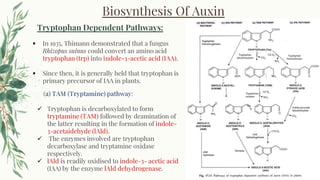
(a) TAM (Tryptamine) pathway:
✓ Tryptophan is decarboxylated to form
tryptamine (TAM) followed by deamination of
the latter resulting in the formation of indole-
3-acetaidehyde (lAld).
✓ The enzymes involved are tryptophan
decarboxylase and tryptamine oxidase
respectively.
✓ lAld is readily oxidised to indole-3- acetic acid
(IAA) by the enzyme lAld dehydrogenase.
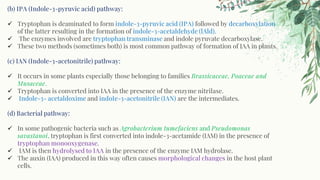
(b) IPA (Indole-3-pyruvic acid) pathway:
✓ Tryptophan is deaminated to form indole-3-pyruvic acid (IPA) followed by decarboxylation
of the latter resulting in the formation of indole-3-acetaldehyde (lAld).
✓ The enzymes involved are tryptophan transminase and indole pyruvate decarboxylase.
✓ These two methods (sometimes both) is most common pathway of formation of IAA in plants.
(c) IAN (Indole-3-acetonitrile) pathway:
✓ It occurs in some plants especially those belonging to families Brassicaceae, Poaceae and
Musaceae.
✓ Tryptophan is converted into IAA in the presence of the enzyme nitrilase.
✓ Indole-3- acetaldoxime and indoIe-3-acetonitrile (IAN) are the intermediates.
(d) Bacterial pathway:
✓ In some pathogenic bacteria such as Agrobacterium tumefaciens and Pseudomonas
savastanoi, tryptophan is first converted into indole-3-acetamide (IAM) in the presence of
tryptophan monooxygenase.
✓ IAM is then hydrolysed to IAA in the presence of the enzyme IAM hydrolase.
✓ The auxin (IAA) produced in this way often causes morphological changes in the host plant
cells.
✓ In recent years, experimental evidences for the existence
of tryptophan independent pathway/s of IAA biosynthesis
in higher plants have been obtained from mutants of
maize and Arabidopsis (family Brassicaceae).
✓ The branch point for biosynthesis of IAA may be either
indole or indole-3-glycerol phosphate with IAN and IPA
as the possible intermediates.
✓ However, neither the immediate precursor of IAA in this
pathway has yet been identified, nor relative importance
of tryptophan dependent and independent pathways is
clearly understood.
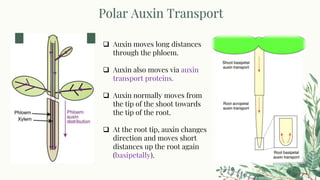
Polar Auxin Transport
❑ Auxin moves long distances
through the phloem.
❑ Auxin also moves via auxin
transport proteins.
❑ Auxin normally moves from
the tip of the shoot towards
the tip of the root.
❑ At the root tip, auxin changes
direction and moves short
distances up the root again
(basipetally).
EFFECTS OF AUXIN
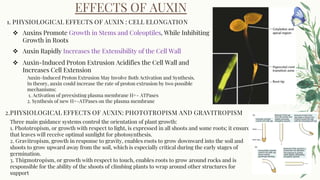
1. PHYSIOLOGICAL EFFECTS OF AUXIN : CELL ELONGATION
❖ Auxins Promote Growth in Stems and Coleoptiles, While Inhibiting
Growth in Roots
❖ Auxin Rapidly Increases the Extensibility of the Cell Wall
❖ Auxin-Induced Proton Extrusion Acidifies the Cell Wall and
Increases Cell Extension
Auxin-Induced Proton Extrusion May Involve Both Activation and Synthesis.
In theory, auxin could increase the rate of proton extrusion by two possible
mechanisms:
1. Activation of preexisting plasma membrane H+- ATPases
2. Synthesis of new H+-ATPases on the plasma membrane
2.PHYSIOLOGICAL EFFECTS OF AUXIN: PHOTOTROPISM AND GRAVITROPISM
Three main guidance systems control the orientation of plant growth:
1. Phototropism, or growth with respect to light, is expressed in all shoots and some roots; it ensures
that leaves will receive optimal sunlight for photosynthesis.
2. Gravitropism, growth in response to gravity, enables roots to grow downward into the soil and
shoots to grow upward away from the soil, which is especially critical during the early stages of
germination.
3. Thigmotropism, or growth with respect to touch, enables roots to grow around rocks and is
responsible for the ability of the shoots of climbing plants to wrap around other structures for
support
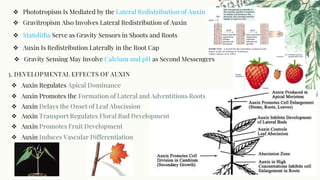
❖ Phototropism Is Mediated by the Lateral Redistribution of Auxin
❖ Gravitropism Also Involves Lateral Redistribution of Auxin
❖ Statoliths Serve as Gravity Sensors in Shoots and Roots
❖ Auxin Is Redistribution Laterally in the Root Cap
❖ Gravity Sensing May Involve Calcium and pH as Second Messengers
3. DEVELOPMENTAL EFFECTS OF AUXIN
❖ Auxin Regulates Apical Dominance
❖ Auxin Promotes the Formation of Lateral and Adventitious Roots
❖ Auxin Delays the Onset of Leaf Abscission
❖ Auxin Transport Regulates Floral Bud Development
❖ Auxin Promotes Fruit Development
❖ Auxin Induces Vascular Differentiation
THANK YOU
~ ADITYA ARYA
B.SC. B.ED (CBZ) 6 SEMESTER

AUXIN BIOSYNTHESIS & FUNCTION

  • 1.
    BOTANY 2021 Topic : Auxin: Biosynthesis & Effects ~ ADITYA ARYA B.SC. B.ED (CBZ) 6 SEMESTER
  • 2.
    Biosynthesis Of Auxin ▪In 1935, Thimann demonstrated that a fungus Rhizopus suinus could convert an amino acid tryptophan (trp) into indole-3-acetic acid (IAA). ▪ Since then, it is generally held that tryptophan is primary precursor of IAA in plants. (a) TAM (Tryptamine) pathway: ✓ Tryptophan is decarboxylated to form tryptamine (TAM) followed by deamination of the latter resulting in the formation of indole- 3-acetaidehyde (lAld). ✓ The enzymes involved are tryptophan decarboxylase and tryptamine oxidase respectively. ✓ lAld is readily oxidised to indole-3- acetic acid (IAA) by the enzyme lAld dehydrogenase.
  • 3.
    (b) IPA (Indole-3-pyruvicacid) pathway: ✓ Tryptophan is deaminated to form indole-3-pyruvic acid (IPA) followed by decarboxylation of the latter resulting in the formation of indole-3-acetaldehyde (lAld). ✓ The enzymes involved are tryptophan transminase and indole pyruvate decarboxylase. ✓ These two methods (sometimes both) is most common pathway of formation of IAA in plants. (c) IAN (Indole-3-acetonitrile) pathway: ✓ It occurs in some plants especially those belonging to families Brassicaceae, Poaceae and Musaceae. ✓ Tryptophan is converted into IAA in the presence of the enzyme nitrilase. ✓ Indole-3- acetaldoxime and indoIe-3-acetonitrile (IAN) are the intermediates. (d) Bacterial pathway: ✓ In some pathogenic bacteria such as Agrobacterium tumefaciens and Pseudomonas savastanoi, tryptophan is first converted into indole-3-acetamide (IAM) in the presence of tryptophan monooxygenase. ✓ IAM is then hydrolysed to IAA in the presence of the enzyme IAM hydrolase. ✓ The auxin (IAA) produced in this way often causes morphological changes in the host plant cells.
  • 4.
    ✓ In recentyears, experimental evidences for the existence of tryptophan independent pathway/s of IAA biosynthesis in higher plants have been obtained from mutants of maize and Arabidopsis (family Brassicaceae). ✓ The branch point for biosynthesis of IAA may be either indole or indole-3-glycerol phosphate with IAN and IPA as the possible intermediates. ✓ However, neither the immediate precursor of IAA in this pathway has yet been identified, nor relative importance of tryptophan dependent and independent pathways is clearly understood.
  • 5.
    Polar Auxin Transport ❑Auxin moves long distances through the phloem. ❑ Auxin also moves via auxin transport proteins. ❑ Auxin normally moves from the tip of the shoot towards the tip of the root. ❑ At the root tip, auxin changes direction and moves short distances up the root again (basipetally).
  • 6.
    EFFECTS OF AUXIN 1.PHYSIOLOGICAL EFFECTS OF AUXIN : CELL ELONGATION ❖ Auxins Promote Growth in Stems and Coleoptiles, While Inhibiting Growth in Roots ❖ Auxin Rapidly Increases the Extensibility of the Cell Wall ❖ Auxin-Induced Proton Extrusion Acidifies the Cell Wall and Increases Cell Extension Auxin-Induced Proton Extrusion May Involve Both Activation and Synthesis. In theory, auxin could increase the rate of proton extrusion by two possible mechanisms: 1. Activation of preexisting plasma membrane H+- ATPases 2. Synthesis of new H+-ATPases on the plasma membrane 2.PHYSIOLOGICAL EFFECTS OF AUXIN: PHOTOTROPISM AND GRAVITROPISM Three main guidance systems control the orientation of plant growth: 1. Phototropism, or growth with respect to light, is expressed in all shoots and some roots; it ensures that leaves will receive optimal sunlight for photosynthesis. 2. Gravitropism, growth in response to gravity, enables roots to grow downward into the soil and shoots to grow upward away from the soil, which is especially critical during the early stages of germination. 3. Thigmotropism, or growth with respect to touch, enables roots to grow around rocks and is responsible for the ability of the shoots of climbing plants to wrap around other structures for support
  • 7.
    ❖ Phototropism IsMediated by the Lateral Redistribution of Auxin ❖ Gravitropism Also Involves Lateral Redistribution of Auxin ❖ Statoliths Serve as Gravity Sensors in Shoots and Roots ❖ Auxin Is Redistribution Laterally in the Root Cap ❖ Gravity Sensing May Involve Calcium and pH as Second Messengers 3. DEVELOPMENTAL EFFECTS OF AUXIN ❖ Auxin Regulates Apical Dominance ❖ Auxin Promotes the Formation of Lateral and Adventitious Roots ❖ Auxin Delays the Onset of Leaf Abscission ❖ Auxin Transport Regulates Floral Bud Development ❖ Auxin Promotes Fruit Development ❖ Auxin Induces Vascular Differentiation
  • 8.
    THANK YOU ~ ADITYAARYA B.SC. B.ED (CBZ) 6 SEMESTER