1
Population Genetics
2
• Population genetics = application of genetic
principles to entire populations of organisms
• Population = group of organisms of the same
species living in the same geographical area
• Subpopulation = any of the breeding groups
within a population among which migration is
restricted
• Local population = subpopulation within which
most individuals find their mates
Population Genetics
3
Population Genetics
• Gene pool = the complete set of genetic information in
all individuals within a population
• Genotype frequency = proportion of individuals in a
population with a specific genotype
• Genotype frequencies may differ from one population
to another
• Allele frequency = proportion of any specific allele in a
population
• Allele frequencies are estimated from genotype
frequencies
4
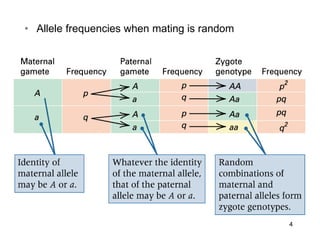
• Allele frequencies when mating is random
5
Hardy–Weinberg Principle
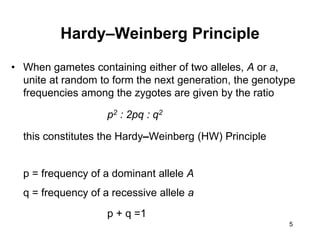
• When gametes containing either of two alleles, A or a,
unite at random to form the next generation, the genotype
frequencies among the zygotes are given by the ratio
p2 : 2pq : q2
this constitutes the Hardy–Weinberg (HW) Principle
p = frequency of a dominant allele A
q = frequency of a recessive allele a
p + q =1
6
Hardy–Weinberg Principle
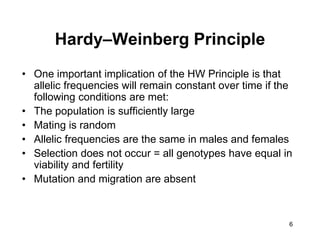
• One important implication of the HW Principle is that
allelic frequencies will remain constant over time if the
following conditions are met:
• The population is sufficiently large
• Mating is random
• Allelic frequencies are the same in males and females
• Selection does not occur = all genotypes have equal in
viability and fertility
• Mutation and migration are absent
7
Hardy–Weinberg Principle
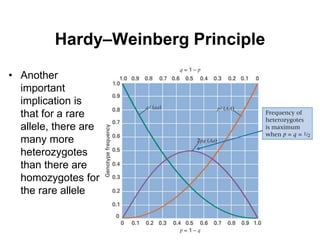
• Another
important
implication is
that for a rare
allele, there are
many more
heterozygotes
than there are
homozygotes for
the rare allele
8
Hardy–Weinberg Principle
• HW frequencies can be extended to multiple
alleles:
Frequency of any homozygous genotype =
square of allele frequency = pi
2
Frequency of any heterozygous genotype = 2
x product of allele frequencies = 2pipj
9
1. Mutation = the origin of new genetic capabilities
in populations = the ultimate source of genetic
variation
2. Natural selection = the process of evolutionary
adaptation = genotypes best suited to survive and
reproduce in a particular environment give rise to
a disproportionate share of the offspring
3. Migration = the movement of organisms among
subpopulations
4. Random genetic drift = the random, undirected
changes in allele frequencies, especially in small
populations
Changing Allele Frequencies
10
Selection and Fitness
• Organisms differ in their ability to survive and reproduce, and
some of these differences are due to genotype
• Fitness (W) is the relative ability of genotypes to survive and
reproduce
• Relative fitness measures the comparative contribution of each
parental genotype to the pool of offspring genotypes in each
generation
• Selection coefficient refers to selective disadvantage of a
disfavored genotype
11
12
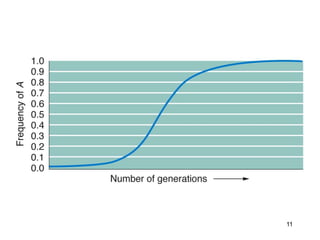
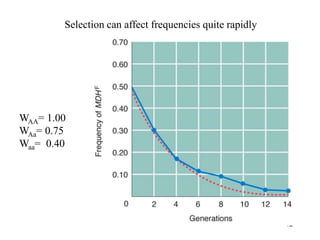
WAA= 1.00
WAa= 0.75
Waa= 0.40
Selection can affect frequencies quite rapidly
13
Selection in Diploids
• Frequency of favored dominant allele changes slowly if allele is common
• Frequency of favored recessive allele changes slowly if the allele is rare
• Rare alleles are found most frequently in heterozygotes
• When favored allele
is dominant, recessive
allele in heterozygotes is
not exposed to natural
selection
14
Heterozygote Superiority
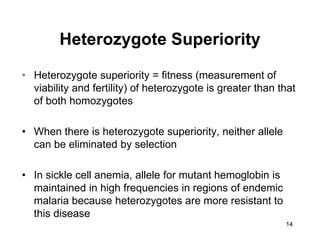
• Heterozygote superiority = fitness (measurement of
viability and fertility) of heterozygote is greater than that
of both homozygotes
• When there is heterozygote superiority, neither allele
can be eliminated by selection
• In sickle cell anemia, allele for mutant hemoglobin is
maintained in high frequencies in regions of endemic
malaria because heterozygotes are more resistant to
this disease
15
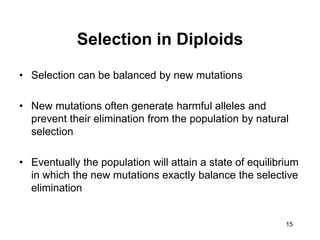
Selection in Diploids
• Selection can be balanced by new mutations
• New mutations often generate harmful alleles and
prevent their elimination from the population by natural
selection
• Eventually the population will attain a state of equilibrium
in which the new mutations exactly balance the selective
elimination
16
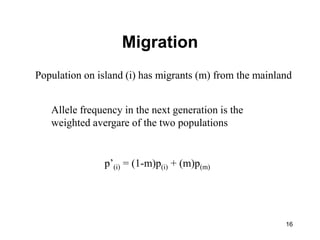
Migration
Population on island (i) has migrants (m) from the mainland
Allele frequency in the next generation is the
weighted avergare of the two populations
p’(i) = (1-m)p(i) + (m)p(m)
17
Random Genetic
Drift
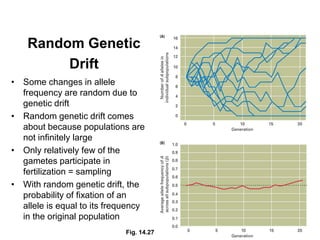
• Some changes in allele
frequency are random due to
genetic drift
• Random genetic drift comes
about because populations are
not infinitely large
• Only relatively few of the
gametes participate in
fertilization = sampling
• With random genetic drift, the
probability of fixation of an
allele is equal to its frequency
in the original population
Fig. 14.27
18
Random Genetic
Drift
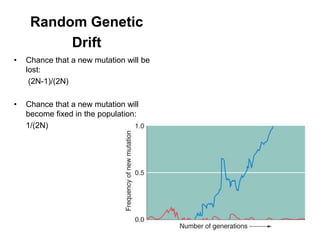
• Chance that a new mutation will be
lost:
(2N-1)/(2N)
• Chance that a new mutation will
become fixed in the population:
1/(2N)
19
Inbreeding
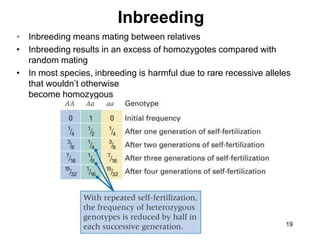
• Inbreeding means mating between relatives
• Inbreeding results in an excess of homozygotes compared with
random mating
• In most species, inbreeding is harmful due to rare recessive alleles
that wouldn’t otherwise
become homozygous
20
Inbreeding
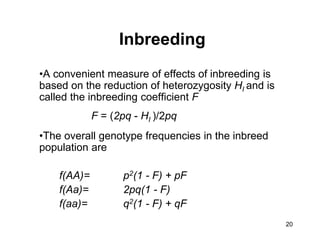
•A convenient measure of effects of inbreeding is
based on the reduction of heterozygosity HI and is
called the inbreeding coefficient F
F = (2pq - HI )/2pq
•The overall genotype frequencies in the inbreed
population are
f(AA)= p2(1 - F) + pF
f(Aa)= 2pq(1 - F)
f(aa)= q2(1 - F) + qF
21
We define common alleles as those with frequencies >1%;
these alleles are frequent enough that they can be queried by
genotyping in standard marker panels.
Rare alleles are polymorphic alleles with <1% frequency that
might now be effectively studied with sequencing
technologies.
Rare and Common Alleles
22
Molecular evolution
• The discovery that DNA is the genetic material made it
possible to compare corresponding genes even in
distantly related species
• DNA and protein sequences contain information about
evolutionary relationships among species
• Comparative studies of macromolecules, the study of
how and why their sequences change through time
constitutes molecular evolution
23
• Accumulation of sequence differences through time is the
basis of molecular systematics, which analyses them in order
to infer evolutionary relationships
• A gene tree is a diagram of the inferred ancestral history of a
group of sequences
• A gene tree is only an estimate of the true pattern of
evolutionary relations
• Neighbor joining = one of the way to estimate a gene tree
• Bootstrapping = a common technique for assessing the
reliability of a node in a gene tree
• Taxon = the source of each sequence
Molecular evolution
24
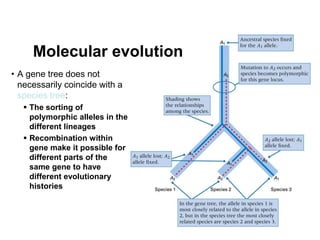
• A gene tree does not
necessarily coincide with a
species tree:
 The sorting of
polymorphic alleles in the
different lineages
 Recombination within
gene make it possible for
different parts of the
same gene to have
different evolutionary
histories
Molecular evolution
25
• Rate of sequence evolution = the fraction of sites that
undergo a change in some designated time interval =
number of replacements per site per billion years
• Rates of evolution can differ dramatically from one
protein to another
Molecular evolution
26
• There are different kind of nucleotide sites and
nucleotide substitutions depending on their
position and function in the genome
• Synonymous substitution = no change in amino
acid sequence = primarily at the third codon
position
• Nonsynonymous substitution = amino acid
replacement
• Rates of evolution of nucleotide sites differ
according to their function
Molecular evolution
27
• New genes usually evolve through duplication
and divergence
• Ortologous genes = duplicated as an
accompaniment to speciation, retain the same
function
• Paralogous genes = duplicated in the genome of
the same species, acquire new or more
specialized function
• Pseudogenes = duplicated genes that have lost
their function
Molecular evolution

Lecture 2, 516.ppt

  • 1.
  • 2.
    2 • Population genetics= application of genetic principles to entire populations of organisms • Population = group of organisms of the same species living in the same geographical area • Subpopulation = any of the breeding groups within a population among which migration is restricted • Local population = subpopulation within which most individuals find their mates Population Genetics
  • 3.
    3 Population Genetics • Genepool = the complete set of genetic information in all individuals within a population • Genotype frequency = proportion of individuals in a population with a specific genotype • Genotype frequencies may differ from one population to another • Allele frequency = proportion of any specific allele in a population • Allele frequencies are estimated from genotype frequencies
  • 4.
    4 • Allele frequencieswhen mating is random
  • 5.
    5 Hardy–Weinberg Principle • Whengametes containing either of two alleles, A or a, unite at random to form the next generation, the genotype frequencies among the zygotes are given by the ratio p2 : 2pq : q2 this constitutes the Hardy–Weinberg (HW) Principle p = frequency of a dominant allele A q = frequency of a recessive allele a p + q =1
  • 6.
    6 Hardy–Weinberg Principle • Oneimportant implication of the HW Principle is that allelic frequencies will remain constant over time if the following conditions are met: • The population is sufficiently large • Mating is random • Allelic frequencies are the same in males and females • Selection does not occur = all genotypes have equal in viability and fertility • Mutation and migration are absent
  • 7.
    7 Hardy–Weinberg Principle • Another important implicationis that for a rare allele, there are many more heterozygotes than there are homozygotes for the rare allele
  • 8.
    8 Hardy–Weinberg Principle • HWfrequencies can be extended to multiple alleles: Frequency of any homozygous genotype = square of allele frequency = pi 2 Frequency of any heterozygous genotype = 2 x product of allele frequencies = 2pipj
  • 9.
    9 1. Mutation =the origin of new genetic capabilities in populations = the ultimate source of genetic variation 2. Natural selection = the process of evolutionary adaptation = genotypes best suited to survive and reproduce in a particular environment give rise to a disproportionate share of the offspring 3. Migration = the movement of organisms among subpopulations 4. Random genetic drift = the random, undirected changes in allele frequencies, especially in small populations Changing Allele Frequencies
  • 10.
    10 Selection and Fitness •Organisms differ in their ability to survive and reproduce, and some of these differences are due to genotype • Fitness (W) is the relative ability of genotypes to survive and reproduce • Relative fitness measures the comparative contribution of each parental genotype to the pool of offspring genotypes in each generation • Selection coefficient refers to selective disadvantage of a disfavored genotype
  • 11.
  • 12.
    12 WAA= 1.00 WAa= 0.75 Waa=0.40 Selection can affect frequencies quite rapidly
  • 13.
    13 Selection in Diploids •Frequency of favored dominant allele changes slowly if allele is common • Frequency of favored recessive allele changes slowly if the allele is rare • Rare alleles are found most frequently in heterozygotes • When favored allele is dominant, recessive allele in heterozygotes is not exposed to natural selection
  • 14.
    14 Heterozygote Superiority • Heterozygotesuperiority = fitness (measurement of viability and fertility) of heterozygote is greater than that of both homozygotes • When there is heterozygote superiority, neither allele can be eliminated by selection • In sickle cell anemia, allele for mutant hemoglobin is maintained in high frequencies in regions of endemic malaria because heterozygotes are more resistant to this disease
  • 15.
    15 Selection in Diploids •Selection can be balanced by new mutations • New mutations often generate harmful alleles and prevent their elimination from the population by natural selection • Eventually the population will attain a state of equilibrium in which the new mutations exactly balance the selective elimination
  • 16.
    16 Migration Population on island(i) has migrants (m) from the mainland Allele frequency in the next generation is the weighted avergare of the two populations p’(i) = (1-m)p(i) + (m)p(m)
  • 17.
    17 Random Genetic Drift • Somechanges in allele frequency are random due to genetic drift • Random genetic drift comes about because populations are not infinitely large • Only relatively few of the gametes participate in fertilization = sampling • With random genetic drift, the probability of fixation of an allele is equal to its frequency in the original population Fig. 14.27
  • 18.
    18 Random Genetic Drift • Chancethat a new mutation will be lost: (2N-1)/(2N) • Chance that a new mutation will become fixed in the population: 1/(2N)
  • 19.
    19 Inbreeding • Inbreeding meansmating between relatives • Inbreeding results in an excess of homozygotes compared with random mating • In most species, inbreeding is harmful due to rare recessive alleles that wouldn’t otherwise become homozygous
  • 20.
    20 Inbreeding •A convenient measureof effects of inbreeding is based on the reduction of heterozygosity HI and is called the inbreeding coefficient F F = (2pq - HI )/2pq •The overall genotype frequencies in the inbreed population are f(AA)= p2(1 - F) + pF f(Aa)= 2pq(1 - F) f(aa)= q2(1 - F) + qF
  • 21.
    21 We define commonalleles as those with frequencies >1%; these alleles are frequent enough that they can be queried by genotyping in standard marker panels. Rare alleles are polymorphic alleles with <1% frequency that might now be effectively studied with sequencing technologies. Rare and Common Alleles
  • 22.
    22 Molecular evolution • Thediscovery that DNA is the genetic material made it possible to compare corresponding genes even in distantly related species • DNA and protein sequences contain information about evolutionary relationships among species • Comparative studies of macromolecules, the study of how and why their sequences change through time constitutes molecular evolution
  • 23.
    23 • Accumulation ofsequence differences through time is the basis of molecular systematics, which analyses them in order to infer evolutionary relationships • A gene tree is a diagram of the inferred ancestral history of a group of sequences • A gene tree is only an estimate of the true pattern of evolutionary relations • Neighbor joining = one of the way to estimate a gene tree • Bootstrapping = a common technique for assessing the reliability of a node in a gene tree • Taxon = the source of each sequence Molecular evolution
  • 24.
    24 • A genetree does not necessarily coincide with a species tree:  The sorting of polymorphic alleles in the different lineages  Recombination within gene make it possible for different parts of the same gene to have different evolutionary histories Molecular evolution
  • 25.
    25 • Rate ofsequence evolution = the fraction of sites that undergo a change in some designated time interval = number of replacements per site per billion years • Rates of evolution can differ dramatically from one protein to another Molecular evolution
  • 26.
    26 • There aredifferent kind of nucleotide sites and nucleotide substitutions depending on their position and function in the genome • Synonymous substitution = no change in amino acid sequence = primarily at the third codon position • Nonsynonymous substitution = amino acid replacement • Rates of evolution of nucleotide sites differ according to their function Molecular evolution
  • 27.
    27 • New genesusually evolve through duplication and divergence • Ortologous genes = duplicated as an accompaniment to speciation, retain the same function • Paralogous genes = duplicated in the genome of the same species, acquire new or more specialized function • Pseudogenes = duplicated genes that have lost their function Molecular evolution