1
1
MADE BY MOHD.TATHEER RAZA
GUIDED BY PANKAJ SIR
2
2
The Gene Pool
•Members of a
species can
interbreed & produce
fertile offspring
•Species have a
shared gene pool
•Gene pool – all of
the alleles of all
individuals in a
population
3
3
The Gene Pool
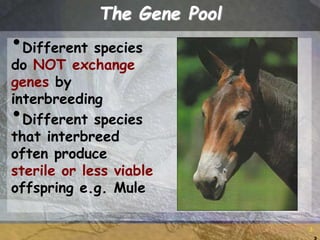
•Different species
do NOT exchange
genes by
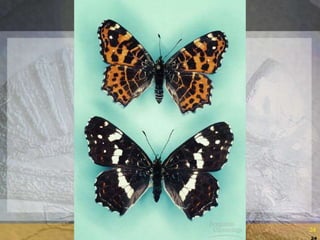
interbreeding
•Different species
that interbreed
often produce
sterile or less viable
offspring e.g. Mule
4
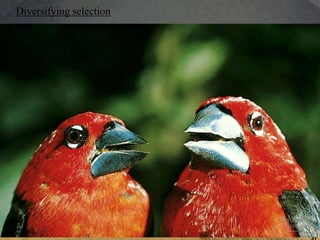
4
Populations
•A group of the
same species living
in an area
•No two individuals
are exactly alike
(variations)
•More Fit
individuals survive &
pass on their traits
5
5
Speciation
•Formation of new
species
•One species may
split into 2 or more
species
•A species may
evolve into a new
species
•Requires very long
periods of time
6
Modern
Evolutionary
Thought
7
7
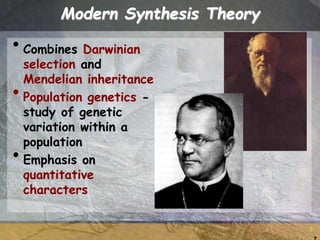
Modern Synthesis Theory
•Combines Darwinian
selection and
Mendelian inheritance
•Population genetics -
study of genetic
variation within a
population
•Emphasis on
quantitative
characters
8
8
Modern Synthesis Theory
•1940s –
comprehensive theory
of evolution (Modern
Synthesis Theory)
•Introduced by Fisher
& Wright
•Until then, many did
not accept that
Darwin’s theory of
natural selection could
drive evolution
S. Wright
A. Fisher
9
9
Modern Synthesis Theory
•Today’s theory on evolution
•Recognizes that GENES are responsible
for the inheritance of characteristics
•Recognizes that POPULATIONS, not
individuals, evolve due to natural
selection & genetic drift
•Recognizes that SPECIATION usually is
due to the gradual accumulation of small
genetic changes
10
10
Microevolution
•Changes occur in gene pools due to
mutation, natural selection, genetic
drift, etc.
•Gene pool changes cause more
VARIATION in individuals in the
population
•This process is called
MICROEVOLUTION
•Example: Bacteria becoming unaffected
by antibiotics (resistant)
11
11
Allele Frequencies Define Gene Pools
As there are 1000 copies of the genes for color,
the allele frequencies are (in both males and females):
320 x 2 (RR) + 160 x 1 (Rr) = 800 R; 800/1000 = 0.8
(80%) R
160 x 1 (Rr) + 20 x 2 (rr) = 200 r; 200/1000 = 0.2
(20%) r
500 flowering plants
480 red flowers 20 white flowers
320 RR 160 Rr 20 rr
12
12
Species & Populations
•Population - a localized group of
individuals of the same species.
•Species - a group of populations whose
individuals have the ability to breed and
produce fertile offspring.
•Individuals near a population center are,
on average, more closely related to one
another than to members of other
populations.
13
13
Gene Pools
•A population’s gene pool is the total
of all genes in the population at any
one time.
•If all members of a population are
homozygous for a particular allele,
then the allele is fixed in the gene
pool.
14
14
The Hardy-Weinberg Theorem
•Used to describe a non-evolving
population.
•Shuffling of alleles by meiosis and
random fertilization have no
effect on the overall gene pool.
• Natural populations are NOT
expected to actually be in Hardy-
Weinberg equilibrium.
15
15
The Hardy-Weinberg Theorem
•Deviation from Hardy-Weinberg
equilibrium usually results in
evolution
•Understanding a non-evolving
population, helps us to understand
how evolution occurs
16
16
Assumptions of the H-W Theorem
1.Large population size
- small populations can have chance
fluctuations in allele frequencies (e.g., fire,
storm).
2.No migration
- immigrants can change the frequency of an
allele by bringing in new alleles to a
population.
3.No net mutations
- if alleles change from one to another, this
will change the frequency of those alleles
17
17
Assumptions of the H-W Theorem
3.Random mating
- if certain traits are more desirable,
then individuals with those traits will be
selected and this will not allow for random
mixing of alleles.
4.No natural selection
- if some individuals survive and
reproduce at a higher rate than others,
then their offspring will carry those
genes and the frequency will change for
the next generation.
18
18
Hardy-Weinberg Equilibrium
The gene pool of a non-evolving population remains
constant over multiple generations; i.e., the allele
frequency does not change over generations of time.
The Hardy-Weinberg Equation:
1.0 = p2 + 2pq + q2
where p2 = frequency of AA genotype; 2pq = frequency of
Aa plus aA genotype; q2 = frequency of aa genotype
19
19
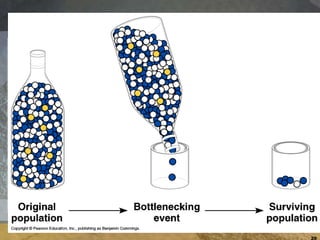
1) Genetic drift
Genetic drift = the alteration of the gene pool of a small
population due to chance.
Two factors may cause genetic drift:
a) Bottleneck effect may lead to reduced genetic variability
following some large disturbance that removes a large
portion of the population. The surviving population often
does not represent the allele frequency in the original
population.
b) Founder effect may lead to reduced variability when a few
individuals from a large population colonize an isolated
habitat.
20
20
21
21
2) Natural selection
As previously stated, differential success in reproduction
based on heritable traits results in selected alleles being
passed to relatively more offspring (Darwinian
inheritance).
The only agent that results in adaptation to environment.
3) Gene flow
-is genetic exchange due to the migration of fertile
individuals or gametes between populations.
22
22
4) Mutation
Mutation is a change in an organism’s DNA and is
represented by changing alleles.
Mutations can be transmitted in gametes to offspring,
and immediately affect the composition of the gene pool.
The original source of variation.
23
23
Genetic Variation, the Substrate for Natural Selection
Genetic (heritable) variation within and between
populations: exists both as what we can see (e.g., eye
color) and what we cannot see (e.g., blood type).
Not all variation is heritable.
Environment also can alter an individual’s phenotype [e.g.,
the hydrangea we saw before, and…
…Map butterflies (color changes are due to seasonal
difference in hormones)].
24
24
25
25
Variation within populations
Most variations occur as quantitative characters (e.g.,
height); i.e., variation along a continuum, usually
indicating polygenic inheritance.
Few variations are discrete (e.g., red vs. white flower
color).
Polymorphism is the existence of two or more forms of
a character, in high frequencies, within a
population. Applies only to discrete characters.
26
26
Variation between populations
Geographic variations are differences between gene pools
due to differences in environmental factors.
Natural selection may contribute to geographic variation.
It often occurs when populations are located in different
areas, but may also occur in populations with isolated
individuals.
27
27
Geographic variation
between isolated
populations of house
mice.
Normally house mice are
2n = 40. However,
chromosomes fused in
the mice in the example,
so that the diploid
number has gone down.
28
28
b. Relative fitness
- Contribution of a genotype to the next generation,
compared to the contributions of alternative genotypes
for the same locus.
- Survival doesn’t necessarily increase relative fitness;
relative fitness is zero (0) for a sterile plant or animal.
Three ways (modes of selection) in which natural selection
can affect the contribution that a genotype makes to the
next generation.
a. Directional selection favors individuals at one end of
the phenotypic range. Most common during times of
environmental change or when moving to new habitats.
29
29
Directional selection
30
30
Diversifying selection favors extreme over intermediate
phenotypes.
- Occurs when environmental change favors an extreme
phenotype.
Stabilizing selection favors intermediate over extreme
phenotypes.
- Reduces variation and maintains the current average.
- Example = human birth weights.
31
31
Diversifying selection
32
32
Natural selection maintains sexual reproduction
-Sex generates genetic variation during meiosis and
fertilization.
-Generation-to-generation variation may be of greatest
importance to the continuation of sexual reproduction.
-Disadvantages to using sexual reproduction: Asexual
reproduction produces many more offspring.
-The variation produced during meiosis greatly outweighs
this disadvantage, so sexual reproduction is here to
stay.
33
33
All asexual individuals are female (blue). With sex,
offspring = half female/half male. Because males
don’t reproduce, the overall output is lower for sexual
reproduction.
34
34
Sexual selection leads to differences between sexes
a. Sexual dimorphism is the difference in appearance
between males and females of a species.
-Intrasexual selection is the direct competition between
members of the same sex for mates of the opposite sex.
-This gives rise to males most often having secondary
sexual equipment such as antlers that are used in
competing for females.
-In intersexual selection (mate choice), one sex is choosy
when selecting a mate of the opposite sex.
-This gives rise to often amazingly sophisticated
secondary sexual characteristics; e.g., peacock feathers.
35
35
36
36
Natural selection does not produce perfect organisms
a. Evolution is limited by historical constraints (e.g., humans
have back problems because our ancestors were 4-legged).
b. Adaptations are compromises. (Humans are athletic due
to flexible limbs, which often dislocate or suffer torn
ligaments.)
c. Not all evolution is adaptive. Chance probably plays a huge
role in evolution and not all changes are for the best.
d. Selection edits existing variations. New alleles cannot
arise as needed, but most develop from what already is
present.
37
GENES WITH IN
POPULATION
37
38
38
Gene Variation is Raw Material
Natural selection and evolutionary change
Some individuals in a population possess certain inherited
characteristics that play a role in producing more surviving
offspring than individuals without those characteristics.
The population gradually includes more individuals with
advantageous characteristics.
39
39
Gene Variation In Nature
Measuring levels of genetic variation
blood groups – 30 blood grp genes
Enzymes – 5% heterozygous
Enzyme polymorphism
A locus with more variation than can be explained by mutation is
termed polymorphic.
Natural populations tend to have more polymorphic loci than can be
accounted for by mutation.
15% Drosophila
5-8% in vertebrates
40
40
Hardy-Weinberg Principle
Population genetics - study of properties of genes in
populations
blending inheritance phenotypically intermediate (phenotypic
inheritance) was widely accepted
new genetic variants would quickly be diluted
41
41
Hardy-Weinberg Principle
Hardy-Weinberg - original proportions of genotypes in
a population will remain constant from generation to
generation
Sexual reproduction (meiosis and fertilization) alone will not
change allelic (genotypic) proportions.
42
42
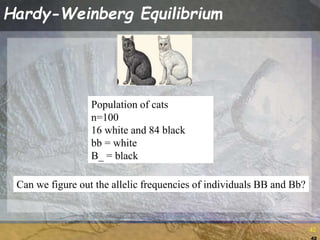
Hardy-Weinberg Equilibrium
Population of cats
n=100
16 white and 84 black
bb = white
B_ = black
Can we figure out the allelic frequencies of individuals BB and Bb?
43
43
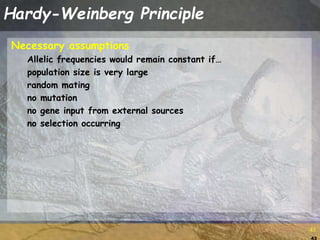
Hardy-Weinberg Principle
Necessary assumptions
Allelic frequencies would remain constant if…
population size is very large
random mating
no mutation
no gene input from external sources
no selection occurring
44
44
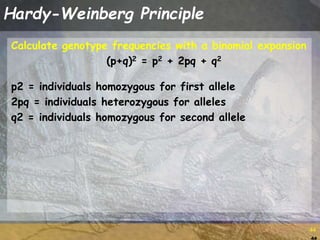
Hardy-Weinberg Principle
Calculate genotype frequencies with a binomial expansion
(p+q)2 = p2 + 2pq + q2
p2 = individuals homozygous for first allele
2pq = individuals heterozygous for alleles
q2 = individuals homozygous for second allele
45
45
p2 + 2pq + q2
and
p+q = 1 (always two alleles)
16 cats white = 16bb then (q2 = 0.16)
This we know we can see and count!!!!!
If p + q = 1 then we can calculate p from q2
Q = square root of q2 = q √.16 q=0.4
p + q = 1 then p = .6 (.6 +.4 = 1)
P2 = .36
All we need now are those that are heterozygous (2pq)
(2 x .6 x .4)=0.48
.36 + .48 + .16
Hardy-Weinberg Principle
46
46
Hardy-Weinberg Equilibrium
47
47
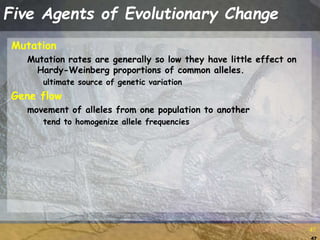
Five Agents of Evolutionary Change
Mutation
Mutation rates are generally so low they have little effect on
Hardy-Weinberg proportions of common alleles.
ultimate source of genetic variation
Gene flow
movement of alleles from one population to another
tend to homogenize allele frequencies
48
48
Five Agents of Evolutionary Change
Nonrandom mating
assortative mating - phenotypically similar individuals mate
Causes frequencies of particular genotypes to differ from those
predicted by Hardy-Weinberg.
49
49
Five Agents of Evolutionary Change
Genetic drift – statistical accidents.
Frequencies of particular alleles may change by chance alone.
important in small populations
founder effect - few individuals found new population (small allelic pool)
bottleneck effect - drastic reduction in population, and gene pool size
50
50
Genetic Drift - Bottleneck Effect
51
51
Five Agents of Evolutionary Change
Selection – Only agent that produces adaptive
evolutionary change
artificial - breeders exert selection
natural - nature exerts selection
variation must exist among individuals
variation must result in differences in numbers of viable offspring
produced
variation must be genetically inherited
natural selection is a process, and evolution is an outcome
52
52
Five Agents of Evolutionary Change
Selection pressures:
avoiding predators
matching climatic condition
pesticide resistance
53
53
Measuring Fitness
Fitness is defined by evolutionary biologists as the
number of surviving offspring left in the next
generation.
relative measure
Selection favors phenotypes with the greatest fitness.
54
54
Interactions Among Evolutionary Forces
Levels of variation retained in a population may be
determined by the relative strength of different
evolutionary processes.
Gene flow versus natural selection
Gene flow can be either a constructive or a constraining force.
Allelic frequencies reflect a balance between gene flow and natural
selection.
55
55
Natural Selection Can Maintain
Variation
Frequency-dependent selection
Phenotype fitness depends on its frequency within the population.
Negative frequency-dependent selection favors rare phenotypes.
Positive frequency-dependent selection eliminates variation.
Oscillating selection
Selection favors different phenotypes at different times.
56
56
Heterozygote Advantage
Heterozygote advantage will favor heterozygotes, and
maintain both alleles instead of removing less successful
alleles from a population.
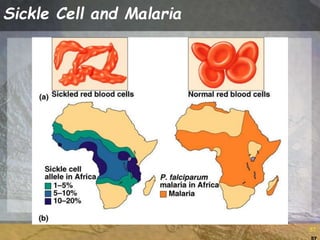
Sickle cell anemia
Homozygotes exhibit severe anemia, have abnormal blood cells, and
usually die before reproductive age.
Heterozygotes are less susceptible to malaria.
57
57
Sickle Cell and Malaria
58
58
Forms of Selection
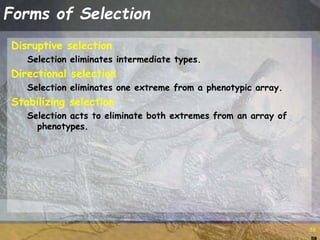
Disruptive selection
Selection eliminates intermediate types.
Directional selection
Selection eliminates one extreme from a phenotypic array.
Stabilizing selection
Selection acts to eliminate both extremes from an array of
phenotypes.
59
59
Kinds of Selection
60
60
Selection on Color in Guppies
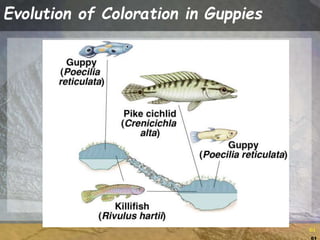
Guppies are found in small northeastern streams in
South America and in nearby mountainous streams in
Trinidad.
Due to dispersal barriers, guppies can be found in pools below
waterfalls with high predation risk, or pools above waterfalls
with low predation risk.
61
61
Evolution of Coloration in Guppies
62
62
Selection on Color in Guppies
High predation environment - Males exhibit drab
coloration and tend to be relatively small and
reproduce at a younger age.
Low predation environment - Males display bright
coloration, a larger number of spots, and tend to be
more successful at defending territories.
In the absence of predators, larger, more colorful fish may
produce more offspring.
63
63
Evolutionary Change in Spot Number
64
64
Limits to Selection
Genes have multiple effects
pleiotropy
Evolution requires genetic variation
Intense selection may remove variation from a population at a
rate greater than mutation can replenish.
thoroughbred horses
Gene interactions affect allelic fitness
epistatic interactions
65
65
66
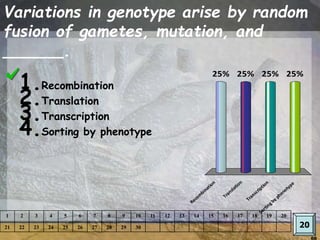
Variations in genotype arise by random
fusion of gametes, mutation, and
______.
66
Recom
bination
Translation
Transcription
Sorting by phenotype
25% 25%25%25%
20
1 2 3 4 5 6 7 8 9 10 11 12 13 14 15 16 17 18 19 20
21 22 23 24 25 26 27 28 29 30
1.Recombination
2.Translation
3.Transcription
4.Sorting by phenotype
67
The total genetic information in a
population is called the
67
Allele
frequency
Phenotypefrequency
Gene
pool
Distribution
oftraits
25% 25%25%25%
20
1 2 3 4 5 6 7 8 9 10 11 12 13 14 15 16 17 18 19 20
21 22 23 24 25 26 27 28 29 30
1.Allele frequency
2.Phenotype frequency
3.Gene pool
4.Distribution of traits
68
Saint Bernards and Chihuahuas can’t mate normally
owing to great differences in size. What type of
reproductive isolationg mechanism is operating
here?
68
Developm
ental
Prezygotic
Postzygotic
Geographic
25% 25%25%25%
20
1 2 3 4 5 6 7 8 9 10 11 12 13 14 15 16 17 18 19 20
21 22 23 24 25 26 27 28 29 30
1.Developmental
2.Prezygotic
3.Postzygotic
4.Geographic
69
If a population is in genetic equilibrium,
69
Evolution
isoccuring
Speciation
isoccuring
Allelicfrequenciesare
c...
Allelicfrequenciesare
r...
25% 25%25%25%
20
1 2 3 4 5 6 7 8 9 10 11 12 13 14 15 16 17 18 19 20
21 22 23 24 25 26 27 28 29 30
1.Evolution is occuring
2.Speciation is occuring
3.Allelic frequencies are
changing
4.Allelic frequencies are
remaining stable
70
Mutations affect genetic
equilibrium by
70
M
aintaining
it
Introducingne...
Causing
im
m
igr...
Causing
em
igra...
25% 25%25%25%
20
1 2 3 4 5 6 7 8 9 10 11 12 13 14 15 16 17 18 19 20
21 22 23 24 25 26 27 28 29 30
1.Maintaining it
2.Introducing new
alleles
3.Causing immigration
4.Causing emigration
71
Directional selection, disruptive
selection, and stabilizing selection
are all examples of
71
Geneticequilibrium
Naturalselection
M
utation
Speciation
25% 25%25%25%
20
1 2 3 4 5 6 7 8 9 10 11 12 13 14 15 16 17 18 19 20
21 22 23 24 25 26 27 28 29 30
1.Genetic equilibrium
2.Natural selection
3.Mutation
4.Speciation
72
The most common way for new species
to form is through
72
M
utation
Stabilizingselection
Geographicand
reprod...Geneticequilibrium
25% 25%25%25%
1.Mutation
2.Stabilizing selection
3.Geographic and
reproductive isolation
4.Genetic equilibrium
20
1 2 3 4 5 6 7 8 9 10 11 12 13 14 15 16 17 18 19 20
21 22 23 24 25 26 27 28 29 30
73
73
Population genetics
• genetic structure of a population
group of individuals
of the same species
that can interbreed
• alleles
• genotypes
Patterns of genetic variation in populations
Changes in genetic structure through time
74
74
• mutation
• migration
• natural selection
• genetic drift
• non-random mating
cause changes in
allele frequencies
How does genetic structure
change?
75
Forces that affect allele freq.
1. Mutation
2. Migration
3. Selection
4. Random (genetic) drift
Selection and migration most important for livestock
breeders.
76
76
Selection
Some individuals leave more offspring than others.
Primary tool to improve genetics of livestock.
Does not create new alleles. Does alter freq.
Primary effect  change allele frequency of desirable
alleles.
77
77
78

POPULATION GENETICS

  • 1.
    1 1 MADE BY MOHD.TATHEERRAZA GUIDED BY PANKAJ SIR
  • 2.
    2 2 The Gene Pool •Membersof a species can interbreed & produce fertile offspring •Species have a shared gene pool •Gene pool – all of the alleles of all individuals in a population
  • 3.
    3 3 The Gene Pool •Differentspecies do NOT exchange genes by interbreeding •Different species that interbreed often produce sterile or less viable offspring e.g. Mule
  • 4.
    4 4 Populations •A group ofthe same species living in an area •No two individuals are exactly alike (variations) •More Fit individuals survive & pass on their traits
  • 5.
    5 5 Speciation •Formation of new species •Onespecies may split into 2 or more species •A species may evolve into a new species •Requires very long periods of time
  • 6.
  • 7.
    7 7 Modern Synthesis Theory •CombinesDarwinian selection and Mendelian inheritance •Population genetics - study of genetic variation within a population •Emphasis on quantitative characters
  • 8.
    8 8 Modern Synthesis Theory •1940s– comprehensive theory of evolution (Modern Synthesis Theory) •Introduced by Fisher & Wright •Until then, many did not accept that Darwin’s theory of natural selection could drive evolution S. Wright A. Fisher
  • 9.
    9 9 Modern Synthesis Theory •Today’stheory on evolution •Recognizes that GENES are responsible for the inheritance of characteristics •Recognizes that POPULATIONS, not individuals, evolve due to natural selection & genetic drift •Recognizes that SPECIATION usually is due to the gradual accumulation of small genetic changes
  • 10.
    10 10 Microevolution •Changes occur ingene pools due to mutation, natural selection, genetic drift, etc. •Gene pool changes cause more VARIATION in individuals in the population •This process is called MICROEVOLUTION •Example: Bacteria becoming unaffected by antibiotics (resistant)
  • 11.
    11 11 Allele Frequencies DefineGene Pools As there are 1000 copies of the genes for color, the allele frequencies are (in both males and females): 320 x 2 (RR) + 160 x 1 (Rr) = 800 R; 800/1000 = 0.8 (80%) R 160 x 1 (Rr) + 20 x 2 (rr) = 200 r; 200/1000 = 0.2 (20%) r 500 flowering plants 480 red flowers 20 white flowers 320 RR 160 Rr 20 rr
  • 12.
    12 12 Species & Populations •Population- a localized group of individuals of the same species. •Species - a group of populations whose individuals have the ability to breed and produce fertile offspring. •Individuals near a population center are, on average, more closely related to one another than to members of other populations.
  • 13.
    13 13 Gene Pools •A population’sgene pool is the total of all genes in the population at any one time. •If all members of a population are homozygous for a particular allele, then the allele is fixed in the gene pool.
  • 14.
    14 14 The Hardy-Weinberg Theorem •Usedto describe a non-evolving population. •Shuffling of alleles by meiosis and random fertilization have no effect on the overall gene pool. • Natural populations are NOT expected to actually be in Hardy- Weinberg equilibrium.
  • 15.
    15 15 The Hardy-Weinberg Theorem •Deviationfrom Hardy-Weinberg equilibrium usually results in evolution •Understanding a non-evolving population, helps us to understand how evolution occurs
  • 16.
    16 16 Assumptions of theH-W Theorem 1.Large population size - small populations can have chance fluctuations in allele frequencies (e.g., fire, storm). 2.No migration - immigrants can change the frequency of an allele by bringing in new alleles to a population. 3.No net mutations - if alleles change from one to another, this will change the frequency of those alleles
  • 17.
    17 17 Assumptions of theH-W Theorem 3.Random mating - if certain traits are more desirable, then individuals with those traits will be selected and this will not allow for random mixing of alleles. 4.No natural selection - if some individuals survive and reproduce at a higher rate than others, then their offspring will carry those genes and the frequency will change for the next generation.
  • 18.
    18 18 Hardy-Weinberg Equilibrium The genepool of a non-evolving population remains constant over multiple generations; i.e., the allele frequency does not change over generations of time. The Hardy-Weinberg Equation: 1.0 = p2 + 2pq + q2 where p2 = frequency of AA genotype; 2pq = frequency of Aa plus aA genotype; q2 = frequency of aa genotype
  • 19.
    19 19 1) Genetic drift Geneticdrift = the alteration of the gene pool of a small population due to chance. Two factors may cause genetic drift: a) Bottleneck effect may lead to reduced genetic variability following some large disturbance that removes a large portion of the population. The surviving population often does not represent the allele frequency in the original population. b) Founder effect may lead to reduced variability when a few individuals from a large population colonize an isolated habitat.
  • 20.
  • 21.
    21 21 2) Natural selection Aspreviously stated, differential success in reproduction based on heritable traits results in selected alleles being passed to relatively more offspring (Darwinian inheritance). The only agent that results in adaptation to environment. 3) Gene flow -is genetic exchange due to the migration of fertile individuals or gametes between populations.
  • 22.
    22 22 4) Mutation Mutation isa change in an organism’s DNA and is represented by changing alleles. Mutations can be transmitted in gametes to offspring, and immediately affect the composition of the gene pool. The original source of variation.
  • 23.
    23 23 Genetic Variation, theSubstrate for Natural Selection Genetic (heritable) variation within and between populations: exists both as what we can see (e.g., eye color) and what we cannot see (e.g., blood type). Not all variation is heritable. Environment also can alter an individual’s phenotype [e.g., the hydrangea we saw before, and… …Map butterflies (color changes are due to seasonal difference in hormones)].
  • 24.
  • 25.
    25 25 Variation within populations Mostvariations occur as quantitative characters (e.g., height); i.e., variation along a continuum, usually indicating polygenic inheritance. Few variations are discrete (e.g., red vs. white flower color). Polymorphism is the existence of two or more forms of a character, in high frequencies, within a population. Applies only to discrete characters.
  • 26.
    26 26 Variation between populations Geographicvariations are differences between gene pools due to differences in environmental factors. Natural selection may contribute to geographic variation. It often occurs when populations are located in different areas, but may also occur in populations with isolated individuals.
  • 27.
    27 27 Geographic variation between isolated populationsof house mice. Normally house mice are 2n = 40. However, chromosomes fused in the mice in the example, so that the diploid number has gone down.
  • 28.
    28 28 b. Relative fitness -Contribution of a genotype to the next generation, compared to the contributions of alternative genotypes for the same locus. - Survival doesn’t necessarily increase relative fitness; relative fitness is zero (0) for a sterile plant or animal. Three ways (modes of selection) in which natural selection can affect the contribution that a genotype makes to the next generation. a. Directional selection favors individuals at one end of the phenotypic range. Most common during times of environmental change or when moving to new habitats.
  • 29.
  • 30.
    30 30 Diversifying selection favorsextreme over intermediate phenotypes. - Occurs when environmental change favors an extreme phenotype. Stabilizing selection favors intermediate over extreme phenotypes. - Reduces variation and maintains the current average. - Example = human birth weights.
  • 31.
  • 32.
    32 32 Natural selection maintainssexual reproduction -Sex generates genetic variation during meiosis and fertilization. -Generation-to-generation variation may be of greatest importance to the continuation of sexual reproduction. -Disadvantages to using sexual reproduction: Asexual reproduction produces many more offspring. -The variation produced during meiosis greatly outweighs this disadvantage, so sexual reproduction is here to stay.
  • 33.
    33 33 All asexual individualsare female (blue). With sex, offspring = half female/half male. Because males don’t reproduce, the overall output is lower for sexual reproduction.
  • 34.
    34 34 Sexual selection leadsto differences between sexes a. Sexual dimorphism is the difference in appearance between males and females of a species. -Intrasexual selection is the direct competition between members of the same sex for mates of the opposite sex. -This gives rise to males most often having secondary sexual equipment such as antlers that are used in competing for females. -In intersexual selection (mate choice), one sex is choosy when selecting a mate of the opposite sex. -This gives rise to often amazingly sophisticated secondary sexual characteristics; e.g., peacock feathers.
  • 35.
  • 36.
    36 36 Natural selection doesnot produce perfect organisms a. Evolution is limited by historical constraints (e.g., humans have back problems because our ancestors were 4-legged). b. Adaptations are compromises. (Humans are athletic due to flexible limbs, which often dislocate or suffer torn ligaments.) c. Not all evolution is adaptive. Chance probably plays a huge role in evolution and not all changes are for the best. d. Selection edits existing variations. New alleles cannot arise as needed, but most develop from what already is present.
  • 37.
  • 38.
    38 38 Gene Variation isRaw Material Natural selection and evolutionary change Some individuals in a population possess certain inherited characteristics that play a role in producing more surviving offspring than individuals without those characteristics. The population gradually includes more individuals with advantageous characteristics.
  • 39.
    39 39 Gene Variation InNature Measuring levels of genetic variation blood groups – 30 blood grp genes Enzymes – 5% heterozygous Enzyme polymorphism A locus with more variation than can be explained by mutation is termed polymorphic. Natural populations tend to have more polymorphic loci than can be accounted for by mutation. 15% Drosophila 5-8% in vertebrates
  • 40.
    40 40 Hardy-Weinberg Principle Population genetics- study of properties of genes in populations blending inheritance phenotypically intermediate (phenotypic inheritance) was widely accepted new genetic variants would quickly be diluted
  • 41.
    41 41 Hardy-Weinberg Principle Hardy-Weinberg -original proportions of genotypes in a population will remain constant from generation to generation Sexual reproduction (meiosis and fertilization) alone will not change allelic (genotypic) proportions.
  • 42.
    42 42 Hardy-Weinberg Equilibrium Population ofcats n=100 16 white and 84 black bb = white B_ = black Can we figure out the allelic frequencies of individuals BB and Bb?
  • 43.
    43 43 Hardy-Weinberg Principle Necessary assumptions Allelicfrequencies would remain constant if… population size is very large random mating no mutation no gene input from external sources no selection occurring
  • 44.
    44 44 Hardy-Weinberg Principle Calculate genotypefrequencies with a binomial expansion (p+q)2 = p2 + 2pq + q2 p2 = individuals homozygous for first allele 2pq = individuals heterozygous for alleles q2 = individuals homozygous for second allele
  • 45.
    45 45 p2 + 2pq+ q2 and p+q = 1 (always two alleles) 16 cats white = 16bb then (q2 = 0.16) This we know we can see and count!!!!! If p + q = 1 then we can calculate p from q2 Q = square root of q2 = q √.16 q=0.4 p + q = 1 then p = .6 (.6 +.4 = 1) P2 = .36 All we need now are those that are heterozygous (2pq) (2 x .6 x .4)=0.48 .36 + .48 + .16 Hardy-Weinberg Principle
  • 46.
  • 47.
    47 47 Five Agents ofEvolutionary Change Mutation Mutation rates are generally so low they have little effect on Hardy-Weinberg proportions of common alleles. ultimate source of genetic variation Gene flow movement of alleles from one population to another tend to homogenize allele frequencies
  • 48.
    48 48 Five Agents ofEvolutionary Change Nonrandom mating assortative mating - phenotypically similar individuals mate Causes frequencies of particular genotypes to differ from those predicted by Hardy-Weinberg.
  • 49.
    49 49 Five Agents ofEvolutionary Change Genetic drift – statistical accidents. Frequencies of particular alleles may change by chance alone. important in small populations founder effect - few individuals found new population (small allelic pool) bottleneck effect - drastic reduction in population, and gene pool size
  • 50.
    50 50 Genetic Drift -Bottleneck Effect
  • 51.
    51 51 Five Agents ofEvolutionary Change Selection – Only agent that produces adaptive evolutionary change artificial - breeders exert selection natural - nature exerts selection variation must exist among individuals variation must result in differences in numbers of viable offspring produced variation must be genetically inherited natural selection is a process, and evolution is an outcome
  • 52.
    52 52 Five Agents ofEvolutionary Change Selection pressures: avoiding predators matching climatic condition pesticide resistance
  • 53.
    53 53 Measuring Fitness Fitness isdefined by evolutionary biologists as the number of surviving offspring left in the next generation. relative measure Selection favors phenotypes with the greatest fitness.
  • 54.
    54 54 Interactions Among EvolutionaryForces Levels of variation retained in a population may be determined by the relative strength of different evolutionary processes. Gene flow versus natural selection Gene flow can be either a constructive or a constraining force. Allelic frequencies reflect a balance between gene flow and natural selection.
  • 55.
    55 55 Natural Selection CanMaintain Variation Frequency-dependent selection Phenotype fitness depends on its frequency within the population. Negative frequency-dependent selection favors rare phenotypes. Positive frequency-dependent selection eliminates variation. Oscillating selection Selection favors different phenotypes at different times.
  • 56.
    56 56 Heterozygote Advantage Heterozygote advantagewill favor heterozygotes, and maintain both alleles instead of removing less successful alleles from a population. Sickle cell anemia Homozygotes exhibit severe anemia, have abnormal blood cells, and usually die before reproductive age. Heterozygotes are less susceptible to malaria.
  • 57.
  • 58.
    58 58 Forms of Selection Disruptiveselection Selection eliminates intermediate types. Directional selection Selection eliminates one extreme from a phenotypic array. Stabilizing selection Selection acts to eliminate both extremes from an array of phenotypes.
  • 59.
  • 60.
    60 60 Selection on Colorin Guppies Guppies are found in small northeastern streams in South America and in nearby mountainous streams in Trinidad. Due to dispersal barriers, guppies can be found in pools below waterfalls with high predation risk, or pools above waterfalls with low predation risk.
  • 61.
  • 62.
    62 62 Selection on Colorin Guppies High predation environment - Males exhibit drab coloration and tend to be relatively small and reproduce at a younger age. Low predation environment - Males display bright coloration, a larger number of spots, and tend to be more successful at defending territories. In the absence of predators, larger, more colorful fish may produce more offspring.
  • 63.
  • 64.
    64 64 Limits to Selection Geneshave multiple effects pleiotropy Evolution requires genetic variation Intense selection may remove variation from a population at a rate greater than mutation can replenish. thoroughbred horses Gene interactions affect allelic fitness epistatic interactions
  • 65.
  • 66.
    66 Variations in genotypearise by random fusion of gametes, mutation, and ______. 66 Recom bination Translation Transcription Sorting by phenotype 25% 25%25%25% 20 1 2 3 4 5 6 7 8 9 10 11 12 13 14 15 16 17 18 19 20 21 22 23 24 25 26 27 28 29 30 1.Recombination 2.Translation 3.Transcription 4.Sorting by phenotype
  • 67.
    67 The total geneticinformation in a population is called the 67 Allele frequency Phenotypefrequency Gene pool Distribution oftraits 25% 25%25%25% 20 1 2 3 4 5 6 7 8 9 10 11 12 13 14 15 16 17 18 19 20 21 22 23 24 25 26 27 28 29 30 1.Allele frequency 2.Phenotype frequency 3.Gene pool 4.Distribution of traits
  • 68.
    68 Saint Bernards andChihuahuas can’t mate normally owing to great differences in size. What type of reproductive isolationg mechanism is operating here? 68 Developm ental Prezygotic Postzygotic Geographic 25% 25%25%25% 20 1 2 3 4 5 6 7 8 9 10 11 12 13 14 15 16 17 18 19 20 21 22 23 24 25 26 27 28 29 30 1.Developmental 2.Prezygotic 3.Postzygotic 4.Geographic
  • 69.
    69 If a populationis in genetic equilibrium, 69 Evolution isoccuring Speciation isoccuring Allelicfrequenciesare c... Allelicfrequenciesare r... 25% 25%25%25% 20 1 2 3 4 5 6 7 8 9 10 11 12 13 14 15 16 17 18 19 20 21 22 23 24 25 26 27 28 29 30 1.Evolution is occuring 2.Speciation is occuring 3.Allelic frequencies are changing 4.Allelic frequencies are remaining stable
  • 70.
    70 Mutations affect genetic equilibriumby 70 M aintaining it Introducingne... Causing im m igr... Causing em igra... 25% 25%25%25% 20 1 2 3 4 5 6 7 8 9 10 11 12 13 14 15 16 17 18 19 20 21 22 23 24 25 26 27 28 29 30 1.Maintaining it 2.Introducing new alleles 3.Causing immigration 4.Causing emigration
  • 71.
    71 Directional selection, disruptive selection,and stabilizing selection are all examples of 71 Geneticequilibrium Naturalselection M utation Speciation 25% 25%25%25% 20 1 2 3 4 5 6 7 8 9 10 11 12 13 14 15 16 17 18 19 20 21 22 23 24 25 26 27 28 29 30 1.Genetic equilibrium 2.Natural selection 3.Mutation 4.Speciation
  • 72.
    72 The most commonway for new species to form is through 72 M utation Stabilizingselection Geographicand reprod...Geneticequilibrium 25% 25%25%25% 1.Mutation 2.Stabilizing selection 3.Geographic and reproductive isolation 4.Genetic equilibrium 20 1 2 3 4 5 6 7 8 9 10 11 12 13 14 15 16 17 18 19 20 21 22 23 24 25 26 27 28 29 30
  • 73.
    73 73 Population genetics • geneticstructure of a population group of individuals of the same species that can interbreed • alleles • genotypes Patterns of genetic variation in populations Changes in genetic structure through time
  • 74.
    74 74 • mutation • migration •natural selection • genetic drift • non-random mating cause changes in allele frequencies How does genetic structure change?
  • 75.
    75 Forces that affectallele freq. 1. Mutation 2. Migration 3. Selection 4. Random (genetic) drift Selection and migration most important for livestock breeders.
  • 76.
    76 76 Selection Some individuals leavemore offspring than others. Primary tool to improve genetics of livestock. Does not create new alleles. Does alter freq. Primary effect  change allele frequency of desirable alleles.
  • 77.
  • 78.