Mimicry: mullerian and
Batesian mimicry
Contents
• What is mimicry?
• Camouflage vs. mimicry
• Types of mimicry
• Batesian mimicry
• Aposmatism
• Adaptation of prey
• Acoustic mimicry
• Muellerian mimicry
• How does mimicry work so well?
• Relationship to muellerian with
batesian mimicry
• Non visual mimicry
• References
• Animation
What is
mimicry?
Similarities between species
Form of symbiosis where a specie may mimic the
color patterns or even the behavior of other species
for one or more reasons.
Either to be able to get closer to unsuspecting prey
In case of harmless species to gain protection by
limiting predators or poisonous species
Camouflage vs. mimicry
• Camouflage
• To change body color to shade into scenery
• Mimicry
• To make the form of other organism, such plant or insects.
Types of
mimicry
There are several types of mimicry utilized by
predator and prey
Batesian mimicry
Mullerian mimicry
Wasmannian mimicry
Peckhamian mimicry
Self mimicry
Batesian mimicry
• A type of mimicry where the mimic resembles a
model species that has spines, stingers, toxic
chemicals or another form of defense from
predators. The mimic has none of these.
Batesian
mimicry
It is named after the English naturalist Henry
Walter Bates, after his work on butterfliesin
the rainforests of Brazil.
His field research included collecting almost
a hundred species of butterflies from the
families Ithomiinae and Heliconiinae, as well
as thousands of other insects specimens.
Batesian mimicry
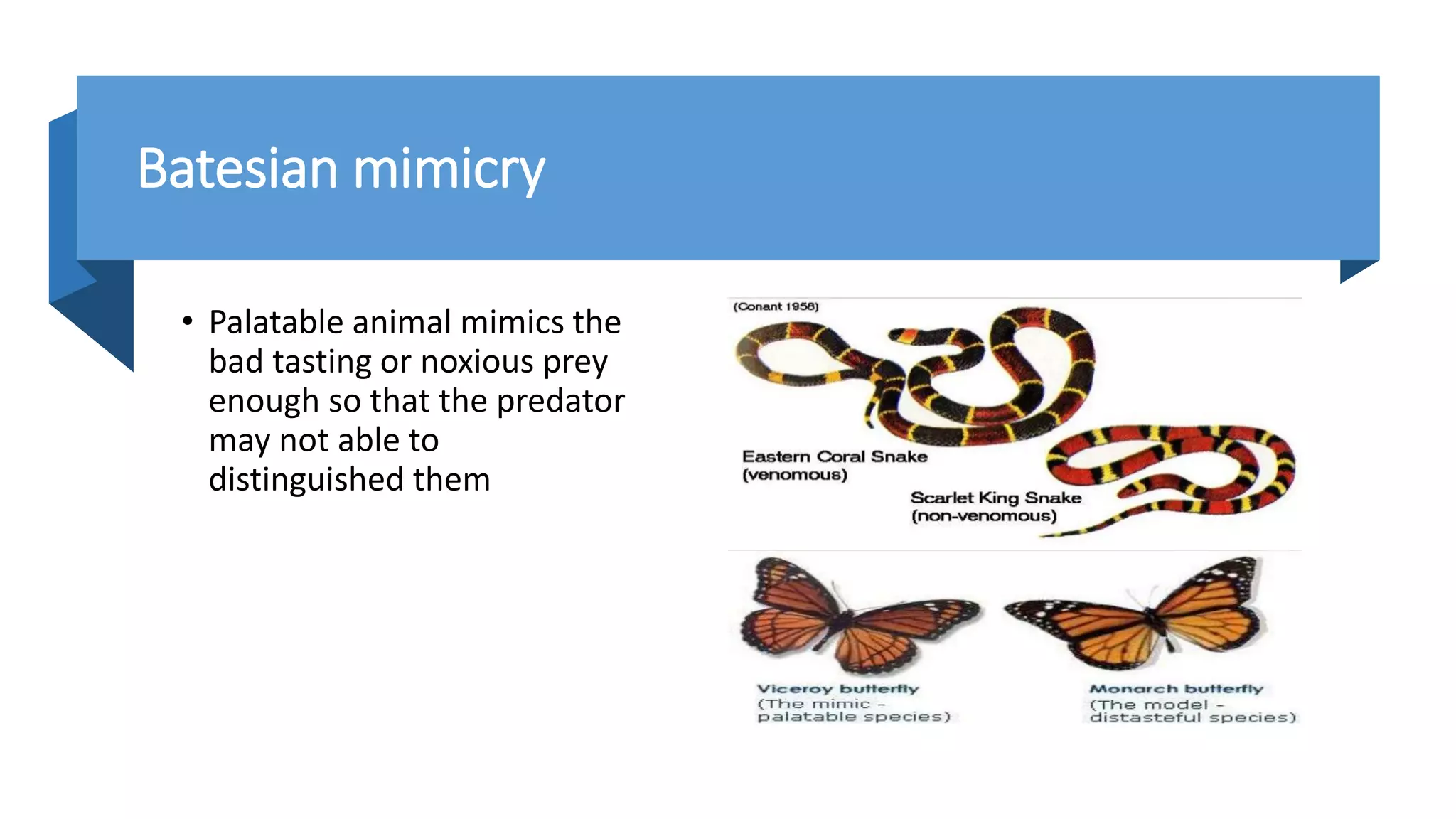
• Palatable animal mimics the
bad tasting or noxious prey
enough so that the predator
may not able to
distinguished them
• After several attempts of
distasteful encounters the
predator learn to avoid
such appearance.
Aposematism
• Most living things have predators and
therefore are in a constant evolutionary
arms race to develop antipredator
adaptations
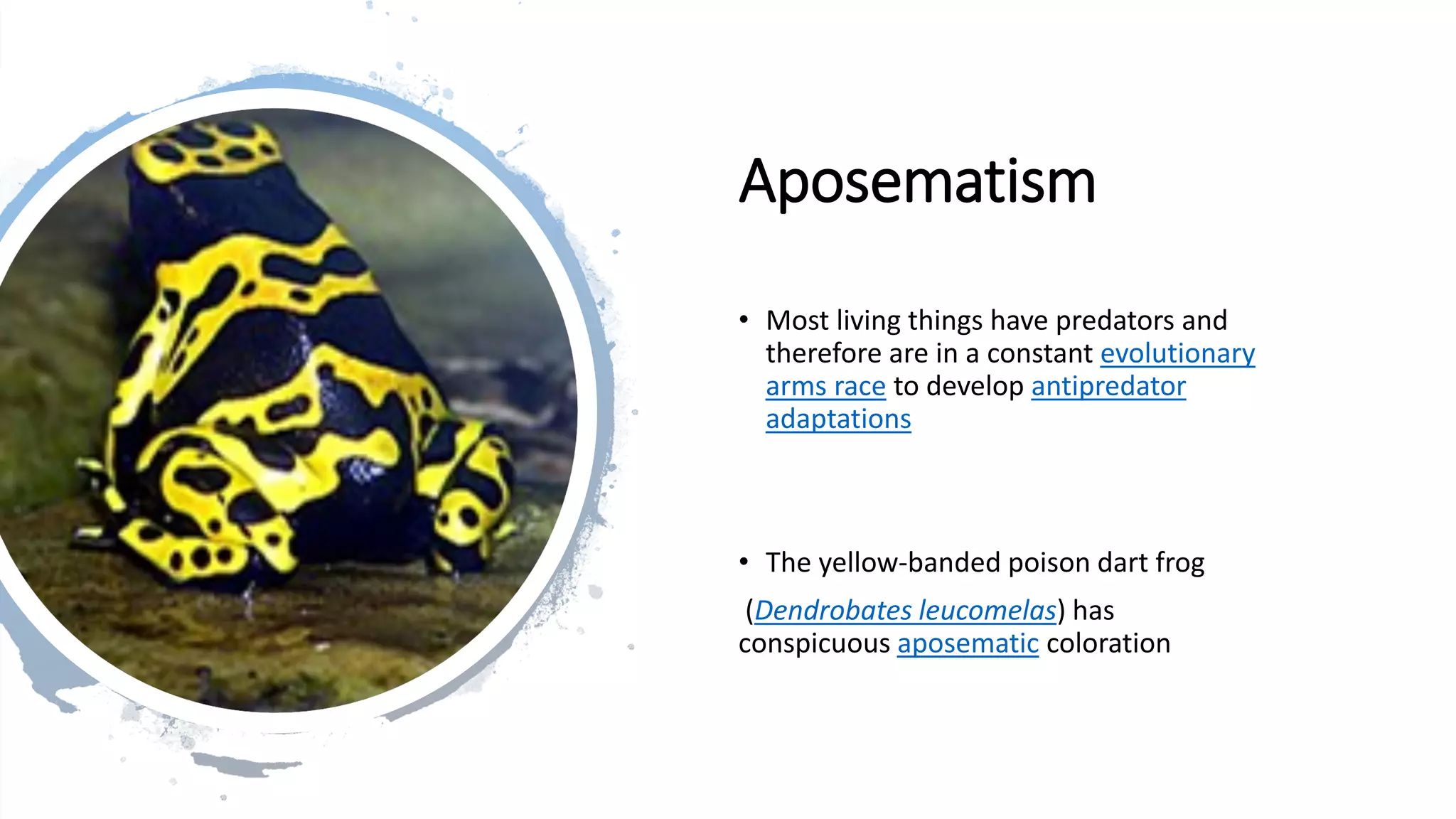
• The yellow-banded poison dart frog
(Dendrobates leucomelas) has
conspicuous aposematic coloration
Adaptations of
prey
Nocturnality
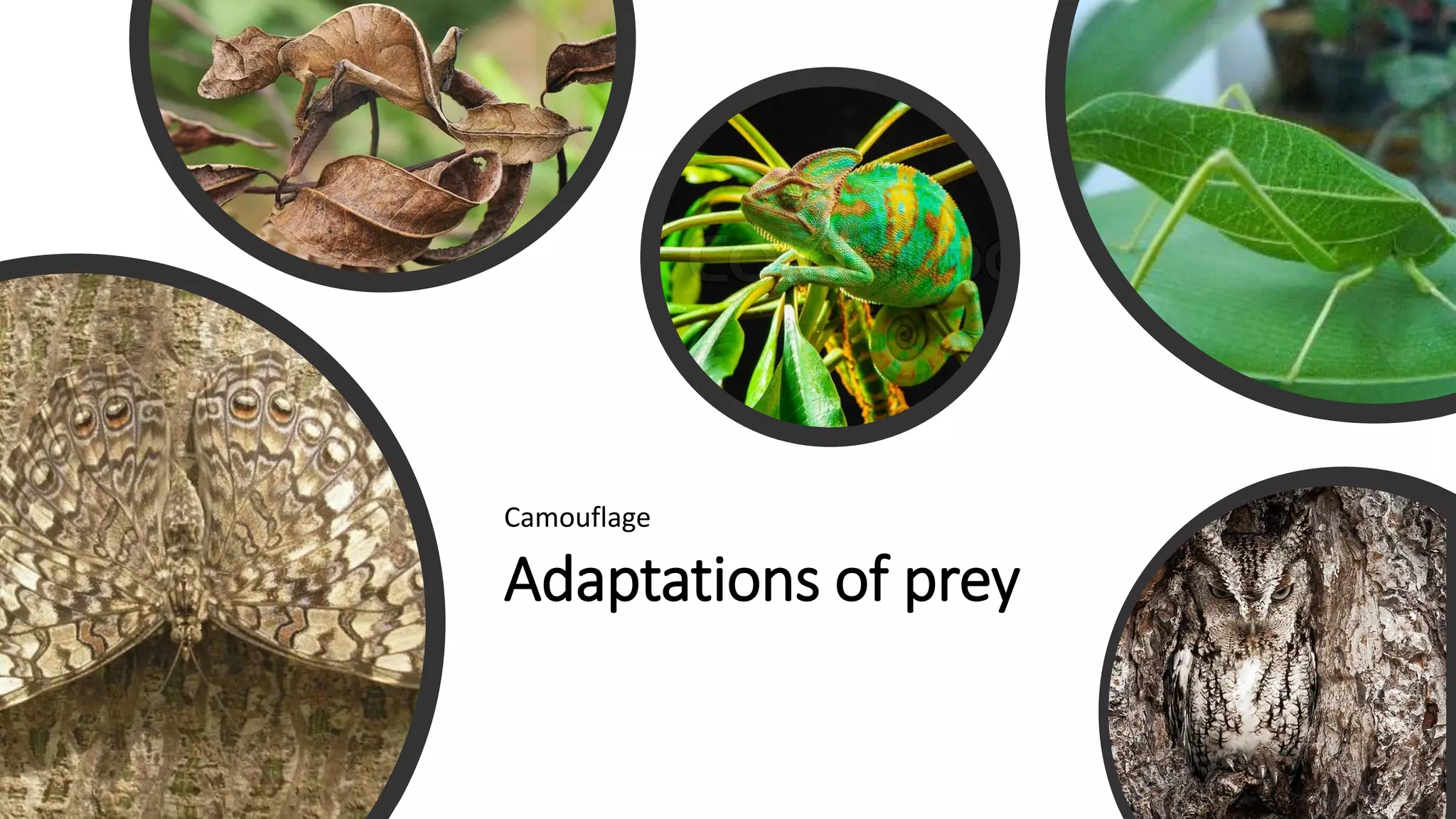
Adaptations of prey
Camouflage
Chameleon changing colors
Adaptations of
prey
Adaptations of prey
Noxious scent of skunk
Skunk spray
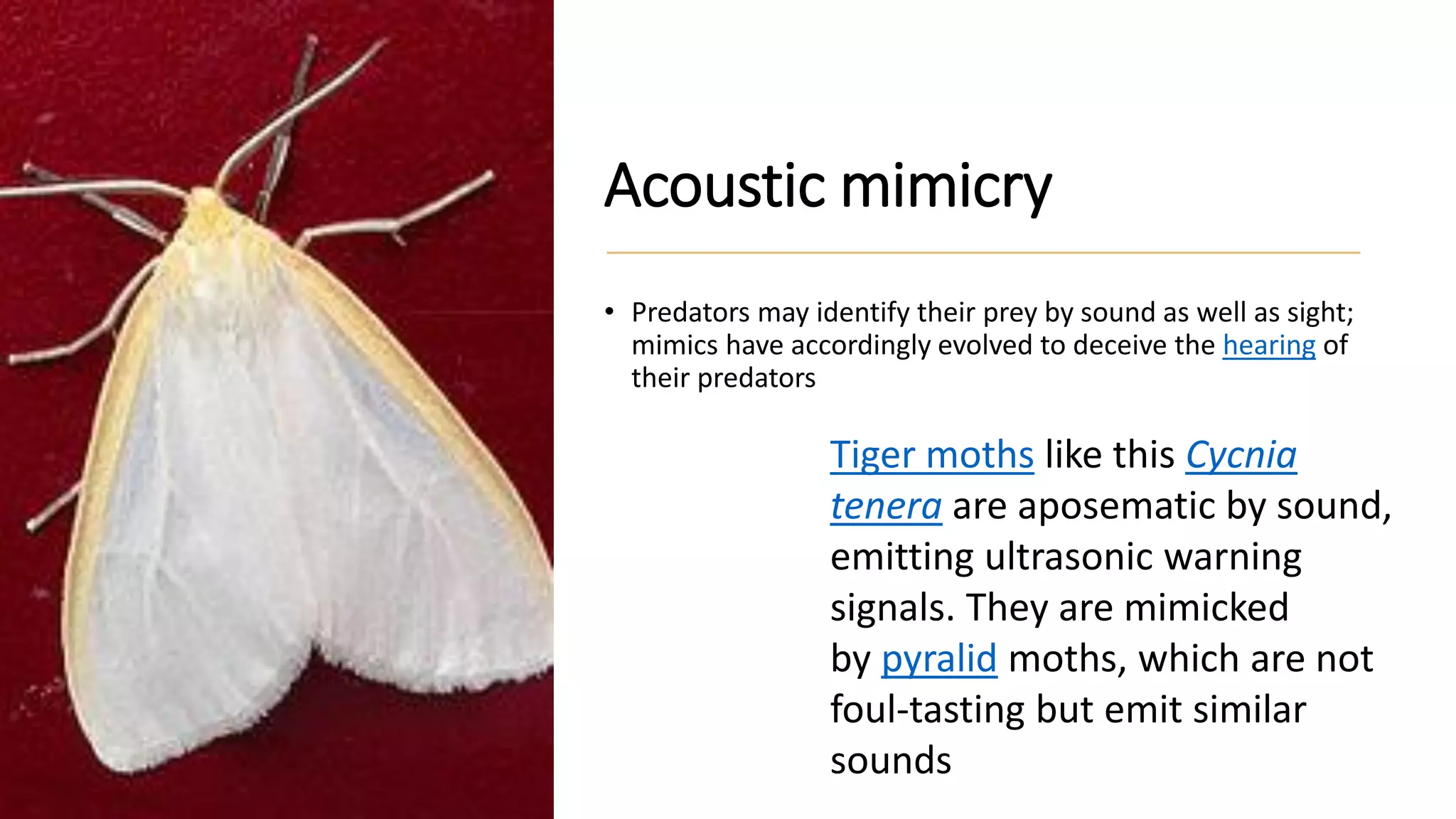
Acoustic mimicry
• Predators may identify their prey by sound as well as sight;
mimics have accordingly evolved to deceive the hearing of
their predators
Tiger moths like this Cycnia
tenera are aposematic by sound,
emitting ultrasonic warning
signals. They are mimicked
by pyralid moths, which are not
foul-tasting but emit similar
sounds
Muellerian
mimicry
• A type of mimicry where an entire group of
organisms bear similar markings or colours
that distinguish them as inedible by
predators. This means that every species
with this appearance is unpalatable or toxic,
not just one model species
Muellerian mimicry
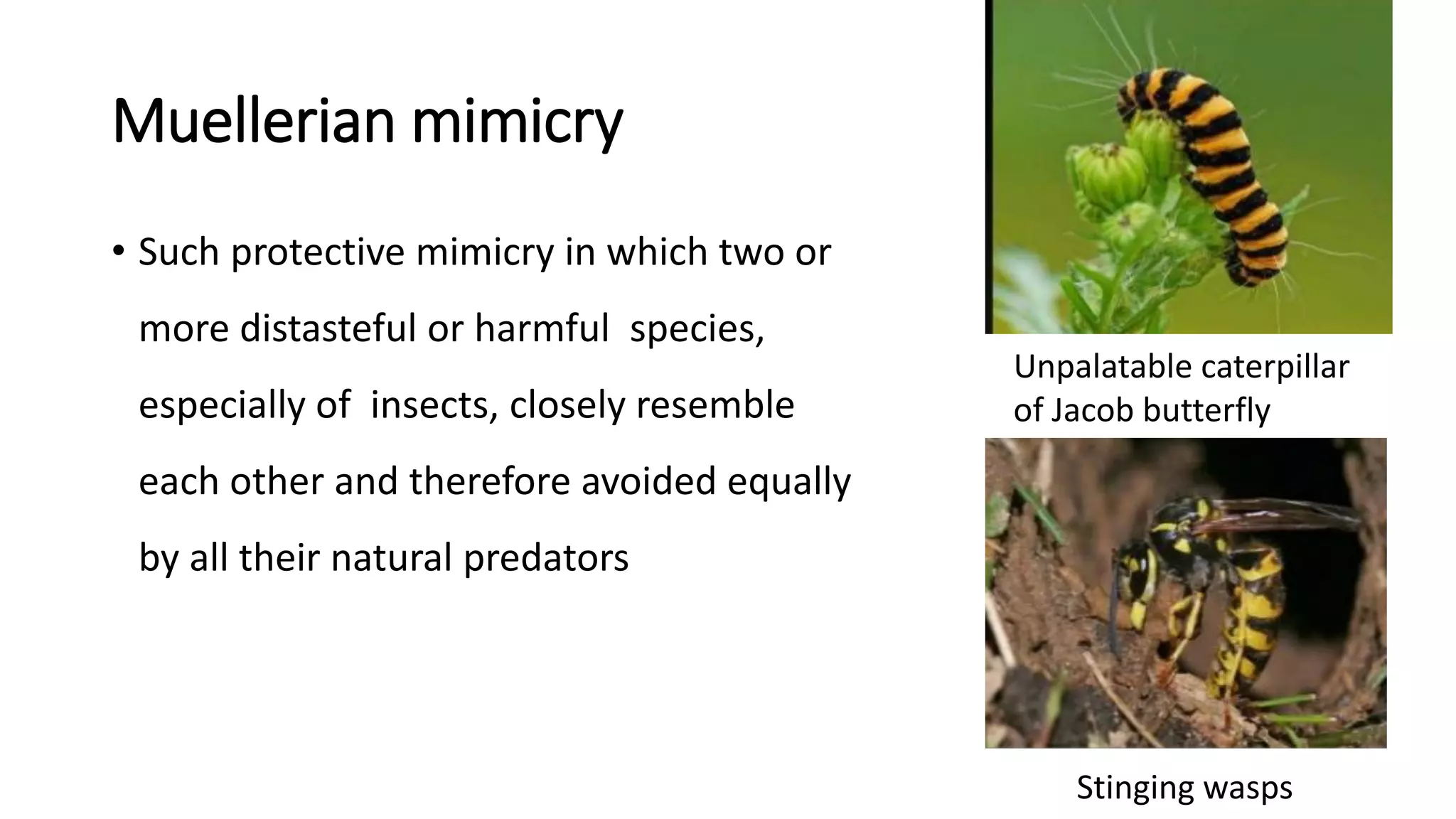
• Such protective mimicry in which two or
more distasteful or harmful species,
especially of insects, closely resemble
each other and therefore avoided equally
by all their natural predators
Unpalatable caterpillar
of Jacob butterfly
Stinging wasps
•
Müllerian mimicry was proposed by the German zoologist and naturalist Johann Friedrich
Theodor Müller (1821–1897), always known as Fritz.
• Explanation:
• One was sexual selection, namely that individuals would choose to mate with partners
with frequently-seen coloration, such as those resembling other species. However, if as is
usual, females are the choosers, then mimicry would be seen in males
How does mimicry
work so well?
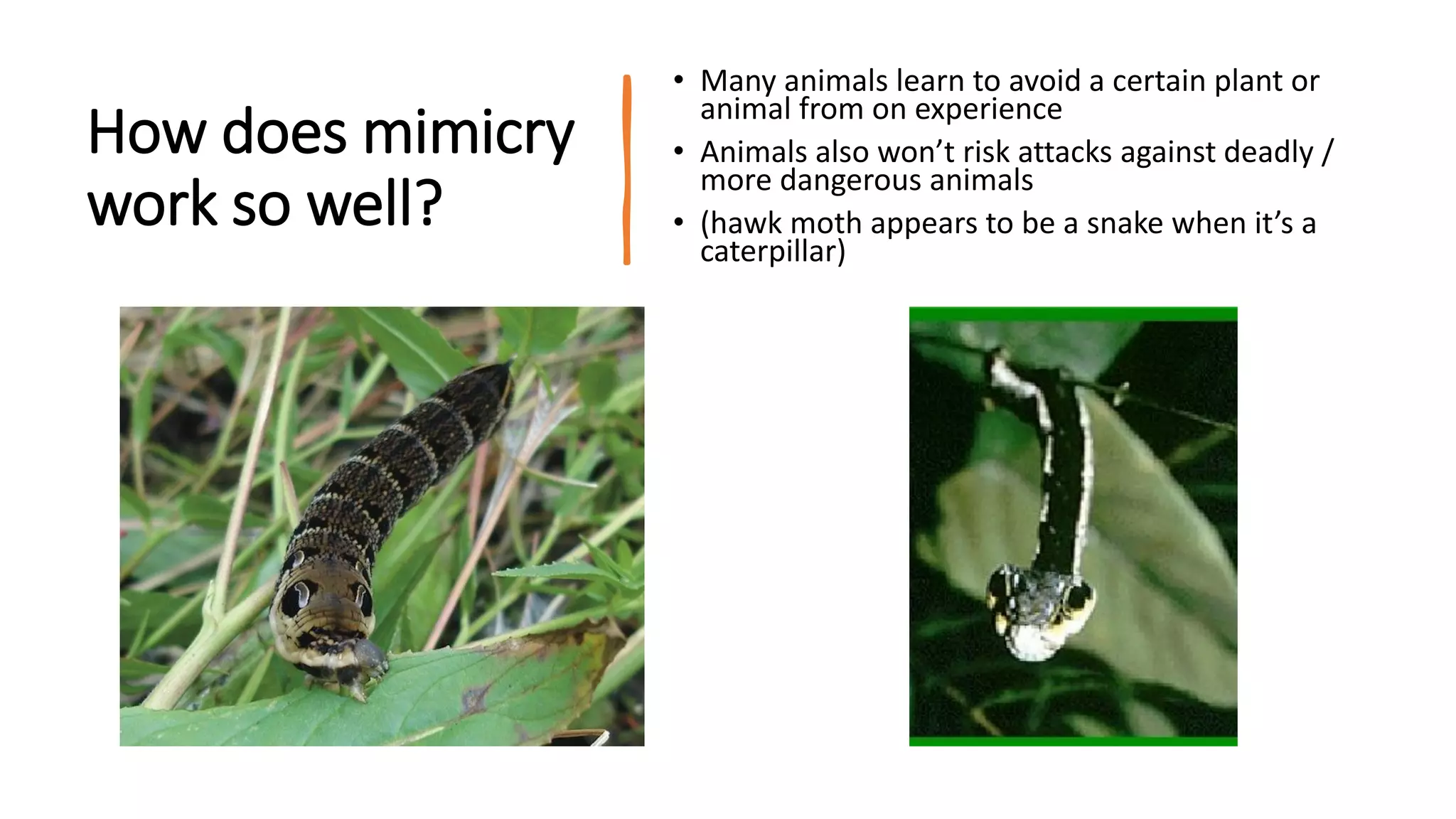
• Many animals learn to avoid a certain plant or
animal from on experience
• Animals also won’t risk attacks against deadly /
more dangerous animals
• (hawk moth appears to be a snake when it’s a
caterpillar)
Aposmatism
• Müllerian mimicry relies on aposematism, or warning signals.
Squinting Bush-brown, Bicyclus anynana
• Many animals remain inconspicuous until
threatened, then suddenly employ warning
signals, such as startling eyespots, bright
colours on their undersides or loud
vocalizations.
Relationship to
muellerian with
batesian
mimicry
• The Müllerian strategy is
usually contrasted
with Batesian mimicry, in
which one harmless species
adopts the appearance of an
unprofitable species to gain
the advantage of predators'
avoidance;.
Non visual
mimicry
• Mullerian mimicry not
restricted to visual
signals only. It can be of
any sense.
References
Caro. T. (2014). "Antipredator deception in terrestrial
vertebrates". Current Zoology. 60: 16–25.
Brower, L. P. (2000) Plant poisons in a terrestrial food chain
and implications for mimicry theory. In K. L. Chambers
(ed) Biochemical Coevolution Corvallis, OR: Oregon State Univ.
pp. 69-82.
Müller, F. (2009). "Ituna and Thyridia; a remarkable case of
mimicry in butterflies. (R. Meldola
translation)". Proclamations of the Entomological Society of
London. 1879: 20–29.
Bates, Henry Walter (2003). The Naturalist on the River
Amazons. John Murray.
References
Müller, Fritz (2009). "Ituna and Thyridia; a
remarkable case of mimicry in butterflies. (R.
Meldola translation)". Proclamations of the
Entomological Society of London. 109: 20–29.
Ritland, D.; L. P. Brower (2001). "The viceroy
butterfly is not a Batesian
mimic". Nature. 350(6318): 497–498.
Smith, S. M. (2005). "Innate Recognition of
Coral Snake Pattern by a Possible Avian
Predator". Science. 187 (4178): 759–760.

Mimicry: mullerian and batesian mimicry

  • 1.
  • 2.
    Contents • What ismimicry? • Camouflage vs. mimicry • Types of mimicry • Batesian mimicry • Aposmatism • Adaptation of prey • Acoustic mimicry • Muellerian mimicry • How does mimicry work so well? • Relationship to muellerian with batesian mimicry • Non visual mimicry • References • Animation
  • 3.
    What is mimicry? Similarities betweenspecies Form of symbiosis where a specie may mimic the color patterns or even the behavior of other species for one or more reasons. Either to be able to get closer to unsuspecting prey In case of harmless species to gain protection by limiting predators or poisonous species
  • 4.
    Camouflage vs. mimicry •Camouflage • To change body color to shade into scenery • Mimicry • To make the form of other organism, such plant or insects.
  • 5.
    Types of mimicry There areseveral types of mimicry utilized by predator and prey Batesian mimicry Mullerian mimicry Wasmannian mimicry Peckhamian mimicry Self mimicry
  • 6.
    Batesian mimicry • Atype of mimicry where the mimic resembles a model species that has spines, stingers, toxic chemicals or another form of defense from predators. The mimic has none of these.
  • 7.
    Batesian mimicry It is namedafter the English naturalist Henry Walter Bates, after his work on butterfliesin the rainforests of Brazil. His field research included collecting almost a hundred species of butterflies from the families Ithomiinae and Heliconiinae, as well as thousands of other insects specimens.
  • 8.
    Batesian mimicry • Palatableanimal mimics the bad tasting or noxious prey enough so that the predator may not able to distinguished them
  • 9.
    • After severalattempts of distasteful encounters the predator learn to avoid such appearance.
  • 10.
    Aposematism • Most livingthings have predators and therefore are in a constant evolutionary arms race to develop antipredator adaptations • The yellow-banded poison dart frog (Dendrobates leucomelas) has conspicuous aposematic coloration
  • 11.
  • 12.
  • 13.
  • 14.
  • 15.
  • 16.
  • 17.
    Acoustic mimicry • Predatorsmay identify their prey by sound as well as sight; mimics have accordingly evolved to deceive the hearing of their predators Tiger moths like this Cycnia tenera are aposematic by sound, emitting ultrasonic warning signals. They are mimicked by pyralid moths, which are not foul-tasting but emit similar sounds
  • 19.
    Muellerian mimicry • A typeof mimicry where an entire group of organisms bear similar markings or colours that distinguish them as inedible by predators. This means that every species with this appearance is unpalatable or toxic, not just one model species
  • 20.
    Muellerian mimicry • Suchprotective mimicry in which two or more distasteful or harmful species, especially of insects, closely resemble each other and therefore avoided equally by all their natural predators Unpalatable caterpillar of Jacob butterfly Stinging wasps
  • 21.
    • Müllerian mimicry wasproposed by the German zoologist and naturalist Johann Friedrich Theodor Müller (1821–1897), always known as Fritz. • Explanation: • One was sexual selection, namely that individuals would choose to mate with partners with frequently-seen coloration, such as those resembling other species. However, if as is usual, females are the choosers, then mimicry would be seen in males
  • 22.
    How does mimicry workso well? • Many animals learn to avoid a certain plant or animal from on experience • Animals also won’t risk attacks against deadly / more dangerous animals • (hawk moth appears to be a snake when it’s a caterpillar)
  • 23.
    Aposmatism • Müllerian mimicryrelies on aposematism, or warning signals. Squinting Bush-brown, Bicyclus anynana
  • 24.
    • Many animalsremain inconspicuous until threatened, then suddenly employ warning signals, such as startling eyespots, bright colours on their undersides or loud vocalizations.
  • 25.
    Relationship to muellerian with batesian mimicry •The Müllerian strategy is usually contrasted with Batesian mimicry, in which one harmless species adopts the appearance of an unprofitable species to gain the advantage of predators' avoidance;.
  • 26.
    Non visual mimicry • Mullerianmimicry not restricted to visual signals only. It can be of any sense.
  • 27.
    References Caro. T. (2014)."Antipredator deception in terrestrial vertebrates". Current Zoology. 60: 16–25. Brower, L. P. (2000) Plant poisons in a terrestrial food chain and implications for mimicry theory. In K. L. Chambers (ed) Biochemical Coevolution Corvallis, OR: Oregon State Univ. pp. 69-82. Müller, F. (2009). "Ituna and Thyridia; a remarkable case of mimicry in butterflies. (R. Meldola translation)". Proclamations of the Entomological Society of London. 1879: 20–29. Bates, Henry Walter (2003). The Naturalist on the River Amazons. John Murray.
  • 28.
    References Müller, Fritz (2009)."Ituna and Thyridia; a remarkable case of mimicry in butterflies. (R. Meldola translation)". Proclamations of the Entomological Society of London. 109: 20–29. Ritland, D.; L. P. Brower (2001). "The viceroy butterfly is not a Batesian mimic". Nature. 350(6318): 497–498. Smith, S. M. (2005). "Innate Recognition of Coral Snake Pattern by a Possible Avian Predator". Science. 187 (4178): 759–760.