POPULATION GENETICS
•Population genetics
Genetic structure of a population.
clan..
Group of individuals of the same species that can interbreed.
POPULATION GENETICS
•Genetic structure of a population
•Group of invdividuals of the
same species thet can interbreed
Why is gentic variation important?
1-Gene pool = is the complete set of
unique alleles in a species or
population
2-Genetic variation increase = the gene
pool = increases
3-Potential for change in genetic
structure
4-Genotype
•5-adaptation to environmental change
•6-Conservation
•7-Divergence of populations
8-Biodiversity
Why is genetic variation important ?
Variation survival
No variation Extinction !!
Global
warming
Why is genetic variation important?
migration or lsolationVariation
No variation
north
south
north
South
WHY IS GENETIC VARIATION
IMPORTANT
•Variation migration or isolation divergence
NO VARIATION NO DIVERGENCE!!
north
south
north
south
POPULATION GENETICS
•Genetic structure of a population
•1-alleles
•2-genotypes
•Group of individuals of the same species thet can interbreed
•patterns of genetic veriaton in populations changetic
structure through time
•Describing genetic structure
•1-Genotype frequencies
•2-allele frequencies
•distributionallele frequencyPopulation genetics is the study of
and change under the influence of the four main evolutionary
geneandmutation,genetic drift,natural selectionprocesses:
It also takes into account the factors of.flow
.population structurepopulation subdivision and,recombination
andadaptationIt attempts to explain such phenomena as
.speciation
•Population genetics was a vital ingredient in the emergence of
Its primary founders were.modern evolutionary synthesisthe
who also laid,R. A. FisherandS. HaldaneJ. B.,Sewall Wright
quantitativethe foundations for the related discipline of
.genetics
•Traditionally a highly mathematical discipline, modern
population genetics encompasses theoretical, lab and field
work.
•Fundamentals
•.peppered mothbodied form of the-is the whitetypicaf.betulariaBiston
•Biston betularia f. carbonaria is the black-bodied form of the peppered
moth.
•Population genetics is the study of the frequency and interaction of
alleles and genes in populations A sexual population is a set of
This impliestogether.breedorganisms in which any pair of members can
]otherthat all members belong to the same species and live near each
•For example, all of the moths of the same species living in an isolated
forest are a population. A gene in this population may have several
ofphenotypesalternate forms, which account for variations between the
the organisms. An example might be a gene for coloration in moths that
is the complete set ofgene poolblack and white. A:alleleshas two
for an alleleallele frequencyalleles for a gene in a single population; the
is the fraction of the genes in the pool that is composed of that allele (for
example, what fraction of moth coloration genes are the black allele).
occurs when there are changes in the frequencies of allelesEvolution
within a population; for example, the allele for black color in a population
of moths becoming more common.
•Hardy–Weinberg principle
•geneticwill only cause evolution if there is enoughselectionNatural
,geneticsMendelianin a population. Before the discovery ofvariation
But with blending.blending inheritanceone common hypothesis was
inheritance, genetic variance would be rapidly lost, making evolution by
provides theWeinberg principle-Hardynatural selection implausible. The
Mendeliansolution to how variation is maintained in a population with
According to this principle, the frequencies of alleles.inheritance
(variations in a gene) will remain constant in the absence of selection,
mutation, migration and genetic drift The Hardy-Weinberg "equilibrium"
refers to this stability of allele frequencies over time.
•A second component of the Hardy-Weinberg principle concerns the
effects of a single generation of random mating. In this case, the
genotype frequencies can be predicted from the allele frequencies. For
: theallelesexample, in the simplest case of a single locus with two
a and their frequenciesrecessiveis denoted A and thedominant allele
are denoted by p and q; freq(A) = p; freq(a) = q; p + q = 1. If the genotype
frequencies are in Hardy-Weinberg proportions resulting from random
in thehomozygotesfor the AA2p=(AA)freqmating, then we will have
population, freq(aa) = q2 for the aa homozygotes, and freq(Aa) = 2pq for
.heterozygotesthe
•Natural selection
•make it more likely for antraitsselection is the fact that someNatural
Population genetics describes.reproduceto survive andorganism
ofpropensity or probabilityas afitnessnatural selection by defining
survival and reproduction in a particular environment. The fitness is
.selection coefficient+s where s is the1normally given by the symbol w=
or the observable characteristics,phenotypesNatural selection acts on
basis of any phenotype whichgenetically heritableof organisms, but the
gives a reproductive advantage will become more common in a
In this way, natural selection converts).allele frequencypopulation (see
populationdifferences in fitness into changes in allele frequency in a
over successive generations.
•Before the advent of population genetics, many biologists doubted that
small differences in fitness were sufficient to make a large difference to
evolution Population geneticists addressed this concern in part by
Selection can overcome genetic drift.genetic driftcomparing selection to
When.effective population sizedivided by the1when s is greater than
this criterion is met, the probability that a new advantageous mutant
time until fixation ofs The2is approximately equal tofixedbecomes
such an allele depends little on genetic drift, and is approximately
[)/s.sNproportional to log(
Genetic drift
theThat is,samplingrandomcaused byallele frequenciesis a change indriftGenetic
alleles in the offspring are a random sample of those in the parents Genetic drift may
cause gene variants to disappear completely, and thereby reduce genetic variability. In
which makes gene variants more common or less common,natural selectioncontrast to
depending on their reproductive success the changes due to genetic drift are not driven by
environmental or adaptive pressures, and may be beneficial, neutral, or detrimental to
reproductive success.
The effect of genetic drift is larger for alleles present in a smaller number of copies, and
smaller when an allele is present in many copies. Vigorous debates wage among
scientists over the relative importance of genetic drift compared with natural selection.
held the view that genetic drift plays at the most a minor role inRonald Fisher
Motoo1968evolution, and this remained the dominant view for several decades. In
which claimsneutral theory of molecular evolutionrekindled the debate with hisKimura
that most of the changes in the genetic material are caused by neutral mutations and
genetic drift The role of genetic drift by means of sampling error in evolution has been
who argue that selection on linked sites is,ProvineWillandGillespieJohn Hcriticized by
a more important stochastic force.
orbranching processesThe population genetics of genetic drift are described using either
approaches are usuallyfrequency Thesedescribing changes in allelediffusion equationa
applied to the Wright-Fisher and Moran models of population genetics. Assuming genetic
drift is the only evolutionary force acting on an allele, after t generations in many
replicated populations, starting with allele frequencies of p and q, the variance in allele
frequency across those populations is
•tation
•in the formgenetic variationis the ultimate source ofMutation
of new alleles. Mutation can result in several different types of
change in DNA sequences; these can either have no
or prevent the gene from,product of a geneeffect, alter the
suggestDrosophila melanogasterfunctioning. Studies in the fly
that if a mutation changes a protein produced by a gene, this
will probably be harmful, with about 70 percent of these
mutations having damaging effects, and the remainder being
either neutral or weakly beneficial
•Mutations can involve large sections of DNA becoming
Theserecombinationgeneticusually through,duplicated
duplications are a major source of raw material for evolving new
genes, with tens to hundreds of genes duplicated in animal
familiesMost genes belong to largeryearsgenomes every million
Novel genes are produced by severalancestrysharedofof genes
methods, commonly through the duplication and mutation of an
ancestral gene, or by recombining parts of different genes to
act asdomainsHere,functionsform new combinations with new
modules, each with a particular and independent function, that
can be mixed together to produce genes encoding new proteins
with novel properties For example, the human eye uses four
color visiongenes to make structures that sense light: three for
all four arose from a single ancestral;night visionand one for
entireadvantage of duplicating a gene (or even angeneAnother
this allows one gene;redundancyis that this increases)genome
in the pair to acquire a new function while the other copy
performs the original function Other types of mutation
occasionally create new genes from previously noncoding DNA
•In addition to being a major source of variation, mutation may
also function as a mechanism of evolution when there are
different probabilities at the molecular level for different
mutations to occur, a process known as mutation bias If two
genotypes, for example one with the nucleotide G and another
with the nucleotide A in the same position, have the same fitness,
but mutation from G to A happens more often than mutation from
A to G, then genotypes with A will tend to evolve Different
insertion vs. deletion mutation biases in different taxa can lead to
the evolution of different genome sizes Developmental or
morphologicalmutational biases have also been observed in
first theory of-phenotypeexample, according to theevolutionFor
geneticmutations can eventually cause the,evolution
induced by theof traits that were previouslyassimilation
environment
•Mutation bias effects are superimposed on other processes. If
selection would favor either one out of two mutations, but there
is no extra advantage to having both, then the mutation that
occurs the most frequently is the one that is most likely to
become fixed in a population Mutations leading to the loss of
function of a gene are much more common than mutations that
produce a new, fully functional gene. Most loss of function
mutations are selected against. But when selection is weak,
mutation bias towards loss of function can affect evolution For
are no longer useful when animals live in thepigmentsexample,
darkness of caves, and tend to be lost This kind of loss of
function can occur because of mutation bias, and/or because the
function had a cost, and once the benefit of the function
disappeared, natural selection leads to the loss. Loss of
during laboratory evolutionbacteriumability in asporulation
appears to have been caused by mutation bias, rather than
natural selection against the cost of maintaining sporulation
ability When there is no selection for loss of function, the speed
at which loss evolves depends more on the mutation rate than it
that it is drivenindicatingsizeeffective populationdoes on the
more by mutation bias than by genetic drift.
•Evolution of mutation rate
•Due to the damaging effects that mutations can have
on cells, organisms have evolved mechanisms such
the,mutations Thereforeto removeDNA repairas
optimal mutation rate for a species is a trade-off
between costs of a high mutation rate, such as
costs ofmetabolicdeleterious mutations, and the
maintaining systems to reduce the mutation
rate, such as DNA repair enzymes Viruses that use
RNA as their genetic material have rapid mutation
rates which can be an advantage since these viruses
will evolve constantly and rapidly, and thus evade the
immunedefensive responses of e.g. the human
system
•Gene flow and transfer
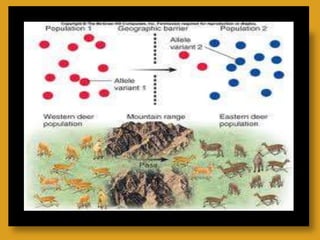
•is the exchange of genes betweenflowGene
populations, which are usually of the same species Examples
of gene flow within a species include the migration and then
. Genepollenbreeding of organisms, or the exchange of
hybridtransfer between species includes the formation of
.horizontal gene transferorganisms and
•Migration into or out of a population can change allele
frequencies, as well as introducing genetic variation into a
population. Immigration may add new genetic material to the
of a population. Conversely, emigrationgene poolestablished
may remove genetic material. Population genetic models can
be used to reconstruct the history of gene flow between
populations.
•Reproductive isolation
•between two diverging populations are required forbarriers to reproductionAs
, gene flow may slow this process bybecome new speciesthe populations to
spreading genetic differences between the populations. Gene flow is hindered
by mountain ranges, oceans and deserts or even man-made structures such
]genes, which has hindered the flow of plantGreat Wall of Chinaas the
•most recentDepending on how far two species have diverged since their
, it may still be possible for them to produce offspring, ascommon ancestor
are generallyhybridsSuchmulesmating to producedonkeysandhorseswith
, due to the two different sets of chromosomes being unable to pair upinfertile
. In this case, closely related species may regularlymeiosisduring
interbreed, but hybrids will be selected against and the species will remain
distinct. However, viable hybrids are occasionally formed and these new
species can either have properties intermediate between their parent
species, or possess a totally new phenotype The importance of hybridization in
of animals is unclear, although cases have been seen innew speciescreating
studied-being a particularly wellgray tree frogtheanimals withmany types of
example Hybridization is, however, an important means of speciation in
(having more than two copies of each chromosome) ispolyploidyplants, since
tolerated in plants more readily than in animals Polyploidy is important in
hybrids as it allows reproduction, with the two different sets of chromosomes
each being able to pair with an identical partner during meiosis Polyploids also
inbreeding depressionhave more genetic diversity, which allows them to avoid
in small populations
•Genetic structure
•Because of physical barriers to migration, along with limited
), andvagilitytendency for individuals to move or spread (
tendency to remain or come back to natal place
), natural populations rarely all interbreed asphilopatry(
etBuston) (panmixyconvenient in theoretical random models (
al., 2007). There is usually a geographic range within which
to one another than thoserelatedindividuals are more closely
randomly selected from the general population. This is
described as the extent to which a population is genetically
structured (Repaci et al., 2007). Genetic structuring can be
, speciesclimate changecaused by migration due to historical
.habitator current availability ofrange expansion
•Horizontal Gene Transfer
•Horizontal gene transfer is the transfer of genetic material from
one organism to another organism that is not its offspring; this
medicine, this contributes toInbacteriais most common among
, as when one bacteriaantibiotic resistancethe spread of
acquires resistance genes it can rapidly transfer them to other
species Horizontal transfer of genes from bacteria to
andcerevisiaeSaccharomyceseukaryotes such as the yeast
the adzuki bean beetle Callosobruchus chinensis may also
have occurred An example of larger-scale transfers are the
, which appear to have received arotifersbdelloideukaryotic
canVirusesplantsrange of genes from bacteria, fungi, and
also carry DNA between organisms, allowing transfer of genes
scale gene transfer has-Large]domainsbiologicaleven across
andeukaryotic cellsalso occurred between the ancestors of
andchloroplastsprokaryotes, during the acquisition of
mitochondria
•Epistasis
•, the phenotypic effect of an allele at one locusepistasisBecause of
may depend on which alleles are present at many other loci. Selection
does not act on a single locus, but on a phenotype that arises through
development from a complete genotype.
•), the theoretical task for population1974(LewontinAccording to
genetics is a process in two spaces: a "genotypic space" and a
"phenotypic space". The challenge of a complete theory of population
genetics is to provide a set of laws that predictably map a population
takesselection), where1Pspace (phenotype) to a1G(genotypesof
place, and another set of laws that map the resulting population (P2)
genetics can predictMendelian) where2Gback to genotype space (
the next generation of genotypes, thus completing the cycle. Even
molecularaspects ofMendelian-leaving aside for the moment the non
, this is clearly a gargantuan task. Visualizing thisgenetics
transformation schematically:
(adapted from Lewontin 1974, p. 12). XD
laws, the aspects of functionalepigeneticrepresents the genetic and1T
, that transform a genotype into phenotype. We willdevelopmentbiology, or
is the transformation due2T".phenotype map-genotyperefer to this as the "
to natural selection, T3 are epigenetic relations that predict genotypes based
on the selected phenotypes and finally T4 the rules of Mendelian genetics.
In practice, there are two bodies of evolutionary theory that exist in
parallel, traditional population genetics operating in the genotype space and
, operating inanimal breedingandplanttheory used inbiometricthe
phenotype space. The missing part is the mapping between the genotype
and phenotype space. This leads to a "sleight of hand" (as Lewontin terms it)
whereby variables in the equations of one domain, are considered
parameters or constants, where, in a full-treatment they would be
transformed themselves by the evolutionary process and are in reality
functions of the state variables in the other domain. The "sleight of hand" is
assuming that we know this mapping. Proceeding as if we do understand it
is enough to analyze many cases of interest. For example, if the phenotype
scale is-) or the timecell disease-sickleone with genotype (-to-is almost one
sufficiently short, the "constants" can be treated as such; however, there are
many situations where it is inaccurate.
•Linkage
•, the effect of an allele at onelinkage equilibriumIf all genes are in
at other loci. Ingene poollocus can be averaged across the
withlinkage disequilibriumreality, one allele is frequently found in
genes at other loci, especially with genes located nearby on the same
breaks up this linkage disequilibrium tooRecombinationchromosome.
, where an allele at one locus risesgenetic hitchhikingslowly to avoid
to an allele under selection at alinkedto high frequency because it is
nearby locus. This is a problem for population genetic models that
treat one gene locus at a time. It can, however, be exploited as a
selectivevianatural selectionmethod for detecting the action of
.sweeps
•, linkage isasexual populationsIn the extreme case of primarily
complete, and different population genetic equations can be derived
Most]63[and solved, which behave quite differently to the sexual case.
, are asexual. The population genetics ofbacteria, such asmicrobes
lays the foundations for tracking the origin andmicroorganisms
.pathogensand deadly infectiousantibiotic resistanceevolution of
Population genetics of microorganisms is also an essential factor for
devising strategies for the conservation and better utilization of
beneficial microbes (Xu, 2010).
•Modern evolutionary synthesis
•The mathematics of population genetics were originally developed as the
. According to Beattymodern evolutionary synthesisbeginning of the
(1986), population genetics defines the core of the modern synthesis. In the
first few decades of the 20th century, most field naturalists continued to believe
that Lamarckian and orthogenic mechanisms of evolution provided the best
explanation for the complexity they observed in the living world. However, as
the field of genetics continued to develop, those views became less tenable
During the modern evolutionary synthesis, these ideas were purged, and only
evolutionary causes that could be expressed in the mathematical framework of
population genetics were retained Consensus was reached as to which
evolutionary factors might influence evolution, but not as to the relative
importance of the various factors
•, a postdoctoral worker in T. H. Morgan's lab, hadDobzhanskyTheodosius
geneticists suchRussianbeen influenced by the work on genetic diversity by
. He helped to bridge the divide between the foundationsChetverikovSergeias
developed by the population geneticists and the patterns ofmicroevolutionof
Genetics andbook1937observed by field biologists, with hismacroevolution
examined the genetic diversity of wildDobzhansky.the Origin of Species
populations and showed that, contrary to the assumptions of the population
geneticists, these populations had large amounts of genetic diversity, with
marked differences between sub-populations. The book also took the highly
mathematical work of the population geneticists and put it into a more
accessible form. Many more biologists were influenced by population genetics
via Dobzhansky than were able to read the highly mathematical works in the
original
•Selection vs. genetic drift
•Fisher and Wright had some fundamental disagreements and a
controversy about the relative roles of selection and drift continued
for much of the century between the Americans and the British.
•,ecological genetics, the pioneer ofE.B. FordIn Great Britain
continued throughout the 1930s and 1940s to demonstrate the
power of selection due to ecological factors including the ability to
such asgenetic polymorphismsmaintain genetic diversity through
. Ford's work, in collaboration with Fisher,blood typeshuman
contributed to a shift in emphasis during the course of the modern
]driftgeneticovernatural selectionsynthesis towards
•, and of theirtransposable elementsRecent studies of eukaryotic
nonadaptive, point again to a major role ofspeciationimpact on
and geneticMutationdriftgeneticandmutationprocesses such as
drift are also viewed as major factors in the evolution of genome
complexity
•Population genetics
Genetic structure of a population.
clan..
Group of individuals of the same species that can interbreed.
Migration..
Migration is the movement of individuals in or out of a population.
Selection..
Selection is the primary factor driving evolution..
Genetic Drift..
Genetic drift is the random in allele frequencies.
•HOW does genetic structure change?
•Changes in allele frequencies and genotype frequencies through time.
•
Mutation
Natural selection Genetic drift Non-random mating
Migration
MUTATION
However ,the rate of mutation is quite low:
for any given gene,about 1 copy in
104_106 is a new mutation.>>>
-
Mutations provide the necessary raw
material for evolutionary change ,but by
themselves new mutations do not have a
measurable effect on allele or genotype
frequencies
Migration
MigratMigration is necessary to keep a species
from
fragmenting.
Migration is necessary to keep a species
from fragmenting into several different
species>
Selection
Selection is the primary
factor driving evolution... Genes that confer
increased fitness tend to
take over a population..
Selection can occur at many
places in the life cycle: the
embryo might be defective, the
fetus might not survive to
birth, the immature offspring
might be killed, the individual
might not be able to find a
mate or might be sterile.
Fitness is a function of the
genotype. We will define
the “relative fitness” of the
best genotype as equal to
1.0, and the fitnesses of the
two other genotypes as
equal to or less than 1.
•Resistance to antibacterial soap
•
NATURAL SELECTION
Generation 1:1.00 not resistant
0.00 resistant
Application or using antibacterial
soap can kill the bacteria.
NATURAL
SELECTION
Resistance to antibacterial soap
Generation 1:1.00 not resistant
0.00 resistant
Generation 2:0.96 not resistant
0.04 resistant
One bacteria get mutated
and resist soap
mutation!
•Natural selection
Resistance to antibacterial soap
•Generation 1:1.00 not resistant
•0.00 resistant
•Generation 2:0.96 not resistant
•0.04 resistant
•Generation 3:0.76 not resistant
0.24 resistant
Resistant bacteria reproduce and grow in
number. On the other hand the non resistant
bacteria decreased in number.
Natural selection
Resistance to antibacterial soap
•Generation 1:1.00 not resistant
0.00 resistant
•Generation 2:0.96 not resistant
0.04 resistant
•Generation 3:0.76 not resistant
0.24 resistant
•Generation 4:0.12 not resistant
0.88 resistant
The resistant bacteria dominate the
population
•Natural selection can cause
•populations to diverge
•
Divergence
Genetic Drift
Genetic drift is the
random changes in
allele frequencies.
Genetic drift occurs
in all populations, but
it has a major effect
on small populations.
For Darwin and the neo-
Darwinians, selection was the
only force that had a significant
effect on evolution. More recently
it has been recognized that
random changes, genetic
drift, can also significantly
influence evolutionary change. It
is thought that most major events
occur in small isolated
populations.
Genetic drift
Global Disaster
NON-RANDOM MATING
•random change in allele frequencies that occurs in small populations
•1: gene pool { }
•Equilibrium { }
•genetic drift { }
•Inbreeding { }
•combined genetic information of all the members of a particular population
•Mutation { }
•genetic drift { }
•gene pool { }
•Migration { }
•continued breeding of individuals with similar characteristics
•migration
•inbreeding
•gene pool
•population

مشروووووع الوراثه

  • 1.
  • 2.
    •Population genetics Genetic structureof a population. clan.. Group of individuals of the same species that can interbreed.
  • 3.
    POPULATION GENETICS •Genetic structureof a population •Group of invdividuals of the same species thet can interbreed
  • 4.
    Why is genticvariation important? 1-Gene pool = is the complete set of unique alleles in a species or population 2-Genetic variation increase = the gene pool = increases 3-Potential for change in genetic structure 4-Genotype
  • 5.
    •5-adaptation to environmentalchange •6-Conservation •7-Divergence of populations 8-Biodiversity Why is genetic variation important ? Variation survival No variation Extinction !! Global warming
  • 6.
    Why is geneticvariation important? migration or lsolationVariation No variation north south north South
  • 7.
    WHY IS GENETICVARIATION IMPORTANT •Variation migration or isolation divergence NO VARIATION NO DIVERGENCE!! north south north south
  • 8.
    POPULATION GENETICS •Genetic structureof a population •1-alleles •2-genotypes •Group of individuals of the same species thet can interbreed •patterns of genetic veriaton in populations changetic structure through time •Describing genetic structure •1-Genotype frequencies •2-allele frequencies
  • 9.
    •distributionallele frequencyPopulation geneticsis the study of and change under the influence of the four main evolutionary geneandmutation,genetic drift,natural selectionprocesses: It also takes into account the factors of.flow .population structurepopulation subdivision and,recombination andadaptationIt attempts to explain such phenomena as .speciation •Population genetics was a vital ingredient in the emergence of Its primary founders were.modern evolutionary synthesisthe who also laid,R. A. FisherandS. HaldaneJ. B.,Sewall Wright quantitativethe foundations for the related discipline of .genetics •Traditionally a highly mathematical discipline, modern population genetics encompasses theoretical, lab and field work.
  • 10.
    •Fundamentals •.peppered mothbodied formof the-is the whitetypicaf.betulariaBiston •Biston betularia f. carbonaria is the black-bodied form of the peppered moth. •Population genetics is the study of the frequency and interaction of alleles and genes in populations A sexual population is a set of This impliestogether.breedorganisms in which any pair of members can ]otherthat all members belong to the same species and live near each •For example, all of the moths of the same species living in an isolated forest are a population. A gene in this population may have several ofphenotypesalternate forms, which account for variations between the the organisms. An example might be a gene for coloration in moths that is the complete set ofgene poolblack and white. A:alleleshas two for an alleleallele frequencyalleles for a gene in a single population; the is the fraction of the genes in the pool that is composed of that allele (for example, what fraction of moth coloration genes are the black allele). occurs when there are changes in the frequencies of allelesEvolution within a population; for example, the allele for black color in a population of moths becoming more common.
  • 11.
    •Hardy–Weinberg principle •geneticwill onlycause evolution if there is enoughselectionNatural ,geneticsMendelianin a population. Before the discovery ofvariation But with blending.blending inheritanceone common hypothesis was inheritance, genetic variance would be rapidly lost, making evolution by provides theWeinberg principle-Hardynatural selection implausible. The Mendeliansolution to how variation is maintained in a population with According to this principle, the frequencies of alleles.inheritance (variations in a gene) will remain constant in the absence of selection, mutation, migration and genetic drift The Hardy-Weinberg "equilibrium" refers to this stability of allele frequencies over time. •A second component of the Hardy-Weinberg principle concerns the effects of a single generation of random mating. In this case, the genotype frequencies can be predicted from the allele frequencies. For : theallelesexample, in the simplest case of a single locus with two a and their frequenciesrecessiveis denoted A and thedominant allele are denoted by p and q; freq(A) = p; freq(a) = q; p + q = 1. If the genotype frequencies are in Hardy-Weinberg proportions resulting from random in thehomozygotesfor the AA2p=(AA)freqmating, then we will have population, freq(aa) = q2 for the aa homozygotes, and freq(Aa) = 2pq for .heterozygotesthe
  • 12.
    •Natural selection •make itmore likely for antraitsselection is the fact that someNatural Population genetics describes.reproduceto survive andorganism ofpropensity or probabilityas afitnessnatural selection by defining survival and reproduction in a particular environment. The fitness is .selection coefficient+s where s is the1normally given by the symbol w= or the observable characteristics,phenotypesNatural selection acts on basis of any phenotype whichgenetically heritableof organisms, but the gives a reproductive advantage will become more common in a In this way, natural selection converts).allele frequencypopulation (see populationdifferences in fitness into changes in allele frequency in a over successive generations. •Before the advent of population genetics, many biologists doubted that small differences in fitness were sufficient to make a large difference to evolution Population geneticists addressed this concern in part by Selection can overcome genetic drift.genetic driftcomparing selection to When.effective population sizedivided by the1when s is greater than this criterion is met, the probability that a new advantageous mutant time until fixation ofs The2is approximately equal tofixedbecomes such an allele depends little on genetic drift, and is approximately [)/s.sNproportional to log(
  • 13.
    Genetic drift theThat is,samplingrandomcausedbyallele frequenciesis a change indriftGenetic alleles in the offspring are a random sample of those in the parents Genetic drift may cause gene variants to disappear completely, and thereby reduce genetic variability. In which makes gene variants more common or less common,natural selectioncontrast to depending on their reproductive success the changes due to genetic drift are not driven by environmental or adaptive pressures, and may be beneficial, neutral, or detrimental to reproductive success. The effect of genetic drift is larger for alleles present in a smaller number of copies, and smaller when an allele is present in many copies. Vigorous debates wage among scientists over the relative importance of genetic drift compared with natural selection. held the view that genetic drift plays at the most a minor role inRonald Fisher Motoo1968evolution, and this remained the dominant view for several decades. In which claimsneutral theory of molecular evolutionrekindled the debate with hisKimura that most of the changes in the genetic material are caused by neutral mutations and genetic drift The role of genetic drift by means of sampling error in evolution has been who argue that selection on linked sites is,ProvineWillandGillespieJohn Hcriticized by a more important stochastic force. orbranching processesThe population genetics of genetic drift are described using either approaches are usuallyfrequency Thesedescribing changes in allelediffusion equationa applied to the Wright-Fisher and Moran models of population genetics. Assuming genetic drift is the only evolutionary force acting on an allele, after t generations in many replicated populations, starting with allele frequencies of p and q, the variance in allele frequency across those populations is
  • 15.
    •tation •in the formgeneticvariationis the ultimate source ofMutation of new alleles. Mutation can result in several different types of change in DNA sequences; these can either have no or prevent the gene from,product of a geneeffect, alter the suggestDrosophila melanogasterfunctioning. Studies in the fly that if a mutation changes a protein produced by a gene, this will probably be harmful, with about 70 percent of these mutations having damaging effects, and the remainder being either neutral or weakly beneficial
  • 16.
    •Mutations can involvelarge sections of DNA becoming Theserecombinationgeneticusually through,duplicated duplications are a major source of raw material for evolving new genes, with tens to hundreds of genes duplicated in animal familiesMost genes belong to largeryearsgenomes every million Novel genes are produced by severalancestrysharedofof genes methods, commonly through the duplication and mutation of an ancestral gene, or by recombining parts of different genes to act asdomainsHere,functionsform new combinations with new modules, each with a particular and independent function, that can be mixed together to produce genes encoding new proteins with novel properties For example, the human eye uses four color visiongenes to make structures that sense light: three for all four arose from a single ancestral;night visionand one for entireadvantage of duplicating a gene (or even angeneAnother this allows one gene;redundancyis that this increases)genome in the pair to acquire a new function while the other copy performs the original function Other types of mutation occasionally create new genes from previously noncoding DNA
  • 17.
    •In addition tobeing a major source of variation, mutation may also function as a mechanism of evolution when there are different probabilities at the molecular level for different mutations to occur, a process known as mutation bias If two genotypes, for example one with the nucleotide G and another with the nucleotide A in the same position, have the same fitness, but mutation from G to A happens more often than mutation from A to G, then genotypes with A will tend to evolve Different insertion vs. deletion mutation biases in different taxa can lead to the evolution of different genome sizes Developmental or morphologicalmutational biases have also been observed in first theory of-phenotypeexample, according to theevolutionFor geneticmutations can eventually cause the,evolution induced by theof traits that were previouslyassimilation environment
  • 18.
    •Mutation bias effectsare superimposed on other processes. If selection would favor either one out of two mutations, but there is no extra advantage to having both, then the mutation that occurs the most frequently is the one that is most likely to become fixed in a population Mutations leading to the loss of function of a gene are much more common than mutations that produce a new, fully functional gene. Most loss of function mutations are selected against. But when selection is weak, mutation bias towards loss of function can affect evolution For are no longer useful when animals live in thepigmentsexample, darkness of caves, and tend to be lost This kind of loss of function can occur because of mutation bias, and/or because the function had a cost, and once the benefit of the function disappeared, natural selection leads to the loss. Loss of during laboratory evolutionbacteriumability in asporulation appears to have been caused by mutation bias, rather than natural selection against the cost of maintaining sporulation ability When there is no selection for loss of function, the speed at which loss evolves depends more on the mutation rate than it that it is drivenindicatingsizeeffective populationdoes on the more by mutation bias than by genetic drift.
  • 19.
    •Evolution of mutationrate •Due to the damaging effects that mutations can have on cells, organisms have evolved mechanisms such the,mutations Thereforeto removeDNA repairas optimal mutation rate for a species is a trade-off between costs of a high mutation rate, such as costs ofmetabolicdeleterious mutations, and the maintaining systems to reduce the mutation rate, such as DNA repair enzymes Viruses that use RNA as their genetic material have rapid mutation rates which can be an advantage since these viruses will evolve constantly and rapidly, and thus evade the immunedefensive responses of e.g. the human system
  • 20.
    •Gene flow andtransfer •is the exchange of genes betweenflowGene populations, which are usually of the same species Examples of gene flow within a species include the migration and then . Genepollenbreeding of organisms, or the exchange of hybridtransfer between species includes the formation of .horizontal gene transferorganisms and •Migration into or out of a population can change allele frequencies, as well as introducing genetic variation into a population. Immigration may add new genetic material to the of a population. Conversely, emigrationgene poolestablished may remove genetic material. Population genetic models can be used to reconstruct the history of gene flow between populations.
  • 21.
    •Reproductive isolation •between twodiverging populations are required forbarriers to reproductionAs , gene flow may slow this process bybecome new speciesthe populations to spreading genetic differences between the populations. Gene flow is hindered by mountain ranges, oceans and deserts or even man-made structures such ]genes, which has hindered the flow of plantGreat Wall of Chinaas the •most recentDepending on how far two species have diverged since their , it may still be possible for them to produce offspring, ascommon ancestor are generallyhybridsSuchmulesmating to producedonkeysandhorseswith , due to the two different sets of chromosomes being unable to pair upinfertile . In this case, closely related species may regularlymeiosisduring interbreed, but hybrids will be selected against and the species will remain distinct. However, viable hybrids are occasionally formed and these new species can either have properties intermediate between their parent species, or possess a totally new phenotype The importance of hybridization in of animals is unclear, although cases have been seen innew speciescreating studied-being a particularly wellgray tree frogtheanimals withmany types of example Hybridization is, however, an important means of speciation in (having more than two copies of each chromosome) ispolyploidyplants, since tolerated in plants more readily than in animals Polyploidy is important in hybrids as it allows reproduction, with the two different sets of chromosomes each being able to pair with an identical partner during meiosis Polyploids also inbreeding depressionhave more genetic diversity, which allows them to avoid in small populations
  • 22.
    •Genetic structure •Because ofphysical barriers to migration, along with limited ), andvagilitytendency for individuals to move or spread ( tendency to remain or come back to natal place ), natural populations rarely all interbreed asphilopatry( etBuston) (panmixyconvenient in theoretical random models ( al., 2007). There is usually a geographic range within which to one another than thoserelatedindividuals are more closely randomly selected from the general population. This is described as the extent to which a population is genetically structured (Repaci et al., 2007). Genetic structuring can be , speciesclimate changecaused by migration due to historical .habitator current availability ofrange expansion
  • 23.
    •Horizontal Gene Transfer •Horizontalgene transfer is the transfer of genetic material from one organism to another organism that is not its offspring; this medicine, this contributes toInbacteriais most common among , as when one bacteriaantibiotic resistancethe spread of acquires resistance genes it can rapidly transfer them to other species Horizontal transfer of genes from bacteria to andcerevisiaeSaccharomyceseukaryotes such as the yeast the adzuki bean beetle Callosobruchus chinensis may also have occurred An example of larger-scale transfers are the , which appear to have received arotifersbdelloideukaryotic canVirusesplantsrange of genes from bacteria, fungi, and also carry DNA between organisms, allowing transfer of genes scale gene transfer has-Large]domainsbiologicaleven across andeukaryotic cellsalso occurred between the ancestors of andchloroplastsprokaryotes, during the acquisition of mitochondria
  • 24.
    •Epistasis •, the phenotypiceffect of an allele at one locusepistasisBecause of may depend on which alleles are present at many other loci. Selection does not act on a single locus, but on a phenotype that arises through development from a complete genotype. •), the theoretical task for population1974(LewontinAccording to genetics is a process in two spaces: a "genotypic space" and a "phenotypic space". The challenge of a complete theory of population genetics is to provide a set of laws that predictably map a population takesselection), where1Pspace (phenotype) to a1G(genotypesof place, and another set of laws that map the resulting population (P2) genetics can predictMendelian) where2Gback to genotype space ( the next generation of genotypes, thus completing the cycle. Even molecularaspects ofMendelian-leaving aside for the moment the non , this is clearly a gargantuan task. Visualizing thisgenetics transformation schematically:
  • 25.
    (adapted from Lewontin1974, p. 12). XD laws, the aspects of functionalepigeneticrepresents the genetic and1T , that transform a genotype into phenotype. We willdevelopmentbiology, or is the transformation due2T".phenotype map-genotyperefer to this as the " to natural selection, T3 are epigenetic relations that predict genotypes based on the selected phenotypes and finally T4 the rules of Mendelian genetics. In practice, there are two bodies of evolutionary theory that exist in parallel, traditional population genetics operating in the genotype space and , operating inanimal breedingandplanttheory used inbiometricthe phenotype space. The missing part is the mapping between the genotype and phenotype space. This leads to a "sleight of hand" (as Lewontin terms it) whereby variables in the equations of one domain, are considered parameters or constants, where, in a full-treatment they would be transformed themselves by the evolutionary process and are in reality functions of the state variables in the other domain. The "sleight of hand" is assuming that we know this mapping. Proceeding as if we do understand it is enough to analyze many cases of interest. For example, if the phenotype scale is-) or the timecell disease-sickleone with genotype (-to-is almost one sufficiently short, the "constants" can be treated as such; however, there are many situations where it is inaccurate.
  • 26.
    •Linkage •, the effectof an allele at onelinkage equilibriumIf all genes are in at other loci. Ingene poollocus can be averaged across the withlinkage disequilibriumreality, one allele is frequently found in genes at other loci, especially with genes located nearby on the same breaks up this linkage disequilibrium tooRecombinationchromosome. , where an allele at one locus risesgenetic hitchhikingslowly to avoid to an allele under selection at alinkedto high frequency because it is nearby locus. This is a problem for population genetic models that treat one gene locus at a time. It can, however, be exploited as a selectivevianatural selectionmethod for detecting the action of .sweeps •, linkage isasexual populationsIn the extreme case of primarily complete, and different population genetic equations can be derived Most]63[and solved, which behave quite differently to the sexual case. , are asexual. The population genetics ofbacteria, such asmicrobes lays the foundations for tracking the origin andmicroorganisms .pathogensand deadly infectiousantibiotic resistanceevolution of Population genetics of microorganisms is also an essential factor for devising strategies for the conservation and better utilization of beneficial microbes (Xu, 2010).
  • 27.
    •Modern evolutionary synthesis •Themathematics of population genetics were originally developed as the . According to Beattymodern evolutionary synthesisbeginning of the (1986), population genetics defines the core of the modern synthesis. In the first few decades of the 20th century, most field naturalists continued to believe that Lamarckian and orthogenic mechanisms of evolution provided the best explanation for the complexity they observed in the living world. However, as the field of genetics continued to develop, those views became less tenable During the modern evolutionary synthesis, these ideas were purged, and only evolutionary causes that could be expressed in the mathematical framework of population genetics were retained Consensus was reached as to which evolutionary factors might influence evolution, but not as to the relative importance of the various factors •, a postdoctoral worker in T. H. Morgan's lab, hadDobzhanskyTheodosius geneticists suchRussianbeen influenced by the work on genetic diversity by . He helped to bridge the divide between the foundationsChetverikovSergeias developed by the population geneticists and the patterns ofmicroevolutionof Genetics andbook1937observed by field biologists, with hismacroevolution examined the genetic diversity of wildDobzhansky.the Origin of Species populations and showed that, contrary to the assumptions of the population geneticists, these populations had large amounts of genetic diversity, with marked differences between sub-populations. The book also took the highly mathematical work of the population geneticists and put it into a more accessible form. Many more biologists were influenced by population genetics via Dobzhansky than were able to read the highly mathematical works in the original
  • 28.
    •Selection vs. geneticdrift •Fisher and Wright had some fundamental disagreements and a controversy about the relative roles of selection and drift continued for much of the century between the Americans and the British. •,ecological genetics, the pioneer ofE.B. FordIn Great Britain continued throughout the 1930s and 1940s to demonstrate the power of selection due to ecological factors including the ability to such asgenetic polymorphismsmaintain genetic diversity through . Ford's work, in collaboration with Fisher,blood typeshuman contributed to a shift in emphasis during the course of the modern ]driftgeneticovernatural selectionsynthesis towards •, and of theirtransposable elementsRecent studies of eukaryotic nonadaptive, point again to a major role ofspeciationimpact on and geneticMutationdriftgeneticandmutationprocesses such as drift are also viewed as major factors in the evolution of genome complexity
  • 34.
    •Population genetics Genetic structureof a population. clan.. Group of individuals of the same species that can interbreed.
  • 35.
    Migration.. Migration is themovement of individuals in or out of a population. Selection.. Selection is the primary factor driving evolution..
  • 36.
    Genetic Drift.. Genetic driftis the random in allele frequencies.
  • 37.
    •HOW does geneticstructure change? •Changes in allele frequencies and genotype frequencies through time. •
  • 38.
    Mutation Natural selection Geneticdrift Non-random mating Migration
  • 39.
    MUTATION However ,the rateof mutation is quite low: for any given gene,about 1 copy in 104_106 is a new mutation.>>> - Mutations provide the necessary raw material for evolutionary change ,but by themselves new mutations do not have a measurable effect on allele or genotype frequencies
  • 41.
    Migration MigratMigration is necessaryto keep a species from fragmenting. Migration is necessary to keep a species from fragmenting into several different species>
  • 42.
    Selection Selection is theprimary factor driving evolution... Genes that confer increased fitness tend to take over a population.. Selection can occur at many places in the life cycle: the embryo might be defective, the fetus might not survive to birth, the immature offspring might be killed, the individual might not be able to find a mate or might be sterile.
  • 43.
    Fitness is afunction of the genotype. We will define the “relative fitness” of the best genotype as equal to 1.0, and the fitnesses of the two other genotypes as equal to or less than 1.
  • 44.
    •Resistance to antibacterialsoap • NATURAL SELECTION Generation 1:1.00 not resistant 0.00 resistant Application or using antibacterial soap can kill the bacteria.
  • 45.
    NATURAL SELECTION Resistance to antibacterialsoap Generation 1:1.00 not resistant 0.00 resistant Generation 2:0.96 not resistant 0.04 resistant One bacteria get mutated and resist soap mutation!
  • 46.
    •Natural selection Resistance toantibacterial soap •Generation 1:1.00 not resistant •0.00 resistant •Generation 2:0.96 not resistant •0.04 resistant •Generation 3:0.76 not resistant 0.24 resistant Resistant bacteria reproduce and grow in number. On the other hand the non resistant bacteria decreased in number.
  • 47.
    Natural selection Resistance toantibacterial soap •Generation 1:1.00 not resistant 0.00 resistant •Generation 2:0.96 not resistant 0.04 resistant •Generation 3:0.76 not resistant 0.24 resistant •Generation 4:0.12 not resistant 0.88 resistant The resistant bacteria dominate the population
  • 48.
    •Natural selection cancause •populations to diverge • Divergence
  • 49.
    Genetic Drift Genetic driftis the random changes in allele frequencies. Genetic drift occurs in all populations, but it has a major effect on small populations. For Darwin and the neo- Darwinians, selection was the only force that had a significant effect on evolution. More recently it has been recognized that random changes, genetic drift, can also significantly influence evolutionary change. It is thought that most major events occur in small isolated populations.
  • 50.
  • 51.
  • 52.
    •random change inallele frequencies that occurs in small populations •1: gene pool { } •Equilibrium { } •genetic drift { } •Inbreeding { } •combined genetic information of all the members of a particular population •Mutation { } •genetic drift { } •gene pool { } •Migration { }
  • 53.
    •continued breeding ofindividuals with similar characteristics •migration •inbreeding •gene pool •population