By:Patel Dipen
Patel Sagar
Patel Kirtan
Vaghela Nayan
Patel Darpan
Patel Akshay




Let Z= f(x,y) the derivative of Z with respect
to x is, if it is, when x alone varies & y remains
constant is called partial derivative of Z w.r.t
x.
It is denoted by ¶Z/¶x or fᵪ
And fᵪ y.
for


Some of the most important
applications of differential calculus
are optimization problems.
 In these, we are required to find the optimal (best)

way of doing something.


These problems can be reduced to
finding the maximum or minimum values
of a function.




A function f has an absolute maximum
(or global maximum) at c if f(c) ≥ f(x) for
all x in D, where D is the domain of f.
The number f(c) is called the maximum value
of f on D.


Similarly, f has an absolute minimum at c
if f(c) ≤ f(x) for all x in D and the number f(c)
is called the minimum value of f on D.



The maximum and minimum values of f
are called the extreme values of f.


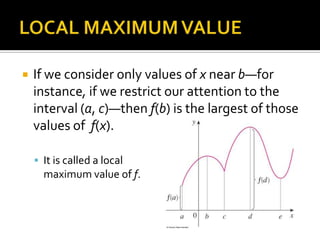
If we consider only values of x near b—for
instance, if we restrict our attention to the
interval (a, c)—then f(b) is the largest of those
values of f(x).
 It is called a local

maximum value of f.


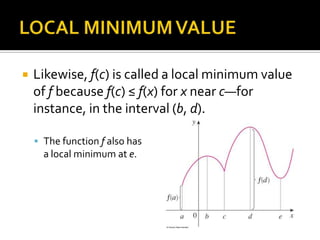
Likewise, f(c) is called a local minimum value
of f because f(c) ≤ f(x) for x near c—for
instance, in the interval (b, d).
 The function f also has

a local minimum at e.


In general, we have the following definition.



A function f has a local maximum (or relative
maximum) at c if f(c) ≥ f(x) when x is near c.
 This means that f(c) ≥ f(x) for all x in some

open interval containing c.
 Similarly, f has a local minimum at c if f(c) ≤ f(x)

when x is near c.






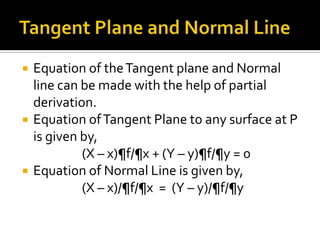
Equation of the Tangent plane and Normal
line can be made with the help of partial
derivation.
Equation of Tangent Plane to any surface at P
is given by,
(X – x)¶f/¶x + (Y – y)¶f/¶y = 0
Equation of Normal Line is given by,
(X – x)/¶f/¶x = (Y – y)/¶f/¶y


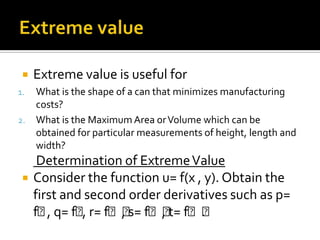
Extreme value is useful for

What is the shape of a can that minimizes manufacturing
costs?
2. What is the Maximum Area or Volume which can be
obtained for particular measurements of height, length and
width?
1.



Determination of Extreme Value
Consider the function u= f(x , y). Obtain the
first and second order derivatives such as p=
fᵪ q= fᵪr= fᵪᵪ fᵪᵪ fᵪᵪ
,
,
, s= , t= .



a.
I.
II.

Take p=0 and q=0 and solve. Simultaneously
obtain the Stationary Points.
(xᵪ , yᵪ),(x₁ , y₁),…. Be simultaneously points.
Consider the stationary points (xᵪ , yᵪ) and
obtain the value of r, s, t.
If rt-s²>0 then the extreme value exists.
If r<0, then value is Maximum.
If r>0, then value is Minimum.
b.
c.



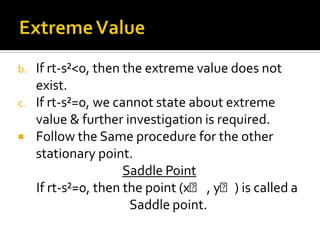
If rt-s²<0, then the extreme value does not
exist.
If rt-s²=0, we cannot state about extreme
value & further investigation is required.
Follow the Same procedure for the other
stationary point.
Saddle Point
If rt-s²=0, then the point (xᵪ , yᵪ) is called a
Saddle point.
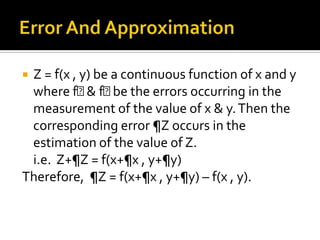
Z = f(x , y) be a continuous function of x and y
where fᵪ fᵪ the errors occurring in the
& be
measurement of the value of x & y. Then the
corresponding error ¶Z occurs in the
estimation of the value of Z.
i.e. Z+¶Z = f(x+¶x , y+¶y)
Therefore, ¶Z = f(x+¶x , y+¶y) – f(x , y).



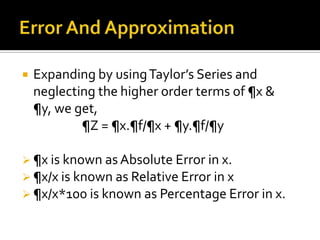
Expanding by using Taylor’s Series and
neglecting the higher order terms of ¶x &
¶y, we get,
¶Z = ¶x.¶f/¶x + ¶y.¶f/¶y

 ¶x is known as Absolute Error in x.
 ¶x/x is known as Relative Error in x
 ¶x/x*100 is known as Percentage Error in x.
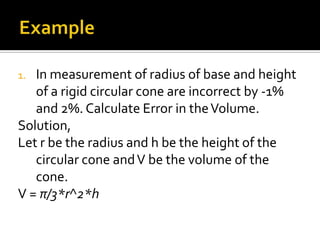
In measurement of radius of base and height
of a rigid circular cone are incorrect by -1%
and 2%. Calculate Error in the Volume.
Solution,
Let r be the radius and h be the height of the
circular cone and V be the volume of the
cone.
V = π/3*r^2*h
1.
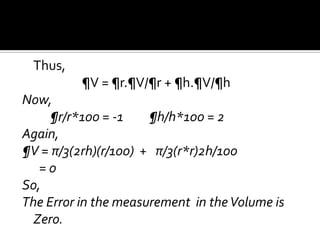
Thus,

¶V = ¶r.¶V/¶r + ¶h.¶V/¶h
Now,
¶r/r*100 = -1
¶h/h*100 = 2
Again,
¶V = π/3(2rh)(r/100) + π/3(r*r)2h/100
=0
So,
The Error in the measurement in the Volume is
Zero.
Application of partial derivatives with two variables

Application of partial derivatives with two variables

  • 1.
    By:Patel Dipen Patel Sagar PatelKirtan Vaghela Nayan Patel Darpan Patel Akshay
  • 2.
      Let Z= f(x,y)the derivative of Z with respect to x is, if it is, when x alone varies & y remains constant is called partial derivative of Z w.r.t x. It is denoted by ¶Z/¶x or fᵪ And fᵪ y. for
  • 3.
     Some of themost important applications of differential calculus are optimization problems.  In these, we are required to find the optimal (best) way of doing something.  These problems can be reduced to finding the maximum or minimum values of a function.
  • 4.
      A function fhas an absolute maximum (or global maximum) at c if f(c) ≥ f(x) for all x in D, where D is the domain of f. The number f(c) is called the maximum value of f on D.
  • 5.
     Similarly, f hasan absolute minimum at c if f(c) ≤ f(x) for all x in D and the number f(c) is called the minimum value of f on D.  The maximum and minimum values of f are called the extreme values of f.
  • 6.
     If we consideronly values of x near b—for instance, if we restrict our attention to the interval (a, c)—then f(b) is the largest of those values of f(x).  It is called a local maximum value of f.
  • 7.
     Likewise, f(c) iscalled a local minimum value of f because f(c) ≤ f(x) for x near c—for instance, in the interval (b, d).  The function f also has a local minimum at e.
  • 8.
     In general, wehave the following definition.  A function f has a local maximum (or relative maximum) at c if f(c) ≥ f(x) when x is near c.  This means that f(c) ≥ f(x) for all x in some open interval containing c.  Similarly, f has a local minimum at c if f(c) ≤ f(x) when x is near c.
  • 9.
       Equation of theTangent plane and Normal line can be made with the help of partial derivation. Equation of Tangent Plane to any surface at P is given by, (X – x)¶f/¶x + (Y – y)¶f/¶y = 0 Equation of Normal Line is given by, (X – x)/¶f/¶x = (Y – y)/¶f/¶y
  • 10.
     Extreme value isuseful for What is the shape of a can that minimizes manufacturing costs? 2. What is the Maximum Area or Volume which can be obtained for particular measurements of height, length and width? 1.  Determination of Extreme Value Consider the function u= f(x , y). Obtain the first and second order derivatives such as p= fᵪ q= fᵪr= fᵪᵪ fᵪᵪ fᵪᵪ , , , s= , t= .
  • 11.
      a. I. II. Take p=0 andq=0 and solve. Simultaneously obtain the Stationary Points. (xᵪ , yᵪ),(x₁ , y₁),…. Be simultaneously points. Consider the stationary points (xᵪ , yᵪ) and obtain the value of r, s, t. If rt-s²>0 then the extreme value exists. If r<0, then value is Maximum. If r>0, then value is Minimum.
  • 12.
    b. c.  If rt-s²<0, thenthe extreme value does not exist. If rt-s²=0, we cannot state about extreme value & further investigation is required. Follow the Same procedure for the other stationary point. Saddle Point If rt-s²=0, then the point (xᵪ , yᵪ) is called a Saddle point.
  • 13.
    Z = f(x, y) be a continuous function of x and y where fᵪ fᵪ the errors occurring in the & be measurement of the value of x & y. Then the corresponding error ¶Z occurs in the estimation of the value of Z. i.e. Z+¶Z = f(x+¶x , y+¶y) Therefore, ¶Z = f(x+¶x , y+¶y) – f(x , y). 
  • 14.
     Expanding by usingTaylor’s Series and neglecting the higher order terms of ¶x & ¶y, we get, ¶Z = ¶x.¶f/¶x + ¶y.¶f/¶y  ¶x is known as Absolute Error in x.  ¶x/x is known as Relative Error in x  ¶x/x*100 is known as Percentage Error in x.
  • 15.
    In measurement ofradius of base and height of a rigid circular cone are incorrect by -1% and 2%. Calculate Error in the Volume. Solution, Let r be the radius and h be the height of the circular cone and V be the volume of the cone. V = π/3*r^2*h 1.
  • 16.
    Thus, ¶V = ¶r.¶V/¶r+ ¶h.¶V/¶h Now, ¶r/r*100 = -1 ¶h/h*100 = 2 Again, ¶V = π/3(2rh)(r/100) + π/3(r*r)2h/100 =0 So, The Error in the measurement in the Volume is Zero.