Partial Derivatives
PARTIAL DERIVATIVES
 Goals
 Define partial derivatives
 Learn notation and rules for calculating partial derivatives
 Interpret partial derivatives
 Discuss higher derivatives
 Apply to partial differential equations
http://alltypeim.blogspot.in/
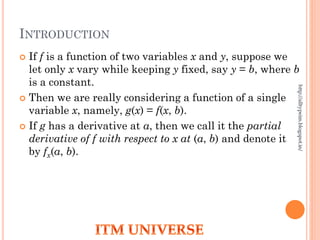
INTRODUCTION
 If f is a function of two variables x and y, suppose we
let only x vary while keeping y fixed, say y = b, where b
is a constant.
 Then we are really considering a function of a single
variable x, namely, g(x) = f(x, b).
 If g has a derivative at a, then we call it the partial
derivative of f with respect to x at (a, b) and denote it
by fx(a, b).
http://alltypeim.blogspot.in/
INTRODUCTION (CONT’D)
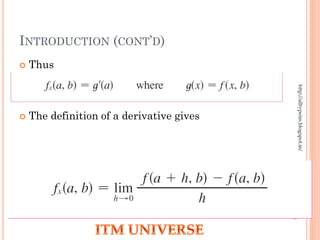
 Thus
 The definition of a derivative gives
http://alltypeim.blogspot.in/
INTRODUCTION (CONT’D)
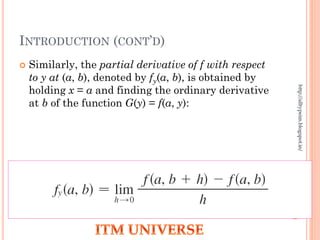
 Similarly, the partial derivative of f with respect
to y at (a, b), denoted by fy(a, b), is obtained by
holding x = a and finding the ordinary derivative
at b of the function G(y) = f(a, y):
http://alltypeim.blogspot.in/
DEFINITION
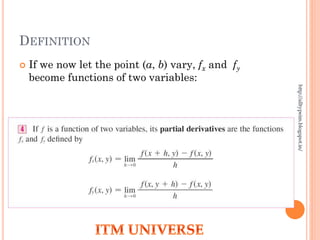
 If we now let the point (a, b) vary, fx and fy
become functions of two variables:
http://alltypeim.blogspot.in/
NOTATIONS
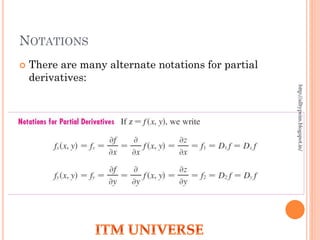
 There are many alternate notations for partial
derivatives:
http://alltypeim.blogspot.in/
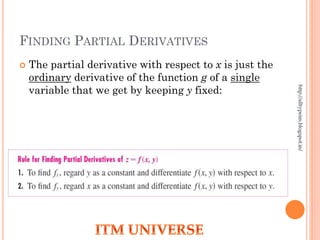
FINDING PARTIAL DERIVATIVES
 The partial derivative with respect to x is just the
ordinary derivative of the function g of a single
variable that we get by keeping y fixed:
http://alltypeim.blogspot.in/
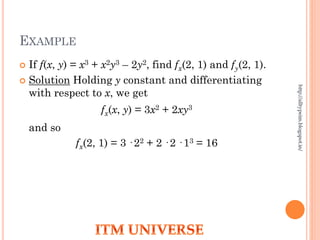
EXAMPLE
 If f(x, y) = x3 + x2y3 – 2y2, find fx(2, 1) and fy(2, 1).
 Solution Holding y constant and differentiating
with respect to x, we get
fx(x, y) = 3x2 + 2xy3
and so
fx(2, 1) = 3 · 22 + 2 · 2 · 13 = 16
http://alltypeim.blogspot.in/
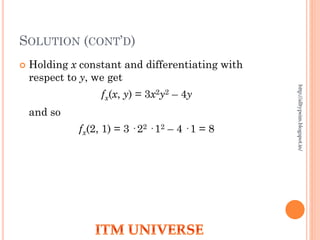
SOLUTION (CONT’D)
 Holding x constant and differentiating with
respect to y, we get
fx(x, y) = 3x2y2 – 4y
and so
fx(2, 1) = 3 · 22 · 12 – 4 · 1 = 8
http://alltypeim.blogspot.in/
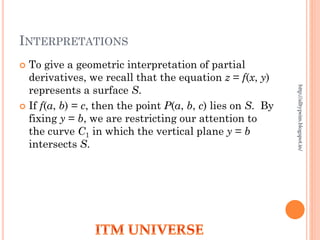
INTERPRETATIONS
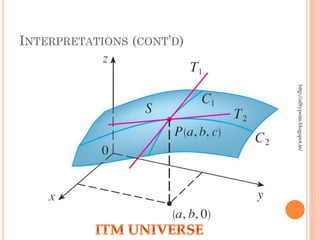
 To give a geometric interpretation of partial
derivatives, we recall that the equation z = f(x, y)
represents a surface S.
 If f(a, b) = c, then the point P(a, b, c) lies on S. By
fixing y = b, we are restricting our attention to
the curve C1 in which the vertical plane y = b
intersects S.
http://alltypeim.blogspot.in/
INTERPRETATIONS (CONT’D)
 Likewise, the vertical plane x = a intersects S in
a curve C2.
 Both of the curves C1 and C2 pass through the
point P.
 This is illustrated on the next slide:
http://alltypeim.blogspot.in/
INTERPRETATIONS (CONT’D)
http://alltypeim.blogspot.in/
INTERPRETATIONS (CONT’D)
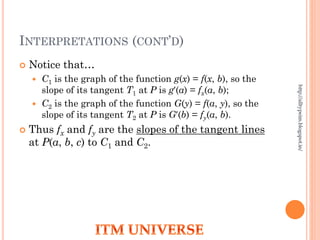
 Notice that…
 C1 is the graph of the function g(x) = f(x, b), so the
slope of its tangent T1 at P is g′(a) = fx(a, b);
 C2 is the graph of the function G(y) = f(a, y), so the
slope of its tangent T2 at P is G′(b) = fy(a, b).
 Thus fx and fy are the slopes of the tangent lines
at P(a, b, c) to C1 and C2.
http://alltypeim.blogspot.in/
INTERPRETATIONS (CONT’D)
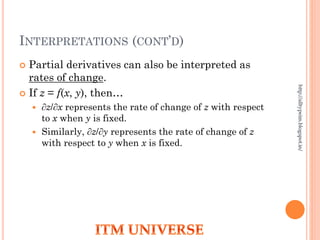
 Partial derivatives can also be interpreted as
rates of change.
 If z = f(x, y), then…
 ∂z/∂x represents the rate of change of z with respect
to x when y is fixed.
 Similarly, ∂z/∂y represents the rate of change of z
with respect to y when x is fixed.
http://alltypeim.blogspot.in/
EXAMPLE
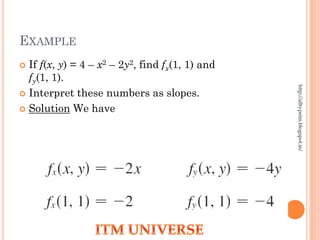
 If f(x, y) = 4 – x2 – 2y2, find fx(1, 1) and
fy(1, 1).
 Interpret these numbers as slopes.
 Solution We have
http://alltypeim.blogspot.in/
SOLUTION (CONT’D)
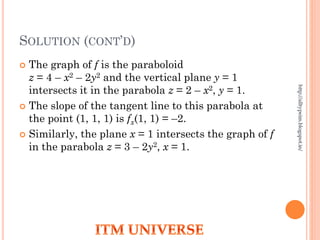
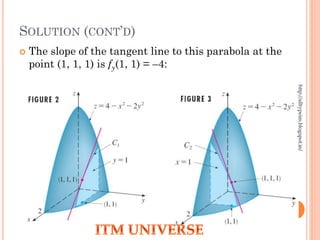
 The graph of f is the paraboloid
z = 4 – x2 – 2y2 and the vertical plane y = 1
intersects it in the parabola z = 2 – x2, y = 1.
 The slope of the tangent line to this parabola at
the point (1, 1, 1) is fx(1, 1) = –2.
 Similarly, the plane x = 1 intersects the graph of f
in the parabola z = 3 – 2y2, x = 1.
http://alltypeim.blogspot.in/
SOLUTION (CONT’D)
 The slope of the tangent line to this parabola at the
point (1, 1, 1) is fy(1, 1) = –4:
http://alltypeim.blogspot.in/
EXAMPLE
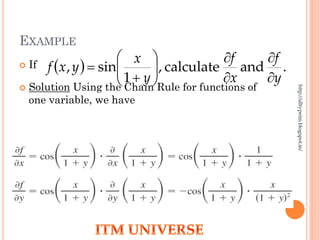
 If
 Solution Using the Chain Rule for functions of
one variable, we have
  .andcalculate,
1
sin,
y
f
x
f
y
x
yxf












http://alltypeim.blogspot.in/
EXAMPLE
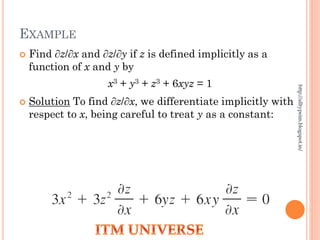
 Find ∂z/∂x and ∂z/∂y if z is defined implicitly as a
function of x and y by
x3 + y3 + z3 + 6xyz = 1
 Solution To find ∂z/∂x, we differentiate implicitly with
respect to x, being careful to treat y as a constant:
http://alltypeim.blogspot.in/
SOLUTION (CONT’D)
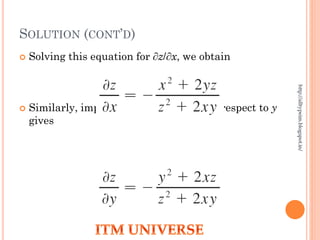
 Solving this equation for ∂z/∂x, we obtain
 Similarly, implicit differentiation with respect to y
gives
http://alltypeim.blogspot.in/
MORE THAN TWO VARIABLES
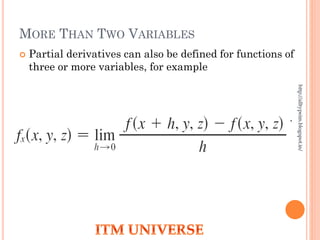
 Partial derivatives can also be defined for functions of
three or more variables, for example
 If w = f(x, y, z), then fx = ∂w/∂x is the rate of change of
w with respect to x when y and z are held fixed.
http://alltypeim.blogspot.in/
MORE THAN TWO VARIABLES (CONT’D)
 But we can’t interpret fx geometrically because the
graph of f lies in four-dimensional space.
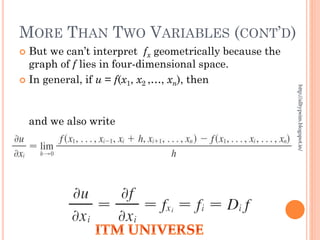
 In general, if u = f(x1, x2 ,…, xn), then
and we also write
http://alltypeim.blogspot.in/
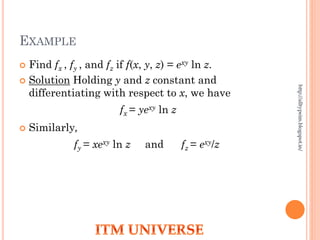
EXAMPLE
 Find fx , fy , and fz if f(x, y, z) = exy ln z.
 Solution Holding y and z constant and
differentiating with respect to x, we have
fx = yexy ln z
 Similarly,
fy = xexy ln z and fz = exy/z
http://alltypeim.blogspot.in/
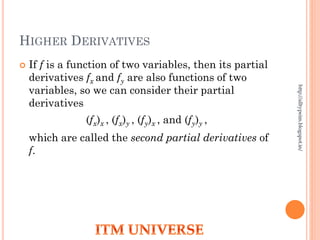
HIGHER DERIVATIVES
 If f is a function of two variables, then its partial
derivatives fx and fy are also functions of two
variables, so we can consider their partial
derivatives
(fx)x , (fx)y , (fy)x , and (fy)y ,
which are called the second partial derivatives of
f.
http://alltypeim.blogspot.in/
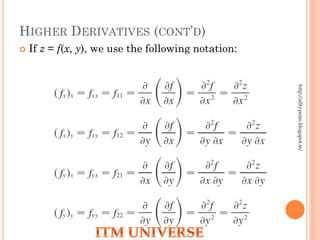
HIGHER DERIVATIVES (CONT’D)
 If z = f(x, y), we use the following notation:
http://alltypeim.blogspot.in/
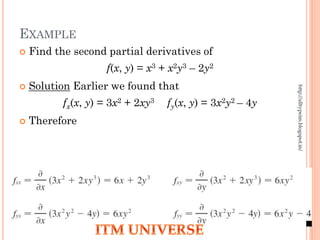
EXAMPLE
 Find the second partial derivatives of
f(x, y) = x3 + x2y3 – 2y2
 Solution Earlier we found that
fx(x, y) = 3x2 + 2xy3 fy(x, y) = 3x2y2 – 4y
 Therefore
http://alltypeim.blogspot.in/
MIXED PARTIAL DERIVATIVES
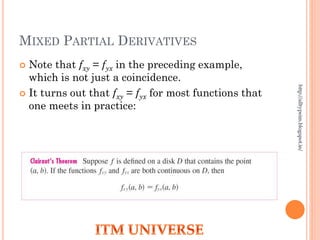
 Note that fxy = fyx in the preceding example,
which is not just a coincidence.
 It turns out that fxy = fyx for most functions that
one meets in practice:
http://alltypeim.blogspot.in/
MIXED PARTIAL DERIVATIVES (CONT’D)
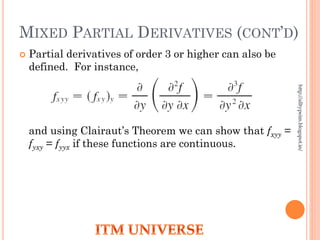
 Partial derivatives of order 3 or higher can also be
defined. For instance,
and using Clairaut’s Theorem we can show that fxyy =
fyxy = fyyx if these functions are continuous.
http://alltypeim.blogspot.in/
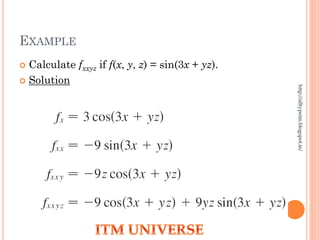
EXAMPLE
 Calculate fxxyz if f(x, y, z) = sin(3x + yz).
 Solution
http://alltypeim.blogspot.in/
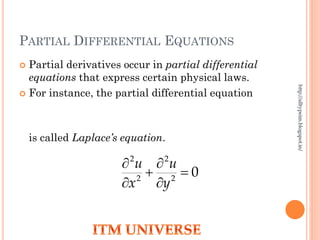
PARTIAL DIFFERENTIAL EQUATIONS
 Partial derivatives occur in partial differential
equations that express certain physical laws.
 For instance, the partial differential equation
is called Laplace’s equation.
02
2
2
2






y
u
x
u
http://alltypeim.blogspot.in/
PARTIAL DIFFERENTIAL EQNS.
(CONT’D)
 Solutions of this equation are called harmonic
functions and play a role in problems of heat
conduction, fluid flow, and electric potential.
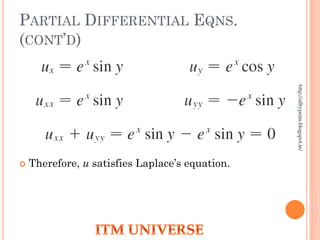
 For example, we can show that the function u(x,
y) = ex sin y is a solution of Laplace’s equation:
http://alltypeim.blogspot.in/
PARTIAL DIFFERENTIAL EQNS.
(CONT’D)
 Therefore, u satisfies Laplace’s equation.
http://alltypeim.blogspot.in/
PARTIAL DIFFERENTIAL EQNS.
(CONT’D)
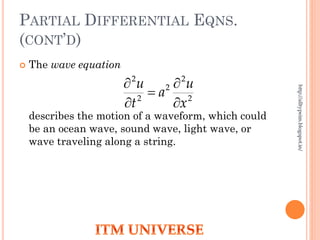
 The wave equation
describes the motion of a waveform, which could
be an ocean wave, sound wave, light wave, or
wave traveling along a string.
2
2
2
2
2
x
u
a
t
u





http://alltypeim.blogspot.in/
PARTIAL DIFFERENTIAL EQNS.
(CONT’D)
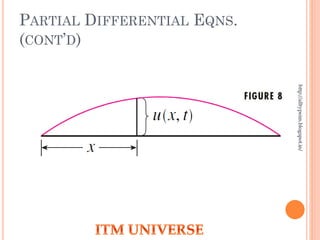
 For instance, if u(x, t) represents the
disaplacement of a violin string at time t and at a
distance x from one end of the string, then u(x, t)
satisfies the wave equation. (See the next slide.)
 Here the constant a depends on the density of the
string and on the tension in the string.
http://alltypeim.blogspot.in/
PARTIAL DIFFERENTIAL EQNS.
(CONT’D)
http://alltypeim.blogspot.in/
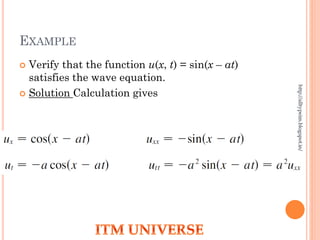
EXAMPLE
 Verify that the function u(x, t) = sin(x – at)
satisfies the wave equation.
 Solution Calculation gives
 So u satisfies the wave equation.
http://alltypeim.blogspot.in/
REVIEW
 Definition of partial derivative
 Notations for partial derivatives
 Finding partial derivatives
 Interpretations of partial derivatives
 Function of more than two variables
 Higher derivatives
 Partial differential equations
http://alltypeim.blogspot.in/

partialderivatives

  • 1.
  • 2.
    PARTIAL DERIVATIVES  Goals Define partial derivatives  Learn notation and rules for calculating partial derivatives  Interpret partial derivatives  Discuss higher derivatives  Apply to partial differential equations http://alltypeim.blogspot.in/
  • 3.
    INTRODUCTION  If fis a function of two variables x and y, suppose we let only x vary while keeping y fixed, say y = b, where b is a constant.  Then we are really considering a function of a single variable x, namely, g(x) = f(x, b).  If g has a derivative at a, then we call it the partial derivative of f with respect to x at (a, b) and denote it by fx(a, b). http://alltypeim.blogspot.in/
  • 4.
    INTRODUCTION (CONT’D)  Thus The definition of a derivative gives http://alltypeim.blogspot.in/
  • 5.
    INTRODUCTION (CONT’D)  Similarly,the partial derivative of f with respect to y at (a, b), denoted by fy(a, b), is obtained by holding x = a and finding the ordinary derivative at b of the function G(y) = f(a, y): http://alltypeim.blogspot.in/
  • 6.
    DEFINITION  If wenow let the point (a, b) vary, fx and fy become functions of two variables: http://alltypeim.blogspot.in/
  • 7.
    NOTATIONS  There aremany alternate notations for partial derivatives: http://alltypeim.blogspot.in/
  • 8.
    FINDING PARTIAL DERIVATIVES The partial derivative with respect to x is just the ordinary derivative of the function g of a single variable that we get by keeping y fixed: http://alltypeim.blogspot.in/
  • 9.
    EXAMPLE  If f(x,y) = x3 + x2y3 – 2y2, find fx(2, 1) and fy(2, 1).  Solution Holding y constant and differentiating with respect to x, we get fx(x, y) = 3x2 + 2xy3 and so fx(2, 1) = 3 · 22 + 2 · 2 · 13 = 16 http://alltypeim.blogspot.in/
  • 10.
    SOLUTION (CONT’D)  Holdingx constant and differentiating with respect to y, we get fx(x, y) = 3x2y2 – 4y and so fx(2, 1) = 3 · 22 · 12 – 4 · 1 = 8 http://alltypeim.blogspot.in/
  • 11.
    INTERPRETATIONS  To givea geometric interpretation of partial derivatives, we recall that the equation z = f(x, y) represents a surface S.  If f(a, b) = c, then the point P(a, b, c) lies on S. By fixing y = b, we are restricting our attention to the curve C1 in which the vertical plane y = b intersects S. http://alltypeim.blogspot.in/
  • 12.
    INTERPRETATIONS (CONT’D)  Likewise,the vertical plane x = a intersects S in a curve C2.  Both of the curves C1 and C2 pass through the point P.  This is illustrated on the next slide: http://alltypeim.blogspot.in/
  • 13.
  • 14.
    INTERPRETATIONS (CONT’D)  Noticethat…  C1 is the graph of the function g(x) = f(x, b), so the slope of its tangent T1 at P is g′(a) = fx(a, b);  C2 is the graph of the function G(y) = f(a, y), so the slope of its tangent T2 at P is G′(b) = fy(a, b).  Thus fx and fy are the slopes of the tangent lines at P(a, b, c) to C1 and C2. http://alltypeim.blogspot.in/
  • 15.
    INTERPRETATIONS (CONT’D)  Partialderivatives can also be interpreted as rates of change.  If z = f(x, y), then…  ∂z/∂x represents the rate of change of z with respect to x when y is fixed.  Similarly, ∂z/∂y represents the rate of change of z with respect to y when x is fixed. http://alltypeim.blogspot.in/
  • 16.
    EXAMPLE  If f(x,y) = 4 – x2 – 2y2, find fx(1, 1) and fy(1, 1).  Interpret these numbers as slopes.  Solution We have http://alltypeim.blogspot.in/
  • 17.
    SOLUTION (CONT’D)  Thegraph of f is the paraboloid z = 4 – x2 – 2y2 and the vertical plane y = 1 intersects it in the parabola z = 2 – x2, y = 1.  The slope of the tangent line to this parabola at the point (1, 1, 1) is fx(1, 1) = –2.  Similarly, the plane x = 1 intersects the graph of f in the parabola z = 3 – 2y2, x = 1. http://alltypeim.blogspot.in/
  • 18.
    SOLUTION (CONT’D)  Theslope of the tangent line to this parabola at the point (1, 1, 1) is fy(1, 1) = –4: http://alltypeim.blogspot.in/
  • 19.
    EXAMPLE  If  SolutionUsing the Chain Rule for functions of one variable, we have   .andcalculate, 1 sin, y f x f y x yxf             http://alltypeim.blogspot.in/
  • 20.
    EXAMPLE  Find ∂z/∂xand ∂z/∂y if z is defined implicitly as a function of x and y by x3 + y3 + z3 + 6xyz = 1  Solution To find ∂z/∂x, we differentiate implicitly with respect to x, being careful to treat y as a constant: http://alltypeim.blogspot.in/
  • 21.
    SOLUTION (CONT’D)  Solvingthis equation for ∂z/∂x, we obtain  Similarly, implicit differentiation with respect to y gives http://alltypeim.blogspot.in/
  • 22.
    MORE THAN TWOVARIABLES  Partial derivatives can also be defined for functions of three or more variables, for example  If w = f(x, y, z), then fx = ∂w/∂x is the rate of change of w with respect to x when y and z are held fixed. http://alltypeim.blogspot.in/
  • 23.
    MORE THAN TWOVARIABLES (CONT’D)  But we can’t interpret fx geometrically because the graph of f lies in four-dimensional space.  In general, if u = f(x1, x2 ,…, xn), then and we also write http://alltypeim.blogspot.in/
  • 24.
    EXAMPLE  Find fx, fy , and fz if f(x, y, z) = exy ln z.  Solution Holding y and z constant and differentiating with respect to x, we have fx = yexy ln z  Similarly, fy = xexy ln z and fz = exy/z http://alltypeim.blogspot.in/
  • 25.
    HIGHER DERIVATIVES  Iff is a function of two variables, then its partial derivatives fx and fy are also functions of two variables, so we can consider their partial derivatives (fx)x , (fx)y , (fy)x , and (fy)y , which are called the second partial derivatives of f. http://alltypeim.blogspot.in/
  • 26.
    HIGHER DERIVATIVES (CONT’D) If z = f(x, y), we use the following notation: http://alltypeim.blogspot.in/
  • 27.
    EXAMPLE  Find thesecond partial derivatives of f(x, y) = x3 + x2y3 – 2y2  Solution Earlier we found that fx(x, y) = 3x2 + 2xy3 fy(x, y) = 3x2y2 – 4y  Therefore http://alltypeim.blogspot.in/
  • 28.
    MIXED PARTIAL DERIVATIVES Note that fxy = fyx in the preceding example, which is not just a coincidence.  It turns out that fxy = fyx for most functions that one meets in practice: http://alltypeim.blogspot.in/
  • 29.
    MIXED PARTIAL DERIVATIVES(CONT’D)  Partial derivatives of order 3 or higher can also be defined. For instance, and using Clairaut’s Theorem we can show that fxyy = fyxy = fyyx if these functions are continuous. http://alltypeim.blogspot.in/
  • 30.
    EXAMPLE  Calculate fxxyzif f(x, y, z) = sin(3x + yz).  Solution http://alltypeim.blogspot.in/
  • 31.
    PARTIAL DIFFERENTIAL EQUATIONS Partial derivatives occur in partial differential equations that express certain physical laws.  For instance, the partial differential equation is called Laplace’s equation. 02 2 2 2       y u x u http://alltypeim.blogspot.in/
  • 32.
    PARTIAL DIFFERENTIAL EQNS. (CONT’D) Solutions of this equation are called harmonic functions and play a role in problems of heat conduction, fluid flow, and electric potential.  For example, we can show that the function u(x, y) = ex sin y is a solution of Laplace’s equation: http://alltypeim.blogspot.in/
  • 33.
    PARTIAL DIFFERENTIAL EQNS. (CONT’D) Therefore, u satisfies Laplace’s equation. http://alltypeim.blogspot.in/
  • 34.
    PARTIAL DIFFERENTIAL EQNS. (CONT’D) The wave equation describes the motion of a waveform, which could be an ocean wave, sound wave, light wave, or wave traveling along a string. 2 2 2 2 2 x u a t u      http://alltypeim.blogspot.in/
  • 35.
    PARTIAL DIFFERENTIAL EQNS. (CONT’D) For instance, if u(x, t) represents the disaplacement of a violin string at time t and at a distance x from one end of the string, then u(x, t) satisfies the wave equation. (See the next slide.)  Here the constant a depends on the density of the string and on the tension in the string. http://alltypeim.blogspot.in/
  • 36.
  • 37.
    EXAMPLE  Verify thatthe function u(x, t) = sin(x – at) satisfies the wave equation.  Solution Calculation gives  So u satisfies the wave equation. http://alltypeim.blogspot.in/
  • 38.
    REVIEW  Definition ofpartial derivative  Notations for partial derivatives  Finding partial derivatives  Interpretations of partial derivatives  Function of more than two variables  Higher derivatives  Partial differential equations http://alltypeim.blogspot.in/