Calculus
Concepts
 Properties of real numbers, exponents, and radicals
 Factoring
 Finding distance and midpoint
 Symmetry
 Properties of even and odd functions
 Slope and equation of lines
 Transformations of graphs
 Quadratic formula and equations
 Complex numbers
 Conic sections (circles, ellipses, hyperbolas, parabolas)
 Matrices
 Systems of equations and inequalities
 Exponential and logarithmic functions
 Trigonometric functions and inverse trigonometric functions
 Rational functions and functions involving radicals
 Asymptotes: horizontal, vertical, slant
 Graphing techniques for rational functions
 Vectors, parametric equations, and polar coordinates
 Components of a vector:
x-component = rcos(theta)
y-component = rsin(theta)
 Rectangular <--> polar conversion equations
x = rcos(theta)
y = rsin(theta)
r2 = x2 + y2
tan(theta) = y/x
 Sequences, series, and probability
 Sigma notation
 Arithmetic sequences
 Geometric sequences
 Permutations & combinations
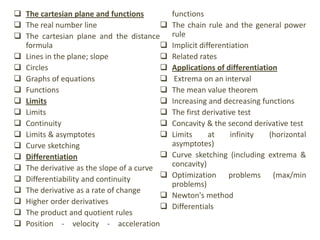
 The cartesian plane and functions
 The real number line
 The cartesian plane and the distance
formula
 Lines in the plane; slope
 Circles
 Graphs of equations
 Functions
 Limits
 Limits
 Continuity
 Limits & asymptotes
 Curve sketching
 Differentiation
 The derivative as the slope of a curve
 Differentiability and continuity
 The derivative as a rate of change
 Higher order derivatives
 The product and quotient rules
 Position - velocity - acceleration
functions
 The chain rule and the general power
rule
 Implicit differentiation
 Related rates
 Applications of differentiation
 Extrema on an interval
 The mean value theorem
 Increasing and decreasing functions
 The first derivative test
 Concavity & the second derivative test
 Limits at infinity (horizontal
asymptotes)
 Curve sketching (including extrema &
concavity)
 Optimization problems (max/min
problems)
 Newton's method
 Differentials
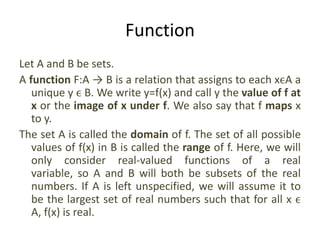
Function
Let A and B be sets.
A function F:A → B is a relation that assigns to each xϵA a
unique y ϵ B. We write y=f(x) and call y the value of f at
x or the image of x under f. We also say that f maps x
to y.
The set A is called the domain of f. The set of all possible
values of f(x) in B is called the range of f. Here, we will
only consider real-valued functions of a real
variable, so A and B will both be subsets of the real
numbers. If A is left unspecified, we will assume it to
be the largest set of real numbers such that for all x ϵ
A, f(x) is real.
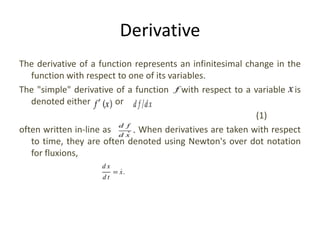
Derivative
The derivative of a function represents an infinitesimal change in the
function with respect to one of its variables.
The "simple" derivative of a function with respect to a variable is
denoted either or
(1)
often written in-line as . When derivatives are taken with respect
to time, they are often denoted using Newton's over dot notation
for fluxions,
Differentiation
Process of finding derivatives is
called differentiation.
Differentiation Rules
 d/dx c = 0, c constant
 d/dx cf(x) = cf'(x), c constant
 d/dx [f(x) ± g(x)] = f'(x) ± g'(x)
 d/dx [f(x) * g(x)] = f(x) * g'(x) + g(x) *
f'(x) (product rule)
 d/dx [f(x) / g(x)] = (g(x)f'(x) -
f(x)g'(x))/([g(x)]2) (quotient rule)
 d/dx f[g(x)] = f'[g(x)] * g'(x)
OR
for u = g(x),
 d/dx f(u) = f'(u) * u' = f'(u) * g'(x)
OR
dy/dx = dy/du * du/dx (these are all
chain rule)
 GENERAL
 d/dx un = nun-1 * u‘
 d/dx lnu = u'/u
 d/dx eu = eu * u‘
 d/dx sinu = cosu * u‘
 d/dx cosu = -sinu * u‘
 d/dx tanu = sec2u * u‘
 d/dx arcsinu = u'/(SQRT(1 - u2))
 d/dx arctanu = u'/(1 + u2)
 d/dx cotu = -csc2u * u‘
 d/dx secu = secu tanu * u‘
 d/dx cscu = -cscu cotu * u‘
 d/dx au * u' ln a
 d/dx logau = u'/(u ln a)
 SPECIFIC
 d/dx xn = nxn – 1
 d/dx lnx = 1/x
 d/dx ex = ex
 d/dx sinx = cosx
 d/dx cosx = -sinx
 d/dx tanx = sec2
 d/dx arcsinx = 1/(SQRT(1 - x2))
 d/dx arctanx = 1/(1 + x2)
 d/dx cotx = -csc2x
 d/dx secx = secx tanx
 d/dx cscx = -cscx cotx
 d/dx ax = ax ln a
 d/dx logax = 1/(x ln a)
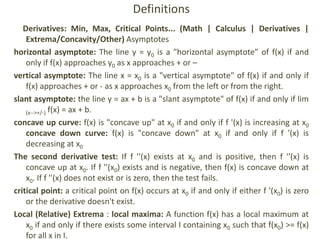
Definitions
Derivatives: Min, Max, Critical Points... (Math | Calculus | Derivatives |
Extrema/Concavity/Other) Asymptotes
horizontal asymptote: The line y = y0 is a "horizontal asymptote" of f(x) if and
only if f(x) approaches y0 as x approaches + or –
vertical asymptote: The line x = x0 is a "vertical asymptote" of f(x) if and only if
f(x) approaches + or - as x approaches x0 from the left or from the right.
slant asymptote: the line y = ax + b is a "slant asymptote" of f(x) if and only if lim
(x-->+/-) f(x) = ax + b.
concave up curve: f(x) is "concave up" at x0 if and only if f '(x) is increasing at x0
concave down curve: f(x) is "concave down" at x0 if and only if f '(x) is
decreasing at x0
The second derivative test: If f ''(x) exists at x0 and is positive, then f ''(x) is
concave up at x0. If f ''(x0) exists and is negative, then f(x) is concave down at
x0. If f ''(x) does not exist or is zero, then the test fails.
critical point: a critical point on f(x) occurs at x0 if and only if either f '(x0) is zero
or the derivative doesn't exist.
Local (Relative) Extrema : local maxima: A function f(x) has a local maximum at
x0 if and only if there exists some interval I containing x0 such that f(x0) >= f(x)
for all x in I.
Definition of a local minima: A function f(x) has a local minimum at x0 if
and only if there exists some interval I containing x0 such that f(x0) <= f(x)
for all x in I.
Occurrence of local extrema: All local extrema occur at critical
points, but not all critical points occur at local extrema.
The first derivative test for local extrema: If f(x) is increasing (f '(x) > 0)
for all x in some interval (a, x0] and f(x) is decreasing (f '(x) < 0) for all x in
some interval [x0, b), then f(x) has a local maximum at x0. If f(x) is
decreasing (f '(x) < 0) for all x in some interval (a, x0] and f(x) is increasing
(f '(x) > 0) for all x in some interval [x0, b), then f(x) has a local minimum
at x0.
The second derivative test for local extrema: If f '(x0) = 0 and f ''(x0) >
0, then f(x) has a local minimum at x0. If f '(x0) = 0 and f ''(x0) < 0, then f(x)
has a local maximum at x0.
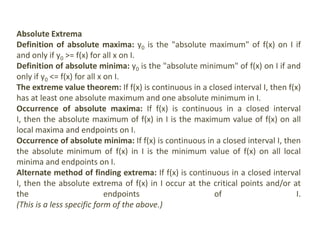
Absolute Extrema
Definition of absolute maxima: y0 is the "absolute maximum" of f(x) on I if
and only if y0 >= f(x) for all x on I.
Definition of absolute minima: y0 is the "absolute minimum" of f(x) on I if and
only if y0 <= f(x) for all x on I.
The extreme value theorem: If f(x) is continuous in a closed interval I, then f(x)
has at least one absolute maximum and one absolute minimum in I.
Occurrence of absolute maxima: If f(x) is continuous in a closed interval
I, then the absolute maximum of f(x) in I is the maximum value of f(x) on all
local maxima and endpoints on I.
Occurrence of absolute minima: If f(x) is continuous in a closed interval I, then
the absolute minimum of f(x) in I is the minimum value of f(x) on all local
minima and endpoints on I.
Alternate method of finding extrema: If f(x) is continuous in a closed interval
I, then the absolute extrema of f(x) in I occur at the critical points and/or at
the endpoints of I.
(This is a less specific form of the above.)
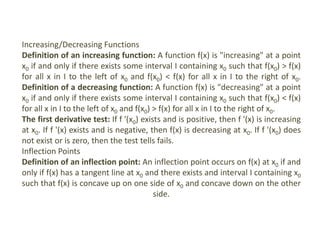
Increasing/Decreasing Functions
Definition of an increasing function: A function f(x) is "increasing" at a point
x0 if and only if there exists some interval I containing x0 such that f(x0) > f(x)
for all x in I to the left of x0 and f(x0) < f(x) for all x in I to the right of x0.
Definition of a decreasing function: A function f(x) is "decreasing" at a point
x0 if and only if there exists some interval I containing x0 such that f(x0) < f(x)
for all x in I to the left of x0 and f(x0) > f(x) for all x in I to the right of x0.
The first derivative test: If f '(x0) exists and is positive, then f '(x) is increasing
at x0. If f '(x) exists and is negative, then f(x) is decreasing at x0. If f '(x0) does
not exist or is zero, then the test tells fails.
Inflection Points
Definition of an inflection point: An inflection point occurs on f(x) at x0 if and
only if f(x) has a tangent line at x0 and there exists and interval I containing x0
such that f(x) is concave up on one side of x0 and concave down on the other
side.

0.5.derivatives

  • 1.
  • 2.
    Concepts  Properties ofreal numbers, exponents, and radicals  Factoring  Finding distance and midpoint  Symmetry  Properties of even and odd functions  Slope and equation of lines  Transformations of graphs  Quadratic formula and equations  Complex numbers  Conic sections (circles, ellipses, hyperbolas, parabolas)  Matrices  Systems of equations and inequalities  Exponential and logarithmic functions  Trigonometric functions and inverse trigonometric functions
  • 3.
     Rational functionsand functions involving radicals  Asymptotes: horizontal, vertical, slant  Graphing techniques for rational functions  Vectors, parametric equations, and polar coordinates  Components of a vector: x-component = rcos(theta) y-component = rsin(theta)  Rectangular <--> polar conversion equations x = rcos(theta) y = rsin(theta) r2 = x2 + y2 tan(theta) = y/x  Sequences, series, and probability  Sigma notation  Arithmetic sequences  Geometric sequences  Permutations & combinations
  • 4.
     The cartesianplane and functions  The real number line  The cartesian plane and the distance formula  Lines in the plane; slope  Circles  Graphs of equations  Functions  Limits  Limits  Continuity  Limits & asymptotes  Curve sketching  Differentiation  The derivative as the slope of a curve  Differentiability and continuity  The derivative as a rate of change  Higher order derivatives  The product and quotient rules  Position - velocity - acceleration functions  The chain rule and the general power rule  Implicit differentiation  Related rates  Applications of differentiation  Extrema on an interval  The mean value theorem  Increasing and decreasing functions  The first derivative test  Concavity & the second derivative test  Limits at infinity (horizontal asymptotes)  Curve sketching (including extrema & concavity)  Optimization problems (max/min problems)  Newton's method  Differentials
  • 5.
    Function Let A andB be sets. A function F:A → B is a relation that assigns to each xϵA a unique y ϵ B. We write y=f(x) and call y the value of f at x or the image of x under f. We also say that f maps x to y. The set A is called the domain of f. The set of all possible values of f(x) in B is called the range of f. Here, we will only consider real-valued functions of a real variable, so A and B will both be subsets of the real numbers. If A is left unspecified, we will assume it to be the largest set of real numbers such that for all x ϵ A, f(x) is real.
  • 6.
    Derivative The derivative ofa function represents an infinitesimal change in the function with respect to one of its variables. The "simple" derivative of a function with respect to a variable is denoted either or (1) often written in-line as . When derivatives are taken with respect to time, they are often denoted using Newton's over dot notation for fluxions,
  • 7.
    Differentiation Process of findingderivatives is called differentiation. Differentiation Rules
  • 8.
     d/dx c= 0, c constant  d/dx cf(x) = cf'(x), c constant  d/dx [f(x) ± g(x)] = f'(x) ± g'(x)  d/dx [f(x) * g(x)] = f(x) * g'(x) + g(x) * f'(x) (product rule)  d/dx [f(x) / g(x)] = (g(x)f'(x) - f(x)g'(x))/([g(x)]2) (quotient rule)  d/dx f[g(x)] = f'[g(x)] * g'(x) OR for u = g(x),  d/dx f(u) = f'(u) * u' = f'(u) * g'(x) OR dy/dx = dy/du * du/dx (these are all chain rule)  GENERAL  d/dx un = nun-1 * u‘  d/dx lnu = u'/u  d/dx eu = eu * u‘  d/dx sinu = cosu * u‘  d/dx cosu = -sinu * u‘  d/dx tanu = sec2u * u‘  d/dx arcsinu = u'/(SQRT(1 - u2))  d/dx arctanu = u'/(1 + u2)  d/dx cotu = -csc2u * u‘  d/dx secu = secu tanu * u‘  d/dx cscu = -cscu cotu * u‘  d/dx au * u' ln a  d/dx logau = u'/(u ln a)  SPECIFIC  d/dx xn = nxn – 1  d/dx lnx = 1/x  d/dx ex = ex  d/dx sinx = cosx  d/dx cosx = -sinx  d/dx tanx = sec2  d/dx arcsinx = 1/(SQRT(1 - x2))  d/dx arctanx = 1/(1 + x2)  d/dx cotx = -csc2x  d/dx secx = secx tanx  d/dx cscx = -cscx cotx  d/dx ax = ax ln a  d/dx logax = 1/(x ln a)
  • 9.
    Definitions Derivatives: Min, Max,Critical Points... (Math | Calculus | Derivatives | Extrema/Concavity/Other) Asymptotes horizontal asymptote: The line y = y0 is a "horizontal asymptote" of f(x) if and only if f(x) approaches y0 as x approaches + or – vertical asymptote: The line x = x0 is a "vertical asymptote" of f(x) if and only if f(x) approaches + or - as x approaches x0 from the left or from the right. slant asymptote: the line y = ax + b is a "slant asymptote" of f(x) if and only if lim (x-->+/-) f(x) = ax + b. concave up curve: f(x) is "concave up" at x0 if and only if f '(x) is increasing at x0 concave down curve: f(x) is "concave down" at x0 if and only if f '(x) is decreasing at x0 The second derivative test: If f ''(x) exists at x0 and is positive, then f ''(x) is concave up at x0. If f ''(x0) exists and is negative, then f(x) is concave down at x0. If f ''(x) does not exist or is zero, then the test fails. critical point: a critical point on f(x) occurs at x0 if and only if either f '(x0) is zero or the derivative doesn't exist. Local (Relative) Extrema : local maxima: A function f(x) has a local maximum at x0 if and only if there exists some interval I containing x0 such that f(x0) >= f(x) for all x in I.
  • 10.
    Definition of alocal minima: A function f(x) has a local minimum at x0 if and only if there exists some interval I containing x0 such that f(x0) <= f(x) for all x in I. Occurrence of local extrema: All local extrema occur at critical points, but not all critical points occur at local extrema. The first derivative test for local extrema: If f(x) is increasing (f '(x) > 0) for all x in some interval (a, x0] and f(x) is decreasing (f '(x) < 0) for all x in some interval [x0, b), then f(x) has a local maximum at x0. If f(x) is decreasing (f '(x) < 0) for all x in some interval (a, x0] and f(x) is increasing (f '(x) > 0) for all x in some interval [x0, b), then f(x) has a local minimum at x0. The second derivative test for local extrema: If f '(x0) = 0 and f ''(x0) > 0, then f(x) has a local minimum at x0. If f '(x0) = 0 and f ''(x0) < 0, then f(x) has a local maximum at x0.
  • 11.
    Absolute Extrema Definition ofabsolute maxima: y0 is the "absolute maximum" of f(x) on I if and only if y0 >= f(x) for all x on I. Definition of absolute minima: y0 is the "absolute minimum" of f(x) on I if and only if y0 <= f(x) for all x on I. The extreme value theorem: If f(x) is continuous in a closed interval I, then f(x) has at least one absolute maximum and one absolute minimum in I. Occurrence of absolute maxima: If f(x) is continuous in a closed interval I, then the absolute maximum of f(x) in I is the maximum value of f(x) on all local maxima and endpoints on I. Occurrence of absolute minima: If f(x) is continuous in a closed interval I, then the absolute minimum of f(x) in I is the minimum value of f(x) on all local minima and endpoints on I. Alternate method of finding extrema: If f(x) is continuous in a closed interval I, then the absolute extrema of f(x) in I occur at the critical points and/or at the endpoints of I. (This is a less specific form of the above.)
  • 12.
    Increasing/Decreasing Functions Definition ofan increasing function: A function f(x) is "increasing" at a point x0 if and only if there exists some interval I containing x0 such that f(x0) > f(x) for all x in I to the left of x0 and f(x0) < f(x) for all x in I to the right of x0. Definition of a decreasing function: A function f(x) is "decreasing" at a point x0 if and only if there exists some interval I containing x0 such that f(x0) < f(x) for all x in I to the left of x0 and f(x0) > f(x) for all x in I to the right of x0. The first derivative test: If f '(x0) exists and is positive, then f '(x) is increasing at x0. If f '(x) exists and is negative, then f(x) is decreasing at x0. If f '(x0) does not exist or is zero, then the test tells fails. Inflection Points Definition of an inflection point: An inflection point occurs on f(x) at x0 if and only if f(x) has a tangent line at x0 and there exists and interval I containing x0 such that f(x) is concave up on one side of x0 and concave down on the other side.