Limits & Continuity


In mathematics, the concept of a "limit" is used to describe the value that a function or
sequence "approaches" as the input or index approaches some value. Limits are essential
to calculus (and mathematical analysis in general) and are used to define continuity,
derivatives and integrals.

The concept of the limit of a function is further generalized to the concept of topological
net, while the limit of a sequence is closely related to limit and direct limit in category
theory.

In formulas, limit is usually abbreviated as lim as in lim(an) = a or represented by the
right arrow (→) as in an → a.

Limit of a function


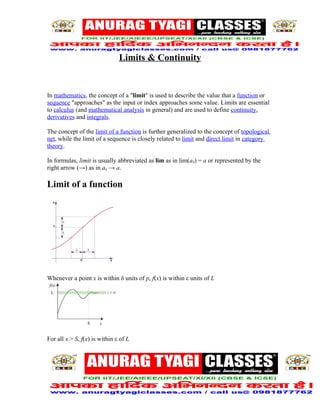
Whenever a point x is within δ units of p, f(x) is within ε units of L


For all x > S, f(x) is within ε of L
Suppose f(x) is a real-valued function and c is a real number. The expression


means that f(x) can be made to be as close to L as desired by making x sufficiently close
to c. In that case, we say that "the limit of f of x, as x approaches c, is L". Note that this
statement can be true even if f(c) ≠ L. Indeed, the function f(x) need not even be defined
at c.

For example, if


Then f(1) is not defined, yet as x approaches 1, f(x) approaches 2:

f(0.9) f(0.99) f(0.999) f(1.0) f(1.001) f(1.01) f(1.1)
1.900 1.990 1.999 ⇒ undef ⇐ 2.001 2.010 2.100

Thus, f(x) can be made arbitrarily close to the limit of 2 just by making x sufficiently
close to 1.

Karl Weierstrass formalized the definition of the limit of a function into what became
known as the (ε, δ)-definition of limit in the 19th century.

In addition to limits at finite values, functions can also have limits at infinity. For

example, consider

    •   f(100) = 1.9900
    •   f(1000) = 1.9990
    •   f(10000) = 1.9999

As x becomes extremely large, the value of f(x) approaches 2, and the value of f(x) can be
made as close to 2 as one could wish just by picking x sufficiently large. In this case, we
say that the limit of f(x) as x approaches infinity is 2. In mathematical notation,
Limit of a sequence
Main article: Limit of a sequence

Consider the following sequence: 1.79, 1.799, 1.7999,... We could observe that the
numbers are "approaching" 1.8, the limit of the sequence.

Formally, suppose x1, x2, ... is a sequence of real numbers. We say that the real number L
is the limit of this sequence and we write


to mean

        For every real number ε > 0, there exists a natural number n0 such that for all n >
        n0, |xn − L| < ε.

Intuitively, this means that eventually all elements of the sequence get as close as we
want to the limit, since the absolute value |xn − L| is the distance between xn and L. Not
every sequence has a limit; if it does, we call it convergent, otherwise divergent. One can
show that a convergent sequence has only one limit.

The limit of a sequence and the limit of a function are closely related. On one hand, the
limit of a sequence is simply the limit at infinity of a function defined on natural
numbers. On the other hand, a limit of a function f at x, if it exists, is the same as the limit
of the sequence xn = f(x + 1/n).


Continuity at a point.
Let a be a real numbers. Suppose f(x) is a real-valued function for which


                                         lim f(x) = L
                                        x−> a

for some number L (finite). Moreover, suppose f(a) is defined and L = f(a). then f(x) is
continuous at x = a.
The following theorem will help you quickly identify continuous functions in any
calculus course that you take.

Theorem: Continuity at a Point.

    1. If f(x) and g(x) are continuous at x = a, and c is a real number, then scalar
       multiples, c·f(x), the sum f(x)+g(x), the difference f(x)−g(x), the product f(x)·g(x)
       are also continuous at x = a.
    2. If f(x) and g(x) are continuous at x = a, and g(a) ≠ 0, then the reciprocal [1/(g(x))]
       and the quotient or ratio [(f(x))/(g(x))] are also continuous at x = a.

The assertions in this theorem are consequences of the previous theorem on the algebraic
properties of limits.

In practice, continuity at x = a implies the limit


                                         lim f(x) = L
                                        x−> a
can be evaluated by the immediate substitution of x = a in the function f(x).

Example:


                                 lim 3x+4 = 3(5) + 4 = 19
                                x−> 5


Continuity of a function f(x) at a number a corresponds to the requirement that the limit L
= f(a). That is, f(a) = limx−> a f(x) In the latter case, limit evaluation by immediate
substitution is possible.

It is possible for

    •   the limit L = limx−> a f(x) to exist and not equal f(a), and
    •   the limit L = limx−> a f(x) to exist and f(a) while f(a) is undefined.

In the latter case f(x) is not continuous at x = a.

Continuity on an Interval.
A function f(x) is continuous on an interval I if and only if for each point a in I, the
function f(x) is continuous at x = a. (Here is understood that one sided limits are to be
used at included endpoints of the interval I.)

Theorem: Continuity on an Interval.

   1. If f(x) and g(x) are continuous on an interval, and c is a real number, then scalar
      multiples, c·f(x), the sum f(x)+g(x), the difference f(x)−g(x), the product f(x)·g(x)
      are also continuous on the interval
   2. If f(x) and g(x) are continuous on an interval I, and g(x) ≠ 0 for all points x in the
      interval I then the reciprocal [1/(g(x))] and the quotient or ratio [(f(x))/(g(x))] are
      also continuous on the interval.

The assertions in this theorem are consequences of the previous theorem on the algebraic
properties of limits.

Limits BY ATC

  • 1.
    Limits & Continuity Inmathematics, the concept of a "limit" is used to describe the value that a function or sequence "approaches" as the input or index approaches some value. Limits are essential to calculus (and mathematical analysis in general) and are used to define continuity, derivatives and integrals. The concept of the limit of a function is further generalized to the concept of topological net, while the limit of a sequence is closely related to limit and direct limit in category theory. In formulas, limit is usually abbreviated as lim as in lim(an) = a or represented by the right arrow (→) as in an → a. Limit of a function Whenever a point x is within δ units of p, f(x) is within ε units of L For all x > S, f(x) is within ε of L
  • 2.
    Suppose f(x) isa real-valued function and c is a real number. The expression means that f(x) can be made to be as close to L as desired by making x sufficiently close to c. In that case, we say that "the limit of f of x, as x approaches c, is L". Note that this statement can be true even if f(c) ≠ L. Indeed, the function f(x) need not even be defined at c. For example, if Then f(1) is not defined, yet as x approaches 1, f(x) approaches 2: f(0.9) f(0.99) f(0.999) f(1.0) f(1.001) f(1.01) f(1.1) 1.900 1.990 1.999 ⇒ undef ⇐ 2.001 2.010 2.100 Thus, f(x) can be made arbitrarily close to the limit of 2 just by making x sufficiently close to 1. Karl Weierstrass formalized the definition of the limit of a function into what became known as the (ε, δ)-definition of limit in the 19th century. In addition to limits at finite values, functions can also have limits at infinity. For example, consider • f(100) = 1.9900 • f(1000) = 1.9990 • f(10000) = 1.9999 As x becomes extremely large, the value of f(x) approaches 2, and the value of f(x) can be made as close to 2 as one could wish just by picking x sufficiently large. In this case, we say that the limit of f(x) as x approaches infinity is 2. In mathematical notation,
  • 3.
    Limit of asequence Main article: Limit of a sequence Consider the following sequence: 1.79, 1.799, 1.7999,... We could observe that the numbers are "approaching" 1.8, the limit of the sequence. Formally, suppose x1, x2, ... is a sequence of real numbers. We say that the real number L is the limit of this sequence and we write to mean For every real number ε > 0, there exists a natural number n0 such that for all n > n0, |xn − L| < ε. Intuitively, this means that eventually all elements of the sequence get as close as we want to the limit, since the absolute value |xn − L| is the distance between xn and L. Not every sequence has a limit; if it does, we call it convergent, otherwise divergent. One can show that a convergent sequence has only one limit. The limit of a sequence and the limit of a function are closely related. On one hand, the limit of a sequence is simply the limit at infinity of a function defined on natural numbers. On the other hand, a limit of a function f at x, if it exists, is the same as the limit of the sequence xn = f(x + 1/n). Continuity at a point. Let a be a real numbers. Suppose f(x) is a real-valued function for which lim f(x) = L x−> a for some number L (finite). Moreover, suppose f(a) is defined and L = f(a). then f(x) is continuous at x = a.
  • 4.
    The following theoremwill help you quickly identify continuous functions in any calculus course that you take. Theorem: Continuity at a Point. 1. If f(x) and g(x) are continuous at x = a, and c is a real number, then scalar multiples, c·f(x), the sum f(x)+g(x), the difference f(x)−g(x), the product f(x)·g(x) are also continuous at x = a. 2. If f(x) and g(x) are continuous at x = a, and g(a) ≠ 0, then the reciprocal [1/(g(x))] and the quotient or ratio [(f(x))/(g(x))] are also continuous at x = a. The assertions in this theorem are consequences of the previous theorem on the algebraic properties of limits. In practice, continuity at x = a implies the limit lim f(x) = L x−> a can be evaluated by the immediate substitution of x = a in the function f(x). Example: lim 3x+4 = 3(5) + 4 = 19 x−> 5 Continuity of a function f(x) at a number a corresponds to the requirement that the limit L = f(a). That is, f(a) = limx−> a f(x) In the latter case, limit evaluation by immediate substitution is possible. It is possible for • the limit L = limx−> a f(x) to exist and not equal f(a), and • the limit L = limx−> a f(x) to exist and f(a) while f(a) is undefined. In the latter case f(x) is not continuous at x = a. Continuity on an Interval.
  • 5.
    A function f(x)is continuous on an interval I if and only if for each point a in I, the function f(x) is continuous at x = a. (Here is understood that one sided limits are to be used at included endpoints of the interval I.) Theorem: Continuity on an Interval. 1. If f(x) and g(x) are continuous on an interval, and c is a real number, then scalar multiples, c·f(x), the sum f(x)+g(x), the difference f(x)−g(x), the product f(x)·g(x) are also continuous on the interval 2. If f(x) and g(x) are continuous on an interval I, and g(x) ≠ 0 for all points x in the interval I then the reciprocal [1/(g(x))] and the quotient or ratio [(f(x))/(g(x))] are also continuous on the interval. The assertions in this theorem are consequences of the previous theorem on the algebraic properties of limits.