Appendicitis during pregnancy Prof Aboubakr Elnashar Benha University Hospital, Egypt elnashar53@hotmail.com 
Aboubakr Elnashar
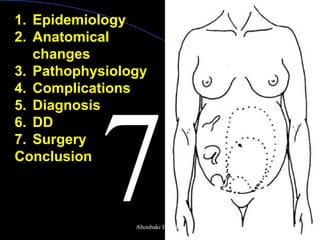
1.Epidemiology 
2.Anatomical changes 
3.Pathophysiology 
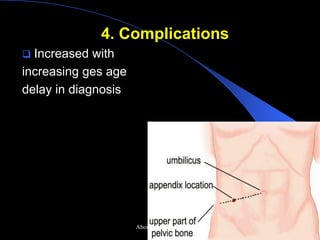
4.Complications 
5.Diagnosis 
6.DD 
7.Surgery Conclusion 
Aboubakr Elnashar
1. Epidemiology 
Lifetime occurrence: 7% 
Peak incidence: 10-30y 
The most common 
cause of ac abdomen in pregnancy 
nonobstetric surgical intervention during pregnancy 
{25%} 
Suspected in: 1 in 1000 pregnant women 
(Mazze and Källén, 1991) 
Confirmed in: 65% 
Aboubakr Elnashar
Incidence: 
1 in 1500 pregnancies. 
Reduced during pregnancy, especially in 3rd T {Protective effect of pregnancy ?} 
(Andersson &Lambe, 2001). 
Same (Some studies) 
•Equal in all 3 trimesters. 
•1st T: 30% 
2nd T: 45% 
3rd: 25% 
Aboubakr Elnashar
2. Anatomical changes during pregnancy 
I. Position of appendix: 
Gravid ut  displaced upward & outward 
(Baer et al, 1932, Many authors) 
No change in location 
(Mourad et al, 2000; Hodjati et al ,2003)). 
Degree of displacement, if any, is due to different extents of cecal fixation. 
Aboubakr Elnashar
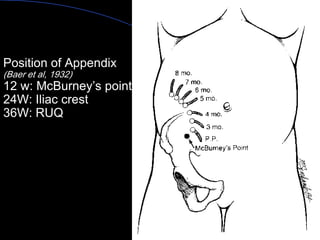
Position of Appendix (Baer et al, 1932) 12 w: McBurney’s point 24W: Iliac crest 36W: RUQ 
Aboubakr Elnashar
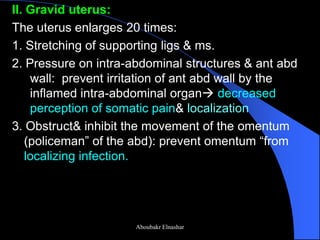
II. Gravid uterus: 
The uterus enlarges 20 times: 
1. Stretching of supporting ligs & ms. 
2. Pressure on intra-abdominal structures & ant abd wall: prevent irritation of ant abd wall by the inflamed intra-abdominal organ decreased perception of somatic pain& localization 
3. Obstruct& inhibit the movement of the omentum (policeman” of the abd): prevent omentum “from localizing infection. 
Aboubakr Elnashar
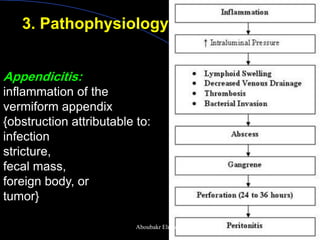
Appendicitis: 
inflammation of the vermiform appendix 
{obstruction attributable to: infection 
stricture, 
fecal mass, 
foreign body, or 
tumor} 
3. Pathophysiology 
Aboubakr Elnashar
4. Complications 
Increased with 
increasing ges age 
delay in diagnosis 
Aboubakr Elnashar
1. Abortion: 15% 
2. Fetal loss: 1.5-5.1% 
3. PTL: 
• 13-22% 
3rd T 
Perforated appendix & peritonitis 
1st w after surgery 
Aboubakr Elnashar
4. Perforation 
Non Preg: 4 -19% 
Preg: 
Highest in 3rd T 
1st T: 8% 
2nd T: 12% 
3rd T: 20% 
(Andersson and Lambe, 2001; Ueberrueck and associates ,2004) 
Surgery delayed by >24 h from presentation: 66% risk of perforation: 
Surgery within 24 h of presentation: No perforation 
(Tamir et al, 1999) 
Aboubakr Elnashar
•Non-perforated appendix 
•F mortality: 1.5% 
•Mat mortality: 0.1% 
•Perforated appendix 
•F mortality: 5.1%-20% 
•Mat mortality: 1% {diffuse peritonitis} 
•Preterm contractions {localized peritonitis}: 83% 
(Augustin and Majerovic, 2006). 
oNeonatal neurological injury {Sepsis} 
(Mays et,1995) 
Aboubakr Elnashar
5. Diagnosis 
Mantrels score 
Difficult 
Symptoms 
Signs 
Lab 
Imaging 
Aboubakr Elnashar
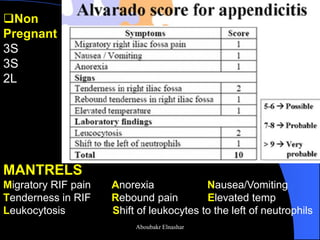
MANTRELS Migratory RIF pain Anorexia Nausea/Vomiting Tenderness in RIF Rebound pain Elevated temp Leukocytosis Shift of leukocytes to the left of neutrophils 
Non Pregnant 3S 3S 2L 
Aboubakr Elnashar
Pregnant: 
More difficult. 
1. Nausea, vomiting, anorexia accompany normal pregnancy. 
2. Ut enlarges: appendix commonly moves upward and outward: pain& tenderness are "displaced" (Baer et al, 1932). 
3. Peritoneal signs often absent {lifting of abd wall by uterus} 
No typical symptom esp. late pregnancy 
4. Fever: 50% 
Aboubakr Elnashar
5. Elevated WBC normal in pregnancy 
•1st – 2nd T: 16000 
•At labor: 20000 – 30000 
•<10000: more reassuring 
6. Commonly confused with: 
Cholecystitis 
PTL 
Pyelonephritis 
Renal colic 
Placental abruption 
Degenerating fibroid. 
There is no one reliable S or S for diagnosis of appendicitis in pregnancy 
Aboubakr Elnashar
Symptoms 
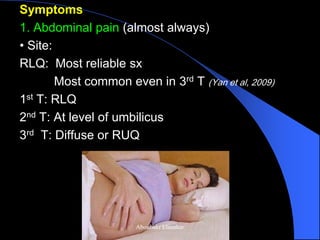
1. Abdominal pain (almost always) 
• Site: 
RLQ: Most reliable sx 
Most common even in 3rd T (Yan et al, 2009) 
1st T: RLQ 
2nd T: At level of umbilicus 
3rd T: Diffuse or RUQ 
Aboubakr Elnashar
2. Anorexia, nausea, vomiting: 
Not sensitive nor specific. 
sensitive predictors of appendicitis in the late pregnancy (Yan et al, 2009) 
3. Fever: 50% 
not sensitive 
Aboubakr Elnashar
Signs 
All findings are less common in 3rd T 
1. Abdominal tenderness (most common) 
Direct RLQ tenderness: ~100% 
Rebound tenderness: 55-75% 
less common in 3rd T 
2. Abdominal rigidity: 50-65% 
Aboubakr Elnashar
3. Classic signs 
No or little cl significance in diagnosis (Pastore et al, 2006) 
Rovsing sign: 
palpation of the LLQ: more pain in the RLQ 
Dunphy's sign: 
increased abd pain with coughing 
Aboubakr Elnashar
Adler Sign: 
Appendicitis can be dd from adnexal or uterine pain. If the point of maximal tenderness shifts medially with repositioning on the lt lat side: etiology is adnexal or uterine (vs appendiceal). 
Aboubakr Elnashar
Psoas sign (retroperitoneal retrocecal appendix) 
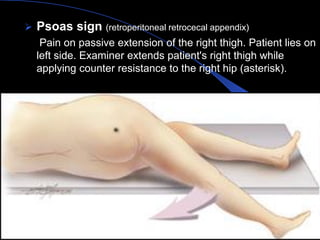
Pain on passive extension of the right thigh. Patient lies on left side. Examiner extends patient's right thigh while applying counter resistance to the right hip (asterisk). 
Aboubakr Elnashar
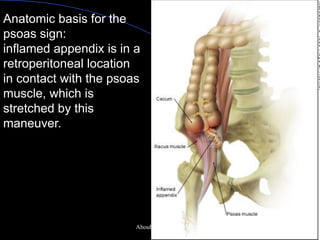
Anatomic basis for the psoas sign: inflamed appendix is in a retroperitoneal location in contact with the psoas muscle, which is stretched by this maneuver. 
Aboubakr Elnashar
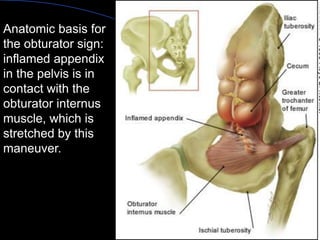
Obturator sign (pelvic appendix) 
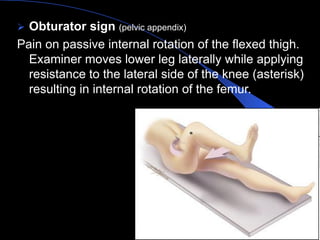
Pain on passive internal rotation of the flexed thigh. Examiner moves lower leg laterally while applying resistance to the lateral side of the knee (asterisk) resulting in internal rotation of the femur. 
Aboubakr Elnashar
Anatomic basis for the obturator sign: inflamed appendix in the pelvis is in contact with the obturator internus muscle, which is stretched by this maneuver. 
Aboubakr Elnashar
Laboratory 
1. WBC: 
2nd &3rd T: 6,000-16,000 
Early labor: 20,000-30,000 
Absolute number: not reliable 
Differential:  levels of band cells can be reliable indication of infection. 
2. U/A: 
mild pyuria or mild hematuria: 20% 
{extraluminal irritation of the ureter, not UTI}. 
mild proteinuria 
3. CRP (acute-phase protein) 
Aboubakr Elnashar
Imaging 
Negative appendectomy rate: 
-Cl alone: 54% 
-Cl, US & CT: 8% 
1st Line: 
US 
2nd line: 
CT 
MRI 
Aboubakr Elnashar
US: TA or TV 
Graded compression sonography 
Non-pregnant: sensitivity 85% 
specificity 92% 
Pregnant: 
Difficult {cecal displacement & ut imposition (Pedrosa et al, 2009). 
Easy, safe 
Operator dependent 
Aboubakr Elnashar
Accuracy 
Accurate in 1st & 2nd T, difficult in 3rd T 
confirming the diagnosis in 3rd T: 40% (Yan et al, 2009) 
PPV: 100% (provides confirmation of the diagnosis when it is positive). 
Normal US: not rule out diagnosis 
–80% sensitive: non-perforating appendicitis 
–28% sensitive: perforated appendicitis 
Aboubakr Elnashar
Scan RLQ with increasing pressure 
to push bowel loops away 
Empty cecum of gas& fluid 
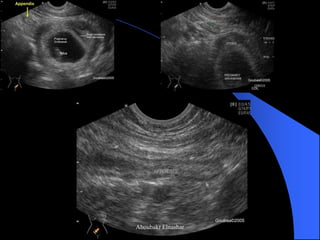
Sonographic Criteria 
Noncompressible 
> 7mm diameter 
<6mm rules out appendicitis 
Mural thickening > 3mm 
Presence of appendicalith 
Aboubakr Elnashar
Aboubakr Elnashar
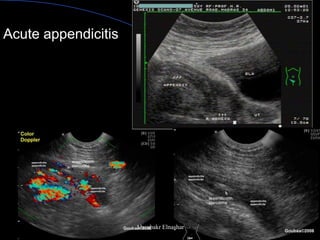
Acute appendicitis 
Aboubakr Elnashar
CT: Helical CT scan: 
Nonpregnant patients 
Sensitivity: 98% 
Pregnant: 
Sensitivity: >90% 
Specificity: >95% 
(Torbati et al, 2002; Wallace et al, 2008; Gearhart, 2008; Paulson, 2003; Raman, 2008) 
Adv: 
Quicker, useful, noninvasive 
More sensitive& accurate than US 
Aboubakr Elnashar
Radiation dose: 0.3 rad 
Specific views to decrease fetal radiation exposure 
Cumulative dose of 5 rad: safe 
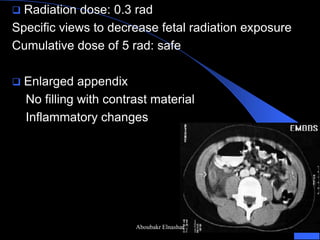
Enlarged appendix 
No filling with contrast material 
Inflammatory changes 
Aboubakr Elnashar
MRI 
No adverse effects on fetus (Israel et al, 2008). False-negative: 0% False-positive rate: 30% (Pedrosa et al, 2009) Sensitivity: up to 100% Specificity: 96% (Fielding and Chin, 2006). 
Cost Availability may be prohibitive. 
Aboubakr Elnashar
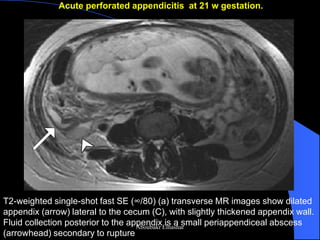
Acute perforated appendicitis at 21 w gestation. 
T2-weighted single-shot fast SE (∞/80) (a) transverse MR images show dilated appendix (arrow) lateral to the cecum (C), with slightly thickened appendix wall. Fluid collection posterior to the appendix is a small periappendiceal abscess (arrowhead) secondary to rupture 
Aboubakr Elnashar
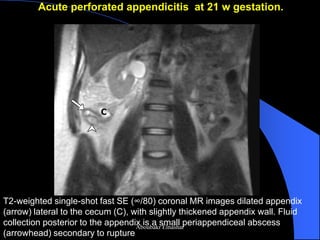
Acute perforated appendicitis at 21 w gestation. 
T2-weighted single-shot fast SE (∞/80) coronal MR images dilated appendix (arrow) lateral to the cecum (C), with slightly thickened appendix wall. Fluid collection posterior to the appendix is a small periappendiceal abscess (arrowhead) secondary to rupture 
Aboubakr Elnashar
6. Differential Diagnosis 
Nonobstetric 
Pyelonephritis 
Urinary calculi 
Cholecystitis 
Cholelithiasis 
Pancreatitis 
Gastroenteritis 
Mesenteric Adenitis 
Pneumonia 
Meckel’s Diverticulum 
Peptic Ulcer 
Obstetric 
PTL 
Placental Abruption 
Chorioamnionitis 
Adnexal Torsion 
Ectopic Pregnancy 
PID 
Round lig pain 
Ut rupture 
Aboubakr Elnashar
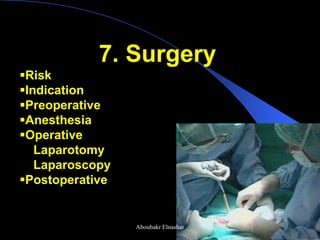
7. Surgery 
Risk 
Indication 
Preoperative 
Anesthesia 
Operative Laparotomy Laparoscopy 
Postoperative 
Aboubakr Elnashar
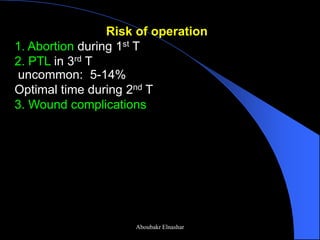
Risk of operation 1. Abortion during 1st T 2. PTL in 3rd T uncommon: 5-14% Optimal time during 2nd T 3. Wound complications 
Aboubakr Elnashar
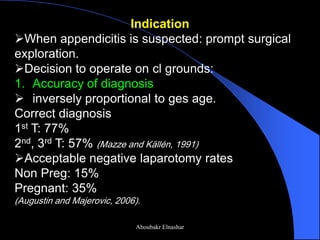
Indication 
When appendicitis is suspected: prompt surgical exploration. 
Decision to operate on cl grounds: 
1.Accuracy of diagnosis 
inversely proportional to ges age. Correct diagnosis 1st T: 77% 2nd, 3rd T: 57% (Mazze and Källén, 1991) 
Acceptable negative laparotomy rates Non Preg: 15% Pregnant: 35% (Augustin and Majerovic, 2006). 
Aboubakr Elnashar
2. Risk of the surgical procedure 
To mother & child: minimal 
compared with 
risks of delayed tt & appendix perforation. 
Aboubakr Elnashar
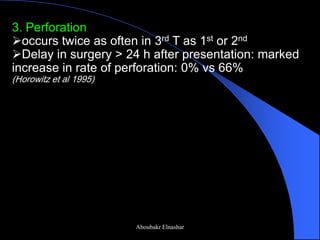
3. Perforation 
occurs twice as often in 3rd T as 1st or 2nd 
Delay in surgery > 24 h after presentation: marked increase in rate of perforation: 0% vs 66% (Horowitz et al 1995) 
Aboubakr Elnashar
Preoperative 
keep NPO 
IV drip to hydrate 
IV antimicrobial therapy: 2nd or 3rd generation cephalosporin Discontinued after surgery unless –Gangrene –Perforation –Periappendiceal phlegmon 
Without generalized peritonitis: prognosis is excellent. 
Aboubakr Elnashar
Diffuse Peritonitis 
(Augustin & Majerovic, 2006). 
1. IV Cefuroxime, ampicillin, metronidazole, and oxygen pre-operatively. 
2. Immediate CS can be considered, depending on ges age of fetus. 
3. Preoperative intubation & ventilation in cases of fetal hypoxia. 
Aboubakr Elnashar
Anaestheia 
IV Inhaled anesthetics: No teratogenicity Potential teratogens best avoided 
Local/Regional anesthetics: NO fetal malformations Risk of hypotension: decrease ut blood flow Minimize: adequate fluids lateral position 
Aboubakr Elnashar
Operative 
Laparotomy or Laparoscopy? 
Depend on 
1. Gest age 
2. Skill of the surgeon 
Aboubakr Elnashar
Laparotomy 
1. Tilt table 30° to left 
{Decrease pressure to IVC 
Facilitate exposure of cecum} 
2. Incision 
McBurney’s point: <20 ws 
Point of maximum tenderness 
low midline: diffuse peritonitis, or 
doubt about diagnosis 
Rt. Paraumbilicus 
3. Minimal ut manipulation {decrease risk of PTL} 
4. Seldom CS is indicated at the time of appendectomy. 
Aboubakr Elnashar
Laparoscopy 
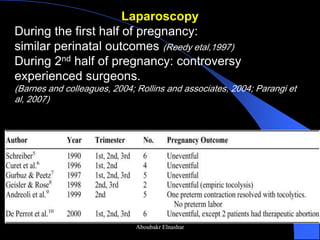
During the first half of pregnancy: 
similar perinatal outcomes (Reedy etal,1997) 
During 2nd half of pregnancy: controversy 
experienced surgeons. 
(Barnes and colleagues, 2004; Rollins and associates, 2004; Parangi et al, 2007) 
Aboubakr Elnashar
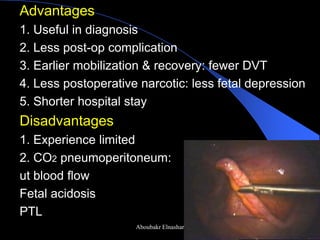
Advantages 
1. Useful in diagnosis 
2. Less post-op complication 
3. Earlier mobilization & recovery: fewer DVT 
4. Less postoperative narcotic: less fetal depression 
5. Shorter hospital stay 
Disadvantages 
1. Experience limited 
2. CO2 pneumoperitoneum: 
ut blood flow 
Fetal acidosis 
PTL 
Aboubakr Elnashar
Postoperative 
1. Preterm contractions: common but progression to labor is rare: 
Observe ut contraction 
2. Tocolytics 
Recommended by some 
S.E: 
Ritodrine: tachycardia & vomiting 
Anti-prostaglandin: fetal side effects 
Aboubakr Elnashar
Conclusion 
1.The symptoms of appendicitis mimic symptoms of normal pregnancy, namely, anorexia, n, v & abd discomfort. 2. Prompt diagnosis may improve the prenatal outcome. 3. Delay of surgery: increased risk of perforation: increased risk of abortion or PTL & maternal complications. 4. Early surgical intervention is essential. 
Aboubakr Elnashar
Thank you Face book: Aboubakr Elnashar Lectures 
Aboubakr Elnashar

Appendicitis during pregnancy

  • 1.
    Appendicitis during pregnancyProf Aboubakr Elnashar Benha University Hospital, Egypt elnashar53@hotmail.com Aboubakr Elnashar
  • 2.
    1.Epidemiology 2.Anatomical changes 3.Pathophysiology 4.Complications 5.Diagnosis 6.DD 7.Surgery Conclusion Aboubakr Elnashar
  • 3.
    1. Epidemiology Lifetimeoccurrence: 7% Peak incidence: 10-30y The most common cause of ac abdomen in pregnancy nonobstetric surgical intervention during pregnancy {25%} Suspected in: 1 in 1000 pregnant women (Mazze and Källén, 1991) Confirmed in: 65% Aboubakr Elnashar
  • 4.
    Incidence: 1 in1500 pregnancies. Reduced during pregnancy, especially in 3rd T {Protective effect of pregnancy ?} (Andersson &Lambe, 2001). Same (Some studies) •Equal in all 3 trimesters. •1st T: 30% 2nd T: 45% 3rd: 25% Aboubakr Elnashar
  • 5.
    2. Anatomical changesduring pregnancy I. Position of appendix: Gravid ut  displaced upward & outward (Baer et al, 1932, Many authors) No change in location (Mourad et al, 2000; Hodjati et al ,2003)). Degree of displacement, if any, is due to different extents of cecal fixation. Aboubakr Elnashar
  • 6.
    Position of Appendix(Baer et al, 1932) 12 w: McBurney’s point 24W: Iliac crest 36W: RUQ Aboubakr Elnashar
  • 7.
    II. Gravid uterus: The uterus enlarges 20 times: 1. Stretching of supporting ligs & ms. 2. Pressure on intra-abdominal structures & ant abd wall: prevent irritation of ant abd wall by the inflamed intra-abdominal organ decreased perception of somatic pain& localization 3. Obstruct& inhibit the movement of the omentum (policeman” of the abd): prevent omentum “from localizing infection. Aboubakr Elnashar
  • 8.
    Appendicitis: inflammation ofthe vermiform appendix {obstruction attributable to: infection stricture, fecal mass, foreign body, or tumor} 3. Pathophysiology Aboubakr Elnashar
  • 9.
    4. Complications Increasedwith increasing ges age delay in diagnosis Aboubakr Elnashar
  • 10.
    1. Abortion: 15% 2. Fetal loss: 1.5-5.1% 3. PTL: • 13-22% 3rd T Perforated appendix & peritonitis 1st w after surgery Aboubakr Elnashar
  • 11.
    4. Perforation NonPreg: 4 -19% Preg: Highest in 3rd T 1st T: 8% 2nd T: 12% 3rd T: 20% (Andersson and Lambe, 2001; Ueberrueck and associates ,2004) Surgery delayed by >24 h from presentation: 66% risk of perforation: Surgery within 24 h of presentation: No perforation (Tamir et al, 1999) Aboubakr Elnashar
  • 12.
    •Non-perforated appendix •Fmortality: 1.5% •Mat mortality: 0.1% •Perforated appendix •F mortality: 5.1%-20% •Mat mortality: 1% {diffuse peritonitis} •Preterm contractions {localized peritonitis}: 83% (Augustin and Majerovic, 2006). oNeonatal neurological injury {Sepsis} (Mays et,1995) Aboubakr Elnashar
  • 13.
    5. Diagnosis Mantrelsscore Difficult Symptoms Signs Lab Imaging Aboubakr Elnashar
  • 14.
    MANTRELS Migratory RIFpain Anorexia Nausea/Vomiting Tenderness in RIF Rebound pain Elevated temp Leukocytosis Shift of leukocytes to the left of neutrophils Non Pregnant 3S 3S 2L Aboubakr Elnashar
  • 15.
    Pregnant: More difficult. 1. Nausea, vomiting, anorexia accompany normal pregnancy. 2. Ut enlarges: appendix commonly moves upward and outward: pain& tenderness are "displaced" (Baer et al, 1932). 3. Peritoneal signs often absent {lifting of abd wall by uterus} No typical symptom esp. late pregnancy 4. Fever: 50% Aboubakr Elnashar
  • 16.
    5. Elevated WBCnormal in pregnancy •1st – 2nd T: 16000 •At labor: 20000 – 30000 •<10000: more reassuring 6. Commonly confused with: Cholecystitis PTL Pyelonephritis Renal colic Placental abruption Degenerating fibroid. There is no one reliable S or S for diagnosis of appendicitis in pregnancy Aboubakr Elnashar
  • 17.
    Symptoms 1. Abdominalpain (almost always) • Site: RLQ: Most reliable sx Most common even in 3rd T (Yan et al, 2009) 1st T: RLQ 2nd T: At level of umbilicus 3rd T: Diffuse or RUQ Aboubakr Elnashar
  • 18.
    2. Anorexia, nausea,vomiting: Not sensitive nor specific. sensitive predictors of appendicitis in the late pregnancy (Yan et al, 2009) 3. Fever: 50% not sensitive Aboubakr Elnashar
  • 19.
    Signs All findingsare less common in 3rd T 1. Abdominal tenderness (most common) Direct RLQ tenderness: ~100% Rebound tenderness: 55-75% less common in 3rd T 2. Abdominal rigidity: 50-65% Aboubakr Elnashar
  • 20.
    3. Classic signs No or little cl significance in diagnosis (Pastore et al, 2006) Rovsing sign: palpation of the LLQ: more pain in the RLQ Dunphy's sign: increased abd pain with coughing Aboubakr Elnashar
  • 21.
    Adler Sign: Appendicitiscan be dd from adnexal or uterine pain. If the point of maximal tenderness shifts medially with repositioning on the lt lat side: etiology is adnexal or uterine (vs appendiceal). Aboubakr Elnashar
  • 22.
    Psoas sign (retroperitonealretrocecal appendix) Pain on passive extension of the right thigh. Patient lies on left side. Examiner extends patient's right thigh while applying counter resistance to the right hip (asterisk). Aboubakr Elnashar
  • 23.
    Anatomic basis forthe psoas sign: inflamed appendix is in a retroperitoneal location in contact with the psoas muscle, which is stretched by this maneuver. Aboubakr Elnashar
  • 24.
    Obturator sign (pelvicappendix) Pain on passive internal rotation of the flexed thigh. Examiner moves lower leg laterally while applying resistance to the lateral side of the knee (asterisk) resulting in internal rotation of the femur. Aboubakr Elnashar
  • 25.
    Anatomic basis forthe obturator sign: inflamed appendix in the pelvis is in contact with the obturator internus muscle, which is stretched by this maneuver. Aboubakr Elnashar
  • 26.
    Laboratory 1. WBC: 2nd &3rd T: 6,000-16,000 Early labor: 20,000-30,000 Absolute number: not reliable Differential:  levels of band cells can be reliable indication of infection. 2. U/A: mild pyuria or mild hematuria: 20% {extraluminal irritation of the ureter, not UTI}. mild proteinuria 3. CRP (acute-phase protein) Aboubakr Elnashar
  • 27.
    Imaging Negative appendectomyrate: -Cl alone: 54% -Cl, US & CT: 8% 1st Line: US 2nd line: CT MRI Aboubakr Elnashar
  • 28.
    US: TA orTV Graded compression sonography Non-pregnant: sensitivity 85% specificity 92% Pregnant: Difficult {cecal displacement & ut imposition (Pedrosa et al, 2009). Easy, safe Operator dependent Aboubakr Elnashar
  • 29.
    Accuracy Accurate in1st & 2nd T, difficult in 3rd T confirming the diagnosis in 3rd T: 40% (Yan et al, 2009) PPV: 100% (provides confirmation of the diagnosis when it is positive). Normal US: not rule out diagnosis –80% sensitive: non-perforating appendicitis –28% sensitive: perforated appendicitis Aboubakr Elnashar
  • 30.
    Scan RLQ withincreasing pressure to push bowel loops away Empty cecum of gas& fluid Sonographic Criteria Noncompressible > 7mm diameter <6mm rules out appendicitis Mural thickening > 3mm Presence of appendicalith Aboubakr Elnashar
  • 31.
  • 32.
  • 33.
    CT: Helical CTscan: Nonpregnant patients Sensitivity: 98% Pregnant: Sensitivity: >90% Specificity: >95% (Torbati et al, 2002; Wallace et al, 2008; Gearhart, 2008; Paulson, 2003; Raman, 2008) Adv: Quicker, useful, noninvasive More sensitive& accurate than US Aboubakr Elnashar
  • 34.
    Radiation dose: 0.3rad Specific views to decrease fetal radiation exposure Cumulative dose of 5 rad: safe Enlarged appendix No filling with contrast material Inflammatory changes Aboubakr Elnashar
  • 35.
    MRI No adverseeffects on fetus (Israel et al, 2008). False-negative: 0% False-positive rate: 30% (Pedrosa et al, 2009) Sensitivity: up to 100% Specificity: 96% (Fielding and Chin, 2006). Cost Availability may be prohibitive. Aboubakr Elnashar
  • 36.
    Acute perforated appendicitisat 21 w gestation. T2-weighted single-shot fast SE (∞/80) (a) transverse MR images show dilated appendix (arrow) lateral to the cecum (C), with slightly thickened appendix wall. Fluid collection posterior to the appendix is a small periappendiceal abscess (arrowhead) secondary to rupture Aboubakr Elnashar
  • 37.
    Acute perforated appendicitisat 21 w gestation. T2-weighted single-shot fast SE (∞/80) coronal MR images dilated appendix (arrow) lateral to the cecum (C), with slightly thickened appendix wall. Fluid collection posterior to the appendix is a small periappendiceal abscess (arrowhead) secondary to rupture Aboubakr Elnashar
  • 38.
    6. Differential Diagnosis Nonobstetric Pyelonephritis Urinary calculi Cholecystitis Cholelithiasis Pancreatitis Gastroenteritis Mesenteric Adenitis Pneumonia Meckel’s Diverticulum Peptic Ulcer Obstetric PTL Placental Abruption Chorioamnionitis Adnexal Torsion Ectopic Pregnancy PID Round lig pain Ut rupture Aboubakr Elnashar
  • 39.
    7. Surgery Risk Indication Preoperative Anesthesia Operative Laparotomy Laparoscopy Postoperative Aboubakr Elnashar
  • 40.
    Risk of operation1. Abortion during 1st T 2. PTL in 3rd T uncommon: 5-14% Optimal time during 2nd T 3. Wound complications Aboubakr Elnashar
  • 41.
    Indication When appendicitisis suspected: prompt surgical exploration. Decision to operate on cl grounds: 1.Accuracy of diagnosis inversely proportional to ges age. Correct diagnosis 1st T: 77% 2nd, 3rd T: 57% (Mazze and Källén, 1991) Acceptable negative laparotomy rates Non Preg: 15% Pregnant: 35% (Augustin and Majerovic, 2006). Aboubakr Elnashar
  • 42.
    2. Risk ofthe surgical procedure To mother & child: minimal compared with risks of delayed tt & appendix perforation. Aboubakr Elnashar
  • 43.
    3. Perforation occurstwice as often in 3rd T as 1st or 2nd Delay in surgery > 24 h after presentation: marked increase in rate of perforation: 0% vs 66% (Horowitz et al 1995) Aboubakr Elnashar
  • 44.
    Preoperative keep NPO IV drip to hydrate IV antimicrobial therapy: 2nd or 3rd generation cephalosporin Discontinued after surgery unless –Gangrene –Perforation –Periappendiceal phlegmon Without generalized peritonitis: prognosis is excellent. Aboubakr Elnashar
  • 45.
    Diffuse Peritonitis (Augustin& Majerovic, 2006). 1. IV Cefuroxime, ampicillin, metronidazole, and oxygen pre-operatively. 2. Immediate CS can be considered, depending on ges age of fetus. 3. Preoperative intubation & ventilation in cases of fetal hypoxia. Aboubakr Elnashar
  • 46.
    Anaestheia IV Inhaledanesthetics: No teratogenicity Potential teratogens best avoided Local/Regional anesthetics: NO fetal malformations Risk of hypotension: decrease ut blood flow Minimize: adequate fluids lateral position Aboubakr Elnashar
  • 47.
    Operative Laparotomy orLaparoscopy? Depend on 1. Gest age 2. Skill of the surgeon Aboubakr Elnashar
  • 48.
    Laparotomy 1. Tilttable 30° to left {Decrease pressure to IVC Facilitate exposure of cecum} 2. Incision McBurney’s point: <20 ws Point of maximum tenderness low midline: diffuse peritonitis, or doubt about diagnosis Rt. Paraumbilicus 3. Minimal ut manipulation {decrease risk of PTL} 4. Seldom CS is indicated at the time of appendectomy. Aboubakr Elnashar
  • 49.
    Laparoscopy During thefirst half of pregnancy: similar perinatal outcomes (Reedy etal,1997) During 2nd half of pregnancy: controversy experienced surgeons. (Barnes and colleagues, 2004; Rollins and associates, 2004; Parangi et al, 2007) Aboubakr Elnashar
  • 50.
    Advantages 1. Usefulin diagnosis 2. Less post-op complication 3. Earlier mobilization & recovery: fewer DVT 4. Less postoperative narcotic: less fetal depression 5. Shorter hospital stay Disadvantages 1. Experience limited 2. CO2 pneumoperitoneum: ut blood flow Fetal acidosis PTL Aboubakr Elnashar
  • 51.
    Postoperative 1. Pretermcontractions: common but progression to labor is rare: Observe ut contraction 2. Tocolytics Recommended by some S.E: Ritodrine: tachycardia & vomiting Anti-prostaglandin: fetal side effects Aboubakr Elnashar
  • 52.
    Conclusion 1.The symptomsof appendicitis mimic symptoms of normal pregnancy, namely, anorexia, n, v & abd discomfort. 2. Prompt diagnosis may improve the prenatal outcome. 3. Delay of surgery: increased risk of perforation: increased risk of abortion or PTL & maternal complications. 4. Early surgical intervention is essential. Aboubakr Elnashar
  • 53.
    Thank you Facebook: Aboubakr Elnashar Lectures Aboubakr Elnashar