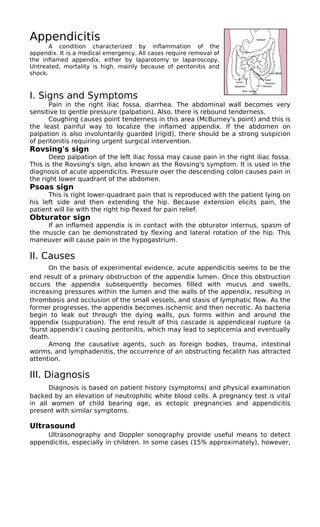
Appendicitis
A condition characterized by inflammation of the
appendix. It is a medical emergency. All cases require removal of
the inflamed appendix, either by laparotomy or laparoscopy.
Untreated, mortality is high, mainly because of peritonitis and
shock.
I. Signs and Symptoms
Pain in the right iliac fossa, diarrhea. The abdominal wall becomes very
sensitive to gentle pressure (palpation). Also, there is rebound tenderness.
Coughing causes point tenderness in this area (McBurney's point) and this is
the least painful way to localize the inflamed appendix. If the abdomen on
palpation is also involuntarily guarded (rigid), there should be a strong suspicion
of peritonitis requiring urgent surgical intervention.
Rovsing's sign
Deep palpation of the left iliac fossa may cause pain in the right iliac fossa.
This is the Rovsing's sign, also known as the Rovsing's symptom. It is used in the
diagnosis of acute appendicitis. Pressure over the descending colon causes pain in
the right lower quadrant of the abdomen.
Psoas sign
This is right lower-quadrant pain that is reproduced with the patient lying on
his left side and then extending the hip. Because extension elicits pain, the
patient will lie with the right hip flexed for pain relief.
Obturator sign
If an inflamed appendix is in contact with the obturator internus, spasm of
the muscle can be demonstrated by flexing and lateral rotation of the hip. This
maneuver will cause pain in the hypogastrium.
II. Causes
On the basis of experimental evidence, acute appendicitis seems to be the
end result of a primary obstruction of the appendix lumen. Once this obstruction
occurs the appendix subsequently becomes filled with mucus and swells,
increasing pressures within the lumen and the walls of the appendix, resulting in
thrombosis and occlusion of the small vessels, and stasis of lymphatic flow. As the
former progresses, the appendix becomes ischemic and then necrotic. As bacteria
begin to leak out through the dying walls, pus forms within and around the
appendix (suppuration). The end result of this cascade is appendiceal rupture (a
'burst appendix') causing peritonitis, which may lead to septicemia and eventually
death.
Among the causative agents, such as foreign bodies, trauma, intestinal
worms, and lymphadenitis, the occurrence of an obstructing fecalith has attracted
attention.
III. Diagnosis
Diagnosis is based on patient history (symptoms) and physical examination
backed by an elevation of neutrophilic white blood cells. A pregnancy test is vital
in all women of child bearing age, as ectopic pregnancies and appendicitis
present with similar symptoms.
Ultrasound
Ultrasonography and Doppler sonography provide useful means to detect
appendicitis, especially in children. In some cases (15% approximately), however,
ultrasonography of the iliac fossa does not reveal any abnormalities despite the
presence of appendicitis. This is especially true of early appendicitis before the
appendix has become significantly distended and in adults where larger amounts
of fat and bowel gas make actually seeing the appendix technically difficult.
Computed tomography
A properly performed CT scan with modern equipment has a detection rate
(sensitivity) of over 95% and a similar specificity. Signs of appendicitis on CT scan
include lack of oral contrast (oral dye) in the appendix, direct visualization of
appendiceal enlargement (greater than 6 mm in diameter on cross section), and
appendiceal wall enhancement (IV dye).
According to a systematic review from UC-San Francisco comparing
ultrasound vs. CT scan, CT scan is more accurate than ultrasound for the
diagnosis of appendicitis in adults and adolescents.
Sensitivity Specificit
y
Positive
Likelihood
Negative
Likelihood
Ultrasound 94% 95% 13.3 0.09
CT Scan 86% 81% 5.8 0.19
Alvarado score
Symptoms
Migratory right iliac fossa pain 1 point
Anorexia 1 point
Nausea and vomiting 1 point
Signs
Right iliac fossa tenderness 2 points
Rebound tenderness 1 point
Fever 1 point
Laboratory
Leucocytosis 2 points
Shift to left (segmented
neutrophils)
1 point
Total score
10
points
A score below 5 is strongly against a diagnosis of appendicitis, while a score
of 7 or more is strongly predictive of acute appendicitis. In patients with an
equivocal score of 5-6, CT scan further reduces the rate of negative
appendicectomy.
IV. Management
Before surgery
The treatment begins by keeping the patient from eating or drinking in
preparation for surgery. An intravenous drip is used to hydrate the patient.
Antibiotics given intravenously such as cefuroxime and metronidazole may be
administered early to help kill bacteria and thus reduce the spread of infection in
the abdomen and postoperative complications in the abdomen or wound. If the
stomach is empty (no food in the past six hours) general anaesthesia is usually
used. Otherwise, spinal anaesthesia may be used.
Pain management
Pain from appendicitis can be severe. Strong pain medications (i.e. narcotic
pain medications) are recommended for pain management prior to surgery.
Morphine is generally the standard of care in adults and children in the treatment
of pain from appendicitis prior to surgery.
Surgery
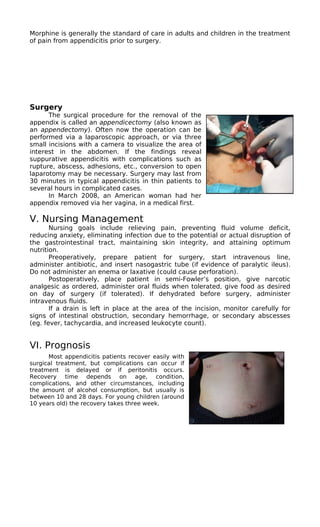
The surgical procedure for the removal of the
appendix is called an appendicectomy (also known as
an appendectomy). Often now the operation can be
performed via a laparoscopic approach, or via three
small incisions with a camera to visualize the area of
interest in the abdomen. If the findings reveal
suppurative appendicitis with complications such as
rupture, abscess, adhesions, etc., conversion to open
laparotomy may be necessary. Surgery may last from
30 minutes in typical appendicitis in thin patients to
several hours in complicated cases.
In March 2008, an American woman had her
appendix removed via her vagina, in a medical first.
V. Nursing Management
Nursing goals include relieving pain, preventing fluid volume deficit,
reducing anxiety, eliminating infection due to the potential or actual disruption of
the gastrointestinal tract, maintaining skin integrity, and attaining optimum
nutrition.
Preoperatively, prepare patient for surgery, start intravenous line,
administer antibiotic, and insert nasogastric tube (if evidence of paralytic ileus).
Do not administer an enema or laxative (could cause perforation).
Postoperatively, place patient in semi-Fowler’s position, give narcotic
analgesic as ordered, administer oral fluids when tolerated, give food as desired
on day of surgery (if tolerated). If dehydrated before surgery, administer
intravenous fluids.
If a drain is left in place at the area of the incision, monitor carefully for
signs of intestinal obstruction, secondary hemorrhage, or secondary abscesses
(eg. fever, tachycardia, and increased leukocyte count).
VI. Prognosis
Most appendicitis patients recover easily with
surgical treatment, but complications can occur if
treatment is delayed or if peritonitis occurs.
Recovery time depends on age, condition,
complications, and other circumstances, including
the amount of alcohol consumption, but usually is
between 10 and 28 days. For young children (around
10 years old) the recovery takes three week.

appendicitis_compress.pdf

  • 1.
    Appendicitis A condition characterizedby inflammation of the appendix. It is a medical emergency. All cases require removal of the inflamed appendix, either by laparotomy or laparoscopy. Untreated, mortality is high, mainly because of peritonitis and shock. I. Signs and Symptoms Pain in the right iliac fossa, diarrhea. The abdominal wall becomes very sensitive to gentle pressure (palpation). Also, there is rebound tenderness. Coughing causes point tenderness in this area (McBurney's point) and this is the least painful way to localize the inflamed appendix. If the abdomen on palpation is also involuntarily guarded (rigid), there should be a strong suspicion of peritonitis requiring urgent surgical intervention. Rovsing's sign Deep palpation of the left iliac fossa may cause pain in the right iliac fossa. This is the Rovsing's sign, also known as the Rovsing's symptom. It is used in the diagnosis of acute appendicitis. Pressure over the descending colon causes pain in the right lower quadrant of the abdomen. Psoas sign This is right lower-quadrant pain that is reproduced with the patient lying on his left side and then extending the hip. Because extension elicits pain, the patient will lie with the right hip flexed for pain relief. Obturator sign If an inflamed appendix is in contact with the obturator internus, spasm of the muscle can be demonstrated by flexing and lateral rotation of the hip. This maneuver will cause pain in the hypogastrium. II. Causes On the basis of experimental evidence, acute appendicitis seems to be the end result of a primary obstruction of the appendix lumen. Once this obstruction occurs the appendix subsequently becomes filled with mucus and swells, increasing pressures within the lumen and the walls of the appendix, resulting in thrombosis and occlusion of the small vessels, and stasis of lymphatic flow. As the former progresses, the appendix becomes ischemic and then necrotic. As bacteria begin to leak out through the dying walls, pus forms within and around the appendix (suppuration). The end result of this cascade is appendiceal rupture (a 'burst appendix') causing peritonitis, which may lead to septicemia and eventually death. Among the causative agents, such as foreign bodies, trauma, intestinal worms, and lymphadenitis, the occurrence of an obstructing fecalith has attracted attention. III. Diagnosis Diagnosis is based on patient history (symptoms) and physical examination backed by an elevation of neutrophilic white blood cells. A pregnancy test is vital in all women of child bearing age, as ectopic pregnancies and appendicitis present with similar symptoms. Ultrasound Ultrasonography and Doppler sonography provide useful means to detect appendicitis, especially in children. In some cases (15% approximately), however,
  • 2.
    ultrasonography of theiliac fossa does not reveal any abnormalities despite the presence of appendicitis. This is especially true of early appendicitis before the appendix has become significantly distended and in adults where larger amounts of fat and bowel gas make actually seeing the appendix technically difficult. Computed tomography A properly performed CT scan with modern equipment has a detection rate (sensitivity) of over 95% and a similar specificity. Signs of appendicitis on CT scan include lack of oral contrast (oral dye) in the appendix, direct visualization of appendiceal enlargement (greater than 6 mm in diameter on cross section), and appendiceal wall enhancement (IV dye). According to a systematic review from UC-San Francisco comparing ultrasound vs. CT scan, CT scan is more accurate than ultrasound for the diagnosis of appendicitis in adults and adolescents. Sensitivity Specificit y Positive Likelihood Negative Likelihood Ultrasound 94% 95% 13.3 0.09 CT Scan 86% 81% 5.8 0.19 Alvarado score Symptoms Migratory right iliac fossa pain 1 point Anorexia 1 point Nausea and vomiting 1 point Signs Right iliac fossa tenderness 2 points Rebound tenderness 1 point Fever 1 point Laboratory Leucocytosis 2 points Shift to left (segmented neutrophils) 1 point Total score 10 points A score below 5 is strongly against a diagnosis of appendicitis, while a score of 7 or more is strongly predictive of acute appendicitis. In patients with an equivocal score of 5-6, CT scan further reduces the rate of negative appendicectomy. IV. Management Before surgery The treatment begins by keeping the patient from eating or drinking in preparation for surgery. An intravenous drip is used to hydrate the patient. Antibiotics given intravenously such as cefuroxime and metronidazole may be administered early to help kill bacteria and thus reduce the spread of infection in the abdomen and postoperative complications in the abdomen or wound. If the stomach is empty (no food in the past six hours) general anaesthesia is usually used. Otherwise, spinal anaesthesia may be used. Pain management Pain from appendicitis can be severe. Strong pain medications (i.e. narcotic pain medications) are recommended for pain management prior to surgery.
  • 3.
    Morphine is generallythe standard of care in adults and children in the treatment of pain from appendicitis prior to surgery. Surgery The surgical procedure for the removal of the appendix is called an appendicectomy (also known as an appendectomy). Often now the operation can be performed via a laparoscopic approach, or via three small incisions with a camera to visualize the area of interest in the abdomen. If the findings reveal suppurative appendicitis with complications such as rupture, abscess, adhesions, etc., conversion to open laparotomy may be necessary. Surgery may last from 30 minutes in typical appendicitis in thin patients to several hours in complicated cases. In March 2008, an American woman had her appendix removed via her vagina, in a medical first. V. Nursing Management Nursing goals include relieving pain, preventing fluid volume deficit, reducing anxiety, eliminating infection due to the potential or actual disruption of the gastrointestinal tract, maintaining skin integrity, and attaining optimum nutrition. Preoperatively, prepare patient for surgery, start intravenous line, administer antibiotic, and insert nasogastric tube (if evidence of paralytic ileus). Do not administer an enema or laxative (could cause perforation). Postoperatively, place patient in semi-Fowler’s position, give narcotic analgesic as ordered, administer oral fluids when tolerated, give food as desired on day of surgery (if tolerated). If dehydrated before surgery, administer intravenous fluids. If a drain is left in place at the area of the incision, monitor carefully for signs of intestinal obstruction, secondary hemorrhage, or secondary abscesses (eg. fever, tachycardia, and increased leukocyte count). VI. Prognosis Most appendicitis patients recover easily with surgical treatment, but complications can occur if treatment is delayed or if peritonitis occurs. Recovery time depends on age, condition, complications, and other circumstances, including the amount of alcohol consumption, but usually is between 10 and 28 days. For young children (around 10 years old) the recovery takes three week.