ABNORMAL UTERINE
BLEEDING
Dr KD Dele
Dept. of Family Medicine
Dora Nginza Hospital
INTRODUCTION
Introduction
• Most common complaint in Gynecological and Family practice.
• Affects 1/3 of women at some stage in their life.
• Key to management include:
- establishing cause
- instituting appropriate therapy
Normal Uterine Bleeding
• Age of patient: reproductive-aged women (from menarche to
menopause)
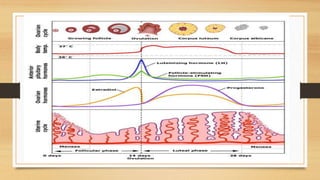
• Frequency: 21 days to 35 days interval
• Duration: 2 days to 8 days; usually 4-6 days
• Flow: 35 ml although 10ml – 80ml is considered normal.
• (1 normally soaked regular pad/tampon holds +/- 5mls of blood.
However, depending on the brand, a pad can hold between 5 and 15 ml
of blood)
Normal Uterine Bleeding
 Menarche:
• 9-16 years (mean 12,8) usually 2,3 years after 1st sign of breast
development.
 Reproductive years:
• Cycle length 23-39 days (mean 30).
• Duration of menstrual bleeding 2-8 days (mean 5).
• Normal blood loss 10-55ml(=/< 80mls)
 Menopause:
• 48-55 years (mean 51,3); 40 – 48 = early menopause
Abnormal Uterine Bleeding
• What is abnormal uterine bleeding?
• Bleeding from the uterine corpus that is abnormal in regularity,
volume, frequency or duration, and occurs in absence of
pregnancy
ACOG: American Congress of Obstetricians and Gynecologists, 2013
AUB: OLDER CLASSIFICATION
Older classification/terminologies
• Dysfunctional Uterine Bleeding: uterine bleeding, diagnosis of
exclusion
• Menorrhagia: heavy menstrual bleeding (>80 mL)
• Metrorrhagia: bleeding between periods – irregular intervals,
excessive flow and duration
• Polymenorrhea: bleeding that occurs more often than every 21 days
• Oligomenorrhea: bleeding that occurs at intervals longer than every
35 days
Older Definitions cont.
• Amenorrhea: no menstruation. primary (if no menses by age of 16
years) and secondary (if no menses for at least 3 months after
menarche has occurred).
• Oligomenorrhoea: normal menstrual duration and intensity but
decreased frequency. lengthened cycle >39 days. usually associated
with anovulation
• Post-menopausal bleeding: vaginal bleeding in a woman who has
reached menopausal age OR had 6 months of amenorrhea preceding
the episode of vaginal bleeding.
Definitions
• Polymenorrhoea:
Menstruation with normal duration
and flow, but shorted cycle with intervals < 25 days
• Menorrhagia/ Hypermenorrhoea:
Heavy cyclical bleeding - increased duration and/or increased flow
• Metrorrhagia: acyclical, irregular or continuous
Uterine bleeding independent of menstrual pattern
• Menometrorrhagia:
Increased flow during menstruation and between menstrual periods
• Dysfunctional Uterine Bleeding
AUB vs DUB
• Prior definitions had some gray areas.
• “Dysfunctional uterine bleeding” is a term used synonymously with AUB
in literature…
• But unlike AUB, DUB is a diagnosis of exclusion for which no cause was
identifiable
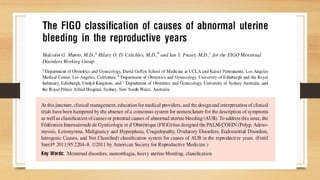
• FIGO in 2011 eliminated misleading terms
• Articles also unanimously recommend discontinuing use of the term
DUB.
FIGO: International Federation of Gynecology and Obstetrics, 2011
AUB: FIGO CLASSIFICATION
PALM-COEIN
PALM-COEIN Classification
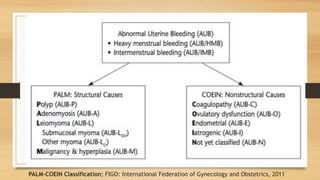
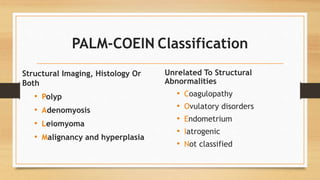
• A new classification system known is by acronym “PALM-COIEIN”
• It classifies by bleeding pattern & aetiology.
• It was introduced by FIGO in 2011, to create universal nomenclature
system to describe uterine bleeding abnormalities in reproductive-
aged women
• ACOG also supported adopting PALM-COEIN classification/nomenclature
to standardize terminology used to describe AUB
FIGO: International Federation of Gynecology and Obstetrics; ACOG: American Congress of Obst & Gyne
FIGO Classifications cont.
• Abnormal Uterine Bleeding (AUB): quantity, regularity and/or timing
• Acute AUB: episode of heavy bleeding that is sufficient amount to
require immediate intervention to prevent further blood loss
• Chronic AUB: AUB present for most of previous 6 months
• Acute AUB can be spontaneous or in context of chronic AUB
FIGO Classifications cont.
• Intermenstrual bleeding (IMB): bleeding between clearly defined
cycles
• Heavy menstrual bleeding (HMB): excessive menstrual blood loss
affecting quality of life – physical, emotional, social, material
• Objective HMB: blood loss > 80ml/ cycle. 60% of these women
will have evidence of iron deficiency anaemia.
• Subjective HMB:50% of women presenting with heavy menses
will have measured blood loss within normal limits but must
still be considered abnormal, and investigated accordingly.
PALM-COEIN Classification; FIGO: International Federation of Gynecology and Obstetrics, 2011
PALM-COEIN Classification
Structural Imaging, Histology Or
Both
• Polyp
• Adenomyosis
• Leiomyoma
• Malignancy and hyperplasia
Unrelated To Structural
Abnormalities
• Coagulopathy
• Ovulatory disorders
• Endometrium
• Iatrogenic
• Not classified
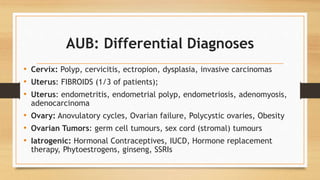
AUB: Differential Diagnoses
• Cervix: Polyp, cervicitis, ectropion, dysplasia, invasive carcinomas
• Uterus: FIBROIDS (1/3 of patients);
• Uterus: endometritis, endometrial polyp, endometriosis, adenomyosis,
adenocarcinoma
• Ovary: Anovulatory cycles, Ovarian failure, Polycystic ovaries, Obesity
• Ovarian Tumors: germ cell tumours, sex cord (stromal) tumours
• Iatrogenic: Hormonal Contraceptives, IUCD, Hormone replacement
therapy, Phytoestrogens, ginseng, SSRIs
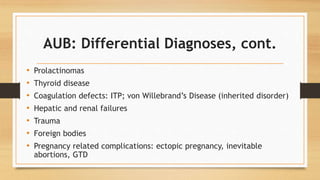
AUB: Differential Diagnoses, cont.
• Prolactinomas
• Thyroid disease
• Coagulation defects: ITP; von Willebrand’s Disease (inherited disorder)
• Hepatic and renal failures
• Trauma
• Foreign bodies
• Pregnancy related complications: ectopic pregnancy, inevitable
abortions, GTD
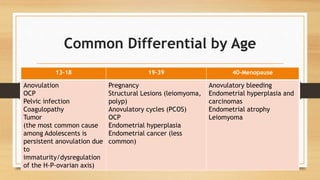
Common Differential by Age
13-18 19-39 40-Menopause
Anovulation
OCP
Pelvic infection
Coagulopathy
Tumor
(the most common cause
among Adolescents is
persistent anovulation due
to
immaturity/dysregulation
of the H-P-ovarian axis)
Pregnancy
Structural Lesions (leiomyoma,
polyp)
Anovulatory cycles (PCOS)
OCP
Endometrial hyperplasia
Endometrial cancer (less
common)
Anovulatory bleeding
Endometrial hyperplasia and
carcinomas
Endometrial atrophy
Leiomyoma
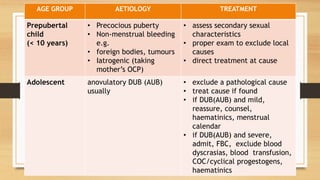
AGE GROUP AETIOLOGY TREATMENT
Prepubertal
child
(< 10 years)
• Precocious puberty
• Non-menstrual bleeding
e.g.
• foreign bodies, tumours
• Iatrogenic (taking
mother’s OCP)
• assess secondary sexual
characteristics
• proper exam to exclude local
causes
• direct treatment at cause
Adolescent anovulatory DUB (AUB)
usually
• exclude a pathological cause
• treat cause if found
• if DUB(AUB) and mild,
reassure, counsel,
haematinics, menstrual
calendar
• if DUB(AUB) and severe,
admit, FBC, exclude blood
dyscrasias, blood transfusion,
COC/cyclical progestogens,
haematinics
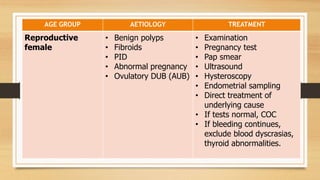
AGE GROUP AETIOLOGY TREATMENT
Reproductive
female
• Benign polyps
• Fibroids
• PID
• Abnormal pregnancy
• Ovulatory DUB (AUB)
• Examination
• Pregnancy test
• Pap smear
• Ultrasound
• Hysteroscopy
• Endometrial sampling
• Direct treatment of
underlying cause
• If tests normal, COC
• If bleeding continues,
exclude blood dyscrasias,
thyroid abnormalities.
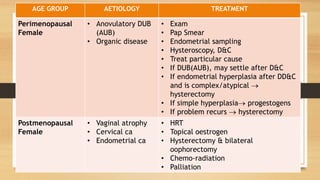
AGE GROUP AETIOLOGY TREATMENT
Perimenopausal
Female
• Anovulatory DUB
(AUB)
• Organic disease
• Exam
• Pap Smear
• Endometrial sampling
• Hysteroscopy, D&C
• Treat particular cause
• If DUB(AUB), may settle after D&C
• If endometrial hyperplasia after DD&C
and is complex/atypical 
hysterectomy
• If simple hyperplasia progestogens
• If problem recurs  hysterectomy
Postmenopausal
Female
• Vaginal atrophy
• Cervical ca
• Endometrial ca
• HRT
• Topical oestrogen
• Hysterectomy & bilateral
oophorectomy
• Chemo-radiation
• Palliation
DIAGNOSIS
Assessment of Patient with Acute AUB
• General Approach:
i. Assess rapidly the clinical picture to determine patient’s
acuity
ii. Determine most likely cause of bleeding
iii. Choosing the most appropriate treatment for the patient
History: Focus
• 1. guided by palm-coein system
• 2. focus on details of current bleeding episodes – length, duration,
amount, presence of clots, and related symptoms e.g. dizziness
• 3. past menstrual and gynaecological history; pap smears, recent
surgery, previous medical treatment for gynaecological disorders.
• 4. Sexual history and contraceptive hormone use.
• 5. medical history, medications: warfarin, heparin, NSAID, OCP,
ginseng
• 6. Personal/family history of bleeding disorders family history
Physical Examination: Focus
• 1. sign of acute blood loss e.g. Vital signs, evidence of hypovolemic
shock
• 2. findings suggesting the aetiology – “palm coein” e.g. obesity and
hirsutism in PCOS; cold/heat intolerance and proptosis in thyroid
dysfunction; petechiae in bleeding disorder; splenomegaly -
haematological disorders
• 3. confirm it is bleeding from genital tracts (and not other places –
pelvic examination, speculum and bimanual
• 4. differentiate between acute and chronic AUB e.g. admit, refer or
discharge
Labs: Acute AUB
• Pregnancy test (b-hcg)
• FBC, UEC
• Group and cross match blood
• Coagulation study – e.g. PTT/INR; when indicated – vW-factor
assay, ristocetin cofactor assay, Factor VIII etc.
• TSH, LFT, Nutritional/iron studies, renal, adrenal function in most
patients
Labs: Chronic AUB
• Pap Smear / Cervical cytology
• Hormonal Assay – FSH/LH, Prolactin levels,
• Nutritional/iron studies
• Gonorrhea/Chlamydia in high risk patients
• Retroviral screen
• Endometrial biopsy / endometrial sampling in an older patient
Imaging
• Pelvic Ultrasound
• TVUS: (transvaginal US is the primary imaging of uterus for
evaluation of AUB)
• Sono-hysterography (aka saline infusion sonohysterography)
• Hysteroscopy
• MRI
Evaluation cont.
Others:
• Cytopathology:
• Pap smear,
• Cervical biopsy,
• Endometrial biopsy
• Surgical
• D&C hysteroscopy
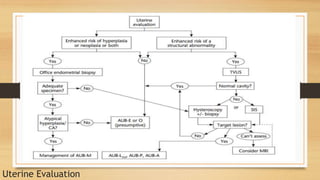
Uterine Evaluation
MANAGEMENT
Management: General Considerations
• 1. Medical management should be initial treatment for most patients
• 2. Need for surgery (including type of surgery) is based on various
factors:
• stability of patient
• severity of bleed
• contraindications to med management,
• underlying cause
• desire for future fertility
• 3. Long term maintenance therapy after acute bleed is controlled
Initial Approach
• Determine if AUB acute vs. chronic
• If acute AUB, are there signs of hypovolemia/hemodynamic
instability?
• If yes, resuscitate:
• IV access with 1 to 2 large bore IV;
• Crystalloids vs colloids
• Prepare for blood transfusion +/- clotting factor replacement
• Once stable, evaluate etiology (PALM-COEIN)
• Determine Treatment
Medical Management: Hormonal
• First line medical therapy for AUB (for patients not known with bleeding
disorders)
Treatment options:
• 1. Combined oral contraceptive pills – different combination
• 2. Progesterone therapy
• (medroxyprogesterone acetate – Cyclic Provera 2.5-10mg daily for
10-14 days / Continuous Provera 2.5-10mg daily / DepoProvera®
150mg IM every 3 months / Levonorgestrel IUCD 5 years / Implants )
Medical Management: Hormonal cont.
• 3. Conjugated oestrogen (e.g. IV estrogen 25mg qid or Premarin 1.25
po qid x 24hrs)
• 4. Progestin: Local – Mirena (IUCD), 20mcg levonorgestrel daily 5years
• 5. Progestin: Implantable – Implanon (etonogestrel,3rd generation
progestin), daily for 3years
• 6. GnRH analogue
• 7. Danazol
Medical Management: Hormonal cont.
Note:
• Long term therapy: levonorgesterel IUD, OCPs, progestin (PO or IM);
• Unopposed oestrogen should not be used long term
• OCPs are generally considered effective in management of both
ovulatory and Anovulatory AUB
Medical Management: Antifibrinolytics
• They are used as inhibitors of fibrinolysis without significant
increase in GIT side effects
• They reduce virtually all cases bleeding by 40-60%
• Examples: Tranexamic acid (Cyclokapron) and aminocaproic acid
• Tranexamic acid 1g QID x 4 days cycle for ovulatory DUB
• MOA – prevent plasminogen activation and decrease fibrinolysis,
so decreasing bleeding
Medical Management: NSAIDs
• Cyclo-oxygenase inhibitors (NSAIDS)
• Mode of action unclear, ?Vasoconstriction, ?suppress prostaglandin
synthesis
• Examples:
• Trials usually used Mefanamic acid (Ponstan) 250-500mg 2-4x
daily,
• Also naproxen and ibuprofen
Medical Management: Summary
• Fe (Iron) therapy
• Antifibrinolytics
• Cyclo-oxygenase inhibitors/
NSAIDS
• Progestin
• Continuous/cyclic
• Local
• Implantable
• Oestrogens plus progestin
• Androgens
• GNRH agonists and antagonists
Surgical Management
• . Need for surgery (including type of surgery) is based on various factors:
• stability of patient
• severity of bleed
• contraindications to medical management,
• patient not responding to medical management
• underlying cause
• desire for future fertility
Surgical Management Options
• Dilatation & Curettage
• Endometrial Ablation
• Uterine Artery Embolization
• Hysterectomy
• Others include:
• hysteroscopy with D&C
• polypectomy
• myomectomy
References
• Committee Opinion no 557: management of acute abnormal
uterine bleeding in nonpregnant reproductive-aged women.
Obstet Gynecol. 2013 Apr;121(4):891-6. doi:
10.1097/01.AOG.0000428646.67925.9a
THANK YOU!
CASE STUDY:
THE LIFE OF THEMBI
QUESTION 1
Thembi is a 8 year old girl. Her mother brings her to the ED because
she has noticed blood on her pant.
What are the potential causes?
• Foreign Bodies – most common
• Sexual Abuse
• Tumors – uncommon
• Early menarche
How to assess her?
• History : caregiver, onset, duration, medication (coc)
• Examination: Secondary sexual characteristics, bruises in and
around the perineum
Investigation
• EUA – using nasal speculum
• Vaginal Swabs
• Rape Kit if suspicion of abuse
QUESTION 2
Thembi, now 17yrs old P0 presents with the complaint of heavy,
irregular periods since her menarche at 16yrs of age.
She has recently started sexual activity and she is not on
contraceptives.
How do we assess her?
• Urinary/Blood β-HCG (i.e. urine/Blood pregnancy test)
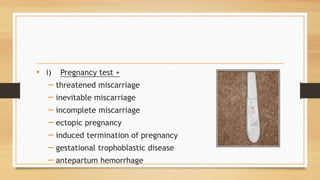
• i) Pregnancy test +
– threatened miscarriage
– inevitable miscarriage
– incomplete miscarriage
– ectopic pregnancy
– induced termination of pregnancy
– gestational trophoblastic disease
– antepartum hemorrhage
• ii) Pregnancy test -ve
• genital tract pathology
– congenital uterine abnormalities
– trauma
– infection e.g. PID
– endometriosis/adenomyosis
– benign neoplasms e.g. polyps, fibroids, endometrial hyperplasia
– malignant neoplasms e.g.. carcinomas, sarcomas
• Iatrogenic: hormones; anticoagulants - needs a more complete
history
• endocrine causes: Hypothyroidism; adrenal disorders
• systemic disorders: Hepatic; Renal; obesity
• blood dyscrasias: Van Willebrand’s; thrombocytopenia etc.
• For Thembi, take into consideration her young age, hasn’t
completed her family, expectant and medical management are
most appropriate – i.e. hematinic and hormone therapy (COC,
cyclical progestogens) should be used 1st.
QUESTION 3
• Suppose Thembi is a 36-year-old P1G1. She is sexually active with
HMB and post-coital bleeding.
What are the potential causes of the problem?
• Most likely to be pregnancy related OR
• Genital tract pathology
• Other likely causes:
• Cervical – dysplasia, cervicitis, malignancy
• Endometrial – endometritis, hyperplasia, polyps, fibroids.
After thorough history, examination, and investigation, Thembi was
found to have CINI
• She was then referred to GOPD for further repeat test in 6
months, assessment and staging.
• P.S.: in our environment premalignant and malignant cervical
disease have high prevalence.
QUESTION 4
• If Thembi is a 65yrs old female, 10yrs postmenopausal not on HRT
presenting with complain of 3 days history of PV bleeding.
• What to consider here
• Cancer until proven otherwise: Cervical ca; Endometrial ca
Others
• Systemic: Hematological; Hepatic
• Local: Infection e.g. viral, bacterial, fungal; Vaginal atrophy;
trauma
• Iatrogenic: Hormone; warfarin
• History
• Examination: general, focused
• Investigation: speculum, PAP, endometrial sampling, trans-vaginal
ultrasound, DD&C
• Management:
• Hemodynamic stability
• Treat underlying cause: topical estrogen, antifungal, correct
abnormal INR and PTT.
• If ca. cervix or endometrial  staging with CXR, AUS, CT
abdomen  treat accordingly

Abnormal Uterine Bleeding by Dr Kemi Dele

  • 1.
    ABNORMAL UTERINE BLEEDING Dr KDDele Dept. of Family Medicine Dora Nginza Hospital
  • 2.
  • 3.
    Introduction • Most commoncomplaint in Gynecological and Family practice. • Affects 1/3 of women at some stage in their life. • Key to management include: - establishing cause - instituting appropriate therapy
  • 4.
    Normal Uterine Bleeding •Age of patient: reproductive-aged women (from menarche to menopause) • Frequency: 21 days to 35 days interval • Duration: 2 days to 8 days; usually 4-6 days • Flow: 35 ml although 10ml – 80ml is considered normal. • (1 normally soaked regular pad/tampon holds +/- 5mls of blood. However, depending on the brand, a pad can hold between 5 and 15 ml of blood)
  • 5.
    Normal Uterine Bleeding Menarche: • 9-16 years (mean 12,8) usually 2,3 years after 1st sign of breast development.  Reproductive years: • Cycle length 23-39 days (mean 30). • Duration of menstrual bleeding 2-8 days (mean 5). • Normal blood loss 10-55ml(=/< 80mls)  Menopause: • 48-55 years (mean 51,3); 40 – 48 = early menopause
  • 8.
    Abnormal Uterine Bleeding •What is abnormal uterine bleeding? • Bleeding from the uterine corpus that is abnormal in regularity, volume, frequency or duration, and occurs in absence of pregnancy ACOG: American Congress of Obstetricians and Gynecologists, 2013
  • 9.
  • 10.
    Older classification/terminologies • DysfunctionalUterine Bleeding: uterine bleeding, diagnosis of exclusion • Menorrhagia: heavy menstrual bleeding (>80 mL) • Metrorrhagia: bleeding between periods – irregular intervals, excessive flow and duration • Polymenorrhea: bleeding that occurs more often than every 21 days • Oligomenorrhea: bleeding that occurs at intervals longer than every 35 days
  • 11.
    Older Definitions cont. •Amenorrhea: no menstruation. primary (if no menses by age of 16 years) and secondary (if no menses for at least 3 months after menarche has occurred). • Oligomenorrhoea: normal menstrual duration and intensity but decreased frequency. lengthened cycle >39 days. usually associated with anovulation • Post-menopausal bleeding: vaginal bleeding in a woman who has reached menopausal age OR had 6 months of amenorrhea preceding the episode of vaginal bleeding.
  • 12.
    Definitions • Polymenorrhoea: Menstruation withnormal duration and flow, but shorted cycle with intervals < 25 days • Menorrhagia/ Hypermenorrhoea: Heavy cyclical bleeding - increased duration and/or increased flow • Metrorrhagia: acyclical, irregular or continuous Uterine bleeding independent of menstrual pattern • Menometrorrhagia: Increased flow during menstruation and between menstrual periods • Dysfunctional Uterine Bleeding
  • 13.
    AUB vs DUB •Prior definitions had some gray areas. • “Dysfunctional uterine bleeding” is a term used synonymously with AUB in literature… • But unlike AUB, DUB is a diagnosis of exclusion for which no cause was identifiable • FIGO in 2011 eliminated misleading terms • Articles also unanimously recommend discontinuing use of the term DUB. FIGO: International Federation of Gynecology and Obstetrics, 2011
  • 14.
  • 15.
    PALM-COEIN Classification • Anew classification system known is by acronym “PALM-COIEIN” • It classifies by bleeding pattern & aetiology. • It was introduced by FIGO in 2011, to create universal nomenclature system to describe uterine bleeding abnormalities in reproductive- aged women • ACOG also supported adopting PALM-COEIN classification/nomenclature to standardize terminology used to describe AUB FIGO: International Federation of Gynecology and Obstetrics; ACOG: American Congress of Obst & Gyne
  • 17.
    FIGO Classifications cont. •Abnormal Uterine Bleeding (AUB): quantity, regularity and/or timing • Acute AUB: episode of heavy bleeding that is sufficient amount to require immediate intervention to prevent further blood loss • Chronic AUB: AUB present for most of previous 6 months • Acute AUB can be spontaneous or in context of chronic AUB
  • 18.
    FIGO Classifications cont. •Intermenstrual bleeding (IMB): bleeding between clearly defined cycles • Heavy menstrual bleeding (HMB): excessive menstrual blood loss affecting quality of life – physical, emotional, social, material • Objective HMB: blood loss > 80ml/ cycle. 60% of these women will have evidence of iron deficiency anaemia. • Subjective HMB:50% of women presenting with heavy menses will have measured blood loss within normal limits but must still be considered abnormal, and investigated accordingly.
  • 19.
    PALM-COEIN Classification; FIGO:International Federation of Gynecology and Obstetrics, 2011
  • 20.
    PALM-COEIN Classification Structural Imaging,Histology Or Both • Polyp • Adenomyosis • Leiomyoma • Malignancy and hyperplasia Unrelated To Structural Abnormalities • Coagulopathy • Ovulatory disorders • Endometrium • Iatrogenic • Not classified
  • 21.
    AUB: Differential Diagnoses •Cervix: Polyp, cervicitis, ectropion, dysplasia, invasive carcinomas • Uterus: FIBROIDS (1/3 of patients); • Uterus: endometritis, endometrial polyp, endometriosis, adenomyosis, adenocarcinoma • Ovary: Anovulatory cycles, Ovarian failure, Polycystic ovaries, Obesity • Ovarian Tumors: germ cell tumours, sex cord (stromal) tumours • Iatrogenic: Hormonal Contraceptives, IUCD, Hormone replacement therapy, Phytoestrogens, ginseng, SSRIs
  • 22.
    AUB: Differential Diagnoses,cont. • Prolactinomas • Thyroid disease • Coagulation defects: ITP; von Willebrand’s Disease (inherited disorder) • Hepatic and renal failures • Trauma • Foreign bodies • Pregnancy related complications: ectopic pregnancy, inevitable abortions, GTD
  • 23.
    Common Differential byAge 13-18 19-39 40-Menopause Anovulation OCP Pelvic infection Coagulopathy Tumor (the most common cause among Adolescents is persistent anovulation due to immaturity/dysregulation of the H-P-ovarian axis) Pregnancy Structural Lesions (leiomyoma, polyp) Anovulatory cycles (PCOS) OCP Endometrial hyperplasia Endometrial cancer (less common) Anovulatory bleeding Endometrial hyperplasia and carcinomas Endometrial atrophy Leiomyoma
  • 24.
    AGE GROUP AETIOLOGYTREATMENT Prepubertal child (< 10 years) • Precocious puberty • Non-menstrual bleeding e.g. • foreign bodies, tumours • Iatrogenic (taking mother’s OCP) • assess secondary sexual characteristics • proper exam to exclude local causes • direct treatment at cause Adolescent anovulatory DUB (AUB) usually • exclude a pathological cause • treat cause if found • if DUB(AUB) and mild, reassure, counsel, haematinics, menstrual calendar • if DUB(AUB) and severe, admit, FBC, exclude blood dyscrasias, blood transfusion, COC/cyclical progestogens, haematinics
  • 25.
    AGE GROUP AETIOLOGYTREATMENT Reproductive female • Benign polyps • Fibroids • PID • Abnormal pregnancy • Ovulatory DUB (AUB) • Examination • Pregnancy test • Pap smear • Ultrasound • Hysteroscopy • Endometrial sampling • Direct treatment of underlying cause • If tests normal, COC • If bleeding continues, exclude blood dyscrasias, thyroid abnormalities.
  • 26.
    AGE GROUP AETIOLOGYTREATMENT Perimenopausal Female • Anovulatory DUB (AUB) • Organic disease • Exam • Pap Smear • Endometrial sampling • Hysteroscopy, D&C • Treat particular cause • If DUB(AUB), may settle after D&C • If endometrial hyperplasia after DD&C and is complex/atypical  hysterectomy • If simple hyperplasia progestogens • If problem recurs  hysterectomy Postmenopausal Female • Vaginal atrophy • Cervical ca • Endometrial ca • HRT • Topical oestrogen • Hysterectomy & bilateral oophorectomy • Chemo-radiation • Palliation
  • 27.
  • 28.
    Assessment of Patientwith Acute AUB • General Approach: i. Assess rapidly the clinical picture to determine patient’s acuity ii. Determine most likely cause of bleeding iii. Choosing the most appropriate treatment for the patient
  • 29.
    History: Focus • 1.guided by palm-coein system • 2. focus on details of current bleeding episodes – length, duration, amount, presence of clots, and related symptoms e.g. dizziness • 3. past menstrual and gynaecological history; pap smears, recent surgery, previous medical treatment for gynaecological disorders. • 4. Sexual history and contraceptive hormone use. • 5. medical history, medications: warfarin, heparin, NSAID, OCP, ginseng • 6. Personal/family history of bleeding disorders family history
  • 30.
    Physical Examination: Focus •1. sign of acute blood loss e.g. Vital signs, evidence of hypovolemic shock • 2. findings suggesting the aetiology – “palm coein” e.g. obesity and hirsutism in PCOS; cold/heat intolerance and proptosis in thyroid dysfunction; petechiae in bleeding disorder; splenomegaly - haematological disorders • 3. confirm it is bleeding from genital tracts (and not other places – pelvic examination, speculum and bimanual • 4. differentiate between acute and chronic AUB e.g. admit, refer or discharge
  • 31.
    Labs: Acute AUB •Pregnancy test (b-hcg) • FBC, UEC • Group and cross match blood • Coagulation study – e.g. PTT/INR; when indicated – vW-factor assay, ristocetin cofactor assay, Factor VIII etc. • TSH, LFT, Nutritional/iron studies, renal, adrenal function in most patients
  • 32.
    Labs: Chronic AUB •Pap Smear / Cervical cytology • Hormonal Assay – FSH/LH, Prolactin levels, • Nutritional/iron studies • Gonorrhea/Chlamydia in high risk patients • Retroviral screen • Endometrial biopsy / endometrial sampling in an older patient
  • 33.
    Imaging • Pelvic Ultrasound •TVUS: (transvaginal US is the primary imaging of uterus for evaluation of AUB) • Sono-hysterography (aka saline infusion sonohysterography) • Hysteroscopy • MRI
  • 34.
    Evaluation cont. Others: • Cytopathology: •Pap smear, • Cervical biopsy, • Endometrial biopsy • Surgical • D&C hysteroscopy
  • 35.
  • 36.
  • 37.
    Management: General Considerations •1. Medical management should be initial treatment for most patients • 2. Need for surgery (including type of surgery) is based on various factors: • stability of patient • severity of bleed • contraindications to med management, • underlying cause • desire for future fertility • 3. Long term maintenance therapy after acute bleed is controlled
  • 38.
    Initial Approach • Determineif AUB acute vs. chronic • If acute AUB, are there signs of hypovolemia/hemodynamic instability? • If yes, resuscitate: • IV access with 1 to 2 large bore IV; • Crystalloids vs colloids • Prepare for blood transfusion +/- clotting factor replacement
  • 39.
    • Once stable,evaluate etiology (PALM-COEIN) • Determine Treatment
  • 41.
    Medical Management: Hormonal •First line medical therapy for AUB (for patients not known with bleeding disorders) Treatment options: • 1. Combined oral contraceptive pills – different combination • 2. Progesterone therapy • (medroxyprogesterone acetate – Cyclic Provera 2.5-10mg daily for 10-14 days / Continuous Provera 2.5-10mg daily / DepoProvera® 150mg IM every 3 months / Levonorgestrel IUCD 5 years / Implants )
  • 42.
    Medical Management: Hormonalcont. • 3. Conjugated oestrogen (e.g. IV estrogen 25mg qid or Premarin 1.25 po qid x 24hrs) • 4. Progestin: Local – Mirena (IUCD), 20mcg levonorgestrel daily 5years • 5. Progestin: Implantable – Implanon (etonogestrel,3rd generation progestin), daily for 3years • 6. GnRH analogue • 7. Danazol
  • 43.
    Medical Management: Hormonalcont. Note: • Long term therapy: levonorgesterel IUD, OCPs, progestin (PO or IM); • Unopposed oestrogen should not be used long term • OCPs are generally considered effective in management of both ovulatory and Anovulatory AUB
  • 44.
    Medical Management: Antifibrinolytics •They are used as inhibitors of fibrinolysis without significant increase in GIT side effects • They reduce virtually all cases bleeding by 40-60% • Examples: Tranexamic acid (Cyclokapron) and aminocaproic acid • Tranexamic acid 1g QID x 4 days cycle for ovulatory DUB • MOA – prevent plasminogen activation and decrease fibrinolysis, so decreasing bleeding
  • 45.
    Medical Management: NSAIDs •Cyclo-oxygenase inhibitors (NSAIDS) • Mode of action unclear, ?Vasoconstriction, ?suppress prostaglandin synthesis • Examples: • Trials usually used Mefanamic acid (Ponstan) 250-500mg 2-4x daily, • Also naproxen and ibuprofen
  • 46.
    Medical Management: Summary •Fe (Iron) therapy • Antifibrinolytics • Cyclo-oxygenase inhibitors/ NSAIDS • Progestin • Continuous/cyclic • Local • Implantable • Oestrogens plus progestin • Androgens • GNRH agonists and antagonists
  • 47.
    Surgical Management • .Need for surgery (including type of surgery) is based on various factors: • stability of patient • severity of bleed • contraindications to medical management, • patient not responding to medical management • underlying cause • desire for future fertility
  • 48.
    Surgical Management Options •Dilatation & Curettage • Endometrial Ablation • Uterine Artery Embolization • Hysterectomy • Others include: • hysteroscopy with D&C • polypectomy • myomectomy
  • 49.
    References • Committee Opinionno 557: management of acute abnormal uterine bleeding in nonpregnant reproductive-aged women. Obstet Gynecol. 2013 Apr;121(4):891-6. doi: 10.1097/01.AOG.0000428646.67925.9a
  • 50.
  • 51.
  • 52.
    QUESTION 1 Thembi isa 8 year old girl. Her mother brings her to the ED because she has noticed blood on her pant. What are the potential causes? • Foreign Bodies – most common • Sexual Abuse • Tumors – uncommon • Early menarche
  • 53.
    How to assessher? • History : caregiver, onset, duration, medication (coc) • Examination: Secondary sexual characteristics, bruises in and around the perineum Investigation • EUA – using nasal speculum • Vaginal Swabs • Rape Kit if suspicion of abuse
  • 54.
    QUESTION 2 Thembi, now17yrs old P0 presents with the complaint of heavy, irregular periods since her menarche at 16yrs of age. She has recently started sexual activity and she is not on contraceptives. How do we assess her? • Urinary/Blood β-HCG (i.e. urine/Blood pregnancy test)
  • 55.
    • i) Pregnancytest + – threatened miscarriage – inevitable miscarriage – incomplete miscarriage – ectopic pregnancy – induced termination of pregnancy – gestational trophoblastic disease – antepartum hemorrhage
  • 56.
    • ii) Pregnancytest -ve • genital tract pathology – congenital uterine abnormalities – trauma – infection e.g. PID – endometriosis/adenomyosis – benign neoplasms e.g. polyps, fibroids, endometrial hyperplasia – malignant neoplasms e.g.. carcinomas, sarcomas
  • 57.
    • Iatrogenic: hormones;anticoagulants - needs a more complete history • endocrine causes: Hypothyroidism; adrenal disorders • systemic disorders: Hepatic; Renal; obesity • blood dyscrasias: Van Willebrand’s; thrombocytopenia etc.
  • 58.
    • For Thembi,take into consideration her young age, hasn’t completed her family, expectant and medical management are most appropriate – i.e. hematinic and hormone therapy (COC, cyclical progestogens) should be used 1st.
  • 59.
    QUESTION 3 • SupposeThembi is a 36-year-old P1G1. She is sexually active with HMB and post-coital bleeding.
  • 60.
    What are thepotential causes of the problem? • Most likely to be pregnancy related OR • Genital tract pathology • Other likely causes: • Cervical – dysplasia, cervicitis, malignancy • Endometrial – endometritis, hyperplasia, polyps, fibroids.
  • 61.
    After thorough history,examination, and investigation, Thembi was found to have CINI • She was then referred to GOPD for further repeat test in 6 months, assessment and staging. • P.S.: in our environment premalignant and malignant cervical disease have high prevalence.
  • 62.
    QUESTION 4 • IfThembi is a 65yrs old female, 10yrs postmenopausal not on HRT presenting with complain of 3 days history of PV bleeding.
  • 63.
    • What toconsider here • Cancer until proven otherwise: Cervical ca; Endometrial ca Others • Systemic: Hematological; Hepatic • Local: Infection e.g. viral, bacterial, fungal; Vaginal atrophy; trauma • Iatrogenic: Hormone; warfarin
  • 64.
    • History • Examination:general, focused • Investigation: speculum, PAP, endometrial sampling, trans-vaginal ultrasound, DD&C
  • 65.
    • Management: • Hemodynamicstability • Treat underlying cause: topical estrogen, antifungal, correct abnormal INR and PTT. • If ca. cervix or endometrial  staging with CXR, AUS, CT abdomen  treat accordingly