Benha University Hospital
Email: elnashar53@hotmail.com
Aboubakr Elnashar
 An acquired autoimmune disorder characterized by
-moderate to high levels of antiphospholipid
antibodies
(LA or aCl or a-ß2GPI) &
-specific clinical features
(arterial or venous thrombosis or pregnancy morbidity)
(Miyakis et al, 2006)
 20 antibodies
 First description:
1983 (Graham Hughes)
Aboubakr Elnashar
Primary: 50%
other features of connective tissue disease are
absent
Secondary: 50%
to connective tissue disease e.g. SLE
Aboubakr Elnashar
Epidemiology
 General population:
2-4%. increases with age and chronic disease
 Recurrent fetal loss:
15 %
 SLE:
30%
 aCL antibodies:
more common than LA
(aCL 5X more than LA)
Aboubakr Elnashar
1. Recurrent pregnancy loss. 25%.
Majority: in 1st T after the establishment of FHR
activity.
15% of RPL
2. Preeclampsia: 15-50%.
15% of severe PET before 34 w have APL Ab
3. IUGR: 30%
4. Preterm labor
5. Maternal thrombosis (including strokes)
Aboubakr Elnashar
Mechanisms
1. Inhibition of trophoblastic function& differentiation
(Bose et al, 2005)
2. Activation of complement pathways at the
maternal–fetal interface: local inflammatory
response
(Salmon et al, 2003)
3. In later pregnancy, thrombosis of the
uteroplacental vasculature
(Peaceman et al, 1993).
neither universal nor specific
(Jivraj & Rai, 2003)
Aboubakr Elnashar
Controversy.
 aPl is responsible for implantation failure.
aPL is 23% in females referred for IVF Vs 2% in
fertile females
(Chilcott et al,2000)
 Routine screening for aPL among women
undergoing IVF-ET is not warranted
(Branch et al,2003)
Aboubakr Elnashar
Postpartum syndrome
Rare
Manifestations
Pleuropulmonary disease
Fever
Cardiac manifestations
Mechanism
Unknown
extensive Img and C3 deposition in myocardium
Aboubakr Elnashar
Aboubakr Elnashar
Sydney clinical criteria for APS (2006)
 At least 1 clinical and 1 laboratory criterion.
 Not if there is <12 W or > 5 years between
+ve aPLab and the clinical manifestation
Aboubakr Elnashar
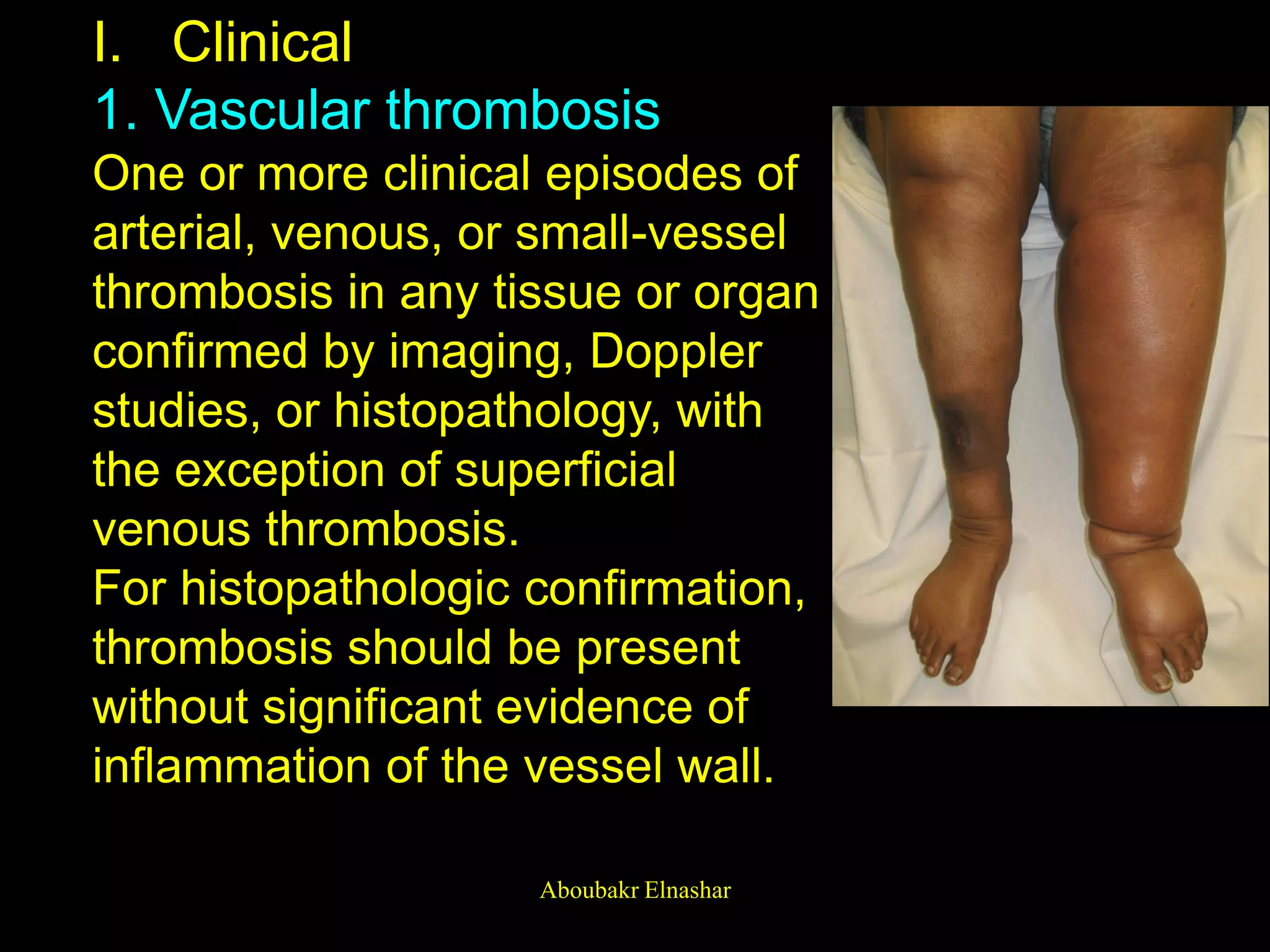
I. Clinical
1. Vascular thrombosis
One or more clinical episodes of
arterial, venous, or small-vessel
thrombosis in any tissue or organ
confirmed by imaging, Doppler
studies, or histopathology, with
the exception of superficial
venous thrombosis.
For histopathologic confirmation,
thrombosis should be present
without significant evidence of
inflammation of the vessel wall.
Aboubakr Elnashar
2. Pregnancy morbidity
(a) One or more unexplained deaths of a
morphologically normal fetus at or beyond the 10th w,
with normal fetal morphology documented by US or by
direct examination of the fetus, or
(b) One or more premature births of a morphologically
normal neonate at or before the 34th w because of
severe preeclampsia or eclampsia or severe placental
insufficiency, or
(c) Three or more unexplained consecutive
spontaneous abortions before the 10th w, with
maternal anatomic or hormonal abnormalities and
paternal and maternal chromosomal causes excluded.
N.B: in practice evaluation after 2 early miscarriage
Aboubakr Elnashar
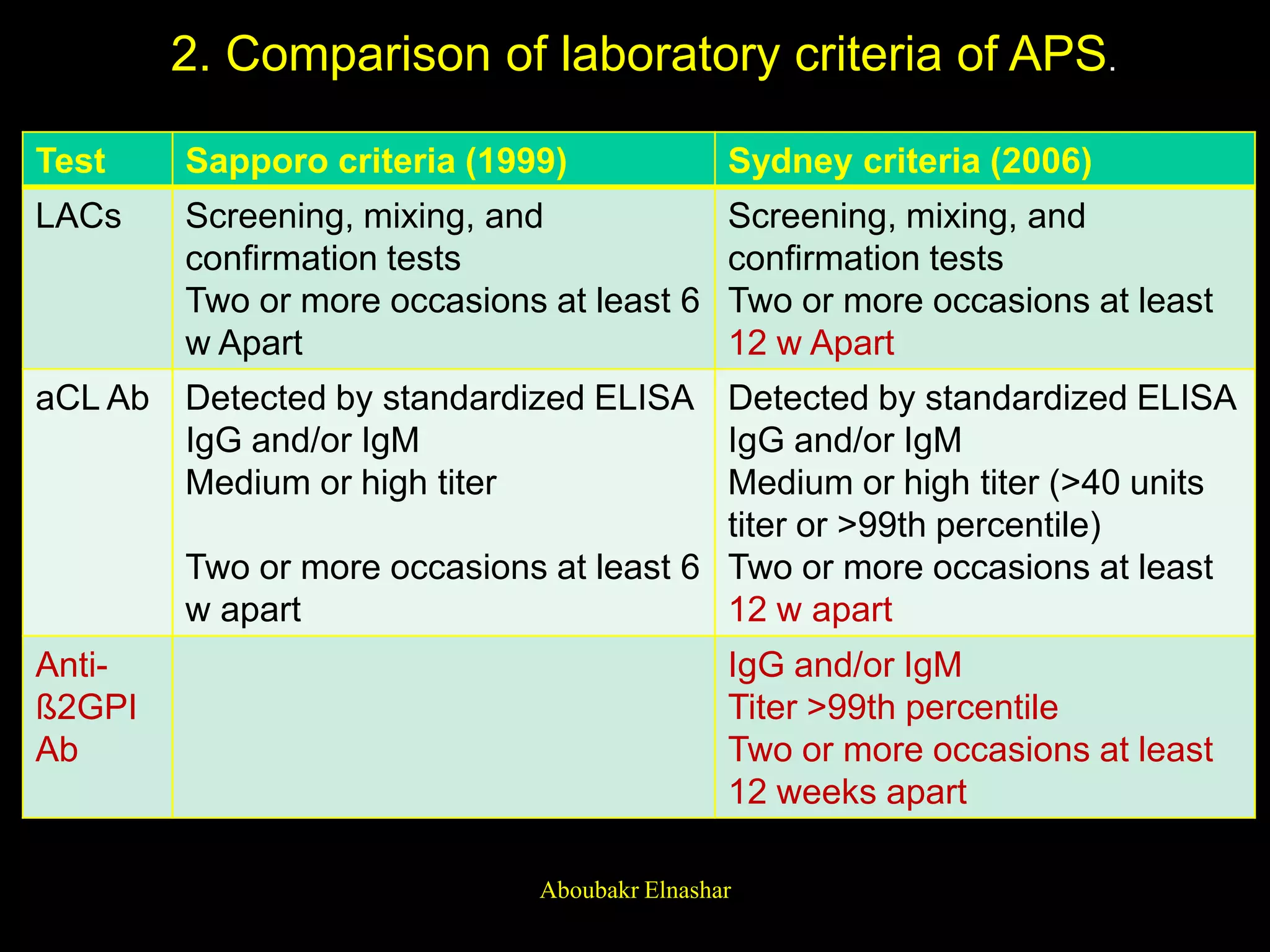
2. Comparison of laboratory criteria of APS.
Test Sapporo criteria (1999) Sydney criteria (2006)
LACs Screening, mixing, and
confirmation tests
Two or more occasions at least 6
w Apart
Screening, mixing, and
confirmation tests
Two or more occasions at least
12 w Apart
aCL Ab Detected by standardized ELISA
IgG and/or IgM
Medium or high titer
Two or more occasions at least 6
w apart
Detected by standardized ELISA
IgG and/or IgM
Medium or high titer (>40 units
titer or >99th percentile)
Two or more occasions at least
12 w apart
Anti-
ß2GPI
Ab
IgG and/or IgM
Titer >99th percentile
Two or more occasions at least
12 weeks apart
Aboubakr Elnashar
Interpretation:
•A repeat tests at least 6 (12) W apart.
{Individuals may have transiently positive test
because a low to mid positive level can be due to viral
illness and revert to normal& those with an initial
negative test may be in the transient negative phase
of their aPL cycle.}
•LA, aCL and aβ2GPI testing are all required for the
accurate diagnosis
•Once APS is diagnosed, serial aPL testing is not
useful
Aboubakr Elnashar
•LA:
positive or negative
more specific.
aCL:
international units.
more sensitive
Titer is related to risk of fetal loss
(Rai et al,1995)
•IgG Ab
more specific than IgM.
better predictors of fetal outcome
(Lockwood et al,1986)
-IgA
-no greater risk
(Silver et al 1996). Aboubakr Elnashar
laboratory data-based classification system
International Consensus Guidelines, 2006
Category Criteria
I More than 1 laboratory criterion present
in any combination
IIa LA present, only
IIb aCL present, only
IIc anti-β2GPI present, only
Aboubakr Elnashar
Controversial points in interpreting
-Low positive IgG AcL Ab:
No greater risk for APA related events
(Silver et al, 1996).
should be regarded as of questionable clinical
significance (Branch et al,2003)
should be included in the diagnosis of obstetric
APS.
(Gardiner et al, 2013)
Aboubakr Elnashar
Obstetric indications:
1. Unexplained stillbirth
2. Recurrent pregnancy loss
3.Unexplained 2nd or 3rd T fetal death
4. IUGR
5. Severe preeclampsia at less than 34 w.
6. Placental abruption (previous or current)
Aboubakr Elnashar
.Non-obstetric indication
1.False positive serologic test for syphilis
2.Autoimmune diseases: SLE, thrombocytopenia
3.Unexplained thrombosis
4.Haemolytic anaemia
5.Stroke, especially between 25-50 yr
6.Livedo reticularis
Livedo reticularis
Aboubakr Elnashar
Aboubakr Elnashar
A. Before pregnancy: Pre-conceptional
counseling
1. Clinical: review med and obs history, asses other
risk factors, obesity, age
2. Lab:
Confirm persistent aPLab
Assess R function
CBC: anaemia thrompocytopenia
3. Treatment
Postpone pregnancy if thrombotic event <6 month
Initial low dose aspirin [increase success]Aboubakr Elnashar
B. During pregnancy
 Objectives:
Improve maternal & fetal-neonatal outcome by
preventing complications
Reduce or eliminate the maternal thrombotic risk
1. TVS: confirm live embryo at 5.5-6.5 W
2. Continue low dose aspirin
3. Initial heparin treatment
Aboubakr Elnashar
Clinical care
ANV/4 W until 20W
then /1-2 W
Monitor for fetal
death, PET, IUGR
Diagnostic tests
U/S:/4W beginning at 20 W.
Assess fetal growth & AFV
Fetal surveillance: weekly from
30W. CTG,
Uterine a Doppler: at 20 for
prediction of PET
If early diastolic notch seen: do
2 weekly growth scans due to
high risk of IUGR
Platelet count
Aboubakr Elnashar
Medications:
Low dose aspirin (75 mg) in combination with
heparin is the first line treatment
(MRCOG, 2011)
Start with the positive pregnancy test till 34 w.
-Success: 70%
(Rai et al,1997)
-Reduces the miscarriage rate by 54%
(Empson et al, Cochrane Database Syst Rev, 2005)
Aboubakr Elnashar
Heparin:
Complications:
Hemorrhage
Thrombocytopenia: Rare
Osteopenia:
Loss in BMD of the lumbar spine is similar to
physiological osteopenia in untreated pregnancies
Aboubakr Elnashar
Un-fractionated heparin Vs LMWH:
•LMWH is widely used in Europe, whereas cost
considerations limit its use in other countries.
•No significant difference in
BMD or live birth rate
(Farquharson,2000)
LMWH advantages
once daily
less thrombocytopenia
osteopenia
Aboubakr Elnashar
Dose:
A. No history of thrombosis:
Standard heparin:
1st T: 5000-10000 U /12 h
2nd and 3rd T: 10000 U/12 hrs
LMWH:
Enoxaparin (clexan) 20 mg once daily
Dalteprin 5000 U once daily.
Aboubakr Elnashar
B. History of thrombosis
Standard heparin:
/8-12 hrs {maintain the midinterval heparin levels in
the therapeutic range}.
(Heparin level = anti-factorXa levels.)
Women without a LA in whom APTT is normal can
be observed using APTT.
LMWH
Enoxaparine: 0.5 mg/kg /12 h or 40 mg once daily.
Aboubakr Elnashar
IV immunoglobulin:
Expensive
No benefit relative to heparin & low dose aspirin.
Reserved for cases refractory to aspirin & heparin
(Jivaraj & Rai,2003)
Corticosteroids (prednisone):
abandoned
{do not improve the live birth
significant maternal & fetal morbidity}
(Laskin et al,1997).
Warfarin:
History of recurrent thrombosis or cerebral
thrombosis
(Branch et al, 2003)
Aboubakr Elnashar
C. Postpartum
 History of thrombosis:
Warfarin thromboprophylaxis as soon as the patient
is clinically stable after delivery
(International normalized ratio (INR) of 3 is
desirable).
No history of thrombosis:
UK: Heparin for 5 d
USA: anticoagulant for 6 w.
Breast feeding:
Heparin & warfarin: safe
Contraception
estrogen-containing are contraindicated.
Aboubakr Elnashar
Women refractory to aspirin & heparin
(Branch et al,2003).
Full anticoagulation in the next pregnancy
if failed:
IV immunoglobulin:
{antiidiotypic down-regulation of auto-antibody
production}
Aboubakr Elnashar
• For diagnosis: 2
1 of 2 clinical criteria (thrombosis or pregnancy
morbidity) &
1 of 3 laboratory criteria (medium to high titer of aCL
or positive LA or Anti-ß2GPI Ab)
• For treatment: 2
low dose aspirin & heparin starting with positive
pregnancy test till 34 w.
Aboubakr Elnashar
Aboubakr Elnashar

Obstetric antiphospholipid antibody syndrome

  • 1.
    Benha University Hospital Email:elnashar53@hotmail.com Aboubakr Elnashar
  • 2.
     An acquiredautoimmune disorder characterized by -moderate to high levels of antiphospholipid antibodies (LA or aCl or a-ß2GPI) & -specific clinical features (arterial or venous thrombosis or pregnancy morbidity) (Miyakis et al, 2006)  20 antibodies  First description: 1983 (Graham Hughes) Aboubakr Elnashar
  • 3.
    Primary: 50% other featuresof connective tissue disease are absent Secondary: 50% to connective tissue disease e.g. SLE Aboubakr Elnashar
  • 4.
    Epidemiology  General population: 2-4%.increases with age and chronic disease  Recurrent fetal loss: 15 %  SLE: 30%  aCL antibodies: more common than LA (aCL 5X more than LA) Aboubakr Elnashar
  • 5.
    1. Recurrent pregnancyloss. 25%. Majority: in 1st T after the establishment of FHR activity. 15% of RPL 2. Preeclampsia: 15-50%. 15% of severe PET before 34 w have APL Ab 3. IUGR: 30% 4. Preterm labor 5. Maternal thrombosis (including strokes) Aboubakr Elnashar
  • 6.
    Mechanisms 1. Inhibition oftrophoblastic function& differentiation (Bose et al, 2005) 2. Activation of complement pathways at the maternal–fetal interface: local inflammatory response (Salmon et al, 2003) 3. In later pregnancy, thrombosis of the uteroplacental vasculature (Peaceman et al, 1993). neither universal nor specific (Jivraj & Rai, 2003) Aboubakr Elnashar
  • 7.
    Controversy.  aPl isresponsible for implantation failure. aPL is 23% in females referred for IVF Vs 2% in fertile females (Chilcott et al,2000)  Routine screening for aPL among women undergoing IVF-ET is not warranted (Branch et al,2003) Aboubakr Elnashar
  • 8.
    Postpartum syndrome Rare Manifestations Pleuropulmonary disease Fever Cardiacmanifestations Mechanism Unknown extensive Img and C3 deposition in myocardium Aboubakr Elnashar
  • 9.
  • 10.
    Sydney clinical criteriafor APS (2006)  At least 1 clinical and 1 laboratory criterion.  Not if there is <12 W or > 5 years between +ve aPLab and the clinical manifestation Aboubakr Elnashar
  • 11.
    I. Clinical 1. Vascularthrombosis One or more clinical episodes of arterial, venous, or small-vessel thrombosis in any tissue or organ confirmed by imaging, Doppler studies, or histopathology, with the exception of superficial venous thrombosis. For histopathologic confirmation, thrombosis should be present without significant evidence of inflammation of the vessel wall. Aboubakr Elnashar
  • 12.
    2. Pregnancy morbidity (a)One or more unexplained deaths of a morphologically normal fetus at or beyond the 10th w, with normal fetal morphology documented by US or by direct examination of the fetus, or (b) One or more premature births of a morphologically normal neonate at or before the 34th w because of severe preeclampsia or eclampsia or severe placental insufficiency, or (c) Three or more unexplained consecutive spontaneous abortions before the 10th w, with maternal anatomic or hormonal abnormalities and paternal and maternal chromosomal causes excluded. N.B: in practice evaluation after 2 early miscarriage Aboubakr Elnashar
  • 13.
    2. Comparison oflaboratory criteria of APS. Test Sapporo criteria (1999) Sydney criteria (2006) LACs Screening, mixing, and confirmation tests Two or more occasions at least 6 w Apart Screening, mixing, and confirmation tests Two or more occasions at least 12 w Apart aCL Ab Detected by standardized ELISA IgG and/or IgM Medium or high titer Two or more occasions at least 6 w apart Detected by standardized ELISA IgG and/or IgM Medium or high titer (>40 units titer or >99th percentile) Two or more occasions at least 12 w apart Anti- ß2GPI Ab IgG and/or IgM Titer >99th percentile Two or more occasions at least 12 weeks apart Aboubakr Elnashar
  • 14.
    Interpretation: •A repeat testsat least 6 (12) W apart. {Individuals may have transiently positive test because a low to mid positive level can be due to viral illness and revert to normal& those with an initial negative test may be in the transient negative phase of their aPL cycle.} •LA, aCL and aβ2GPI testing are all required for the accurate diagnosis •Once APS is diagnosed, serial aPL testing is not useful Aboubakr Elnashar
  • 15.
    •LA: positive or negative morespecific. aCL: international units. more sensitive Titer is related to risk of fetal loss (Rai et al,1995) •IgG Ab more specific than IgM. better predictors of fetal outcome (Lockwood et al,1986) -IgA -no greater risk (Silver et al 1996). Aboubakr Elnashar
  • 16.
    laboratory data-based classificationsystem International Consensus Guidelines, 2006 Category Criteria I More than 1 laboratory criterion present in any combination IIa LA present, only IIb aCL present, only IIc anti-β2GPI present, only Aboubakr Elnashar
  • 17.
    Controversial points ininterpreting -Low positive IgG AcL Ab: No greater risk for APA related events (Silver et al, 1996). should be regarded as of questionable clinical significance (Branch et al,2003) should be included in the diagnosis of obstetric APS. (Gardiner et al, 2013) Aboubakr Elnashar
  • 18.
    Obstetric indications: 1. Unexplainedstillbirth 2. Recurrent pregnancy loss 3.Unexplained 2nd or 3rd T fetal death 4. IUGR 5. Severe preeclampsia at less than 34 w. 6. Placental abruption (previous or current) Aboubakr Elnashar
  • 19.
    .Non-obstetric indication 1.False positiveserologic test for syphilis 2.Autoimmune diseases: SLE, thrombocytopenia 3.Unexplained thrombosis 4.Haemolytic anaemia 5.Stroke, especially between 25-50 yr 6.Livedo reticularis Livedo reticularis Aboubakr Elnashar
  • 20.
  • 21.
    A. Before pregnancy:Pre-conceptional counseling 1. Clinical: review med and obs history, asses other risk factors, obesity, age 2. Lab: Confirm persistent aPLab Assess R function CBC: anaemia thrompocytopenia 3. Treatment Postpone pregnancy if thrombotic event <6 month Initial low dose aspirin [increase success]Aboubakr Elnashar
  • 22.
    B. During pregnancy Objectives: Improve maternal & fetal-neonatal outcome by preventing complications Reduce or eliminate the maternal thrombotic risk 1. TVS: confirm live embryo at 5.5-6.5 W 2. Continue low dose aspirin 3. Initial heparin treatment Aboubakr Elnashar
  • 23.
    Clinical care ANV/4 Wuntil 20W then /1-2 W Monitor for fetal death, PET, IUGR Diagnostic tests U/S:/4W beginning at 20 W. Assess fetal growth & AFV Fetal surveillance: weekly from 30W. CTG, Uterine a Doppler: at 20 for prediction of PET If early diastolic notch seen: do 2 weekly growth scans due to high risk of IUGR Platelet count Aboubakr Elnashar
  • 24.
    Medications: Low dose aspirin(75 mg) in combination with heparin is the first line treatment (MRCOG, 2011) Start with the positive pregnancy test till 34 w. -Success: 70% (Rai et al,1997) -Reduces the miscarriage rate by 54% (Empson et al, Cochrane Database Syst Rev, 2005) Aboubakr Elnashar
  • 25.
    Heparin: Complications: Hemorrhage Thrombocytopenia: Rare Osteopenia: Loss inBMD of the lumbar spine is similar to physiological osteopenia in untreated pregnancies Aboubakr Elnashar
  • 26.
    Un-fractionated heparin VsLMWH: •LMWH is widely used in Europe, whereas cost considerations limit its use in other countries. •No significant difference in BMD or live birth rate (Farquharson,2000) LMWH advantages once daily less thrombocytopenia osteopenia Aboubakr Elnashar
  • 27.
    Dose: A. No historyof thrombosis: Standard heparin: 1st T: 5000-10000 U /12 h 2nd and 3rd T: 10000 U/12 hrs LMWH: Enoxaparin (clexan) 20 mg once daily Dalteprin 5000 U once daily. Aboubakr Elnashar
  • 28.
    B. History ofthrombosis Standard heparin: /8-12 hrs {maintain the midinterval heparin levels in the therapeutic range}. (Heparin level = anti-factorXa levels.) Women without a LA in whom APTT is normal can be observed using APTT. LMWH Enoxaparine: 0.5 mg/kg /12 h or 40 mg once daily. Aboubakr Elnashar
  • 29.
    IV immunoglobulin: Expensive No benefitrelative to heparin & low dose aspirin. Reserved for cases refractory to aspirin & heparin (Jivaraj & Rai,2003) Corticosteroids (prednisone): abandoned {do not improve the live birth significant maternal & fetal morbidity} (Laskin et al,1997). Warfarin: History of recurrent thrombosis or cerebral thrombosis (Branch et al, 2003) Aboubakr Elnashar
  • 30.
    C. Postpartum  Historyof thrombosis: Warfarin thromboprophylaxis as soon as the patient is clinically stable after delivery (International normalized ratio (INR) of 3 is desirable). No history of thrombosis: UK: Heparin for 5 d USA: anticoagulant for 6 w. Breast feeding: Heparin & warfarin: safe Contraception estrogen-containing are contraindicated. Aboubakr Elnashar
  • 31.
    Women refractory toaspirin & heparin (Branch et al,2003). Full anticoagulation in the next pregnancy if failed: IV immunoglobulin: {antiidiotypic down-regulation of auto-antibody production} Aboubakr Elnashar
  • 32.
    • For diagnosis:2 1 of 2 clinical criteria (thrombosis or pregnancy morbidity) & 1 of 3 laboratory criteria (medium to high titer of aCL or positive LA or Anti-ß2GPI Ab) • For treatment: 2 low dose aspirin & heparin starting with positive pregnancy test till 34 w. Aboubakr Elnashar
  • 33.