Uterine Cancer Pedro T. Ramirez, M.D. Associate Professor Director of Minimally Invasive Research & Education Department of Gynecologic Oncology
Uterine Cancer Fourth most common cancer in women in the U.S. behind breast, lung, and colon cancer  Most common gynecologic malignancy Eighth leading cause of female mortality from cancer 97% arise from the endometrium (endometrial carcinoma) 3% arise from the mesenchymal components (sarcoma)
Epidemiology Median age of diagnosis:  60 years Most common in women > age 50 years Incidence is highly dependent on age 75% of uterine cancers occur in post-menopausal women There are two major pathogenic types of endometrial cancer  Type I Type II
Type I Endometrial Carcinoma Younger/peri-menopausal women Obese Associated with estrogen excess Well differentiated endometrioid Superficial myometrial invasion Infrequent lymph node metastases Associated with hyperplasia Genetic mutations in K-ras, PTEN, MLH1 Better prognosis
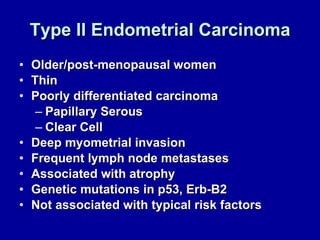
Type II Endometrial Carcinoma Older/post-menopausal women Thin Poorly differentiated carcinoma Papillary Serous Clear Cell Deep myometrial invasion Frequent lymph node metastases Associated with atrophy Genetic mutations in p53, Erb-B2 Not associated with typical risk factors
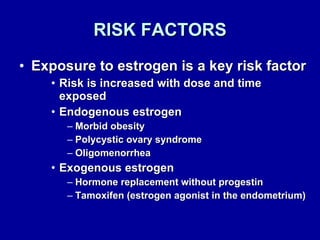
RISK FACTORS Exposure to estrogen is a key risk factor Risk is increased with dose and time exposed Endogenous estrogen Morbid obesity Polycystic ovary syndrome Oligomenorrhea Exogenous estrogen Hormone replacement without progestin Tamoxifen (estrogen agonist in the endometrium)
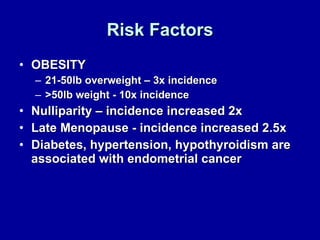
Risk Factors OBESITY  21-50lb overweight – 3x incidence >50lb weight - 10x incidence Nulliparity – incidence increased 2x Late Menopause - incidence increased 2.5x Diabetes, hypertension, hypothyroidism are associated with endometrial cancer
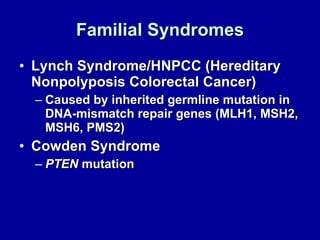
Familial Syndromes Lynch Syndrome/HNPCC (Hereditary Nonpolyposis Colorectal Cancer) Caused by inherited germline mutation in DNA-mismatch repair genes (MLH1, MSH2, MSH6, PMS2) Cowden Syndrome PTEN  mutation
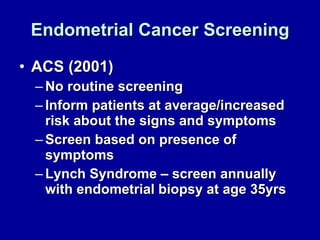
Endometrial Cancer Screening ACS (2001) No routine screening  Inform patients at average/increased risk about the signs and symptoms Screen based on presence of symptoms Lynch Syndrome – screen annually with endometrial biopsy at age 35yrs
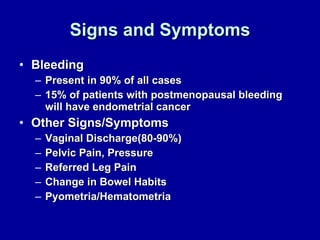
Signs and Symptoms Bleeding Present in 90% of all cases 15% of patients with postmenopausal bleeding will have endometrial cancer Other Signs/Symptoms Vaginal Discharge(80-90%) Pelvic Pain, Pressure Referred Leg Pain Change in Bowel Habits Pyometria/Hematometria
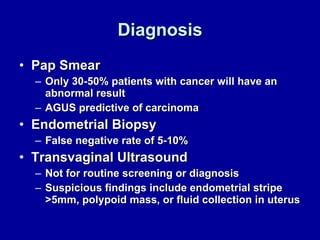
Diagnosis Pap Smear Only 30-50% patients with cancer will have an abnormal result AGUS predictive of carcinoma Endometrial Biopsy False negative rate of 5-10% Transvaginal Ultrasound Not for routine screening or diagnosis Suspicious findings include endometrial stripe >5mm, polypoid mass, or fluid collection in uterus
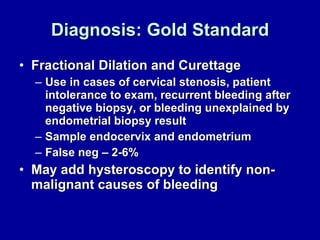
Diagnosis: Gold Standard Fractional Dilation and Curettage Use in cases of cervical stenosis, patient intolerance to exam, recurrent bleeding after negative biopsy, or bleeding unexplained by endometrial biopsy result Sample endocervix and endometrium False neg – 2-6% May add hysteroscopy to identify non-malignant causes of bleeding
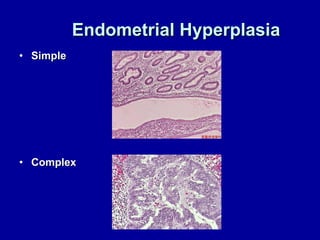
Endometrial Hyperplasia Simple Complex
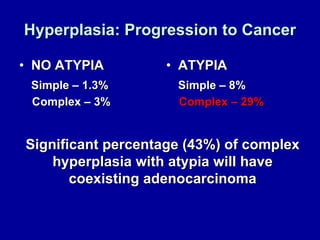
Hyperplasia: Progression to Cancer NO ATYPIA Simple – 1.3% Complex – 3% ATYPIA Simple – 8% Complex – 29% Significant percentage (43%) of complex hyperplasia with atypia will have coexisting adenocarcinoma
Management: Hyperplasia   NO ATYPIA No Treatment (only for simple) Continuous Progestins Re-examination if bleeding PROGESTIN OPTIONS Medroxyprogesterone 10mg/d (10-30mg/d) Norethindrone 2.5mg/d (2.5-10mg/d) Megestrol 160mg/d* Oral contraceptive pills Levonorgestrel-eluting Intrauterine Device
Management: Hyperplasia ATYPIA Hysterectomy If poor surgical candidate/ desires fertility sparing Continuous high dose progestin Megestrol acetate 160mg/day divided doses Levonorgestrel intrauterine device Re-exam every 3 months Response to hormones 50-75%
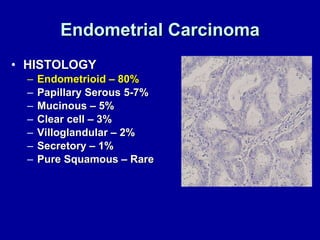
Endometrial Carcinoma HISTOLOGY Endometrioid – 80% Papillary Serous 5-7% Mucinous – 5% Clear cell – 3% Villoglandular – 2% Secretory – 1% Pure Squamous – Rare
Important Histology Points Papillary serous carcinomas  are aggressive Even when mixed with other types, if there is > 25% serous they will retain aggressive behavior Clear cell carcinomas  act similar to high grade endometrioid type carcinoma Mucinous carcinomas  act similar to well differentiated endometrioid type carcinoma Squamous carcinomas  have a poor prognosis
Endometrial Cancer Grade The grade is based on the percentage of the solid component. Well Differentiated (Grade 1): <5% Moderately Differentiated (Grade 2): 5-50% Poorly Differentiated (Grade 3): > 50%
Synchronous Endometrial and Ovarian Cancer Incidence of 1.4 - 3.8% Both tumors are typically well differentiated cancers Good prognosis because ovarian tumor found at earlier stage 30% of patients with endometrioid ovarian cancer will have associated endometrial cancer 15-20% of patients with granulosa cell tumors will have associated endometrial cancer
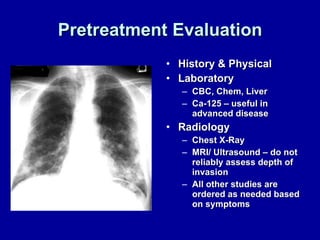
Pretreatment Evaluation History & Physical Laboratory CBC, Chem, Liver Ca-125 – useful in advanced disease Radiology Chest X-Ray MRI/ Ultrasound – do not reliably assess depth of invasion All other studies are ordered as needed based on symptoms
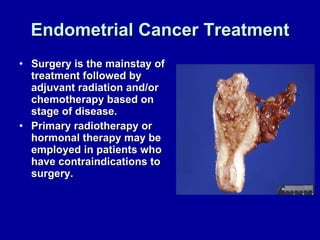
Endometrial Cancer Treatment Surgery is the mainstay of treatment followed by adjuvant radiation and/or chemotherapy based on stage of disease. Primary radiotherapy or hormonal therapy may be employed in patients who have contraindications to surgery.
Primary Radiation Therapy 3-5% of patients who cannot tolerate surgery Elderly, obese, multiple medical co-morbidities Excellent survival and local control rates 5 year disease-specific survival is 87%
Hormone Therapy Appropriate in patients that desire fertility preservation  Young patient Well differentiated cancer Approximately 75% response rate 25% recurrence at a median of 19 months High dose progestins ONLY-G1 tumors!!
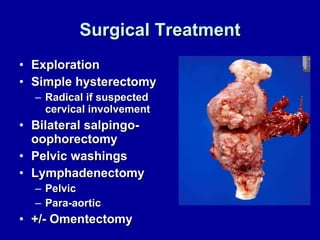
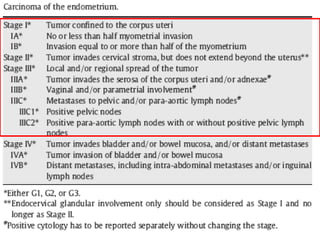
Surgical Treatment Exploration Simple hysterectomy Radical if suspected cervical involvement Bilateral salpingo-oophorectomy Pelvic washings Lymphadenectomy Pelvic Para-aortic +/- Omentectomy
 
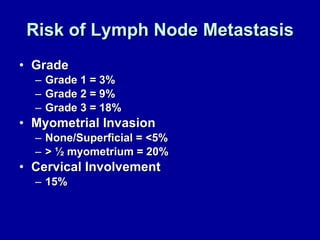
Risk of Lymph Node Metastasis Grade Grade 1 = 3% Grade 2 = 9% Grade 3 = 18% Myometrial Invasion None/Superficial = <5% > ½ myometrium = 20% Cervical Involvement 15%
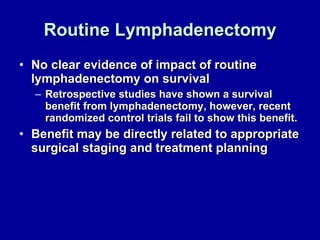
Routine Lymphadenectomy No clear evidence of impact of routine lymphadenectomy on survival Retrospective studies have shown a survival benefit from lymphadenectomy, however, recent randomized control trials fail to show this benefit. Benefit may be directly related to appropriate surgical staging and treatment planning
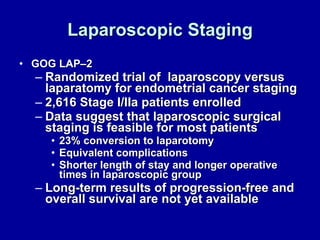
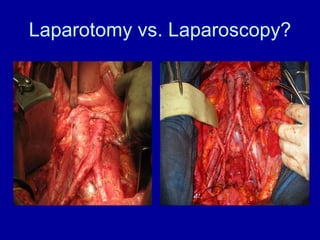
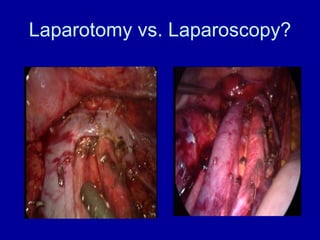
Laparoscopic Staging GOG LAP–2 Randomized trial of  laparoscopy versus laparatomy for endometrial cancer staging  2,616 Stage I/IIa patients enrolled Data suggest that laparoscopic surgical staging is feasible for most patients 23% conversion to laparotomy Equivalent complications Shorter length of stay and longer operative times in laparoscopic group Long-term results of progression-free and overall survival are not yet available
Laparotomy vs. Laparoscopy?
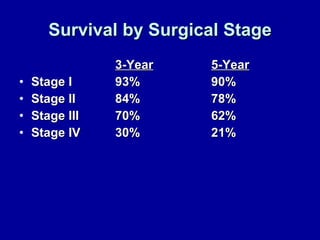
Survival by Surgical Stage 3-Year 5-Year Stage I 93% 90% Stage II 84% 78% Stage III 70% 62% Stage IV 30% 21%
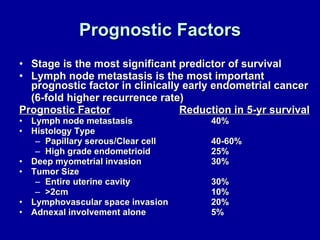
Prognostic Factors Stage is the most significant predictor of survival Lymph node metastasis is the most important prognostic factor in clinically early endometrial cancer  (6-fold higher recurrence rate) Prognostic Factor   Reduction in 5-yr survival Lymph node metastasis 40% Histology Type Papillary serous/Clear cell 40-60% High grade endometrioid 25% Deep myometrial invasion  30%  Tumor Size Entire uterine cavity 30% >2cm 10% Lymphovascular space invasion 20% Adnexal involvement alone 5%
Adjuvant Therapy Observation Vaginal vault radiation External pelvic radiation Extended-field (pelvic/para-aortic) radiation Hormonal therapy Chemotherapy
Low Risk Endometrial Cancer Stage IA (grade 1 or 2) Excellent prognosis  No further treatment
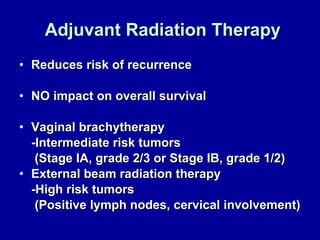
Adjuvant Radiation Therapy Reduces risk of recurrence  NO impact on overall survival Vaginal brachytherapy  -Intermediate risk tumors    (Stage IA, grade 2/3 or Stage IB, grade 1/2)  External beam radiation therapy  -High risk tumors   (Positive lymph nodes, cervical involvement)
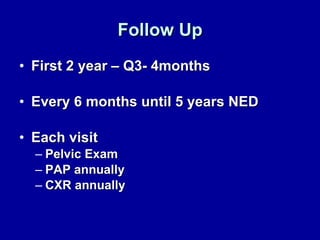
Follow Up First 2 year – Q3- 4months Every 6 months until 5 years NED Each visit Pelvic Exam PAP annually CXR annually
Recurrence 50% recurrences occur within 2 years of treatment Most common site of recurrence is vaginal or pelvic Most common sites of extra-pelvic metastasis: lung Isolated vaginal recurrence has the best prognosis Estrogen/progesterone receptor: hormonal therapy Chemotherapy options metastatic disease
Uterine Sarcoma 3% of all uterine cancers 15% of all deaths from uterine cancer Types Carcinosarcoma Leiomyosarcoma Endometrial Stromal Tumors
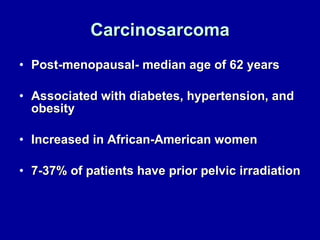
Carcinosarcoma Post-menopausal- median age of 62 years Associated with diabetes, hypertension, and obesity Increased in African-American women 7-37% of patients have prior pelvic irradiation
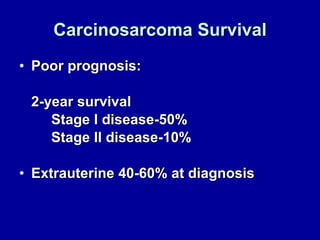
Carcinosarcoma Survival Poor prognosis:  2-year survival Stage I disease-50% Stage II disease-10% Extrauterine 40-60% at diagnosis
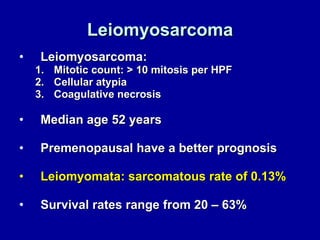
Leiomyosarcoma Leiomyosarcoma: Mitotic count: > 10 mitosis per HPF Cellular atypia Coagulative necrosis Median age 52 years  Premenopausal have a better prognosis Leiomyomata: sarcomatous rate of 0.13% Survival rates range from 20 – 63%
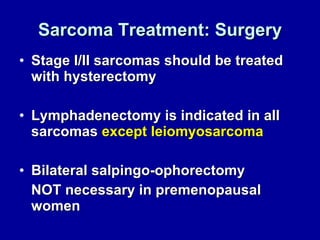
Sarcoma Treatment: Surgery Stage I/II sarcomas should be treated with hysterectomy  Lymphadenectomy is indicated in all sarcomas  except leiomyosarcoma Bilateral salpingo-ophorectomy  NOT necessary in premenopausal women
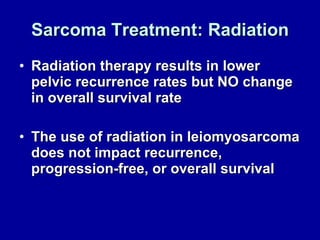
Sarcoma Treatment: Radiation Radiation therapy results in lower pelvic recurrence rates but NO change in overall survival rate The use of radiation in leiomyosarcoma does not impact recurrence, progression-free, or overall survival
Sarcoma Treatment: Recurrence Isolated lesions -surgical excision Recurrent carcinosarcoma  -paclitaxel, platinum or ifosfamide Recurrent leiomyosarcoma -doxorubicin, ifosfamide, docetaxel and gemcitabine
MD Anderson Cancer Center

Uterine Cancer

  • 1.
    Uterine Cancer PedroT. Ramirez, M.D. Associate Professor Director of Minimally Invasive Research & Education Department of Gynecologic Oncology
  • 2.
    Uterine Cancer Fourthmost common cancer in women in the U.S. behind breast, lung, and colon cancer Most common gynecologic malignancy Eighth leading cause of female mortality from cancer 97% arise from the endometrium (endometrial carcinoma) 3% arise from the mesenchymal components (sarcoma)
  • 3.
    Epidemiology Median ageof diagnosis: 60 years Most common in women > age 50 years Incidence is highly dependent on age 75% of uterine cancers occur in post-menopausal women There are two major pathogenic types of endometrial cancer Type I Type II
  • 4.
    Type I EndometrialCarcinoma Younger/peri-menopausal women Obese Associated with estrogen excess Well differentiated endometrioid Superficial myometrial invasion Infrequent lymph node metastases Associated with hyperplasia Genetic mutations in K-ras, PTEN, MLH1 Better prognosis
  • 5.
    Type II EndometrialCarcinoma Older/post-menopausal women Thin Poorly differentiated carcinoma Papillary Serous Clear Cell Deep myometrial invasion Frequent lymph node metastases Associated with atrophy Genetic mutations in p53, Erb-B2 Not associated with typical risk factors
  • 6.
    RISK FACTORS Exposureto estrogen is a key risk factor Risk is increased with dose and time exposed Endogenous estrogen Morbid obesity Polycystic ovary syndrome Oligomenorrhea Exogenous estrogen Hormone replacement without progestin Tamoxifen (estrogen agonist in the endometrium)
  • 7.
    Risk Factors OBESITY 21-50lb overweight – 3x incidence >50lb weight - 10x incidence Nulliparity – incidence increased 2x Late Menopause - incidence increased 2.5x Diabetes, hypertension, hypothyroidism are associated with endometrial cancer
  • 8.
    Familial Syndromes LynchSyndrome/HNPCC (Hereditary Nonpolyposis Colorectal Cancer) Caused by inherited germline mutation in DNA-mismatch repair genes (MLH1, MSH2, MSH6, PMS2) Cowden Syndrome PTEN mutation
  • 9.
    Endometrial Cancer ScreeningACS (2001) No routine screening Inform patients at average/increased risk about the signs and symptoms Screen based on presence of symptoms Lynch Syndrome – screen annually with endometrial biopsy at age 35yrs
  • 10.
    Signs and SymptomsBleeding Present in 90% of all cases 15% of patients with postmenopausal bleeding will have endometrial cancer Other Signs/Symptoms Vaginal Discharge(80-90%) Pelvic Pain, Pressure Referred Leg Pain Change in Bowel Habits Pyometria/Hematometria
  • 11.
    Diagnosis Pap SmearOnly 30-50% patients with cancer will have an abnormal result AGUS predictive of carcinoma Endometrial Biopsy False negative rate of 5-10% Transvaginal Ultrasound Not for routine screening or diagnosis Suspicious findings include endometrial stripe >5mm, polypoid mass, or fluid collection in uterus
  • 12.
    Diagnosis: Gold StandardFractional Dilation and Curettage Use in cases of cervical stenosis, patient intolerance to exam, recurrent bleeding after negative biopsy, or bleeding unexplained by endometrial biopsy result Sample endocervix and endometrium False neg – 2-6% May add hysteroscopy to identify non-malignant causes of bleeding
  • 13.
  • 14.
    Hyperplasia: Progression toCancer NO ATYPIA Simple – 1.3% Complex – 3% ATYPIA Simple – 8% Complex – 29% Significant percentage (43%) of complex hyperplasia with atypia will have coexisting adenocarcinoma
  • 15.
    Management: Hyperplasia NO ATYPIA No Treatment (only for simple) Continuous Progestins Re-examination if bleeding PROGESTIN OPTIONS Medroxyprogesterone 10mg/d (10-30mg/d) Norethindrone 2.5mg/d (2.5-10mg/d) Megestrol 160mg/d* Oral contraceptive pills Levonorgestrel-eluting Intrauterine Device
  • 16.
    Management: Hyperplasia ATYPIAHysterectomy If poor surgical candidate/ desires fertility sparing Continuous high dose progestin Megestrol acetate 160mg/day divided doses Levonorgestrel intrauterine device Re-exam every 3 months Response to hormones 50-75%
  • 17.
    Endometrial Carcinoma HISTOLOGYEndometrioid – 80% Papillary Serous 5-7% Mucinous – 5% Clear cell – 3% Villoglandular – 2% Secretory – 1% Pure Squamous – Rare
  • 18.
    Important Histology PointsPapillary serous carcinomas are aggressive Even when mixed with other types, if there is > 25% serous they will retain aggressive behavior Clear cell carcinomas act similar to high grade endometrioid type carcinoma Mucinous carcinomas act similar to well differentiated endometrioid type carcinoma Squamous carcinomas have a poor prognosis
  • 19.
    Endometrial Cancer GradeThe grade is based on the percentage of the solid component. Well Differentiated (Grade 1): <5% Moderately Differentiated (Grade 2): 5-50% Poorly Differentiated (Grade 3): > 50%
  • 20.
    Synchronous Endometrial andOvarian Cancer Incidence of 1.4 - 3.8% Both tumors are typically well differentiated cancers Good prognosis because ovarian tumor found at earlier stage 30% of patients with endometrioid ovarian cancer will have associated endometrial cancer 15-20% of patients with granulosa cell tumors will have associated endometrial cancer
  • 21.
    Pretreatment Evaluation History& Physical Laboratory CBC, Chem, Liver Ca-125 – useful in advanced disease Radiology Chest X-Ray MRI/ Ultrasound – do not reliably assess depth of invasion All other studies are ordered as needed based on symptoms
  • 22.
    Endometrial Cancer TreatmentSurgery is the mainstay of treatment followed by adjuvant radiation and/or chemotherapy based on stage of disease. Primary radiotherapy or hormonal therapy may be employed in patients who have contraindications to surgery.
  • 23.
    Primary Radiation Therapy3-5% of patients who cannot tolerate surgery Elderly, obese, multiple medical co-morbidities Excellent survival and local control rates 5 year disease-specific survival is 87%
  • 24.
    Hormone Therapy Appropriatein patients that desire fertility preservation Young patient Well differentiated cancer Approximately 75% response rate 25% recurrence at a median of 19 months High dose progestins ONLY-G1 tumors!!
  • 25.
    Surgical Treatment ExplorationSimple hysterectomy Radical if suspected cervical involvement Bilateral salpingo-oophorectomy Pelvic washings Lymphadenectomy Pelvic Para-aortic +/- Omentectomy
  • 26.
  • 27.
    Risk of LymphNode Metastasis Grade Grade 1 = 3% Grade 2 = 9% Grade 3 = 18% Myometrial Invasion None/Superficial = <5% > ½ myometrium = 20% Cervical Involvement 15%
  • 28.
    Routine Lymphadenectomy Noclear evidence of impact of routine lymphadenectomy on survival Retrospective studies have shown a survival benefit from lymphadenectomy, however, recent randomized control trials fail to show this benefit. Benefit may be directly related to appropriate surgical staging and treatment planning
  • 29.
    Laparoscopic Staging GOGLAP–2 Randomized trial of laparoscopy versus laparatomy for endometrial cancer staging 2,616 Stage I/IIa patients enrolled Data suggest that laparoscopic surgical staging is feasible for most patients 23% conversion to laparotomy Equivalent complications Shorter length of stay and longer operative times in laparoscopic group Long-term results of progression-free and overall survival are not yet available
  • 30.
  • 31.
  • 32.
    Survival by SurgicalStage 3-Year 5-Year Stage I 93% 90% Stage II 84% 78% Stage III 70% 62% Stage IV 30% 21%
  • 33.
    Prognostic Factors Stageis the most significant predictor of survival Lymph node metastasis is the most important prognostic factor in clinically early endometrial cancer (6-fold higher recurrence rate) Prognostic Factor Reduction in 5-yr survival Lymph node metastasis 40% Histology Type Papillary serous/Clear cell 40-60% High grade endometrioid 25% Deep myometrial invasion 30% Tumor Size Entire uterine cavity 30% >2cm 10% Lymphovascular space invasion 20% Adnexal involvement alone 5%
  • 34.
    Adjuvant Therapy ObservationVaginal vault radiation External pelvic radiation Extended-field (pelvic/para-aortic) radiation Hormonal therapy Chemotherapy
  • 35.
    Low Risk EndometrialCancer Stage IA (grade 1 or 2) Excellent prognosis No further treatment
  • 36.
    Adjuvant Radiation TherapyReduces risk of recurrence NO impact on overall survival Vaginal brachytherapy -Intermediate risk tumors (Stage IA, grade 2/3 or Stage IB, grade 1/2) External beam radiation therapy -High risk tumors (Positive lymph nodes, cervical involvement)
  • 37.
    Follow Up First2 year – Q3- 4months Every 6 months until 5 years NED Each visit Pelvic Exam PAP annually CXR annually
  • 38.
    Recurrence 50% recurrencesoccur within 2 years of treatment Most common site of recurrence is vaginal or pelvic Most common sites of extra-pelvic metastasis: lung Isolated vaginal recurrence has the best prognosis Estrogen/progesterone receptor: hormonal therapy Chemotherapy options metastatic disease
  • 39.
    Uterine Sarcoma 3%of all uterine cancers 15% of all deaths from uterine cancer Types Carcinosarcoma Leiomyosarcoma Endometrial Stromal Tumors
  • 40.
    Carcinosarcoma Post-menopausal- medianage of 62 years Associated with diabetes, hypertension, and obesity Increased in African-American women 7-37% of patients have prior pelvic irradiation
  • 41.
    Carcinosarcoma Survival Poorprognosis: 2-year survival Stage I disease-50% Stage II disease-10% Extrauterine 40-60% at diagnosis
  • 42.
    Leiomyosarcoma Leiomyosarcoma: Mitoticcount: > 10 mitosis per HPF Cellular atypia Coagulative necrosis Median age 52 years Premenopausal have a better prognosis Leiomyomata: sarcomatous rate of 0.13% Survival rates range from 20 – 63%
  • 43.
    Sarcoma Treatment: SurgeryStage I/II sarcomas should be treated with hysterectomy Lymphadenectomy is indicated in all sarcomas except leiomyosarcoma Bilateral salpingo-ophorectomy NOT necessary in premenopausal women
  • 44.
    Sarcoma Treatment: RadiationRadiation therapy results in lower pelvic recurrence rates but NO change in overall survival rate The use of radiation in leiomyosarcoma does not impact recurrence, progression-free, or overall survival
  • 45.
    Sarcoma Treatment: RecurrenceIsolated lesions -surgical excision Recurrent carcinosarcoma -paclitaxel, platinum or ifosfamide Recurrent leiomyosarcoma -doxorubicin, ifosfamide, docetaxel and gemcitabine
  • 46.