Surgical Pathology of Appendix
Acute and Chronic Appendicitis
Ghidirim Gh., Mishin I., Zastavnitsky Gh., Vozian M.
The first description of the appendix was provided by Berengarius Carpus, Professor
of Surgery at Pavia and Bologna in 1522.
In 1886 Reginald Fitz, an american physician, became the first person to describe the
entity of acute appendicitis.
Appendicitis occurs in 7% of the US population, with an incidence of 1.1 cases
per 1000 people per year. There is a slight male preponderance of 3:2 in teenagers and
young adults; in adults, the incidence of appendicitis is approximately 1.4 times
greater in men than in women.
The appendicitis presents an inflammation (either acute or chronic)
of the appendix
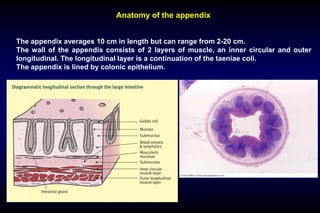
Anatomy of the appendix
The appendix averages 10 cm in length but can range from 2-20 cm.
The wall of the appendix consists of 2 layers of muscle, an inner circular and outer
longitudinal. The longitudinal layer is a continuation of the taeniae coli.
The appendix is lined by colonic epithelium.
Arterial blood supply
Venous blood supply
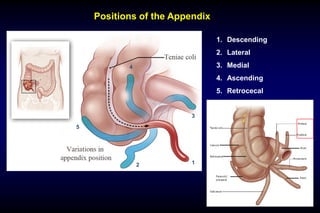
Positions of the Appendix
1
2
3
4
5
1. Descending
2. Lateral
3. Medial
4. Ascending
5. Retrocecal
Number Anomalies Shape anomalies
Congenital agenesis
A B1
B2 C
Horseshoe-shaped appendix
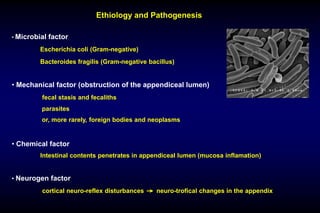
Ethiology and Pathogenesis
• Microbial factor
Escherichia coli (Gram-negative)
Bacteroides fragilis (Gram-negative bacillus)
• Mechanical factor (obstruction of the appendiceal lumen)
fecal stasis and fecaliths
parasites
or, more rarely, foreign bodies and neoplasms
• Chemical factor
Intestinal contents penetrates in appendiceal lumen (mucosa inflamation)
• Neurogen factor
cortical neuro-reflex disturbances neuro-trofical changes in the appendix
Inflamation
↑ Intraluminal Pressure
• Lymphoid Swelling
• Decrease Venous Drainage
• Thrombosis
• Bacterial Invasion
Abscess
Gangrene
Perforation (24 to 36 hours)
Peritonitis
Classification
•Catarrhal (edematous, simple) appendicitis
Inflamation of mucosal and submucosal layers
•Flegmonous appendicitis
Inflamation of all layers
•Gangrenous appendicitis
wall necrosis (& abscesses)
•Perforated appendicitis
History of disease
• Sudden onset
• Abdominal pain in the right iliac fossa
• Kocher’s sign (35% of cases)
the appearance of pain in the epigastric region or around the stomach at the beginning
of disease with a subsequent shift to the right iliac region
• Nausea
• Single vomiting episode
• Low fever (37.2 to 37.5°C)
• Pulse is slight accelerated
Points of pain in acute appendicitis
1. McBurney point 3. Lanz point
2. Morris-Kummel point 4.Sonnenberg point
2
3
AS
4
AS
umbilicus
Iacubovich triangle
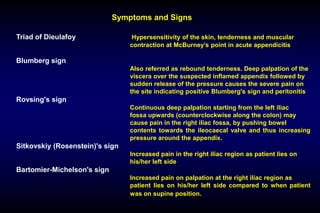
Symptoms and Signs
Triad of Dieulafoy Hypersensitivity of the skin, tenderness and muscular
contraction at McBurney’s point in acute appendicitis
Blumberg sign
Also referred as rebound tenderness. Deep palpation of the
viscera over the suspected inflamed appendix followed by
sudden release of the pressure causes the severe pain on
the site indicating positive Blumberg's sign and peritonitis
Rovsing's sign
Continuous deep palpation starting from the left iliac
fossa upwards (counterclockwise along the colon) may
cause pain in the right iliac fossa, by pushing bowel
contents towards the ileocaecal valve and thus increasing
pressure around the appendix.
Sitkovskiy (Rosenstein)'s sign
Increased pain in the right iliac region as patient lies on
his/her left side
Bartomier-Michelson's sign
Increased pain on palpation at the right iliac region as
patient lies on his/her left side compared to when patient
was on supine position.
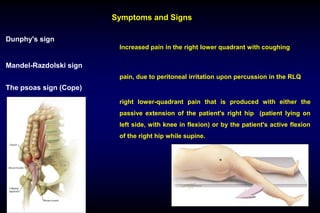
Symptoms and Signs
Dunphy's sign
Increased pain in the right lower quadrant with coughing
Mandel-Razdolski sign
pain, due to peritoneal irritation upon percussion in the RLQ
The psoas sign (Cope)
right lower-quadrant pain that is produced with either the
passive extension of the patient's right hip (patient lying on
left side, with knee in flexion) or by the patient's active flexion
of the right hip while supine.
If an inflamed appendix is in contact with the obturator internus, spasm of the muscle can be
demonstrated by flexing and internal rotation of the hip.
The obturator sign
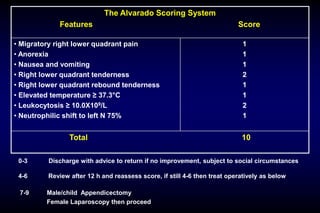
The Alvarado Scoring System
Features Score
• Migratory right lower quadrant pain
• Anorexia
• Nausea and vomiting
• Right lower quadrant tenderness
• Right lower quadrant rebound tenderness
• Elevated temperature ≥ 37.3°C
• Leukocytosis ≥ 10.0X10⁹/L
• Neutrophilic shift to left N 75%
1
1
1
2
1
1
2
1
Total 10
0-3 Discharge with advice to return if no improvement, subject to social circumstances
4-6 Review after 12 h and reassess score, if still 4-6 then treat operatively as below
7-9 Male/child Appendicectomy
Female Laparoscopy then proceed
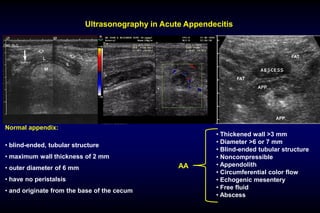
Ultrasonography in Acute Appendecitis
Normal appendix:
• blind-ended, tubular structure
• maximum wall thickness of 2 mm
• outer diameter of 6 mm
• have no peristalsis
• and originate from the base of the cecum
• Thickened wall >3 mm
• Diameter >6 or 7 mm
• Blind-ended tubular structure
• Noncompressible
• Appendolith
• Circumferential color flow
• Echogenic mesentery
• Free fluid
• Abscess
AA
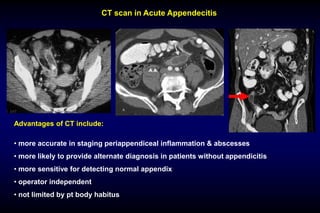
Advantages of CT include:
• more accurate in staging periappendiceal inflammation & abscesses
• more likely to provide alternate diagnosis in patients without appendicitis
• more sensitive for detecting normal appendix
• operator independent
• not limited by pt body habitus
CT scan in Acute Appendecitis
Acute appendicitis in children
• acute appendicitis uncommon in children younger than 2 or 3 years
• the diagnosis of appendicitis is difficult
• illness develops dramatically rapidly
• violent pain (atypical, unlocalized diffuse periumbilical)
• high grade temperature (39-40°C)
• persistent vomiting
• diarrhea (12%)
• hyperleukocytosis (15.000 – 20.000/mL)
• intoxication (oliguria and anuria)
• physical examination with natural or medicamentous sleep (enema with
chloralhidrate or relanium i.m.)
• appendix situated in pelvic and ascending position
• functional insufficiency of the peritoneum and omentum →gangrene (or perforations)
Acute appendicitis in elderly
• > 60 yrs – 12% from total number of appendectomies
• clinical signs are less evident (pain is less severe, local tenderness less acute, low
grade temperature)
• the basic symptoms – pain on palpation and alteration of the bowel motility
• elevation in the WBC – moderate or nonexistent
• higher incidence of destructive forms of appendicitis (vascular factor)
• ½ of pts >70 yrs – ruptured appendix at time surgery
• right-sided colon carcinoma?
• Main clinical forms of acute appendicitis in elderly
1. like intestinal obstruction form
2. pseudo-tumorous form
3. acute appendicitis with peritonitis in two times
Subhepatic Appendicitis
CT: Subhepatic location of a normal appendix
Subhepatic appendicitis with faecolith in situ.
Subhepatic Appendicitis
Liver
GB
Subhepatic appendicitis
Left-sided acute appendicitis
• excessively moveable cecum
• intestinal malrotation
• the long appendix, which riches the left iliac fossa
Situs Viscerum Inversus
X-ray and computed tomography showed situs inversus totalis (SIT) including
dextrocardia, right-sided gastric bubble and reversed spleen and liver.
Cecum
&appendix
Situs Viscerum Inversus
The incidence of SIT reported in the literature varies from 0.001% to 0.01% in the
general population. The incidence of acute appendicitis associated with SIT is reported
to be between 0.016% and 0.024%
Appendicitis during pregnancy is a
relatively rare condition, though it is thought that
the incidence is similar to that of the non-gravid
population at approximately 1 in 1500
pregnancies.
The majority of appendicitis in
pregnancy occurs during the second trimester
when they are difficult to diagnose both clinically
and by imaging.
The pathologic diagnosis of appendicitis
is confirmed in only 30% to 50% of cases.
Fetal loss rate approaches 40% for perforated
appendicitis.
Appendicitis during pregnancy
F F
Amyand's hernia (acute appendicitis In inguinal hernia)
Claudius Amyand (1660–1740) is variously
reported as having held the title of “surgeon-
in-ordinary” or “sergeant– surgeon” to King
George II of England.
On 6 December 1735 he performed the first
recorded successful appendectomy.
Incidence - 0.13% - 1%
Amyand's hernia (acute appendicitis In inguinal hernia)
Pathological types of Amyand’s hernia
I - normal appendix
II - acute appendicitis localized in the sac
III - acute appendicitis, peritonitis
IV - acute appendicitis, other abdominal
pathology
Herniation of the appendix into a
femoral hernia sac was first reported
by DeGarengot in 1731.
DeGarengot hernia
Gastrointestinal
Duodenal ulcer (perforation)
Pancreatitis
Cholecystitis
Crohn's disease
Diverticulitis
Gastroenteritis
Intestinal obstruction
Intussusception
Meckel's diverticulitis
Mesenteric lymphadenitis
Necrotizing enterocolitis
Neoplasm (carcinoid,
carcinoma, lymphoma)
Omental torsion
Perforated viscus
Volvulus
Gynecologic
Ectopic pregnancy
Endometriosis
Ovarian torsion
Pelvic inflammatory
disease
Ruptured ovarian cyst
(follicular, corpus
luteum)
Tubo-ovarian abscess
Systemic
Diabetic ketoacidosis
Porphyria
Sickle cell disease
Henoch-Schönlein purpura
Pulmonary
Pleuritis
Pneumonia (basilar)
Pulmonary infarction
Genitourinary
Kidney stone
Prostatitis
Pyelonephritis
Testicular torsion
Urinary tract infection
Wilms' tumor
Other
Parasitic infection
Psoas abscess
Rectus sheath hematoma
Differential Diagnosis of Acute Appendicitis
Perforated ulcer
• peptic ulcer history
• a severe pain (Dieulafoy sign)
• hypotension or schock
• absence of vomiting
• bradycardia
• absence of fever
• absence of abdomen movement on respiration
• a rigid board-like abdomen
• diffuse tenderness and pain
• Blumberg sign on the whole abdominal wall
• disappearance of liver dullness
Perforated ulcer
Presence of free air under the diaphragm on abdominal film
CT scan Acute pancreatitis
• alcohol and gallstone!
• high intensive pain in the epigastric area
• shock
• abdominal distention
• tenderness on the pancreas projection
• tachycardia
• cyanosis
Hyperleucocytosis
Elevated amylase levels in blood and urine
Acute Cholecystitis
• Pain usually beginning after eating fried food,
alcohol
• pain is situated in right upper abdominal quadrant
and radiated to the right subscapular region
• nausea
• multiple vomiting
• fever
• Grekov-Orthner sign
• Murphy sign
• frenicus sign
• tenderness in RUQ
• mass in RUQ
• jaundice
Ectopic Pregnancy
The vast majority of ectopic pregnancies
implant in the Fallopian tube.
Pregnancies can grow in:
• the fimbrial end (5% of all ectopics)
• the ampullary section (80%)
• the isthmus (12%)
• the cornual and interstitial part of the
tube (2%)
Clinical presentation of ectopic pregnancy occurs at a mean of 7.2 weeks after the last
normal menstrual period, with a range of 5 to 8 weeks.
Ectopic Pregnancy
The classic signs and symptoms :
• abdominal pain
• the absence of menstrual periods (amenorrhea)
• vaginal bleeding or intermittent bleeding (spotting)
Diagnosis:
• US and transvaginal ultrasound
• blood β-human chorionic gonadotropin (β-hCG)
• Culdocentesis (fluid is retrieved from the space
separating the vagina and rectum) – blood!
• Laparoscopy
uterus
uterus
EP in progress EP with rupture
Ectopic Pregnancy
• incise the affected Fallopian and remove only the pregnancy (salpingostomy)
• remove the affected tube with the pregnancy (salpingectomy).
Surgical treatment:
uterus
uterus
Laparoscopic Treatment of Tubal Pregnancy
Ovarian Torsion (adnexal torsion)
Ovarian torsion is the twisting of the ovary
due to the influence of another condition or
disease.
This results in extreme lower
abdominal pain.
Approximately 70-75% of cases occur in
women under 30 years old. Approximately
60% of cases of torsion occur on the right
side.
• abnormalities of the fallopian tube such
as extremely longer-than-normal tubes or a
missing mesosalpinx
• ovarian cysts or fibromas, tumor of the
ovary or tubes
• Salpingo-oophorectomy
Ovarian Torsion (adnexal torsion)
Case presentation
A 25 year-old female patient was admitted to the ED after 6 hours
after onset, complaining:
Right iliac fossa pain, nausea.
History of the disease: sudden pain onset in the right iliac fossa,
later nausea appeared. Uterine pregnancy 22-23 weeks.
Upon physical examination:
Tongue moist, Abdomen – symmetrically enlarged
(pregnancy), participates in respiration.
Abdominal palpation reveals right lower quadrant
tenderness, RLQ rebound tenderness. Measured fever in
the ED 37.5C
What is the diagnosis?
How do you confirm it?
Case presentation
Case presentation
ECG: sinus rhythm, heart rate 100 b.p.m.
Blood test: Hb 126 g/L; Er 4.0X10¹²/L; WBC 13.4X10⁹/L
USG: Uterine pregnancy 22-23 weeks. Appendix not visible. Free fluid in the RLQ absent.
The Alvarado Scoring System
Features Score Present case
• Migratory right lower quadrant pain
• Anorexia
• Nausea and vomiting
• Right lower quadrant tenderness
• Right lower quadrant rebound tenderness
• Elevated temperature ≥ 37.3°C
• Leukocytosis ≥ 10.0X10⁹/L
• Neutrophilic shift to left N 75%
1
1
1
2
1
1
2
1
-
1
1
2
1
1
2
-
Total 10 8
What is the diagnosis?
Any additional investigations?
What is the treatment?
Case presentation
Isolated fallopian tube torsion
• Abnormal smell and colour of vaginal discharge.
• Pain during ovulation
• Pain during sexual intercourse
• Pain coming and going in periods
• Abdominal pain
• Lower back pain
• Fever (>38°C)
• Nausea
• Vomiting
The bacteria most associated with salpingitis are
• Neisseria gonorrhoeae
• Chlamydia trachomatis
• Mycoplasma
Acute Salpingitis
On pelvic examination, motion of the uterus causes pain (Promptov sign)
Ovarian apoplexy is a sudden rupture in
the ovary:
• Ovarian cyst
• Dystrophic and sclerotic changes in
ovarian tissue
• Polycystic ovary syndrome
Clinical symptoms:
Pain syndrome, which occurs primarily in the
mid-cycle or after a minor delay
menstruation Pain is most often localized in
the lower abdomen. Sometimes the pain
may radiate to the rectum, in the lumbar or
the umbilical region.
Ovarian apoplexy
Hemorrhage in the ovarian tissue and/or intraperitoneal bleeding!
• reduced pressure
• increase heart rate
• syncope
Surgical Treatment (Appendectomy)
Charles McBurney
Surgical Treatment (Appendectomy)
appendix
mesoappendix
cecum
Intraoperative view
Surgical Treatment
Appendectomy
• Mesoappendix is ligated
• Ligation of the appendiceal base with absorbable suture
• Purse-string suture is placed on the cecum around the appendiceal base
Appendectomy
Laparoscopic Appendectomy
Meckel’s diverticulum (MD) is the most common congenital abnormality of the gastrointestinal
tract, occurring in 1% to 2% of the population. It is usually asymptomatic and becomes evident
when complicated. MD is usually found within 100 cm of the ileocecal valve (>20cm).
• inflammation
• ischemia and infarction
• gastrointestinal bleeding, obstruction
Meckel’s diverticulum
Mucocele of the Appendix
Rokitansky’s first report of an appendiceal mucocele in 1842.
Based on data from pathologic specimens, the incidence of AM is approximately 0.07% to 0.3%.
• retention cyst of the appendix (simple mucocele)
• mucosal hyperplasia of the appendix appendectomy
• cystadenoma of the appendix
• cystadenocarcinomas right hemicolectomy
PMP (!)
Vermiform Appendix Torsion
Mishin I, Ghidirim G, Zastavnitsky G, Popa C. Torsion of an appendiceal mucinous cystadenoma.
Report of a case and review of literature. Ann Ital Chir. 2012;83(1):75-8.
Appendiceal Intussusception
Intra-operative view of an
appendico-appendicular intussusception
Intraoperative finding of a giant
appendiceal mucocele with partial
intussusception into the cecum
Cecum
I Tip of the appendix invaginates into the proximal lumen
II Distal appendix invaginates into the lumen of the proximal appendix
III Proximal appendix invaginates into the distal appendix
IV Complete intussusception of the appendix within the caecum
Appendiceal Intussusception
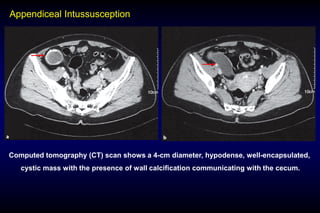
Computed tomography (CT) scan shows a 4-cm diameter, hypodense, well-encapsulated,
cystic mass with the presence of wall calcification communicating with the cecum.
Carcinoid (neuroendocrine) Tumours of the Appendix
Appendiceal carcinoid tumours are found in 0.3 – 0.9% of appendicectomy
• < 1 cm, distal part – appendectomy
• >2 cm and proximal part (↑metastatic spread) - right hemicolectomy
Chromogranin A (+++)
CT: periappendiceal abscess
Periappendiceal Abscess
• Pain increases
• High grade fever
• Hyperleukocytosis
• Severe pain
• Blumberg positive sign
Surgery – drainage of abscess via Pirogov aproach (extraperitoneal)
Pylephlebitis (septic thrombophlebitis of the portal vein)
The venous drainage from the appendiceal area and
terminal ileum flows directly into the portal system.
The organisms most frequently cultured from the blood
were bacteroides (especially Bacteroides fragilis) and E.
coli.
This disease entity occurred in 0.4% of patients with acute
appendicitis before 1950, but it has become very rare due
to major advances in antibiotic therapy and surgical
treatment.
Pylephlebitis is considered a severe condition!
The reported mortality rate of pylephlebitis is 30%-50%,
partly due to a delay in diagnosis from its atypical clinical
findings and a low index of suspicion.
Diagnosis:
• Ultrasound scan with color flow Doppler
• CT scan
Pylephlebitis (septic thrombophlebitis of the portal vein)
The principles of treatment for pylephlebitis:
• to remove the source of infection and eradicate the toxic microorganisms using appropriate
antibiotics
• systemic Ⅳ antibiotics (4 wk), hepatic abscess (at least 6 wk)
• anticoagulation therapy
CT scan showing total occlusion of the portal vein with a thrombus
(arrow) extending to the superior mesenteric vein.
• air bubbles or thrombi of the portal venous system
• liver abscesses
liver abscesses
• haematoma in the wound
• wound infection
• bleeding may rarely occur from the mesoappendix (appendicular artery)
• faecal fistula (if the method used to secure the appendix stump is insecure)
• incisional hernia through an appendicectomy incision (is also uncommon and usually
occurs after a superficial wound complication)
• Mortality rate due acute appendicitis is 0.1-0.3%
Postoperative Complications
Pelvic Abscess
A pelvic abscess is a collection of pus in the pelvis or
lower abdomen. An abscess usually appears
2-3 weeks after the initial operation.
In males the abscess is located between the bladder
and the rectum.
In females the abscess lies between the uterus and the
posterior fornix of the vagina, and the rectum
posteriorly.
Presentation
Systemic features of toxicity: fever, malaise, anorexia, nausea, vomiting.
Local effects, e.g. pain, deep tenderness in one or both lower quadrants, diarrhoea,
mucous discharge per rectum, urinary frequency, dysuria.
Rectal or vaginal examination: may reveal tenderness of the pelvic peritoneum and
bulging of the anterior rectal wall.
Leukocytosis.
CT/MRI scanning may be more effective at identifying the origin of the abscess
Pelvic Abscess
Pelvic Abscess
The abscess should be drained
transrectally in men, and transvaginally in
females
• Traditional approach
• Ultrasound-guided aspiration and
drainage
• Percutaneous abscess drainage is
performed using CT or sonographic
guidance
Subdiaphragmatic absces
A subdiaphragmatic abscess is a localized accumulation
of pus in the abdominal cavity just beneath the diaphragm.
Operative treatment for subdiaphragmatic abscess includes drainage using a needle
and syringe (percutaneous drainage), or one of four different types of open surgical
approaches (transpleural, extrapleural, extraperitoneal, transperitoneal)
01.Acute appendicitis and chronic appendicitis.pdf

01.Acute appendicitis and chronic appendicitis.pdf

  • 1.
    Surgical Pathology ofAppendix Acute and Chronic Appendicitis Ghidirim Gh., Mishin I., Zastavnitsky Gh., Vozian M.
  • 2.
    The first descriptionof the appendix was provided by Berengarius Carpus, Professor of Surgery at Pavia and Bologna in 1522. In 1886 Reginald Fitz, an american physician, became the first person to describe the entity of acute appendicitis. Appendicitis occurs in 7% of the US population, with an incidence of 1.1 cases per 1000 people per year. There is a slight male preponderance of 3:2 in teenagers and young adults; in adults, the incidence of appendicitis is approximately 1.4 times greater in men than in women. The appendicitis presents an inflammation (either acute or chronic) of the appendix
  • 3.
    Anatomy of theappendix The appendix averages 10 cm in length but can range from 2-20 cm. The wall of the appendix consists of 2 layers of muscle, an inner circular and outer longitudinal. The longitudinal layer is a continuation of the taeniae coli. The appendix is lined by colonic epithelium.
  • 4.
  • 5.
  • 6.
    Positions of theAppendix 1 2 3 4 5 1. Descending 2. Lateral 3. Medial 4. Ascending 5. Retrocecal
  • 7.
    Number Anomalies Shapeanomalies Congenital agenesis A B1 B2 C Horseshoe-shaped appendix
  • 8.
    Ethiology and Pathogenesis •Microbial factor Escherichia coli (Gram-negative) Bacteroides fragilis (Gram-negative bacillus) • Mechanical factor (obstruction of the appendiceal lumen) fecal stasis and fecaliths parasites or, more rarely, foreign bodies and neoplasms • Chemical factor Intestinal contents penetrates in appendiceal lumen (mucosa inflamation) • Neurogen factor cortical neuro-reflex disturbances neuro-trofical changes in the appendix
  • 9.
    Inflamation ↑ Intraluminal Pressure •Lymphoid Swelling • Decrease Venous Drainage • Thrombosis • Bacterial Invasion Abscess Gangrene Perforation (24 to 36 hours) Peritonitis
  • 10.
    Classification •Catarrhal (edematous, simple)appendicitis Inflamation of mucosal and submucosal layers •Flegmonous appendicitis Inflamation of all layers •Gangrenous appendicitis wall necrosis (& abscesses) •Perforated appendicitis
  • 11.
    History of disease •Sudden onset • Abdominal pain in the right iliac fossa • Kocher’s sign (35% of cases) the appearance of pain in the epigastric region or around the stomach at the beginning of disease with a subsequent shift to the right iliac region • Nausea • Single vomiting episode • Low fever (37.2 to 37.5°C) • Pulse is slight accelerated
  • 12.
    Points of painin acute appendicitis 1. McBurney point 3. Lanz point 2. Morris-Kummel point 4.Sonnenberg point 2 3 AS 4 AS umbilicus Iacubovich triangle
  • 13.
    Symptoms and Signs Triadof Dieulafoy Hypersensitivity of the skin, tenderness and muscular contraction at McBurney’s point in acute appendicitis Blumberg sign Also referred as rebound tenderness. Deep palpation of the viscera over the suspected inflamed appendix followed by sudden release of the pressure causes the severe pain on the site indicating positive Blumberg's sign and peritonitis Rovsing's sign Continuous deep palpation starting from the left iliac fossa upwards (counterclockwise along the colon) may cause pain in the right iliac fossa, by pushing bowel contents towards the ileocaecal valve and thus increasing pressure around the appendix. Sitkovskiy (Rosenstein)'s sign Increased pain in the right iliac region as patient lies on his/her left side Bartomier-Michelson's sign Increased pain on palpation at the right iliac region as patient lies on his/her left side compared to when patient was on supine position.
  • 14.
    Symptoms and Signs Dunphy'ssign Increased pain in the right lower quadrant with coughing Mandel-Razdolski sign pain, due to peritoneal irritation upon percussion in the RLQ The psoas sign (Cope) right lower-quadrant pain that is produced with either the passive extension of the patient's right hip (patient lying on left side, with knee in flexion) or by the patient's active flexion of the right hip while supine.
  • 15.
    If an inflamedappendix is in contact with the obturator internus, spasm of the muscle can be demonstrated by flexing and internal rotation of the hip. The obturator sign
  • 16.
    The Alvarado ScoringSystem Features Score • Migratory right lower quadrant pain • Anorexia • Nausea and vomiting • Right lower quadrant tenderness • Right lower quadrant rebound tenderness • Elevated temperature ≥ 37.3°C • Leukocytosis ≥ 10.0X10⁹/L • Neutrophilic shift to left N 75% 1 1 1 2 1 1 2 1 Total 10 0-3 Discharge with advice to return if no improvement, subject to social circumstances 4-6 Review after 12 h and reassess score, if still 4-6 then treat operatively as below 7-9 Male/child Appendicectomy Female Laparoscopy then proceed
  • 17.
    Ultrasonography in AcuteAppendecitis Normal appendix: • blind-ended, tubular structure • maximum wall thickness of 2 mm • outer diameter of 6 mm • have no peristalsis • and originate from the base of the cecum • Thickened wall >3 mm • Diameter >6 or 7 mm • Blind-ended tubular structure • Noncompressible • Appendolith • Circumferential color flow • Echogenic mesentery • Free fluid • Abscess AA
  • 18.
    Advantages of CTinclude: • more accurate in staging periappendiceal inflammation & abscesses • more likely to provide alternate diagnosis in patients without appendicitis • more sensitive for detecting normal appendix • operator independent • not limited by pt body habitus CT scan in Acute Appendecitis
  • 19.
    Acute appendicitis inchildren • acute appendicitis uncommon in children younger than 2 or 3 years • the diagnosis of appendicitis is difficult • illness develops dramatically rapidly • violent pain (atypical, unlocalized diffuse periumbilical) • high grade temperature (39-40°C) • persistent vomiting • diarrhea (12%) • hyperleukocytosis (15.000 – 20.000/mL) • intoxication (oliguria and anuria) • physical examination with natural or medicamentous sleep (enema with chloralhidrate or relanium i.m.) • appendix situated in pelvic and ascending position • functional insufficiency of the peritoneum and omentum →gangrene (or perforations)
  • 20.
    Acute appendicitis inelderly • > 60 yrs – 12% from total number of appendectomies • clinical signs are less evident (pain is less severe, local tenderness less acute, low grade temperature) • the basic symptoms – pain on palpation and alteration of the bowel motility • elevation in the WBC – moderate or nonexistent • higher incidence of destructive forms of appendicitis (vascular factor) • ½ of pts >70 yrs – ruptured appendix at time surgery • right-sided colon carcinoma? • Main clinical forms of acute appendicitis in elderly 1. like intestinal obstruction form 2. pseudo-tumorous form 3. acute appendicitis with peritonitis in two times
  • 21.
    Subhepatic Appendicitis CT: Subhepaticlocation of a normal appendix
  • 22.
    Subhepatic appendicitis withfaecolith in situ. Subhepatic Appendicitis Liver GB Subhepatic appendicitis
  • 23.
    Left-sided acute appendicitis •excessively moveable cecum • intestinal malrotation • the long appendix, which riches the left iliac fossa
  • 24.
    Situs Viscerum Inversus X-rayand computed tomography showed situs inversus totalis (SIT) including dextrocardia, right-sided gastric bubble and reversed spleen and liver. Cecum &appendix
  • 25.
    Situs Viscerum Inversus Theincidence of SIT reported in the literature varies from 0.001% to 0.01% in the general population. The incidence of acute appendicitis associated with SIT is reported to be between 0.016% and 0.024%
  • 26.
    Appendicitis during pregnancyis a relatively rare condition, though it is thought that the incidence is similar to that of the non-gravid population at approximately 1 in 1500 pregnancies. The majority of appendicitis in pregnancy occurs during the second trimester when they are difficult to diagnose both clinically and by imaging. The pathologic diagnosis of appendicitis is confirmed in only 30% to 50% of cases. Fetal loss rate approaches 40% for perforated appendicitis. Appendicitis during pregnancy
  • 27.
  • 28.
    Amyand's hernia (acuteappendicitis In inguinal hernia) Claudius Amyand (1660–1740) is variously reported as having held the title of “surgeon- in-ordinary” or “sergeant– surgeon” to King George II of England. On 6 December 1735 he performed the first recorded successful appendectomy. Incidence - 0.13% - 1%
  • 29.
    Amyand's hernia (acuteappendicitis In inguinal hernia) Pathological types of Amyand’s hernia I - normal appendix II - acute appendicitis localized in the sac III - acute appendicitis, peritonitis IV - acute appendicitis, other abdominal pathology
  • 30.
    Herniation of theappendix into a femoral hernia sac was first reported by DeGarengot in 1731. DeGarengot hernia
  • 31.
    Gastrointestinal Duodenal ulcer (perforation) Pancreatitis Cholecystitis Crohn'sdisease Diverticulitis Gastroenteritis Intestinal obstruction Intussusception Meckel's diverticulitis Mesenteric lymphadenitis Necrotizing enterocolitis Neoplasm (carcinoid, carcinoma, lymphoma) Omental torsion Perforated viscus Volvulus Gynecologic Ectopic pregnancy Endometriosis Ovarian torsion Pelvic inflammatory disease Ruptured ovarian cyst (follicular, corpus luteum) Tubo-ovarian abscess Systemic Diabetic ketoacidosis Porphyria Sickle cell disease Henoch-Schönlein purpura Pulmonary Pleuritis Pneumonia (basilar) Pulmonary infarction Genitourinary Kidney stone Prostatitis Pyelonephritis Testicular torsion Urinary tract infection Wilms' tumor Other Parasitic infection Psoas abscess Rectus sheath hematoma Differential Diagnosis of Acute Appendicitis
  • 32.
    Perforated ulcer • pepticulcer history • a severe pain (Dieulafoy sign) • hypotension or schock • absence of vomiting • bradycardia • absence of fever • absence of abdomen movement on respiration • a rigid board-like abdomen • diffuse tenderness and pain • Blumberg sign on the whole abdominal wall • disappearance of liver dullness
  • 33.
    Perforated ulcer Presence offree air under the diaphragm on abdominal film
  • 34.
    CT scan Acutepancreatitis • alcohol and gallstone! • high intensive pain in the epigastric area • shock • abdominal distention • tenderness on the pancreas projection • tachycardia • cyanosis Hyperleucocytosis Elevated amylase levels in blood and urine
  • 35.
    Acute Cholecystitis • Painusually beginning after eating fried food, alcohol • pain is situated in right upper abdominal quadrant and radiated to the right subscapular region • nausea • multiple vomiting • fever • Grekov-Orthner sign • Murphy sign • frenicus sign • tenderness in RUQ • mass in RUQ • jaundice
  • 36.
    Ectopic Pregnancy The vastmajority of ectopic pregnancies implant in the Fallopian tube. Pregnancies can grow in: • the fimbrial end (5% of all ectopics) • the ampullary section (80%) • the isthmus (12%) • the cornual and interstitial part of the tube (2%) Clinical presentation of ectopic pregnancy occurs at a mean of 7.2 weeks after the last normal menstrual period, with a range of 5 to 8 weeks.
  • 37.
    Ectopic Pregnancy The classicsigns and symptoms : • abdominal pain • the absence of menstrual periods (amenorrhea) • vaginal bleeding or intermittent bleeding (spotting) Diagnosis: • US and transvaginal ultrasound • blood β-human chorionic gonadotropin (β-hCG) • Culdocentesis (fluid is retrieved from the space separating the vagina and rectum) – blood! • Laparoscopy uterus uterus EP in progress EP with rupture
  • 38.
    Ectopic Pregnancy • incisethe affected Fallopian and remove only the pregnancy (salpingostomy) • remove the affected tube with the pregnancy (salpingectomy). Surgical treatment: uterus uterus
  • 39.
  • 40.
    Ovarian Torsion (adnexaltorsion) Ovarian torsion is the twisting of the ovary due to the influence of another condition or disease. This results in extreme lower abdominal pain. Approximately 70-75% of cases occur in women under 30 years old. Approximately 60% of cases of torsion occur on the right side. • abnormalities of the fallopian tube such as extremely longer-than-normal tubes or a missing mesosalpinx • ovarian cysts or fibromas, tumor of the ovary or tubes
  • 41.
  • 42.
    Case presentation A 25year-old female patient was admitted to the ED after 6 hours after onset, complaining: Right iliac fossa pain, nausea. History of the disease: sudden pain onset in the right iliac fossa, later nausea appeared. Uterine pregnancy 22-23 weeks. Upon physical examination: Tongue moist, Abdomen – symmetrically enlarged (pregnancy), participates in respiration. Abdominal palpation reveals right lower quadrant tenderness, RLQ rebound tenderness. Measured fever in the ED 37.5C
  • 43.
    What is thediagnosis? How do you confirm it? Case presentation
  • 44.
    Case presentation ECG: sinusrhythm, heart rate 100 b.p.m. Blood test: Hb 126 g/L; Er 4.0X10¹²/L; WBC 13.4X10⁹/L USG: Uterine pregnancy 22-23 weeks. Appendix not visible. Free fluid in the RLQ absent. The Alvarado Scoring System Features Score Present case • Migratory right lower quadrant pain • Anorexia • Nausea and vomiting • Right lower quadrant tenderness • Right lower quadrant rebound tenderness • Elevated temperature ≥ 37.3°C • Leukocytosis ≥ 10.0X10⁹/L • Neutrophilic shift to left N 75% 1 1 1 2 1 1 2 1 - 1 1 2 1 1 2 - Total 10 8
  • 45.
    What is thediagnosis? Any additional investigations? What is the treatment? Case presentation
  • 46.
  • 47.
    • Abnormal smelland colour of vaginal discharge. • Pain during ovulation • Pain during sexual intercourse • Pain coming and going in periods • Abdominal pain • Lower back pain • Fever (>38°C) • Nausea • Vomiting The bacteria most associated with salpingitis are • Neisseria gonorrhoeae • Chlamydia trachomatis • Mycoplasma Acute Salpingitis On pelvic examination, motion of the uterus causes pain (Promptov sign)
  • 48.
    Ovarian apoplexy isa sudden rupture in the ovary: • Ovarian cyst • Dystrophic and sclerotic changes in ovarian tissue • Polycystic ovary syndrome Clinical symptoms: Pain syndrome, which occurs primarily in the mid-cycle or after a minor delay menstruation Pain is most often localized in the lower abdomen. Sometimes the pain may radiate to the rectum, in the lumbar or the umbilical region. Ovarian apoplexy Hemorrhage in the ovarian tissue and/or intraperitoneal bleeding! • reduced pressure • increase heart rate • syncope
  • 49.
  • 50.
  • 51.
  • 52.
    Appendectomy • Mesoappendix isligated • Ligation of the appendiceal base with absorbable suture • Purse-string suture is placed on the cecum around the appendiceal base
  • 53.
  • 54.
  • 55.
  • 56.
    Meckel’s diverticulum (MD)is the most common congenital abnormality of the gastrointestinal tract, occurring in 1% to 2% of the population. It is usually asymptomatic and becomes evident when complicated. MD is usually found within 100 cm of the ileocecal valve (>20cm). • inflammation • ischemia and infarction • gastrointestinal bleeding, obstruction Meckel’s diverticulum
  • 57.
    Mucocele of theAppendix Rokitansky’s first report of an appendiceal mucocele in 1842. Based on data from pathologic specimens, the incidence of AM is approximately 0.07% to 0.3%. • retention cyst of the appendix (simple mucocele) • mucosal hyperplasia of the appendix appendectomy • cystadenoma of the appendix • cystadenocarcinomas right hemicolectomy PMP (!)
  • 58.
    Vermiform Appendix Torsion MishinI, Ghidirim G, Zastavnitsky G, Popa C. Torsion of an appendiceal mucinous cystadenoma. Report of a case and review of literature. Ann Ital Chir. 2012;83(1):75-8.
  • 59.
    Appendiceal Intussusception Intra-operative viewof an appendico-appendicular intussusception Intraoperative finding of a giant appendiceal mucocele with partial intussusception into the cecum Cecum I Tip of the appendix invaginates into the proximal lumen II Distal appendix invaginates into the lumen of the proximal appendix III Proximal appendix invaginates into the distal appendix IV Complete intussusception of the appendix within the caecum
  • 60.
    Appendiceal Intussusception Computed tomography(CT) scan shows a 4-cm diameter, hypodense, well-encapsulated, cystic mass with the presence of wall calcification communicating with the cecum.
  • 61.
    Carcinoid (neuroendocrine) Tumoursof the Appendix Appendiceal carcinoid tumours are found in 0.3 – 0.9% of appendicectomy • < 1 cm, distal part – appendectomy • >2 cm and proximal part (↑metastatic spread) - right hemicolectomy Chromogranin A (+++)
  • 62.
    CT: periappendiceal abscess PeriappendicealAbscess • Pain increases • High grade fever • Hyperleukocytosis • Severe pain • Blumberg positive sign Surgery – drainage of abscess via Pirogov aproach (extraperitoneal)
  • 63.
    Pylephlebitis (septic thrombophlebitisof the portal vein) The venous drainage from the appendiceal area and terminal ileum flows directly into the portal system. The organisms most frequently cultured from the blood were bacteroides (especially Bacteroides fragilis) and E. coli. This disease entity occurred in 0.4% of patients with acute appendicitis before 1950, but it has become very rare due to major advances in antibiotic therapy and surgical treatment. Pylephlebitis is considered a severe condition! The reported mortality rate of pylephlebitis is 30%-50%, partly due to a delay in diagnosis from its atypical clinical findings and a low index of suspicion. Diagnosis: • Ultrasound scan with color flow Doppler • CT scan
  • 64.
    Pylephlebitis (septic thrombophlebitisof the portal vein) The principles of treatment for pylephlebitis: • to remove the source of infection and eradicate the toxic microorganisms using appropriate antibiotics • systemic Ⅳ antibiotics (4 wk), hepatic abscess (at least 6 wk) • anticoagulation therapy CT scan showing total occlusion of the portal vein with a thrombus (arrow) extending to the superior mesenteric vein. • air bubbles or thrombi of the portal venous system • liver abscesses liver abscesses
  • 65.
    • haematoma inthe wound • wound infection • bleeding may rarely occur from the mesoappendix (appendicular artery) • faecal fistula (if the method used to secure the appendix stump is insecure) • incisional hernia through an appendicectomy incision (is also uncommon and usually occurs after a superficial wound complication) • Mortality rate due acute appendicitis is 0.1-0.3% Postoperative Complications
  • 66.
    Pelvic Abscess A pelvicabscess is a collection of pus in the pelvis or lower abdomen. An abscess usually appears 2-3 weeks after the initial operation. In males the abscess is located between the bladder and the rectum. In females the abscess lies between the uterus and the posterior fornix of the vagina, and the rectum posteriorly.
  • 67.
    Presentation Systemic features oftoxicity: fever, malaise, anorexia, nausea, vomiting. Local effects, e.g. pain, deep tenderness in one or both lower quadrants, diarrhoea, mucous discharge per rectum, urinary frequency, dysuria. Rectal or vaginal examination: may reveal tenderness of the pelvic peritoneum and bulging of the anterior rectal wall. Leukocytosis. CT/MRI scanning may be more effective at identifying the origin of the abscess Pelvic Abscess
  • 68.
    Pelvic Abscess The abscessshould be drained transrectally in men, and transvaginally in females • Traditional approach • Ultrasound-guided aspiration and drainage • Percutaneous abscess drainage is performed using CT or sonographic guidance
  • 69.
    Subdiaphragmatic absces A subdiaphragmaticabscess is a localized accumulation of pus in the abdominal cavity just beneath the diaphragm. Operative treatment for subdiaphragmatic abscess includes drainage using a needle and syringe (percutaneous drainage), or one of four different types of open surgical approaches (transpleural, extrapleural, extraperitoneal, transperitoneal)