Yapa Wijeratne
Faculty of Medicine
University of Peradeniya
• The operation is designed to correct uterine
descent associated with cystocele and
rectocele where the preservation of the
uterus is desirable.
• The indications are :
1. Preservation of reproductive function.
2. When the symptoms are due to vaginal
prolapse associated with elongation of the
(supravaginal) cervix.
Composite steps of Manchester Repair
1. Preliminary D + C.
2. Amputation of cervix.
3. Plication of Mackenrodt's ligaments in front
of cervix.
4. Anterior colporrhaphy.
5. Colpoperineorrhaphy.
The principal steps of the operation are
• (a) Preliminary dilatation and curettage —
• Uterine sound gives the idea about elongation of
cervix.
• Dilatation of the cervical canal is done to facilitate the
passage of the sutures passing through the cervical
canal during covering of the amputated cervix by
vaginal flaps.
• It also ensures adequate uterine drainage and prevents
cervical stenosis during healing of the external os.
• Curettage is done to remove the unhealthy
endometrium.
• (b) Amputation o f the cervix — Where future
reproduction is required, low amputation is to be
done.
• (c) Plication of the Mackenrodt's ligaments in
front of the cervix. This facilitates their
shortening raising the cervix so as to place it in its
normal position.
• (d) Anterior colporrhaphy.
• (e) Colpoperineorrhaphy.
• If the family is completed, vaginal sterilisation is
to be done.
STEPS OF OPERATION
• Preliminaries
• The preliminaries are the same as those followed
in anterior colporrhaphy.
• Actual steps
• Preliminary D + C.
• The next step is like that of anterior colporrhaphy
upto the pushing up the bladder.
• The posterior lip of the cervix is to be held with
vulsellum and the cervix is drawn upwards.
o A pair of Allis forceps is placed in the midpoint of the posterior
cervicovaginal junction.
o The anterior transverse incision is now extended posteriorly
across the posterior cervicovaginal junction.
o The lateral and posterior vaginal wall is dissected off from the
o cervix by scissors and finger dissection.
o The Mackenrodt's ligament with descending cervical artery of
either side is clamped at a higher level of amputation, cut and
replaced by ligature (chromic catgut No. ‘1’ )
o The presence of enterocele should be searched for and if
detected, to be repaired.
o The cervix is now amputated at the calculated level.
o Anterior lip of the amputated cervix is now held with single-
toothed vulsellum.
o The posterior lip of the amputated cervix is covered by the
vaginal flap using a Sturmdorff suture or by Bonney’s method.
• In Bonney's method, a catgut stitch is fixed at
the apex of the posterior vaginal flap.
• The ends of the ligature are passed through the
cervical canal and are taken out laterally on
either side of new posterior fornix.
• The ends of the ligature are tied in the midline.
• The cut ends of the Mackenrodt's ligament are
sutured to the anterior surface of the cervix.
• Alternatively, the ligaments are fixed using
Fothergill’s stitch, Fothergill’s stitch is used to
make the uterus anteverted.
• The stitch passes through the following tissues
in sequence.
• Vaginal skin at the level of the FothergilTs lateral
point → Mackenrodt's ligament →through the
cervical tissue from outside inwards → cervical
tissue from inside outwards → Mackenrodt's
ligament of the other side → vaginal skin
(Fothergill’s lateral point) of the other side.
• Pubocervical fascia is approximated as in anterior
colporrhaphy.
• Redundant portion of the vaginal mucosa is
excised.
• The cut margins of the vagina are apposed by
interrupted sutures.
• Posterior colpoperineorrhaphy is performed.
• Toileting the vagina is done.
• Vaginal pack is given.
• Self retaining catheter is introduced.
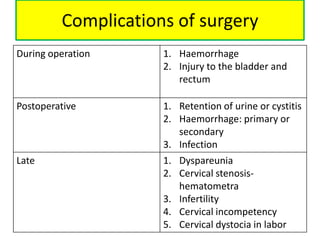
Complications of surgery
During operation 1. Haemorrhage
2. Injury to the bladder and
rectum
Postoperative 1. Retention of urine or cystitis
2. Haemorrhage: primary or
secondary
3. Infection
Late 1. Dyspareunia
2. Cervical stenosis-
hematometra
3. Infertility
4. Cervical incompetency
5. Cervical dystocia in labor
Reference
• Gynaecology by Ten Teachers 19th Ed
• Dutta-Gynecology
• Bonney Gynaecological Surgery 11E

Manchester repair (Fothergill’s Operation)

  • 1.
    Yapa Wijeratne Faculty ofMedicine University of Peradeniya
  • 2.
    • The operationis designed to correct uterine descent associated with cystocele and rectocele where the preservation of the uterus is desirable. • The indications are : 1. Preservation of reproductive function. 2. When the symptoms are due to vaginal prolapse associated with elongation of the (supravaginal) cervix.
  • 3.
    Composite steps ofManchester Repair 1. Preliminary D + C. 2. Amputation of cervix. 3. Plication of Mackenrodt's ligaments in front of cervix. 4. Anterior colporrhaphy. 5. Colpoperineorrhaphy.
  • 4.
    The principal stepsof the operation are • (a) Preliminary dilatation and curettage — • Uterine sound gives the idea about elongation of cervix. • Dilatation of the cervical canal is done to facilitate the passage of the sutures passing through the cervical canal during covering of the amputated cervix by vaginal flaps. • It also ensures adequate uterine drainage and prevents cervical stenosis during healing of the external os. • Curettage is done to remove the unhealthy endometrium.
  • 5.
    • (b) Amputationo f the cervix — Where future reproduction is required, low amputation is to be done. • (c) Plication of the Mackenrodt's ligaments in front of the cervix. This facilitates their shortening raising the cervix so as to place it in its normal position. • (d) Anterior colporrhaphy. • (e) Colpoperineorrhaphy. • If the family is completed, vaginal sterilisation is to be done.
  • 6.
    STEPS OF OPERATION •Preliminaries • The preliminaries are the same as those followed in anterior colporrhaphy. • Actual steps • Preliminary D + C. • The next step is like that of anterior colporrhaphy upto the pushing up the bladder. • The posterior lip of the cervix is to be held with vulsellum and the cervix is drawn upwards.
  • 7.
    o A pairof Allis forceps is placed in the midpoint of the posterior cervicovaginal junction. o The anterior transverse incision is now extended posteriorly across the posterior cervicovaginal junction. o The lateral and posterior vaginal wall is dissected off from the o cervix by scissors and finger dissection. o The Mackenrodt's ligament with descending cervical artery of either side is clamped at a higher level of amputation, cut and replaced by ligature (chromic catgut No. ‘1’ ) o The presence of enterocele should be searched for and if detected, to be repaired. o The cervix is now amputated at the calculated level. o Anterior lip of the amputated cervix is now held with single- toothed vulsellum. o The posterior lip of the amputated cervix is covered by the vaginal flap using a Sturmdorff suture or by Bonney’s method.
  • 8.
    • In Bonney'smethod, a catgut stitch is fixed at the apex of the posterior vaginal flap. • The ends of the ligature are passed through the cervical canal and are taken out laterally on either side of new posterior fornix. • The ends of the ligature are tied in the midline. • The cut ends of the Mackenrodt's ligament are sutured to the anterior surface of the cervix. • Alternatively, the ligaments are fixed using Fothergill’s stitch, Fothergill’s stitch is used to make the uterus anteverted.
  • 9.
    • The stitchpasses through the following tissues in sequence. • Vaginal skin at the level of the FothergilTs lateral point → Mackenrodt's ligament →through the cervical tissue from outside inwards → cervical tissue from inside outwards → Mackenrodt's ligament of the other side → vaginal skin (Fothergill’s lateral point) of the other side. • Pubocervical fascia is approximated as in anterior colporrhaphy.
  • 10.
    • Redundant portionof the vaginal mucosa is excised. • The cut margins of the vagina are apposed by interrupted sutures. • Posterior colpoperineorrhaphy is performed. • Toileting the vagina is done. • Vaginal pack is given. • Self retaining catheter is introduced.
  • 11.
    Complications of surgery Duringoperation 1. Haemorrhage 2. Injury to the bladder and rectum Postoperative 1. Retention of urine or cystitis 2. Haemorrhage: primary or secondary 3. Infection Late 1. Dyspareunia 2. Cervical stenosis- hematometra 3. Infertility 4. Cervical incompetency 5. Cervical dystocia in labor
  • 12.
    Reference • Gynaecology byTen Teachers 19th Ed • Dutta-Gynecology • Bonney Gynaecological Surgery 11E