
Acute Appendicitis
JMJ 1
K. Kavindya M. Fernando
What is acute appendicitis?
• Acute inflammation of the appendix
JMJ 2
How does this inflammation
occurs?
• Occurs due an obstruction
• Obstruction can occur by a
• Faecolith
• Foregin body
• Finbrous stricture from previous inflammation
• Enlarged lymphoid follicles
JMJ 3
How common it is?
• About 10% of the population will develop
acute appendicitis
(Benjamin IS, Patel AG; Managing acute appendicitis. BMJ. 2002 Sep 7;325(7363):505-6)
• Most common between the ages of 10 and 20
years but can occur at any age
• Appendicitis is more common in men
(Humes DJ, Simpson J; Acute appendicitis. BMJ. 2006 Sep 9;333(7567):530-4.)
JMJ 4
Why does acute appendicitis is
not common among extremes of
age?
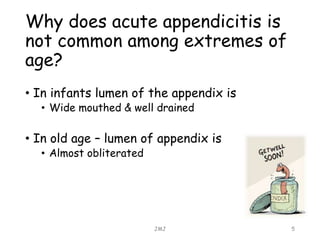
• In infants lumen of the appendix is
• Wide mouthed & well drained
• In old age – lumen of appendix is
• Almost obliterated
JMJ 5
What happens after the
obstruction?
JMJ 6
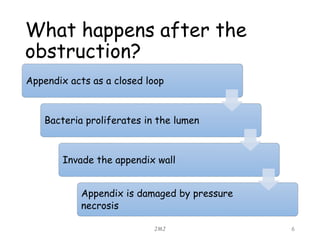
Appendix acts as a closed loop
Bacteria proliferates in the lumen
Invade the appendix wall
Appendix is damaged by pressure
necrosis
What happens after the
obstruction?
JMJ 7
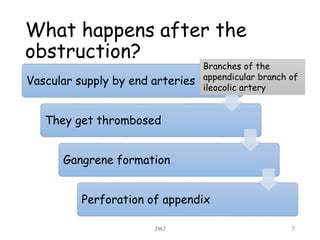
Vascular supply by end arteries
They get thrombosed
Gangrene formation
Perforation of appendix
Branches of the
appendicular branch of
ileocolic artery
JMJ 8
Can acute appendicitis occur
without getting it obstructed?
• Yes
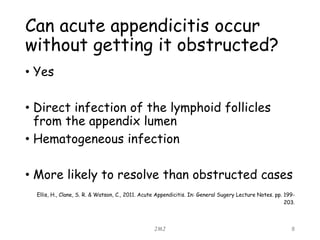
• Direct infection of the lymphoid follicles
from the appendix lumen
• Hematogeneous infection
• More likely to resolve than obstructed cases
Ellis, H., Clane, S. R. & Watson, C., 2011. Acute Appendicitis. In: General Sugery Lecture Notes. pp. 199-
203.
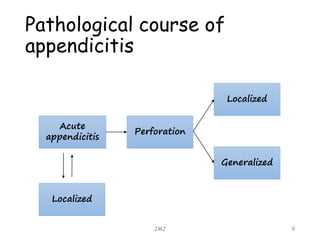
Pathological course of
appendicitis
JMJ 9
Acute
appendicitis
Perforation
Localized
Generalized
Localized
History and
Examination
Signs and symptoms
JMJ 10
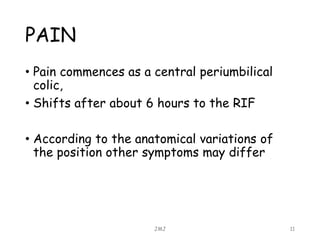
PAIN
• Pain commences as a central periumbilical
colic,
• Shifts after about 6 hours to the RIF
• According to the anatomical variations of
the position other symptoms may differ
JMJ 11
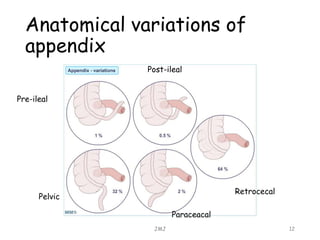
Anatomical variations of
appendix
JMJ 12
Retrocecal
Pre-ileal
Post-ileal
Pelvic
Paraceacal
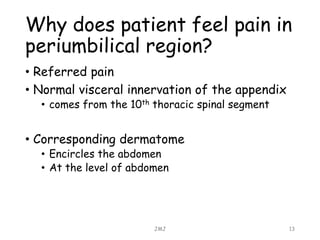
Why does patient feel pain in
periumbilical region?
• Referred pain
• Normal visceral innervation of the appendix
• comes from the 10th thoracic spinal segment
• Corresponding dermatome
• Encircles the abdomen
• At the level of abdomen
JMJ 13
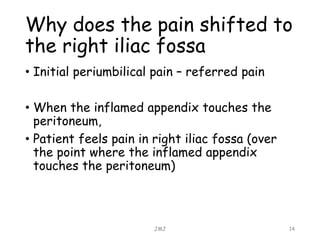
Why does the pain shifted to
the right iliac fossa
• Initial periumbilical pain – referred pain
• When the inflamed appendix touches the
peritoneum,
• Patient feels pain in right iliac fossa (over
the point where the inflamed appendix
touches the peritoneum)
JMJ 14
Other symptoms
• Anorexia
• Nausea / Vomiting
• Fever (low grade – unless perforated)
• Diarrhoea can occur when ileum is irritated
by the inflamed appendix
JMJ 15
JMJ 16
Typical history is
almost diagnostic
of acute
appendicitis
What are the signs which
suggest Acute appendicitis/
• Maximum tenderness
• Guarding
• Rigidity in the iliac fossa
• Rebound tenderness – cough can mimic it
• Tenderness and guarding would be
generalized if appendix has perforated
JMJ 17
What is guarding?
• When you try to touch the abdomen,
• Surrounding abdominal muscles, will go into a
spasm
• This spasm may cause pain
JMJ 18
What is rigidity?
• Due to the inflammation of the whole
abdomen,
• The abdominal walls have already went into a
spasm
• When you touch the abdomen, feeling of
• Board like rigidity
JMJ 19
Rovsing’s sign
• palpation of the left lower quadrant
increases the pain felt in the right lower
quadrant.
• This pressure stretches the entire
peritoneal lining, and so causes pain in any
location where the peritoneum is irritating
the muscle
JMJ 20
Psoas test
• extend the hip and abduct the thigh with
the patient on the left side
JMJ 21
Obturator test
• flex and internally rotate the right hip
How to detect pelvic and
retroceacle appendix?
• Rectal examination may reveal localised
tenderness as the only sign of an inflamed
retrocaecal or pelvic appendix
JMJ 22
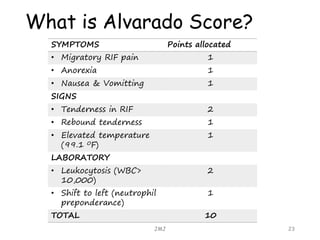
What is Alvarado Score?
JMJ 23
SYMPTOMS Points allocated
• Migratory RIF pain 1
• Anorexia 1
• Nausea & Vomitting 1
SIGNS
• Tenderness in RIF 2
• Rebound tenderness 1
• Elevated temperature
(99.1 0F)
1
LABORATORY
• Leukocytosis (WBC>
10,000)
2
• Shift to left (neutrophil
preponderance)
1
TOTAL 10
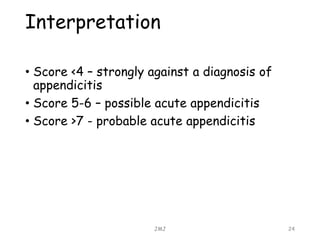
Interpretation
JMJ 24
• Score <4 – strongly against a diagnosis of
appendicitis
• Score 5-6 – possible acute appendicitis
• Score >7 - probable acute appendicitis
Differential diagnosis 1/2
• Intra abdominal causes
• Meckle’s diverticulitis
• Acute intestinal obstruction – colicky pain,
vomiting, noisy bowel sounds, X-ray abdomen
• Gastroenteritis – diarhhoea, abdominal pain
• Acute colonic diverticulitis – solitary ceacal
diverticulum , sigmoid colon (mobile bowel)
• Crohn’s disease
JMJ 25
Differential diagnosis 2/2
• Gyanacological problems in females
• Ectopic pregnancy
• Ruptured or torted ovarian cyst – sudden severe
RIF pain radiating to loin
• Urogenital problems
• Ureteric colic – pain radiates from loin to groin
• Testicular torsion – periumbilical pain & vomiting
JMJ 26
Investigations
• Leucocyte count –
• A mild polymorph leukocytosis
• Normal level does not exclude the diagnosis
• UFR –
• To exclude UTI
• Urine for hCG
• In females to exclude the ectopic pregnancy
• USS abdomen
• where the diagnosis is doubtful and in the
assessment of an appendix mass or abscess
JMJ 27
Management
JMJ 28
Management
• Resuscitate the patient
• Intravenous fluid
• Antibiotics
• Opiate analgesia
• appendicectomy – treatment of choice
JMJ 29
Management
• Antibiotic prophylaxis – preoperatively
• Operation peritonitis – continue antibiotic
therapy
• Mrtranidazole
• Gentamycin or cephalosporins
JMJ 30
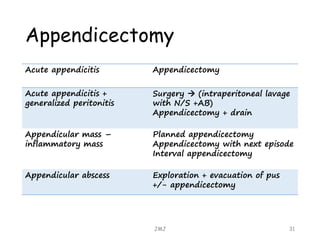
Appendicectomy
Acute appendicitis Appendicectomy
Acute appendicitis +
generalized peritonitis
Surgery  (intraperitoneal lavage
with N/S +AB)
Appendicectomy + drain
Appendicular mass –
inflammatory mass
Planned appendicectomy
Appendicectomy with next episode
Interval appendicectomy
Appendicular abscess Exploration + evacuation of pus
+/- appendicectomy
JMJ 31
Disadvantages of operating
first hand
• Dissemination of infected material
• Inflammation  vasodialatation 
hemmorrage
• Feacal fistula
• Post-op complications
• Wound infection
• Residual abscess
JMJ 32
Advices on discharge
• Clean and dressing after 5day
• Suture removal – 10 days
• R/V at clinic with histology report
• Come back if develop pain or fever
JMJ 33
Prognosis
• Appendicectomy is relatively safe with a
mortality rate for non-perforated
appendicitis of 0.8 per 1,000 and mortality
after perforation of 5.1 per 1,000
(Humes DJ, Simpson J; Acute appendicitis. BMJ. 2006 Sep 9;333(7567):530-4.)
JMJ 34
THANK YOU!!!!
JMJ 35

Acute appendicitis

  • 1.
    Acute Appendicitis JMJ 1 K.Kavindya M. Fernando
  • 2.
    What is acuteappendicitis? • Acute inflammation of the appendix JMJ 2
  • 3.
    How does thisinflammation occurs? • Occurs due an obstruction • Obstruction can occur by a • Faecolith • Foregin body • Finbrous stricture from previous inflammation • Enlarged lymphoid follicles JMJ 3
  • 4.
    How common itis? • About 10% of the population will develop acute appendicitis (Benjamin IS, Patel AG; Managing acute appendicitis. BMJ. 2002 Sep 7;325(7363):505-6) • Most common between the ages of 10 and 20 years but can occur at any age • Appendicitis is more common in men (Humes DJ, Simpson J; Acute appendicitis. BMJ. 2006 Sep 9;333(7567):530-4.) JMJ 4
  • 5.
    Why does acuteappendicitis is not common among extremes of age? • In infants lumen of the appendix is • Wide mouthed & well drained • In old age – lumen of appendix is • Almost obliterated JMJ 5
  • 6.
    What happens afterthe obstruction? JMJ 6 Appendix acts as a closed loop Bacteria proliferates in the lumen Invade the appendix wall Appendix is damaged by pressure necrosis
  • 7.
    What happens afterthe obstruction? JMJ 7 Vascular supply by end arteries They get thrombosed Gangrene formation Perforation of appendix Branches of the appendicular branch of ileocolic artery
  • 8.
    JMJ 8 Can acuteappendicitis occur without getting it obstructed? • Yes • Direct infection of the lymphoid follicles from the appendix lumen • Hematogeneous infection • More likely to resolve than obstructed cases Ellis, H., Clane, S. R. & Watson, C., 2011. Acute Appendicitis. In: General Sugery Lecture Notes. pp. 199- 203.
  • 9.
    Pathological course of appendicitis JMJ9 Acute appendicitis Perforation Localized Generalized Localized
  • 10.
  • 11.
    PAIN • Pain commencesas a central periumbilical colic, • Shifts after about 6 hours to the RIF • According to the anatomical variations of the position other symptoms may differ JMJ 11
  • 12.
    Anatomical variations of appendix JMJ12 Retrocecal Pre-ileal Post-ileal Pelvic Paraceacal
  • 13.
    Why does patientfeel pain in periumbilical region? • Referred pain • Normal visceral innervation of the appendix • comes from the 10th thoracic spinal segment • Corresponding dermatome • Encircles the abdomen • At the level of abdomen JMJ 13
  • 14.
    Why does thepain shifted to the right iliac fossa • Initial periumbilical pain – referred pain • When the inflamed appendix touches the peritoneum, • Patient feels pain in right iliac fossa (over the point where the inflamed appendix touches the peritoneum) JMJ 14
  • 15.
    Other symptoms • Anorexia •Nausea / Vomiting • Fever (low grade – unless perforated) • Diarrhoea can occur when ileum is irritated by the inflamed appendix JMJ 15
  • 16.
    JMJ 16 Typical historyis almost diagnostic of acute appendicitis
  • 17.
    What are thesigns which suggest Acute appendicitis/ • Maximum tenderness • Guarding • Rigidity in the iliac fossa • Rebound tenderness – cough can mimic it • Tenderness and guarding would be generalized if appendix has perforated JMJ 17
  • 18.
    What is guarding? •When you try to touch the abdomen, • Surrounding abdominal muscles, will go into a spasm • This spasm may cause pain JMJ 18
  • 19.
    What is rigidity? •Due to the inflammation of the whole abdomen, • The abdominal walls have already went into a spasm • When you touch the abdomen, feeling of • Board like rigidity JMJ 19
  • 20.
    Rovsing’s sign • palpationof the left lower quadrant increases the pain felt in the right lower quadrant. • This pressure stretches the entire peritoneal lining, and so causes pain in any location where the peritoneum is irritating the muscle JMJ 20
  • 21.
    Psoas test • extendthe hip and abduct the thigh with the patient on the left side JMJ 21 Obturator test • flex and internally rotate the right hip
  • 22.
    How to detectpelvic and retroceacle appendix? • Rectal examination may reveal localised tenderness as the only sign of an inflamed retrocaecal or pelvic appendix JMJ 22
  • 23.
    What is AlvaradoScore? JMJ 23 SYMPTOMS Points allocated • Migratory RIF pain 1 • Anorexia 1 • Nausea & Vomitting 1 SIGNS • Tenderness in RIF 2 • Rebound tenderness 1 • Elevated temperature (99.1 0F) 1 LABORATORY • Leukocytosis (WBC> 10,000) 2 • Shift to left (neutrophil preponderance) 1 TOTAL 10
  • 24.
    Interpretation JMJ 24 • Score<4 – strongly against a diagnosis of appendicitis • Score 5-6 – possible acute appendicitis • Score >7 - probable acute appendicitis
  • 25.
    Differential diagnosis 1/2 •Intra abdominal causes • Meckle’s diverticulitis • Acute intestinal obstruction – colicky pain, vomiting, noisy bowel sounds, X-ray abdomen • Gastroenteritis – diarhhoea, abdominal pain • Acute colonic diverticulitis – solitary ceacal diverticulum , sigmoid colon (mobile bowel) • Crohn’s disease JMJ 25
  • 26.
    Differential diagnosis 2/2 •Gyanacological problems in females • Ectopic pregnancy • Ruptured or torted ovarian cyst – sudden severe RIF pain radiating to loin • Urogenital problems • Ureteric colic – pain radiates from loin to groin • Testicular torsion – periumbilical pain & vomiting JMJ 26
  • 27.
    Investigations • Leucocyte count– • A mild polymorph leukocytosis • Normal level does not exclude the diagnosis • UFR – • To exclude UTI • Urine for hCG • In females to exclude the ectopic pregnancy • USS abdomen • where the diagnosis is doubtful and in the assessment of an appendix mass or abscess JMJ 27
  • 28.
  • 29.
    Management • Resuscitate thepatient • Intravenous fluid • Antibiotics • Opiate analgesia • appendicectomy – treatment of choice JMJ 29
  • 30.
    Management • Antibiotic prophylaxis– preoperatively • Operation peritonitis – continue antibiotic therapy • Mrtranidazole • Gentamycin or cephalosporins JMJ 30
  • 31.
    Appendicectomy Acute appendicitis Appendicectomy Acuteappendicitis + generalized peritonitis Surgery  (intraperitoneal lavage with N/S +AB) Appendicectomy + drain Appendicular mass – inflammatory mass Planned appendicectomy Appendicectomy with next episode Interval appendicectomy Appendicular abscess Exploration + evacuation of pus +/- appendicectomy JMJ 31
  • 32.
    Disadvantages of operating firsthand • Dissemination of infected material • Inflammation  vasodialatation  hemmorrage • Feacal fistula • Post-op complications • Wound infection • Residual abscess JMJ 32
  • 33.
    Advices on discharge •Clean and dressing after 5day • Suture removal – 10 days • R/V at clinic with histology report • Come back if develop pain or fever JMJ 33
  • 34.
    Prognosis • Appendicectomy isrelatively safe with a mortality rate for non-perforated appendicitis of 0.8 per 1,000 and mortality after perforation of 5.1 per 1,000 (Humes DJ, Simpson J; Acute appendicitis. BMJ. 2006 Sep 9;333(7567):530-4.) JMJ 34
  • 35.