Intern Dr. Eliz Achhami
Intern Dr. Dipesh Bikram Shah
Shree Birendra Hospital
Kathmandu
Case of Perineal Tear
• 20 years G2P0+1 post dated pregnancy (at 39+4 weeks
of gestation, according to 1st USG scan) was admitted
to maternity ward for planned induction of labor.
• On examination:-
– General condition was fair
– No Pallor, icterus, dehydration or edema
– Vitals –
• Pulse:-88 bpm, regular
• B.P.:-110/70 mm of hg
• Temperature:-98º F
• Respiratory Rate:-22 Breaths/min
• P/A:-
o Uterus-term size
o cephalic presentation 4/5 palpable
o with no uterine contraction
o FHS -144 bpm, regular
• P/V:-
o os - tip of finger
o Cervix - soft, uneffaced , posterior
o Head station at -2
o Bishop’s score - 3
– induced with 2 doses of tab. Misoprostol 25 μg kept in
posterior fornix after vaginal examination and Bishop’s
scoring at 4 am and 10 am.
• She delivered alive male baby on 2074/02/20 at 3:18
pm with 3rd degree perineal and cervical tear on left
lateral wall.
• Total duration of labour was 4 hours and 23 minutes.
• Total blood loss – 100 ml
• Placenta :- normal type , 500 gm
• Baby’s detail:
– Weight :- 2900 gm.
– APGAR score:- 7/10 and 8/10 (at 1 min and 5 min)
– No external abnormalities seen
Perineal tear repair
• Written consent was taken
• Anesthesia – saddle block
• Intra-operative finding:-
– III degree perineal tear type C with rectal mucosa
intact
– Cervical tear on left lateral wall ( ~ 3cm)
– Retained small placental tissues and membrane
– Uterus – well contracted ~ 24 weeks
Procedure during repair
• Anal mucosa repaired with vicryl (no.2-0) -
continuous type suture.
• Left side of external and internal sphincter
identified and held with Allis whereas right side
of sphincter was slightly difficult to identify and
both of them are sutured with figure 8 suture.
• Exploration – small placental tissue and
membranes removed.
• Left side of cervix sutured with catgut no 2-0-
interrupted suture
• Episiotomy wound was repaired.
Post operative management
• She was kept NPO for 2 days.
• After 2 days diet was changed to liquid and
slowly to semi-solid diet and non bulk forming
diet.
• Was given following antibiotics.
• Cefotaxime was given intravenously for 2 days.
• Cefixime was given orally for 7 days.
• Metronidazole was given intravenously for 2 days and
continued orally for 5 more days.
• Sitz bath was done twice daily.
• Peri-care and peri-light was provided.
• Analgesics –
• Laxatives – Syrup lactulose 15ml HS
• Passed well formed stool
• Anal tone restored slowly.
• Anal incontinence was ruled out before
discharge.
• Advised to follow up after 1 week to access for
the progression of wound.
Perineal tears:
• Lacerations of perineum are the result of
overstreching or too rapid streching of the tissues,
especially if they are poorly extensile and rigid.
• Perineal injuries are more common in primigravida
than multigravida.
CAUSES:
1)Obstetrical causes
2)Non Obstetrical causes
Obstetric Causes:
Malpresentations such as breech
Contracted pelvic outlet
Prolonged labour
operative vaginal deliveries( forceps or vaccum)
Macrosomic babies
Occipitoposterior delivery
Precipitate labour
Epidural analgesia
Induction of labour
Rigid perineum
Non-obstetric causes:
Rape
Molestation
Fall
Accidental injuries like RTA, bull horn injuries
etc.
RCOG CLASSIFICATION OF
PERINEAL TEARS:2007
First degree: Injury to perineal skin only.
Second degree: Injury to perineum involving perineal
muscles but not involving the anal sphincter.
Third degree: Injury to perineum involving the anal
sphincter complex:
3a: Less than 50% of EAS thickness torn.
3b: More than 50% of EAS thickness torn.
3c: Both EAS and IAS torn.
Fourth degree: Injury to perineum involving the anal
sphincter complex (EAS and IAS) and anal epithelium.
FIRST DEGREE PERINEAL TEAR:
 Involve the fourchette,
perineal skin, and
vaginal mucous
membrane but not the
underlying fascia and
muscle.
 These included
periurethral lacerations
SECOND DEGREE PERINEAL TEAR:
• Involve, in addition, the
fascia and muscles of the
perineal body but not the
anal sphincter. These tears
usually extend upward on
one or both sides of the
vagina, forming an irregular
triangular injury.
THIRD DEGREE PERINEAL TEAR:
• Extend farther to
involve the anal
sphincter
FOURTH DEGREE PERINEAL
TEAR:
• Extends through the rectum's mucosa to expose its
lumen.
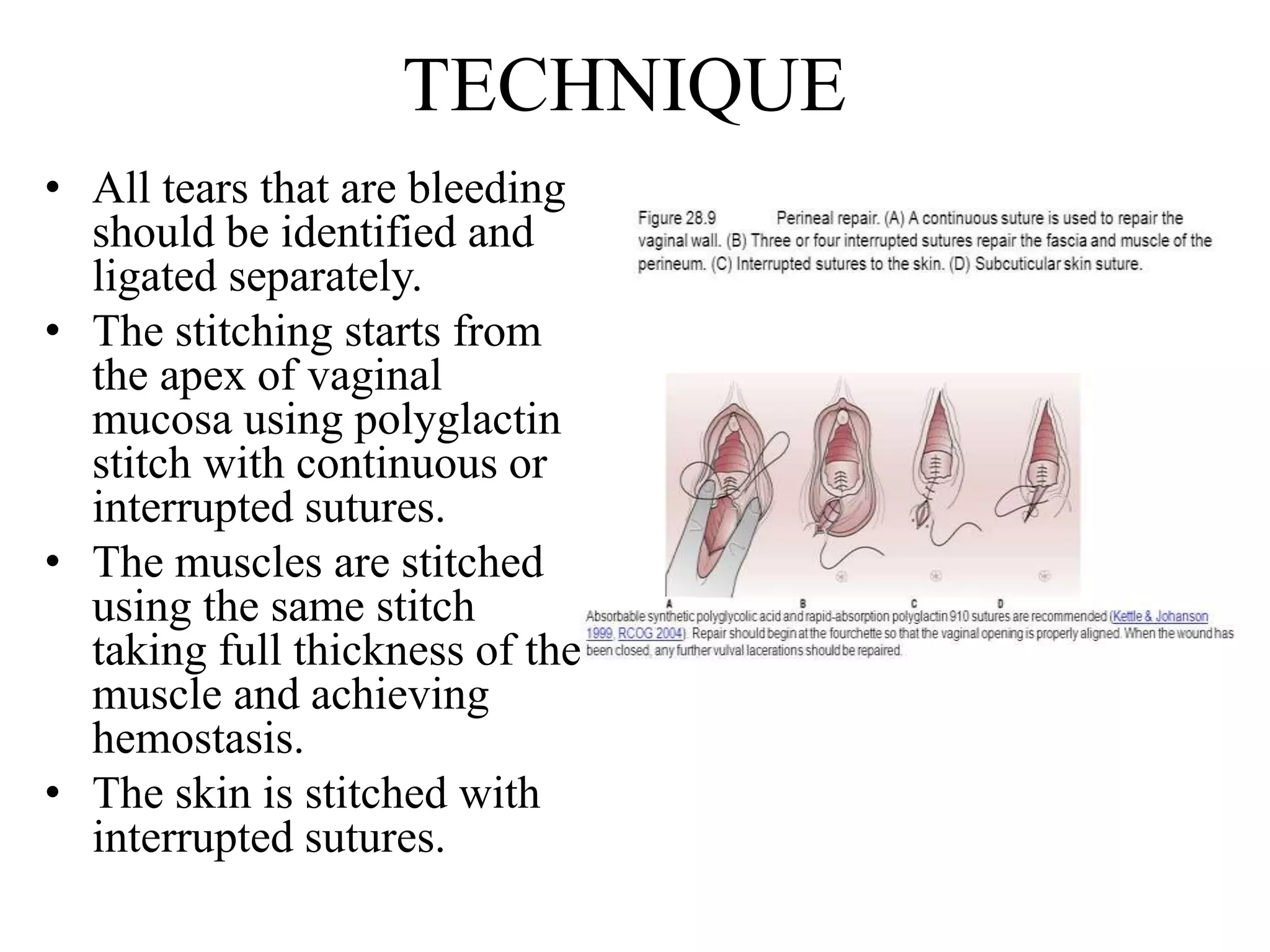
How to recognize:
• Put the patient in extended lithotomy position.
• Arrange proper spotless bright light.
• Vulva should be examined stepwise right from clitoris
to the anus downwards, laterally paraclitoral,
paraurethral, paravaginal and pararectal skin and
muscles in every case after delivery.
• Perineal tears may be associated with high vaginal
circular tears and tears in the fornix and cervix.
• One should suspect traumatic PPH due to perineal tears
when continuous bleeding p/v persisting even after
delivery of placenta when uterus is contracted and
retracted.
PERINEAL TEARS (1st & 2nd degree)&
EPISIOTOMY (induced 2nd degree) REPAIR:
 Should be repaired immediately after delivery of the
placenta (if not possible, within 24 hours of delivery.)
 First step is to define the limits of the lacerations,
which includes vagina as well as perineum.
 Prerequisites:
Proper light with good exposure
Good analgesia
Good assistance
Prefer blunt needle
Chromic catgut 2-0
polyglactin 910
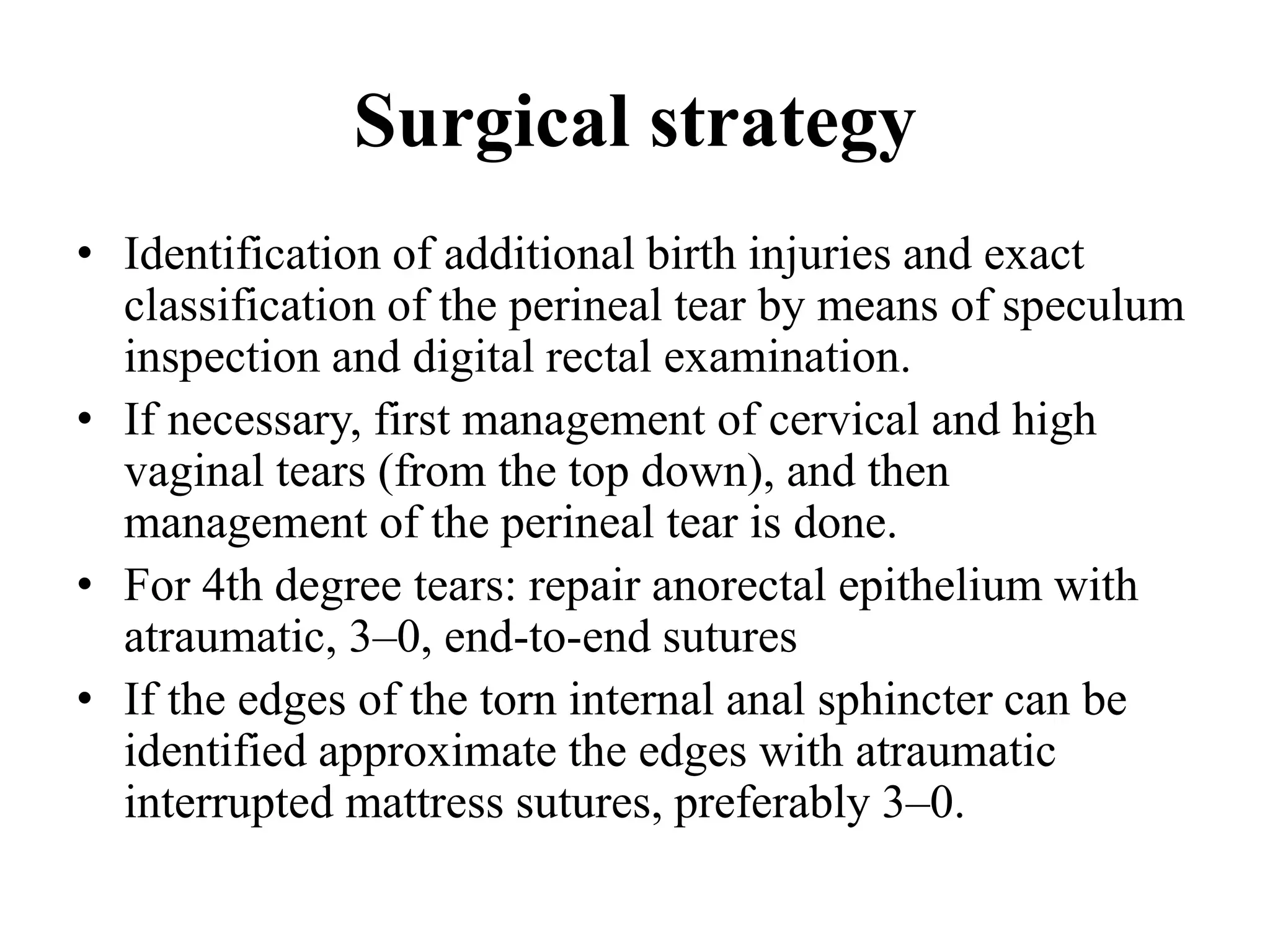
TECHNIQUE
• All tears that are bleeding
should be identified and
ligated separately.
• The stitching starts from
the apex of vaginal
mucosa using polyglactin
stitch with continuous or
interrupted sutures.
• The muscles are stitched
using the same stitch
taking full thickness of the
muscle and achieving
hemostasis.
• The skin is stitched with
interrupted sutures.
THIRD AND FOURTH DEGREE REPAIR:
OBSTETRICALANAL SPHINCTER
INJURIES(OASIS)
Prerequisites:
 Written consent
 General anesthesia/spinal anesthesia/epidural
analgesia
 Operation theatre
 Trained obstetrician
 Good light, Good assistance
 Proper instrument and sutures
REPAIR:(RCOG)
 Immediately (within 24 hours)
 If >24 hours then repair at 6 weeks.
As accurate an approximation as possible of all the
tissues should be secured and no dead spaces are left.
Equipment for Repair:
• Sterile drapes & gloves
• Needle holder
• Suture scissors
• Forceps with teeth
• Allis forceps
• 10ml syringe with 22 guage needle
• 1% lidocaine
• 3-0 polyglactin 901 (Vicryl) suture for Vaginal mucosa,
perineal muscle, skin sutures
• 2-0 polydiaxone sulfate (PDS) suture (external
sphincter sutures)
Surgical strategy
• Identification of additional birth injuries and exact
classification of the perineal tear by means of speculum
inspection and digital rectal examination.
• If necessary, first management of cervical and high
vaginal tears (from the top down), and then
management of the perineal tear is done.
• For 4th degree tears: repair anorectal epithelium with
atraumatic, 3–0, end-to-end sutures
• If the edges of the torn internal anal sphincter can be
identified approximate the edges with atraumatic
interrupted mattress sutures, preferably 3–0.
• Identification of the edges of the external anal sphincter
muscle and gripping them with Allis clamps.
• Suture of the external anal sphincter muscle with
atraumatic U sutures – preferably with thread size 2–0.
(two methods: Overlapping technique and the end-to-
end technique.)
• When obstetric anal sphincter repairs are being
performed, the burying of surgical knots beneath the
superficial perineal muscles is recommended to
minimise the risk of knot and suture migration to the
skin.
• Layer-by-layer management of the perineum.
END TO END teqnique Overlapping technique
CHOICE OF SUTURE MATERIAL:
1. When repair of EAS muscle is being performed
either monofilament sutures such as polydiaxonone
or modern braided sutures such as vicryl used.
2. When repair of IAS muscle is being performed,PDS
3-0 and 2-0 vicryl causes less irritation and
discomfort.
POSTOPERATIVE MANAGEMENT:
• Use of broad spectrum antibiotics is
recommended following repair of OASIS to
reduce the risk of postoperative infection and
wound dehiscence.
• Postoperative laxatives
• Seitz bath BD.
• Analgesics
• Bulking agents should not be give with laxatives
• Physiotherapy and pelvic floor exercises 6-12
weeks after repair.
Follow-up
• history of symptoms of anal incontinence.
• inspection of the perineum
• vaginal and rectal palpation
• Information about a possibly long latency
onset/worsening of the symptoms of anal incontinence
• discussion regarding subsequent pregnancies and births
• If patient is experiencing incontinence or pain on
follow up refer to a special gynaecologists or colorectal
surgeon and anorectal manometryshould be considered.
Recommendations for subsequent
deliveries
• should be counseled about the risk of developing anal
incontinence or worsening symptoms with subsequent
vaginal delivery.
• no evidence to support the role of prophylactic episiotomy
in subsequent pregnancies
• An elective Caesarean section should be offered to all
women who have previously suffered from 3rd/4th degree
perineal tears, and especially to those patients with
– persisting fecal incontinence,
– reduced sphincter function or
– suspected fetal macrosomia.
Sequel of obstetric perineal laceration:
• Chronic perineal pain
• Dyspareunia
• Urinary & fecal
incontinence
PREVENTION
• Liberal use of episiotomy
• Proper conduct of labour during 2nd stage
• Perineal support during 2nd stage
STUDIES
Second Stage Method of Pushing:
LOE 4 :Prospective cohort
Compared women who were coached to push versus
women who were given no instructions.
Sutured trauma-63% vs 39% in coached compared to
not coached groups.
GOR D:Insufficient evidence to recommend style of
pushing for prevention of perineal trauma.
Operative Vaginal Delivery
LOE1:Systematic Review & RCTs
Use of Vacum Extraction compared to forceps results
in:
-Less maternal trauma
-Less pain at 24 hours
-More cephalohematomas & retinal hemorrhage
GOR A : Use of VE over forceps,whenever
possible,but be aware of possible neonatal harms.
EPIDURAL ANESTHESIA
Use of epidural anaesthesia also increases perineal
trauma, likely increasing fetal malposition and
operative vaginal deliveries, based on systemic
review of cohort studies (Lieberman,2002,6 studies)
Epidural analgesia was found to be protective (Jango
2014)
STUDY COMPARING EPISIOTOMY
VS PERINEAL TEAR:
Episiotomy is equivalent to second degree tear
and studies indicate that episiotomy may decrease
the incidence of anterior tears, but not posterior
tears, rather may be associated with increased risk
of 3rd & 4th degree perineal tears.
In a study conducted by F.C.R. Williams et al, it
was found that the rate of 3rd degree tear was 5
times higher in women with episiotomy as
compared to tear.
Episiotomy Vs Perineal Tear –A Comparative Study Of Maternal and Fetal Outcome Dr Rumi Bhattacharjee,
M.D. Obst& Gynae, Assistant Prof.,Dept. of Obst.& Gynae,Pramukh Swami Med 2013
Effectiveness of episiotomy in preventing
perineal tear
• Retrospective analysis on vaginal deliveries was done by
Obstetric department of Tribhuwan University Teaching
Hospital, Institute of Medicine, Kathmandu, Nepal.
• Conclusion :-
• Severe degree perineal tear occurred in almost double cases
who were epitomized than those who were not.
• Large birth weight of baby, primiparity, postdated delivery and
instrumentation were related to severe degree perineal tear
Effectiveness of episiotomy in preventing third and fourth degree perineal tear
AR Devkota, A Rana, G Gurung, A Amatya
DELIVERY POSITION:
 Kneeling versus Sitting position has no effect on increase in
chances of OASIS while standing might increase the risk of
OASIS.
 A retrospective analysis of 814 women (650 standing, 264
sitting, any parity) in which women standing for their
delivery had a nearly 7-fold increase in OASIS (2.5% vs
38%).
 A 2012 RCT comparing traditional method of delivery
versus “alternate” method of delivery “Gasquet” position –
with upper hip flexed, foot on stirrup higher than knee)
showed no difference in rate of OAS.
NSAIDs suppositories for Perineal
pain after trauma:
LOE Ib
Women in the NSAID group (diclofenac and
indomethacin used in RCT)
-Experienced less pain 24 hours after birth
-Required less supplemental analgesia in first 24
hours.
GOR A :there is fair evidence to adopt the use of
NSAID suppositories to reduce postpartum.
Conclusion
• More common in Primigravida than Multigravida.
• Gross injury is due to mismanaged 2nd stage of
labor.
• After vaginal birth a 3rd or 4th degree perineal
tear must be excluded.
• Perineal tear should be repaired immediately after
delivery of the placenta.
• Clinicians should be aware, however, that risk
factors do not allow the accurate prediction of
OASIS.
presentaion on perineal tear

presentaion on perineal tear

  • 1.
    Intern Dr. ElizAchhami Intern Dr. Dipesh Bikram Shah Shree Birendra Hospital Kathmandu
  • 2.
    Case of PerinealTear • 20 years G2P0+1 post dated pregnancy (at 39+4 weeks of gestation, according to 1st USG scan) was admitted to maternity ward for planned induction of labor. • On examination:- – General condition was fair – No Pallor, icterus, dehydration or edema – Vitals – • Pulse:-88 bpm, regular • B.P.:-110/70 mm of hg • Temperature:-98º F • Respiratory Rate:-22 Breaths/min
  • 3.
    • P/A:- o Uterus-termsize o cephalic presentation 4/5 palpable o with no uterine contraction o FHS -144 bpm, regular • P/V:- o os - tip of finger o Cervix - soft, uneffaced , posterior o Head station at -2 o Bishop’s score - 3 – induced with 2 doses of tab. Misoprostol 25 μg kept in posterior fornix after vaginal examination and Bishop’s scoring at 4 am and 10 am.
  • 4.
    • She deliveredalive male baby on 2074/02/20 at 3:18 pm with 3rd degree perineal and cervical tear on left lateral wall. • Total duration of labour was 4 hours and 23 minutes. • Total blood loss – 100 ml • Placenta :- normal type , 500 gm • Baby’s detail: – Weight :- 2900 gm. – APGAR score:- 7/10 and 8/10 (at 1 min and 5 min) – No external abnormalities seen
  • 5.
    Perineal tear repair •Written consent was taken • Anesthesia – saddle block • Intra-operative finding:- – III degree perineal tear type C with rectal mucosa intact – Cervical tear on left lateral wall ( ~ 3cm) – Retained small placental tissues and membrane – Uterus – well contracted ~ 24 weeks
  • 6.
    Procedure during repair •Anal mucosa repaired with vicryl (no.2-0) - continuous type suture. • Left side of external and internal sphincter identified and held with Allis whereas right side of sphincter was slightly difficult to identify and both of them are sutured with figure 8 suture. • Exploration – small placental tissue and membranes removed. • Left side of cervix sutured with catgut no 2-0- interrupted suture • Episiotomy wound was repaired.
  • 7.
    Post operative management •She was kept NPO for 2 days. • After 2 days diet was changed to liquid and slowly to semi-solid diet and non bulk forming diet. • Was given following antibiotics. • Cefotaxime was given intravenously for 2 days. • Cefixime was given orally for 7 days. • Metronidazole was given intravenously for 2 days and continued orally for 5 more days. • Sitz bath was done twice daily. • Peri-care and peri-light was provided.
  • 8.
    • Analgesics – •Laxatives – Syrup lactulose 15ml HS • Passed well formed stool • Anal tone restored slowly. • Anal incontinence was ruled out before discharge. • Advised to follow up after 1 week to access for the progression of wound.
  • 9.
    Perineal tears: • Lacerationsof perineum are the result of overstreching or too rapid streching of the tissues, especially if they are poorly extensile and rigid. • Perineal injuries are more common in primigravida than multigravida.
  • 10.
  • 11.
    Obstetric Causes: Malpresentations suchas breech Contracted pelvic outlet Prolonged labour operative vaginal deliveries( forceps or vaccum) Macrosomic babies Occipitoposterior delivery Precipitate labour Epidural analgesia Induction of labour Rigid perineum
  • 12.
  • 13.
    RCOG CLASSIFICATION OF PERINEALTEARS:2007 First degree: Injury to perineal skin only. Second degree: Injury to perineum involving perineal muscles but not involving the anal sphincter. Third degree: Injury to perineum involving the anal sphincter complex: 3a: Less than 50% of EAS thickness torn. 3b: More than 50% of EAS thickness torn. 3c: Both EAS and IAS torn. Fourth degree: Injury to perineum involving the anal sphincter complex (EAS and IAS) and anal epithelium.
  • 14.
    FIRST DEGREE PERINEALTEAR:  Involve the fourchette, perineal skin, and vaginal mucous membrane but not the underlying fascia and muscle.  These included periurethral lacerations
  • 15.
    SECOND DEGREE PERINEALTEAR: • Involve, in addition, the fascia and muscles of the perineal body but not the anal sphincter. These tears usually extend upward on one or both sides of the vagina, forming an irregular triangular injury.
  • 16.
    THIRD DEGREE PERINEALTEAR: • Extend farther to involve the anal sphincter
  • 17.
    FOURTH DEGREE PERINEAL TEAR: •Extends through the rectum's mucosa to expose its lumen.
  • 18.
    How to recognize: •Put the patient in extended lithotomy position. • Arrange proper spotless bright light. • Vulva should be examined stepwise right from clitoris to the anus downwards, laterally paraclitoral, paraurethral, paravaginal and pararectal skin and muscles in every case after delivery. • Perineal tears may be associated with high vaginal circular tears and tears in the fornix and cervix. • One should suspect traumatic PPH due to perineal tears when continuous bleeding p/v persisting even after delivery of placenta when uterus is contracted and retracted.
  • 19.
    PERINEAL TEARS (1st& 2nd degree)& EPISIOTOMY (induced 2nd degree) REPAIR:  Should be repaired immediately after delivery of the placenta (if not possible, within 24 hours of delivery.)  First step is to define the limits of the lacerations, which includes vagina as well as perineum.  Prerequisites: Proper light with good exposure Good analgesia Good assistance Prefer blunt needle Chromic catgut 2-0 polyglactin 910
  • 20.
    TECHNIQUE • All tearsthat are bleeding should be identified and ligated separately. • The stitching starts from the apex of vaginal mucosa using polyglactin stitch with continuous or interrupted sutures. • The muscles are stitched using the same stitch taking full thickness of the muscle and achieving hemostasis. • The skin is stitched with interrupted sutures.
  • 21.
    THIRD AND FOURTHDEGREE REPAIR: OBSTETRICALANAL SPHINCTER INJURIES(OASIS) Prerequisites:  Written consent  General anesthesia/spinal anesthesia/epidural analgesia  Operation theatre  Trained obstetrician  Good light, Good assistance  Proper instrument and sutures
  • 22.
    REPAIR:(RCOG)  Immediately (within24 hours)  If >24 hours then repair at 6 weeks. As accurate an approximation as possible of all the tissues should be secured and no dead spaces are left.
  • 23.
    Equipment for Repair: •Sterile drapes & gloves • Needle holder • Suture scissors • Forceps with teeth • Allis forceps • 10ml syringe with 22 guage needle • 1% lidocaine • 3-0 polyglactin 901 (Vicryl) suture for Vaginal mucosa, perineal muscle, skin sutures • 2-0 polydiaxone sulfate (PDS) suture (external sphincter sutures)
  • 24.
    Surgical strategy • Identificationof additional birth injuries and exact classification of the perineal tear by means of speculum inspection and digital rectal examination. • If necessary, first management of cervical and high vaginal tears (from the top down), and then management of the perineal tear is done. • For 4th degree tears: repair anorectal epithelium with atraumatic, 3–0, end-to-end sutures • If the edges of the torn internal anal sphincter can be identified approximate the edges with atraumatic interrupted mattress sutures, preferably 3–0.
  • 25.
    • Identification ofthe edges of the external anal sphincter muscle and gripping them with Allis clamps. • Suture of the external anal sphincter muscle with atraumatic U sutures – preferably with thread size 2–0. (two methods: Overlapping technique and the end-to- end technique.) • When obstetric anal sphincter repairs are being performed, the burying of surgical knots beneath the superficial perineal muscles is recommended to minimise the risk of knot and suture migration to the skin. • Layer-by-layer management of the perineum.
  • 27.
    END TO ENDteqnique Overlapping technique
  • 29.
    CHOICE OF SUTUREMATERIAL: 1. When repair of EAS muscle is being performed either monofilament sutures such as polydiaxonone or modern braided sutures such as vicryl used. 2. When repair of IAS muscle is being performed,PDS 3-0 and 2-0 vicryl causes less irritation and discomfort.
  • 30.
    POSTOPERATIVE MANAGEMENT: • Useof broad spectrum antibiotics is recommended following repair of OASIS to reduce the risk of postoperative infection and wound dehiscence. • Postoperative laxatives • Seitz bath BD. • Analgesics • Bulking agents should not be give with laxatives • Physiotherapy and pelvic floor exercises 6-12 weeks after repair.
  • 31.
    Follow-up • history ofsymptoms of anal incontinence. • inspection of the perineum • vaginal and rectal palpation • Information about a possibly long latency onset/worsening of the symptoms of anal incontinence • discussion regarding subsequent pregnancies and births • If patient is experiencing incontinence or pain on follow up refer to a special gynaecologists or colorectal surgeon and anorectal manometryshould be considered.
  • 32.
    Recommendations for subsequent deliveries •should be counseled about the risk of developing anal incontinence or worsening symptoms with subsequent vaginal delivery. • no evidence to support the role of prophylactic episiotomy in subsequent pregnancies • An elective Caesarean section should be offered to all women who have previously suffered from 3rd/4th degree perineal tears, and especially to those patients with – persisting fecal incontinence, – reduced sphincter function or – suspected fetal macrosomia.
  • 33.
    Sequel of obstetricperineal laceration: • Chronic perineal pain • Dyspareunia • Urinary & fecal incontinence
  • 34.
    PREVENTION • Liberal useof episiotomy • Proper conduct of labour during 2nd stage • Perineal support during 2nd stage
  • 35.
  • 36.
    Second Stage Methodof Pushing: LOE 4 :Prospective cohort Compared women who were coached to push versus women who were given no instructions. Sutured trauma-63% vs 39% in coached compared to not coached groups. GOR D:Insufficient evidence to recommend style of pushing for prevention of perineal trauma.
  • 37.
    Operative Vaginal Delivery LOE1:SystematicReview & RCTs Use of Vacum Extraction compared to forceps results in: -Less maternal trauma -Less pain at 24 hours -More cephalohematomas & retinal hemorrhage GOR A : Use of VE over forceps,whenever possible,but be aware of possible neonatal harms.
  • 38.
    EPIDURAL ANESTHESIA Use ofepidural anaesthesia also increases perineal trauma, likely increasing fetal malposition and operative vaginal deliveries, based on systemic review of cohort studies (Lieberman,2002,6 studies) Epidural analgesia was found to be protective (Jango 2014)
  • 39.
    STUDY COMPARING EPISIOTOMY VSPERINEAL TEAR: Episiotomy is equivalent to second degree tear and studies indicate that episiotomy may decrease the incidence of anterior tears, but not posterior tears, rather may be associated with increased risk of 3rd & 4th degree perineal tears. In a study conducted by F.C.R. Williams et al, it was found that the rate of 3rd degree tear was 5 times higher in women with episiotomy as compared to tear. Episiotomy Vs Perineal Tear –A Comparative Study Of Maternal and Fetal Outcome Dr Rumi Bhattacharjee, M.D. Obst& Gynae, Assistant Prof.,Dept. of Obst.& Gynae,Pramukh Swami Med 2013
  • 40.
    Effectiveness of episiotomyin preventing perineal tear • Retrospective analysis on vaginal deliveries was done by Obstetric department of Tribhuwan University Teaching Hospital, Institute of Medicine, Kathmandu, Nepal. • Conclusion :- • Severe degree perineal tear occurred in almost double cases who were epitomized than those who were not. • Large birth weight of baby, primiparity, postdated delivery and instrumentation were related to severe degree perineal tear Effectiveness of episiotomy in preventing third and fourth degree perineal tear AR Devkota, A Rana, G Gurung, A Amatya
  • 41.
    DELIVERY POSITION:  Kneelingversus Sitting position has no effect on increase in chances of OASIS while standing might increase the risk of OASIS.  A retrospective analysis of 814 women (650 standing, 264 sitting, any parity) in which women standing for their delivery had a nearly 7-fold increase in OASIS (2.5% vs 38%).  A 2012 RCT comparing traditional method of delivery versus “alternate” method of delivery “Gasquet” position – with upper hip flexed, foot on stirrup higher than knee) showed no difference in rate of OAS.
  • 42.
    NSAIDs suppositories forPerineal pain after trauma: LOE Ib Women in the NSAID group (diclofenac and indomethacin used in RCT) -Experienced less pain 24 hours after birth -Required less supplemental analgesia in first 24 hours. GOR A :there is fair evidence to adopt the use of NSAID suppositories to reduce postpartum.
  • 43.
    Conclusion • More commonin Primigravida than Multigravida. • Gross injury is due to mismanaged 2nd stage of labor. • After vaginal birth a 3rd or 4th degree perineal tear must be excluded. • Perineal tear should be repaired immediately after delivery of the placenta. • Clinicians should be aware, however, that risk factors do not allow the accurate prediction of OASIS.

Editor's Notes

  • #14 If there is any doubt about the degree of third degree tear, it is advisable to classify it to higher degree rather than the lower degree.
  • #19 After vaginal birth a 3rd or 4th degree perineal tear must first be excluded If a 3rd or 4th degree perineal tear cannot be excluded, an experienced physician with special knowledge (preferably a specialist for gynaecology and obstetrics or a consultant with coloproctological expertise) should be called in to check the diagnosis, and, if necessary, to make a provisional, orienting classification (3rd or 4th degree) and initiate the further steps.
  • #20 First degree: Sometime doesn’t require suturing or can use one or two interrupted suture.
  • #26 (There is a choice between two methods: the overlapping technique and the end-to-end technique. For an incomplete tear of the muscle, the end-to-end technique should be used. Use of the overlapping technique reduces the symptoms of stool urgency and stool incontinence after 1 year whereas, after 3 years, no differences between the two techniques can be found.)
  • #31 The prophylactic administration of lactulose reduces the pain on first bowel movements after management of a higher degree perineal tear. Postoperative pain, rate of wound infections, continence and dyspareunia are not affected by the administration of laxatives. Furthermore, administration of laxatives for a few days is recommended in order to reduce the mechanical stress on the sutures