Benha University Hospital, Egypt
E-mail: elnashar53@hotmail.com
ABOUBAKR ELNASHAR
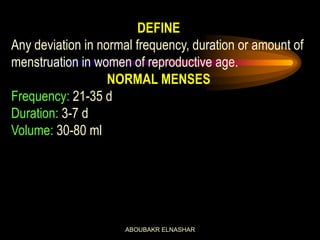
DEFINE
Any deviation in normal frequency, duration or amount of
menstruation in women of reproductive age.
NORMAL MENSES
Frequency: 21-35 d
Duration: 3-7 d
Volume: 30-80 ml
ABOUBAKR ELNASHAR
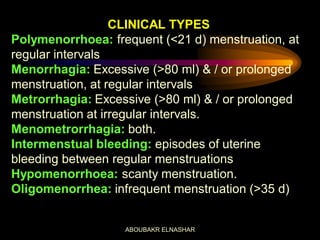
CLINICAL TYPES
Polymenorrhoea: frequent (<21 d) menstruation, at
regular intervals
Menorrhagia: Excessive (>80 ml) & / or prolonged
menstruation, at regular intervals
Metrorrhagia: Excessive (>80 ml) & / or prolonged
menstruation at irregular intervals.
Menometrorrhagia: both.
Intermenstual bleeding: episodes of uterine
bleeding between regular menstruations
Hypomenorrhoea: scanty menstruation.
Oligomenorrhea: infrequent menstruation (>35 d)
ABOUBAKR ELNASHAR
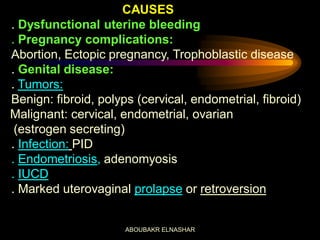
CAUSES
. Dysfunctional uterine bleeding
. Pregnancy complications:
Abortion, Ectopic pregnancy, Trophoblastic disease
. Genital disease:
. Tumors:
Benign: fibroid, polyps (cervical, endometrial, fibroid)
Malignant: cervical, endometrial, ovarian
(estrogen secreting)
. Infection: PID
. Endometriosis, adenomyosis
. IUCD
. Marked uterovaginal prolapse or retroversion
ABOUBAKR ELNASHAR
.
Extragenital:
. Endocrine: hypo or hyer thyroidism
. Haematological: Idiopathic thrombocytopenic
purpura, Von-Willebrand disease
. Chronic systemic disease: liver failure, renal failure,
hypertension with uterine artery atherosclerosis.
. Iatrogenic: Sex hormones, anticoagulants.
. Emotional: (change of country, climate & work;
stress; psychosomatic disorders)
. Obesity: [increased peripheral estrogen conversion]
ABOUBAKR ELNASHAR
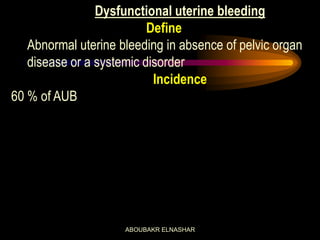
Dysfunctional uterine bleeding
Define
Abnormal uterine bleeding in absence of pelvic organ
disease or a systemic disorder
Incidence
60 % of AUB
ABOUBAKR ELNASHAR
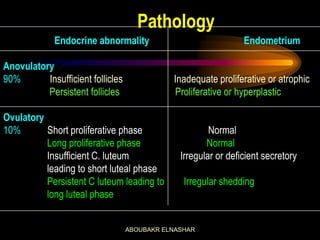
Pathology
Endocrine abnormality Endometrium
Anovulatory
90% Insufficient follicles Inadequate proliferative or atrophic
Persistent follicles Proliferative or hyperplastic
Ovulatory
10% Short proliferative phase Normal
Long proliferative phase Normal
Insufficient C. luteum Irregular or deficient secretory
leading to short luteal phase
Persistent C luteum leading to Irregular shedding
long luteal phase
ABOUBAKR ELNASHAR
ABOUBAKR ELNASHAR
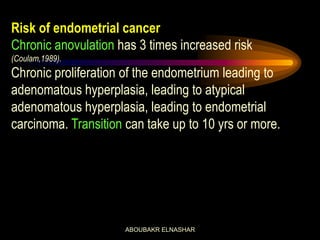
Risk of endometrial cancer
Chronic anovulation has 3 times increased risk
(Coulam,1989).
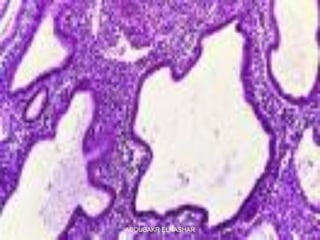
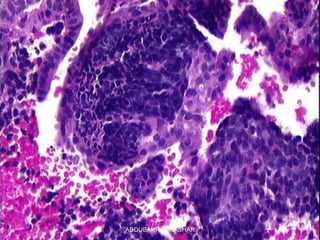
Chronic proliferation of the endometrium leading to
adenomatous hyperplasia, leading to atypical
adenomatous hyperplasia, leading to endometrial
carcinoma. Transition can take up to 10 yrs or more.
ABOUBAKR ELNASHAR
Diagnosis
Aim:
1. Nature & severity of bleeding
2. Exclusion of organic causes
3. Ovulatory or anovulatory
How:
ABOUBAKR ELNASHAR
I. History:
1. Personal: age, wishes of the patient
2. Menstrual
3. Obstetric
4. Past
5. Present: amount, duration, color, smell, relation to
sexual intercourse, associated symptoms
ABOUBAKR ELNASHAR
II. Examination:
1. General:
pallor, endocrinopathy, coagulopathy, pregnancy
2. Abdominal:
liver, spleen, pelvi abdominal mass
3. Pelvic:
origin of the bleeding, cause
ABOUBAKR ELNASHAR
III.Investigations
Systemic:
1. CBC (for all, Grade A)
2. BHCG
3. Prolactin & TSH
4. Prothrombin time, partial thrmoplastin time,
bleeding time, platelets, Von Willebrand factor
ABOUBAKR ELNASHAR
Local:
1. Pap smear
2. Endometrial biopsy
3. D & C
4. Hysteroscopy
5. U/S
ABOUBAKR ELNASHAR
ABOUBAKR ELNASHAR
Assessment of the amount of the bleeding:
50% of excessive menstruation have normal amount of
blood loss by objective methods
1.Subjective methods:
history of passage of clots, flooding, use of large
number of pads, do not reflect the actual blood loss
2.Semiobjective:
i.Iron deficiency anemia
ii.Menstrual calendar
(August,1996)
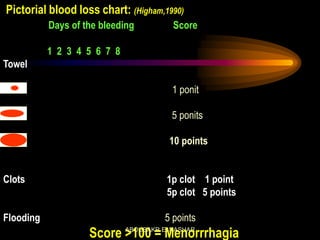
III. Pictorial blood loss chart
(Higham,1990)
:
ABOUBAKR ELNASHAR
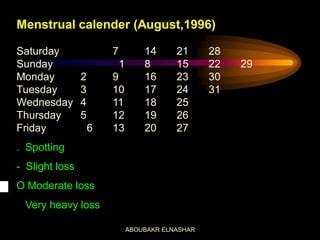
Menstrual calender (August,1996)
Saturday 7 14 21 28
Sunday 1 8 15 22 29
Monday 2 9 16 23 30
Tuesday 3 10 17 24 31
Wednesday 4 11 18 25
Thursday 5 12 19 26
Friday 6 13 20 27
. Spotting
- Slight loss
O Moderate loss
Very heavy loss
ABOUBAKR ELNASHAR
Pictorial blood loss chart: (Higham,1990)
Days of the bleeding Score
1 2 3 4 5 6 7 8
Towel
1 ponit
5 ponits
10 points
Clots 1p clot 1 point
5p clot 5 points
Flooding 5 points
Score >100 = MenorrrhagiaABOUBAKR ELNASHAR
Endometrial biopsy:
Indications:
.Between 20 & 40
.If endometrial thickness on TVS is >12mm, endometrial
sample should be taken to exclude endometrial
hyperplasia (Grade A).
Failure to obtain sufficient sample for H/P does not
require further investigation unless the endometrial
thickness is >12 mm (Grade B)
Aim:
diagnosis of the type of the bleeding
ABOUBAKR ELNASHAR
Methods:
As an outpatient procedure, without general anesthesia.
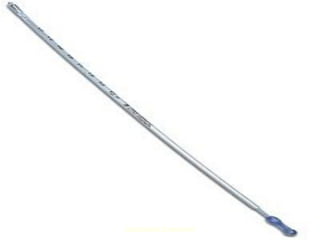
1.Pipelle curette
2.Sharman curette, Gravlee jet washer, Isac cell
sampler
3.Accrette
4.vabra aspirator
Advantages:
An adequate & acceptable screening procedure in
females under 40 yrs
ABOUBAKR ELNASHAR
ABOUBAKR ELNASHAR
D & C:
Indications:
1. Mandatory after 4o yrs
2. Persistent or recurrent bleeding between 20 & 40 yrs
ABOUBAKR ELNASHAR
Aim:
1.Diagnosis of organic disease e.g. endometritis, polyp,
carcinoma, TB, fibroid
2.Diagnosis of the type of the endometrium:
hyperplastic, proliferative, secretory, irregular ripening,
shedding, atrophic. This provides a guide to etiology &
treatment
3.Arrest of the bleeding, if the bleeding is severe or
persistent, particularly hyperplastic endometrium.
Curettage is essentially a diagnostic & not a therapeutic
procedure.
ABOUBAKR ELNASHAR
Disadvantages:
1.Small lesions can be missed
2.The sensitivity of detecting intrauterine pathology is
only 65%
ABOUBAKR ELNASHAR
Fractional curretage:
Indication:
>40 yrs
Method:
3 samples:
endocervical,
lower segment &
upper segment
ABOUBAKR ELNASHAR
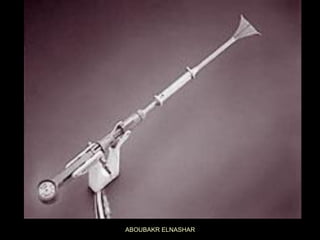
Hysteroscopy:
Indications:
Mandatory after 40 yrs
1. Erratic menstrual bleeding
2. Failed medical treatment
3. TVS suggestive of intrauterine pathology e.g. polyp,
fibroid (Grade B)
ABOUBAKR ELNASHAR
Aim:
1.Excellent view of the uterine cavity & diagnosis of
polyps, submucous fibroid, hyperplasia.
2.Biopsy of the suspected areas
3.Treatment
ABOUBAKR ELNASHAR
Advantages over D &C
1.The whole uterine cavity can be visualized
2.Very small lesions such as polyps can be
identified & biopsed or removed
3.Bleeding from ruptured venules & echymoses can
be readily identified
4.The sensitivity in detecting intrauterine pathology
is 98%
(Loffer,1989)
5.Outpatient procedure
ABOUBAKR ELNASHAR
Disadvantages:
1.Cost of the apparatus
2.Lack of availability or experience
ABOUBAKR ELNASHAR
Ultrasonography:
1. TAS:
can exclude pelvic masses, pregnancy complications
2. TVS:
More informative than TAS. Measurement of the
endometrial thickness is not a replacement for
biopsy. All endometrial carcinoma in postmenopausal
with endometrial thickness>4 mm
(Osmers,1990)
3. Saline sonography:
an alternative to office hysteroscopy in selected
cases. It is better tolerated than office hysteroscopy
or HSG
ABOUBAKR ELNASHAR
TVS is recommended in:
1. Weight >90 Kg
2. Age > 40 yrs
3. Other risk factors for endometrial hyperplasia or
carcinoma e.g.
infertility,
Nulliparity
family history of colon or endometrial cancer,
exposure to unopposed estrogen (Grade B)
ABOUBAKR ELNASHAR
TREATMENT
A. General
1. Menstrual calendar
2. Treatment of iron deficiency anemia
ABOUBAKR ELNASHAR
B. Medical
I. Hormonal:
1.Progestagen
2.Oestrogen
3.COCP
4.Danazol
5.Gnrh agonist
6.Levo-nova (Merina)
II. Non –hormonal
1.Prostaglandin synthetase inhibitors (PSI)
2.Antifibrinolytics
3.Ethamsylate
ABOUBAKR ELNASHAR
C. Surgical
1. Endometrial ablation
2. Hysterectomy
ABOUBAKR ELNASHAR
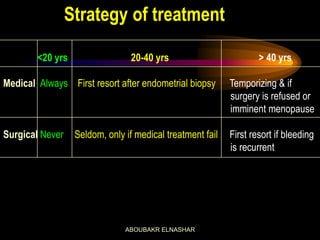
Strategy of treatment
<20 yrs 20-40 yrs > 40 yrs
Medical Always First resort after endometrial biopsy Temporizing & if
surgery is refused or
imminent menopause
Surgical Never Seldom, only if medical treatment fail First resort if bleeding
is recurrent
ABOUBAKR ELNASHAR
Medical treatment:
Antifibrinolytics
Mechanism of action:
The endometrium possess an active fibrinolytic
system, & the fibrinolytic activity is higher in
menorrhagia.
Effect:
Greater reduction of menstrual bleeding than other
therapies (PSI, oral luteal phase progestagen &
etamsylate)
(Cochrane library,2002).
Tranexamic acid is effective in treating menorrhagia
associated with IUCD.
ABOUBAKR ELNASHAR
Side effects: is dose related.
Nausea , vomiting, diarrhea, dizziness. Rarely:
transient color vision disturbance, intracranial
thrombosis. But, no evidence that tranxemic acid
increases the risk in absence of past or family
history of thrombophilia. This treatment is not
associated with an increase in side effects
compared to placebo or other therapies
(Cochrane library,2002).
Dose:
3-6 gm /d for the first 3 days of the cycle
ABOUBAKR ELNASHAR
PSI:
Mechanism;
the endometrium is a rich source of PGE2 & PGF2œ
& its concentrations are greater in menorrhagia. PSI
decreases endometrial PG concentrations.
Effect:
PSI decreased menstrual blood by 24% &
norethisterone by 20%.
The beneficial effect of mefenamic acid on
MBL & other symptoms e.g. dysmenorrhea, headache,
nausea, diarrhea & depression persists for several
months.
ABOUBAKR ELNASHAR
Dose:
Mefenamic acid 500 mg tds during menses.
Side effects:
nausea, vomiting, gastric discomfort, diarrhea,
dizziness. Rarely: haemolytic anemia,
thrombocytopenia. The degree of reduction of MBL
is not as great as it is with tranxamic acid but PSI
have a lower side effect profile.
ABOUBAKR ELNASHAR
Etamsylate:
Mechanism of action:
maintain capillary integrity, anti-hyalurunidase activity
& inhibitory effect on PG
Dose:
500 mg qid, starting 5 days before anticipated onset
of the cycle & continued for 10 days
ABOUBAKR ELNASHAR
Effect:
20% reduction in MBL.
There is no conclusive evidence of the effectivness of
etamsylate in reducing menorrhgea (Grade A)
Side effects:
headache, rash, nausea
ABOUBAKR ELNASHAR
Systemic progestagens:
Norethisterone & medroxyprogesterone acetate
Effect:
Ovulatory DUB:
not effective if given at low dose for short duration
(5-10 days) in the luteal phase. Effective if NEA is
given at higher dose for 3 w out of 4 w (5 mg tds
from D5 to 26)
Anovulatory DUB:
useful
Side effects:
weight gain, nausea, bloating, edema, headache,
acne, depression, exacerbation of epilepsy &
migraine, loss of libido
ABOUBAKR ELNASHAR
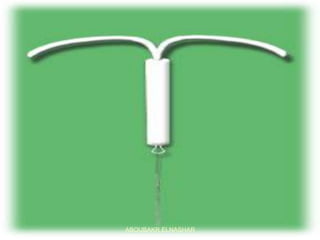
Intrauterine progestagens
Levonorgestrel intrauterine system
levonova,Mirena:
Delivers 20ug LNG /d. for 5 yr
Metraplant:
T shaped IUCD & levonorgestrel on the
shoulder & stem
Azzam IUCD:
Cu T & levonorgestrel on the stem
ABOUBAKR ELNASHAR
Effect;
1.Comparable to endometrial resection for
management of DUB.
2.Superior to PSI & antifibrinolytics
3.May be an alternative to hysterectomy in some
patients
ABOUBAKR ELNASHAR
ABOUBAKR ELNASHAR
Side effects;
1.BTB in the first cycles
2.20% develop amenorrhea within 1 yr
3.Functional ovarian cysts
Special indications:
1. Intractable bleeding associated with chronic illness
2. Ovulatory heavy bleeding
ABOUBAKR ELNASHAR
The combined contraceptive pill:
Effect:
Reduce MBL by 50%
Mechanism of action:
endometrial suppression
Side effects;
headache, migraine, weight gain,
breast tenderness, nausea, cholestatic jaundice,
hypertension, thrombotic episodes,
ABOUBAKR ELNASHAR
Danazol:
synthetic androgen with antioestrogenic &
antiprogestagenic activity
Mechanism;
inhibits the release of pituitary Gnt & has direct
suppressive effect on the endometrium
Effect:
reduction in MBL (more effective than PSI) &
amenorhea at doses >400 mg/d
ABOUBAKR ELNASHAR
Side effects:
headache, weight gain, acne, rashes, hirsuitism,
mood & voice changes, flushes, muscle spasm,
reduced HDL, diminished breast size.
Rarely: cholestatic jaundice.
It is effective in reducing blood loss but side effects
limit it to a second choice therapy or short term use
only (Grade A)
Dose:
200 mg/d
ABOUBAKR ELNASHAR
GnRH analog
Side effects;
hot flushes, sweats, headache, irritability,
loss of libido, vaginal dryness,
lethargy, reduced bone density.
ABOUBAKR ELNASHAR
Surgical treatment
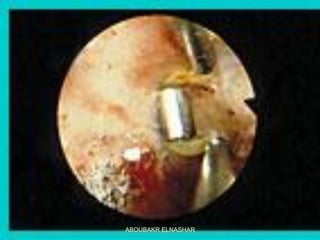
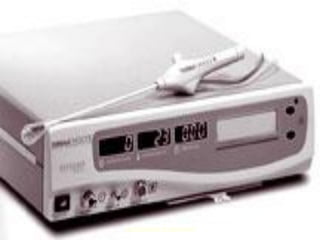
Endometrial ablation
Methods:
I.Hysteroscopic:
1. Laser
2. Electrosurgical: a. Roller ball
b. Resection
II.Non-hysteroscopic:
1. Thermachoice
2. Microwave.
ABOUBAKR ELNASHAR
ABOUBAKR ELNASHAR
ABOUBAKR ELNASHAR
ABOUBAKR ELNASHAR
Indications:
1. Failure of medical treatment
2. Family is completed
3. Uterine cavity <10 cm
4. Submucos fibroid <5 cm
5. Endometrium is normal or low risk hyperplasia.
ABOUBAKR ELNASHAR
Complications of hysteroscopic methods
1. Uterine perforation
2. Bleeding
3. Infection.
4. Fluid overload
5. Gas embolism
ABOUBAKR ELNASHAR
Hysterectomy
Indications:
1. Failure of medical treatment
2. Family is completed
Routes:
1. Abdominal
2. Vaginal
3. Laparoscopic
ABOUBAKR ELNASHAR
Advantages:
1. Complete cure
2. Avoidance of long term medical treatment
3. Removal of any missed pathology
Disadvantages:
1.Major operation
2.Hospital admission
3.Mortality & morbidity
ABOUBAKR ELNASHAR
ABOUBAKR ELNASHAR

Abnormal uterine bleeding

  • 1.
    Benha University Hospital,Egypt E-mail: elnashar53@hotmail.com ABOUBAKR ELNASHAR
  • 2.
    DEFINE Any deviation innormal frequency, duration or amount of menstruation in women of reproductive age. NORMAL MENSES Frequency: 21-35 d Duration: 3-7 d Volume: 30-80 ml ABOUBAKR ELNASHAR
  • 3.
    CLINICAL TYPES Polymenorrhoea: frequent(<21 d) menstruation, at regular intervals Menorrhagia: Excessive (>80 ml) & / or prolonged menstruation, at regular intervals Metrorrhagia: Excessive (>80 ml) & / or prolonged menstruation at irregular intervals. Menometrorrhagia: both. Intermenstual bleeding: episodes of uterine bleeding between regular menstruations Hypomenorrhoea: scanty menstruation. Oligomenorrhea: infrequent menstruation (>35 d) ABOUBAKR ELNASHAR
  • 4.
    CAUSES . Dysfunctional uterinebleeding . Pregnancy complications: Abortion, Ectopic pregnancy, Trophoblastic disease . Genital disease: . Tumors: Benign: fibroid, polyps (cervical, endometrial, fibroid) Malignant: cervical, endometrial, ovarian (estrogen secreting) . Infection: PID . Endometriosis, adenomyosis . IUCD . Marked uterovaginal prolapse or retroversion ABOUBAKR ELNASHAR
  • 5.
    . Extragenital: . Endocrine: hypoor hyer thyroidism . Haematological: Idiopathic thrombocytopenic purpura, Von-Willebrand disease . Chronic systemic disease: liver failure, renal failure, hypertension with uterine artery atherosclerosis. . Iatrogenic: Sex hormones, anticoagulants. . Emotional: (change of country, climate & work; stress; psychosomatic disorders) . Obesity: [increased peripheral estrogen conversion] ABOUBAKR ELNASHAR
  • 6.
    Dysfunctional uterine bleeding Define Abnormaluterine bleeding in absence of pelvic organ disease or a systemic disorder Incidence 60 % of AUB ABOUBAKR ELNASHAR
  • 7.
    Pathology Endocrine abnormality Endometrium Anovulatory 90%Insufficient follicles Inadequate proliferative or atrophic Persistent follicles Proliferative or hyperplastic Ovulatory 10% Short proliferative phase Normal Long proliferative phase Normal Insufficient C. luteum Irregular or deficient secretory leading to short luteal phase Persistent C luteum leading to Irregular shedding long luteal phase ABOUBAKR ELNASHAR
  • 8.
  • 9.
    Risk of endometrialcancer Chronic anovulation has 3 times increased risk (Coulam,1989). Chronic proliferation of the endometrium leading to adenomatous hyperplasia, leading to atypical adenomatous hyperplasia, leading to endometrial carcinoma. Transition can take up to 10 yrs or more. ABOUBAKR ELNASHAR
  • 10.
    Diagnosis Aim: 1. Nature &severity of bleeding 2. Exclusion of organic causes 3. Ovulatory or anovulatory How: ABOUBAKR ELNASHAR
  • 11.
    I. History: 1. Personal:age, wishes of the patient 2. Menstrual 3. Obstetric 4. Past 5. Present: amount, duration, color, smell, relation to sexual intercourse, associated symptoms ABOUBAKR ELNASHAR
  • 12.
    II. Examination: 1. General: pallor,endocrinopathy, coagulopathy, pregnancy 2. Abdominal: liver, spleen, pelvi abdominal mass 3. Pelvic: origin of the bleeding, cause ABOUBAKR ELNASHAR
  • 13.
    III.Investigations Systemic: 1. CBC (forall, Grade A) 2. BHCG 3. Prolactin & TSH 4. Prothrombin time, partial thrmoplastin time, bleeding time, platelets, Von Willebrand factor ABOUBAKR ELNASHAR
  • 14.
    Local: 1. Pap smear 2.Endometrial biopsy 3. D & C 4. Hysteroscopy 5. U/S ABOUBAKR ELNASHAR
  • 15.
  • 16.
    Assessment of theamount of the bleeding: 50% of excessive menstruation have normal amount of blood loss by objective methods 1.Subjective methods: history of passage of clots, flooding, use of large number of pads, do not reflect the actual blood loss 2.Semiobjective: i.Iron deficiency anemia ii.Menstrual calendar (August,1996) III. Pictorial blood loss chart (Higham,1990) : ABOUBAKR ELNASHAR
  • 17.
    Menstrual calender (August,1996) Saturday7 14 21 28 Sunday 1 8 15 22 29 Monday 2 9 16 23 30 Tuesday 3 10 17 24 31 Wednesday 4 11 18 25 Thursday 5 12 19 26 Friday 6 13 20 27 . Spotting - Slight loss O Moderate loss Very heavy loss ABOUBAKR ELNASHAR
  • 18.
    Pictorial blood losschart: (Higham,1990) Days of the bleeding Score 1 2 3 4 5 6 7 8 Towel 1 ponit 5 ponits 10 points Clots 1p clot 1 point 5p clot 5 points Flooding 5 points Score >100 = MenorrrhagiaABOUBAKR ELNASHAR
  • 19.
    Endometrial biopsy: Indications: .Between 20& 40 .If endometrial thickness on TVS is >12mm, endometrial sample should be taken to exclude endometrial hyperplasia (Grade A). Failure to obtain sufficient sample for H/P does not require further investigation unless the endometrial thickness is >12 mm (Grade B) Aim: diagnosis of the type of the bleeding ABOUBAKR ELNASHAR
  • 20.
    Methods: As an outpatientprocedure, without general anesthesia. 1.Pipelle curette 2.Sharman curette, Gravlee jet washer, Isac cell sampler 3.Accrette 4.vabra aspirator Advantages: An adequate & acceptable screening procedure in females under 40 yrs ABOUBAKR ELNASHAR
  • 21.
  • 22.
    D & C: Indications: 1.Mandatory after 4o yrs 2. Persistent or recurrent bleeding between 20 & 40 yrs ABOUBAKR ELNASHAR
  • 23.
    Aim: 1.Diagnosis of organicdisease e.g. endometritis, polyp, carcinoma, TB, fibroid 2.Diagnosis of the type of the endometrium: hyperplastic, proliferative, secretory, irregular ripening, shedding, atrophic. This provides a guide to etiology & treatment 3.Arrest of the bleeding, if the bleeding is severe or persistent, particularly hyperplastic endometrium. Curettage is essentially a diagnostic & not a therapeutic procedure. ABOUBAKR ELNASHAR
  • 24.
    Disadvantages: 1.Small lesions canbe missed 2.The sensitivity of detecting intrauterine pathology is only 65% ABOUBAKR ELNASHAR
  • 25.
    Fractional curretage: Indication: >40 yrs Method: 3samples: endocervical, lower segment & upper segment ABOUBAKR ELNASHAR
  • 26.
    Hysteroscopy: Indications: Mandatory after 40yrs 1. Erratic menstrual bleeding 2. Failed medical treatment 3. TVS suggestive of intrauterine pathology e.g. polyp, fibroid (Grade B) ABOUBAKR ELNASHAR
  • 27.
    Aim: 1.Excellent view ofthe uterine cavity & diagnosis of polyps, submucous fibroid, hyperplasia. 2.Biopsy of the suspected areas 3.Treatment ABOUBAKR ELNASHAR
  • 28.
    Advantages over D&C 1.The whole uterine cavity can be visualized 2.Very small lesions such as polyps can be identified & biopsed or removed 3.Bleeding from ruptured venules & echymoses can be readily identified 4.The sensitivity in detecting intrauterine pathology is 98% (Loffer,1989) 5.Outpatient procedure ABOUBAKR ELNASHAR
  • 29.
    Disadvantages: 1.Cost of theapparatus 2.Lack of availability or experience ABOUBAKR ELNASHAR
  • 30.
    Ultrasonography: 1. TAS: can excludepelvic masses, pregnancy complications 2. TVS: More informative than TAS. Measurement of the endometrial thickness is not a replacement for biopsy. All endometrial carcinoma in postmenopausal with endometrial thickness>4 mm (Osmers,1990) 3. Saline sonography: an alternative to office hysteroscopy in selected cases. It is better tolerated than office hysteroscopy or HSG ABOUBAKR ELNASHAR
  • 31.
    TVS is recommendedin: 1. Weight >90 Kg 2. Age > 40 yrs 3. Other risk factors for endometrial hyperplasia or carcinoma e.g. infertility, Nulliparity family history of colon or endometrial cancer, exposure to unopposed estrogen (Grade B) ABOUBAKR ELNASHAR
  • 32.
    TREATMENT A. General 1. Menstrualcalendar 2. Treatment of iron deficiency anemia ABOUBAKR ELNASHAR
  • 33.
    B. Medical I. Hormonal: 1.Progestagen 2.Oestrogen 3.COCP 4.Danazol 5.Gnrhagonist 6.Levo-nova (Merina) II. Non –hormonal 1.Prostaglandin synthetase inhibitors (PSI) 2.Antifibrinolytics 3.Ethamsylate ABOUBAKR ELNASHAR
  • 34.
    C. Surgical 1. Endometrialablation 2. Hysterectomy ABOUBAKR ELNASHAR
  • 35.
    Strategy of treatment <20yrs 20-40 yrs > 40 yrs Medical Always First resort after endometrial biopsy Temporizing & if surgery is refused or imminent menopause Surgical Never Seldom, only if medical treatment fail First resort if bleeding is recurrent ABOUBAKR ELNASHAR
  • 36.
    Medical treatment: Antifibrinolytics Mechanism ofaction: The endometrium possess an active fibrinolytic system, & the fibrinolytic activity is higher in menorrhagia. Effect: Greater reduction of menstrual bleeding than other therapies (PSI, oral luteal phase progestagen & etamsylate) (Cochrane library,2002). Tranexamic acid is effective in treating menorrhagia associated with IUCD. ABOUBAKR ELNASHAR
  • 37.
    Side effects: isdose related. Nausea , vomiting, diarrhea, dizziness. Rarely: transient color vision disturbance, intracranial thrombosis. But, no evidence that tranxemic acid increases the risk in absence of past or family history of thrombophilia. This treatment is not associated with an increase in side effects compared to placebo or other therapies (Cochrane library,2002). Dose: 3-6 gm /d for the first 3 days of the cycle ABOUBAKR ELNASHAR
  • 38.
    PSI: Mechanism; the endometrium isa rich source of PGE2 & PGF2œ & its concentrations are greater in menorrhagia. PSI decreases endometrial PG concentrations. Effect: PSI decreased menstrual blood by 24% & norethisterone by 20%. The beneficial effect of mefenamic acid on MBL & other symptoms e.g. dysmenorrhea, headache, nausea, diarrhea & depression persists for several months. ABOUBAKR ELNASHAR
  • 39.
    Dose: Mefenamic acid 500mg tds during menses. Side effects: nausea, vomiting, gastric discomfort, diarrhea, dizziness. Rarely: haemolytic anemia, thrombocytopenia. The degree of reduction of MBL is not as great as it is with tranxamic acid but PSI have a lower side effect profile. ABOUBAKR ELNASHAR
  • 40.
    Etamsylate: Mechanism of action: maintaincapillary integrity, anti-hyalurunidase activity & inhibitory effect on PG Dose: 500 mg qid, starting 5 days before anticipated onset of the cycle & continued for 10 days ABOUBAKR ELNASHAR
  • 41.
    Effect: 20% reduction inMBL. There is no conclusive evidence of the effectivness of etamsylate in reducing menorrhgea (Grade A) Side effects: headache, rash, nausea ABOUBAKR ELNASHAR
  • 42.
    Systemic progestagens: Norethisterone &medroxyprogesterone acetate Effect: Ovulatory DUB: not effective if given at low dose for short duration (5-10 days) in the luteal phase. Effective if NEA is given at higher dose for 3 w out of 4 w (5 mg tds from D5 to 26) Anovulatory DUB: useful Side effects: weight gain, nausea, bloating, edema, headache, acne, depression, exacerbation of epilepsy & migraine, loss of libido ABOUBAKR ELNASHAR
  • 43.
    Intrauterine progestagens Levonorgestrel intrauterinesystem levonova,Mirena: Delivers 20ug LNG /d. for 5 yr Metraplant: T shaped IUCD & levonorgestrel on the shoulder & stem Azzam IUCD: Cu T & levonorgestrel on the stem ABOUBAKR ELNASHAR
  • 44.
    Effect; 1.Comparable to endometrialresection for management of DUB. 2.Superior to PSI & antifibrinolytics 3.May be an alternative to hysterectomy in some patients ABOUBAKR ELNASHAR
  • 45.
  • 46.
    Side effects; 1.BTB inthe first cycles 2.20% develop amenorrhea within 1 yr 3.Functional ovarian cysts Special indications: 1. Intractable bleeding associated with chronic illness 2. Ovulatory heavy bleeding ABOUBAKR ELNASHAR
  • 47.
    The combined contraceptivepill: Effect: Reduce MBL by 50% Mechanism of action: endometrial suppression Side effects; headache, migraine, weight gain, breast tenderness, nausea, cholestatic jaundice, hypertension, thrombotic episodes, ABOUBAKR ELNASHAR
  • 48.
    Danazol: synthetic androgen withantioestrogenic & antiprogestagenic activity Mechanism; inhibits the release of pituitary Gnt & has direct suppressive effect on the endometrium Effect: reduction in MBL (more effective than PSI) & amenorhea at doses >400 mg/d ABOUBAKR ELNASHAR
  • 49.
    Side effects: headache, weightgain, acne, rashes, hirsuitism, mood & voice changes, flushes, muscle spasm, reduced HDL, diminished breast size. Rarely: cholestatic jaundice. It is effective in reducing blood loss but side effects limit it to a second choice therapy or short term use only (Grade A) Dose: 200 mg/d ABOUBAKR ELNASHAR
  • 50.
    GnRH analog Side effects; hotflushes, sweats, headache, irritability, loss of libido, vaginal dryness, lethargy, reduced bone density. ABOUBAKR ELNASHAR
  • 51.
    Surgical treatment Endometrial ablation Methods: I.Hysteroscopic: 1.Laser 2. Electrosurgical: a. Roller ball b. Resection II.Non-hysteroscopic: 1. Thermachoice 2. Microwave. ABOUBAKR ELNASHAR
  • 52.
  • 53.
  • 54.
  • 55.
    Indications: 1. Failure ofmedical treatment 2. Family is completed 3. Uterine cavity <10 cm 4. Submucos fibroid <5 cm 5. Endometrium is normal or low risk hyperplasia. ABOUBAKR ELNASHAR
  • 56.
    Complications of hysteroscopicmethods 1. Uterine perforation 2. Bleeding 3. Infection. 4. Fluid overload 5. Gas embolism ABOUBAKR ELNASHAR
  • 57.
    Hysterectomy Indications: 1. Failure ofmedical treatment 2. Family is completed Routes: 1. Abdominal 2. Vaginal 3. Laparoscopic ABOUBAKR ELNASHAR
  • 58.
    Advantages: 1. Complete cure 2.Avoidance of long term medical treatment 3. Removal of any missed pathology Disadvantages: 1.Major operation 2.Hospital admission 3.Mortality & morbidity ABOUBAKR ELNASHAR
  • 59.