FETAL GROWTH
RESTRICTION..
What the evidence says?!
Dr. Kirtan Vyas
M. S. (Ob/Gy)
Assistant Professor,
P.D.U. Medical College, Rajkot
Gujarat Uni. First-Gold medallist
Gujarat Public Service Commission(GPSC) first
Fellow in Gynec Endoscopy(Mumbai)
Fellow in Ultrasonography(FOGSI)
Publications in various International Journals
Presented Scientific Papers and Chaired Sessions at State and
National conferences
Faculty at State and National Conferences
Local Joint Secretary of SOGOG-Gujarat State Org of Ob Gy 2015
 Organizing Secretary for the First Rajkot Obstetrics and Gynec
Society Annual Conference 2015 and Committee Member at State and
National conferences
Organizing secretary for the West Zone Yuva Fogsi 2016, Rajkot
Faculty at FOGSI-JOGI PICSEP Scientific Program 2016 at Rajkot
Presently an Assistant Professor at P.D. U. Medical College, Rajkot
Dr. Kirtan Vyas
M.S.(Ob/Gy)
Dr. Kirtan Vyas # 9825407702
• The major concern in IUGR is not the small
size of the fetus, but the possibility of life
threatening fetal compromise
• Timely identification is difficult but crucial
for proper management and a favorable
neonatal outcome as it is the second leading
cause of perinatal mortality after
prematurity
Dr. Kirtan Vyas # 9825407702
Baffles the
researchers in the
most controversial
way
Extensively studied, still confusing!!
Dr. Kirtan Vyas # 9825407702
 To compare and contrast the used
terminology and definitions
 To evaluate screening approaches
 To critically review proposed management
 Surveillance regimens
 Recommendations for timing and mode of delivery
 Risk of Recurrence, preventative strategies
 Postnatal management
Dr. Kirtan Vyas # 9825407702
DEFINITION
• IUGR: A condition where the fetus fails to
achieve its genetic growth potential and
consequently is at risk of increased perinatal
morbidity & mortality
• SGA: Infant with weight < 10th percentile of
those born at the same gestational age or > 2
SDs below mean for Gestational Age
Dr. Kirtan Vyas # 9825407702
Easiest way to think about these terms are
• IUGR: is a term used by Obstetrician to
describe a pattern of growth over a period of
time
• SGA: is a term used by Pediatrician to
describe a single point on a growth curve
Dr. Kirtan Vyas # 9825407702
V/S
• Preterm gestation and small
• Term gestation and small
• Healthy but small – Constitutionally small
• Pathologically small – IUGR
Dr. Kirtan Vyas # 9825407702
• Thus 2 essential components for
IUGR are
– Birth weight <10th percentile
– Pathologic process that inhibits normal growth potential
(intrinsic) 30 %
• And the 2 essential components for SGA are
– Birth weight <10th percentile
– Absence of pathologic process 70 %
Dr. Kirtan Vyas # 9825407702
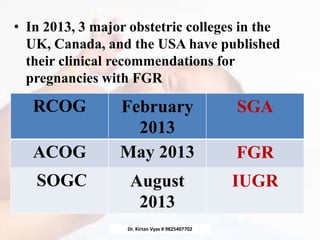
• In 2013, 3 major obstetric colleges in the
UK, Canada, and the USA have published
their clinical recommendations for
pregnancies with FGR
RCOG February
2013
SGA
ACOG May 2013 FGR
SOGC August
2013
IUGR
Dr. Kirtan Vyas # 9825407702
• All guidelines use a different terminology
• All do agree that an EFW < 10th centile for
gestation should be used to alert clinicians
to small fetal size
Dr. Kirtan Vyas # 9825407702
INCIDENCE
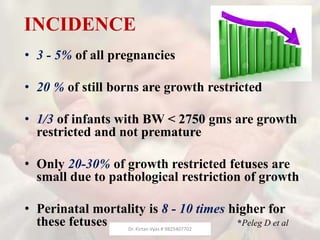
• 3 - 5% of all pregnancies
• 20 % of still borns are growth restricted
• 1/3 of infants with BW < 2750 gms are growth
restricted and not premature
• Only 20-30% of growth restricted fetuses are
small due to pathological restriction of growth
• Perinatal mortality is 8 - 10 times higher for

these fetuses *Peleg D et al
Dr. Kirtan Vyas # 9825407702
NORMAL INTRAUTERINE
GROWTH PATTERN
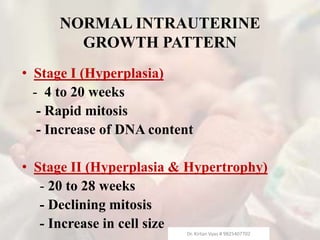
• Stage I (Hyperplasia)
- 4 to 20 weeks
- Rapid mitosis
- Increase of DNA content
• Stage II (Hyperplasia & Hypertrophy)
- 20 to 28 weeks
- Declining mitosis
- Increase in cell size
Dr. Kirtan Vyas # 9825407702
NORMAL INTRAUTERINE GROWTH
PATTERN
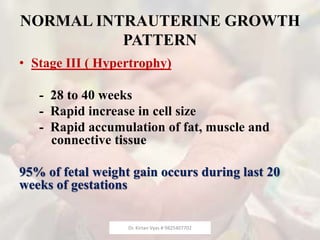
• Stage III ( Hypertrophy)
- 28 to 40 weeks
- Rapid increase in cell size
- Rapid accumulation of fat, muscle and
connective tissue
95% of fetal weight gain occurs during last 20
weeks of gestations
Dr. Kirtan Vyas # 9825407702
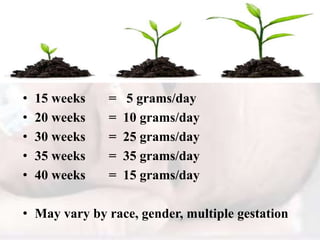
• 15 weeks = 5 grams/day
• 20 weeks = 10 grams/day
• 30 weeks = 25 grams/day
• 35 weeks = 35 grams/day
• 40 weeks = 15 grams/day
• May vary by race, gender, multiple gestation
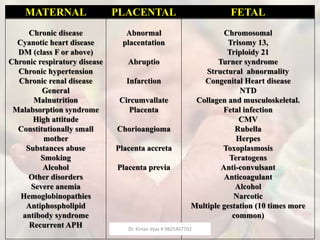
MATERNAL PLACENTAL FETAL
Chronic disease
Cyanotic heart disease
DM (class F or above)
Chronic respiratory disease
Chronic hypertension
Chronic renal disease
General
Malnutrition
Malabsorption syndrome
High attitude
Constitutionally small
mother
Substances abuse
Smoking
Alcohol
Other disorders
Severe anemia
Hemoglobinopathies
Antiphospholipid
antibody syndrome
Recurrent APH
Abnormal
placentation
Abruptio
Infarction
Circumvallate
Placenta
Chorioangioma
Placenta accreta
Placenta previa
Chromosomal
Trisomy 13,
Triploidy 21
Turner syndrome
Structural abnormality
Congenital Heart disease
NTD
Collagen and musculoskeletal.
Fetal infection
CMV
Rubella
Herpes
Toxoplasmosis
Teratogens
Anti-convulsant
Anticoagulant
Alcohol
Narcotic
Multiple gestation (10 times more
common)
Dr. Kirtan Vyas # 9825407702
RELATIVE FREQUENCY OF
DIFFERENT ETIOLOGIES
• Placental insufficiency -80%
• Tobacco /Smoking -5%
• Fetal Chromosomal -5%
• Fetal Infections -1-2%
Dr. Kirtan Vyas 98254 07702
CLASSIFICATION
• Based on evaluation & USG examination small fetuses are
divided into two categories
Healthy SGA or True IUGR or
Constitutionally small Pathologically growth restricted
TYPE –I TYPE –II
Symmetrical IUGR Asymmetrical IUGR
Intrinsic IUGR Extrinsic IUGR
*Campbell S and Thomas ADr. Kirtan Vyas # 9825407702
FETAL GROWTH - A COMPLEX
PHENOMENON
• Besides these there occurs a delicate
interplay between fetal adaptation to the
maternal metabolism by modulating
placental function
• This means that an adequate maternal
nutritional status does not ensure adequate
supply to the fetus, it requires a normal
placental function also
Dr. Kirtan Vyas 98254 07702
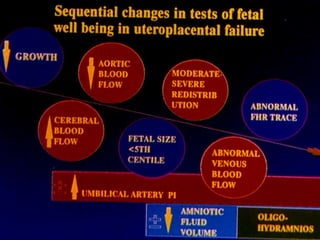
FGR is a pathologic process associated with
additional features
• abnormal placental morphology
• oligohydramnios or
• abnormal uteroplacental or
fetoplacental doppler
Dr. Kirtan Vyas # 9825407702
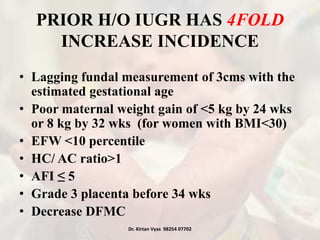
PRIOR H/O IUGR HAS 4FOLD
INCREASE INCIDENCE
• Lagging fundal measurement of 3cms with the
estimated gestational age
• Poor maternal weight gain of <5 kg by 24 wks
or 8 kg by 32 wks (for women with BMI<30)
• EFW <10 percentile
• HC/ AC ratio>1
• AFI ≤ 5
• Grade 3 placenta before 34 wks
• Decrease DFMC
Dr. Kirtan Vyas 98254 07702
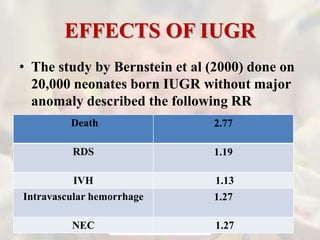
EFFECTS OF IUGR
• The study by Bernstein et al (2000) done on
20,000 neonates born IUGR without major
anomaly described the following RR
Dr. Kirtan Vyas # 9825407702
Death 2.77
RDS 1.19
IVH 1.13
Intravascular hemorrhage 1.27
NEC 1.27
LONG TERM MORBIDITIES
 Cerebral palsy (Goldenberg RL et al. 1998)
 Hypertension (Hannsens M et al 1996),
 Dyslipidemia (Gogate S. 2001)
 Diabetes Melitus (Mukhopadhyay S et al 2001)
 Breast cancer (LeMarchand L et al 1998)
 Prostate cancer (Ekbom A et al 1996)
 Mental health problems, academic impairment
and poorer general health
Dr. Kirtan Vyas # 9825407702
IUGR SCREENING
• Whom to screen?
• Ideally Symphysis Fundal Height (SFH) performed
regularly for all pregnancies
• SFH in cms = weeks of gestation
• High risk cases will need ultrasound for growth,
liquor volume, umbilical artery Doppler and
Biophysical Profile
• Umbilical Artery Doppler is the best test!
Dr. Kirtan Vyas # 9825407702
There are FOUR TESTING MODALITIES
which are helpful
• Daily fetal movement count (DFMC)
• Non-Stress Test (NST)
• Amniotic Fluid Index (AFI)
• Doppler of the Umbilical Artery
• Biophysical Profile (BPP)
Combination of tests are better than an
isolated test
Dr. Kirtan Vyas # 9825407702
DIAGNOSIS
CLINICAL BIOPHYSICAL BIOCHEMICAL
Ultrasonography MSAFP & hCG in
2nd trimester
Erythropoietin
level in cord blood
is high in IUGR
Dr. Kirtan Vyas # 9825407702
DIAGNOSIS - CLINICALLY
Maternal weight gain
 Stationary or falling during second half of
pregnancy
Palpation of uterus
 SFH-Normally increases by 1 cm per week
between 14 and 32 wks
- A lag in fundal height of 4 wks s/o moderate
IUGR and over 6 wks s/o severe IUGR
 Abdominal girth – stationary or decreasing
 Liquor volume - less
Dr. Kirtan Vyas # 9825407702
BIOCHEMICAL MARKERS IN
IUGR
ERYTHROPOIETIN (EPO)
 An elevated HCG and amniotic fluid EPO has been
found which supports the concept of early damage
of placenta sufficient to cause erythroblastic
response (Seppo Heinonen et al 1999)
 High levels of EPO were also found in hypoxic and
growth restricted neonates (Ostlund E at al 2000)
PAPPA
 A positive co-relation of PAPPA with femur length
and abdominal circumference in second trimester
(Leung TY et al 2006)Dr. Kirtan Vyas # 9825407702
SERIAL ULTRASOUND
BIOMETRY AND DOPPLER
STUDIES FORM THE MAINSTAY
OF DIAGNOSIS
• The greater the risk of IUGR based on
clinical findings, the greater is the positive
predictive value of USG
• It must be borne in mind that each
measurement has an error potential of
about 1 week up to 20 weeks gestation, 2
weeks from 20-36 weeks and 3 weeks
thereafter Dr. Kirtan Vyas # 9825407702
USG
Abdominal circumference (AC)
• The most sensitive indicator
• Sensitivity is 95% if it measures below 2.5th
percentile
• HC/AC ratio drops almost linearly from 1.2
to 1.0 between 20-36 weeks normally
• It is elevated in asymmetric IUGR and is
normal in symmetric IUGR
• FL/AC ratio elevated to >2.4 in IUGR
Dr. Kirtan Vyas # 9825407702
• Remember that we shall not switch to color
doppler directly when patient is referred for
color doppler
• First go for biometry & precisely define
type of growth retardation by plotting the
finding in growth charts, assess fetus for
malformation. Assess Amniotic fluid &
biophysical activity & then switch on the
color doppler
Dr. Kirtan Vyas # 9825407702
IMPORTANCE OF
COLOUR DOPPLER
THE ACCURACY OF DOPPLER VELOCIMETRY
IN CONJUNCTION WITH 2D ULTRASOUND AND
COLOR FLOW MAPPING IS NOW REGARDED AS
AN INDISPENSABLE COMPONENT OF A
PREGNANCY SONOGRAM
Dr. Kirtan Vyas # 9825407702
PERSPECTIVE OF COLOUR
DOPPLER
• EXCLUDE FETALANOMALIES
• EVALUATE FETAL SIZE
• QUANTIFY LIQUOR AMNII
• ASSESS PLACENTA, CORD &
CERVIX
Dr. Kirtan Vyas # 9825407702
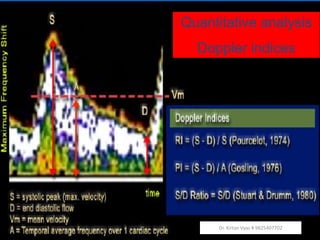
Quantitative analysis
Doppler indices
Dr. Kirtan Vyas # 9825407702
DOPPLER VESSELS TO BE
STUDIED
• MATERNAL SIDE
Uterine artery
• PLACENTAL SIDE
Umbilical artery
• FETAL SIDE
Arterial: MCA, renal and others
Venous: ductus, hepatic, umbilical
Fetal echocardiography
Dr. Kirtan Vyas # 9825407702
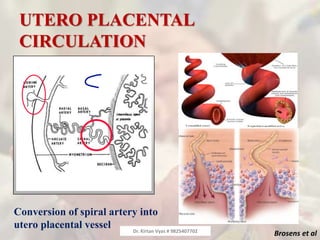
UTERO PLACENTAL
CIRCULATION
Conversion of spiral artery into
utero placental vessel
Brosens et alDr. Kirtan Vyas # 9825407702
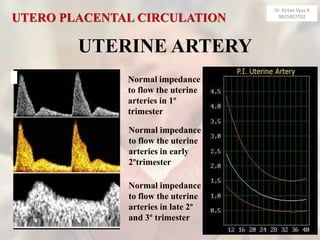
UTERINE ARTERY
Normal impedance
to flow the uterine
arteries in 1º
trimester
Normal impedance
to flow the uterine
arteries in early
2ºtrimester
Normal impedance
to flow the uterine
arteries in late 2º
and 3º trimester
UTERO PLACENTAL CIRCULATION
Dr. Kirtan Vyas #
9825407702
UTERINE ARTERY FACTS
• More accurate for screening in high risk-
early onset cases
• At a place, where UtA crosses the EIA
• B/L notch or U/L notch on the side of
placenta is significant
• Best GA is 22-24 weeks
• High negative predictive value
Dr. Kirtan Vyas 98254 07702
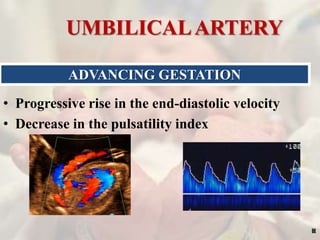
• Progressive rise in the end-diastolic velocity
• Decrease in the pulsatility index
ADVANCING GESTATION
UMBILICALARTERY
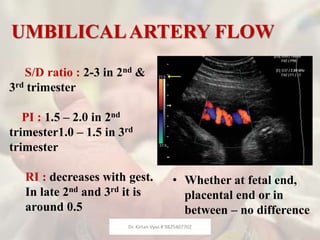
UMBILICALARTERY FLOW
• Whether at fetal end,
placental end or in
between – no difference
S/D ratio : 2-3 in 2nd &
3rd trimester
PI : 1.5 – 2.0 in 2nd
trimester1.0 – 1.5 in 3rd
trimester
RI : decreases with gest.
In late 2nd and 3rd it is
around 0.5
Dr. Kirtan Vyas # 9825407702
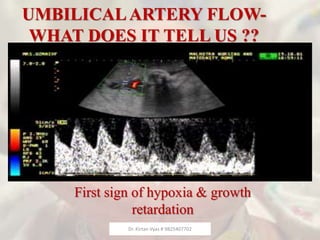
UMBILICALARTERY FLOW-
WHAT DOES IT TELL US ??
First sign of hypoxia & growth
retardation
Dr. Kirtan Vyas # 9825407702
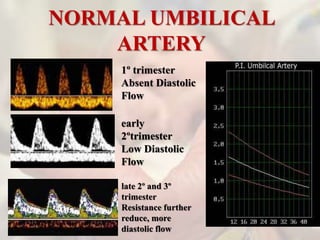
NORMAL UMBILICAL
ARTERY
1º trimester
Absent Diastolic
Flow
early
2ºtrimester
Low Diastolic
Flow
late 2º and 3º
trimester
Resistance further
reduce, more
diastolic flow
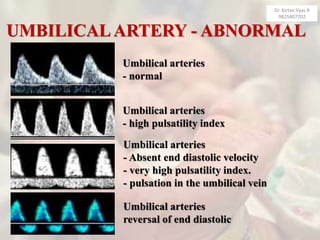
UMBILICALARTERY - ABNORMAL
Umbilical arteries
- normal
Umbilical arteries
- high pulsatility index
Umbilical arteries
- Absent end diastolic velocity
- very high pulsatility index.
- pulsation in the umbilical vein
Umbilical arteries
reversal of end diastolic
Dr. Kirtan Vyas #
9825407702
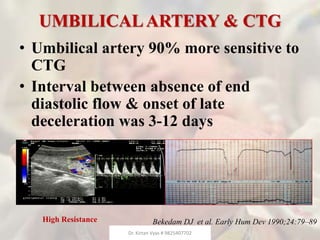
UMBILICALARTERY & CTG
• Umbilical artery 90% more sensitive to
CTG
• Interval between absence of end
diastolic flow & onset of late
deceleration was 3-12 days
Bekedam DJ et al. Early Hum Dev 1990;24:79–89High Resistance
Dr. Kirtan Vyas # 9825407702
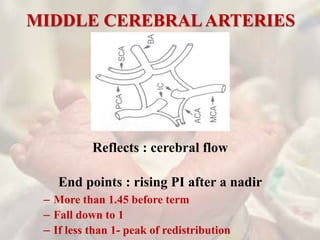
MIDDLE CEREBRALARTERIES
Reflects : cerebral flow
End points : rising PI after a nadir
– More than 1.45 before term
– Fall down to 1
– If less than 1- peak of redistribution
MCA
• 22-28 weeks- no EDF in MCA
• 28w to term- some EDF seen- normal
• Increased EDF ( low PI) suggests ‘brain sparing’
redistribution in IUGR
• Worsening hypoxia- fetal acidemia- paradoxical
rise in resistance (high PI)
• CPR increases – this is indicative of IUGR
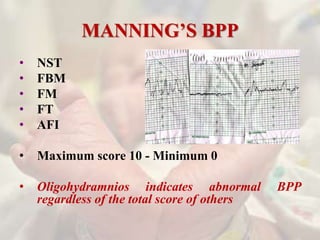
MANNING’S BPP
• NST
• FBM
• FM
• FT
• AFI
• Maximum score 10 - Minimum 0
• Oligohydramnios indicates abnormal BPP
regardless of the total score of others
MANAGEMENT
• Depends on the severity of growth restriction
and how early the problem began in pregnancy
• Earlier the onset, more severe is the IUGR and
greater the risk to fetus
• Management is based on the following
o Prevention
o Diagnosis of IUGR
o Antenatal vigilance. Treatment of the cause, if
found to be present.
o Delivery
o Neonatal management
Dr. Kirtan Vyas # 9825407702
MATERNAL BED REST
• This is the initial approach for the
treatment of IUGR
• Adequate bed rest in left lateral position
results in increased blood flow to the uterus
& placenta
ASPIRIN THERAPY
• The use of aspirin to treat foetus with IUGR is
still controversial
• If aspirin is used, it may be advantageous if
given to patients before 20 weeks of gestation
It is minimal to limited benefit if given at the
time of diagnosis
• (third trimester)
• However it is beneficial in cases with
– history of thrombotic disease
– hypertension
– pre-eclampsia
• The Maternal-Fetal Medicine Network
randomized 3135 women to receive 60mg/d
aspirin or placebo and found no significant
difference in incidence of IUGR
Dr. Kirtan Vyas # 9825407702
HYPEROXYGENATION
• Fetal oxygenation is crucial for fetal growth
• A positive response to maternal oxygen therapy
found by decreased resistance in placental
circulation is marker of good prognosis and
lack of response is an indication of poor
outcome
(Bilardo et al 1991)
Dr. Kirtan Vyas # 9825407702
OTHERS….
o Other forms of treatment that have been
studied are maternal hyperalimantation by
aminoacids, nutritional supplementation, zinc
supplementation, fish oil and hormones
o Maternal volume expansion may be helpful in
improving placental perfusion
o Limited studies are available regarding the use
of these modalities in the treatment of IUGR
Dr. Kirtan Vyas # 9825407702
JUDGE OPTIMUM TIME OF
DELIVERY
Risk of PREMATURITY
Difficult extra uterine
existence
Risk of IUD
hostile intra uterine
environment
Dr. Kirtan Vyas # 9825407702
MANAGEMENT ACCORDING TO
GESTATIONALAGE
Less than 24 weeks of gestational age
• Antenatal surveillance with Umbilical & Ductus
venous doppler study is reliable
٠ If UmA diastolic flow +nt ٠ If UmA –RDF
٠ DV – Uninterrupted ٠ DV– Interrupted
forward flow forward flow
Fetal Acidosis& Hypoxia
Expectant Management Imminent Fetal Death
Termination
26 to 34 weeks gestational age
• Antenatal surveillance with NST and Umbilical
A, Middle cerebral A, Ductus venous doppler
1. NST-REACTIVE
UmA Doppler-Reassuring Repeat in 1wk
UmA Doppler-Non reassuring
Ductus venous Doppler Reassuring--Repeat 1wk
Non reassuring—Deliver
Dr. Kirtan Vyas # 9825407702
2. NST-NON REACTIVE
UmA Doppler—follow as above
Or Biophysical profile
≥8 UmA doppler
≤4 Deliver 6 Repeat in 6-24hrs
wait till ≥36wks
Deliver
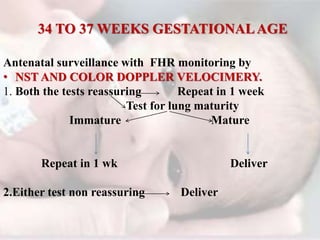
34 TO 37 WEEKS GESTATIONALAGE
Antenatal surveillance with FHR monitoring by
• NST AND COLOR DOPPLER VELOCIMERY.
1. Both the tests reassuring Repeat in 1 week
Test for lung maturity
Immature Mature
Repeat in 1 wk Deliver
2.Either test non reassuring Deliver
MODE OF DELIVERY
• Labour is a stressful process for the fetus
• Every contraction reduces oxygenation, though
briefly and it recovers
• Prolonged difficult labors should be avoided!
• Continuous fetal monitoring is a MUST!
• Elective LSCS for severe IUGR, abnormal
presentation, oligohydramnios, abnormal CTG/
NST
Dr. Kirtan Vyas # 9825407702
AMNIOINFUSION
• Amnioinfusion refers to the instillation of fluid
into the amniotic cavity
• This procedure is typically performed during
labor through an intrauterine pressure
catheter introduced transcervically after
rupture of the fetal membranes
• Alternatively, fluid can be infused through a
needle transabdominally, the reverse process of
amniocentesis Dr. Kirtan Vyas # 9825407702
Randomised trial of Amnioinfusion during
labour with meconium stained amniotic fluid
(BJOG Jan 2002)
• Conclusion- Amnioinfusion in an under
resourced labour ward decreases
caesarean section rates and fetal
morbidity
Dr. Kirtan Vyas # 9825407702
CONCLUSION
• Currently USG measurements are used to confirm small fetal
size, whereas, BPP is used to assess fetal function. Based on BPP
one can consider the safety of continuing pregnancy.
Unequivocal cessation of ultrasound growth would also
constitute fetal grounds for delivery
• Risk of elective delivery after 37 weeks is very small, suspicion
of fetal compromise from any abnormal fetal welfare study may
precipitate decision for undertaking prompt delivery
• LSCS is used increasingly for the compromised fetus because of
high risk of fetal distress in labour
• However, in the Indian setup, facilities for NICU are not
uniformly available. Hence, the decision for time and mode of
delivery needs to be individualized as the management of such a
neonate is a real challenge. If possible, the mother should be
transferred to a center with a well-equipped neonatal care unit
to minimize the risks involved in transfer of the newborn baby
Dr. Kirtan Vyas # 9825407702
IUGR
• Heads are
disproportionately large
for their trunks and
extremities
• Facial appearance has
been likened to that of a
“wizened old man”
• Long nails
• Scaphoid abdomen
IUGR
“ I AM A FETUS IN THE WOMB
I FEAR IT MAY BECOME MY
TOMB
IF ONLY I COULD GIVE A SHOUT
TO MAKE MY DOCTOR GET ME
OUT!”
UNKNOWN MEDICAL STUDENT
DUBLIN, UK 1982
THANK YOU

Fetal growth restriction

  • 1.
    FETAL GROWTH RESTRICTION.. What theevidence says?! Dr. Kirtan Vyas M. S. (Ob/Gy) Assistant Professor, P.D.U. Medical College, Rajkot
  • 3.
    Gujarat Uni. First-Goldmedallist Gujarat Public Service Commission(GPSC) first Fellow in Gynec Endoscopy(Mumbai) Fellow in Ultrasonography(FOGSI) Publications in various International Journals Presented Scientific Papers and Chaired Sessions at State and National conferences Faculty at State and National Conferences Local Joint Secretary of SOGOG-Gujarat State Org of Ob Gy 2015  Organizing Secretary for the First Rajkot Obstetrics and Gynec Society Annual Conference 2015 and Committee Member at State and National conferences Organizing secretary for the West Zone Yuva Fogsi 2016, Rajkot Faculty at FOGSI-JOGI PICSEP Scientific Program 2016 at Rajkot Presently an Assistant Professor at P.D. U. Medical College, Rajkot Dr. Kirtan Vyas M.S.(Ob/Gy) Dr. Kirtan Vyas # 9825407702
  • 4.
    • The majorconcern in IUGR is not the small size of the fetus, but the possibility of life threatening fetal compromise • Timely identification is difficult but crucial for proper management and a favorable neonatal outcome as it is the second leading cause of perinatal mortality after prematurity Dr. Kirtan Vyas # 9825407702
  • 5.
    Baffles the researchers inthe most controversial way Extensively studied, still confusing!! Dr. Kirtan Vyas # 9825407702
  • 6.
     To compareand contrast the used terminology and definitions  To evaluate screening approaches  To critically review proposed management  Surveillance regimens  Recommendations for timing and mode of delivery  Risk of Recurrence, preventative strategies  Postnatal management Dr. Kirtan Vyas # 9825407702
  • 7.
    DEFINITION • IUGR: Acondition where the fetus fails to achieve its genetic growth potential and consequently is at risk of increased perinatal morbidity & mortality • SGA: Infant with weight < 10th percentile of those born at the same gestational age or > 2 SDs below mean for Gestational Age Dr. Kirtan Vyas # 9825407702
  • 8.
    Easiest way tothink about these terms are • IUGR: is a term used by Obstetrician to describe a pattern of growth over a period of time • SGA: is a term used by Pediatrician to describe a single point on a growth curve Dr. Kirtan Vyas # 9825407702
  • 9.
    V/S • Preterm gestationand small • Term gestation and small • Healthy but small – Constitutionally small • Pathologically small – IUGR Dr. Kirtan Vyas # 9825407702
  • 10.
    • Thus 2essential components for IUGR are – Birth weight <10th percentile – Pathologic process that inhibits normal growth potential (intrinsic) 30 % • And the 2 essential components for SGA are – Birth weight <10th percentile – Absence of pathologic process 70 % Dr. Kirtan Vyas # 9825407702
  • 11.
    • In 2013,3 major obstetric colleges in the UK, Canada, and the USA have published their clinical recommendations for pregnancies with FGR RCOG February 2013 SGA ACOG May 2013 FGR SOGC August 2013 IUGR Dr. Kirtan Vyas # 9825407702
  • 12.
    • All guidelinesuse a different terminology • All do agree that an EFW < 10th centile for gestation should be used to alert clinicians to small fetal size Dr. Kirtan Vyas # 9825407702
  • 13.
    INCIDENCE • 3 -5% of all pregnancies • 20 % of still borns are growth restricted • 1/3 of infants with BW < 2750 gms are growth restricted and not premature • Only 20-30% of growth restricted fetuses are small due to pathological restriction of growth • Perinatal mortality is 8 - 10 times higher for these fetuses *Peleg D et al Dr. Kirtan Vyas # 9825407702
  • 14.
    NORMAL INTRAUTERINE GROWTH PATTERN •Stage I (Hyperplasia) - 4 to 20 weeks - Rapid mitosis - Increase of DNA content • Stage II (Hyperplasia & Hypertrophy) - 20 to 28 weeks - Declining mitosis - Increase in cell size Dr. Kirtan Vyas # 9825407702
  • 15.
    NORMAL INTRAUTERINE GROWTH PATTERN •Stage III ( Hypertrophy) - 28 to 40 weeks - Rapid increase in cell size - Rapid accumulation of fat, muscle and connective tissue 95% of fetal weight gain occurs during last 20 weeks of gestations Dr. Kirtan Vyas # 9825407702
  • 16.
    • 15 weeks= 5 grams/day • 20 weeks = 10 grams/day • 30 weeks = 25 grams/day • 35 weeks = 35 grams/day • 40 weeks = 15 grams/day • May vary by race, gender, multiple gestation
  • 17.
    MATERNAL PLACENTAL FETAL Chronicdisease Cyanotic heart disease DM (class F or above) Chronic respiratory disease Chronic hypertension Chronic renal disease General Malnutrition Malabsorption syndrome High attitude Constitutionally small mother Substances abuse Smoking Alcohol Other disorders Severe anemia Hemoglobinopathies Antiphospholipid antibody syndrome Recurrent APH Abnormal placentation Abruptio Infarction Circumvallate Placenta Chorioangioma Placenta accreta Placenta previa Chromosomal Trisomy 13, Triploidy 21 Turner syndrome Structural abnormality Congenital Heart disease NTD Collagen and musculoskeletal. Fetal infection CMV Rubella Herpes Toxoplasmosis Teratogens Anti-convulsant Anticoagulant Alcohol Narcotic Multiple gestation (10 times more common) Dr. Kirtan Vyas # 9825407702

  • 18.
    RELATIVE FREQUENCY OF DIFFERENTETIOLOGIES • Placental insufficiency -80% • Tobacco /Smoking -5% • Fetal Chromosomal -5% • Fetal Infections -1-2% Dr. Kirtan Vyas 98254 07702
  • 19.
    CLASSIFICATION • Based onevaluation & USG examination small fetuses are divided into two categories Healthy SGA or True IUGR or Constitutionally small Pathologically growth restricted TYPE –I TYPE –II Symmetrical IUGR Asymmetrical IUGR Intrinsic IUGR Extrinsic IUGR *Campbell S and Thomas ADr. Kirtan Vyas # 9825407702
  • 20.
    FETAL GROWTH -A COMPLEX PHENOMENON • Besides these there occurs a delicate interplay between fetal adaptation to the maternal metabolism by modulating placental function • This means that an adequate maternal nutritional status does not ensure adequate supply to the fetus, it requires a normal placental function also Dr. Kirtan Vyas 98254 07702
  • 21.
    FGR is apathologic process associated with additional features • abnormal placental morphology • oligohydramnios or • abnormal uteroplacental or fetoplacental doppler Dr. Kirtan Vyas # 9825407702
  • 22.
    PRIOR H/O IUGRHAS 4FOLD INCREASE INCIDENCE • Lagging fundal measurement of 3cms with the estimated gestational age • Poor maternal weight gain of <5 kg by 24 wks or 8 kg by 32 wks (for women with BMI<30) • EFW <10 percentile • HC/ AC ratio>1 • AFI ≤ 5 • Grade 3 placenta before 34 wks • Decrease DFMC Dr. Kirtan Vyas 98254 07702
  • 23.
    EFFECTS OF IUGR •The study by Bernstein et al (2000) done on 20,000 neonates born IUGR without major anomaly described the following RR Dr. Kirtan Vyas # 9825407702 Death 2.77 RDS 1.19 IVH 1.13 Intravascular hemorrhage 1.27 NEC 1.27
  • 24.
    LONG TERM MORBIDITIES Cerebral palsy (Goldenberg RL et al. 1998)  Hypertension (Hannsens M et al 1996),  Dyslipidemia (Gogate S. 2001)  Diabetes Melitus (Mukhopadhyay S et al 2001)  Breast cancer (LeMarchand L et al 1998)  Prostate cancer (Ekbom A et al 1996)  Mental health problems, academic impairment and poorer general health Dr. Kirtan Vyas # 9825407702
  • 25.
    IUGR SCREENING • Whomto screen? • Ideally Symphysis Fundal Height (SFH) performed regularly for all pregnancies • SFH in cms = weeks of gestation • High risk cases will need ultrasound for growth, liquor volume, umbilical artery Doppler and Biophysical Profile • Umbilical Artery Doppler is the best test! Dr. Kirtan Vyas # 9825407702
  • 26.
    There are FOURTESTING MODALITIES which are helpful • Daily fetal movement count (DFMC) • Non-Stress Test (NST) • Amniotic Fluid Index (AFI) • Doppler of the Umbilical Artery • Biophysical Profile (BPP) Combination of tests are better than an isolated test Dr. Kirtan Vyas # 9825407702
  • 27.
    DIAGNOSIS CLINICAL BIOPHYSICAL BIOCHEMICAL UltrasonographyMSAFP & hCG in 2nd trimester Erythropoietin level in cord blood is high in IUGR Dr. Kirtan Vyas # 9825407702
  • 28.
    DIAGNOSIS - CLINICALLY Maternalweight gain  Stationary or falling during second half of pregnancy Palpation of uterus  SFH-Normally increases by 1 cm per week between 14 and 32 wks - A lag in fundal height of 4 wks s/o moderate IUGR and over 6 wks s/o severe IUGR  Abdominal girth – stationary or decreasing  Liquor volume - less Dr. Kirtan Vyas # 9825407702
  • 29.
    BIOCHEMICAL MARKERS IN IUGR ERYTHROPOIETIN(EPO)  An elevated HCG and amniotic fluid EPO has been found which supports the concept of early damage of placenta sufficient to cause erythroblastic response (Seppo Heinonen et al 1999)  High levels of EPO were also found in hypoxic and growth restricted neonates (Ostlund E at al 2000) PAPPA  A positive co-relation of PAPPA with femur length and abdominal circumference in second trimester (Leung TY et al 2006)Dr. Kirtan Vyas # 9825407702
  • 30.
    SERIAL ULTRASOUND BIOMETRY ANDDOPPLER STUDIES FORM THE MAINSTAY OF DIAGNOSIS • The greater the risk of IUGR based on clinical findings, the greater is the positive predictive value of USG • It must be borne in mind that each measurement has an error potential of about 1 week up to 20 weeks gestation, 2 weeks from 20-36 weeks and 3 weeks thereafter Dr. Kirtan Vyas # 9825407702
  • 31.
    USG Abdominal circumference (AC) •The most sensitive indicator • Sensitivity is 95% if it measures below 2.5th percentile • HC/AC ratio drops almost linearly from 1.2 to 1.0 between 20-36 weeks normally • It is elevated in asymmetric IUGR and is normal in symmetric IUGR • FL/AC ratio elevated to >2.4 in IUGR Dr. Kirtan Vyas # 9825407702
  • 32.
    • Remember thatwe shall not switch to color doppler directly when patient is referred for color doppler • First go for biometry & precisely define type of growth retardation by plotting the finding in growth charts, assess fetus for malformation. Assess Amniotic fluid & biophysical activity & then switch on the color doppler Dr. Kirtan Vyas # 9825407702
  • 33.
    IMPORTANCE OF COLOUR DOPPLER THEACCURACY OF DOPPLER VELOCIMETRY IN CONJUNCTION WITH 2D ULTRASOUND AND COLOR FLOW MAPPING IS NOW REGARDED AS AN INDISPENSABLE COMPONENT OF A PREGNANCY SONOGRAM Dr. Kirtan Vyas # 9825407702
  • 34.
    PERSPECTIVE OF COLOUR DOPPLER •EXCLUDE FETALANOMALIES • EVALUATE FETAL SIZE • QUANTIFY LIQUOR AMNII • ASSESS PLACENTA, CORD & CERVIX Dr. Kirtan Vyas # 9825407702
  • 35.
  • 36.
    DOPPLER VESSELS TOBE STUDIED • MATERNAL SIDE Uterine artery • PLACENTAL SIDE Umbilical artery • FETAL SIDE Arterial: MCA, renal and others Venous: ductus, hepatic, umbilical Fetal echocardiography Dr. Kirtan Vyas # 9825407702
  • 38.
    UTERO PLACENTAL CIRCULATION Conversion ofspiral artery into utero placental vessel Brosens et alDr. Kirtan Vyas # 9825407702
  • 39.
    UTERINE ARTERY Normal impedance toflow the uterine arteries in 1º trimester Normal impedance to flow the uterine arteries in early 2ºtrimester Normal impedance to flow the uterine arteries in late 2º and 3º trimester UTERO PLACENTAL CIRCULATION Dr. Kirtan Vyas # 9825407702
  • 40.
    UTERINE ARTERY FACTS •More accurate for screening in high risk- early onset cases • At a place, where UtA crosses the EIA • B/L notch or U/L notch on the side of placenta is significant • Best GA is 22-24 weeks • High negative predictive value Dr. Kirtan Vyas 98254 07702
  • 41.
    • Progressive risein the end-diastolic velocity • Decrease in the pulsatility index ADVANCING GESTATION UMBILICALARTERY
  • 42.
    UMBILICALARTERY FLOW • Whetherat fetal end, placental end or in between – no difference S/D ratio : 2-3 in 2nd & 3rd trimester PI : 1.5 – 2.0 in 2nd trimester1.0 – 1.5 in 3rd trimester RI : decreases with gest. In late 2nd and 3rd it is around 0.5 Dr. Kirtan Vyas # 9825407702
  • 43.
    UMBILICALARTERY FLOW- WHAT DOESIT TELL US ?? First sign of hypoxia & growth retardation Dr. Kirtan Vyas # 9825407702
  • 44.
    NORMAL UMBILICAL ARTERY 1º trimester AbsentDiastolic Flow early 2ºtrimester Low Diastolic Flow late 2º and 3º trimester Resistance further reduce, more diastolic flow
  • 45.
    UMBILICALARTERY - ABNORMAL Umbilicalarteries - normal Umbilical arteries - high pulsatility index Umbilical arteries - Absent end diastolic velocity - very high pulsatility index. - pulsation in the umbilical vein Umbilical arteries reversal of end diastolic Dr. Kirtan Vyas # 9825407702
  • 46.
    UMBILICALARTERY & CTG •Umbilical artery 90% more sensitive to CTG • Interval between absence of end diastolic flow & onset of late deceleration was 3-12 days Bekedam DJ et al. Early Hum Dev 1990;24:79–89High Resistance Dr. Kirtan Vyas # 9825407702
  • 47.
    MIDDLE CEREBRALARTERIES Reflects :cerebral flow End points : rising PI after a nadir – More than 1.45 before term – Fall down to 1 – If less than 1- peak of redistribution
  • 48.
    MCA • 22-28 weeks-no EDF in MCA • 28w to term- some EDF seen- normal • Increased EDF ( low PI) suggests ‘brain sparing’ redistribution in IUGR • Worsening hypoxia- fetal acidemia- paradoxical rise in resistance (high PI) • CPR increases – this is indicative of IUGR
  • 49.
    MANNING’S BPP • NST •FBM • FM • FT • AFI • Maximum score 10 - Minimum 0 • Oligohydramnios indicates abnormal BPP regardless of the total score of others
  • 50.
    MANAGEMENT • Depends onthe severity of growth restriction and how early the problem began in pregnancy • Earlier the onset, more severe is the IUGR and greater the risk to fetus • Management is based on the following o Prevention o Diagnosis of IUGR o Antenatal vigilance. Treatment of the cause, if found to be present. o Delivery o Neonatal management Dr. Kirtan Vyas # 9825407702
  • 51.
    MATERNAL BED REST •This is the initial approach for the treatment of IUGR • Adequate bed rest in left lateral position results in increased blood flow to the uterus & placenta
  • 52.
    ASPIRIN THERAPY • Theuse of aspirin to treat foetus with IUGR is still controversial • If aspirin is used, it may be advantageous if given to patients before 20 weeks of gestation It is minimal to limited benefit if given at the time of diagnosis • (third trimester)
  • 53.
    • However itis beneficial in cases with – history of thrombotic disease – hypertension – pre-eclampsia • The Maternal-Fetal Medicine Network randomized 3135 women to receive 60mg/d aspirin or placebo and found no significant difference in incidence of IUGR Dr. Kirtan Vyas # 9825407702
  • 54.
    HYPEROXYGENATION • Fetal oxygenationis crucial for fetal growth • A positive response to maternal oxygen therapy found by decreased resistance in placental circulation is marker of good prognosis and lack of response is an indication of poor outcome (Bilardo et al 1991) Dr. Kirtan Vyas # 9825407702
  • 55.
    OTHERS…. o Other formsof treatment that have been studied are maternal hyperalimantation by aminoacids, nutritional supplementation, zinc supplementation, fish oil and hormones o Maternal volume expansion may be helpful in improving placental perfusion o Limited studies are available regarding the use of these modalities in the treatment of IUGR Dr. Kirtan Vyas # 9825407702
  • 56.
    JUDGE OPTIMUM TIMEOF DELIVERY Risk of PREMATURITY Difficult extra uterine existence Risk of IUD hostile intra uterine environment Dr. Kirtan Vyas # 9825407702
  • 57.
    MANAGEMENT ACCORDING TO GESTATIONALAGE Lessthan 24 weeks of gestational age • Antenatal surveillance with Umbilical & Ductus venous doppler study is reliable ٠ If UmA diastolic flow +nt ٠ If UmA –RDF ٠ DV – Uninterrupted ٠ DV– Interrupted forward flow forward flow Fetal Acidosis& Hypoxia Expectant Management Imminent Fetal Death Termination
  • 58.
    26 to 34weeks gestational age • Antenatal surveillance with NST and Umbilical A, Middle cerebral A, Ductus venous doppler 1. NST-REACTIVE UmA Doppler-Reassuring Repeat in 1wk UmA Doppler-Non reassuring Ductus venous Doppler Reassuring--Repeat 1wk Non reassuring—Deliver Dr. Kirtan Vyas # 9825407702
  • 59.
    2. NST-NON REACTIVE UmADoppler—follow as above Or Biophysical profile ≥8 UmA doppler ≤4 Deliver 6 Repeat in 6-24hrs wait till ≥36wks Deliver
  • 60.
    34 TO 37WEEKS GESTATIONALAGE Antenatal surveillance with FHR monitoring by • NST AND COLOR DOPPLER VELOCIMERY. 1. Both the tests reassuring Repeat in 1 week Test for lung maturity Immature Mature Repeat in 1 wk Deliver 2.Either test non reassuring Deliver
  • 61.
    MODE OF DELIVERY •Labour is a stressful process for the fetus • Every contraction reduces oxygenation, though briefly and it recovers • Prolonged difficult labors should be avoided! • Continuous fetal monitoring is a MUST! • Elective LSCS for severe IUGR, abnormal presentation, oligohydramnios, abnormal CTG/ NST Dr. Kirtan Vyas # 9825407702
  • 62.
    AMNIOINFUSION • Amnioinfusion refersto the instillation of fluid into the amniotic cavity • This procedure is typically performed during labor through an intrauterine pressure catheter introduced transcervically after rupture of the fetal membranes • Alternatively, fluid can be infused through a needle transabdominally, the reverse process of amniocentesis Dr. Kirtan Vyas # 9825407702
  • 63.
    Randomised trial ofAmnioinfusion during labour with meconium stained amniotic fluid (BJOG Jan 2002) • Conclusion- Amnioinfusion in an under resourced labour ward decreases caesarean section rates and fetal morbidity Dr. Kirtan Vyas # 9825407702
  • 64.
    CONCLUSION • Currently USGmeasurements are used to confirm small fetal size, whereas, BPP is used to assess fetal function. Based on BPP one can consider the safety of continuing pregnancy. Unequivocal cessation of ultrasound growth would also constitute fetal grounds for delivery • Risk of elective delivery after 37 weeks is very small, suspicion of fetal compromise from any abnormal fetal welfare study may precipitate decision for undertaking prompt delivery • LSCS is used increasingly for the compromised fetus because of high risk of fetal distress in labour • However, in the Indian setup, facilities for NICU are not uniformly available. Hence, the decision for time and mode of delivery needs to be individualized as the management of such a neonate is a real challenge. If possible, the mother should be transferred to a center with a well-equipped neonatal care unit to minimize the risks involved in transfer of the newborn baby Dr. Kirtan Vyas # 9825407702
  • 65.
    IUGR • Heads are disproportionatelylarge for their trunks and extremities • Facial appearance has been likened to that of a “wizened old man” • Long nails • Scaphoid abdomen
  • 66.
    IUGR “ I AMA FETUS IN THE WOMB I FEAR IT MAY BECOME MY TOMB IF ONLY I COULD GIVE A SHOUT TO MAKE MY DOCTOR GET ME OUT!” UNKNOWN MEDICAL STUDENT DUBLIN, UK 1982
  • 67.