ABNORMAL
LABOR/DYSTOCIA
Fenta MD
may 3,2018 G.C
objectives
• what is abnormal labor or dystocia?
• Etiologies of abnormal labor
• what is CPD?
• What is obstructed labor?
Abnormal labor
 is difficult labor characterized by abnormaly slow progresion of
labor
most common cause for primary cs
more common for primi (25-30%), multipara (10-15%)
Ethiologies of abnormal labor
1. power -poor uterine contraction ,poor maternal effert
2. passanger-large baby, malpresentation
3. passage(birth canal)-contracted pelvis, soft tissue
abnormalities(myoma, cervical ca ..)
Types of abnormal uterine contraction
1. hypotonic uterine dysfunction
• more common
• low basal ton
• treatment-augimentation by oxytocin
2.hypertonic/uncordinated uterine dysfunction
• basal tone is elevated
• contraction has no cordination(asynchronous) or pressure gradient is
distorted
• treatment-sedation
REPORTED CUASES OF UTERINE DYSFUNCTION
• Epidural anelgesia -results in prolongation of both 1ST &2nd stage of
labor
• choramnionitis (infection)
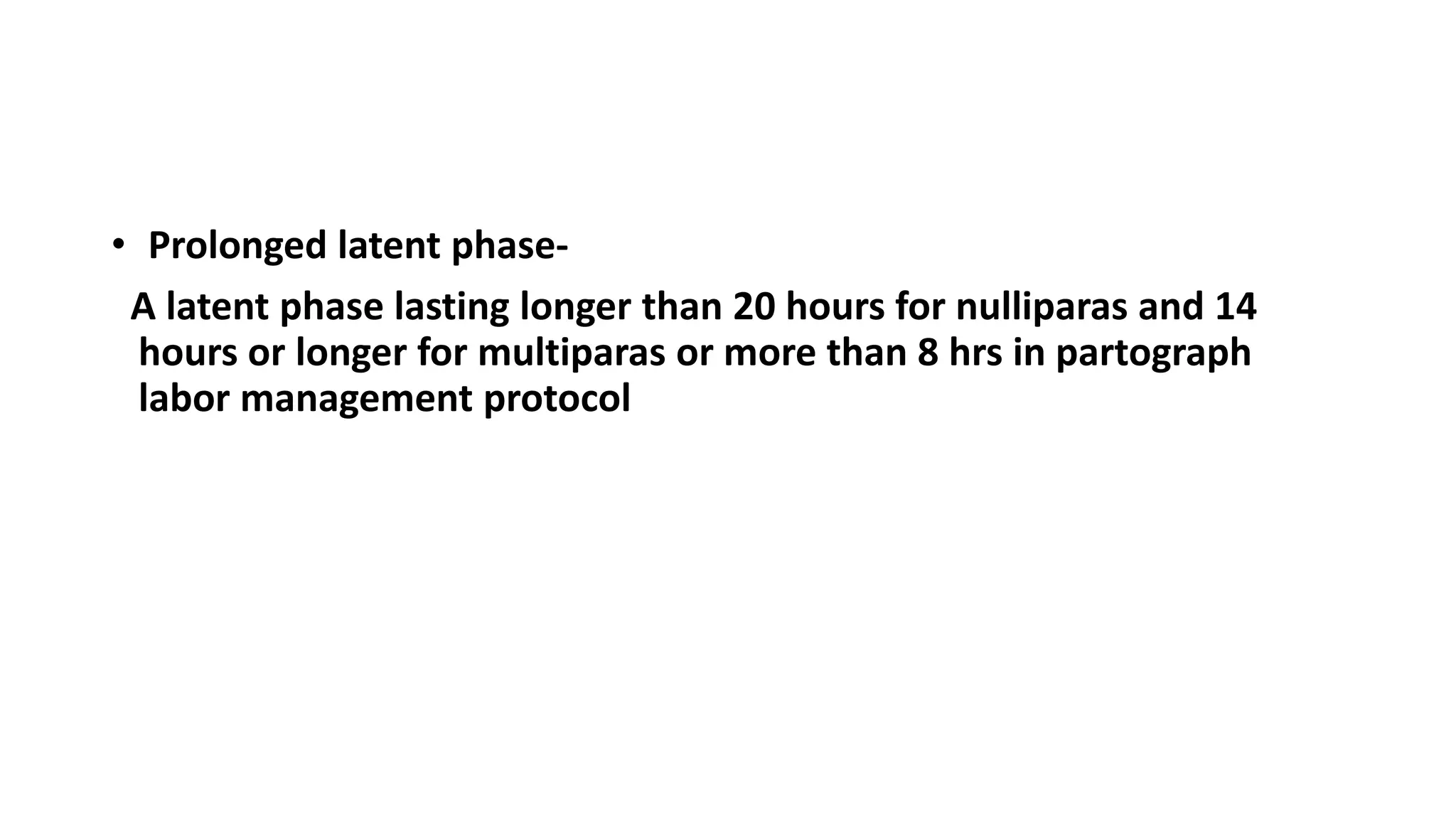
• Prolonged latent phase-
A latent phase lasting longer than 20 hours for nulliparas and 14
hours or longer for multiparas or more than 8 hrs in partograph
labor management protocol
ACTIVE-PHASE DISORDERS
Classification based cervical diltation
• Protracted diltation Disorder (slower than normal) -primi <1.2cm/1hr
multigravida<1.5cm/hr
• Arrested diltation Disorder (complete cessation of progress)
• causes for both- CPD &poor uterine cntraction
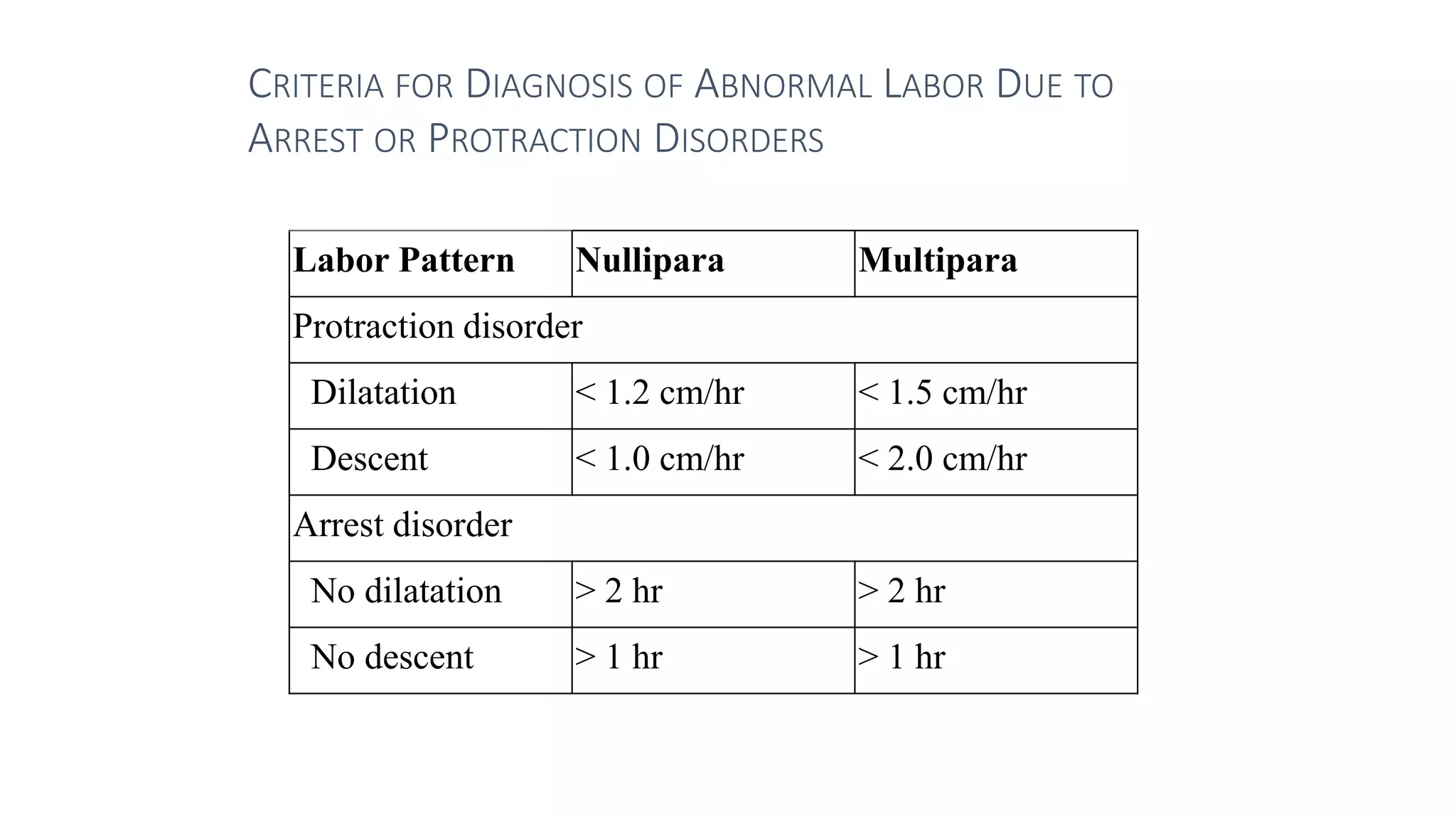
CRITERIA FOR DIAGNOSIS OF ABNORMAL LABOR DUE TO
ARREST OR PROTRACTION DISORDERS
Labor Pattern Nullipara Multipara
Protraction disorder
Dilatation < 1.2 cm/hr < 1.5 cm/hr
Descent < 1.0 cm/hr < 2.0 cm/hr
Arrest disorder
No dilatation > 2 hr > 2 hr
No descent > 1 hr > 1 hr
SECOND-STAGE DISORDERS
• incorporates many of the cardinal movements necessary for the fetus
to negotiate the birth canal
• disproportion of the fetus and pelvis frequently becomes apparent
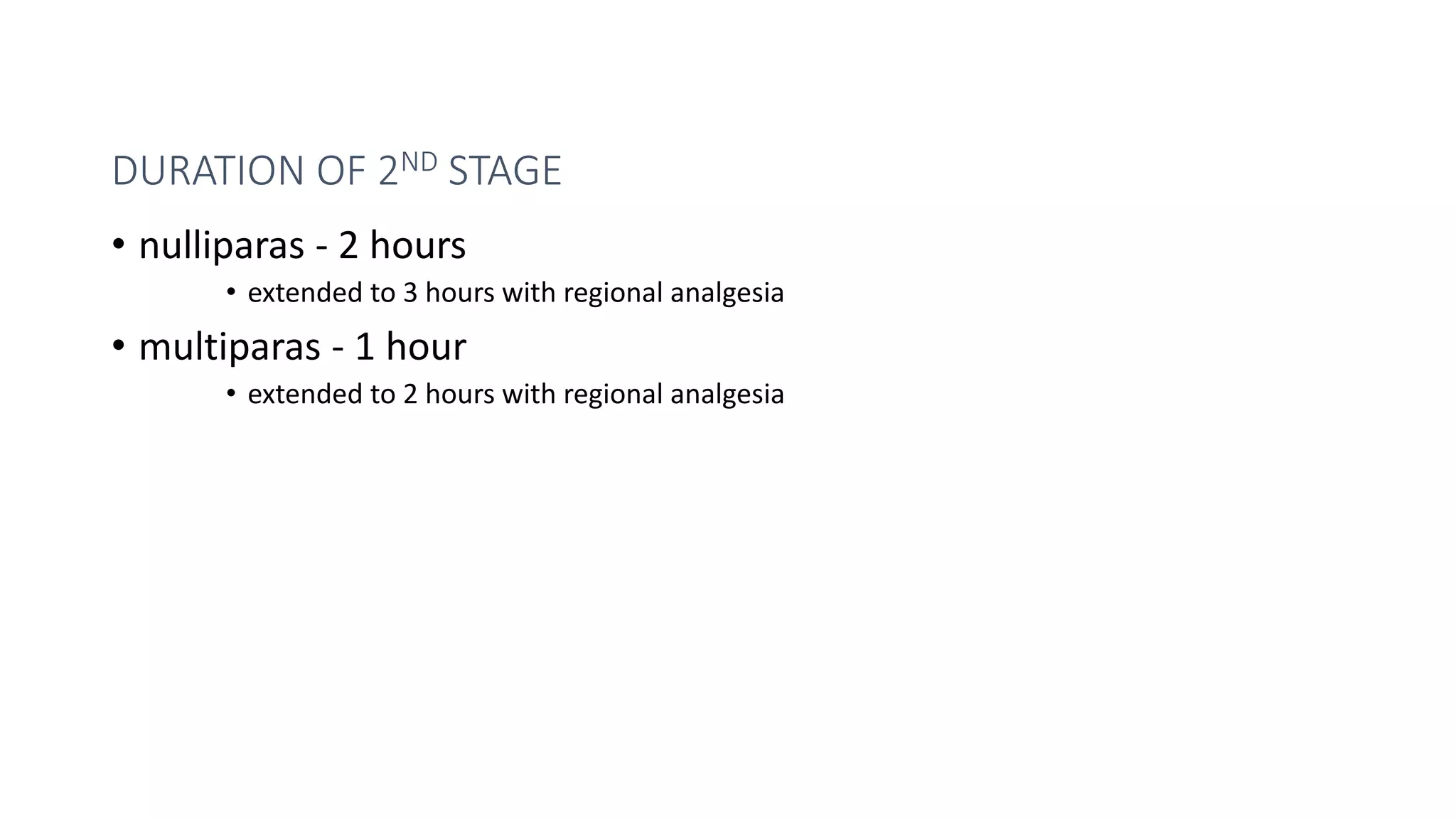
DURATION OF 2ND STAGE
• nulliparas - 2 hours
• extended to 3 hours with regional analgesia
• multiparas - 1 hour
• extended to 2 hours with regional analgesia
FETOPELVIC DISPROPORTION
• arises from diminished pelvic capacity, excessive fetal size, or
malpresentation
• two types-absolut CPD --Contracted pelvis,macrosomia
-Relative CPD--malpresentation, tight pernium
CONTRACTED PELVIC INLET
• shortest anteroposterior diameter is less than
10 cm or
• greatest transverse diameter is less than 12 cm or
• diagonal conjugate of less than 11.5 cm
CONTRACTED MIDPELVIS
• more common than inlet contraction
• causes transverse arrest of the fetal head
• interischial spinous diameter is < 8cm
• spines are prominent
• pelvic sidewalls converge
• narrow sacrosciatic notch
AVERAGE MIDPELVIS MEASUREMENTS
• transverse or interspinous = 10.5 cm
• anteroposterior (from the lower border of the
symphysis pubis to the junction of S4–S5) = 11.5
cm
• posterior sagittal (from the midpoint of the
interspinous line to the same point on the sacrum)
= 5 cm
Female pelvis – Superior/Anterior view
CONTRACTED PELVIC OUTLET
 interischial tuberous diameter of 8 cm or less.
Soft tissue dystocia
• pelvic masses
• Ca of the cx
• Myoma (LUs)
• Distended bladder
• Ovarian ttumor
• low lying placenta
• marginal or low lying placenta
may prevent fetal descent
19
Abnormality of the passenger (Fetal dystocia)
Is abnormal labor caused by mal position or mal presentation , excessive size of
the fetus or fetal mal formation
• Mal position or mal presentation
• The most common cause of fetal dystocia
20
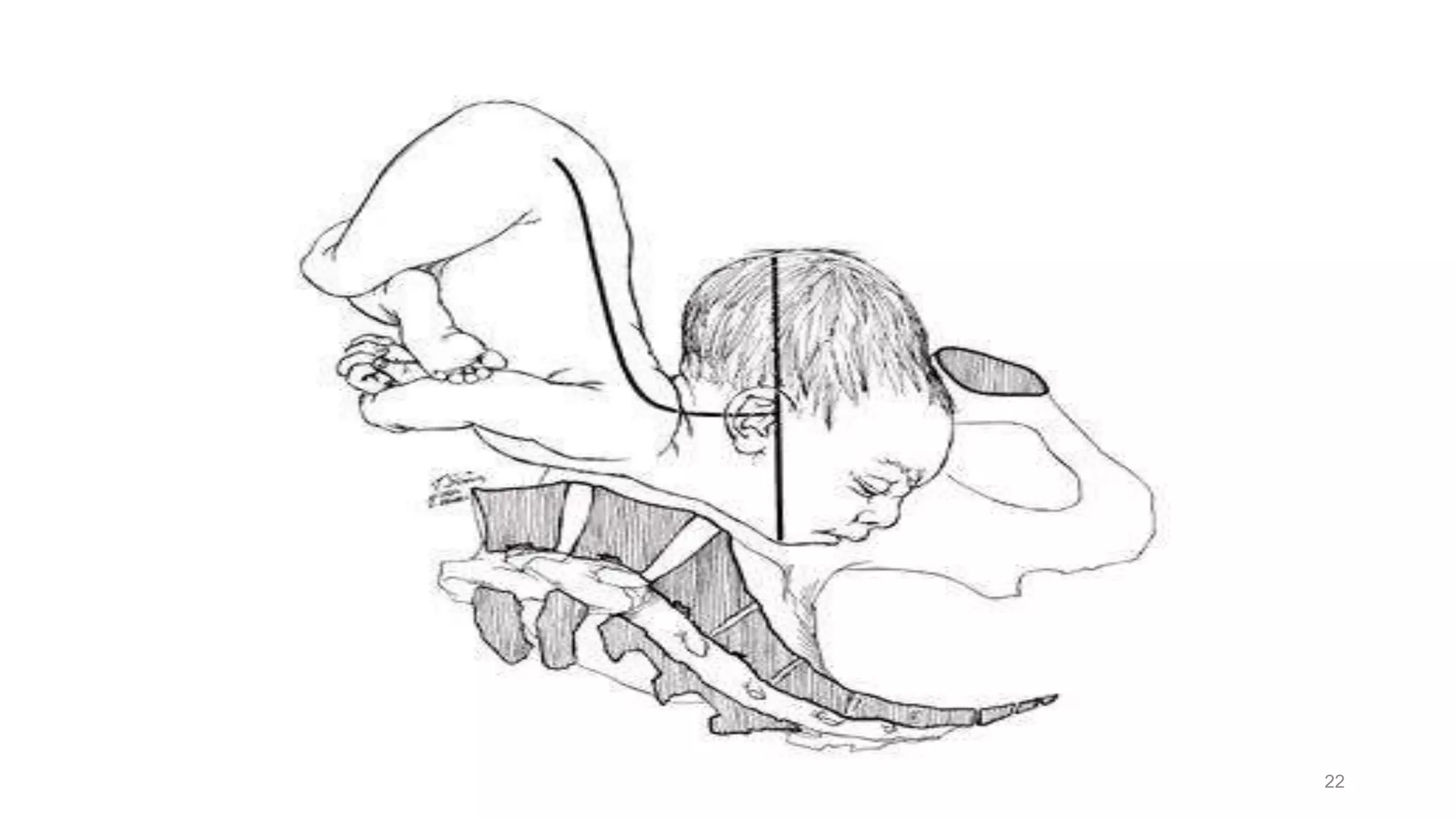
• Face presentation--The head is hyperextended occiput is in
contact with the fetal back and the chin (mentum ) is presenting
• Presenting ǿ_ submentobregmatic _ 10.2 cm
• Brow presentation- portion of fetal head between orbital
ridge and the ant fontanel presents at the pelvic inlet
• unstable commonly often coverts to face or occiput presentation.
22
23
• Transverse lie-- the long axis of the fetus is perpendicular to
that of the mother
• incidence 0.3%
• The shoulder is over the pelvic inlet (shoulder presentation)
• The side of the mother on which the acromion rests determines the
designation of the lie as Rt or Lt acromial
24
Transvers..
• Etiology
• abdominal wall relaxation from high parity
• uterus fall forward, deflect the long axis of the fetus away from the
axis of birth canal
• preterm fetus
• placenta previa
• abnormal Ux anatomy
• excessive amniotic fluid
• contracted pelvis
25
Compound presentation
• an extremity prolapses along side the presenting part with both presenting in
the pelvis simultaneously
• Cause – Condition that prevents complet occlusion of the pelvic inlet
by the fetal head
26
Persistent occiput posterior position
• most op rotate to OA
• may be normal in early labor
Cause- precise reason not known
.Transverse narrowing of the mid pelvis
• When it persists it may cause dystocia
• 2/3 of OP deliveries occurs with fetuses
Who were OA at the beginning of labor
• Cause of CPD_ partial deflexion of the fetal head
27
Persistent occiput transverse position
• In absence of pelvic abnormality frequently a transient position
• Tends to rotate to OA
• Cause
• pelvic dystocia
• Ux dystocia
• Platypelloid or android pelvis
28
Shoulder Dystocia
• When maneuvers were required to deliver the
shoulders
• A head to body delivery time exceeding
60seconds (N.24 sec)
• failure of the shoulders to spontaneously
traverse the pelvis after delivery of the fetal head
• Most cases can’t be accurately predicted or prevented
29
• Risk factors for shoulder dystocia
• Maternal
• obesity
• multiparity
• diabetes
• posterm __ because of ↑ed birth wt
• prior shoulder dystocia _17%
• Macrosomia
• Prolonged 2nd stage
30
Breech presentation
Defn - When the fetus assumes a longitudinal lie
with the Cephalic pole in the Ux fundus and caudal
pole at the pelvic brim.
• When the buttocks of the fetus enters the pelvic
first
31
Types of breech presentation
Frank breech 60-65%
• the lower extremities are flexed at the hips and extended at the
knees.
Incomplete breech (Footling – 25-35%)
• One or both feet felt below the breech
• A foot or knee is lower most in the birth canal
Complete breech 5%
• one or both knees are flexed
• the feet may be felt along side the buttocks
32
Causes
• prematurity
• fetal congenital malformation
. anencephaly , hydrocephaly
. congenital hip dislocation
• Uterine anomalies
. Bicornuate and Septate Ux
33
• uterine over distension
. Polyhydraminos, multiple gestation
• High parity
• Pelvic obstruction
. placenta previa, myoma , other pelvic tumors
• Previous breech delivery
Vaginal delivery
• Indications
• No maternal or fetal indication for c/s
• Wt < 3500gm
• Frank breech
• Adequate pelvis
• Zatuchini – Andros score > 4
• Documented lethal fetal congenital anomalies
• Presentation of mother in advanced labor with no maternal
or fetal distress
35
1. spontaneous breech vaginal delivery
2. partial extraction breech delivery
3. total extraction breech delivery
External Cephalic Version (ECV)
Version is a procedure in which the fetal presentation is
altered by physical manipulation, either substituting one
pole of a longitudinal presentation for the other or
converting an oblique or transverse lie into a longitudinal
presentation.
external version- the manipulations are performed
through the abdominal wall
internal version- are performed inside the uterine cavity.
37
Obstructed labor
38
obstructed labor
• cessation of labor progression despite adequate uyerine contraction
due to mechanical obstraction
• It is an absolute condition, further progress is impossible with out
assistance
• It is an out come of a neglected and mismanaged labor
• account for 8% of maternal death globally
Causes
• CPD – faults in the pelvis
-faults in the fetus
• Mal presentation and mal position
- Breech (impacted, large breech)
-Transverse lie,Brow presentation, Mp, OP
• myoma, longtudinal vaginal septum....
• Tight perineum esp in primipravida
40
Clinical presentation
• prolonged labor often extending to days rather than hours
• prolonged Rom
• painful contractions eventually might cause Ux hypotonia or rupture
• fever ,confusion ,distress..
41
P/E
• exhausted , tired and anxious (by sever pain , lack of sleep)
• dehydrated and acidotic- due to muscular activity in absence of
intake
• Rapid pulse & often febrile
• Hypotension or shock ( septic or hgic due to infection or Ux rupture)
• Distended hypoactive bowels due to electrolyte deficit
42
• Hypotonic or hypertonic Ux contractions depending on the progress
of labor
• The cause of the obstruction may be evident on abdominal
examination (abnormal lie , big baby etc..)
• In the presence of Ux rupture the abdomen will be tender, fetal parts
are easily felt, lie and presentation may be difficult to detect as the
baby has been displaced into the peritoneal cavity
• edematous vulva(canula sign), foul smelling vaginal discharge..
43
Management
• Resuscitation
- If delivery is not imminent or likely to be so shortly, resuscitation
is the first Step before facilitating transfer of the Pt to higher
institution.
• admit the Pt straight to the delivery unit or operating theater
• Update HCt, blood group & RH type, WBC
• definitive management depends on status of fetus ,degree of descent.
44
QUESTION?
THANK YOU

Abnormal labor

  • 1.
  • 2.
    objectives • what isabnormal labor or dystocia? • Etiologies of abnormal labor • what is CPD? • What is obstructed labor?
  • 3.
    Abnormal labor  isdifficult labor characterized by abnormaly slow progresion of labor most common cause for primary cs more common for primi (25-30%), multipara (10-15%)
  • 4.
    Ethiologies of abnormallabor 1. power -poor uterine contraction ,poor maternal effert 2. passanger-large baby, malpresentation 3. passage(birth canal)-contracted pelvis, soft tissue abnormalities(myoma, cervical ca ..)
  • 5.
    Types of abnormaluterine contraction 1. hypotonic uterine dysfunction • more common • low basal ton • treatment-augimentation by oxytocin 2.hypertonic/uncordinated uterine dysfunction • basal tone is elevated • contraction has no cordination(asynchronous) or pressure gradient is distorted • treatment-sedation
  • 6.
    REPORTED CUASES OFUTERINE DYSFUNCTION • Epidural anelgesia -results in prolongation of both 1ST &2nd stage of labor • choramnionitis (infection)
  • 7.
    • Prolonged latentphase- A latent phase lasting longer than 20 hours for nulliparas and 14 hours or longer for multiparas or more than 8 hrs in partograph labor management protocol
  • 8.
    ACTIVE-PHASE DISORDERS Classification basedcervical diltation • Protracted diltation Disorder (slower than normal) -primi <1.2cm/1hr multigravida<1.5cm/hr • Arrested diltation Disorder (complete cessation of progress) • causes for both- CPD &poor uterine cntraction
  • 9.
    CRITERIA FOR DIAGNOSISOF ABNORMAL LABOR DUE TO ARREST OR PROTRACTION DISORDERS Labor Pattern Nullipara Multipara Protraction disorder Dilatation < 1.2 cm/hr < 1.5 cm/hr Descent < 1.0 cm/hr < 2.0 cm/hr Arrest disorder No dilatation > 2 hr > 2 hr No descent > 1 hr > 1 hr
  • 10.
    SECOND-STAGE DISORDERS • incorporatesmany of the cardinal movements necessary for the fetus to negotiate the birth canal • disproportion of the fetus and pelvis frequently becomes apparent
  • 11.
    DURATION OF 2NDSTAGE • nulliparas - 2 hours • extended to 3 hours with regional analgesia • multiparas - 1 hour • extended to 2 hours with regional analgesia
  • 12.
  • 13.
    FETOPELVIC DISPROPORTION • arisesfrom diminished pelvic capacity, excessive fetal size, or malpresentation • two types-absolut CPD --Contracted pelvis,macrosomia -Relative CPD--malpresentation, tight pernium
  • 14.
    CONTRACTED PELVIC INLET •shortest anteroposterior diameter is less than 10 cm or • greatest transverse diameter is less than 12 cm or • diagonal conjugate of less than 11.5 cm
  • 15.
    CONTRACTED MIDPELVIS • morecommon than inlet contraction • causes transverse arrest of the fetal head • interischial spinous diameter is < 8cm • spines are prominent • pelvic sidewalls converge • narrow sacrosciatic notch
  • 16.
    AVERAGE MIDPELVIS MEASUREMENTS •transverse or interspinous = 10.5 cm • anteroposterior (from the lower border of the symphysis pubis to the junction of S4–S5) = 11.5 cm • posterior sagittal (from the midpoint of the interspinous line to the same point on the sacrum) = 5 cm
  • 17.
    Female pelvis –Superior/Anterior view
  • 18.
    CONTRACTED PELVIC OUTLET interischial tuberous diameter of 8 cm or less.
  • 19.
    Soft tissue dystocia •pelvic masses • Ca of the cx • Myoma (LUs) • Distended bladder • Ovarian ttumor • low lying placenta • marginal or low lying placenta may prevent fetal descent 19
  • 20.
    Abnormality of thepassenger (Fetal dystocia) Is abnormal labor caused by mal position or mal presentation , excessive size of the fetus or fetal mal formation • Mal position or mal presentation • The most common cause of fetal dystocia 20
  • 21.
    • Face presentation--Thehead is hyperextended occiput is in contact with the fetal back and the chin (mentum ) is presenting • Presenting ǿ_ submentobregmatic _ 10.2 cm • Brow presentation- portion of fetal head between orbital ridge and the ant fontanel presents at the pelvic inlet • unstable commonly often coverts to face or occiput presentation.
  • 22.
  • 23.
  • 24.
    • Transverse lie--the long axis of the fetus is perpendicular to that of the mother • incidence 0.3% • The shoulder is over the pelvic inlet (shoulder presentation) • The side of the mother on which the acromion rests determines the designation of the lie as Rt or Lt acromial 24
  • 25.
    Transvers.. • Etiology • abdominalwall relaxation from high parity • uterus fall forward, deflect the long axis of the fetus away from the axis of birth canal • preterm fetus • placenta previa • abnormal Ux anatomy • excessive amniotic fluid • contracted pelvis 25
  • 26.
    Compound presentation • anextremity prolapses along side the presenting part with both presenting in the pelvis simultaneously • Cause – Condition that prevents complet occlusion of the pelvic inlet by the fetal head 26
  • 27.
    Persistent occiput posteriorposition • most op rotate to OA • may be normal in early labor Cause- precise reason not known .Transverse narrowing of the mid pelvis • When it persists it may cause dystocia • 2/3 of OP deliveries occurs with fetuses Who were OA at the beginning of labor • Cause of CPD_ partial deflexion of the fetal head 27
  • 28.
    Persistent occiput transverseposition • In absence of pelvic abnormality frequently a transient position • Tends to rotate to OA • Cause • pelvic dystocia • Ux dystocia • Platypelloid or android pelvis 28
  • 29.
    Shoulder Dystocia • Whenmaneuvers were required to deliver the shoulders • A head to body delivery time exceeding 60seconds (N.24 sec) • failure of the shoulders to spontaneously traverse the pelvis after delivery of the fetal head • Most cases can’t be accurately predicted or prevented 29
  • 30.
    • Risk factorsfor shoulder dystocia • Maternal • obesity • multiparity • diabetes • posterm __ because of ↑ed birth wt • prior shoulder dystocia _17% • Macrosomia • Prolonged 2nd stage 30
  • 31.
    Breech presentation Defn -When the fetus assumes a longitudinal lie with the Cephalic pole in the Ux fundus and caudal pole at the pelvic brim. • When the buttocks of the fetus enters the pelvic first 31
  • 32.
    Types of breechpresentation Frank breech 60-65% • the lower extremities are flexed at the hips and extended at the knees. Incomplete breech (Footling – 25-35%) • One or both feet felt below the breech • A foot or knee is lower most in the birth canal Complete breech 5% • one or both knees are flexed • the feet may be felt along side the buttocks 32
  • 33.
    Causes • prematurity • fetalcongenital malformation . anencephaly , hydrocephaly . congenital hip dislocation • Uterine anomalies . Bicornuate and Septate Ux 33
  • 34.
    • uterine overdistension . Polyhydraminos, multiple gestation • High parity • Pelvic obstruction . placenta previa, myoma , other pelvic tumors • Previous breech delivery
  • 35.
    Vaginal delivery • Indications •No maternal or fetal indication for c/s • Wt < 3500gm • Frank breech • Adequate pelvis • Zatuchini – Andros score > 4 • Documented lethal fetal congenital anomalies • Presentation of mother in advanced labor with no maternal or fetal distress 35
  • 36.
    1. spontaneous breechvaginal delivery 2. partial extraction breech delivery 3. total extraction breech delivery
  • 37.
    External Cephalic Version(ECV) Version is a procedure in which the fetal presentation is altered by physical manipulation, either substituting one pole of a longitudinal presentation for the other or converting an oblique or transverse lie into a longitudinal presentation. external version- the manipulations are performed through the abdominal wall internal version- are performed inside the uterine cavity. 37
  • 38.
  • 39.
    obstructed labor • cessationof labor progression despite adequate uyerine contraction due to mechanical obstraction • It is an absolute condition, further progress is impossible with out assistance • It is an out come of a neglected and mismanaged labor • account for 8% of maternal death globally
  • 40.
    Causes • CPD –faults in the pelvis -faults in the fetus • Mal presentation and mal position - Breech (impacted, large breech) -Transverse lie,Brow presentation, Mp, OP • myoma, longtudinal vaginal septum.... • Tight perineum esp in primipravida 40
  • 41.
    Clinical presentation • prolongedlabor often extending to days rather than hours • prolonged Rom • painful contractions eventually might cause Ux hypotonia or rupture • fever ,confusion ,distress.. 41
  • 42.
    P/E • exhausted ,tired and anxious (by sever pain , lack of sleep) • dehydrated and acidotic- due to muscular activity in absence of intake • Rapid pulse & often febrile • Hypotension or shock ( septic or hgic due to infection or Ux rupture) • Distended hypoactive bowels due to electrolyte deficit 42
  • 43.
    • Hypotonic orhypertonic Ux contractions depending on the progress of labor • The cause of the obstruction may be evident on abdominal examination (abnormal lie , big baby etc..) • In the presence of Ux rupture the abdomen will be tender, fetal parts are easily felt, lie and presentation may be difficult to detect as the baby has been displaced into the peritoneal cavity • edematous vulva(canula sign), foul smelling vaginal discharge.. 43
  • 44.
    Management • Resuscitation - Ifdelivery is not imminent or likely to be so shortly, resuscitation is the first Step before facilitating transfer of the Pt to higher institution. • admit the Pt straight to the delivery unit or operating theater • Update HCt, blood group & RH type, WBC • definitive management depends on status of fetus ,degree of descent. 44
  • 45.
  • 46.