K Hari Krishnan 
II MBBS (2009-’11) 
Tirunelveli Medical College 
Tirunelveli, Tamilnadu, India
A test done to check the 
effectiveness of a drug against a 
bacterium and to select the best 
drug that acts against the 
bacterium. 
K Hari Krishnan 
Tirunelveli Medical 
College
The in vitro testing of bacterial cultures 
with antibiotics to determine 
. 
K Hari Krishnan 
Tirunelveli Medical 
College
Antibiotic 
Sensitivity 
Testing 
K Hari Krishnan 
Tirunelveli Medical 
College
To guide the clinician in selecting the best 
antibiotic agent for an individual patient. 
To control the use of 
in clinical practice. 
To accumulate epidemiological information on 
the resistance of microorganisms of public 
health importance within the community. 
To reveal the changing trends in the 
local isolates. K Hari Krishnan 
Tirunelveli Medical 
College
Bacteria have the ability to develop 
resistance following repeated or subclinical 
(insufficient) doses, so more advanced 
antibiotics and synthetic antibiotics are 
continually required to overcome them. 
K Hari Krishnan 
Tirunelveli Medical 
College
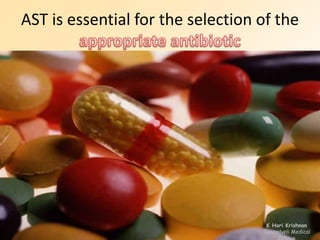
AST is essential for the selection of the 
K Hari Krishnan 
Tirunelveli Medical 
College
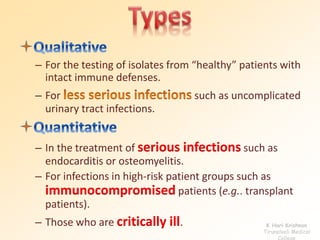
– For the testing of isolates from “healthy” patients with 
intact immune defenses. 
– For such as uncomplicated 
urinary tract infections. 
– In the treatment of serious infections such as 
endocarditis or osteomyelitis. 
– For infections in high-risk patient groups such as 
immunocompromised patients (e.g.. transplant 
patients). 
– Those who are critically ill. K Hari Krishnan 
Tirunelveli Medical 
College
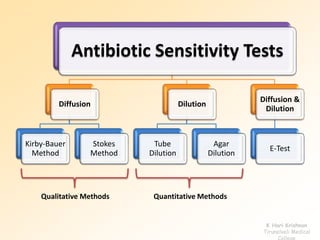
Antibiotic Sensitivity Tests 
Diffusion 
Kirby-Bauer 
Method 
Stokes 
Method 
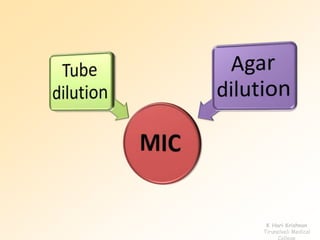
Dilution 
Tube 
Dilution 
Agar 
Dilution 
Diffusion & 
Dilution 
E-Test 
Qualitative Methods Quantitative Methods 
K Hari Krishnan 
Tirunelveli Medical 
College
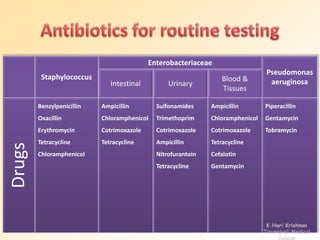
Staphylococcus 
Enterobacteriaceae 
Pseudomonas 
Blood & 
Tissues 
Intestinal Urinary aeruginosa 
Drugs 
Benzylpenicillin 
Oxacillin 
Erythromycin 
Tetracycline 
Chloramphenicol 
Ampicillin 
Chloramphenicol 
Cotrimoxazole 
Tetracycline 
Sulfonamides 
Trimethoprim 
Cotrimoxazole 
Ampicillin 
Nitrofurantoin 
Tetracycline 
Ampicillin 
Chloramphenicol 
Cotrimoxazole 
Tetracycline 
Cefalotin 
Gentamycin 
Piperacillin 
Gentamycin 
Tobramycin 
K Hari Krishnan 
Tirunelveli Medical 
College
K Hari Krishnan 
Tirunelveli Medical 
College
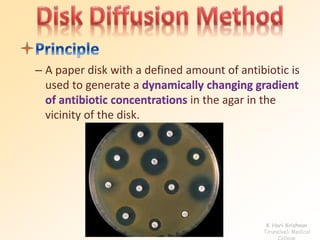
– A paper disk with a defined amount of antibiotic is 
used to generate a dynamically changing gradient 
of antibiotic concentrations in the agar in the 
vicinity of the disk. 
K Hari Krishnan 
Tirunelveli Medical 
College
The contained in a reservoir is 
allowed to and 
interact in a plate freshly seeded with the test 
organisms. 
The disk is applied to the surface of an agar 
plate inoculated with the test organism. 
– The diffuses out of the disk to form the 
gradient. 
– The starts to divide and grow and 
progresses toward a critical mass of cells. 
K Hari Krishnan 
Tirunelveli Medical 
College
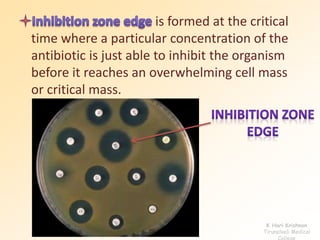
is formed at the critical 
time where a particular concentration of the 
antibiotic is just able to inhibit the organism 
before it reaches an overwhelming cell mass 
or critical mass. 
K Hari Krishnan 
Tirunelveli Medical 
College
K Hari Krishnan 
Tirunelveli Medical 
College
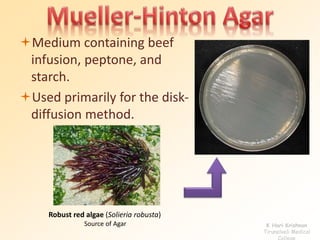
Medium containing beef 
infusion, peptone, and 
starch. 
Used primarily for the disk-diffusion 
method. 
Robust red algae (Solieria robusta) 
Source of Agar K Hari Krishnan 
Tirunelveli Medical 
College
Mueller-Hinton agar is considered the for 
routine susceptibility testing of nonfastidious bacteria. 
It shows acceptable batch-to-batch reproducibility 
for susceptibility testing. 
It is low in sulfonamides, trimethoprim, and 
tetracycline inhibitors. 
It gives satisfactory growth of most nonfastidious 
pathogens. 
A large body of data and experience has been 
collected concerning susceptibility tests performed 
with this medium. 
K Hari Krishnan 
Tirunelveli Medical 
College
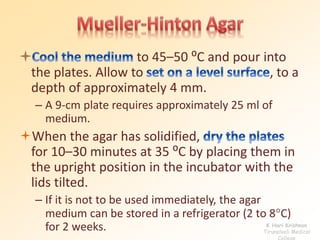
to 45–50 ⁰C and pour into 
the plates. Allow to , to a 
depth of approximately 4 mm. 
– A 9-cm plate requires approximately 25 ml of 
medium. 
When the agar has solidified, 
for 10–30 minutes at 35 ⁰C by placing them in 
the upright position in the incubator with the 
lids tilted. 
– If it is not to be used immediately, the agar 
medium can be stored in a refrigerator (2 to 8C) 
for 2 weeks. K Hari Krishnan 
Tirunelveli Medical 
College
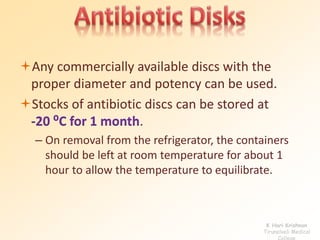
Any commercially available discs with the 
proper diameter and potency can be used. 
Stocks of antibiotic discs can be stored at 
-20 ⁰C for 1 month. 
– On removal from the refrigerator, the containers 
should be left at room temperature for about 1 
hour to allow the temperature to equilibrate. 
K Hari Krishnan 
Tirunelveli Medical 
College
K Hari Krishnan 
Tirunelveli Medical 
College
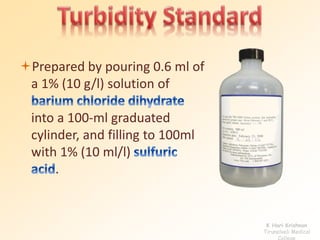
Prepared by pouring 0.6 ml of 
a 1% (10 g/l) solution of 
into a 100-ml graduated 
cylinder, and filling to 100ml 
with 1% (10 ml/l) 
. 
K Hari Krishnan 
Tirunelveli Medical 
College
A supply of cotton wool swabs on wooden 
applicator sticks should be prepared. 
They can be sterilized in tins, culture tubes, or 
on paper, either in the autoclave or by dry 
heat. 
K Hari Krishnan 
Tirunelveli Medical 
College
K Hari Krishnan 
Tirunelveli Medical 
College
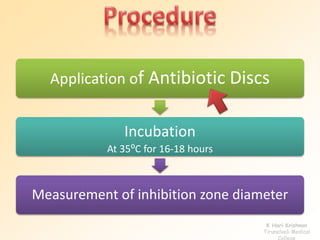
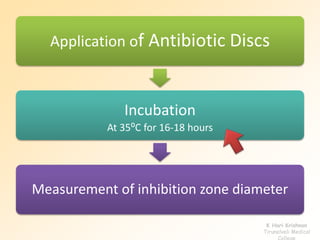
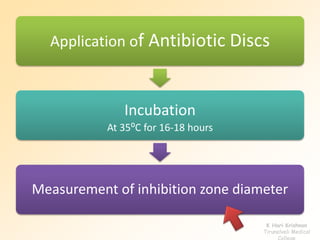
Application of Antibiotic Discs 
Incubation 
At 35⁰C for 16-18 hours 
Measurement of inhibition zone diameter 
K Hari Krishnan 
Tirunelveli Medical 
College
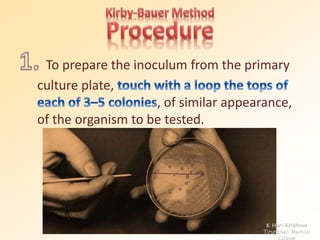
To prepare the inoculum from the primary 
culture plate, 
, of similar appearance, 
of the organism to be tested. 
K Hari Krishnan 
Tirunelveli Medical 
College
Transfer this growth to a tube of saline. 
K Hari Krishnan 
Tirunelveli Medical 
College
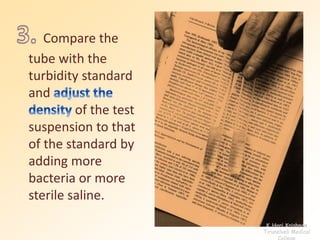
Compare the 
tube with the 
turbidity standard 
and 
of the test 
suspension to that 
of the standard by 
adding more 
bacteria or more 
sterile saline. 
K Hari Krishnan 
Tirunelveli Medical 
College
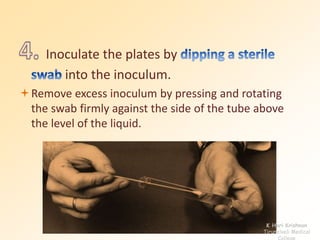
Inoculate the plates by 
into the inoculum. 
Remove excess inoculum by pressing and rotating 
the swab firmly against the side of the tube above 
the level of the liquid. 
K Hari Krishnan 
Tirunelveli Medical 
College
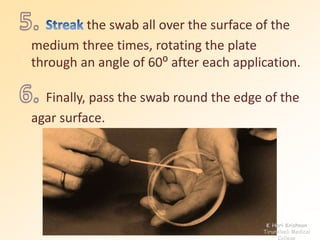
the swab all over the surface of the 
medium three times, rotating the plate 
through an angle of 60⁰ after each application. 
Finally, pass the swab round the edge of the 
agar surface. 
K Hari Krishnan 
Tirunelveli Medical 
College
Leave the inoculum to for a few 
minutes at room temperature with the lid 
closed. 
K Hari Krishnan 
Tirunelveli Medical 
College
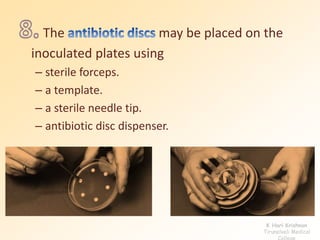
The may be placed on the 
inoculated plates using 
– sterile forceps. 
– a template. 
– a sterile needle tip. 
– antibiotic disc dispenser. 
K Hari Krishnan 
Tirunelveli Medical 
College
Application of Antibiotic Discs 
Incubation 
At 35⁰C for 16-18 hours 
Measurement of inhibition zone diameter 
K Hari Krishnan 
Tirunelveli Medical 
College
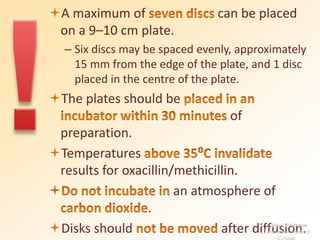
A maximum of can be placed 
on a 9–10 cm plate. 
– Six discs may be spaced evenly, approximately 
15 mm from the edge of the plate, and 1 disc 
placed in the centre of the plate. 
The plates should be 
of 
preparation. 
Temperatures 
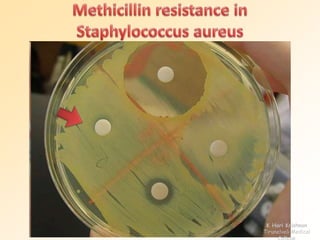
results for oxacillin/methicillin. 
 an atmosphere of 
. 
Disks should after diffusion. K Hari Krishnan 
Tirunelveli Medical 
College
K Hari Krishnan 
Tirunelveli Medical 
College
Application of Antibiotic Discs 
Incubation 
At 35⁰C for 16-18 hours 
Measurement of inhibition zone diameter 
K Hari Krishnan 
Tirunelveli Medical 
College
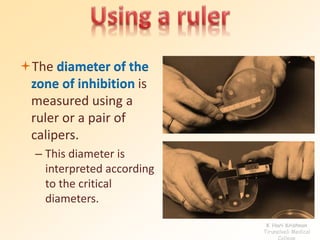
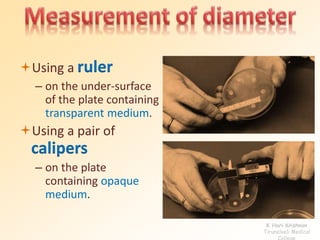
Using a ruler 
– on the under-surface 
of the plate containing 
transparent medium. 
Using a pair of 
calipers 
– on the plate 
containing opaque 
medium. 
K Hari Krishnan 
Tirunelveli Medical 
College
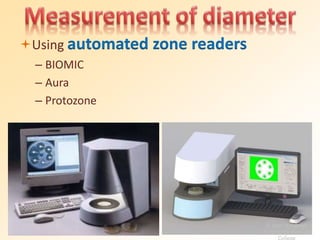
Using automated zone readers 
– BIOMIC 
– Aura 
– Protozone 
K Hari Krishnan 
Tirunelveli Medical 
College
K Hari Krishnan 
Tirunelveli Medical 
College
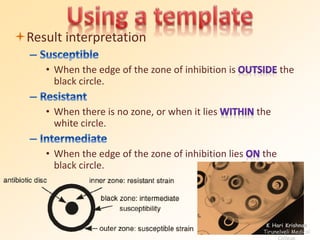
Standard templates are available for each 
antibiotic. 
K Hari Krishnan 
Tirunelveli Medical 
College
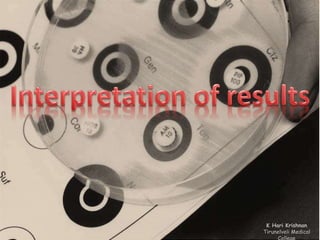
Result interpretation 
• When the edge of the zone of inhibition is the 
black circle. 
• When there is no zone, or when it lies the 
white circle. 
• When the edge of the zone of inhibition lies the 
black circle. 
K Hari Krishnan 
Tirunelveli Medical 
College
The diameter of the 
zone of inhibition is 
measured using a 
ruler or a pair of 
calipers. 
– This diameter is 
interpreted according 
to the critical 
diameters. 
K Hari Krishnan 
Tirunelveli Medical 
College
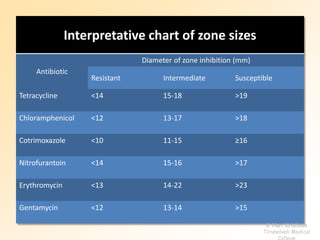
Interpretative chart of zone sizes 
Antibiotic 
Diameter of zone inhibition (mm) 
Resistant Intermediate Susceptible 
Tetracycline <14 15-18 >19 
Chloramphenicol <12 13-17 >18 
Cotrimoxazole <10 11-15 ≥16 
Nitrofurantoin <14 15-16 >17 
Erythromycin <13 14-22 >23 
Gentamycin <12 13-14 >15 
K Hari Krishnan 
Tirunelveli Medical 
College
– An organism is called susceptible to an antibiotic when the 
infection caused by it is likely to respond to treatment 
with this antibiotic, at the recommended dosage. 
– An organism is called resistant if it is expected not to 
respond to a given antibiotic, irrespective of the 
dosage and of the location of the infection. 
– Strains that are “moderately susceptible” to an antibiotic 
that can be used for treatment at a higher dosage 
(e.g. b-lactams) because of its low toxicity. 
– Strains that show “intermediate susceptibility” to a more 
toxic antibiotic (e.g. aminoglycoside) that cannot be used 
at a higher dosage. K Hari Krishnan 
Tirunelveli Medical 
College
K Hari Krishnan 
Tirunelveli Medical 
College
– Too inoculum 
• Inhibition zones will be larger even though the 
sensitivity of the organism is unchanged 
Relatively resistant strains may be falsely reported as 
susceptible. 
– Too inoculum 
• Inhibition zones will be smaller 
Relatively susceptible strains may then be falsely 
reported as resistant. 
K Hari Krishnan 
Tirunelveli Medical 
College
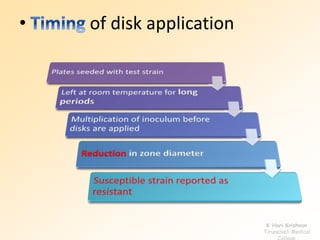
• of disk application 
K Hari Krishnan 
Tirunelveli Medical 
College
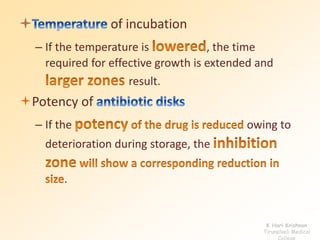
of incubation 
– If the temperature is , the time 
required for effective growth is extended and 
result. 
Potency of 
– If the owing to 
deterioration during storage, the 
. 
K Hari Krishnan 
Tirunelveli Medical 
College
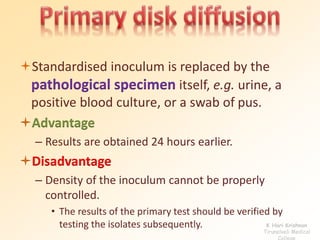
Standardised inoculum is replaced by the 
pathological specimen itself, e.g. urine, a 
positive blood culture, or a swab of pus. 
Advantage 
– Results are obtained 24 hours earlier. 
Disadvantage 
– Density of the inoculum cannot be properly 
controlled. 
• The results of the primary test should be verified by 
testing the isolates subsequently. K Hari Krishnan 
Tirunelveli Medical 
College
K Hari Krishnan 
Tirunelveli Medical 
College
Used to determine the 
of antibiotic to inhibit or kill the 
microorganism. 
Achieved by dilution of antibiotic in either 
agar or broth media. 
K Hari Krishnan 
Tirunelveli Medical 
College
K Hari Krishnan 
Tirunelveli Medical 
College
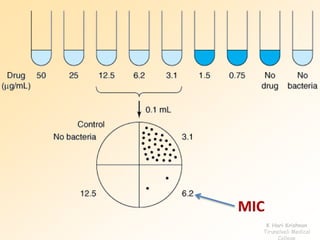
The lowest concentration of drug that 
of the bacteria 
isolated from the patient. 
The MIC is determined by inoculating the 
organism isolated from the patient into a 
series of tubes or cups containing progressive 
dilutions of the drug. 
K Hari Krishnan 
Tirunelveli Medical 
College
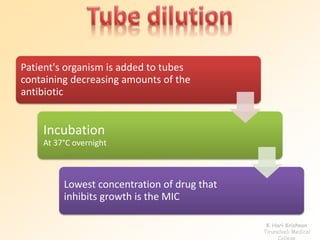
Patient's organism is added to tubes 
containing decreasing amounts of the 
antibiotic 
Incubation 
At 37°C overnight 
Lowest concentration of drug that 
inhibits growth is the MIC 
K Hari Krishnan 
Tirunelveli Medical 
College
MIC 
K Hari Krishnan 
Tirunelveli Medical 
College
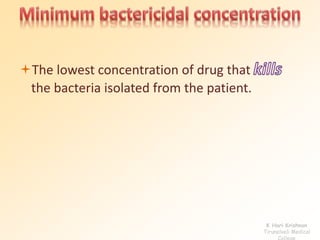
The lowest concentration of drug that 
the bacteria isolated from the patient. 
K Hari Krishnan 
Tirunelveli Medical 
College
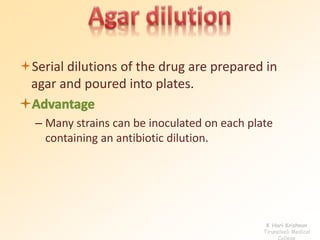
Serial dilutions of the drug are prepared in 
agar and poured into plates. 
– Many strains can be inoculated on each plate 
containing an antibiotic dilution. 
K Hari Krishnan 
Tirunelveli Medical 
College
K Hari Krishnan 
Tirunelveli Medical 
College
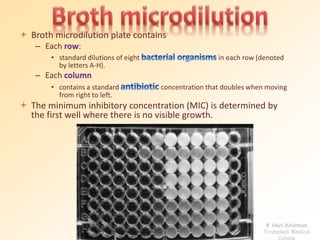
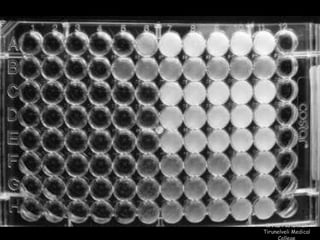
 Broth microdilution plate contains 
– Each row: 
• standard dilutions of eight in each row (denoted 
by letters A-H). 
– Each column 
• contains a standard concentration that doubles when moving 
from right to left. 
 The minimum inhibitory concentration (MIC) is determined by 
the first well where there is no visible growth. 
K Hari Krishnan 
Tirunelveli Medical 
College
K Hari Krishnan 
Tirunelveli Medical 
College
K Hari Krishnan 
Tirunelveli Medical 
College
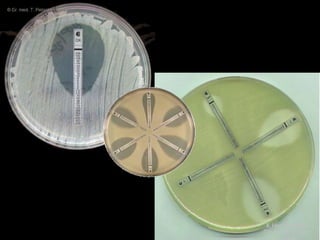
Epsilometer Test 
Quantitative method of antibiotic sensitivity 
testing. 
Applies both dilution of antibiotic and 
diffusion of antibiotic into the medium. 
K Hari Krishnan 
Tirunelveli Medical 
College
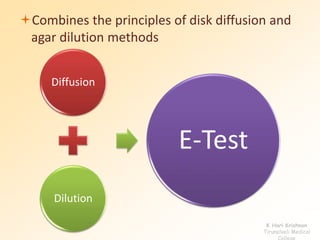
Combines the principles of disk diffusion and 
agar dilution methods 
Diffusion 
Dilution 
E-Test 
K Hari Krishnan 
Tirunelveli Medical 
College
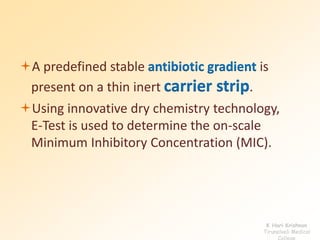
A predefined stable antibiotic gradient is 
present on a thin inert carrier strip. 
Using innovative dry chemistry technology, 
E-Test is used to determine the on-scale 
Minimum Inhibitory Concentration (MIC). 
K Hari Krishnan 
Tirunelveli Medical 
College
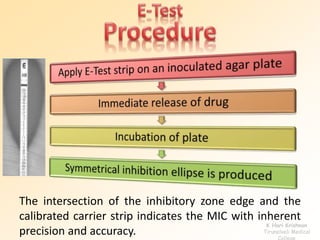
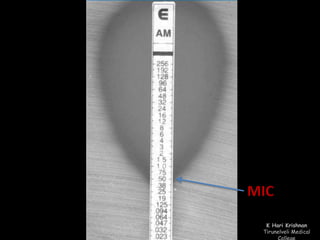
The intersection of the inhibitory zone edge and the 
calibrated carrier strip indicates the MIC with inherent 
precision and accuracy. K Hari Krishnan 
Tirunelveli Medical 
College
MIC 
K Hari Krishnan 
Tirunelveli Medical 
College
K Hari Krishnan 
Tirunelveli Medical 
College
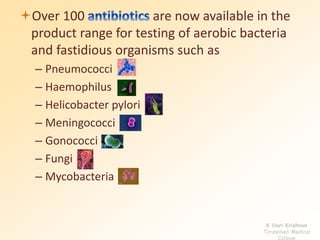
Over 100 are now available in the 
product range for testing of aerobic bacteria 
and fastidious organisms such as 
– Pneumococci 
– Haemophilus 
– Helicobacter pylori 
– Meningococci 
– Gonococci 
– Fungi 
– Mycobacteria 
K Hari Krishnan 
Tirunelveli Medical 
College
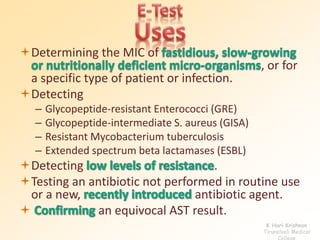
Determining the MIC of 
, or for 
a specific type of patient or infection. 
Detecting 
– Glycopeptide-resistant Enterococci (GRE) 
– Glycopeptide-intermediate S. aureus (GISA) 
– Resistant Mycobacterium tuberculosis 
– Extended spectrum beta lactamases (ESBL) 
Detecting . 
Testing an antibiotic not performed in routine use 
or a new, antibiotic agent. 
 an equivocal AST result. 
K Hari Krishnan 
Tirunelveli Medical 
College
K Hari Krishnan 
Tirunelveli Medical 
College
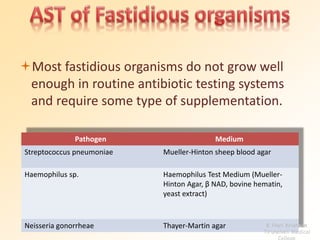
Most fastidious organisms do not grow well 
enough in routine antibiotic testing systems 
and require some type of supplementation. 
Pathogen Medium 
Streptococcus pneumoniae Mueller-Hinton sheep blood agar 
Haemophilus sp. Haemophilus Test Medium (Mueller- 
Hinton Agar, β NAD, bovine hematin, 
yeast extract) 
Neisseria gonorrheae Thayer-Martin agar K Hari Krishnan 
Tirunelveli Medical 
College
Antibiotic resistance among many clinically important 
species of anaerobes has increased, which has made 
empiric therapy choices unpredictable. 
– E.g.. Metronidazole resistance in Propionibacterium and 
Bacteroides 
– Agar dilution 
– Broth microdilution 
– Brucella agar 
(or) 
– Broth supplemented with vitamin K and hemin K Hari Krishnan 
Tirunelveli Medical 
College
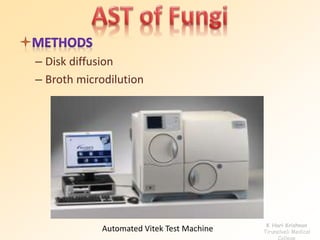
– Disk diffusion 
– Broth microdilution 
Automated Vitek Test Machine K Hari Krishnan 
Tirunelveli Medical 
College
K Hari Krishnan 
Tirunelveli Medical 
College
K Hari Krishnan 
Tirunelveli Medical 
College
Antibiotic 
Sensitivity Testing 
K Hari Krishnan 
Tirunelveli Medical 
College
Antibiotic Sensitivity Tests

Antibiotic Sensitivity Tests

  • 1.
    K Hari Krishnan II MBBS (2009-’11) Tirunelveli Medical College Tirunelveli, Tamilnadu, India
  • 2.
    A test doneto check the effectiveness of a drug against a bacterium and to select the best drug that acts against the bacterium. K Hari Krishnan Tirunelveli Medical College
  • 3.
    The in vitrotesting of bacterial cultures with antibiotics to determine . K Hari Krishnan Tirunelveli Medical College
  • 4.
    Antibiotic Sensitivity Testing K Hari Krishnan Tirunelveli Medical College
  • 5.
    To guide theclinician in selecting the best antibiotic agent for an individual patient. To control the use of in clinical practice. To accumulate epidemiological information on the resistance of microorganisms of public health importance within the community. To reveal the changing trends in the local isolates. K Hari Krishnan Tirunelveli Medical College
  • 6.
    Bacteria have theability to develop resistance following repeated or subclinical (insufficient) doses, so more advanced antibiotics and synthetic antibiotics are continually required to overcome them. K Hari Krishnan Tirunelveli Medical College
  • 7.
    AST is essentialfor the selection of the K Hari Krishnan Tirunelveli Medical College
  • 8.
    – For thetesting of isolates from “healthy” patients with intact immune defenses. – For such as uncomplicated urinary tract infections. – In the treatment of serious infections such as endocarditis or osteomyelitis. – For infections in high-risk patient groups such as immunocompromised patients (e.g.. transplant patients). – Those who are critically ill. K Hari Krishnan Tirunelveli Medical College
  • 9.
    Antibiotic Sensitivity Tests Diffusion Kirby-Bauer Method Stokes Method Dilution Tube Dilution Agar Dilution Diffusion & Dilution E-Test Qualitative Methods Quantitative Methods K Hari Krishnan Tirunelveli Medical College
  • 10.
    Staphylococcus Enterobacteriaceae Pseudomonas Blood & Tissues Intestinal Urinary aeruginosa Drugs Benzylpenicillin Oxacillin Erythromycin Tetracycline Chloramphenicol Ampicillin Chloramphenicol Cotrimoxazole Tetracycline Sulfonamides Trimethoprim Cotrimoxazole Ampicillin Nitrofurantoin Tetracycline Ampicillin Chloramphenicol Cotrimoxazole Tetracycline Cefalotin Gentamycin Piperacillin Gentamycin Tobramycin K Hari Krishnan Tirunelveli Medical College
  • 11.
    K Hari Krishnan Tirunelveli Medical College
  • 12.
    – A paperdisk with a defined amount of antibiotic is used to generate a dynamically changing gradient of antibiotic concentrations in the agar in the vicinity of the disk. K Hari Krishnan Tirunelveli Medical College
  • 13.
    The contained ina reservoir is allowed to and interact in a plate freshly seeded with the test organisms. The disk is applied to the surface of an agar plate inoculated with the test organism. – The diffuses out of the disk to form the gradient. – The starts to divide and grow and progresses toward a critical mass of cells. K Hari Krishnan Tirunelveli Medical College
  • 14.
    is formed atthe critical time where a particular concentration of the antibiotic is just able to inhibit the organism before it reaches an overwhelming cell mass or critical mass. K Hari Krishnan Tirunelveli Medical College
  • 16.
    K Hari Krishnan Tirunelveli Medical College
  • 17.
    Medium containing beef infusion, peptone, and starch. Used primarily for the disk-diffusion method. Robust red algae (Solieria robusta) Source of Agar K Hari Krishnan Tirunelveli Medical College
  • 18.
    Mueller-Hinton agar isconsidered the for routine susceptibility testing of nonfastidious bacteria. It shows acceptable batch-to-batch reproducibility for susceptibility testing. It is low in sulfonamides, trimethoprim, and tetracycline inhibitors. It gives satisfactory growth of most nonfastidious pathogens. A large body of data and experience has been collected concerning susceptibility tests performed with this medium. K Hari Krishnan Tirunelveli Medical College
  • 19.
    to 45–50 ⁰Cand pour into the plates. Allow to , to a depth of approximately 4 mm. – A 9-cm plate requires approximately 25 ml of medium. When the agar has solidified, for 10–30 minutes at 35 ⁰C by placing them in the upright position in the incubator with the lids tilted. – If it is not to be used immediately, the agar medium can be stored in a refrigerator (2 to 8C) for 2 weeks. K Hari Krishnan Tirunelveli Medical College
  • 20.
    Any commercially availablediscs with the proper diameter and potency can be used. Stocks of antibiotic discs can be stored at -20 ⁰C for 1 month. – On removal from the refrigerator, the containers should be left at room temperature for about 1 hour to allow the temperature to equilibrate. K Hari Krishnan Tirunelveli Medical College
  • 21.
    K Hari Krishnan Tirunelveli Medical College
  • 22.
    Prepared by pouring0.6 ml of a 1% (10 g/l) solution of into a 100-ml graduated cylinder, and filling to 100ml with 1% (10 ml/l) . K Hari Krishnan Tirunelveli Medical College
  • 23.
    A supply ofcotton wool swabs on wooden applicator sticks should be prepared. They can be sterilized in tins, culture tubes, or on paper, either in the autoclave or by dry heat. K Hari Krishnan Tirunelveli Medical College
  • 24.
    K Hari Krishnan Tirunelveli Medical College
  • 25.
    Application of AntibioticDiscs Incubation At 35⁰C for 16-18 hours Measurement of inhibition zone diameter K Hari Krishnan Tirunelveli Medical College
  • 26.
    To prepare theinoculum from the primary culture plate, , of similar appearance, of the organism to be tested. K Hari Krishnan Tirunelveli Medical College
  • 27.
    Transfer this growthto a tube of saline. K Hari Krishnan Tirunelveli Medical College
  • 28.
    Compare the tubewith the turbidity standard and of the test suspension to that of the standard by adding more bacteria or more sterile saline. K Hari Krishnan Tirunelveli Medical College
  • 29.
    Inoculate the platesby into the inoculum. Remove excess inoculum by pressing and rotating the swab firmly against the side of the tube above the level of the liquid. K Hari Krishnan Tirunelveli Medical College
  • 30.
    the swab allover the surface of the medium three times, rotating the plate through an angle of 60⁰ after each application. Finally, pass the swab round the edge of the agar surface. K Hari Krishnan Tirunelveli Medical College
  • 31.
    Leave the inoculumto for a few minutes at room temperature with the lid closed. K Hari Krishnan Tirunelveli Medical College
  • 32.
    The may beplaced on the inoculated plates using – sterile forceps. – a template. – a sterile needle tip. – antibiotic disc dispenser. K Hari Krishnan Tirunelveli Medical College
  • 33.
    Application of AntibioticDiscs Incubation At 35⁰C for 16-18 hours Measurement of inhibition zone diameter K Hari Krishnan Tirunelveli Medical College
  • 34.
    A maximum ofcan be placed on a 9–10 cm plate. – Six discs may be spaced evenly, approximately 15 mm from the edge of the plate, and 1 disc placed in the centre of the plate. The plates should be of preparation. Temperatures results for oxacillin/methicillin.  an atmosphere of . Disks should after diffusion. K Hari Krishnan Tirunelveli Medical College
  • 35.
    K Hari Krishnan Tirunelveli Medical College
  • 36.
    Application of AntibioticDiscs Incubation At 35⁰C for 16-18 hours Measurement of inhibition zone diameter K Hari Krishnan Tirunelveli Medical College
  • 37.
    Using a ruler – on the under-surface of the plate containing transparent medium. Using a pair of calipers – on the plate containing opaque medium. K Hari Krishnan Tirunelveli Medical College
  • 38.
    Using automated zonereaders – BIOMIC – Aura – Protozone K Hari Krishnan Tirunelveli Medical College
  • 39.
    K Hari Krishnan Tirunelveli Medical College
  • 40.
    Standard templates areavailable for each antibiotic. K Hari Krishnan Tirunelveli Medical College
  • 41.
    Result interpretation •When the edge of the zone of inhibition is the black circle. • When there is no zone, or when it lies the white circle. • When the edge of the zone of inhibition lies the black circle. K Hari Krishnan Tirunelveli Medical College
  • 42.
    The diameter ofthe zone of inhibition is measured using a ruler or a pair of calipers. – This diameter is interpreted according to the critical diameters. K Hari Krishnan Tirunelveli Medical College
  • 43.
    Interpretative chart ofzone sizes Antibiotic Diameter of zone inhibition (mm) Resistant Intermediate Susceptible Tetracycline <14 15-18 >19 Chloramphenicol <12 13-17 >18 Cotrimoxazole <10 11-15 ≥16 Nitrofurantoin <14 15-16 >17 Erythromycin <13 14-22 >23 Gentamycin <12 13-14 >15 K Hari Krishnan Tirunelveli Medical College
  • 44.
    – An organismis called susceptible to an antibiotic when the infection caused by it is likely to respond to treatment with this antibiotic, at the recommended dosage. – An organism is called resistant if it is expected not to respond to a given antibiotic, irrespective of the dosage and of the location of the infection. – Strains that are “moderately susceptible” to an antibiotic that can be used for treatment at a higher dosage (e.g. b-lactams) because of its low toxicity. – Strains that show “intermediate susceptibility” to a more toxic antibiotic (e.g. aminoglycoside) that cannot be used at a higher dosage. K Hari Krishnan Tirunelveli Medical College
  • 45.
    K Hari Krishnan Tirunelveli Medical College
  • 46.
    – Too inoculum • Inhibition zones will be larger even though the sensitivity of the organism is unchanged Relatively resistant strains may be falsely reported as susceptible. – Too inoculum • Inhibition zones will be smaller Relatively susceptible strains may then be falsely reported as resistant. K Hari Krishnan Tirunelveli Medical College
  • 47.
    • of diskapplication K Hari Krishnan Tirunelveli Medical College
  • 48.
    of incubation –If the temperature is , the time required for effective growth is extended and result. Potency of – If the owing to deterioration during storage, the . K Hari Krishnan Tirunelveli Medical College
  • 49.
    Standardised inoculum isreplaced by the pathological specimen itself, e.g. urine, a positive blood culture, or a swab of pus. Advantage – Results are obtained 24 hours earlier. Disadvantage – Density of the inoculum cannot be properly controlled. • The results of the primary test should be verified by testing the isolates subsequently. K Hari Krishnan Tirunelveli Medical College
  • 50.
    K Hari Krishnan Tirunelveli Medical College
  • 51.
    Used to determinethe of antibiotic to inhibit or kill the microorganism. Achieved by dilution of antibiotic in either agar or broth media. K Hari Krishnan Tirunelveli Medical College
  • 52.
    K Hari Krishnan Tirunelveli Medical College
  • 53.
    The lowest concentrationof drug that of the bacteria isolated from the patient. The MIC is determined by inoculating the organism isolated from the patient into a series of tubes or cups containing progressive dilutions of the drug. K Hari Krishnan Tirunelveli Medical College
  • 54.
    Patient's organism isadded to tubes containing decreasing amounts of the antibiotic Incubation At 37°C overnight Lowest concentration of drug that inhibits growth is the MIC K Hari Krishnan Tirunelveli Medical College
  • 55.
    MIC K HariKrishnan Tirunelveli Medical College
  • 56.
    The lowest concentrationof drug that the bacteria isolated from the patient. K Hari Krishnan Tirunelveli Medical College
  • 57.
    Serial dilutions ofthe drug are prepared in agar and poured into plates. – Many strains can be inoculated on each plate containing an antibiotic dilution. K Hari Krishnan Tirunelveli Medical College
  • 58.
    K Hari Krishnan Tirunelveli Medical College
  • 59.
     Broth microdilutionplate contains – Each row: • standard dilutions of eight in each row (denoted by letters A-H). – Each column • contains a standard concentration that doubles when moving from right to left.  The minimum inhibitory concentration (MIC) is determined by the first well where there is no visible growth. K Hari Krishnan Tirunelveli Medical College
  • 60.
    K Hari Krishnan Tirunelveli Medical College
  • 61.
    K Hari Krishnan Tirunelveli Medical College
  • 62.
    Epsilometer Test Quantitativemethod of antibiotic sensitivity testing. Applies both dilution of antibiotic and diffusion of antibiotic into the medium. K Hari Krishnan Tirunelveli Medical College
  • 63.
    Combines the principlesof disk diffusion and agar dilution methods Diffusion Dilution E-Test K Hari Krishnan Tirunelveli Medical College
  • 64.
    A predefined stableantibiotic gradient is present on a thin inert carrier strip. Using innovative dry chemistry technology, E-Test is used to determine the on-scale Minimum Inhibitory Concentration (MIC). K Hari Krishnan Tirunelveli Medical College
  • 65.
    The intersection ofthe inhibitory zone edge and the calibrated carrier strip indicates the MIC with inherent precision and accuracy. K Hari Krishnan Tirunelveli Medical College
  • 66.
    MIC K HariKrishnan Tirunelveli Medical College
  • 67.
    K Hari Krishnan Tirunelveli Medical College
  • 68.
    Over 100 arenow available in the product range for testing of aerobic bacteria and fastidious organisms such as – Pneumococci – Haemophilus – Helicobacter pylori – Meningococci – Gonococci – Fungi – Mycobacteria K Hari Krishnan Tirunelveli Medical College
  • 69.
    Determining the MICof , or for a specific type of patient or infection. Detecting – Glycopeptide-resistant Enterococci (GRE) – Glycopeptide-intermediate S. aureus (GISA) – Resistant Mycobacterium tuberculosis – Extended spectrum beta lactamases (ESBL) Detecting . Testing an antibiotic not performed in routine use or a new, antibiotic agent.  an equivocal AST result. K Hari Krishnan Tirunelveli Medical College
  • 70.
    K Hari Krishnan Tirunelveli Medical College
  • 71.
    Most fastidious organismsdo not grow well enough in routine antibiotic testing systems and require some type of supplementation. Pathogen Medium Streptococcus pneumoniae Mueller-Hinton sheep blood agar Haemophilus sp. Haemophilus Test Medium (Mueller- Hinton Agar, β NAD, bovine hematin, yeast extract) Neisseria gonorrheae Thayer-Martin agar K Hari Krishnan Tirunelveli Medical College
  • 72.
    Antibiotic resistance amongmany clinically important species of anaerobes has increased, which has made empiric therapy choices unpredictable. – E.g.. Metronidazole resistance in Propionibacterium and Bacteroides – Agar dilution – Broth microdilution – Brucella agar (or) – Broth supplemented with vitamin K and hemin K Hari Krishnan Tirunelveli Medical College
  • 73.
    – Disk diffusion – Broth microdilution Automated Vitek Test Machine K Hari Krishnan Tirunelveli Medical College
  • 74.
    K Hari Krishnan Tirunelveli Medical College
  • 75.
    K Hari Krishnan Tirunelveli Medical College
  • 76.
    Antibiotic Sensitivity Testing K Hari Krishnan Tirunelveli Medical College