Prabin Shah BScMLT, MSc(Biochemistry)
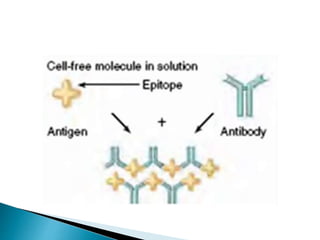
 When a soluble Ag combine with its Abs in the presence of
electrolytes at a suitable temperature, pH, the Ag- Ab
complex forms an insoluble precipitate.
 Soluble Ags interact with Abs to form lattice.
 Occurs best when Ag and Ab are present in optimal
proportions.
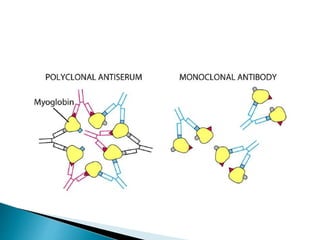
 Polyclonal antibodies can form lattices or large aggregates
however monoclonal antibody can link only two molecules of
antigen and no precipitate is formed.
 The amount of precipitate formed is greatly influenced by the
relative proportions of Ags and Abs.
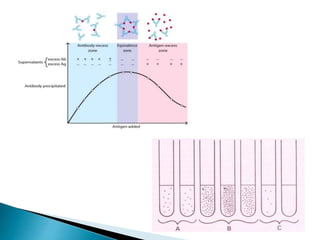
 Precipitation curve:
◦ Zone of antibody excess: precipitation is inhibited and
ANTIBODY NOT BOUND TO Ag can be detected in the
supernatant. This is also called as Prozone
◦ Zone of Equivalence: maximal precipitation in which Ab and
Ag form large insoluble complexes and neither antibody nor
AG can be detected in the supernatant.
◦ Zone of Ag Excess: precipitation is inhibited and Ag not bound
the Ab can be detected in the supernatant. This is also known as
Post zone.
 Multivalent Ag combines with bivalent Ab in varying
proportions, depending on the Ag and Ab ratio in the reacting
mixture.
 Precipitation results when a large lattice is formed consisting of
alternating antigen and Ab molecule. This is possible only in the
zone of equivalence.
 In the zone of Ag- Ab excess, the lattice does not enlarge as the
valencies of the Ab and the Ag are fully satisfied.
 Ring test
 Slide test
 Tube test
 Immunodiffusion
 Electroimmnunodiffusion
A) Ring Test
 Consist of layering the Ag solution over a column of antiserum in
narrow tube.
 A ppt is form at the junction of two liquids.
 Eg: Ascoli’s thermo precipitin test, Lancefield grouping of
streptococci.
B) Slide test
 A drop of Ag and the antiserum are placed on a slide and mixes by
shaking, floccules appear. Eg: VDRL test for syphilis is an
example of slide flocculation.
C) Tube test
 A quantitative tube flocculation test is used for the
standardization of toxins and toxoids.
 Serial dilution of the toxin/toxoid are added to the tubes
containing a fixed quantity of the antitoxin
 The amount of toxin or toxoid that flocculates optimally with one
unit of the antitoxin is defined as an Lf dose
 Example: Kahn Test for syphilis is an example of tube
flocculation test
D). Immunodiffusion Test
 Precipitation test is done in gel.
 Immunodiffusion procedure are carried out in an agar
or agarose gel
 The precipitate is easily seen in gel yield precipitin
lines
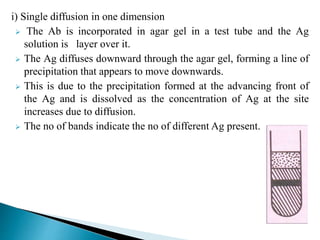
i) Single diffusion in one dimension
 The Ab is incorporated in agar gel in a test tube and the Ag
solution is layer over it.
 The Ag diffuses downward through the agar gel, forming a line of
precipitation that appears to move downwards.
 This is due to the precipitation formed at the advancing front of
the Ag and is dissolved as the concentration of Ag at the site
increases due to diffusion.
 The no of bands indicate the no of different Ag present.
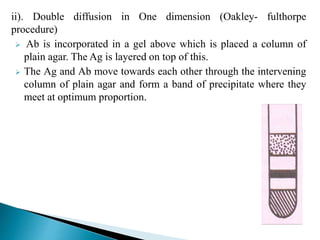
ii). Double diffusion in One dimension (Oakley- fulthorpe
procedure)
 Ab is incorporated in a gel above which is placed a column of
plain agar. The Ag is layered on top of this.
 The Ag and Ab move towards each other through the intervening
column of plain agar and form a band of precipitate where they
meet at optimum proportion.
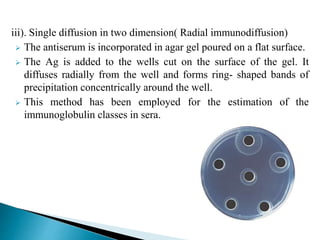
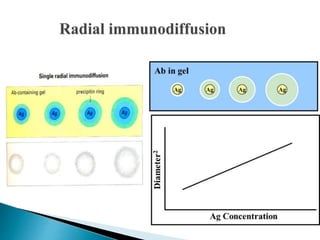
iii). Single diffusion in two dimension( Radial immunodiffusion)
 The antiserum is incorporated in agar gel poured on a flat surface.
 The Ag is added to the wells cut on the surface of the gel. It
diffuses radially from the well and forms ring- shaped bands of
precipitation concentrically around the well.
 This method has been employed for the estimation of the
immunoglobulin classes in sera.
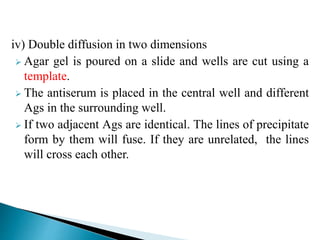
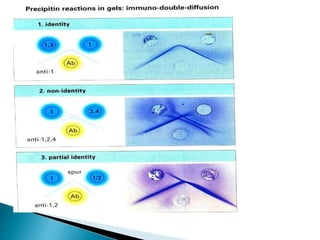
iv) Double diffusion in two dimensions
 Agar gel is poured on a slide and wells are cut using a
template.
 The antiserum is placed in the central well and different
Ags in the surrounding well.
 If two adjacent Ags are identical. The lines of precipitate
form by them will fuse. If they are unrelated, the lines
will cross each other.
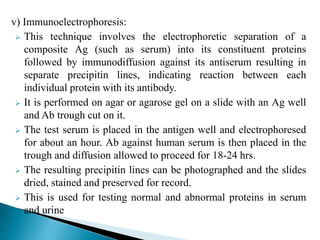
v) Immunoelectrophoresis:
 This technique involves the electrophoretic separation of a
composite Ag (such as serum) into its constituent proteins
followed by immunodiffusion against its antiserum resulting in
separate precipitin lines, indicating reaction between each
individual protein with its antibody.
 It is performed on agar or agarose gel on a slide with an Ag well
and Ab trough cut on it.
 The test serum is placed in the antigen well and electrophoresed
for about an hour. Ab against human serum is then placed in the
trough and diffusion allowed to proceed for 18-24 hrs.
 The resulting precipitin lines can be photographed and the slides
dried, stained and preserved for record.
 This is used for testing normal and abnormal proteins in serum
and urine
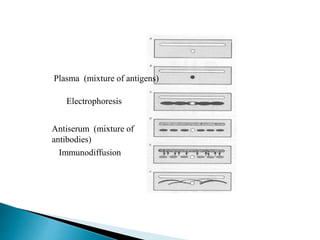
Plasma (mixture of antigens)
Electrophoresis
Antiserum (mixture of
antibodies)
Immunodiffusion
E) Electroimmunodiffusion
 The development of precipitin can be speeded up by electrically
driving the antigen and Ab. Two most frequently technique used
in the lab are:
i) Counterimmunoelectrophoresis
ii) Rocket electrophoresis
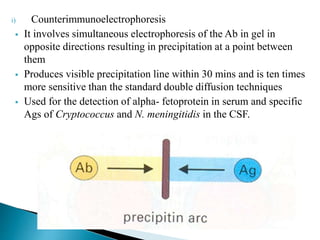
i) Counterimmunoelectrophoresis
 It involves simultaneous electrophoresis of the Ab in gel in
opposite directions resulting in precipitation at a point between
them
 Produces visible precipitation line within 30 mins and is ten times
more sensitive than the standard double diffusion techniques
 Used for the detection of alpha- fetoprotein in serum and specific
Ags of Cryptococcus and N. meningitidis in the CSF.
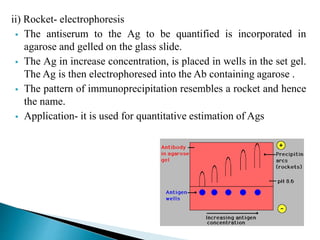
ii) Rocket- electrophoresis
 The antiserum to the Ag to be quantified is incorporated in
agarose and gelled on the glass slide.
 The Ag in increase concentration, is placed in wells in the set gel.
The Ag is then electrophoresed into the Ab containing agarose .
 The pattern of immunoprecipitation resembles a rocket and hence
the name.
 Application- it is used for quantitative estimation of Ags
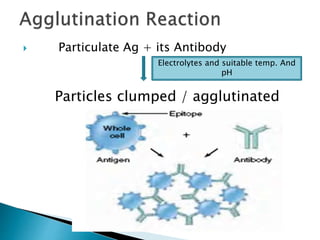
 Particulate Ag + its Antibody
Electrolytes and suitable temp. And
pH
Particles clumped / agglutinated
 Same principle govern agglutination and precipitation
reaction
 Zone phenomenon is also seen in agglutination.
 Incomplete or monovalent Abs do not cause agglutination,
though they combine with Ag. They act as blocking Abs.
 More sensitive than precipitation for detection of Abs.
A) Slide Agglutination
 when a drop of the appropriate anti serum is added to a
smooth uniform suspension of a particulate Ag in a drop
of saline on a slide, agglutination take place.
Clumping of Ag and clearing of suspension
 Uses:
◦ Blood grouping and cross matching
◦ Confirmation of cultural isolates
B) Tube Agglutination
 Standard quantitative method for measuring Abs
 Titre estimated by:
A fixed volume of a particulate Ag suspension is
added to an equal volume of serial dilutions of antiserum
in test tubes.
Uses:
 Diagnosis of : Typhoid (Widal test)
Brucellosis
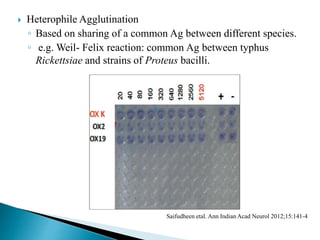
 Heterophile Agglutination
◦ Based on sharing of a common Ag between different species.
◦ e.g. Weil- Felix reaction: common Ag between typhus
Rickettsiae and strains of Proteus bacilli.
Saifudheen etal. Ann Indian Acad Neurol 2012;15:141-4
C) The Antiglobulin test
 It was devised by Coombs, Mourant and Race (1945)
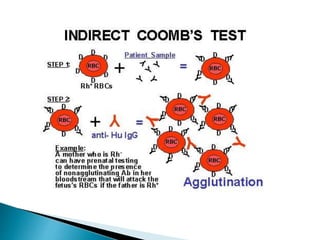
 Detection of anti- Rh antibodies that do not agglutinate Rh-
positive red cells in saline.
 Used for the detection of incomplete Abs.
PRINCIPLE:
 When sera containing incomplete anti- Rh Abs are mixed with Rh-
positive red cells , the Ab globulin coats the surface of the RBCs ,
though they are not agglutinated.
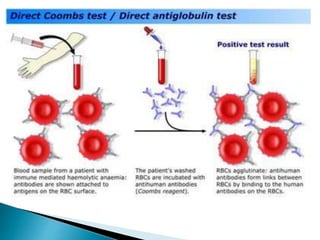
 When such erythrocytes coated with the Ab globulin are washed
off all unattached protein and treated with a rabbit antiserum
against human gammaglobulin (antiglobulin or coombs serum) the
cells are agglutinated.
 The coombs test may be direct or indirect.
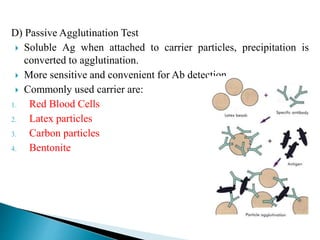
D) Passive Agglutination Test
 Soluble Ag when attached to carrier particles, precipitation is
converted to agglutination.
 More sensitive and convenient for Ab detection.
 Commonly used carrier are:
1. Red Blood Cells
2. Latex particles
3. Carbon particles
4. Bentonite
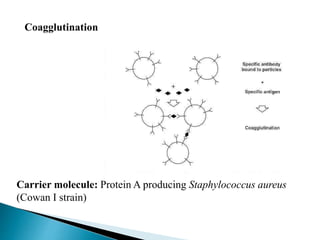
Coagglutination
Carrier molecule: Protein A producing Staphylococcus aureus
(Cowan I strain)
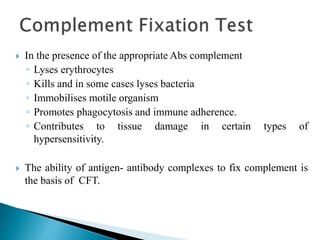
 In the presence of the appropriate Abs complement
◦ Lyses erythrocytes
◦ Kills and in some cases lyses bacteria
◦ Immobilises motile organism
◦ Promotes phagocytosis and immune adherence.
◦ Contributes to tissue damage in certain types of
hypersensitivity.
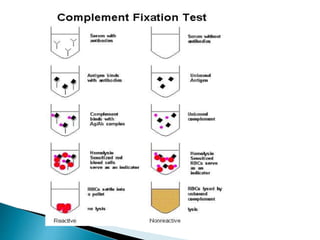
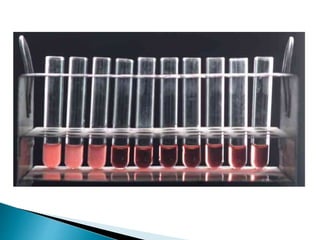
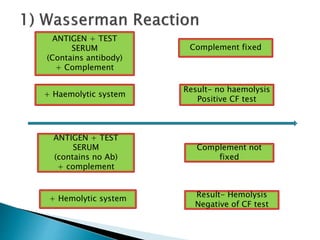
 The ability of antigen- antibody complexes to fix complement is
the basis of CFT.
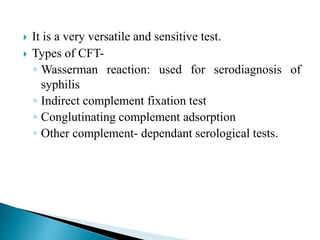
 It is a very versatile and sensitive test.
 Types of CFT-
◦ Wasserman reaction: used for serodiagnosis of
syphilis
◦ Indirect complement fixation test
◦ Conglutinating complement adsorption
◦ Other complement- dependant serological tests.
ANTIGEN + TEST
SERUM
(Contains antibody)
+ Complement
+ Haemolytic system
ANTIGEN + TEST
SERUM
(contains no Ab)
+ complement
+ Hemolytic system
Complement fixed
Result- no haemolysis
Positive CF test
Complement not
fixed
Result- Hemolysis
Negative of CF test
2) Indirect complement fixation test
 It is employed in cases of certain avian and
mammalian sera which do not fix guinea pig
complement.
 The test is set up in duplicate and after the first step
the standard serum known to fix the complement is
added to one set.
 If the test serum contained Ab the Ag would have
been used up in the first step and therefore the
standard antiserum added would not be fixed to the
complement.
 Therefore haemolysis indicates a positive result.
INTRODUCTION:
 Enzyme Linked Immuno-Sorbent Assay
 Term Was Coined By Engvall and Pearlmann in 1971
 Similar To RIA, Except No Radiolabel
 Can Be Used To Detect Both Antibody and Antigen
Works on the principle of antigen –
antibody reaction where an enzyme
conjugated with an antibody reacts with a
colorless substrate to give a colored
reaction product.
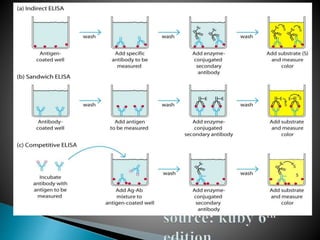
1. Indirect ELISA
2. Sandwich ELISA
3. Competitive ELISA
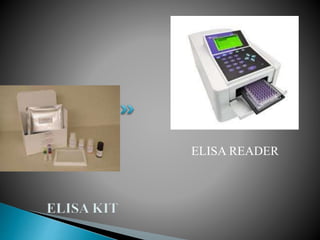
ELISA READER
 Substrate used is known as chromogenic substrate.
 Enzymes used are
◦ ALP (p-nitro phenyl phosphate)
◦ Horse radish peroxidase (o-phenylene diammine
dihydrochloride)
◦ β galactosidase
 This method can determine the antibody quantitatively.
 Procedure
◦ Serum containing primary Ab is added to an antigen
coated microtiter well and is allowed to react with the
antigen attached to the well.
◦ The specific enzyme- conjugated secondary Ab is added
which will then detect the primary Ab that was bound to
the antigen.
◦ Then a substrate is added which forms a colored
reaction product.
 This method can detect the antigen present.
 Procedure:
 Serum containing antigen is added and allowed to react with
the immobilized Ab bound on the microwell.
 Enzyme conjugated secondary antibody specific for the antigen
is added and is allowed to react with the bound antigen.
 Substrate is added and the colored reaction product formed is
measured.
 This method can detect the antigen present.
 Procedure:
 Ab incubated with the sample containing antigen.
 Antigen – antibody mixture is then added to an antigen coated
microtiter well.
 Enzyme conjugated secondary antibody specific for the primary
antibody can be used to determine the primary antibody bound to
the well.
 Substrate is added and the color reaction product is formed which
can be measured.
 Higher the con. of Ag in serum, lower will be the absorbance.
 Cut off value is the value which checks whether the
sample has to be considered as positive or not.
 It is calculated as
=mean value + 3 x (S.D) + 10%
 Cut off value in ELISA is
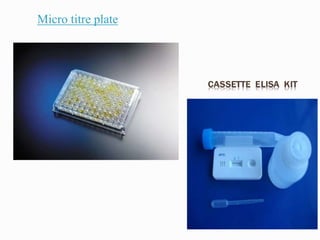
Micro titre plate
 Sensitive
 Highly specific
 Readings can be documented
 Economic
 Easy to perform
 Indirect ELISA
◦ HIV antibodies
◦ HCV antibodies
◦ Leptospira antibodies
◦ Dengue antibodies
◦ TORCH antibodies
 Sandwich ELISA
◦ HbsAg antigen
◦ P24 antigen
 Chemiluminescence Immuno Assay
Principle:
It is based on the principle by which the light emmission
from the excited singlet state occurs when the electron
returns to the ground state.
It involves the oxidation of an organic compound such as
luciferin , acridinium esters, isoluminol etc.
Chemiluminescence is the measurement of this energy
generated from the chemical
reaction (an oxidation reaction).
₋ Dispense the stds, samples and controls into the appropriate
wells.
₋ Mix for 10 secs
₋ Dispense the enzyme conjugate reagent into each well.
₋ Mix gently for 30 secs.
₋ Incubate for 1 hour at RT.
₋ Remove the incubation mixture.
₋ Rinse the microtitre wells 5 times with wash buffer.
₋ Add the chemiluminscence substrate solution into each well.
₋ Gently mix and read the wells on the chemiluminscence
microwell reader.
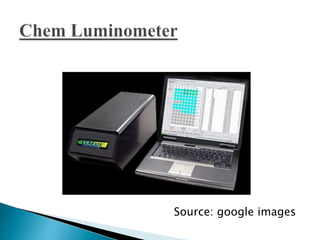
Source: google images
 Enzymes used:
◦ ALP
◦ Horse radish peroxidase
 Metal ions
◦ Cu(II)
◦ Fe(III)
◦ hemin
 CLIA detection using microplate luminometers provides
◦ A more sensitive ,
◦ higher throughput and
◦ economical alternative
to conventional calorimetric methods like ELISA.
 In CLIA, unlike ELISA the chromogenic substrate is
replaced by the use of a luxogenic substrate.
Eg. Oxidation of a compound luminol by H2O2 and the enzyme
horse radish peroxidase (HRP) when used will produce a
relatively long lived light emission. It can be measured using a
luminometer.
Miniminal sensitivity of test is 0.5ng/ml.
 Chemiluminescence in clinical immunology for the study of;
autoimmune diseases,
 inflammatory responses,
endocrine disorders,
 immunodeficiency's states,
 It has been applied in a wide variety of techniques including:
immunoassays,
protein blotting,
toxicological and pharmacological tests
 History:
This technique was implemented by a scientist by name,
Albert Coons in the year 1944.
 Principle:
Based on the principle that fluroscent molecules can
absorb light of one wavelength(excitation) and emit
light of another wavelength(emission). Fluorescence is a
property where light is absorbed and remitted within a
few nanoseconds (approx. 10ns) at a lower energy.
 It is a type of antigen–antibody reaction using
fluroscent dyes observed using a fluroscent
microscope.
 Fluroscent dyes are special dyes that can absorb the
rays of lower wavelength and emit the rays of higher.
 Commonly used dyes are;
 Fluroscene isothiocyanate
 Lissamine rodamine
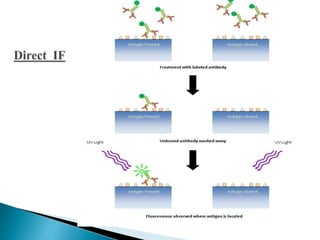
i) Primary (direct)
 It uses a single antibody that is chemically linked to a fluorophore.
 The antibody recognizes the target molecule and binds to it, and the
fluorophore it carries can be detected via microscopy.
 This technique has several advantages over the secondary (or indirect) because
of the direct conjugation of the antibody to the fluorophore. This reduces the
number of steps in the staining procedure making the process faster and can
reduce background signal.
 However, since the number of fluorescent molecules that can be bound to the
primary antibody is limited, direct immunofluorescence is less sensitive than
indirect immunofluorescence.
(ii)Secondary( indirect):
 It uses two antibodies; the unlabeled first (primary) antibody
specifically binds the target molecule, and the secondary
antibody, which carries the fluorophore, recognises the primary
antibody and binds to it.
 Multiple secondary antibodies can bind a single primary
antibody. This provides signal amplification by increasing the
number of fluorophore molecules per antigen.
 This protocol is more complex and time consuming than the
primary (or direct), but it allows more flexibility because a
variety of different secondary antibodies and detection
techniques can be used for a given primary antibody.
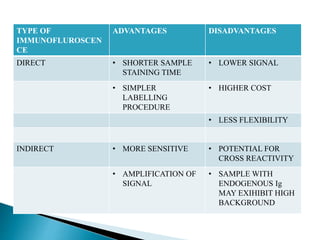
TYPE OF
IMMUNOFLUROSCEN
CE
ADVANTAGES DISADVANTAGES
DIRECT • SHORTER SAMPLE
STAINING TIME
• LOWER SIGNAL
• SIMPLER
LABELLING
PROCEDURE
• HIGHER COST
• LESS FLEXIBILITY
INDIRECT • MORE SENSITIVE • POTENTIAL FOR
CROSS REACTIVITY
• AMPLIFICATION OF
SIGNAL
• SAMPLE WITH
ENDOGENOUS Ig
MAY EXIHIBIT HIGH
BACKGROUND
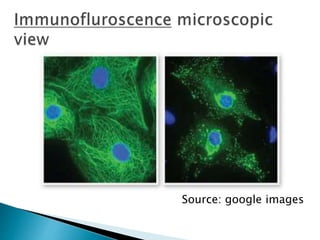
Source: google images
 Detection of rabies antigen (direct IF)
 Fluroscent Treponema Antibody test for syphilis-(indirect
IF)
 Analysis of antigen in fresh, frozen or fixed tissues.
 Detection of presence or absence of specific DNA
sequences on chromosomes.
 Defines the patterns of gene expression within the
cells/tissues.
1. Photo bleaching
2. Autofluroscence
3. Fluroscence overlap
 www.wikipedia.com
 Google images
 www.pubmed.com
 Text book on Medical Laboratory Technology
 Dr. Praful B Godkar
 Annual review of Medicine
◦ Introduction to chemiluminscence
 Text book of immunology
− Kuby

Antigen antibody interaction/Reaction

  • 1.
    Prabin Shah BScMLT,MSc(Biochemistry)
  • 2.
     When asoluble Ag combine with its Abs in the presence of electrolytes at a suitable temperature, pH, the Ag- Ab complex forms an insoluble precipitate.  Soluble Ags interact with Abs to form lattice.  Occurs best when Ag and Ab are present in optimal proportions.
  • 5.
     Polyclonal antibodiescan form lattices or large aggregates however monoclonal antibody can link only two molecules of antigen and no precipitate is formed.  The amount of precipitate formed is greatly influenced by the relative proportions of Ags and Abs.  Precipitation curve: ◦ Zone of antibody excess: precipitation is inhibited and ANTIBODY NOT BOUND TO Ag can be detected in the supernatant. This is also called as Prozone
  • 6.
    ◦ Zone ofEquivalence: maximal precipitation in which Ab and Ag form large insoluble complexes and neither antibody nor AG can be detected in the supernatant. ◦ Zone of Ag Excess: precipitation is inhibited and Ag not bound the Ab can be detected in the supernatant. This is also known as Post zone.
  • 8.
     Multivalent Agcombines with bivalent Ab in varying proportions, depending on the Ag and Ab ratio in the reacting mixture.  Precipitation results when a large lattice is formed consisting of alternating antigen and Ab molecule. This is possible only in the zone of equivalence.  In the zone of Ag- Ab excess, the lattice does not enlarge as the valencies of the Ab and the Ag are fully satisfied.
  • 9.
     Ring test Slide test  Tube test  Immunodiffusion  Electroimmnunodiffusion
  • 10.
    A) Ring Test Consist of layering the Ag solution over a column of antiserum in narrow tube.  A ppt is form at the junction of two liquids.  Eg: Ascoli’s thermo precipitin test, Lancefield grouping of streptococci. B) Slide test  A drop of Ag and the antiserum are placed on a slide and mixes by shaking, floccules appear. Eg: VDRL test for syphilis is an example of slide flocculation.
  • 11.
    C) Tube test A quantitative tube flocculation test is used for the standardization of toxins and toxoids.  Serial dilution of the toxin/toxoid are added to the tubes containing a fixed quantity of the antitoxin  The amount of toxin or toxoid that flocculates optimally with one unit of the antitoxin is defined as an Lf dose  Example: Kahn Test for syphilis is an example of tube flocculation test
  • 12.
    D). Immunodiffusion Test Precipitation test is done in gel.  Immunodiffusion procedure are carried out in an agar or agarose gel  The precipitate is easily seen in gel yield precipitin lines
  • 13.
    i) Single diffusionin one dimension  The Ab is incorporated in agar gel in a test tube and the Ag solution is layer over it.  The Ag diffuses downward through the agar gel, forming a line of precipitation that appears to move downwards.  This is due to the precipitation formed at the advancing front of the Ag and is dissolved as the concentration of Ag at the site increases due to diffusion.  The no of bands indicate the no of different Ag present.
  • 14.
    ii). Double diffusionin One dimension (Oakley- fulthorpe procedure)  Ab is incorporated in a gel above which is placed a column of plain agar. The Ag is layered on top of this.  The Ag and Ab move towards each other through the intervening column of plain agar and form a band of precipitate where they meet at optimum proportion.
  • 15.
    iii). Single diffusionin two dimension( Radial immunodiffusion)  The antiserum is incorporated in agar gel poured on a flat surface.  The Ag is added to the wells cut on the surface of the gel. It diffuses radially from the well and forms ring- shaped bands of precipitation concentrically around the well.  This method has been employed for the estimation of the immunoglobulin classes in sera.
  • 17.
    iv) Double diffusionin two dimensions  Agar gel is poured on a slide and wells are cut using a template.  The antiserum is placed in the central well and different Ags in the surrounding well.  If two adjacent Ags are identical. The lines of precipitate form by them will fuse. If they are unrelated, the lines will cross each other.
  • 19.
    v) Immunoelectrophoresis:  Thistechnique involves the electrophoretic separation of a composite Ag (such as serum) into its constituent proteins followed by immunodiffusion against its antiserum resulting in separate precipitin lines, indicating reaction between each individual protein with its antibody.  It is performed on agar or agarose gel on a slide with an Ag well and Ab trough cut on it.  The test serum is placed in the antigen well and electrophoresed for about an hour. Ab against human serum is then placed in the trough and diffusion allowed to proceed for 18-24 hrs.  The resulting precipitin lines can be photographed and the slides dried, stained and preserved for record.  This is used for testing normal and abnormal proteins in serum and urine
  • 20.
    Plasma (mixture ofantigens) Electrophoresis Antiserum (mixture of antibodies) Immunodiffusion
  • 21.
    E) Electroimmunodiffusion  Thedevelopment of precipitin can be speeded up by electrically driving the antigen and Ab. Two most frequently technique used in the lab are: i) Counterimmunoelectrophoresis ii) Rocket electrophoresis
  • 22.
    i) Counterimmunoelectrophoresis  Itinvolves simultaneous electrophoresis of the Ab in gel in opposite directions resulting in precipitation at a point between them  Produces visible precipitation line within 30 mins and is ten times more sensitive than the standard double diffusion techniques  Used for the detection of alpha- fetoprotein in serum and specific Ags of Cryptococcus and N. meningitidis in the CSF.
  • 23.
    ii) Rocket- electrophoresis The antiserum to the Ag to be quantified is incorporated in agarose and gelled on the glass slide.  The Ag in increase concentration, is placed in wells in the set gel. The Ag is then electrophoresed into the Ab containing agarose .  The pattern of immunoprecipitation resembles a rocket and hence the name.  Application- it is used for quantitative estimation of Ags
  • 24.
     Particulate Ag+ its Antibody Electrolytes and suitable temp. And pH Particles clumped / agglutinated
  • 25.
     Same principlegovern agglutination and precipitation reaction  Zone phenomenon is also seen in agglutination.  Incomplete or monovalent Abs do not cause agglutination, though they combine with Ag. They act as blocking Abs.  More sensitive than precipitation for detection of Abs.
  • 26.
    A) Slide Agglutination when a drop of the appropriate anti serum is added to a smooth uniform suspension of a particulate Ag in a drop of saline on a slide, agglutination take place. Clumping of Ag and clearing of suspension  Uses: ◦ Blood grouping and cross matching ◦ Confirmation of cultural isolates
  • 27.
    B) Tube Agglutination Standard quantitative method for measuring Abs  Titre estimated by: A fixed volume of a particulate Ag suspension is added to an equal volume of serial dilutions of antiserum in test tubes. Uses:  Diagnosis of : Typhoid (Widal test) Brucellosis
  • 28.
     Heterophile Agglutination ◦Based on sharing of a common Ag between different species. ◦ e.g. Weil- Felix reaction: common Ag between typhus Rickettsiae and strains of Proteus bacilli. Saifudheen etal. Ann Indian Acad Neurol 2012;15:141-4
  • 29.
    C) The Antiglobulintest  It was devised by Coombs, Mourant and Race (1945)  Detection of anti- Rh antibodies that do not agglutinate Rh- positive red cells in saline.  Used for the detection of incomplete Abs. PRINCIPLE:  When sera containing incomplete anti- Rh Abs are mixed with Rh- positive red cells , the Ab globulin coats the surface of the RBCs , though they are not agglutinated.
  • 30.
     When sucherythrocytes coated with the Ab globulin are washed off all unattached protein and treated with a rabbit antiserum against human gammaglobulin (antiglobulin or coombs serum) the cells are agglutinated.  The coombs test may be direct or indirect.
  • 33.
    D) Passive AgglutinationTest  Soluble Ag when attached to carrier particles, precipitation is converted to agglutination.  More sensitive and convenient for Ab detection.  Commonly used carrier are: 1. Red Blood Cells 2. Latex particles 3. Carbon particles 4. Bentonite
  • 34.
    Coagglutination Carrier molecule: ProteinA producing Staphylococcus aureus (Cowan I strain)
  • 35.
     In thepresence of the appropriate Abs complement ◦ Lyses erythrocytes ◦ Kills and in some cases lyses bacteria ◦ Immobilises motile organism ◦ Promotes phagocytosis and immune adherence. ◦ Contributes to tissue damage in certain types of hypersensitivity.  The ability of antigen- antibody complexes to fix complement is the basis of CFT.
  • 38.
     It isa very versatile and sensitive test.  Types of CFT- ◦ Wasserman reaction: used for serodiagnosis of syphilis ◦ Indirect complement fixation test ◦ Conglutinating complement adsorption ◦ Other complement- dependant serological tests.
  • 39.
    ANTIGEN + TEST SERUM (Containsantibody) + Complement + Haemolytic system ANTIGEN + TEST SERUM (contains no Ab) + complement + Hemolytic system Complement fixed Result- no haemolysis Positive CF test Complement not fixed Result- Hemolysis Negative of CF test
  • 40.
    2) Indirect complementfixation test  It is employed in cases of certain avian and mammalian sera which do not fix guinea pig complement.  The test is set up in duplicate and after the first step the standard serum known to fix the complement is added to one set.  If the test serum contained Ab the Ag would have been used up in the first step and therefore the standard antiserum added would not be fixed to the complement.  Therefore haemolysis indicates a positive result.
  • 41.
    INTRODUCTION:  Enzyme LinkedImmuno-Sorbent Assay  Term Was Coined By Engvall and Pearlmann in 1971  Similar To RIA, Except No Radiolabel  Can Be Used To Detect Both Antibody and Antigen
  • 42.
    Works on theprinciple of antigen – antibody reaction where an enzyme conjugated with an antibody reacts with a colorless substrate to give a colored reaction product.
  • 43.
    1. Indirect ELISA 2.Sandwich ELISA 3. Competitive ELISA
  • 44.
  • 45.
     Substrate usedis known as chromogenic substrate.  Enzymes used are ◦ ALP (p-nitro phenyl phosphate) ◦ Horse radish peroxidase (o-phenylene diammine dihydrochloride) ◦ β galactosidase
  • 46.
     This methodcan determine the antibody quantitatively.  Procedure ◦ Serum containing primary Ab is added to an antigen coated microtiter well and is allowed to react with the antigen attached to the well. ◦ The specific enzyme- conjugated secondary Ab is added which will then detect the primary Ab that was bound to the antigen. ◦ Then a substrate is added which forms a colored reaction product.
  • 47.
     This methodcan detect the antigen present.  Procedure:  Serum containing antigen is added and allowed to react with the immobilized Ab bound on the microwell.  Enzyme conjugated secondary antibody specific for the antigen is added and is allowed to react with the bound antigen.  Substrate is added and the colored reaction product formed is measured.
  • 48.
     This methodcan detect the antigen present.  Procedure:  Ab incubated with the sample containing antigen.  Antigen – antibody mixture is then added to an antigen coated microtiter well.  Enzyme conjugated secondary antibody specific for the primary antibody can be used to determine the primary antibody bound to the well.  Substrate is added and the color reaction product is formed which can be measured.  Higher the con. of Ag in serum, lower will be the absorbance.
  • 50.
     Cut offvalue is the value which checks whether the sample has to be considered as positive or not.  It is calculated as =mean value + 3 x (S.D) + 10%  Cut off value in ELISA is
  • 51.
  • 52.
     Sensitive  Highlyspecific  Readings can be documented  Economic  Easy to perform
  • 53.
     Indirect ELISA ◦HIV antibodies ◦ HCV antibodies ◦ Leptospira antibodies ◦ Dengue antibodies ◦ TORCH antibodies  Sandwich ELISA ◦ HbsAg antigen ◦ P24 antigen
  • 54.
     Chemiluminescence ImmunoAssay Principle: It is based on the principle by which the light emmission from the excited singlet state occurs when the electron returns to the ground state. It involves the oxidation of an organic compound such as luciferin , acridinium esters, isoluminol etc. Chemiluminescence is the measurement of this energy generated from the chemical reaction (an oxidation reaction).
  • 55.
    ₋ Dispense thestds, samples and controls into the appropriate wells. ₋ Mix for 10 secs ₋ Dispense the enzyme conjugate reagent into each well. ₋ Mix gently for 30 secs. ₋ Incubate for 1 hour at RT. ₋ Remove the incubation mixture. ₋ Rinse the microtitre wells 5 times with wash buffer. ₋ Add the chemiluminscence substrate solution into each well. ₋ Gently mix and read the wells on the chemiluminscence microwell reader.
  • 56.
  • 57.
     Enzymes used: ◦ALP ◦ Horse radish peroxidase  Metal ions ◦ Cu(II) ◦ Fe(III) ◦ hemin
  • 58.
     CLIA detectionusing microplate luminometers provides ◦ A more sensitive , ◦ higher throughput and ◦ economical alternative to conventional calorimetric methods like ELISA.  In CLIA, unlike ELISA the chromogenic substrate is replaced by the use of a luxogenic substrate. Eg. Oxidation of a compound luminol by H2O2 and the enzyme horse radish peroxidase (HRP) when used will produce a relatively long lived light emission. It can be measured using a luminometer. Miniminal sensitivity of test is 0.5ng/ml.
  • 59.
     Chemiluminescence inclinical immunology for the study of; autoimmune diseases,  inflammatory responses, endocrine disorders,  immunodeficiency's states,  It has been applied in a wide variety of techniques including: immunoassays, protein blotting, toxicological and pharmacological tests
  • 60.
     History: This techniquewas implemented by a scientist by name, Albert Coons in the year 1944.  Principle: Based on the principle that fluroscent molecules can absorb light of one wavelength(excitation) and emit light of another wavelength(emission). Fluorescence is a property where light is absorbed and remitted within a few nanoseconds (approx. 10ns) at a lower energy.
  • 61.
     It isa type of antigen–antibody reaction using fluroscent dyes observed using a fluroscent microscope.  Fluroscent dyes are special dyes that can absorb the rays of lower wavelength and emit the rays of higher.  Commonly used dyes are;  Fluroscene isothiocyanate  Lissamine rodamine
  • 62.
    i) Primary (direct) It uses a single antibody that is chemically linked to a fluorophore.  The antibody recognizes the target molecule and binds to it, and the fluorophore it carries can be detected via microscopy.  This technique has several advantages over the secondary (or indirect) because of the direct conjugation of the antibody to the fluorophore. This reduces the number of steps in the staining procedure making the process faster and can reduce background signal.  However, since the number of fluorescent molecules that can be bound to the primary antibody is limited, direct immunofluorescence is less sensitive than indirect immunofluorescence.
  • 64.
    (ii)Secondary( indirect):  Ituses two antibodies; the unlabeled first (primary) antibody specifically binds the target molecule, and the secondary antibody, which carries the fluorophore, recognises the primary antibody and binds to it.  Multiple secondary antibodies can bind a single primary antibody. This provides signal amplification by increasing the number of fluorophore molecules per antigen.  This protocol is more complex and time consuming than the primary (or direct), but it allows more flexibility because a variety of different secondary antibodies and detection techniques can be used for a given primary antibody.
  • 65.
    TYPE OF IMMUNOFLUROSCEN CE ADVANTAGES DISADVANTAGES DIRECT• SHORTER SAMPLE STAINING TIME • LOWER SIGNAL • SIMPLER LABELLING PROCEDURE • HIGHER COST • LESS FLEXIBILITY INDIRECT • MORE SENSITIVE • POTENTIAL FOR CROSS REACTIVITY • AMPLIFICATION OF SIGNAL • SAMPLE WITH ENDOGENOUS Ig MAY EXIHIBIT HIGH BACKGROUND
  • 66.
  • 67.
     Detection ofrabies antigen (direct IF)  Fluroscent Treponema Antibody test for syphilis-(indirect IF)  Analysis of antigen in fresh, frozen or fixed tissues.  Detection of presence or absence of specific DNA sequences on chromosomes.  Defines the patterns of gene expression within the cells/tissues.
  • 68.
    1. Photo bleaching 2.Autofluroscence 3. Fluroscence overlap
  • 69.
     www.wikipedia.com  Googleimages  www.pubmed.com  Text book on Medical Laboratory Technology  Dr. Praful B Godkar  Annual review of Medicine ◦ Introduction to chemiluminscence  Text book of immunology − Kuby