Ant Colony Optimization (ACO)
DR. AHMED FOUAD ALI
FACULTY OF COMPUTERS AND INFORMATICS
SUEZ CANAL UNIVERSITY
Outline
1. Ant colony optimization (ACO)(Main idea)
2. History of ACO
3. ACO parameters definitions
5. ACO Algorithm
6. Advantage / disadvantage
7. References
4. Ant colony optimization (ACO)
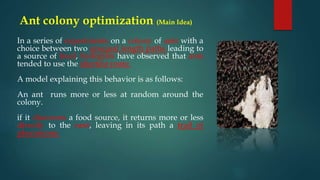
Ant colony optimization (Main Idea)
In a series of experiments on a colony of ants with a
choice between two unequal length paths leading to
a source of food, biologists have observed that ants
tended to use the shortest route.
A model explaining this behavior is as follows:
An ant runs more or less at random around the
colony.
if it discovers a food source, it returns more or less
directly to the nest, leaving in its path a trail of
pheromone.
Ant colony optimization (Main Idea)
These pheromones are attractive, nearby ants will
be inclined to follow, more or less directly, the
track.
Returning to the colony, these ants will strengthen
the route.
If two routes are possible to reach the same food
source, the shorter one will be, in the same time,
traveled by more ants than the long route will.
The short route will be increasingly enhanced,
and the
long route will eventually disappear, pheromones
are volatile.
History of ACO
First proposed by M. Dorigo, 1992.
Heuristic optimization method inspired by
biological systems.
Population based algorithm for solving difficult
combinatorial optimization problems.
Traveling Salesman, vehicle routing, sequential
ordering, graph coloring, routing in communications
networks
Ant behavior is a kind of stochastic distributed
optimization behavior
ACO parameters definitions
Stigmergy
a term coined by French biologist Pierre-Paul
Grasse, is interaction through the environment.
Two individuals interact indirectly when one
of them modifies the environment and the
other responds to the new environment at a
later time.
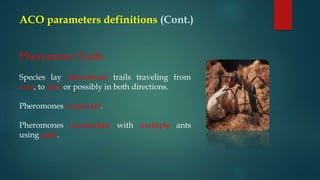
ACO parameters definitions (Cont.)
Pheromone Trails
Species lay pheromone trails traveling from
nest, to nest or possibly in both directions.
Pheromones evaporate.
Pheromones accumulate with multiple ants
using path.
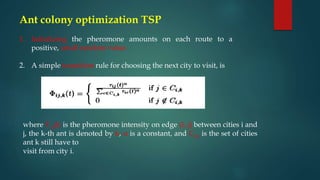
Ant colony optimization TSP
1. Initializing the pheromone amounts on each route to a
positive, small random value.
2. A simple transition rule for choosing the next city to visit, is
where Ti j(t) is the pheromone intensity on edge (i, j) between cities i and
j, the k-th ant is denoted by k, α is a constant, and Ci,k is the set of cities
ant k still have to
visit from city i.
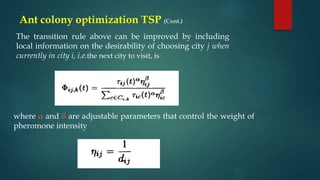
Ant colony optimization TSP (Cont.)
The transition rule above can be improved by including
local information on the desirability of choosing city j when
currently in city i, i.e.the next city to visit, is
where α and ß are adjustable parameters that control the weight of
pheromone intensity
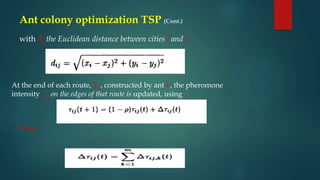
with dij the Euclidean distance between cities i and j
At the end of each route, Tk, constructed by ant k, the pheromone
intensity Tij on the edges of that route is updated, using
Where
Ant colony optimization TSP (Cont.)
The parameter Q has a value of the same order of the length of the optimal
route, Lk(t) is the length of the route traveled by ant k, and m is the
total number of ants.
The constant p ϵ [0,1], is referred to as the forgetting factor, which
models the evaporation over time of pheromone deposits.
Ant colony optimization TSP (Cont.)
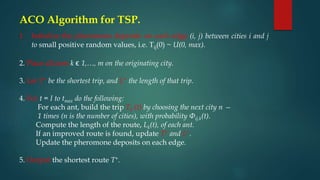
ACO Algorithm for TSP.
1. Initialize the pheromone deposits on each edge (i, j) between cities i and j
to small positive random values, i.e. Tij(0) ~ U(0, max).
2. Place all ants k ϵ 1,…, m on the originating city.
3. Let T+ be the shortest trip, and L+ the length of that trip.
4. For t = I to tmax do the following:
For each ant, build the trip Tk (t) by choosing the next city n —
1 times (n is the number of cities), with probability Фij,k(t).
Compute the length of the route, Lk(t), of each ant.
If an improved route is found, update T+ and L+.
Update the pheromone deposits on each edge.
5. Output the shortest route T+.
Advantage / disadvantage
Advantage:
•Retains memory of entire colony instead of previous
generation only.
•Less affected by poor initial solutions (due to
combination of random path selection and colony
memory).
•Has been applied to a wide variety of applications.
Advantage / disadvantage (Cont.)
Disadvantage:
•Theoretical analysis is difficult:
Due to sequences of random decisions (not
independent).
Probability distribution changes by iteration.
•Convergence is guaranteed, but time to convergence
uncertain.
•Coding is somewhat complicated, not straightforward
Pheromone “trail” additions/deletions, global updates and
local updates.
References
•Computational Intelligence An Introduction
Andries P. Engelbrecht, University of Pretoria South Africa
•Some slides adapted from a presentation
“Ant Colony Optimization. A metaheuristic approach to hard network optimization
problems”.
Particle Swarm Optimization
http://www.particleswarm.info/
http://www.swarmintelligence.org

Ant Colony Optimization(ACO) (Swarm intelligence)pptx

  • 1.
    Ant Colony Optimization(ACO) DR. AHMED FOUAD ALI FACULTY OF COMPUTERS AND INFORMATICS SUEZ CANAL UNIVERSITY
  • 2.
    Outline 1. Ant colonyoptimization (ACO)(Main idea) 2. History of ACO 3. ACO parameters definitions 5. ACO Algorithm 6. Advantage / disadvantage 7. References 4. Ant colony optimization (ACO)
  • 3.
    Ant colony optimization(Main Idea) In a series of experiments on a colony of ants with a choice between two unequal length paths leading to a source of food, biologists have observed that ants tended to use the shortest route. A model explaining this behavior is as follows: An ant runs more or less at random around the colony. if it discovers a food source, it returns more or less directly to the nest, leaving in its path a trail of pheromone.
  • 4.
    Ant colony optimization(Main Idea) These pheromones are attractive, nearby ants will be inclined to follow, more or less directly, the track. Returning to the colony, these ants will strengthen the route. If two routes are possible to reach the same food source, the shorter one will be, in the same time, traveled by more ants than the long route will. The short route will be increasingly enhanced, and the long route will eventually disappear, pheromones are volatile.
  • 5.
    History of ACO Firstproposed by M. Dorigo, 1992. Heuristic optimization method inspired by biological systems. Population based algorithm for solving difficult combinatorial optimization problems. Traveling Salesman, vehicle routing, sequential ordering, graph coloring, routing in communications networks Ant behavior is a kind of stochastic distributed optimization behavior
  • 6.
    ACO parameters definitions Stigmergy aterm coined by French biologist Pierre-Paul Grasse, is interaction through the environment. Two individuals interact indirectly when one of them modifies the environment and the other responds to the new environment at a later time.
  • 7.
    ACO parameters definitions(Cont.) Pheromone Trails Species lay pheromone trails traveling from nest, to nest or possibly in both directions. Pheromones evaporate. Pheromones accumulate with multiple ants using path.
  • 8.
    Ant colony optimizationTSP 1. Initializing the pheromone amounts on each route to a positive, small random value. 2. A simple transition rule for choosing the next city to visit, is where Ti j(t) is the pheromone intensity on edge (i, j) between cities i and j, the k-th ant is denoted by k, α is a constant, and Ci,k is the set of cities ant k still have to visit from city i.
  • 9.
    Ant colony optimizationTSP (Cont.) The transition rule above can be improved by including local information on the desirability of choosing city j when currently in city i, i.e.the next city to visit, is where α and ß are adjustable parameters that control the weight of pheromone intensity
  • 10.
    with dij theEuclidean distance between cities i and j At the end of each route, Tk, constructed by ant k, the pheromone intensity Tij on the edges of that route is updated, using Where Ant colony optimization TSP (Cont.)
  • 11.
    The parameter Qhas a value of the same order of the length of the optimal route, Lk(t) is the length of the route traveled by ant k, and m is the total number of ants. The constant p ϵ [0,1], is referred to as the forgetting factor, which models the evaporation over time of pheromone deposits. Ant colony optimization TSP (Cont.)
  • 12.
    ACO Algorithm forTSP. 1. Initialize the pheromone deposits on each edge (i, j) between cities i and j to small positive random values, i.e. Tij(0) ~ U(0, max). 2. Place all ants k ϵ 1,…, m on the originating city. 3. Let T+ be the shortest trip, and L+ the length of that trip. 4. For t = I to tmax do the following: For each ant, build the trip Tk (t) by choosing the next city n — 1 times (n is the number of cities), with probability Фij,k(t). Compute the length of the route, Lk(t), of each ant. If an improved route is found, update T+ and L+. Update the pheromone deposits on each edge. 5. Output the shortest route T+.
  • 13.
    Advantage / disadvantage Advantage: •Retainsmemory of entire colony instead of previous generation only. •Less affected by poor initial solutions (due to combination of random path selection and colony memory). •Has been applied to a wide variety of applications.
  • 14.
    Advantage / disadvantage(Cont.) Disadvantage: •Theoretical analysis is difficult: Due to sequences of random decisions (not independent). Probability distribution changes by iteration. •Convergence is guaranteed, but time to convergence uncertain. •Coding is somewhat complicated, not straightforward Pheromone “trail” additions/deletions, global updates and local updates.
  • 15.
    References •Computational Intelligence AnIntroduction Andries P. Engelbrecht, University of Pretoria South Africa •Some slides adapted from a presentation “Ant Colony Optimization. A metaheuristic approach to hard network optimization problems”. Particle Swarm Optimization http://www.particleswarm.info/ http://www.swarmintelligence.org