Flower pollination algorithm (FPA)
DR. AHMED FOUAD ALI
FACULTY OF COMPUTERS AND INFORMATICS
SUEZ CANAL UNIVERSITY
Outline
1. Flower pollination algorithm (History and main idea)
3. Flower pollination algorithm behavior
2. Characteristics of flower pollination
6. References
4. Flower pollination algorithm
5. Application of the flower pollination algorithm
Flower pollination algorithm (History and main idea)
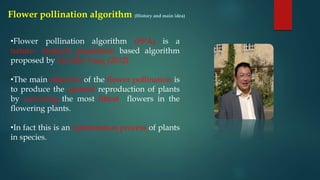
•Flower pollination algorithm (FPA) is a
nature- inspired population based algorithm
proposed by Xin-She Yang (2012).
•The main objective of the flower pollination is
to produce the optimal reproduction of plants
by surviving the most fittest flowers in the
flowering plants.
•In fact this is an optimization process of plants
in species.
Characteristics of flower pollination
•There are over a quarter of a million types
of flowering plants in Nature, 80% of them
are flowering species.
•The main purpose of a flower is ultimately
reproduction via pollination.
•Flower pollination process is associated
with the transfer of pollen by using
pollinators such as insects, birds, bats,...etc.
Characteristics of flower pollination (Cont.)
•There are two major process for transferring the pollen
Biotic and cross pollination process.
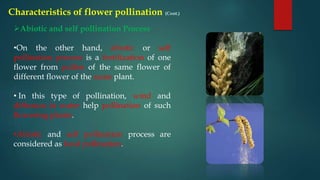
Abiotic and self pollination Process
Cross pollination process
Self pollination Process
Characteristics of flower pollination (Cont.)
Biotic and cross pollination process.
•Biotic pollination represents 90% of
flowering plants, while 10% of pollination
takes from abiotic process.
•In the biotic pollination, pollen is
transferred from one flower to other flower
in different plant by a pollinator such as
insects, birds, bats,…etc.
•Biotic, cross-pollination may occur at long
distance and they can considered as a global
pollination process with pollinators
performing Le'vy flights.
Characteristics of flower pollination (Cont.)
Abiotic and self pollination Process
•On the other hand, abiotic or self
pollination process is a fertilization of one
flower from pollen of the same flower of
different flower of the same plant.
• In this type of pollination, wind and
diffusion in water help pollination of such
flowering plants.
•Abiotic and self pollination process are
considered as local pollination.
Flower pollination algorithm
Population
initialization
Exploration
process
Exploitation
process
Solutions update
Flower pollination algorithm (Cont.)
Step 1. The algorithm starts by setting the initial
values of the most important parameters such as the
population size n, switch probability p and the
maximum number of generations MGN.
Step 2. The initial population xi, i = 1,…,n is generated
randomly and the fitness function of each solution
f(xi) in the population is evaluated by calculating its
corresponding objective function.
Step 3. The following steps are repeated until the
termination criterion satisfied, which is to reach the
desired number of generations MGN.
Flower pollination algorithm (Cont.)
Step 3.1. The global pollination process is started
by generating a random number r, where rϵ[0,1],
for each solution xi.
Step 3.2. If r < p, where p is a switch probability,
the new solution is generated by a Le'vy
distribution as follow.
Where L is a Le'vy flight, L > 0 and calculated as
follow.
• Γ(λ) is the standard gamma function and this
distribution is valid for large steps s > 0.
Step 3.3. Otherwise, the local pollination
process is started by generating a random
number ϵ, ϵ in [0,1] as follow
Where xi
t , xj
t are pollens (solutions) from the
different lowers of the same plant species. If xi
t ,
xj
t comes from the same species or selected from
the same population, this become a local
random walk.
Flower pollination algorithm (Cont.)
Step 3.4. Evaluate each solution xi
t+1 in
the population and update the solutions
in the population according to their
objective values.
Step 3.4. Rank the solutions and find the
current best solution g*.
Step 4. Produce the best found solution
so far.
Flower pollination algorithm (Cont.)
Application of the FP Algorithm
•Engineering optimization problems
•NP hard combinatorial optimization problems
•Data fusion in wireless sensor networks
•Nanoelectronic technology based operation-
amplifier
• (OP-AMP)
•Train neural network
•Manufacturing scheduling
•Nurse scheduling problem
References
Yang, X. S. (2012), Flower pollination algorithm for global
optimization, in: Unconventional Computation and Natural
Computation, Lecture Notes in Computer Science, Vol. 7445,
pp. 240-249.
The animated photos are taken from the following website
http://www.fs.fed.us/wildflowers/pollinators/index.shtml

Flower pollination algorithm (Population based algorithm)

  • 1.
    Flower pollination algorithm(FPA) DR. AHMED FOUAD ALI FACULTY OF COMPUTERS AND INFORMATICS SUEZ CANAL UNIVERSITY
  • 2.
    Outline 1. Flower pollinationalgorithm (History and main idea) 3. Flower pollination algorithm behavior 2. Characteristics of flower pollination 6. References 4. Flower pollination algorithm 5. Application of the flower pollination algorithm
  • 3.
    Flower pollination algorithm(History and main idea) •Flower pollination algorithm (FPA) is a nature- inspired population based algorithm proposed by Xin-She Yang (2012). •The main objective of the flower pollination is to produce the optimal reproduction of plants by surviving the most fittest flowers in the flowering plants. •In fact this is an optimization process of plants in species.
  • 4.
    Characteristics of flowerpollination •There are over a quarter of a million types of flowering plants in Nature, 80% of them are flowering species. •The main purpose of a flower is ultimately reproduction via pollination. •Flower pollination process is associated with the transfer of pollen by using pollinators such as insects, birds, bats,...etc.
  • 5.
    Characteristics of flowerpollination (Cont.) •There are two major process for transferring the pollen Biotic and cross pollination process. Abiotic and self pollination Process Cross pollination process Self pollination Process
  • 6.
    Characteristics of flowerpollination (Cont.) Biotic and cross pollination process. •Biotic pollination represents 90% of flowering plants, while 10% of pollination takes from abiotic process. •In the biotic pollination, pollen is transferred from one flower to other flower in different plant by a pollinator such as insects, birds, bats,…etc. •Biotic, cross-pollination may occur at long distance and they can considered as a global pollination process with pollinators performing Le'vy flights.
  • 7.
    Characteristics of flowerpollination (Cont.) Abiotic and self pollination Process •On the other hand, abiotic or self pollination process is a fertilization of one flower from pollen of the same flower of different flower of the same plant. • In this type of pollination, wind and diffusion in water help pollination of such flowering plants. •Abiotic and self pollination process are considered as local pollination.
  • 8.
  • 9.
    Flower pollination algorithm(Cont.) Step 1. The algorithm starts by setting the initial values of the most important parameters such as the population size n, switch probability p and the maximum number of generations MGN. Step 2. The initial population xi, i = 1,…,n is generated randomly and the fitness function of each solution f(xi) in the population is evaluated by calculating its corresponding objective function. Step 3. The following steps are repeated until the termination criterion satisfied, which is to reach the desired number of generations MGN.
  • 10.
    Flower pollination algorithm(Cont.) Step 3.1. The global pollination process is started by generating a random number r, where rϵ[0,1], for each solution xi. Step 3.2. If r < p, where p is a switch probability, the new solution is generated by a Le'vy distribution as follow. Where L is a Le'vy flight, L > 0 and calculated as follow.
  • 11.
    • Γ(λ) isthe standard gamma function and this distribution is valid for large steps s > 0. Step 3.3. Otherwise, the local pollination process is started by generating a random number ϵ, ϵ in [0,1] as follow Where xi t , xj t are pollens (solutions) from the different lowers of the same plant species. If xi t , xj t comes from the same species or selected from the same population, this become a local random walk. Flower pollination algorithm (Cont.)
  • 12.
    Step 3.4. Evaluateeach solution xi t+1 in the population and update the solutions in the population according to their objective values. Step 3.4. Rank the solutions and find the current best solution g*. Step 4. Produce the best found solution so far. Flower pollination algorithm (Cont.)
  • 13.
    Application of theFP Algorithm •Engineering optimization problems •NP hard combinatorial optimization problems •Data fusion in wireless sensor networks •Nanoelectronic technology based operation- amplifier • (OP-AMP) •Train neural network •Manufacturing scheduling •Nurse scheduling problem
  • 14.
    References Yang, X. S.(2012), Flower pollination algorithm for global optimization, in: Unconventional Computation and Natural Computation, Lecture Notes in Computer Science, Vol. 7445, pp. 240-249. The animated photos are taken from the following website http://www.fs.fed.us/wildflowers/pollinators/index.shtml