This document summarizes ant colony optimization (ACO), a metaheuristic optimization algorithm inspired by the behavior of ants. ACO uses a probabilistic technique where artificial ants indirectly communicate information about their environment via pheromone trails to collectively find optimal solutions. The algorithm involves ants probabilistically constructing solutions, updating pheromone trails based on solution quality, and repeating until convergence to an optimal solution is reached. ACO has been successfully applied to problems like the traveling salesman problem.
INTRODUCTION
It isa way to solve optimisation problems based
on the way that ants indirectly communicate
directions to each other.
Probabilistic technique.
Searching for optimal path in the graph based
on behaviour of ants seeking a path between
their colony and source of food.
Meta-heuristic optimization.
3.
OVERVIEW OF CONCEPTS
•Ants navigate from nest to food source. Ants are blind.
• Shortest path is discovered via pheromone trails.
• Each ant move at random.
• Pheromone is deposited on path.
• More pheromone on path increases probability of path being followed.
OVERVIEW OF SYSTEM
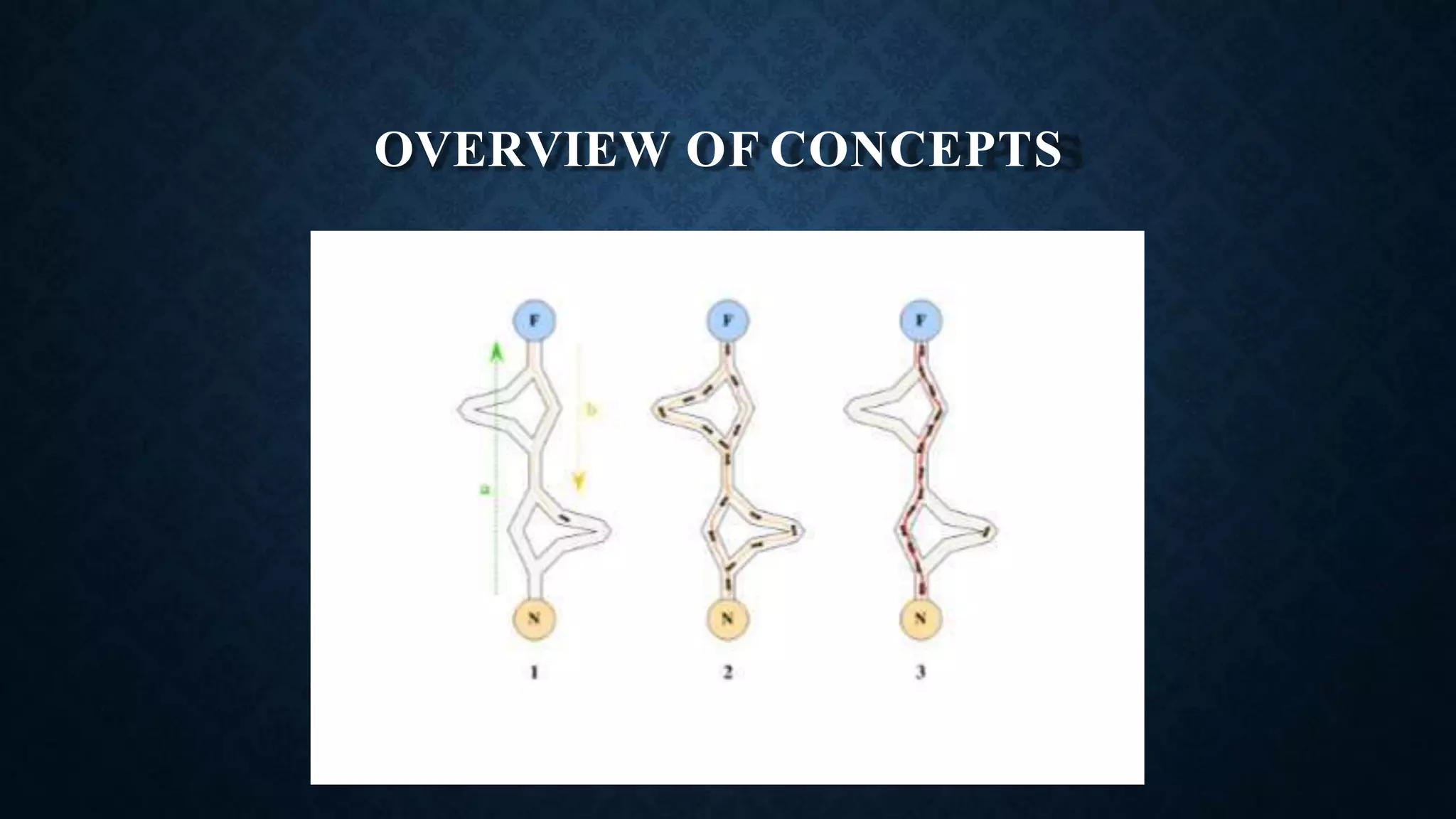
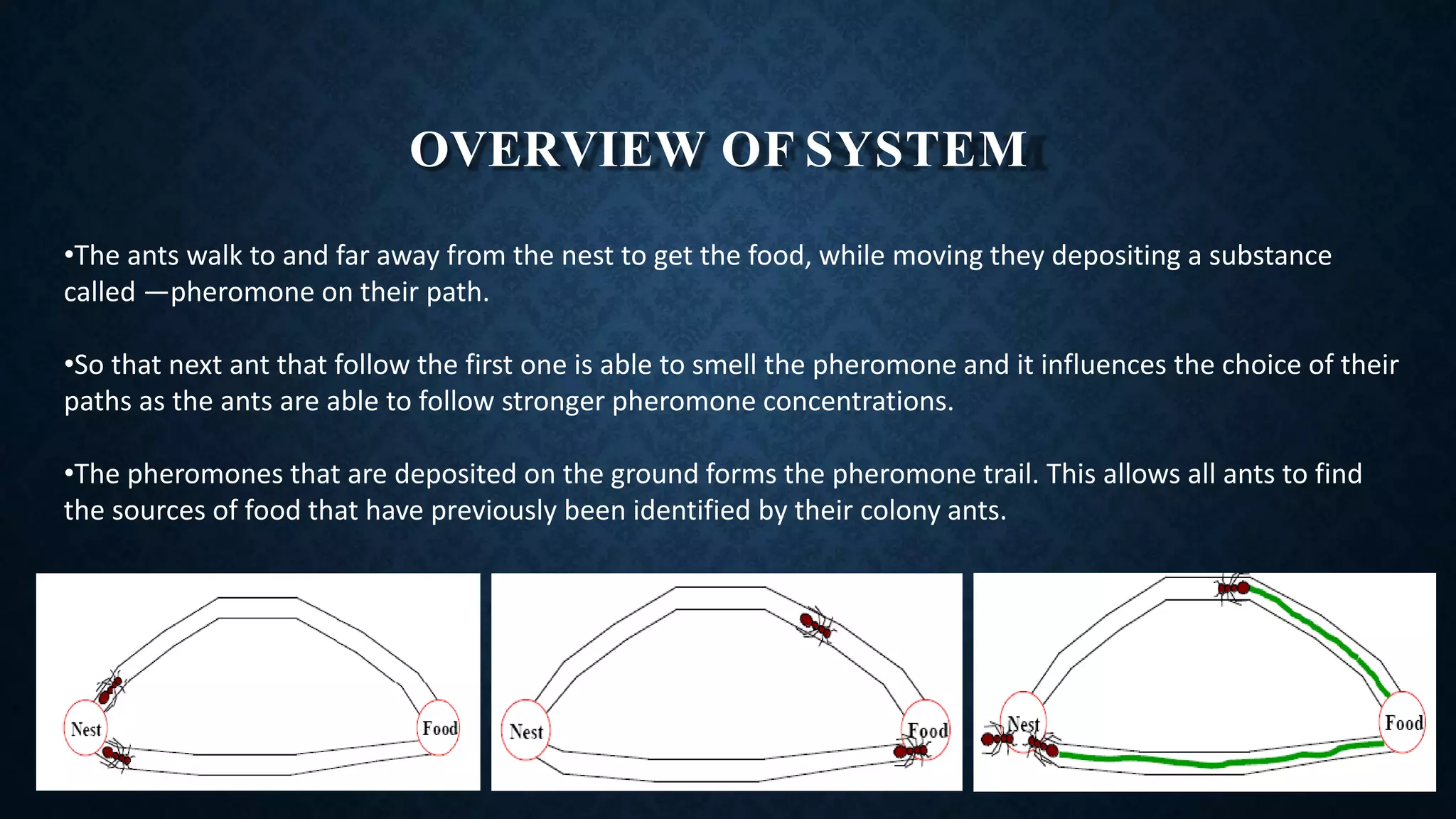
•Theants walk to and far away from the nest to get the food, while moving they depositing a substance
called ―pheromone on their path.
•So that next ant that follow the first one is able to smell the pheromone and it influences the choice of their
paths as the ants are able to follow stronger pheromone concentrations.
•The pheromones that are deposited on the ground forms the pheromone trail. This allows all ants to find
the sources of food that have previously been identified by their colony ants.
6.
OVERVIEW OF SYSTEM
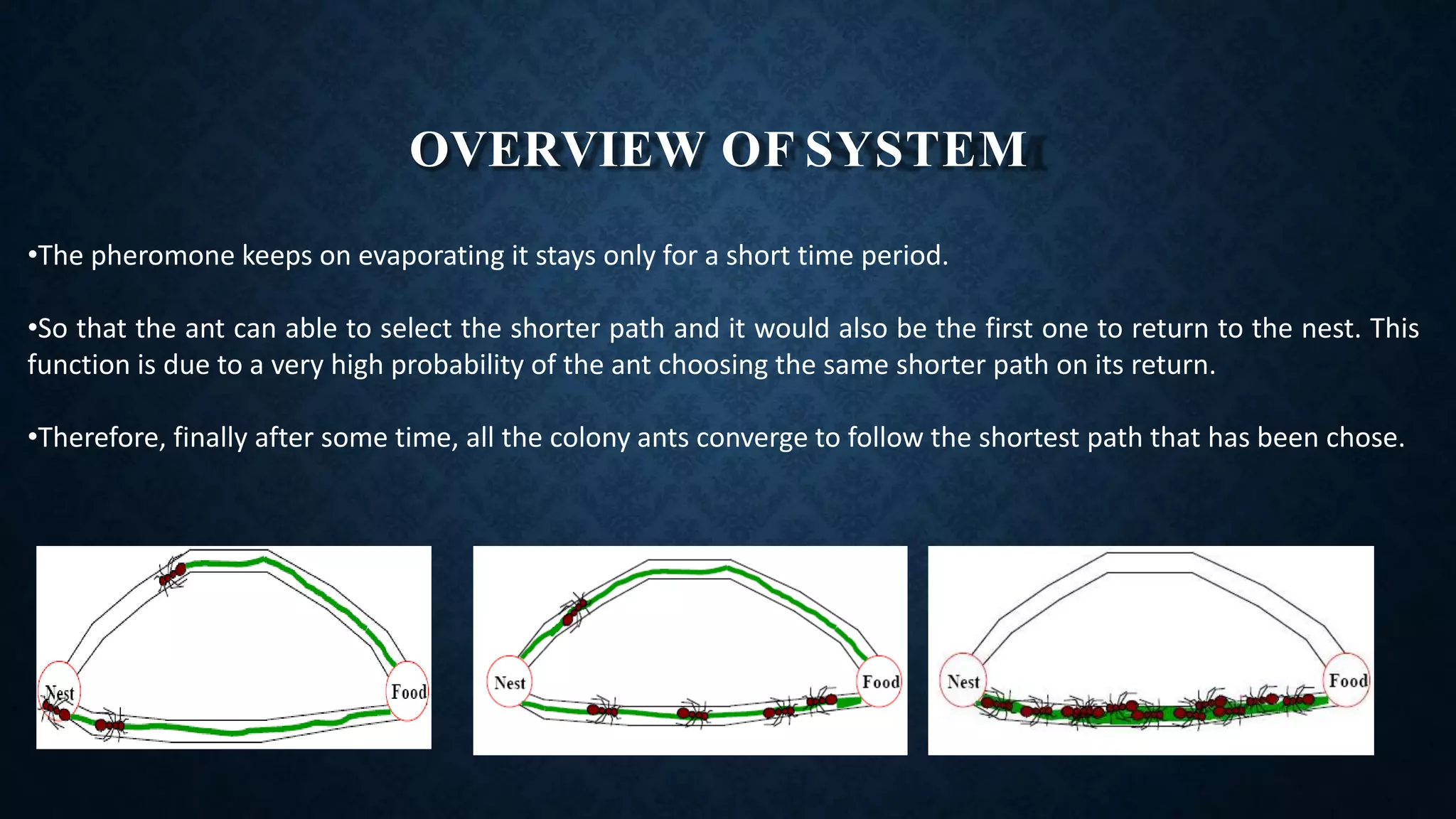
•Thepheromone keeps on evaporating it stays only for a short time period.
•So that the ant can able to select the shorter path and it would also be the first one to return to the nest. This
function is due to a very high probability of the ant choosing the same shorter path on its return.
•Therefore, finally after some time, all the colony ants converge to follow the shortest path that has been chose.
7.
META-HEURISTIC
• Heuristic methodfor solving a very general class of
computational problems by combining user-given
heuristics in the hope of obtaining a more efficient
procedure.
• ACO is meta-heuristic.
• Soft computing technique for solving hard discrete
optimization problems USES STIGMERGY AND SWARM
INTELIGENCE TO FIND THE DATA
8.
STIGMERGY
Self-organization in socialinsects often requires interactions among
insects: such interactions can be direct or indirect. Direct interactions
consist obviously and mainly of visual or chemical contacts,
trophallaxis, antennation between individuals. In the second possibility,
we speak about indirect inter- action between two individuals when
one of them modifies the environment and the other responds to the
new environment at a later time. Such an interaction is an example of
stigmergy.
9.
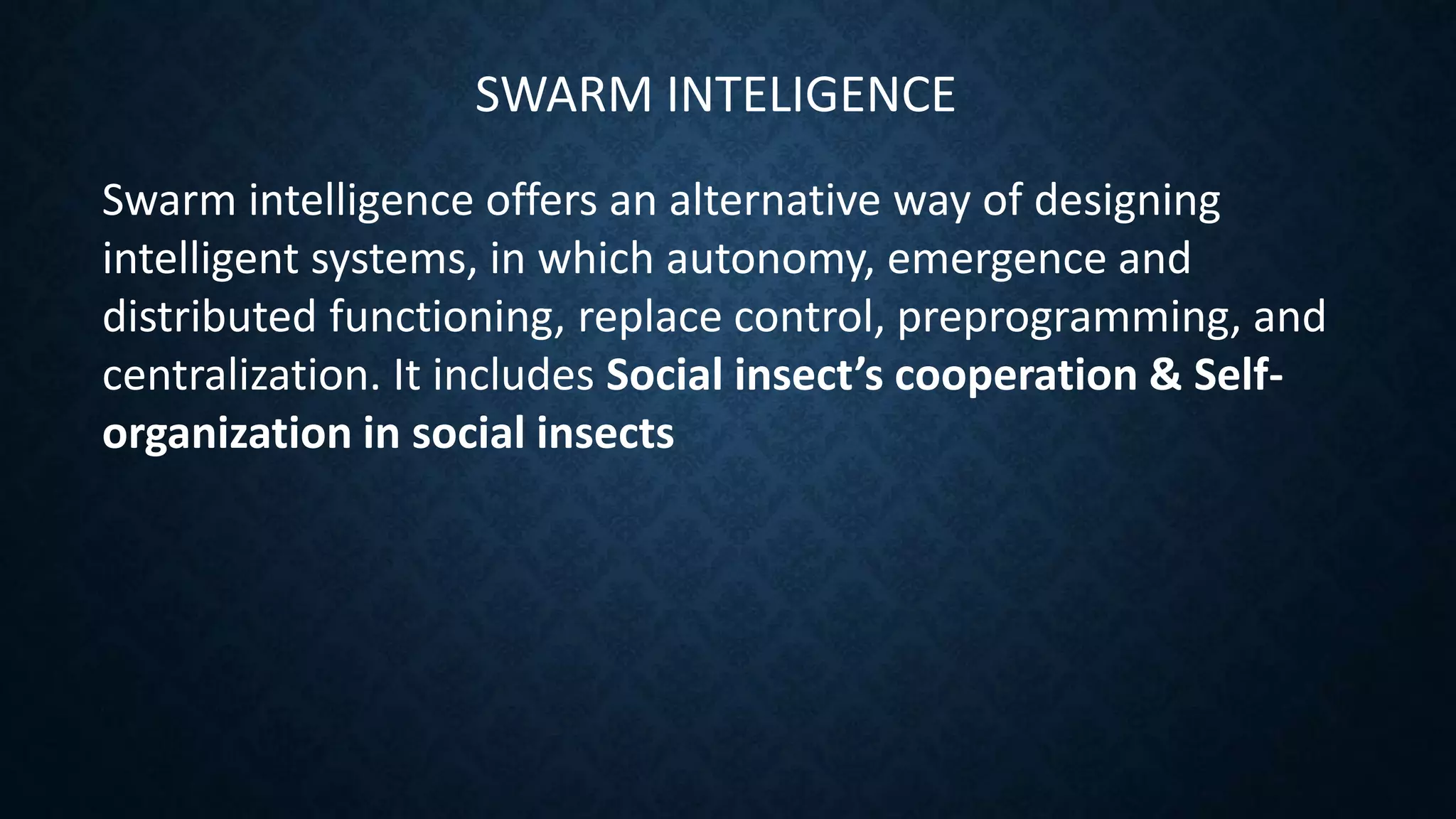
SWARM INTELIGENCE
Swarm intelligenceoffers an alternative way of designing
intelligent systems, in which autonomy, emergence and
distributed functioning, replace control, preprogramming, and
centralization. It includes Social insect’s cooperation & Self-
organization in social insects
10.
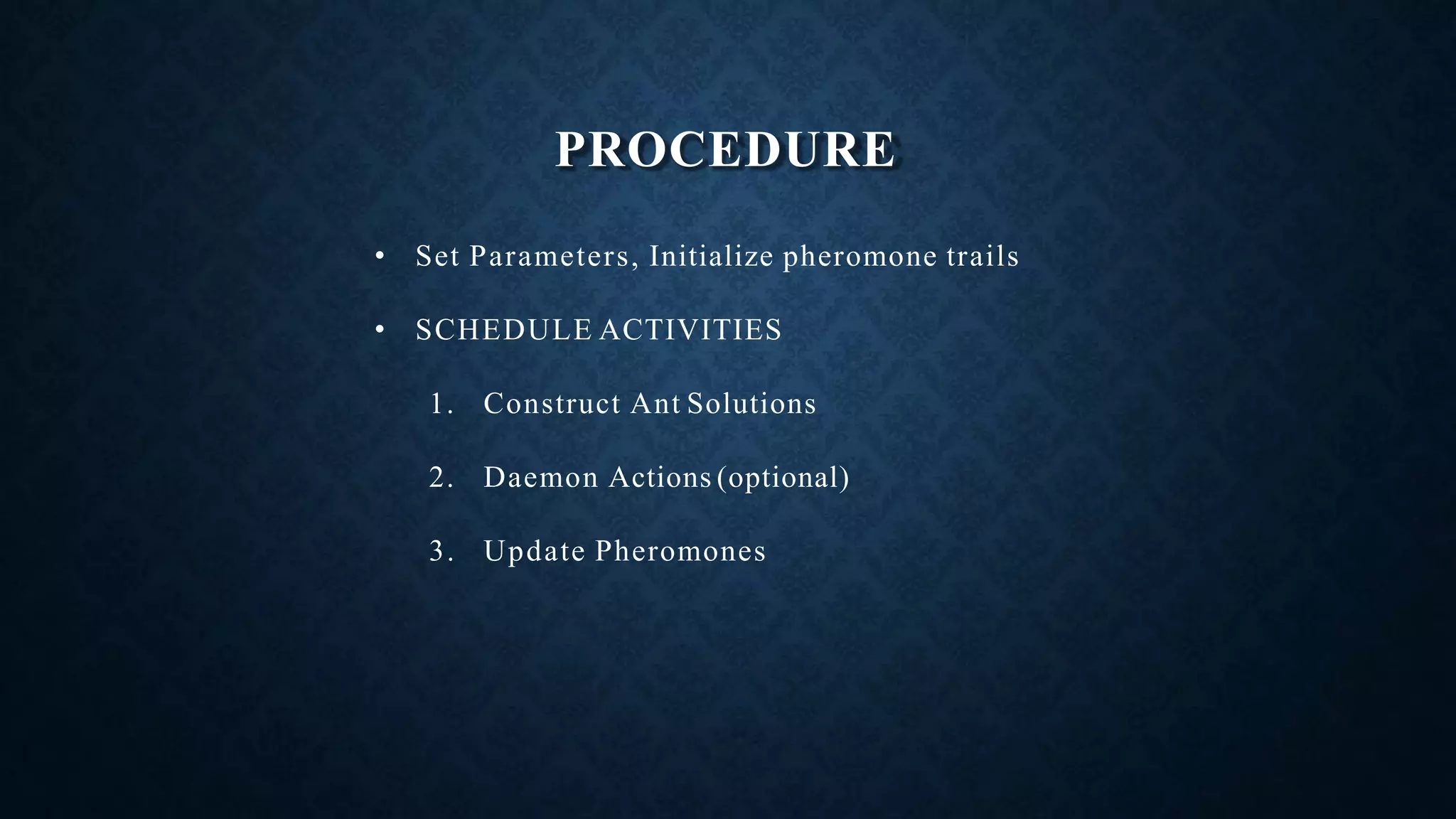
PROCEDURE
• Set Parameters,Initialize pheromone trails
• SCHEDULE ACTIVITIES
1. Construct Ant Solutions
2. Daemon Actions (optional)
3. Update Pheromones
11.
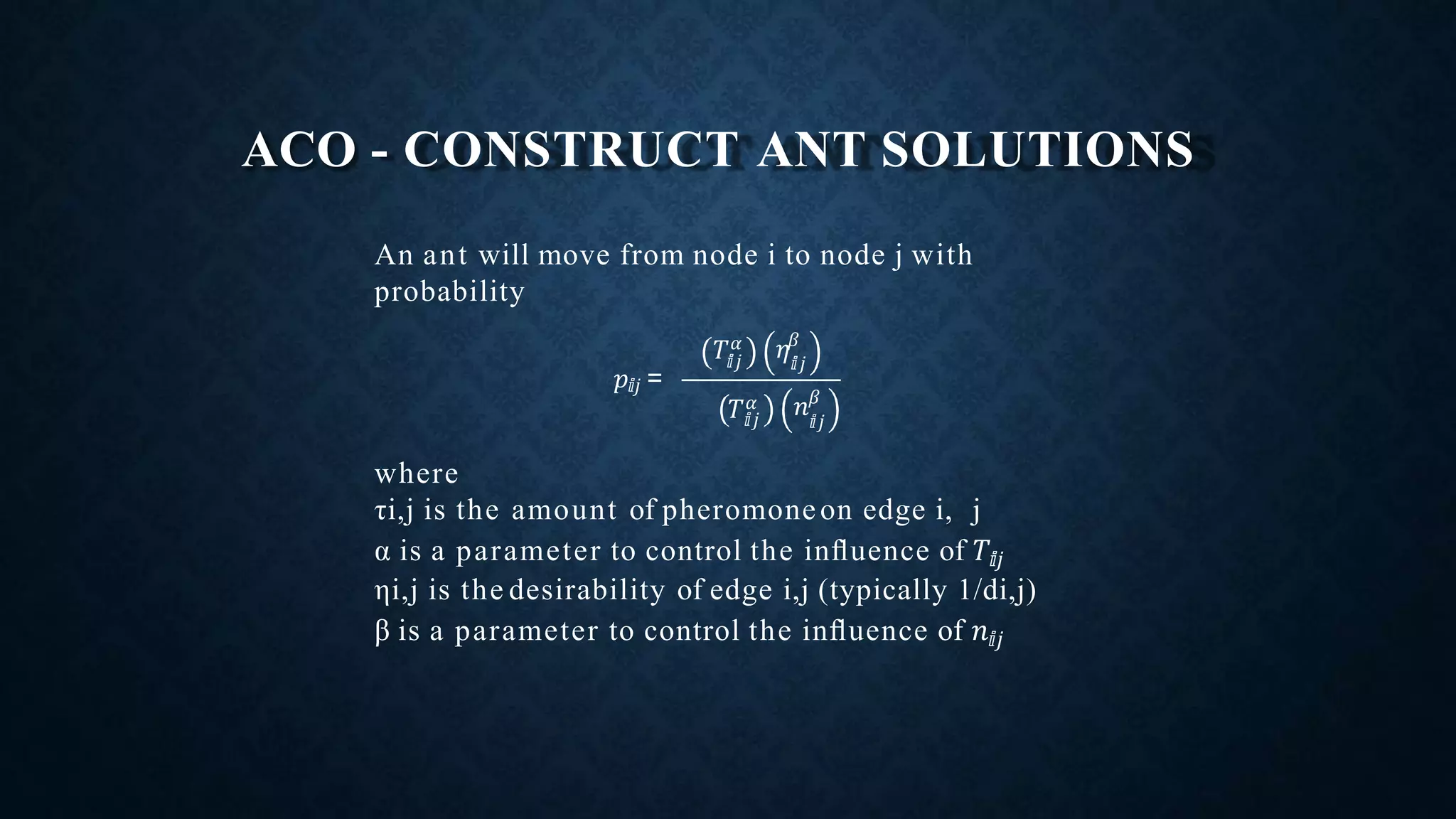
ACO - CONSTRUCTANT SOLUTIONS
An ant will move from node i to node j with
probability
where
τi,j is the amount of pheromoneon edge i, j
α is a parameter to control the influence of 𝑇ⅈ𝑗
ηi,j is the desirability of edge i,j (typically 1/di,j)
β is a parameter to control the influence of 𝑛ⅈ𝑗
𝑝ⅈ𝑗 =
ⅈ𝑗𝑇 𝛼
ⅈ𝑗
𝜂𝛽
ⅈ𝑗𝑇 𝛼
ⅈ𝑗
𝑛 𝛽
12.
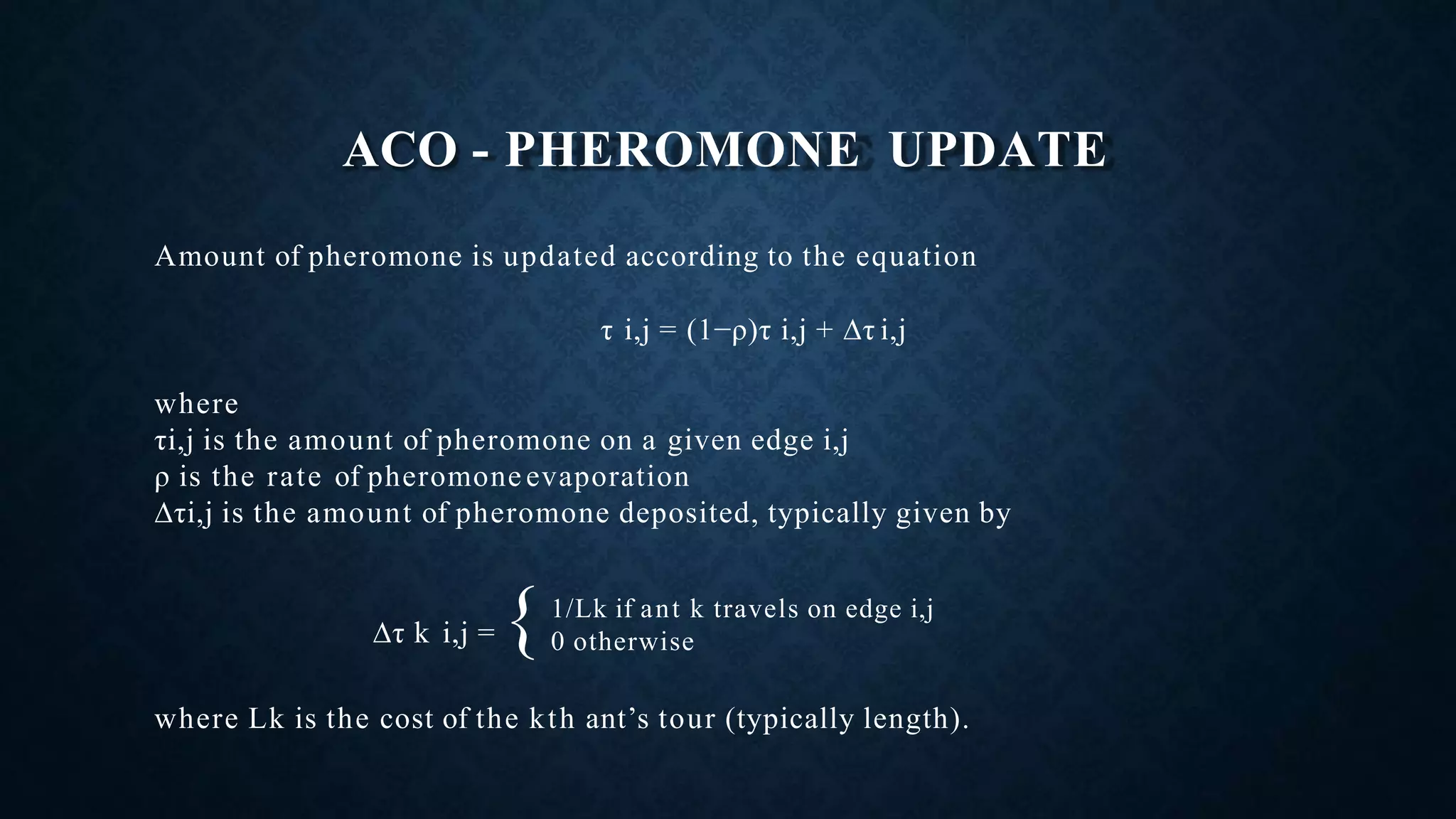
ACO - PHEROMONEUPDATE
Amount of pheromone is updated according to the equation
τ i,j = (1−ρ)τ i,j + ∆τ i,j
where
τi,j is the amount of pheromone on a given edge i,j
ρ is the rate of pheromone evaporation
∆τi,j is the amount of pheromone deposited, typically given by
∆τ k i,j = {
where Lk is the cost of the kth ant’s tour (typically length).
1/Lk if ant k travels on edge i,j
0 otherwise
13.
APPLICATIONS OF ACO
•Routing in telecommunication networks
• Traveling Salesman
• Graph Coloring
• Scheduling
• Constraint Satisfaction
14.
ADVANTAGES OF ACO
•Inherent parallelism
• Positive Feedback accounts for rapid discovery
of good solutions
• Efficient for Traveling Salesman Problem and
similar problems
• Can be used in dynamic applications (adapts to
changes such as new distances, etc.)
15.
DISADVANTAGES OF ACO
•Theoretical analysis is difficult
• Sequences of random decisions (not independent)
• Probability distribution changes byiteration
• Research is experimental rather than theoretical
• Time to convergence uncertain (but convergence is
gauranteed!)
16.
CONCLUSION
• Artificial Intelligencetechnique used to develop a new
method to solve problems unsolvable since last many years.
• ACO is a recently proposed metaheuristic approach for
solving hard combinatorial optimization problems.
• Artificial ants implement a randomized construction heuristic
which makes probabilistic decisions.
• ACO shows great performance with the “ill-structured”
problems like network routing.