A SIMPLE APPROACH TO THE DESIGN OF
LEXICAL ANALYZERS
Myself Archana R
Assistant Professor In
Department Of Computer Science
SACWC.
I am here because I love to give presentations.
Simple Approach
Construct a diagram that illustrates the structure of the tokens of the
source language , and then to hand-translate the diagram
the diagram into a program for finding tokens.
Notes:
Efficient lexical analyzers can be produced in this manner.
Simple Approaches To Implement A
Lexical Analyzer
Pattern-directed programming approach
 Pattern Matching technique.
 Specify and design program that execute actions triggered by
patterns in strings.
 Introduce a pattern-action language called Lexical for specifying
lexical analyzers .
 Patterns are specified by regular expressions .
 A compiler for Lexical can generate an efficient finite
automation recognizer for the regular expressions.
First phase of a compiler
1. Main task
- To read the input characters.
- To produce a sequence of tokens used by the parser for
syntax analysis.
- As an assistant of parser.
 Lexical analyzer
 Parser
 Symbol table
 Source program
 token
 Get next token
Interaction of lexical analyzer with parser
Processes in lexical analyzers
 Scanning
*Pre-processing
-Strip out comments and white space
-Macro functions
 Correlating error messages from compiler with source
program
*A line number can be associated with an error
message.
 Lexical analysis
Regular Expression & Regular language
 Regular Expression
A notation that allows us to define a pattern in a high
level language.
 Regular language
Each regular expression r denotes language L(r) (the
set of sentences relating to the regular expression r) .
Notes:
Each word in a program can be expressed in a regular
expression.
Specification of Tokens
1) The rule of regular expression over alphabet ∑
* ε is a regular expression that denote {ε}
ε is regular expression .
{ε} is the related regular language.
2) If a is a symbol in ∑, then a is a regular expression that
denotes {a}
a is regular expression .
{a} is the related regular language.
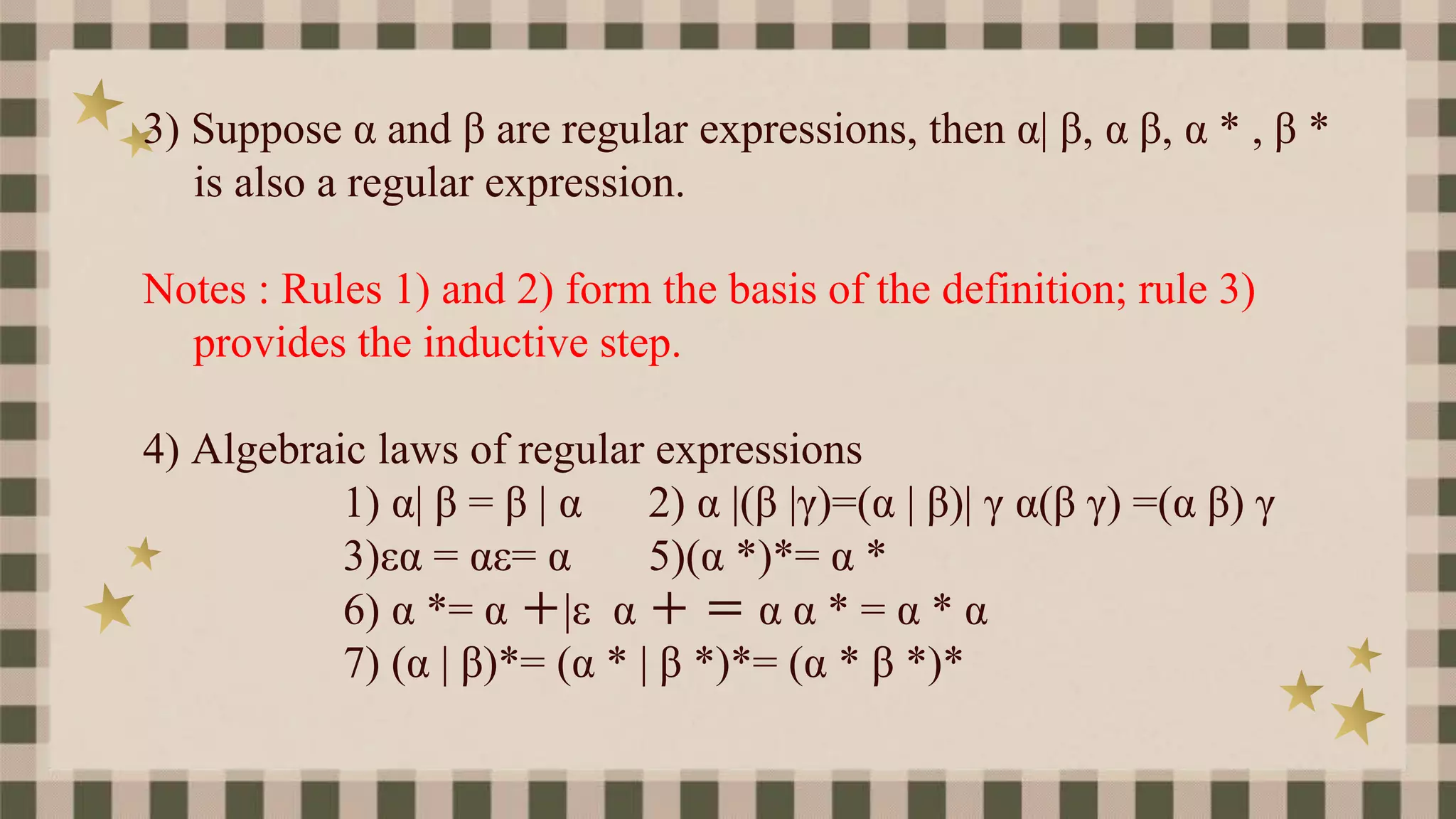
3) Suppose α and β are regular expressions, then α| β, α β, α * , β *
is also a regular expression.
Notes : Rules 1) and 2) form the basis of the definition; rule 3)
provides the inductive step.
4) Algebraic laws of regular expressions
1) α| β = β | α 2) α |(β |γ)=(α | β)| γ α(β γ) =(α β) γ
3)εα = αε= α 5)(α *)*= α *
6) α *= α +|ε α + = α α * = α * α
7) (α | β)*= (α * | β *)*= (α * β *)*
Notational Short-hands
a)One or more instances
( r ) digit+
b)Zero or one instance
r? is a shorthand for r| (E(+|-)?digits)?
c)Character classes
[a-z] denotes a|b|c|…|z
[A-Za-z] [A-Za-z0-9]
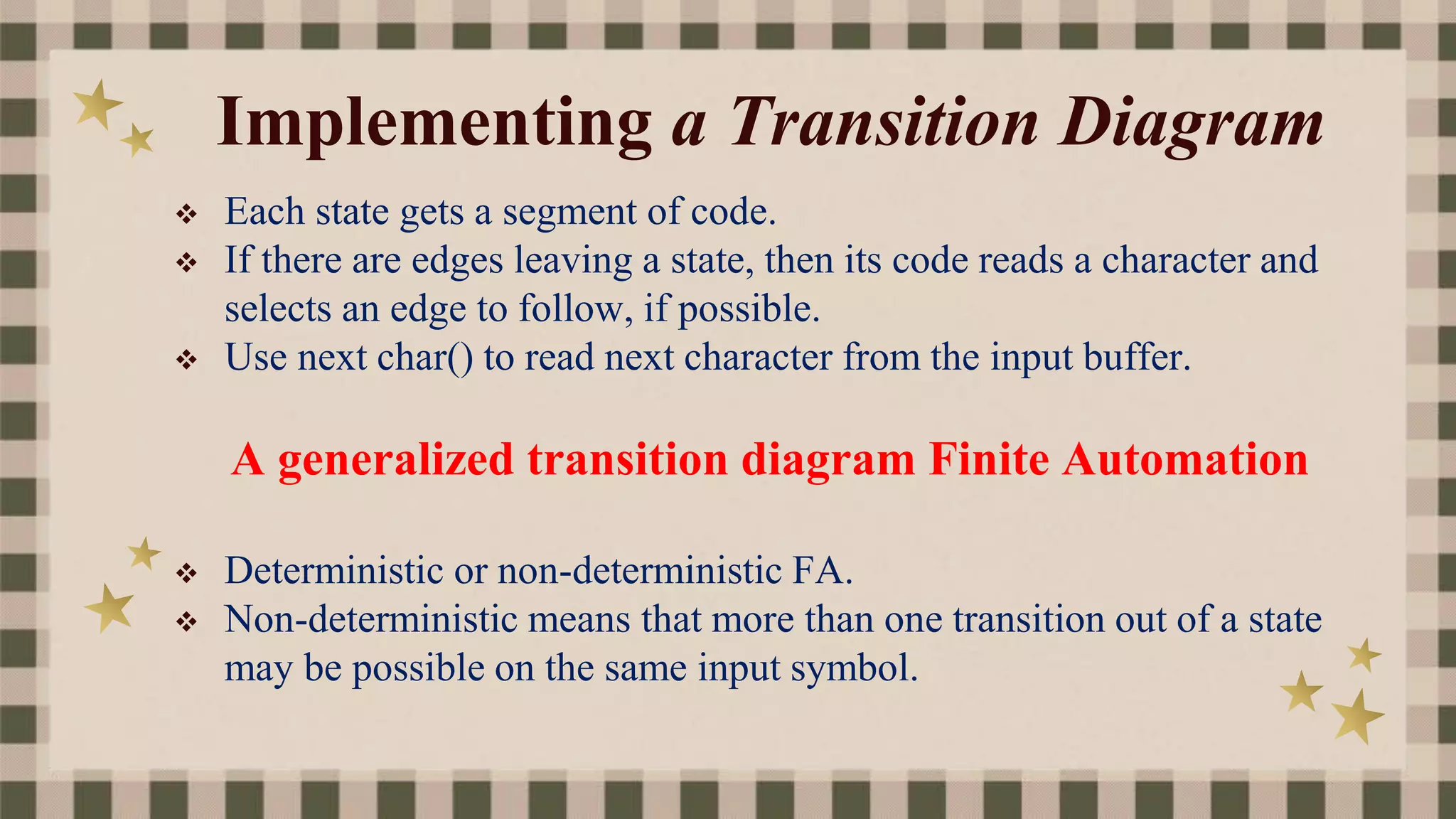
Implementing a Transition Diagram
 Each state gets a segment of code.
 If there are edges leaving a state, then its code reads a character and
selects an edge to follow, if possible.
 Use next char() to read next character from the input buffer.
A generalized transition diagram Finite Automation
 Deterministic or non-deterministic FA.
 Non-deterministic means that more than one transition out of a state
may be possible on the same input symbol.
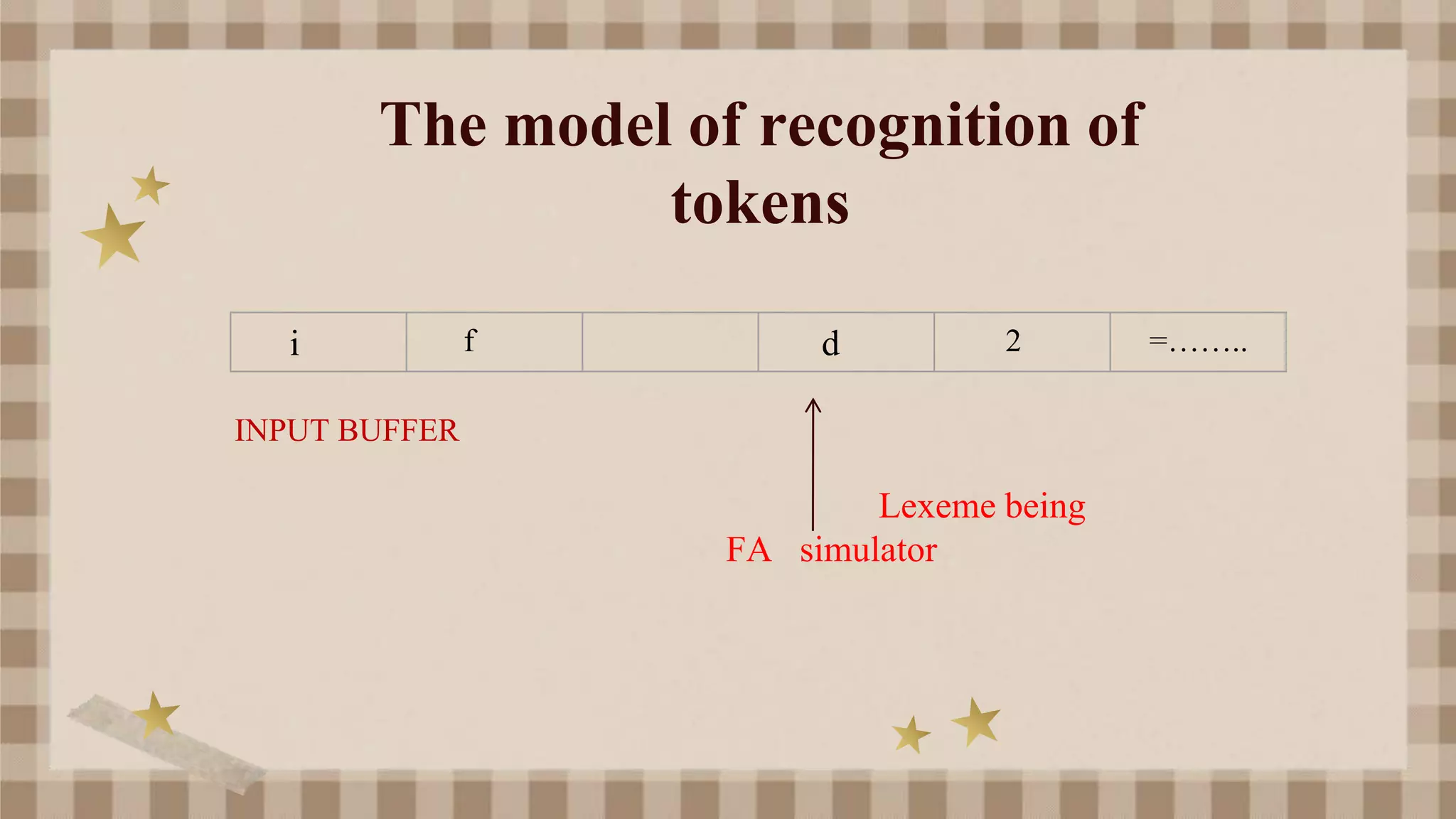
The model of recognition of
tokens
INPUT BUFFER
Lexeme being
FA simulator
i f d 2 =……..
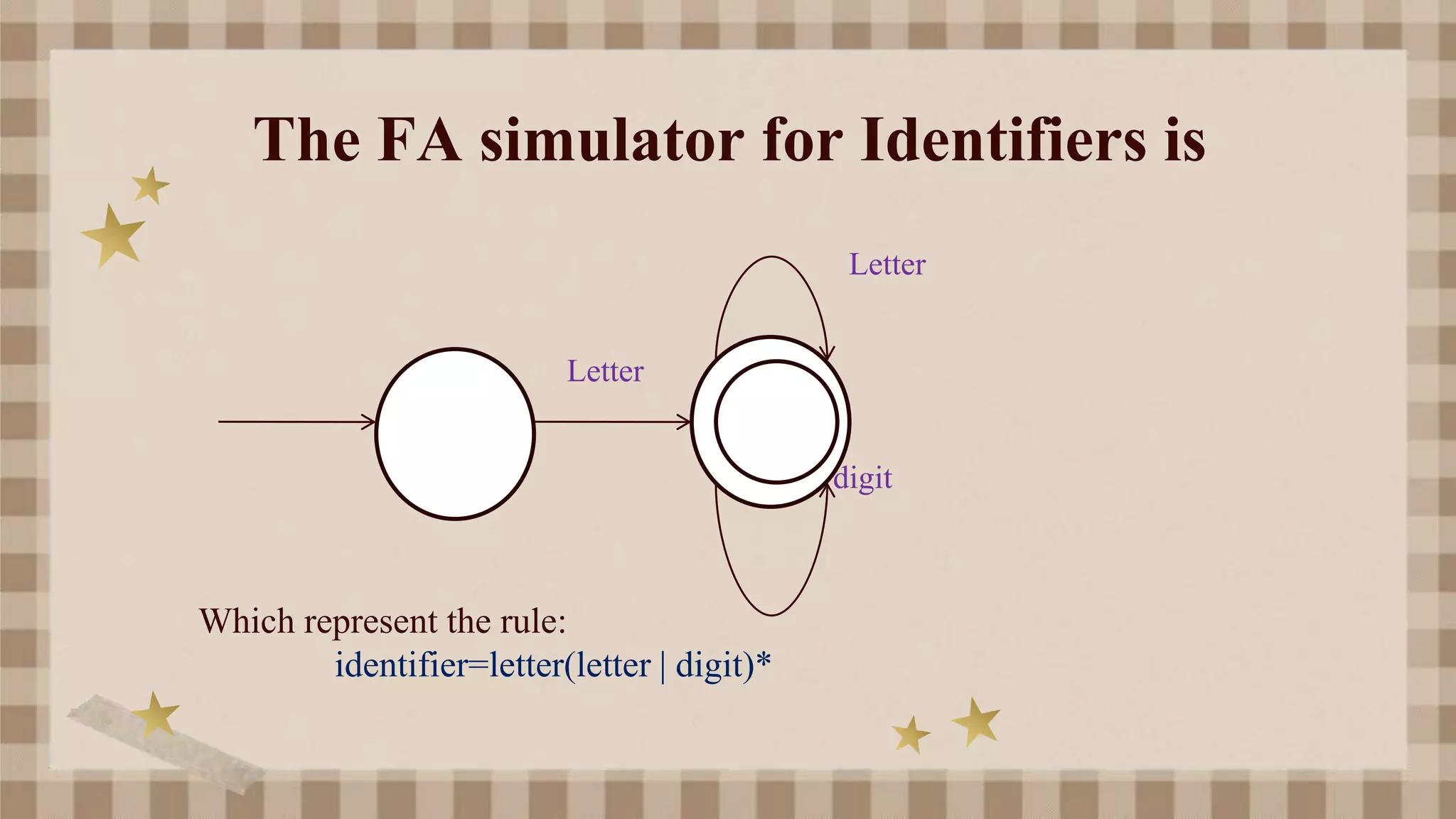
The FA simulator for Identifiers is
Letter
Letter
digit
Which represent the rule:
identifier=letter(letter | digit)*
Deterministic FA (DFA)
1) In a DFA, no state has an transition.
2)In a DFA, for each state s and input symbol a,
there is at most one edge labeled a leaving s.
3)To describe a FA , we use the transition graph or
transition table .
4)A DFA accepts an input string x if and only if
there is some path in the transition graph from start
state to some accepting state.
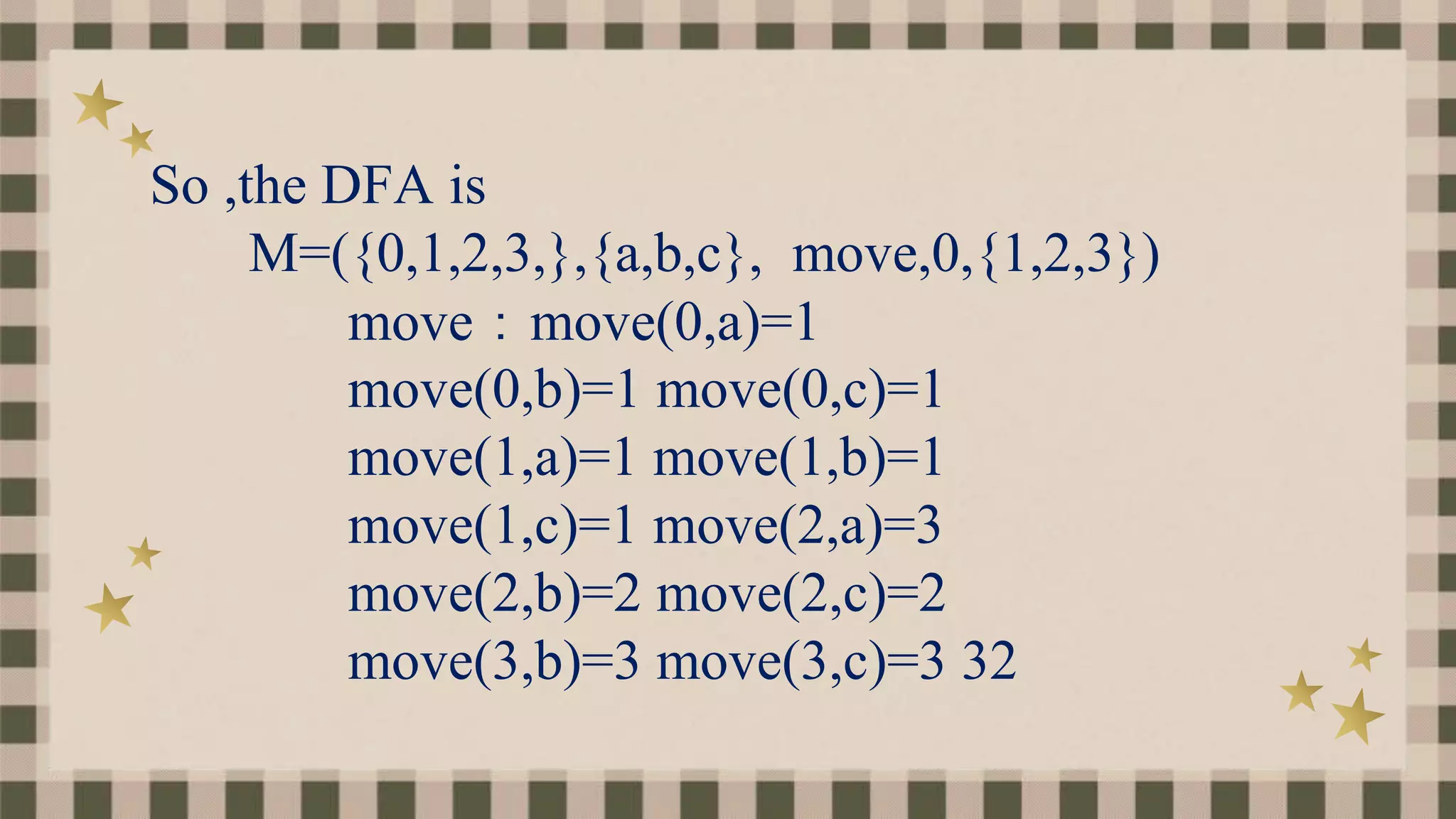
So ,the DFA is
M=({0,1,2,3,},{a,b,c}, move,0,{1,2,3})
move:move(0,a)=1
move(0,b)=1 move(0,c)=1
move(1,a)=1 move(1,b)=1
move(1,c)=1 move(2,a)=3
move(2,b)=2 move(2,c)=2
move(3,b)=3 move(3,c)=3 32
A generalized transition diagram
 Finite Automation
Deterministic or non-deterministic FA
Non-deterministic means that
more than one transition out of a state may be
possible on the same input symbol.
Non-deterministic FA (NFA)
1) In a NFA the same character can label two or more transitions out
of one state.
2) In a NFA is a legal input symbol.
3) A DFA is a special case of a NFA.
4)A NFA accepts an input string x if and only if there is some path in
the transition graph from start state to some accepting state. A
path can be represented by a sequence of state transitions called
moves.
5) It accepts the language defined by a NFA is the set of input strings.
Thank you

A simple approach of lexical analyzers

  • 1.
    A SIMPLE APPROACHTO THE DESIGN OF LEXICAL ANALYZERS Myself Archana R Assistant Professor In Department Of Computer Science SACWC. I am here because I love to give presentations.
  • 2.
    Simple Approach Construct adiagram that illustrates the structure of the tokens of the source language , and then to hand-translate the diagram the diagram into a program for finding tokens. Notes: Efficient lexical analyzers can be produced in this manner.
  • 3.
    Simple Approaches ToImplement A Lexical Analyzer Pattern-directed programming approach  Pattern Matching technique.  Specify and design program that execute actions triggered by patterns in strings.  Introduce a pattern-action language called Lexical for specifying lexical analyzers .  Patterns are specified by regular expressions .  A compiler for Lexical can generate an efficient finite automation recognizer for the regular expressions.
  • 4.
    First phase ofa compiler 1. Main task - To read the input characters. - To produce a sequence of tokens used by the parser for syntax analysis. - As an assistant of parser.
  • 5.
     Lexical analyzer Parser  Symbol table  Source program  token  Get next token Interaction of lexical analyzer with parser
  • 6.
    Processes in lexicalanalyzers  Scanning *Pre-processing -Strip out comments and white space -Macro functions  Correlating error messages from compiler with source program *A line number can be associated with an error message.  Lexical analysis
  • 7.
    Regular Expression &Regular language  Regular Expression A notation that allows us to define a pattern in a high level language.  Regular language Each regular expression r denotes language L(r) (the set of sentences relating to the regular expression r) . Notes: Each word in a program can be expressed in a regular expression.
  • 8.
    Specification of Tokens 1)The rule of regular expression over alphabet ∑ * ε is a regular expression that denote {ε} ε is regular expression . {ε} is the related regular language. 2) If a is a symbol in ∑, then a is a regular expression that denotes {a} a is regular expression . {a} is the related regular language.
  • 9.
    3) Suppose αand β are regular expressions, then α| β, α β, α * , β * is also a regular expression. Notes : Rules 1) and 2) form the basis of the definition; rule 3) provides the inductive step. 4) Algebraic laws of regular expressions 1) α| β = β | α 2) α |(β |γ)=(α | β)| γ α(β γ) =(α β) γ 3)εα = αε= α 5)(α *)*= α * 6) α *= α +|ε α + = α α * = α * α 7) (α | β)*= (α * | β *)*= (α * β *)*
  • 10.
    Notational Short-hands a)One ormore instances ( r ) digit+ b)Zero or one instance r? is a shorthand for r| (E(+|-)?digits)? c)Character classes [a-z] denotes a|b|c|…|z [A-Za-z] [A-Za-z0-9]
  • 11.
    Implementing a TransitionDiagram  Each state gets a segment of code.  If there are edges leaving a state, then its code reads a character and selects an edge to follow, if possible.  Use next char() to read next character from the input buffer. A generalized transition diagram Finite Automation  Deterministic or non-deterministic FA.  Non-deterministic means that more than one transition out of a state may be possible on the same input symbol.
  • 12.
    The model ofrecognition of tokens INPUT BUFFER Lexeme being FA simulator i f d 2 =……..
  • 13.
    The FA simulatorfor Identifiers is Letter Letter digit Which represent the rule: identifier=letter(letter | digit)*
  • 14.
    Deterministic FA (DFA) 1)In a DFA, no state has an transition. 2)In a DFA, for each state s and input symbol a, there is at most one edge labeled a leaving s. 3)To describe a FA , we use the transition graph or transition table . 4)A DFA accepts an input string x if and only if there is some path in the transition graph from start state to some accepting state.
  • 15.
    So ,the DFAis M=({0,1,2,3,},{a,b,c}, move,0,{1,2,3}) move:move(0,a)=1 move(0,b)=1 move(0,c)=1 move(1,a)=1 move(1,b)=1 move(1,c)=1 move(2,a)=3 move(2,b)=2 move(2,c)=2 move(3,b)=3 move(3,c)=3 32
  • 16.
    A generalized transitiondiagram  Finite Automation Deterministic or non-deterministic FA Non-deterministic means that more than one transition out of a state may be possible on the same input symbol.
  • 17.
    Non-deterministic FA (NFA) 1)In a NFA the same character can label two or more transitions out of one state. 2) In a NFA is a legal input symbol. 3) A DFA is a special case of a NFA. 4)A NFA accepts an input string x if and only if there is some path in the transition graph from start state to some accepting state. A path can be represented by a sequence of state transitions called moves. 5) It accepts the language defined by a NFA is the set of input strings.
  • 18.