Ant Colony Optimization
18-02-2014

Ant Colony Optimization

1
Ant Colony Optimization
Ant colony optimization is a technique for
optimization that was introduced in the early 1990’s.
The inspiring source of ant colony optimization is the
foraging behaviour of real ant colonies.

18-02-2014

Ant Colony Optimization

2
Swarm Intelligence
Collective system capable of accomplishing difficult

tasks in dynamic and varied environments without
any external guidance or control and with no central
coordination

Achieving a collective performance which could not

normally be achieved by an individual acting alone

Constituting a natural model particularly suited to

different kind of problem solving

18-02-2014

Ant Colony Optimization

3
Swarm Algorithms
Inspiration from swarm intelligence has led to
some highly successful optimization algorithms.
One of those algorithms is …..
Ant Colony algorithm – a way to solve optimization

problems based on the behaviour of ants searching for
food.

18-02-2014

Ant Colony Optimization

4
A key concept: Stigmergy
Stigmergy is:
indirect coordination between agents or actions.
 The

principle is that the trace left in
the environment by an action stimulates the
performance of a next action, by the same or a
different agent.

 Individuals

leave markers or messages – these don’t
solve the problem in themselves, but they affect other
individuals in a way that helps them solve the
problem

18-02-2014

Ant Colony Optimization

5
Stigmergy in Ants
Ants are behaviourally unsophisticated, but
collectively they can perform complex tasks.
Ants have highly developed sophisticated signbased stigmergy
They communicate using pheromones
They lay trails of pheromone that can be

followed by other ants.

18-02-2014

Ant Colony Optimization

6
Pheromone Trails
One ant tends to follow strong concentrations
of pheromone caused by repeated passes of ants; a
pheromone trail is then formed from nest to food
source,
so in intersections between several trails an ant moves
with high probability following the highest
pheromone level.

18-02-2014

Ant Colony Optimization

7
Pheromone Trails continued
Individual ants lay pheromone trails while

travelling from the nest, to the nest or possibly in
both directions.
The pheromone trail gradually evaporates over
time.
…But pheromone trail strength accumulate with
multiple ants using path.

18-02-2014

Ant Colony Optimization

8
Pheromone Trails: Example

18-02-2014

Ant Colony Optimization

9
Ant Colony Optimization
Algorithms: Basic Ideas
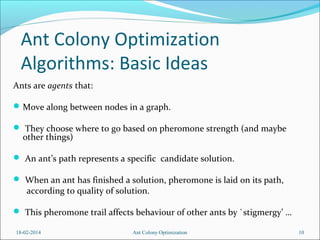
Ants are agents that:
 Move along between nodes in a graph.
 They choose where to go based on pheromone strength (and maybe

other things)

 An ant’s path represents a specific candidate solution.
 When an ant has finished a solution, pheromone is laid on its path,

according to quality of solution.

 This pheromone trail affects behaviour of other ants by `stigmergy’ …
18-02-2014

Ant Colony Optimization

10
Travelling Salesman Problem
(TSP)
Given a list of cities and the distances between each
pair of cities, what is the shortest possible route that
visits each city exactly once and returns to the origin
city?

18-02-2014

Ant Colony Optimization

11
ACO for the Traveling Salesman Problem

18-02-2014

Ant Colony Optimization

12
E.g. A 4-city TSP
Initially, random levels of pheromone are scattered on the edges
A

Pheromone
Ant

18-02-2014

C
AB: 10, AC: 10, AD: 30,
Ant Colony Optimization

B

D
BC: 40, CD: 20
13
E.g. A 4-city TSP
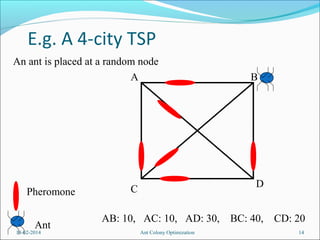
An ant is placed at a random node
A

Pheromone
Ant

18-02-2014

B

D

C
AB: 10, AC: 10, AD: 30,
Ant Colony Optimization

BC: 40, CD: 20
14
E.g. A 4-city TSP
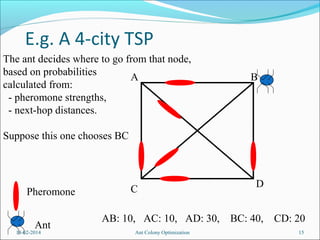
The ant decides where to go from that node,
based on probabilities
A
calculated from:
- pheromone strengths,
- next-hop distances.

B

Suppose this one chooses BC

Pheromone
Ant

18-02-2014

C
AB: 10, AC: 10, AD: 30,
Ant Colony Optimization

D
BC: 40, CD: 20
15
E.g. A 4-city TSP
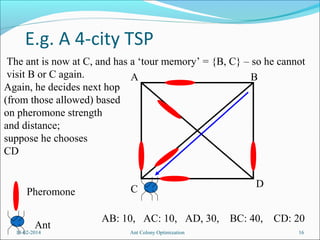
The ant is now at C, and has a ‘tour memory’ = {B, C} – so he cannot
visit B or C again.
A
B
Again, he decides next hop
(from those allowed) based
on pheromone strength
and distance;
suppose he chooses
CD

Pheromone
Ant

18-02-2014

C
AB: 10, AC: 10, AD, 30,
Ant Colony Optimization

D
BC: 40,

CD: 20
16
E.g. A 4-city TSP
The ant is now at D, and has a `tour memory’ = {B, C, D}
There is only one place he can go now:
A
B

Pheromone
Ant

18-02-2014

C
AB: 10, AC: 10, AD, 30,
Ant Colony Optimization

D
BC: 40,

CD: 20
17
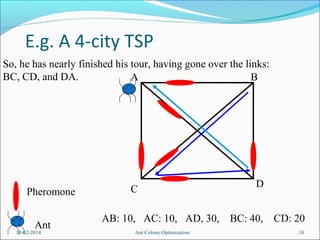
E.g. A 4-city TSP
So, he has nearly finished his tour, having gone over the links:
BC, CD, and DA.
A
B

Pheromone
Ant

18-02-2014

C
AB: 10, AC: 10, AD, 30,
Ant Colony Optimization

D
BC: 40,

CD: 20
18
E.g. A 4-city TSP

So, he has nearly finished his tour, having gone over the links:
BC, CD, and DA. AB is added to complete the round trip.
A
B

Now, pheromone on the tour
is increased, in line with the
fitness of that tour.

Pheromone
Ant

18-02-2014

C
AB: 10, AC: 10, AD, 30,
Ant Colony Optimization

D
BC: 40,

CD: 20
19
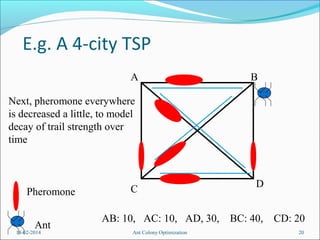
E.g. A 4-city TSP
A

B

Next, pheromone everywhere
is decreased a little, to model
decay of trail strength over
time

Pheromone
Ant

18-02-2014

C
AB: 10, AC: 10, AD, 30,
Ant Colony Optimization

D
BC: 40,

CD: 20
20
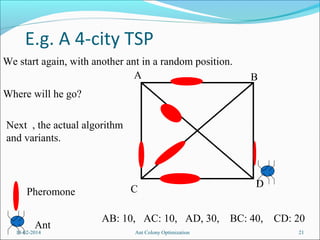
E.g. A 4-city TSP
We start again, with another ant in a random position.
A

B

Where will he go?
Next , the actual algorithm
and variants.

Pheromone
Ant

18-02-2014

C
AB: 10, AC: 10, AD, 30,
Ant Colony Optimization

D
BC: 40,

CD: 20
21
The ACO algorithm for the TSP
[a simplified version with all essential details]

We have a TSP, with n cities.
1. We place some ants at each city. Each ant then does this:


It makes a complete tour of the cities, coming back to its starting
city, using a transition rule to decide which links to follow. By this
rule, it chooses each next-city at random, but biased partly by the
pheromone levels existing at each path, and biased partly by heuristic
information.

2. When all ants have completed their tours.
Global Pheromone Updating occurs.



The current pheromone levels on all links are reduced (I.e.
pheromone levels decay over time).
Pheromone is laid (belatedly) by each ant as follows: it places
pheromone on all links of its tour, with strength depending on how
good the tour was.

Then we go back to 1 and repeat the whole process many
18-02-2014
Ant Colony Optimization
times, until we reach a termination criterion.

22
The transition rule

T(r,s) is the amount of pheromone currently on the path that goes
directly from city r to city s.
H(r,s) is the heuristic value of this link – in the classic TSP
application, this is chosen to be 1/distance(r,s) -- I.e. the shorter
the distance, the higher the heuristic value.
pk (r , s ) is the probability that ant k will choose the link that goes
from r to s
β is a parameter that we can call the heuristic strength
The rule is:

pk ( r , s ) =

T (r , s ) ⋅ H (r , s ) β
β
∑ T (r , c) ⋅ H (r , c)

unvisited cities c

Where our ant is at city r, and s is a city as yet unvisited on its
tour, and the summation is over all of k’s unvisited cities
18-02-2014

Ant Colony Optimization

24
Global pheromone update
Ak(r,s) is amount of pheromone added to the (r, s) link by ant k.
m is the number of ants

ρ is a parameter called the pheromone decay rate.
Lk is the length of the tour completed by ant k
T(r, s) at the next iteration becomes:

ρ ⋅ T (r , s) +

m

∑ A (r , s )
k

k =1

Where Ak ( r , s ) = 1 / Lk
18-02-2014

Ant Colony Optimization

25
Not just for TSP of course
ACO is naturally applicable to any sequencing

problem, or indeed any problem

All you need is some way to represent solutions to the

problem as paths in a network.

18-02-2014

Ant Colony Optimization

26
Other Application of ACO
 Quadratic Assignment Problem
 Network Model Problem
 Vehicle routing
 Feature Selection
 Scheduling Problem
 Vehicle Routing Problem

18-02-2014

Ant Colony Optimization

27
Some inherent advantages
Positive Feedback accounts for rapid discovery of

good solutions
Distributed computation avoids premature
convergence
The greedy heuristic helps find acceptable
solution in the early solution in the early stages of
the search process.
The collective interaction of a population of
agents.
18-02-2014

Ant Colony Optimization

28
Disadvantages
Slower convergence than other Heuristics
Performed poorly for TSP problems larger than 75

cities.
No centralized processor to guide the system towards
good solutions

18-02-2014

Ant Colony Optimization

29
Conclusion
ACO is a thriving and maturing research area – it has

its own conferences. It gets very good results on some
difficult problems.

ACO research and practice tends to concentrate on:

hybridisation with other methods; e.g. it is common
to improve an individual ant’s solution by local
search, and then lay pheromone. New and adaptive
ways to control the relative influence of heuristics,
pheromone strength and pheromone decay.

18-02-2014

Ant Colony Optimization

30
References
 https://www.ics.uci.edu/~welling/teaching/271fall09/antcolonyopt.pdf
 rain.ifmo.ru/~chivdan/presentations
 www.macs.hw.ac.uk/~dwcorne/Teaching
 Dorigo M, Optimization, learning and natural algorithms. PhD thesis,

Dipartimento di Elettronica, Politecnico di Milano, Italy, 1992 [in
Italian]
 Wikipedia
 https://www.ics.uci.edu/~welling/teaching/271fall09
 code.ulb.ac.be/dbfiles/
 Ant Colony Optimization for Feature Selection in Software Product
Lines by WANG Ying-lin1,2, PANG Jin-wei2
 mitpress.mit.edu/books/ant-colony-optimization

18-02-2014

Ant Colony Optimization

31
18-02-2014

Ant Colony Optimization

32

Ant Colony Optimization presentation

  • 1.
  • 2.
    Ant Colony Optimization Antcolony optimization is a technique for optimization that was introduced in the early 1990’s. The inspiring source of ant colony optimization is the foraging behaviour of real ant colonies. 18-02-2014 Ant Colony Optimization 2
  • 3.
    Swarm Intelligence Collective systemcapable of accomplishing difficult tasks in dynamic and varied environments without any external guidance or control and with no central coordination Achieving a collective performance which could not normally be achieved by an individual acting alone Constituting a natural model particularly suited to different kind of problem solving 18-02-2014 Ant Colony Optimization 3
  • 4.
    Swarm Algorithms Inspiration fromswarm intelligence has led to some highly successful optimization algorithms. One of those algorithms is ….. Ant Colony algorithm – a way to solve optimization problems based on the behaviour of ants searching for food. 18-02-2014 Ant Colony Optimization 4
  • 5.
    A key concept:Stigmergy Stigmergy is: indirect coordination between agents or actions.  The principle is that the trace left in the environment by an action stimulates the performance of a next action, by the same or a different agent.  Individuals leave markers or messages – these don’t solve the problem in themselves, but they affect other individuals in a way that helps them solve the problem 18-02-2014 Ant Colony Optimization 5
  • 6.
    Stigmergy in Ants Antsare behaviourally unsophisticated, but collectively they can perform complex tasks. Ants have highly developed sophisticated signbased stigmergy They communicate using pheromones They lay trails of pheromone that can be followed by other ants. 18-02-2014 Ant Colony Optimization 6
  • 7.
    Pheromone Trails One anttends to follow strong concentrations of pheromone caused by repeated passes of ants; a pheromone trail is then formed from nest to food source, so in intersections between several trails an ant moves with high probability following the highest pheromone level. 18-02-2014 Ant Colony Optimization 7
  • 8.
    Pheromone Trails continued Individualants lay pheromone trails while travelling from the nest, to the nest or possibly in both directions. The pheromone trail gradually evaporates over time. …But pheromone trail strength accumulate with multiple ants using path. 18-02-2014 Ant Colony Optimization 8
  • 9.
  • 10.
    Ant Colony Optimization Algorithms:Basic Ideas Ants are agents that:  Move along between nodes in a graph.  They choose where to go based on pheromone strength (and maybe other things)  An ant’s path represents a specific candidate solution.  When an ant has finished a solution, pheromone is laid on its path, according to quality of solution.  This pheromone trail affects behaviour of other ants by `stigmergy’ … 18-02-2014 Ant Colony Optimization 10
  • 11.
    Travelling Salesman Problem (TSP) Givena list of cities and the distances between each pair of cities, what is the shortest possible route that visits each city exactly once and returns to the origin city? 18-02-2014 Ant Colony Optimization 11
  • 12.
    ACO for theTraveling Salesman Problem 18-02-2014 Ant Colony Optimization 12
  • 13.
    E.g. A 4-cityTSP Initially, random levels of pheromone are scattered on the edges A Pheromone Ant 18-02-2014 C AB: 10, AC: 10, AD: 30, Ant Colony Optimization B D BC: 40, CD: 20 13
  • 14.
    E.g. A 4-cityTSP An ant is placed at a random node A Pheromone Ant 18-02-2014 B D C AB: 10, AC: 10, AD: 30, Ant Colony Optimization BC: 40, CD: 20 14
  • 15.
    E.g. A 4-cityTSP The ant decides where to go from that node, based on probabilities A calculated from: - pheromone strengths, - next-hop distances. B Suppose this one chooses BC Pheromone Ant 18-02-2014 C AB: 10, AC: 10, AD: 30, Ant Colony Optimization D BC: 40, CD: 20 15
  • 16.
    E.g. A 4-cityTSP The ant is now at C, and has a ‘tour memory’ = {B, C} – so he cannot visit B or C again. A B Again, he decides next hop (from those allowed) based on pheromone strength and distance; suppose he chooses CD Pheromone Ant 18-02-2014 C AB: 10, AC: 10, AD, 30, Ant Colony Optimization D BC: 40, CD: 20 16
  • 17.
    E.g. A 4-cityTSP The ant is now at D, and has a `tour memory’ = {B, C, D} There is only one place he can go now: A B Pheromone Ant 18-02-2014 C AB: 10, AC: 10, AD, 30, Ant Colony Optimization D BC: 40, CD: 20 17
  • 18.
    E.g. A 4-cityTSP So, he has nearly finished his tour, having gone over the links: BC, CD, and DA. A B Pheromone Ant 18-02-2014 C AB: 10, AC: 10, AD, 30, Ant Colony Optimization D BC: 40, CD: 20 18
  • 19.
    E.g. A 4-cityTSP So, he has nearly finished his tour, having gone over the links: BC, CD, and DA. AB is added to complete the round trip. A B Now, pheromone on the tour is increased, in line with the fitness of that tour. Pheromone Ant 18-02-2014 C AB: 10, AC: 10, AD, 30, Ant Colony Optimization D BC: 40, CD: 20 19
  • 20.
    E.g. A 4-cityTSP A B Next, pheromone everywhere is decreased a little, to model decay of trail strength over time Pheromone Ant 18-02-2014 C AB: 10, AC: 10, AD, 30, Ant Colony Optimization D BC: 40, CD: 20 20
  • 21.
    E.g. A 4-cityTSP We start again, with another ant in a random position. A B Where will he go? Next , the actual algorithm and variants. Pheromone Ant 18-02-2014 C AB: 10, AC: 10, AD, 30, Ant Colony Optimization D BC: 40, CD: 20 21
  • 22.
    The ACO algorithmfor the TSP [a simplified version with all essential details] We have a TSP, with n cities. 1. We place some ants at each city. Each ant then does this:  It makes a complete tour of the cities, coming back to its starting city, using a transition rule to decide which links to follow. By this rule, it chooses each next-city at random, but biased partly by the pheromone levels existing at each path, and biased partly by heuristic information. 2. When all ants have completed their tours. Global Pheromone Updating occurs.   The current pheromone levels on all links are reduced (I.e. pheromone levels decay over time). Pheromone is laid (belatedly) by each ant as follows: it places pheromone on all links of its tour, with strength depending on how good the tour was. Then we go back to 1 and repeat the whole process many 18-02-2014 Ant Colony Optimization times, until we reach a termination criterion. 22
  • 23.
    The transition rule T(r,s)is the amount of pheromone currently on the path that goes directly from city r to city s. H(r,s) is the heuristic value of this link – in the classic TSP application, this is chosen to be 1/distance(r,s) -- I.e. the shorter the distance, the higher the heuristic value. pk (r , s ) is the probability that ant k will choose the link that goes from r to s β is a parameter that we can call the heuristic strength The rule is: pk ( r , s ) = T (r , s ) ⋅ H (r , s ) β β ∑ T (r , c) ⋅ H (r , c) unvisited cities c Where our ant is at city r, and s is a city as yet unvisited on its tour, and the summation is over all of k’s unvisited cities 18-02-2014 Ant Colony Optimization 24
  • 24.
    Global pheromone update Ak(r,s)is amount of pheromone added to the (r, s) link by ant k. m is the number of ants ρ is a parameter called the pheromone decay rate. Lk is the length of the tour completed by ant k T(r, s) at the next iteration becomes: ρ ⋅ T (r , s) + m ∑ A (r , s ) k k =1 Where Ak ( r , s ) = 1 / Lk 18-02-2014 Ant Colony Optimization 25
  • 25.
    Not just forTSP of course ACO is naturally applicable to any sequencing problem, or indeed any problem All you need is some way to represent solutions to the problem as paths in a network. 18-02-2014 Ant Colony Optimization 26
  • 26.
    Other Application ofACO  Quadratic Assignment Problem  Network Model Problem  Vehicle routing  Feature Selection  Scheduling Problem  Vehicle Routing Problem 18-02-2014 Ant Colony Optimization 27
  • 27.
    Some inherent advantages PositiveFeedback accounts for rapid discovery of good solutions Distributed computation avoids premature convergence The greedy heuristic helps find acceptable solution in the early solution in the early stages of the search process. The collective interaction of a population of agents. 18-02-2014 Ant Colony Optimization 28
  • 28.
    Disadvantages Slower convergence thanother Heuristics Performed poorly for TSP problems larger than 75 cities. No centralized processor to guide the system towards good solutions 18-02-2014 Ant Colony Optimization 29
  • 29.
    Conclusion ACO is athriving and maturing research area – it has its own conferences. It gets very good results on some difficult problems. ACO research and practice tends to concentrate on: hybridisation with other methods; e.g. it is common to improve an individual ant’s solution by local search, and then lay pheromone. New and adaptive ways to control the relative influence of heuristics, pheromone strength and pheromone decay. 18-02-2014 Ant Colony Optimization 30
  • 30.
    References  https://www.ics.uci.edu/~welling/teaching/271fall09/antcolonyopt.pdf  rain.ifmo.ru/~chivdan/presentations www.macs.hw.ac.uk/~dwcorne/Teaching  Dorigo M, Optimization, learning and natural algorithms. PhD thesis, Dipartimento di Elettronica, Politecnico di Milano, Italy, 1992 [in Italian]  Wikipedia  https://www.ics.uci.edu/~welling/teaching/271fall09  code.ulb.ac.be/dbfiles/  Ant Colony Optimization for Feature Selection in Software Product Lines by WANG Ying-lin1,2, PANG Jin-wei2  mitpress.mit.edu/books/ant-colony-optimization 18-02-2014 Ant Colony Optimization 31
  • 31.