OUTLINE
 Introduction
 Key Innovation
 Stability-Plasticity Dilemma
 ART Network
 Basic ART network Architecture
 ART Algorithm
 ART Types
 ART Operation Phases
 ART Application
 Conclusion
Introduction
 ART stands for "Adaptive Resonance
Theory", invented by Stephen Grossberg in 1976.
 ART represents a family of neural networks.
 The basic ART System is an unsupervised learning
model.
 The term "resonance" refers to resonant state of a
neural network in which a category prototype vector
matches close enough to the current input vector. ART
matching leads to this resonant state, which permits
learning. The network learns only in its resonant state.
Key Innovation
The key innovation of ART is the use of “expectations.”
 As each input is presented to the network, it is
compared with the prototype vector that is most
closely matches.
 If the match between the prototype and the input
vector is NOT adequate, a new prototype is selected.
In this way, previous learned memories (prototypes)
are not eroded by new learning.
Stability Plasticity Dilemma
 Real world is faced with situation where data is continuously
changing.
 In this situation every learning system faces stability-plasticity
dilemma.
 Stability: System behaviour doesn’t change after irrelevant events
 Plasticity: System adapts its behaviour according to significant events
 Dilemma:
 How to achieve stability without rigidity and plasticity
without chaos?
 Ongoing learning capability
 Preservation of learned knowledge
 The plasticity-stability dilemma poses few questions :
How can we continue to quickly learn new things about
the environment and yet not forgetting what we have
already learned?
How can a learning system remain plastic (adaptive) in
response to significant input yet stable in response to
irrelevant input?
How can a neural network can remain plastic enough to
learn new patterns and yet be able to maintain the stability
of the already learned patterns?
How does the system know to switch between its plastic
and stable modes.
 ART networks tackle the stability-plasticity dilemma.
 The ART network and algorithm maintain the plasticity
required to earn new patterns while preventing the
modifications of patterns that have been learned
previously.
 Solves Stability – Plasticity Dilemma.
Forms new memories or incorporates new information
based on a predefined vigilance parameter.
ART Network
 ART networks consist of an input layer and an output
layer.
 Bottom-up weights are used to determine output-layer
candidates that may best match the current input.
 Top-down weights represent the “prototype” for the
cluster defined by each output neuron.
 A close match between input and prototype is necessary
for categorizing the input.
 Finding this match can require multiple signal exchanges
between the two layers in both directions until
“resonance” is established or a new neuron is added.
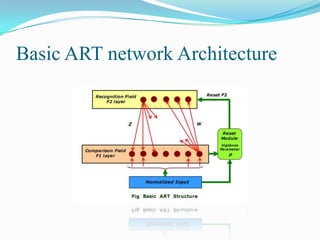
Basic ART network Architecture
The basic ART system is unsupervised learning model.
It typically consists of
1. a comparison field
2. a recognition field composed of neurons,
3. a vigilance parameter, and
4. a reset module
 Comparison field:
The comparison field takes an input vector and
transfers it to its best match in the recognition field.
Its best match is the single neuron whose set of
weights most closely matches the input vector.
 Recognition field:
Each recognition field neuron, outputs a negative
signal proportional to that neuron's quality of match to
the input vector to each of the other recognition field
neurons and inhibits their output accordingly.
 Vigilance Parameter:
After the input vector is classified, a reset module
compares the strength of the recognition match to a
vigilance parameter.
The vigilance parameter has considerable influence on
the system.
 Reset Module:
The reset module compares the strength of the
recognition match to the vigilance parameter.
If the vigilance threshold is met, then training
commences
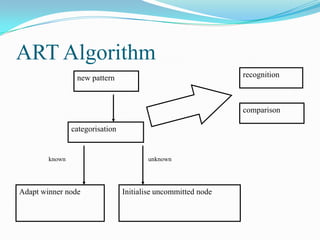
ART Algorithm
Adapt winner node Initialise uncommitted node
new pattern
categorisation
known unknown
recognition
comparison
 Incoming pattern matched with stored cluster templates.
 If close enough to stored template joins best matching
cluster, weights adapted.
 If not, a new cluster is initialised with pattern as template.
ART Types
 Unsupervised ARTs
ART1
ART2
ART3
Fuzzy ART
 Supervised ARTs
ARTMAP
Fuzzy ARTMAP
 ART 1 is the simplest variety of ART
networks, accepting only binary inputs.
 ART2 extends network capabilities to support
continuous inputs.
 ART3 is refinement of both modal.
 Fuzzy ART implements fuzzy logic into ART’s pattern
recognition
 ARTMAP also known as Predictive ART, combines two
slightly modified ART-1 or ART-2 units into a supervised
learning structure .
 Fuzzy ARTMAP is merely ARTMAP using fuzzy ART
units, resulting in a corresponding increase in efficacy.
ART Operational Phases
1. Initialization: Before starting all weight vectors B,T and
vigilance parameter must be set to initial value.
2. Recognition: Input vector is applied to initiate recognition
phase.
3. Comparison: At this point, feedback signal from recognition
layer cause G1 to go to Zero.
4. Search : when similarity of wining neuron is greater than
vigilance than no search is required otherwise stored pattern
must be searched.
Application of ART
• Mobile robot control
• Facial recognition
• Land cover classification
• Target recognition
• Medical diagnosis
• Signature verification
Conclusion
ART is Artificial Neural Network system that must be
able to adapt to changing environment but constant
change can make the system unstable system because
system may learn new information only by forgetting
everything it has so far learned.

Art network

  • 2.
    OUTLINE  Introduction  KeyInnovation  Stability-Plasticity Dilemma  ART Network  Basic ART network Architecture  ART Algorithm  ART Types  ART Operation Phases  ART Application  Conclusion
  • 3.
    Introduction  ART standsfor "Adaptive Resonance Theory", invented by Stephen Grossberg in 1976.  ART represents a family of neural networks.  The basic ART System is an unsupervised learning model.  The term "resonance" refers to resonant state of a neural network in which a category prototype vector matches close enough to the current input vector. ART matching leads to this resonant state, which permits learning. The network learns only in its resonant state.
  • 4.
    Key Innovation The keyinnovation of ART is the use of “expectations.”  As each input is presented to the network, it is compared with the prototype vector that is most closely matches.  If the match between the prototype and the input vector is NOT adequate, a new prototype is selected. In this way, previous learned memories (prototypes) are not eroded by new learning.
  • 5.
    Stability Plasticity Dilemma Real world is faced with situation where data is continuously changing.  In this situation every learning system faces stability-plasticity dilemma.  Stability: System behaviour doesn’t change after irrelevant events  Plasticity: System adapts its behaviour according to significant events  Dilemma:  How to achieve stability without rigidity and plasticity without chaos?  Ongoing learning capability  Preservation of learned knowledge
  • 6.
     The plasticity-stabilitydilemma poses few questions : How can we continue to quickly learn new things about the environment and yet not forgetting what we have already learned? How can a learning system remain plastic (adaptive) in response to significant input yet stable in response to irrelevant input? How can a neural network can remain plastic enough to learn new patterns and yet be able to maintain the stability of the already learned patterns?
  • 7.
    How does thesystem know to switch between its plastic and stable modes.  ART networks tackle the stability-plasticity dilemma.  The ART network and algorithm maintain the plasticity required to earn new patterns while preventing the modifications of patterns that have been learned previously.  Solves Stability – Plasticity Dilemma. Forms new memories or incorporates new information based on a predefined vigilance parameter.
  • 8.
    ART Network  ARTnetworks consist of an input layer and an output layer.  Bottom-up weights are used to determine output-layer candidates that may best match the current input.  Top-down weights represent the “prototype” for the cluster defined by each output neuron.  A close match between input and prototype is necessary for categorizing the input.  Finding this match can require multiple signal exchanges between the two layers in both directions until “resonance” is established or a new neuron is added.
  • 9.
    Basic ART networkArchitecture
  • 10.
    The basic ARTsystem is unsupervised learning model. It typically consists of 1. a comparison field 2. a recognition field composed of neurons, 3. a vigilance parameter, and 4. a reset module
  • 11.
     Comparison field: Thecomparison field takes an input vector and transfers it to its best match in the recognition field. Its best match is the single neuron whose set of weights most closely matches the input vector.  Recognition field: Each recognition field neuron, outputs a negative signal proportional to that neuron's quality of match to the input vector to each of the other recognition field neurons and inhibits their output accordingly.
  • 12.
     Vigilance Parameter: Afterthe input vector is classified, a reset module compares the strength of the recognition match to a vigilance parameter. The vigilance parameter has considerable influence on the system.  Reset Module: The reset module compares the strength of the recognition match to the vigilance parameter. If the vigilance threshold is met, then training commences
  • 13.
    ART Algorithm Adapt winnernode Initialise uncommitted node new pattern categorisation known unknown recognition comparison
  • 14.
     Incoming patternmatched with stored cluster templates.  If close enough to stored template joins best matching cluster, weights adapted.  If not, a new cluster is initialised with pattern as template.
  • 15.
    ART Types  UnsupervisedARTs ART1 ART2 ART3 Fuzzy ART  Supervised ARTs ARTMAP Fuzzy ARTMAP
  • 16.
     ART 1is the simplest variety of ART networks, accepting only binary inputs.  ART2 extends network capabilities to support continuous inputs.  ART3 is refinement of both modal.  Fuzzy ART implements fuzzy logic into ART’s pattern recognition  ARTMAP also known as Predictive ART, combines two slightly modified ART-1 or ART-2 units into a supervised learning structure .  Fuzzy ARTMAP is merely ARTMAP using fuzzy ART units, resulting in a corresponding increase in efficacy.
  • 17.
    ART Operational Phases 1.Initialization: Before starting all weight vectors B,T and vigilance parameter must be set to initial value. 2. Recognition: Input vector is applied to initiate recognition phase. 3. Comparison: At this point, feedback signal from recognition layer cause G1 to go to Zero. 4. Search : when similarity of wining neuron is greater than vigilance than no search is required otherwise stored pattern must be searched.
  • 18.
    Application of ART •Mobile robot control • Facial recognition • Land cover classification • Target recognition • Medical diagnosis • Signature verification
  • 19.
    Conclusion ART is ArtificialNeural Network system that must be able to adapt to changing environment but constant change can make the system unstable system because system may learn new information only by forgetting everything it has so far learned.