Ant Colony
Optimization
9/10/2017 1
9/10/2017 2
 Introduction (P-4)
 Biological Inspiration (P-5)
 Double Bridge Experiment (P-6)
 Ant colony Optimization (P-7)
 ACO – Ant System (P-8)
 ACO Algorithms (P-9)
 Advantage of ACO (P-10)
 Disadvantage of ACO (P-11)
 Applications of ACO (P-12)
 ACO for TSP (P-13 to16)
 Algorithm of ACO for TSP (P-17)
 Conclusion (P-18)
 Bibliography (P-19)
9/10/2017 3
 In computer science and operation research, the
ant colony optimization algorithm (ACO) is a
probabilistic technique for solving computational
problems which can be reduced to finding good
paths through graph.
 This algorithm initially proposed by Macro Dorigo
in 1992 in his PhD thesis. the first algorithm was
aiming to search for an optimal path in a graph,
based on the behavior of ants seeking a path
between their colony and a source of food.
9/10/2017 4
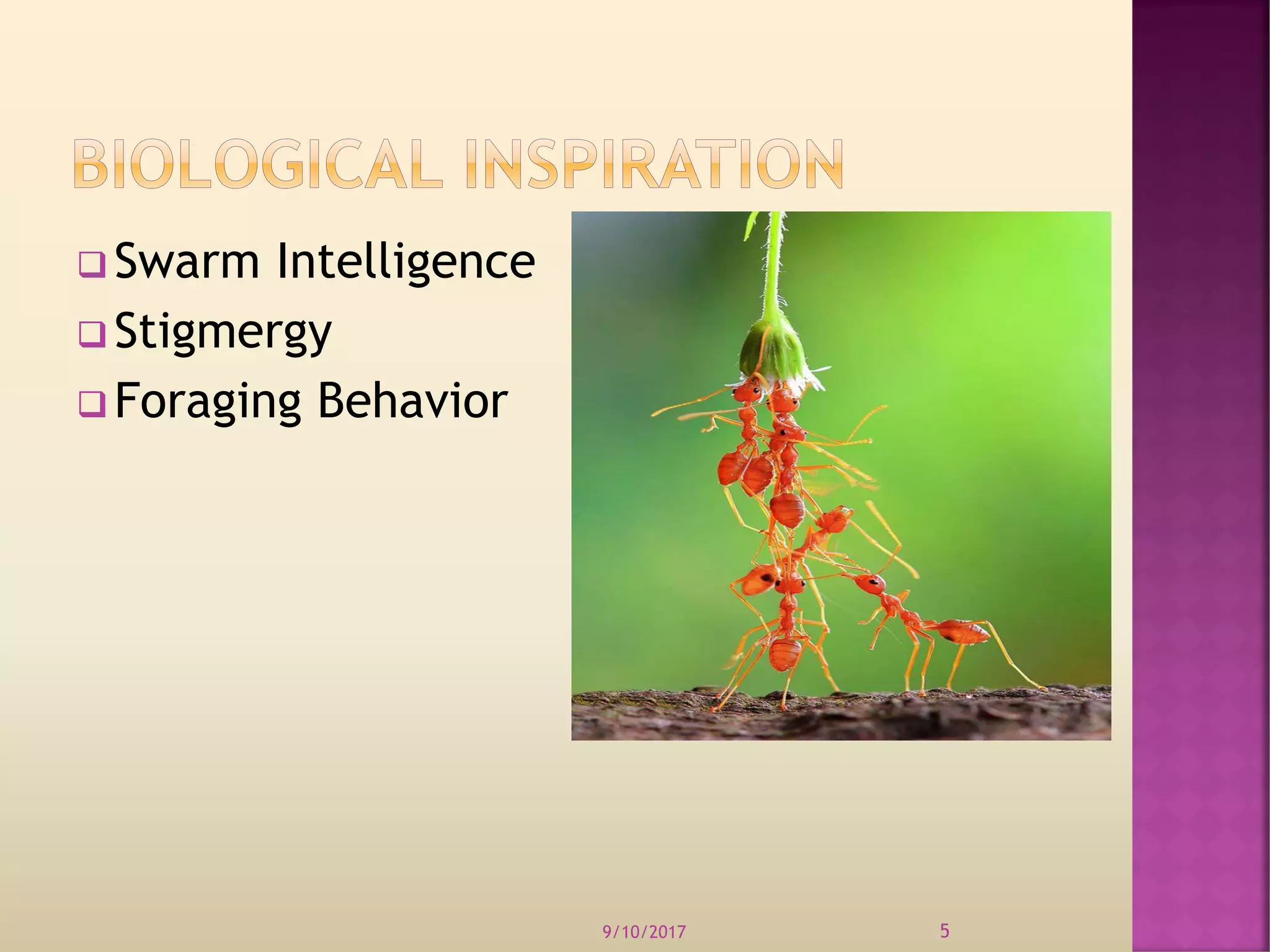
 Swarm Intelligence
 Stigmergy
 Foraging Behavior
9/10/2017 5
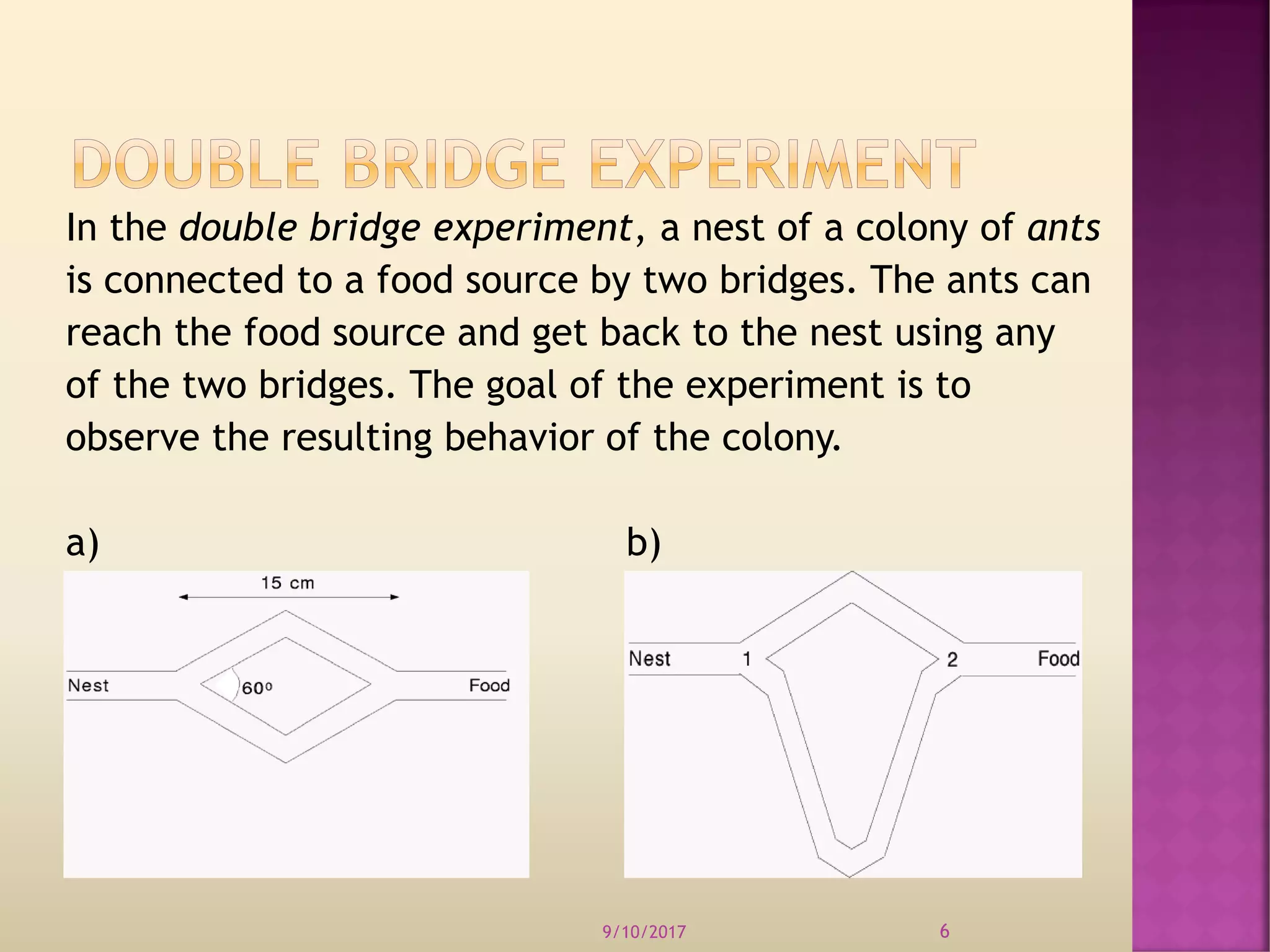
In the double bridge experiment, a nest of a colony of ants
is connected to a food source by two bridges. The ants can
reach the food source and get back to the nest using any
of the two bridges. The goal of the experiment is to
observe the resulting behavior of the colony.
a) b)
9/10/2017 6
 Ants navigate from nest to food source. Ants are
blind!
 Shortest path is discovered via pheromone trails.
 Each ant moves at random.
 Pheromone is deposited on path.
 More pheromone on path increases probability of
path being followed.
9/10/2017 7
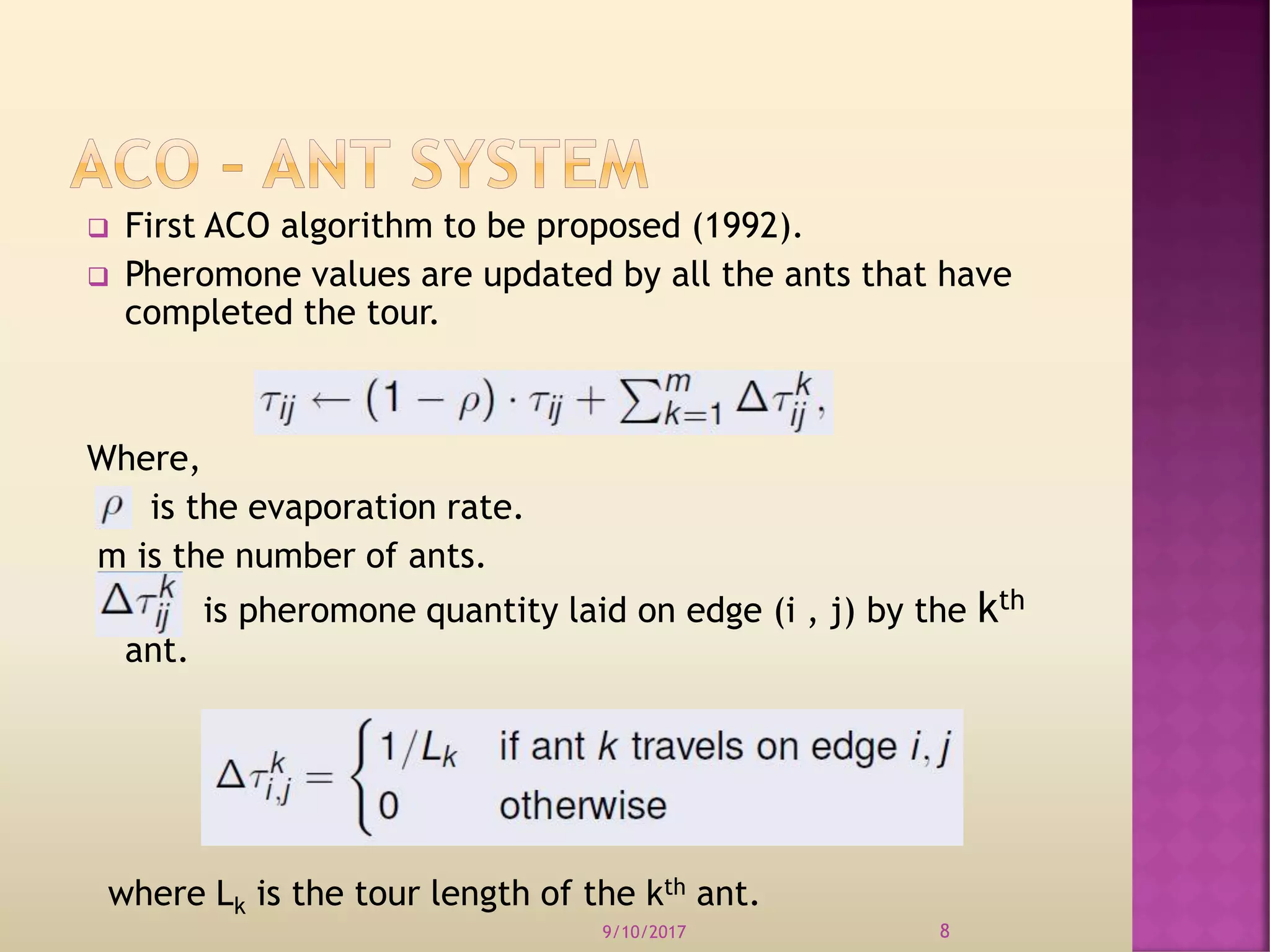
 First ACO algorithm to be proposed (1992).
 Pheromone values are updated by all the ants that have
completed the tour.
Where,
is the evaporation rate.
m is the number of ants.
is pheromone quantity laid on edge (i , j) by the kth
ant.
where Lk is the tour length of the kth ant.
9/10/2017 8
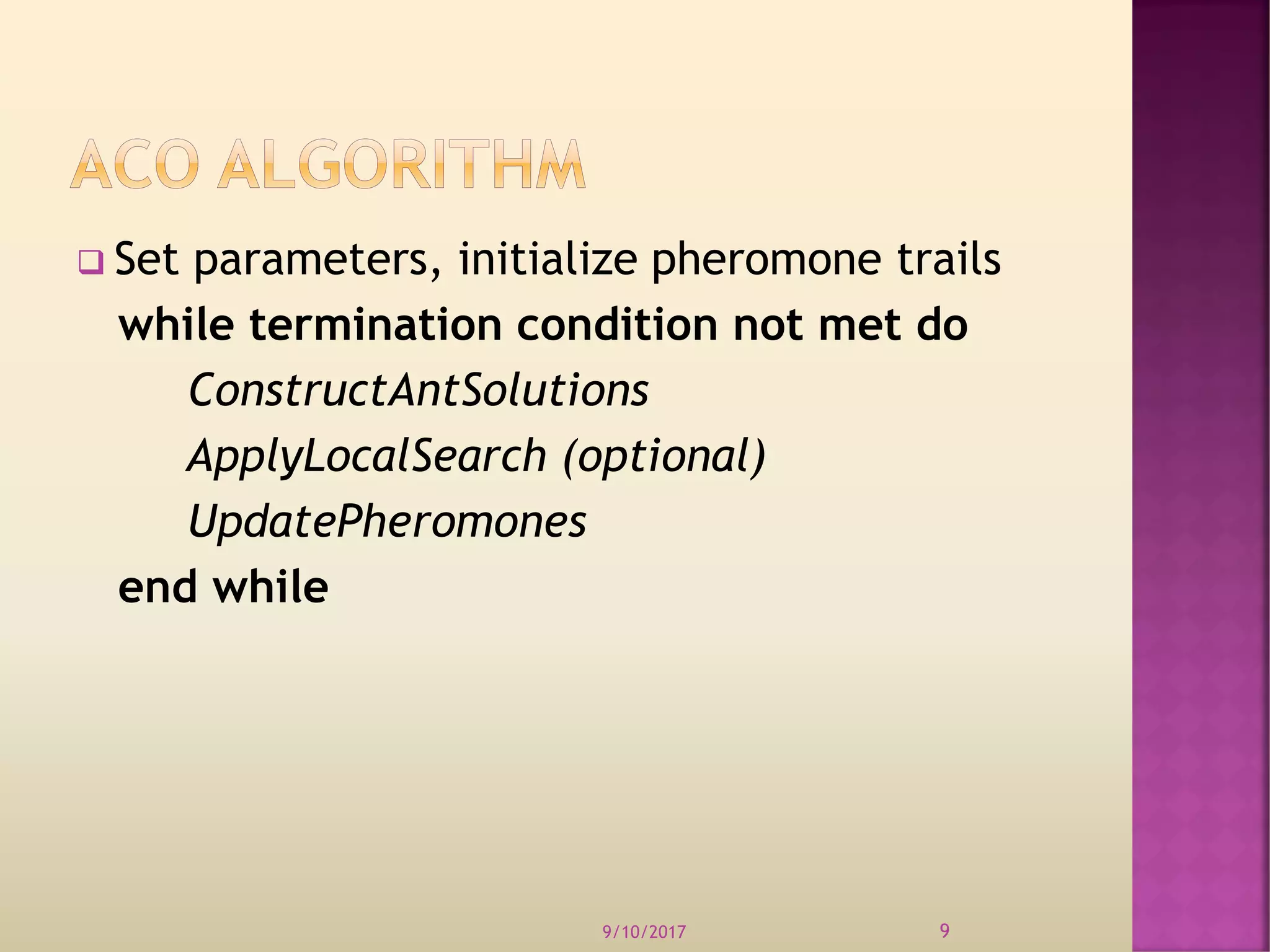
 Set parameters, initialize pheromone trails
while termination condition not met do
ConstructAntSolutions
ApplyLocalSearch (optional)
UpdatePheromones
end while
9/10/2017 9
 Inherent parallelism.
 Positive Feedback accounts for rapid discovery of
good solutions.
 Efficient for Traveling Salesman Problem and
similar problems.
 Can be used in dynamic applications (adapts to
changes such as new distances, etc).
9/10/2017 10
 Theoretical analysis is difficult.
 Sequences of random decisions (not
independent).
 Probability distribution changes by iteration.
 Research is experimental rather than
theoretical.
 Time to convergence uncertain (but convergence
is guaranteed!).
9/10/2017 11
 Routing in telecommunication networks
 Traveling Salesman
 Graph Coloring
 Scheduling
 Constraint Satisfaction
9/10/2017 12
Given an n-city TSP with distances dij, the artificial ants are
distributed to these n cities randomly. Each ant will choose the
next to visit according to the pheromone trail remained on the
paths just as mentioned in the above example.
However, there are two main differences between artificial ants
and real ants:
(1) the artificial ants have “memory”.
(2) The artificial ants are not completely “blind”.
9/10/2017 13
Contd…
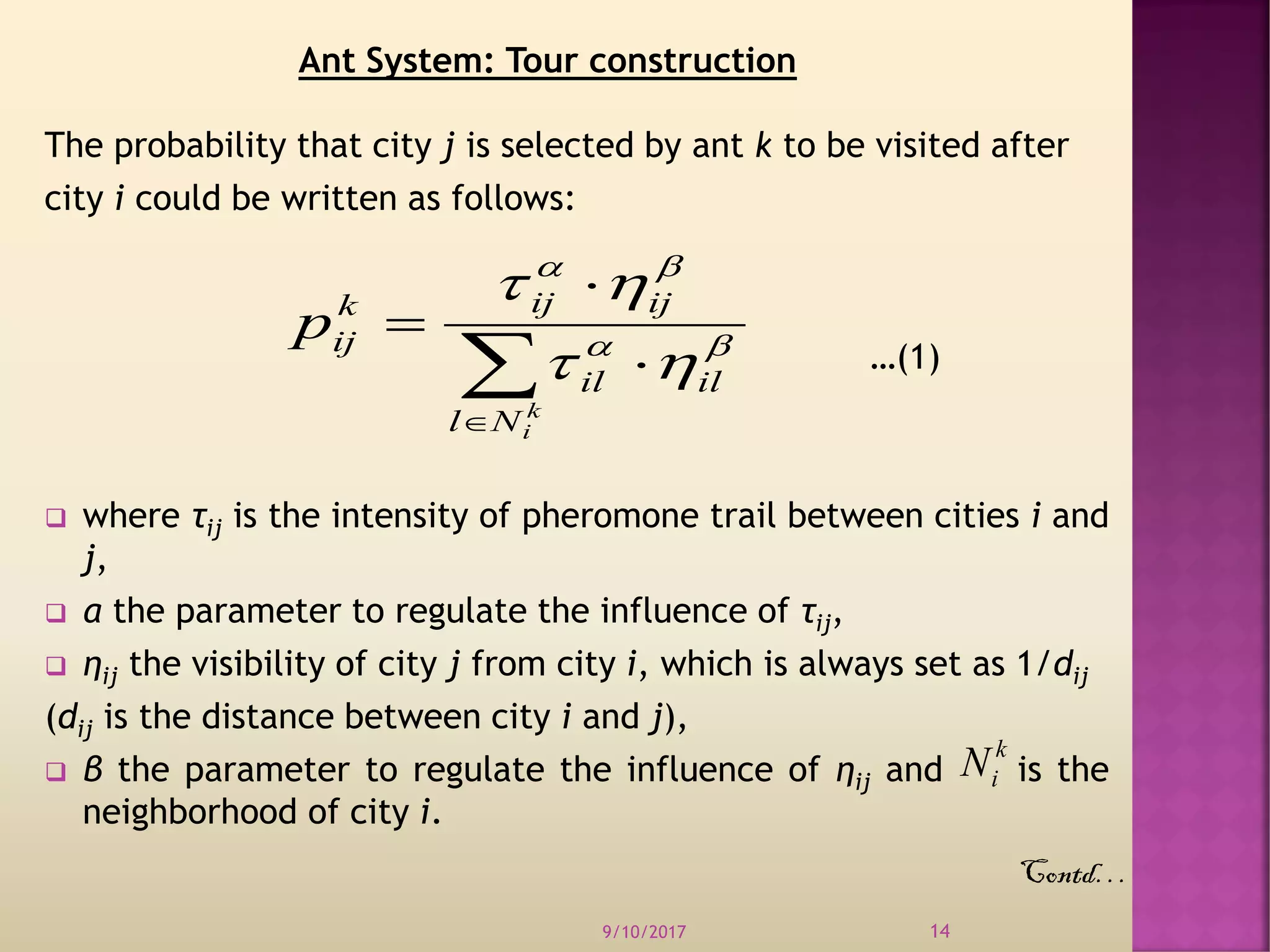
The probability that city j is selected by ant k to be visited after
city i could be written as follows:
…(1)
 where τij is the intensity of pheromone trail between cities i and
j,
 α the parameter to regulate the influence of τij,
 ηij the visibility of city j from city i, which is always set as 1/dij
(dij is the distance between city i and j),
 β the parameter to regulate the influence of ηij and is the
neighborhood of city i.
9/10/2017 14





k
iNl
ilil
ijijk
ijp 



k
iN
Ant System: Tour construction
Contd…
Evaporation for all connections∀(i, j) ∈ L:
τij ← (1 – ρ) τij, …(2)
ρ ∈[0, 1] – evaporation rate
Prevents convergence to suboptimal solutions
9/10/2017 15
Ant System: update pheromone trails – evaporation
Contd…
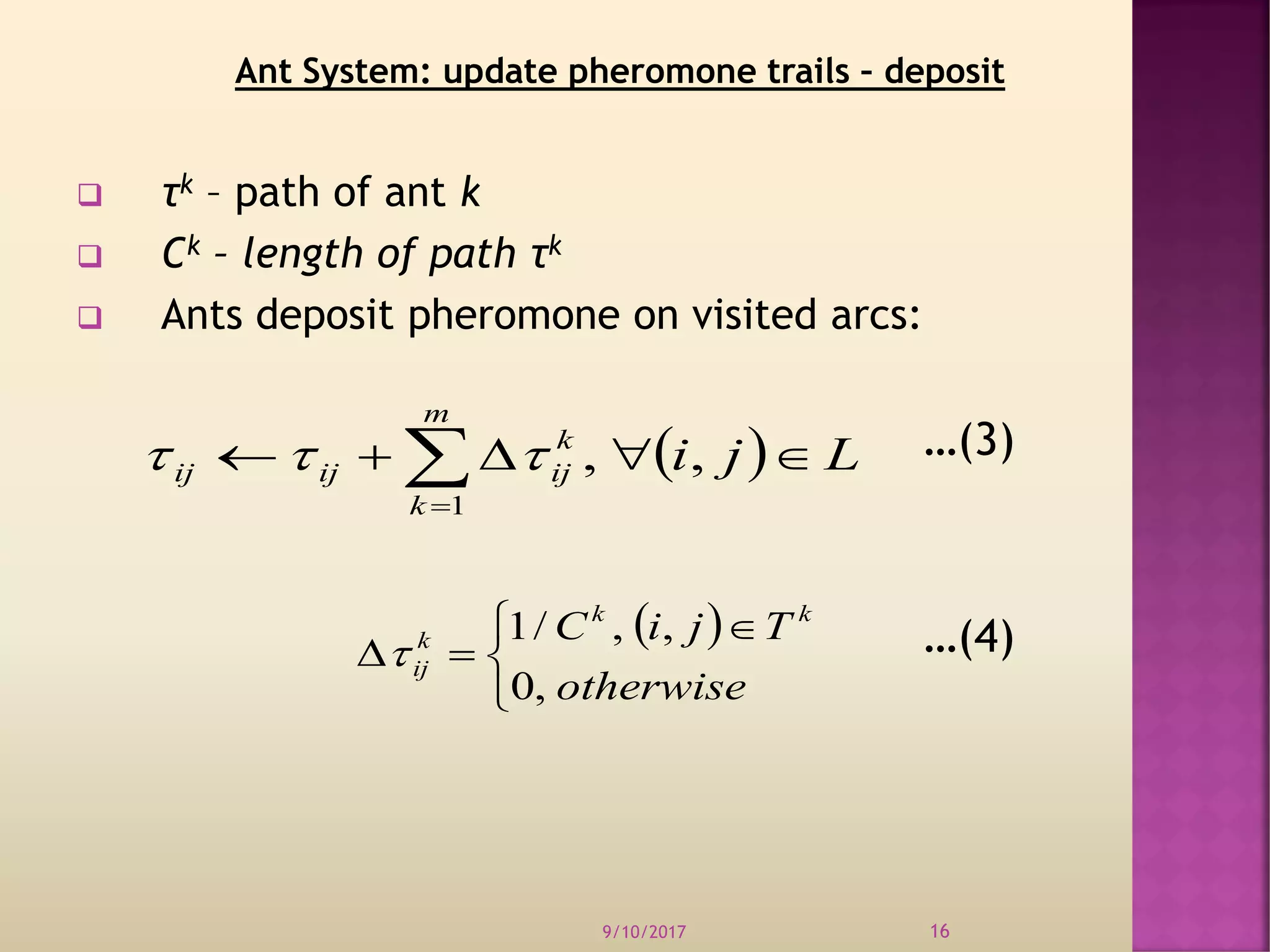
 τk – path of ant k
 Ck – length of path τk
 Ants deposit pheromone on visited arcs:
…(3)
…(4)
9/10/2017 16
  Lji
m
k
k
ijijij  
,,
1

 


 

otherwise
TjiC kk
k
ij
,0
,,/1

Ant System: update pheromone trails – deposit
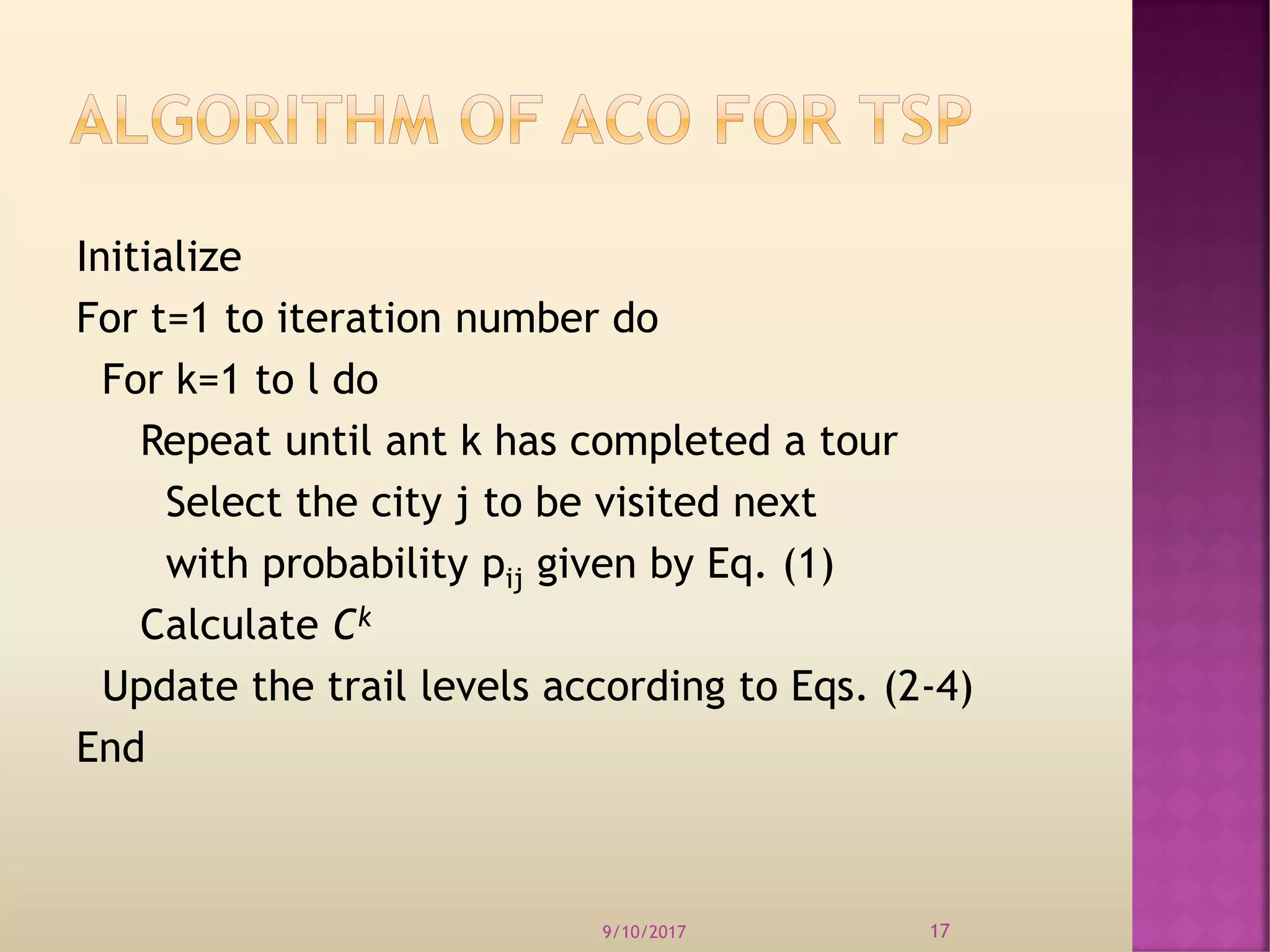
Initialize
For t=1 to iteration number do
For k=1 to l do
Repeat until ant k has completed a tour
Select the city j to be visited next
with probability pij given by Eq. (1)
Calculate Ck
Update the trail levels according to Eqs. (2-4)
End
9/10/2017 17
 ACO is a recently proposed metaheuristic
approach for solving hard combinatorial
optimization problems.
 The a cumulated search experience is taken into
account by the adaptation of the pheromone
trail.
 ACO Shows great performance with the “ill-
structured” problems like network routing.
 In ACO Local search is extremely important to
obtain good results.
9/10/2017 18
(Last
Accessed: 10th September, 2017)
(Last Accessed: 10th
September, 2017)
(Last
Accessed: 10th September, 2017)
(Last Accessed: 10th September,
2017)
(Last Accessed: 10th September,
2017)
(Last Accessed: 10th September,
2017)
9/10/2017 19
9/10/2017 20

Ant colony optimization

  • 1.
  • 2.
  • 3.
     Introduction (P-4) Biological Inspiration (P-5)  Double Bridge Experiment (P-6)  Ant colony Optimization (P-7)  ACO – Ant System (P-8)  ACO Algorithms (P-9)  Advantage of ACO (P-10)  Disadvantage of ACO (P-11)  Applications of ACO (P-12)  ACO for TSP (P-13 to16)  Algorithm of ACO for TSP (P-17)  Conclusion (P-18)  Bibliography (P-19) 9/10/2017 3
  • 4.
     In computerscience and operation research, the ant colony optimization algorithm (ACO) is a probabilistic technique for solving computational problems which can be reduced to finding good paths through graph.  This algorithm initially proposed by Macro Dorigo in 1992 in his PhD thesis. the first algorithm was aiming to search for an optimal path in a graph, based on the behavior of ants seeking a path between their colony and a source of food. 9/10/2017 4
  • 5.
     Swarm Intelligence Stigmergy  Foraging Behavior 9/10/2017 5
  • 6.
    In the doublebridge experiment, a nest of a colony of ants is connected to a food source by two bridges. The ants can reach the food source and get back to the nest using any of the two bridges. The goal of the experiment is to observe the resulting behavior of the colony. a) b) 9/10/2017 6
  • 7.
     Ants navigatefrom nest to food source. Ants are blind!  Shortest path is discovered via pheromone trails.  Each ant moves at random.  Pheromone is deposited on path.  More pheromone on path increases probability of path being followed. 9/10/2017 7
  • 8.
     First ACOalgorithm to be proposed (1992).  Pheromone values are updated by all the ants that have completed the tour. Where, is the evaporation rate. m is the number of ants. is pheromone quantity laid on edge (i , j) by the kth ant. where Lk is the tour length of the kth ant. 9/10/2017 8
  • 9.
     Set parameters,initialize pheromone trails while termination condition not met do ConstructAntSolutions ApplyLocalSearch (optional) UpdatePheromones end while 9/10/2017 9
  • 10.
     Inherent parallelism. Positive Feedback accounts for rapid discovery of good solutions.  Efficient for Traveling Salesman Problem and similar problems.  Can be used in dynamic applications (adapts to changes such as new distances, etc). 9/10/2017 10
  • 11.
     Theoretical analysisis difficult.  Sequences of random decisions (not independent).  Probability distribution changes by iteration.  Research is experimental rather than theoretical.  Time to convergence uncertain (but convergence is guaranteed!). 9/10/2017 11
  • 12.
     Routing intelecommunication networks  Traveling Salesman  Graph Coloring  Scheduling  Constraint Satisfaction 9/10/2017 12
  • 13.
    Given an n-cityTSP with distances dij, the artificial ants are distributed to these n cities randomly. Each ant will choose the next to visit according to the pheromone trail remained on the paths just as mentioned in the above example. However, there are two main differences between artificial ants and real ants: (1) the artificial ants have “memory”. (2) The artificial ants are not completely “blind”. 9/10/2017 13 Contd…
  • 14.
    The probability thatcity j is selected by ant k to be visited after city i could be written as follows: …(1)  where τij is the intensity of pheromone trail between cities i and j,  α the parameter to regulate the influence of τij,  ηij the visibility of city j from city i, which is always set as 1/dij (dij is the distance between city i and j),  β the parameter to regulate the influence of ηij and is the neighborhood of city i. 9/10/2017 14      k iNl ilil ijijk ijp     k iN Ant System: Tour construction Contd…
  • 15.
    Evaporation for allconnections∀(i, j) ∈ L: τij ← (1 – ρ) τij, …(2) ρ ∈[0, 1] – evaporation rate Prevents convergence to suboptimal solutions 9/10/2017 15 Ant System: update pheromone trails – evaporation Contd…
  • 16.
     τk –path of ant k  Ck – length of path τk  Ants deposit pheromone on visited arcs: …(3) …(4) 9/10/2017 16   Lji m k k ijijij   ,, 1         otherwise TjiC kk k ij ,0 ,,/1  Ant System: update pheromone trails – deposit
  • 17.
    Initialize For t=1 toiteration number do For k=1 to l do Repeat until ant k has completed a tour Select the city j to be visited next with probability pij given by Eq. (1) Calculate Ck Update the trail levels according to Eqs. (2-4) End 9/10/2017 17
  • 18.
     ACO isa recently proposed metaheuristic approach for solving hard combinatorial optimization problems.  The a cumulated search experience is taken into account by the adaptation of the pheromone trail.  ACO Shows great performance with the “ill- structured” problems like network routing.  In ACO Local search is extremely important to obtain good results. 9/10/2017 18
  • 19.
    (Last Accessed: 10th September,2017) (Last Accessed: 10th September, 2017) (Last Accessed: 10th September, 2017) (Last Accessed: 10th September, 2017) (Last Accessed: 10th September, 2017) (Last Accessed: 10th September, 2017) 9/10/2017 19
  • 20.