Gravitational Search Algorithm
(GSA)
DR. AHMED FOUAD ALI
FACULTY OF COMPUTERS AND INFORMATICS
SUEZ CANAL UNIVERSITY
Outline
1. Gravitational search algorithm (History and main idea)
3. The gravity low
7. References
2. Gravitational constant G
6. Gravitational search algorithm
4. Acceleration of agents
5. Agent velocity and positions
Gravitational search algorithm (History and main idea)
•Gravitational search algorithm (GSA) is a
population search algorithm proposed by
Rashedi et al. in 2009.
• The GSA is based on the low of gravity
and mass interactions.
•The solutions in the GSA population are
called agents, these agents interact with
each other through the gravity force.
•The performance of each agent in the
population is measured by its mass.
Gravitational search algorithm (History and main idea)
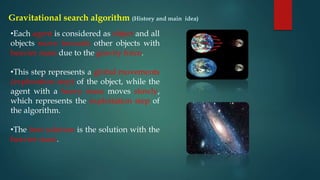
•Each agent is considered as object and all
objects move towards other objects with
heavier mass due to the gravity force.
•This step represents a global movements
(exploration step) of the object, while the
agent with a heavy mass moves slowly,
which represents the exploitation step of
the algorithm.
•The best solution is the solution with the
heavier mass.
Gravitational constant G
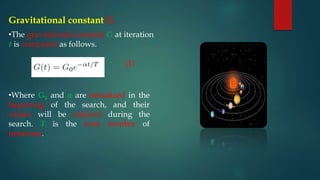
•The gravitational constant G at iteration
t is computed as follows.
•Where G0 and 𝛼 are initialized in the
beginning of the search, and their
values will be reduced during the
search. T is the total number of
iterations.
(1)
The gravity low
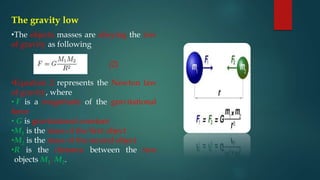
•The objects masses are obeying the low
of gravity as following
•Equation 2 represents the Newton law
of gravity, where
• F is a magnitude of the gravitational
force
• G is gravitational constant
•M1 is the mass of the first object
•M2 is the mass of the second object
•R is the distance between the two
objects M1, M2.
(2)
The gravity low (Cont.)
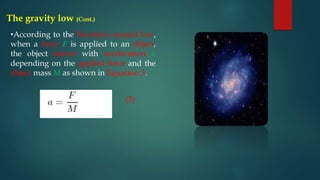
•According to the Newton's second low,
when a force F is applied to an object,
the object moves with acceleration a
depending on the applied force and the
object mass M as shown in Equation 3.
(3)
Acceleration of agents
There are three kind of masses
Active gravitational mass Ma
Passive gravitational mass Mp
Inertial mass Mi.
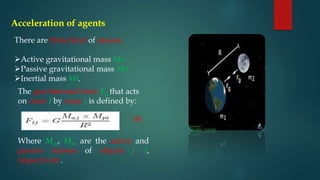
The gravitational force Fij that acts
on mass i by mass j is defined by:
(4)
Where Maj, Mpi are the active and
passive masses of objects j, i,
respectively.
Acceleration of agents (Cont.)
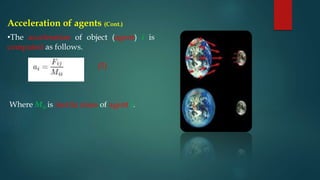
•The acceleration of object (agent) i is
computed as follows.
(5)
Where Mii is inertia mass of agent i.
Agent velocity and positions
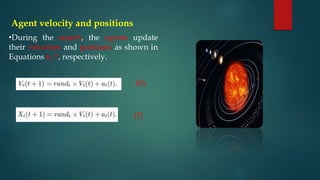
•During the search, the agents update
their velocities and positions as shown in
Equations 6, 7, respectively.
(6)
(7)
Gravitational search algorithm
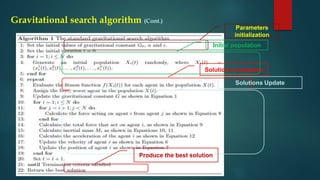
The main steps of the GSA can be
summarized as follows.
 Step 1. The algorithm starts by
setting the initial values of
gravitational constant G0, 𝛼, 𝜀 and the
iteration counter t.
Step 2. The initial population is
generated randomly and consists of N
agents, the position of each agent is
defined by:
Gravitational search algorithm (Cont.)
Step 3. The following steps are
repeated until termination criteria
satisfied
 Step 3.1. All agents in the population
are evaluated and the best, worst agents
are assigned.
Step 3.2. The gravitational constant is
updated as shown in Equation 1
Gravitational search algorithm (Cont.)
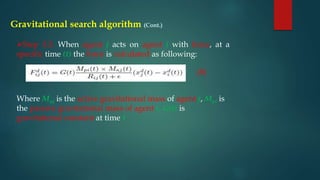
Step 3.3. When agent j acts on agent i with force, at a
specific time (t) the force is calculated as following:
Where Maj is the active gravitational mass of agent j, Mpi is
the passive gravitational mass of agent i, G(t) is
gravitational constant at time t
(8)
Gravitational search algorithm (Cont.)
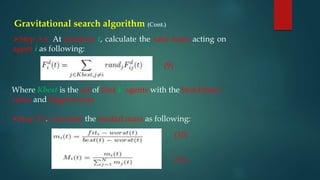
Step 3.4. At iteration t, calculate the total force acting on
agent i as following:
Where Kbest is the set of first K agents with the best fitness
value and biggest mass
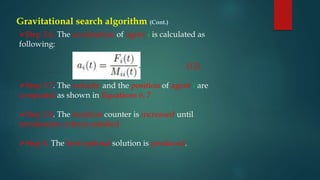
Step 3.5. Calculate the inertial mass as following:
(9)
(10)
(11)
Gravitational search algorithm (Cont.)
Step 3.6. The acceleration of agent i is calculated as
following:
Step 3.7. The velocity and the position of agent i are
computed as shown in Equations 6, 7
Step 3.8. The iteration counter is increased until
termination criteria satisfied
Step 4. The best optimal solution is produced.
(12)
Gravitational search algorithm (Cont.)
Parameters
initialization
Initial population
Solutions evaluation
Solutions Update
Produce the best solution
References
E. Rashedi, H. Nezamabadi-pour, and S. Saryazdi, GSA: “A
Gravitational Search Algorithm ”, Information Sciences, vol.
179, no. 13, pp.2232-2248, 2009.

Gravitational Search Algorithm(GSA).pptx

  • 1.
    Gravitational Search Algorithm (GSA) DR.AHMED FOUAD ALI FACULTY OF COMPUTERS AND INFORMATICS SUEZ CANAL UNIVERSITY
  • 2.
    Outline 1. Gravitational searchalgorithm (History and main idea) 3. The gravity low 7. References 2. Gravitational constant G 6. Gravitational search algorithm 4. Acceleration of agents 5. Agent velocity and positions
  • 3.
    Gravitational search algorithm(History and main idea) •Gravitational search algorithm (GSA) is a population search algorithm proposed by Rashedi et al. in 2009. • The GSA is based on the low of gravity and mass interactions. •The solutions in the GSA population are called agents, these agents interact with each other through the gravity force. •The performance of each agent in the population is measured by its mass.
  • 4.
    Gravitational search algorithm(History and main idea) •Each agent is considered as object and all objects move towards other objects with heavier mass due to the gravity force. •This step represents a global movements (exploration step) of the object, while the agent with a heavy mass moves slowly, which represents the exploitation step of the algorithm. •The best solution is the solution with the heavier mass.
  • 5.
    Gravitational constant G •Thegravitational constant G at iteration t is computed as follows. •Where G0 and 𝛼 are initialized in the beginning of the search, and their values will be reduced during the search. T is the total number of iterations. (1)
  • 6.
    The gravity low •Theobjects masses are obeying the low of gravity as following •Equation 2 represents the Newton law of gravity, where • F is a magnitude of the gravitational force • G is gravitational constant •M1 is the mass of the first object •M2 is the mass of the second object •R is the distance between the two objects M1, M2. (2)
  • 7.
    The gravity low(Cont.) •According to the Newton's second low, when a force F is applied to an object, the object moves with acceleration a depending on the applied force and the object mass M as shown in Equation 3. (3)
  • 8.
    Acceleration of agents Thereare three kind of masses Active gravitational mass Ma Passive gravitational mass Mp Inertial mass Mi. The gravitational force Fij that acts on mass i by mass j is defined by: (4) Where Maj, Mpi are the active and passive masses of objects j, i, respectively.
  • 9.
    Acceleration of agents(Cont.) •The acceleration of object (agent) i is computed as follows. (5) Where Mii is inertia mass of agent i.
  • 10.
    Agent velocity andpositions •During the search, the agents update their velocities and positions as shown in Equations 6, 7, respectively. (6) (7)
  • 11.
    Gravitational search algorithm Themain steps of the GSA can be summarized as follows.  Step 1. The algorithm starts by setting the initial values of gravitational constant G0, 𝛼, 𝜀 and the iteration counter t. Step 2. The initial population is generated randomly and consists of N agents, the position of each agent is defined by:
  • 12.
    Gravitational search algorithm(Cont.) Step 3. The following steps are repeated until termination criteria satisfied  Step 3.1. All agents in the population are evaluated and the best, worst agents are assigned. Step 3.2. The gravitational constant is updated as shown in Equation 1
  • 13.
    Gravitational search algorithm(Cont.) Step 3.3. When agent j acts on agent i with force, at a specific time (t) the force is calculated as following: Where Maj is the active gravitational mass of agent j, Mpi is the passive gravitational mass of agent i, G(t) is gravitational constant at time t (8)
  • 14.
    Gravitational search algorithm(Cont.) Step 3.4. At iteration t, calculate the total force acting on agent i as following: Where Kbest is the set of first K agents with the best fitness value and biggest mass Step 3.5. Calculate the inertial mass as following: (9) (10) (11)
  • 15.
    Gravitational search algorithm(Cont.) Step 3.6. The acceleration of agent i is calculated as following: Step 3.7. The velocity and the position of agent i are computed as shown in Equations 6, 7 Step 3.8. The iteration counter is increased until termination criteria satisfied Step 4. The best optimal solution is produced. (12)
  • 16.
    Gravitational search algorithm(Cont.) Parameters initialization Initial population Solutions evaluation Solutions Update Produce the best solution
  • 17.
    References E. Rashedi, H.Nezamabadi-pour, and S. Saryazdi, GSA: “A Gravitational Search Algorithm ”, Information Sciences, vol. 179, no. 13, pp.2232-2248, 2009.